Source: mongabay.com
Industrial soy expansion in the Brazilian Amazon has contributed to deforestation by pushing cattle ranchers further north into rainforest zones, reports a new study published the journal Environmental Research Letters.
The research, which looked at soy and cattle dynamics in the southern Amazon stats of Mato Grosso and Pará, supports the claim that soy is an important indirect driver of deforestation in the world's largest rainforest.
The authors — including Elizabeth Barona, Navin Ramankutty, Glenn Hyman and Oliver Coomes — analyzed annual census data on deforestation, crop harvest area, livestock population, and pasture area between 2000 and 2006 from municipalities in the Brazilian Legal Amazon. Their analysis found that deforestation shifted 39 km to the northeast during the period, while pasture shifted 87 km to the northwest, from northeastern Mato Grosso to southwestern Para, and soybeans moved 82 km to the northeast, from southern to northeastern Mato Grosso. The researchers also noted that soybean expansion was accompanied by a decline in pasture area in many municipalities in Mato Grosso, lending support to the argument that "decreases in pasture in Mato Grosso owing to soybean expansion may have been compensated by increases in pasture elsewhere in northern Mato Grosso, Para and Rondônia causing some deforestation indirectly, i.e., 'displacement deforestation.'"
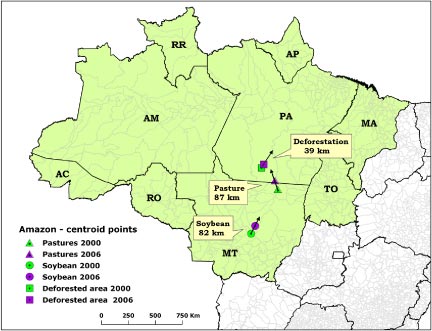 Movement of the centroid of land-use types from 2000 to 2006. For each land use the centroid of all municipalities in the Legal Amazon, weighted by the land-use area in that particular year, was calculated.
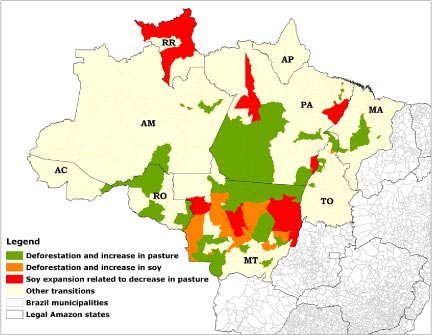 Land-use transitions between 2000 and 2006 in the Legal Amazon. In the municipalities where deforestation occurred over this period (green and orange), we separated those in which pasture increased from those where soy increased. (In municipalities where both soy and pasture increased, we labeled it using the dominant change.) Similarly, we identified municipalities where soy expanded while pasture decreased (and the decrease in pasture exceeds deforestation). Captions and images copyright Barona et. al. (2010)
The authors say future research should "examine more closely how interlinkages between land area, prices, and policies influence the relationship between soy and deforestation, in order to make a conclusive case for 'displacement deforestation.'"
Soy in the Amazon
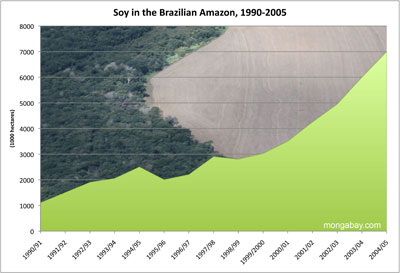
Soy production in the Amazon exploded in the early 1990s following the development of a new variety of soybean suitable to the soils and climate of the region. Most expansion occurred in the cerrado, a wooded grassland ecosystem, and the transition forests in the southern fringes in the Amazon basin, especially in states of Mato Grosso and Pará — direct conversion of rainforests for soy has been relatively limited. Instead, the impact of soy on rainforests — as suggested by the Environmental Research Letters study — is generally seen to be indirect. Soy expansion has driven up land prices, created impetus for infrastructure improvements that promote forest clearing, and displaced cattle ranchers to frontier areas, spurring deforestation.
 The Brazilian soy industry argues that it receives an unfair share of the blame for Amazon forest loss. It notes that producers in the legal Amazon face some of the most stringent environmental laws in the world, with landowners required to maintain 80 percent forest cover on their holdings. By comparison there are no legal forest reserve requirements for U.S. farmers.
Nevertheless soy growers, crushers, and traders have taken steps to reduce the environmental impact of their crop in the Amazon biome. After a damaging Greenpeace campaign in 2006, leading players in the industry agreed to a moratorium on soy grown on newly deforested lands. Analysis last year showed that growers are mostly abiding by the ban: only 12 of 630 sample areas (1,389 of 157,896 hectares) deforested since July 2006 — the date the moratorium took effect — were planted with soy.