Source: mongabay.com
Last week Brazil's National Space Agency INPE reported a 51 percent drop in Amazon deforestation in the six months ended February 2010 compared with the year earlier period. But the seemingly happy news for environmentalists may be premature.
Data from Imazon, an independent organization that aims to improve forest transparency through advanced analysis of satellite imagery and other tools, reveals a 23 percent increase during the period. Why does the data conflict?
Carlos Souza, a researcher with Imazon who was last week honored with the Skoll Award for Social Entrepreneurship together with his colleague Beto Verissimo, attributes the discrepancy to "differences in estimates of deforestation in August and September last year when INPE's results were much higher than ours."
 Deforestation in August 2008 to February 2010 and degradation of September 2008 to February 2010 in the Brazilian Amazon (Source: Imazon / SAD; modified by mongabay.com).
Souza told mongabay.com that INPE's tracking system captured a lot of forest degradation as deforestation during the period, inflating its overall tally for forest loss. The agency's estimates that nearly 1360 square kilometers of forest were cleared from August 2009 to February 2010, down from early 2,800 sq km a year earlier. By comparison, Imazon puts the total around 924 sq km, up from 749 sq km a year earlier.
Intra-year estimates for deforestation in the Brazilian Amazon are notoriously difficult to assess due to cloud cover, distinctions between degradation and deforestation, seasonal variations, and other variables. Figures are usually reconciled each August using a different methodology. INPE generally publishes these results towards the end of the year.
But an uptick in deforestation would not be unsurprising given a 14 percent rise in beef prices during the period. The Amazon is a major cattle-producing region and much of Brazil's beef and leather is exported to Europe. The increase in beef prices during the period outpaced the appreciation of the Brazilian Real against the Euro, a development that would normally diminish beef exports from Brazil to Europe by making beef more expensive for European buyers.
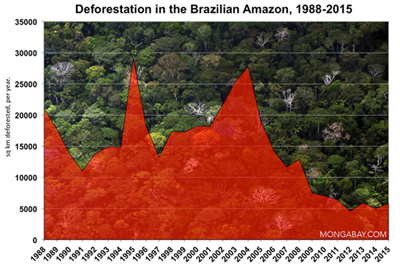 Nevertheless deforestation in the Brazilian Amazon continues to trend downward since peaking in 2004. The decline is attributed to new interest among business leaders in reducing deforestation, new forestry policies and increased vigilance against illegal logging and agriculture, expansion of the country's protected area network, and a stronger real. Confident in Brazil's progress in controlling deforestation, in 2008 President Luis Inacio Lula da Silva announced a plan to reduce annual deforestation in the Brazilian Amazon 70 percent from a 1996-2005 baseline by 2018 as part of the country's climate change commitment.