Wednesday, September 30, 2009

'Amazon Voyage' interactive exhibit opening Oct. 3 features special activities

2009-09-29
From: Media Newswire (press release)

Travel into the rainforest beginning Saturday, Oct. 3 at the Florida Museum of Natural History's newest temporary exhibit, "Amazon Voyage: Vicious Fishes and Other Riches."

Opening day activities from 10 a.m. to 4 p.m. include various hands-on learning and crafts for children, story time with the Alachua County Library District and a presentation on Amazonian indigenous peoples.

Children can compare household tools to mouths of fish to understand adaptations for different diets and feeding methods, learn how imprint fossils develop, make a piranha rubbing and create a masterpiece on the wall with art from the "Amazon Voyage" exhibit.

This family-friendly exhibit features seven ports of call along the most biologically diverse river in the world, the Amazon. Encounter amazing creatures including notorious piranhas, enormous anacondas, beautiful stingrays and mysterious pink dolphins. Visitors may investigate the region's incredible biodiversity through hands-on activities, original artifacts and live fish in uniquely designed tanks, as well as participate in a celebration of the Amazon River.

The museum's Butterfly Rainforest exhibit also is featuring an increased number of butterflies from the Amazon region to complement "Amazon Voyage."

"Amazon Voyage" admission is $8 for adults ( $7 Fla. residents ) and $5.50 for children ages 3-12. Museum members are admitted free! Combo rates are available for both exhibits. For more information, visit www.flmnh.ufl.edu/amazon or call 352-846-2000.

"Amazon Voyage: Vicious Fishes and Other Riches" was created by the Miami Science Museum and made possible with support from the National Science Foundation. The Florida Museum will display "Amazon Voyage" through Jan. 17, 2010.

- 30 -

"Amazon Voyage" Opening Day Activities — Oct. 3

Mouths and Tools ( 10 a.m. - 4 p.m. )
Compare household tools to mouths of fish to understand adaptations for different diets and feeding methods in this matching game for all ages.

Amazon Touch Table ( 10 a.m. - 4 p.m. )
Learn how imprint fossils develop and make your own piranha rubbing. This table will also feature preserved specimens, a piranha skeleton and anthropological artifacts and replicas.

Amazon Shadow Art ( 10 a.m. - 4 p.m. )
Create a masterpiece on our wall with this fun art project featuring art from the Amazon Voyages exhibit.

Amazon Patchwork: The River, the Forest and the People ( 1:30 - 2:30 p.m. )
Join Simone Athayde to learn more about Brazilian Amazonian indigenous peoples' lifestyles, linkages with rivers and forests and current challenges for keeping their cultural identity and control over their natural resources and territories.

Story Time with the Alachua County Library District ( 11:30 a.m., 12:15 p.m., and 1 p.m. )
Join Diane Colson with the Alachua County Library District in the Central Gallery for story time.

Visit the following tables for more information about the Amazon:
- The Center for Latin American Studies
- Alachua County Library
- Latin American Ethnography Collection

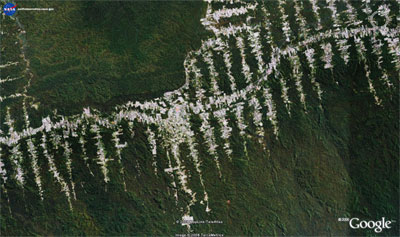
New photos highlight rainforest devastation

September 29, 2009
From: CNN

A series of photographic exhibitions have been organized in Europe and North America this autumn to highlight a campaign by Britain's Prince Charles to combat tropical deforestation.

The photographs were taken by world-renowned environment photographer Daniel Beltra who was this year's winner of the Prince's Rainforest Project Award at the Sony World Photography Awards earlier this year.

The images graphically depict the effects of climate change on the rainforests in the South America, Africa and Indonesia.

Beltra compiled a library of around 40,000 images during month long trips to the Amazon Basin, the Congolese Forest and Borneo and Sumatra in Southeast Asia.

When he returned home Beltra produced a shortlist of around 1000 images from which the final exhibition photos were selected.

"I shoot a lot when I'm in the air," Beltra told CNN. "Trying to concentrate on a small detail on the ground when your flying at a speed of 150 knots is difficult."

And that's not the only problem Beltra encountered. The very acts of destruction he was documenting often got in the way of his work.

"When you are photographing deforestation, you are taking a lot of pictures of logging and fires and the smoke can make it very difficult to shoot."

Beltra was born in Spain but is now based in the United States. His work, which includes freelancing for the international environmental group Greenpeace, has taken him to over 50 countries and he is a fellow of the International League of Conservation Photographers.

HRH Prince Charles has long been a passionate defender of the environment and he founded the Prince's Rainforest Project (PRP) in 2007.

The PRP works alongside governments, international businesses, non-profit organizations and rainforest nations to find a solution to the deforestation and degradation of the rainforests.

Speaking at the Sony Awards in Cannes, France earlier this year the Prince said: "Photographic images can tell a compelling story about the truth of the situation, and the truth is that if we lose the fight against tropical deforestation, then we lose the fight against climate change."

Beltra hopes that his pictures will raise further awareness of the perils that humans face in the wake of continued rainforest destruction.

"I think we are all getting more aware but we really need to get our act together because at the moment we are destroying more than we are protecting," he said.

The multimedia exhibitions organized by Sony are taking place at the Royal Botanical Gardens at Kew in London, the Hotel de Ville, Paris, the Alexa Center, Berlin and the Mercy Corps Action Center, New York.

(Image: An aerial of Jambi Province, Indonesia showing the destruction of the tropical rainforest.)

JBS commits to Amazon deforestation moratorium

29 September, 2009
From: meatinfo.co.uk

Brazilian beef giant JBS has agreed to stop sourcing cattle from farms responsible for deforestation of the Amazon rainforest.

Following months of pressure from environmental campaign group Greenpeace, JBS has finally followed rivals Bertin and Marfrig in adopting moratorium on the purchase of cattle from suppliers linked to illegal deforestation.

The processor has also pledged to reject cattle from farms occupying indigenous lands and protected areas.

A spokesperson for JBS said that the company has always given “special attention” to social and environmental matters, adding that protection of the environment is “fundamental” to JBS.

“Pursuant to these principles JBS has agreed to make a commitment with Greenpeace with respect to the basic
criteria to be followed in its operations in the Amazon biome,” he added.

“These criteria includes the adoption of the Zero Deforestation in the Amazon within the entire supply chain and the rejection of products originating from properties involved in the occupation of indigenous land and protected areas.

“The company also agrees that cattle and beef products can only be sourced from ranches or rural properties that are committed to the adoption of a reliable production traceability system.”

The commitment has been welcomed by Greenpeace, which released a report in June claiming that Bertin, JBS and Marfrig were “knowingly” buying beef from farms engaged in illegal deforestation and laundering them through the supply chain to an “unwitting” global market.

Greenpeace forests campaigner Sara Shokara said: “This announcement is a big step forward in the battle to save the Amazon. The expansion of cattle ranches into the rainforest was becoming a massive problem for local people, biodiversity and the global climate. Huge swathes of pristine forest were being destroyed to make way for pasture.

“This move, by the world’s largest beef producer and exporter, sends a strong signal to farmers that deforestation will no longer lead to quick profit. The potential benefits of this are immense, but we need to keep the pressure on JBS and the other companies to make sure this is permanent.”

Greenpeace wants Brazil’s entire cattle sector to commit to a moratorium on expansion into newly deforested areas and has called on both federal and state governments to ensure this is possible by mapping, registering and monitoring rural properties.

Dust storms 'give nutrients to rainforest'

Tue, Sep 29, 2009
From: Cool Earth

Dust storms of the size seen in Australia last week are leading to the global spread of certain types of airborne viruses, it has been reported.

However, the storms could also help to absorb climate change emissions, it has been noted.

As well as this, the upper layers of the Amazon rainforest in Brazil get much of their nutrients from dust which is blown across the Atlantic Sea from the Sahara Desert, making such natural events vital to the health of the rainforest.

A study published in Environmental Research Letters in 2007 revealed that dust winds from an area north-east of Lake Chad are the main mineral source for parts of the Amazon.

The kind of dust storms which have been hitting much of eastern Australia have also been seen in countries which have very dry areas and an arid climate, such as Iraq, east Africa, northern China and Iran.

Speaking to the Guardian, geography professor at Oxford University Andrew Goudie said that the frequency of such storms often go up and down.

"At the moment they are clearly on an upward trajectory," he noted.

Tuesday, September 29, 2009

Prince's Rainforest exhibition opens at Kew

Monday, 28 September 2009
From: Independent

Stunning images of the world’s rainforests will soon be on show at Kew Gardens as part of a campaign against tropical deforestation spearheaded by Prince Charles.

The photographs, by the winner of this year’s Prince’s Rainforest Project Award, Daniel Beltrá, show the effects of climate change on the rainforests of the Amazon, Democratic Republic of Congo and Indonesia.

“Photographic images can tell a compelling story about the truth of the situation, and the truth is that if we lose the fight against tropical deforestation, then we lose the fight against climate change,” the Prince of Wales said at the Sony World Photography Awards (sponsors of the Prince’s Rainforest Project) earlier this year.

The exhibition opens at Kew Gardens in West London from the 3rd of October and runs until the 6th December, with subsequent showings in Paris and Berlin.

(Image: An aerial view North of Palangkaraya, the capital city of Indonesian province Central Kalimantan)

Chevron’s Recent Setbacks in U.S. Courts Forced its Hand on Arbitration Claim, Lawyers Say Latest Move to Avoid $27 Billion Environmental Liability Co

Monday, September 28th, 2009
From: HototindieNews.com

Chevron’s filing of an arbitration claim against Ecuador’s government over a potential $27.3 billion environmental liability in Ecuador can best be explained by an embarrassing string of legal defeats the company has suffered in U.S. and Ecuadorian courts on several of the same issues the company will bring before the arbitration panel, lawyers for the Amazonian communities said today.

“Filing an arbitration claim smacks of forum shopping and is one of Chevron’s last cards to avoid paying for a half-century of environmental contamination in Ecuador’s Amazon,” said Steven Donziger, a U.S. lawyer who advises the plaintiffs. The plaintiffs include dozens of indigenous and farmer communities in the Amazon rainforest who charge Texaco (now Chevron) discharged billions of gallons of toxic waste onto their lands and waterways.

“Over the last three years every public court that has looked at this case – from the lowest trial court in Ecuador to the United States Supreme Court — has rejected some or all of Chevron’s fundamental claims,” said Donziger. “There is no reason to think the arbitration panel will conclude differently.”
 
Donziger emphasized the filing of the claim – under a trade pact between Ecuador and the U.S. – will have no impact on the underlying case or on the chances of recovery by the plaintiffs.

If the plaintiffs win a judgment against Chevron in Ecuador’s courts, they plan to move “expeditiously” to seize Chevron’s assets in the U.S. and other countries given that Chevron has publicly announced it will never pay, he said.
 
Whether Chevron succeeds in getting a judgment against Ecuador’s government for the environmental liability in Ecuador will have no impact on the strategy to seize the company’s assets, said Donziger.

The environmental case is a private litigation between the indigenous groups and Chevron, while the arbitration case is between Chevron and Ecuador’s government, he added.
 
“Chevron operates in more than 100 countries and has numerous oil tankers that troll the world’s waterways and dock in any number of ports,” Donziger said. “This could end up being one of the biggest forced asset seizures in history and it could have a significant disruptive impact on the company’s operations.
 
“This is not something we would delight in doing,” he added.

“But it appears seizing Chevron’s assets is the only way to uphold the rule of law. Chevron obviously believes it is bigger than the laws of the country where it wanted the trial to be held. It is also clear that the indigenous people in the Amazon who are suffering from cancers and other oil-related diseases are not a factor in the company’s analysis.”
 
Chevron faces a number of legal obstacles in bringing the arbitration claim, said Donziger.

First, the company fought for ten years in U.S. federal court to have the environmental case (which was filed in 1993) moved to Ecuador, praising the country’s courts in 14 sworn affidavits by legal experts. After winning that argument over the objections of the plaintiffs, Chevron then tried to discredit Ecuador’s courts when the evidence began to demonstrate 100% of the company’s 378 former production sites are extensively contaminated – a finding recently confirmed by a review of the evidence by a court-appointed Special Master.

In one of the more surprising findings in Ecuador, the Special Master found that Chevron’s own evidence corroborated claims by the plaintiffs that the sites were contaminated. “Chevron helped us prove our case, which is hugely embarrassing for Chevron’s legal team and helps explain the company’s strategy to focus on the politics of Ecuador rather than on the evidence at trial,” said Donziger.
 
Donziger also pointed to Chevron’s recent legal setbacks in the U.S. to help explain the company’s timing in filing the arbitration claim:

• The U.S. Supreme Court in June of this year rejected a Chevron petition designed to reverse a lower court ruling that Chevron did not have a right to arbitrate against Ecuador’s government over the environmental liability, based on a 1965 operating contract that allowed Texaco (now Chevron) to drill for oil in the Amazon.

• In June 2007, a highly regarded U.S. federal judge – Leonard B. Sand – handed Chevron a stunning rebuke when he ruled that Chevron knew or should have known that Ecuador was not bound by an arbitration provision in Chevron’s operating agreement (this is distinct from the recent arbitration claim, which is made under a bilateral treaty entered into by Ecuador).

• In October 2008, a three-judge panel from a U.S. federal court rejected Chevron’s appeal of the Sand decision in a unanimous summary order – probably the most embarrassing type of decision one can receive in U.S. federal court. Such a decision demonstrates the judges thought Chevron’s concerns were not important enough to warrant even a full written decision.

• In December 2008, Chevron suffered another defeat when the full panel of the U.S. Court of Appeals denied its motion for an en banc hearing to review the unanimous summary order.

• In July of this year, Chevron dealt itself another setback when it voluntarily withdrew a claim before Judge Sand that its controversial legal release from Ecuador’s government – secured by fraud, according to the plaintiffs – absolved of it all clean-up responsibility. Chevron apparently was worried it would lose on that issue and thereby prejudice its ability to bring up the release argument in the arbitration action filed yesterday, said Donziger.

Donziger also said Chevron’s arbitration claim suffers from a number of defects. These include the fact the company has not exhausted domestic remedies in Ecuador (a requirement in the treaty), given that the case is not over; the fact Chevron’s own executives and lawyers could be subject to sworn depositions over recently released videos that the plaintiffs believe likely were contrived by Chevron to taint the trial; and, the fact that Chevron, by claiming its domestic remedies in Ecuador are exhausted, is accelerating the time frame for a final judgment in Ecuador.

In addition, one of the main arguments Chevron will use in the arbitration – that it was released by Ecuador after a remediation in the mid-1990s – is “a total non-starter” given there is express language in that release excluding private claims of the type being pressed in the lawsuit, said Donziger.
 
“One of the interesting wrinkles is that Chevron’s own legal team could be exposing itself to personal liability if it is found that it played a role in the purported bribery scheme in Ecuador to create evidence for the arbitration proceeding,” said Donziger.

“That’s just one scenario where this could blow up for Chevron. Everybody from the CEO on down could be forced to answer questions about whether Chevron manipulated the video and was trying to destabilize a foreign nation’s judicial system to evade a judgment in a private litigation.”
 
“More to the point,” added in Donziger, “if the court in Ecuador rules against Chevron on the environmental case, we think Chevron’s latest move to file the arbitration claim enhances our prospects of getting that trial judgment satisfied sooner rather than later.”
Karen Hinton

Hinton Communications

1215 19th Street, NW
Washington, DC 20036

karen@hintoncommunications.com

703-798-3109, cellular

480-275-3554, fax by email

IF YOU WANT TO KNOW MORE ABOUT CHEVRON – TEXACO CRIMES COMMITTED IN ECUADOR CHECK THE LINK: http://www.texacotoxico.org/eng/

(Image: "We are from the Shuar indigenous nation. We came here in 1978, looking for a better life and a good education. We have 8 children and lost two. Maria Graciela died when she was 24, and Rosa died at 12.")

Florida Museum Exhibits Amazon Voyage

September 28th, 2009
From: HULIQ News

This family-friendly exhibit educates visitors about the Amazon rainforest with a fascinating journey through this untamed land, including information about the plants, animals and people who live there.

"For many Americans, the Amazon is a storied place full of exotic animals, plants and cultures," said Darcie MacMahon, Florida Museum assistant director of exhibits. "This exhibit brings the Amazon to life with beautiful art, hands-on experiences, good science and fascinating stories."

Visitors will travel through seven unique ports-of-call while learning about the incredible biodiversity of the Amazon River. Discover the "Seven Perils of the Amazon," including the electric eel, piranha and the infamous anaconda. Each stop focuses on one of the seven perils and a common type of Amazon terrain. Experience the zap of an electrifying eel in the "Flooded Forest," learn how catfish adapt in the "Deep Channel" and meet other interesting and sometimes dangerous water-dwelling creatures in the piranha area.

"Amazon Voyage" provides visitors a closer look at the regional landscapes and animals that scientists study. An underwater viewing dome provides a unique look at cardinal tetras, marbled hatchetfish and blue discus fish. Visitors can touch live ocellate river stingrays in a tank and help Paulo Petry, lead science advisor for the exhibit, sift through muck in search of new species.

Throughout the exhibit, other aspects of Amazon life give visitors a taste of the environment and lifestyle of local residents. With the help of some Amazonian residents, discover how people learn to live in such a wet environment, dance in the Barcelos fish festival, and listen to native folk tales on Captain Mo's fishing boat.

The traditional seven perils do not harm the Amazon's ecosystem, but the region faces environmental threats from activities including commercial fishing and logging. Exhibit visitors can learn about these threats and what can be done to remedy them from local fishermen and scientists. The museum's Butterfly Rainforest also will feature butterflies from the Amazon region during the exhibit. -- www.flmnh.ufl.edu

4 degrees warming "likely" without CO2 cuts-study

Sun Sept 27, 2009
From: Reuters

Global temperatures may be 4 degrees Celsius hotter by the mid-2050s if current greenhouse gas emissions trends continue, said a study published on Monday.

The study, by Britain's Met Office Hadley Centre, echoed a U.N. report last week which found that climate changes were outpacing worst-case scenarios forecast in 2007 by the U.N.'s Intergovernmental Panel on Climate Change (IPCC). [ID:nN24360533]

"Our results are showing similar patterns (to the IPCC) but also show the possibility that more extreme changes can happen," said Debbie Hemming, co-author of the research published at the start of a climate change conference at Oxford University.

Leaders of the main greenhouse gas-emitting countries recognised in July a scientific view that temperatures should not exceed 2 degrees above pre-industrial levels, to avoid more dangerous changes to the world's climate. [ID:nL6368126]

The IPCC shared the 2007 Nobel Peace Prize for its fourth assessment report, or AR4. One finding was that global temperatures could rise by 4 degrees by the end of the 2050s. Monday's study confirmed that warming could happen even earlier, by the mid-2050s, and suggested more extreme local effects.

"It's affirming the AR4 results and also confirming that it is likely," Hemming told Reuters, referring to 4 degrees warming, assuming no extra global action to cut emissions in the next decade.

One advance since 2007 was to model the effect of "carbon cycles". For example, if parts of the Amazon rainforest died as a result of drought, that would expose soil which would then release carbon from formerly shaded organic matter.

"That amplifies the amount of carbon dioxide that goes into the atmosphere and therefore the global warming. It's really leading to more certainty," said Hemming.


DRASTIC

Some 190 countries will try to reach an agreement on how to slow global warming at a meeting in Copenhagen in December.

Chinese President Hu Jintao won praise for making a commitment to limit emissions growth by a "notable" amount, at a U.N. climate summit in New York last week. Other leaders made pledges to agree a new climate pact. [ID:nSP98073]

Temperature rises are compared with pre-industrial levels. The world warmed 0.7 degrees last century, scientists say.

A global average increase of 4 degrees masked higher regional increases, including more than 15 degrees warmer temperatures in parts of the Arctic, and up to 10 degrees higher in western and southern Africa, Monday's study found.

"It's quite extreme. I don't think it's hit home to people," said Hemming. As sea ice melts, the region will reflect less sunlight, which may help trigger runaway effects.

Such higher Arctic temperatures could also melt permafrost, which until now has trapped the powerful greenhouse gas methane, helping trigger further runaway effects, said Hemming.

"There are potentially quite big negative implications."

The study indicated rainfall may fall this century by a fifth or more in part of Africa, Central America, the Mediterranean, and coastal Australia, "potentially more extreme" than the IPCC's findings in 2007.

"The Mediterranean is a very consistent signal of significant drying in nearly all the model runs," said Hemming. A 20 percent or more fall is "quite a lot in areas like Spain already struggling with rainfall reductions in recent years."

Friday, September 25, 2009

Mekong rich with new species

Sept 26, 2009
From: Straits Times

A bird-eating frog with fangs and powerful jaws, a snake with tiger-like stripes and a gecko with leopard-like spots are among as many as 163 new species of life forms found and documented by scientists in the Greater Mekong area last year alone.

While some of the species were found in habitats that had already been explored, many were found in remote jungles which until recent years were off limits because of politics and conflict. Many are highly specialised, found only in particular habitats or places.

The leopard gecko, with its large cat-like eyes that give it an alien look, is found only on the small island of Cat Ba off the coast of Vietnam.

The newly discovered Nonggang Babbler which prefers to walk and run rather than fly, was discovered in karst rainforest on the Chinese-Vietnamese border, a rugged area of limestone cliffs, caves, sinkholes and underground streams.

Mr Stuart Chapman, director of the World Wide Fund for Nature's (WWF) Greater Mekong Programme told journalists yesterday while releasing the WWF's report on the new species: 'After millennia in hiding, these species are now finally in the spotlight and there are clearly more waiting to be discovered.'

Of the 163 species not previously known to science, 100 are plants; 28 are fish; 18 are reptiles; 14 are amphibians; and there are two mammals and one bird.

Many were discovered through modern technology like self-triggering camera traps set out in remote locations. But some were also discovered through old-fashioned research, with biologists exploring forests at night with torches and collection bags.

'The Mekong is the second most bio-diverse river in the world, and second only to the Amazon in terms of numbers of fish,' Mr Chapman said.

The WWF said an immediate and ongoing threat to the newly discovered species is hunting for meat, medicine and the pet trade.

Forest loss and large infrastructure projects are also isolating species in dwindling habitats.

PERU: Environmental Clean-up not Complete, Say Achuar Communities

Sept 25, 2009
From: ipsnews

Leaders of the Achuar people are challenging a decision by the Peruvian government to declare that a clean-up effort by the PlusPetrol oil company in the northeastern Amazon jungle has been completed.

When PlusPetrol Norte, the Peruvian subsidiary of Argentina's PlusPetrol, took over oil block 1AB along the Corrientes River in Loreto province in 2000, part of the agreement was that it would clean up the environmental mess left by the U.S. Occidental Petroleum Corporation (Oxy).

But Achuar leader Guevara Sandi Chimboras, treasurer of the Federation of Native Communities of the Corrientes River (FECONACO), told IPS that "the environmental damages in our territory have not been fixed. Not enough has been done, and there is still clear evidence of pollution in our rivers and lakes."

Sandi Chimboras, who was also environmental monitor of the impacts of the oil industry in his community, said that so far this year indigenous communities have discovered 10 oil spills along the Corrientes River. The latest was found on Sept. 21 in oil block 1AB.

FECONACO leaders have asked PlusPetrol representatives to meet with them on Sept. 29. The native leaders plan to demand that the company fully comply with its pledge to clean up the area.

"We also want the government to firmly back up our demands, because this pollution is a longstanding problem," said Sandi Chimboras.

The Achuar people have been suffering the effects of oil industry pollution since the 1970s, when Oxy began to operate in their territory. Oxy is facing an ongoing lawsuit for damaging the environment and the health of local Achuar people in block 1AB, which it operated from 1971 to 2000.

Of the 8,000 Achuar Indians living in 31 communities in Loreto province, nearly half are "direct victims" of oil drilling, according to Racimos de Ungurahui, a non-governmental organisation that defends the rights of the Achuar people of the Peruvian Amazon.

PlusPetrol Norte has been operating since 1996 along the Pastaza, Corrientes and Tigre rivers, and expanded its area of operations in 2000, when it acquired block 1AB.

The Argentine company was to clean up the damages left by Oxy, which is accused of illegally dumping toxic wastewater in rivers, causing acid rain with gas flares, and holding toxic waste in unlined earthen pits, while failing to warn the local indigenous people of the health risks.

But a report released this month by E-Tech International, a California-based non-profit technical research firm, found that levels of heavy metals, volatile organic compounds and hydrocarbons in lakes and rivers used by the Achuar community for drinking, washing and fishing are still far above the safety limits set by Peru.

The E-Tech report, carried out at the behest of FECONACO, found that PlusPetrol has not respected national and international standards for environmental clean-ups at block 1AB, and that the government has failed to adequately oversee the effort.

In an earlier report, the technical consultancy firm had analysed the handling of toxic wastewater in the area, and estimated the cost of reinjecting the wastewater back into the ground, in accordance with international practices.

That study was used by the Ministry of Energy and Mines to help draw up a law on hydrocarbons that required oil companies to reinject wastewater as part of any new undertakings.

However, the law did not apply to existing oil operations, such as PlusPetrol's activities in block 1AB, and only in May 2006 did the company commit itself to using the reinjection technique.

The new E-Tech study says the toxic waste left by Oxy continues to pose a serious threat to the health of the Achuar communities.

Sandi Chimboras says the native communities' 14 environmental monitors have found the same problems as E-Tech reported.

Another Achuar leader, Henderson Rengifo of the Peruvian Rainforest Inter-Ethnic Development Association (AIDESEP), told IPS that his organisation - which groups 28 federations of indigenous peoples – is working with the Ministry of Energy and Mines and other central government bodies, to get them to take action against the company based on E-Tech's findings.

The report found toxic substances far above accepted levels, despite the fact that the government and the company are attempting to declare the clean-up work complete.

"Neither the company nor the state have made a responsible effort," said Rengifo. "Some things have improved, but the lives of the Achuar people are still endangered by a job half-done."

Ministry of Health studies have found high blood concentrations of cadmium and lead in Achuar children.

A 2006 report found that cadmium levels exceeded the acceptable limit of 0.1 mg per litre of blood in 98.6 percent of 199 people – including 74 children and adolescents aged two to 17 - examined in the Corrientes River basin area. Cadmium levels in 97.3 percent surpassed even those usually found in smokers - 0.2 mg - even though the subjects of the tests were non-smokers.

Furthermore, dangerous concentrations of 0.21 to 0.5 mg per litre were found in 37.8 percent of the children and adolescents, while the biological tolerance value (BAT) of 0.5 mg was exceeded in 59.4 percent of the minors. Similar levels were found in adults.

This month's E-Tech report also says "The lack of erosion control measures threatens streams and rivers," and reported severe erosion throughout block 1AB.

In addition, it found that zinc results for all water samples taken were higher than the Ministry of Energy and Mines guideline level "that is protective of fish and aquatic life" – which form the basis of the Achuar diet.

Trudie Styler Invites Chevron Employees To See “CRUDE” For Free

Sept 25, 2009
From: Ecorazzi


In an attempt to create a little dialog from within, Trudie Styler has reached out to the more than 6,000 employees of Chevron living in the San Francisco Bay area and personally invited them to see the new documentary CRUDE for free. The movie, was the highest grossing film per-screen in the US last week, tells the story of the 30,000 Amazon rainforest dwellers facing down the 5th largest corporation in the world for the dumping of 18 billion gallons of toxic wastewater and abandoning over 900 unlined crude oil pits in the midst of rainforest communities.

In her invitation, Ms. Styler explained the impact of her experiences visiting Ecuadorian rainforest communities living with oil pollution and contaminated drinking water. “You may know me as Sting’s wife, and you may know of my work for the environment and human rights. You may also have heard my name mentioned as one of the celebrities speaking out in support of the 30,000 Ecuadorean citizens who are pursuing Chevron to clean up the pollution the company left behind in their homeland,” wrote Ms. Styler in her letter to the Chevron employees. “Many people will assume that you and I must be on different sides of the fence on this issue. But I don’t believe that. I’m willing to bet that you and I, and all of your colleagues, agree that everyone has the fundamental right to the life-supporting elements of clean air and clean water…I’d like to give you the opportunity to make up your own mind about what has been going on in Ecuador, and to consider how justice can be achieved for the people suffering there. I’d like to invite you to the movies.”

Should be interesting to see if any employees actually take Styler up on the offer. Granted, we’re not sure many would admit to it anyways. To find out more about the film and where it might be playing near you, jump here.

Diversity of life in rainforest 'mind boggling

Sept 25, 2009
From: Cool Earth

The diversity of life which can be seen in the world's rainforests is "downright mind-boggling", it has been said.

Writing for School Library Journal, Grace Oliff said that the "incredible diversity" of both plants and animals in the rainforest means that even people who have spent their lives studying the rainforests "know they will never learn everything about it".

Due to the huge range of wildlife which inhabits the planet's rainforests, it can be difficult for people to "capture the wonder and beauty of this distinct environment", especially when talking to children.

The writer then detailed a number of books which she said could help adults teach youngsters about the rainforest, including Richard Vogt's Insiders: Rain Forests, which talks about the plants and animals which can be found in such areas and also touches on issues such as deforestation and related environmental issues.

Figures suggest that in the Amazon rainforest in Brazil, more than 232,000 square miles of forest have been cleared since 1970.

Thursday, September 24, 2009

Roads are enablers of rainforest destruction

September 24, 2009
From: mongabay.com

Chainsaws, bulldozers, and fires are tools of rainforest destruction, but roads are enablers.

Roads link markets to resources, enabling loggers, farmers, ranchers, miners, and land speculators to convert remote forests into economic opportunities. But the ecological cost is high: 95 percent of deforestation in the Brazilian Amazon occurs within 50-kilometers of a road, while in Central Africa, where logging roads are rapidly expanding across the Congo basin, the bulk of bushmeat hunting occurs near roads. In Laos and Sumatra, roads are opening last remnants of intact forests to logging, poaching, and plantation development. But roads also cause subtler impacts, fragmenting habitats, altering microclimates, creating highways for invasive species, blocking movement of wildlife, and claiming animals as roadkill. A new paper, published in Trends in Evolution and Ecology, reviews these and other impacts of roads on rainforests. Its conclusions don't bode well for the future of forests.

Examining a large body of scientific literature, William F. Laurance, Miriam Goosem and Susan G.W. Laurance write that roads "can have an array of deleterious effects on tropical forests and their wildlife" in the form of biological and socioeconomic impacts. The latter is a far greater threat to forests.

Over the past half century road networks have expanded across the tropics, opening remote forests to development. Once prompted primarily by political objectives such as national security, alleviating population pressures in cities, and rural development, roads are increasingly built by private interests — loggers, miners, and agribusiness — seeking access to resources and land. These "unofficial" roads complement existing government-sanctioned roads, amplifying their already substantial impact. Industry also exerts pressure on lawmakers to fund road improvement projects, like the paving of highways. These improvements further promote the expansion of unofficial road networks, which improve the economic viability of resource extraction and agricultural production in once inaccessible areas, attracting colonists and speculators, who cut and burn forests, hunt, and introduce alien species. Improved economic viability provides greater incentive for more road-building and the cycle continues.

Roads in the Amazon

The Brazilian Amazon is prime example of how roads have spurred large-scale change in the rainforest. Extensive deforestation began in the late 1960s when the Brazil's military government launched development programs to promote colonization in the region. The plan, which sought to provide economic opportunities for landless poor from crowded parts of the country and establish a national presence in the vast and sparsely populate interior, offered subsidized loans to settlers and ranchers, and funded ambitious highway projects like the Trans-Amazonian highway.

While the Trans-Amazonian largely failed to meet its economic and social goals, it did open up large tracts of previously inaccessible rainforest land to development. Vast stretches of land were cleared for low-intensity cattle pasture and short-term subsistence agriculture. Despite laws restricting land-clearing to 50 percent of a settler's holdings, deforestation rates climbed from negligible to more than 20,000 square kilometers per year in the 1980s. Giant infrastructure projects—notably dams—facilitated development in the region, while logging spurred the growth of unofficial road networks and subsidized agricultural expansion that has helped turn Brazil into the world's largest exporter of many farm products. Its emergence as a global agricultural superpower has today created in Brazil a strong political block that lobbies for new infrastructure developments in the Amazon. With tens of billions of dollars now allocated to projects, including improvement of existing roads and construction of new highways, the future of the Amazon is increasingly linked to globalized markets, including demand for commodities.

But road impacts in the Amazon are not limited to Brazil. Peru is putting the finishing touches on the Carretera Transoceanica, a highway that will connect the heart of the Amazon to Pacific ports. The project, which is largely funded by China and Brazil, will create an export pipeline for timber, minerals, and agricultural products to the world's fasting-growing consumer. Oil, gas, and mining companies are already setting up shop in the area, sometimes in conflict with indigenous groups and protected areas. Meanwhile roads are also extending into key forest areas in Guyana, Colombia, Ecuador, Venezuela, and other parts of Peru.

Outside of Latin America, major roads projects are planned or under construction in a number of tropical forests areas. Among others, the authors note the Trans-Congo Road in Democratic Republic of Congo, a 1600-km road that will cut southeast to northwest across the Congo Basin providing access to timber and minerals; the North–South Economic Corridor, a 1500-km highway across Laos, Cambodia, Thailand and Myanmar; the Leuser Road Plan, a network of more than 1600 km of major and minor roads in northern Sumatra; and the Mamberamo Basin Road which will run 1400 km through primary rainforests in northwestern New Guinea (Indonesia).

Limiting damage from roads

Aside from restricting development of new roads from frontier forest areas, there are limited options for mitigating the impacts of road expansion. Current efforts focus on measures taken in advance of road construction. For example, the Juma Sustainable Development Reserve Project for Reducing Greenhouse Gas Emissions from Deforestation aims to curb forest clearing along the AM-174 and BR-319 highways by establishing a network of strict protected areas along the roads. The project is financed by a forest carbon fund on the basis that it will reduce emissions from deforestation by 190 million tons of carbon dioxide by 2050 compared to a business-as-usual approach.

The authors also highlight other mechanisms for minimizing road impacts, including regulating access to roads, promoting railroads when possible, requiring proper environmental impact assessments prior to construction, limiting road width and gradient, restricting tree clearing along roads, and banning night-time driving. But in the end, the authors conclude that "actively limiting frontier roads... is by far the most realistic, cost-effective approach to promote the conservation of tropical nature and its crucial ecosystem services."

William F. Laurance, Miriam Goosem and Susan G.W. Laurance. Impacts of roads and linear clearings on tropical forests. Trends in Evolution and Ecology (TREE) 1149 1–11

Chevron seeks Ecuador liability in pollution case

September 24, 2009
From: Newsday

Chevron Corp. sought Wednesday to force Ecuador into international arbitration for alleged trade violations, an apparent effort to protect itself against a feared negative ruling in a $27 billion lawsuit over environmental damage.

Chevron accuses Ecuador of "exploitation" of a civil suit filed over environmental damage that plaintiffs allege Texaco caused in the Amazon rainforest between 1964 and 1990. Chevron, the second-largest U.S. oil company, acquired Texaco in 2001.

Texaco spent millions to clean up the region as part of a 1998 agreement with the government and Chevron says it is not liable for further damages. Company officials say Texaco's former partner, state oil company Petroecuador, continued to pollute the region after Texaco departed.

Wednesday's move was Chevron's third attempt to force Ecuador into arbitration related to the lawsuit, which was first filed in a New York court in 1993 and in which a ruling is expected in a matter of months.

"This is a long-expected development, another attempt by Chevron to avoid its own potential liability," Eric Bloom, a U.S.-based lawyer for Ecuador, told The Associated Press. "Isn't it terribly ironic that Chevron fought for 10 years to move this case out of the United States to Ecuador and now that the parties are on the eve of judgment Chevron claims it cannot get a fair trial."

In one attempt by Chevron to force Ecuador to share in the liability, a New York federal court ruled against Chevron and its decision was upheld last year by a U.S. appeals court. Another arbitration claim is pending before the same international court in which Wednesday's case was filed.

An attorney for the plaintiffs in the civil suit, Steven Donziger, called Chevron's filing Wednesday "a sign the company is getting more and more desperate to avoid its legal responsibilities in Ecuador."

He said it reflects the company's failure "to mount a credible defense to charges that they caused massive contamination in Ecuador's rainforest."

Chevron's complaint against Ecuador was filed with the Permanent Court of Arbitration in The Hague, Netherlands. It says the nation's conduct — leftist President Rafael Correa has expressed sympathy for the plaintiffs — has violated a U.S.-Ecuador investment treaty and other trade agreements.

"Because Ecuador's judicial system is incapable of functioning independently of political influence, Chevron has no choice but to seek relief under the treaty between the United States and Ecuador," Chevron's general counsel, Hewitt Pate, said in a statement.

It claims Ecuador is trying to shift its share of liability to Chevron, as well as liability for Petroecuador's own oil operations since 1992 and damage caused by "government-sanctioned colonization and agricultural and industrial exploitation of the Amazonian region."

Chevron officials say Ecuador encouraged people from all over the country to settle in the area without providing them adequate health care or sanitation.

Earlier this month, an Ecuadorean judge presiding over the environmental lawsuit against Chevron asked to be recused after the San Ramon, California-based company released video recordings in which the judge, Juan Nunez, allegedly told two businessmen that he had already made up his mind to rule against the company.

The plaintiffs say they suspect the businessmen may have been colluding with Chevron in a bribery scheme aimed at discrediting both the judge and Correa's government.

Chevron shares fell $1.26 to close at $71.37 on Wednesday.

Supermodel raises voice over endangered rainforests

September 24, 2009
From: Cool Earth

Brazilian supermodel Gisele Bundchen has criticised her own government for its law surrounding the country's endangered rainforest and measures to stop deforestation.
Supermodel lends support to saving the rainforest

After being appointed as a UN goodwill ambassador for environmental awareness, Bundchen said that the president of Brazil Luiz Inacio Lula da Silva should create better laws to stop deforestation in the endangered Amazon rainforest.

Speaking during her acceptance speech of her new role, which is for the UN Environment Program, Bundchen said: "Climate change is something we can't deny. It affects all of us. At the end of the day, it's our planet - we all have to feel accountable."

U.N under-secretary general Achim Steiner called the supermodel a "committed and passionate environmentalist".

During her talk, Gisele talked about her own childhood in Horizontina in the state of Rio Grande do Sul.

She said that she grew up surrounded by nature and that people "must act now" to ensure that children in the future have the same chance.

Strange and weird hotels around the world

September 24, 2009
From: Sun-Sentinel.com

Ariau Towers Hotel, Brazil


"Not for the acrophobic, this hotel lets you sleep in the treetops of the Amazon Rainforest. "Tarzan's house," for example, is perched on stilts, 80 feet above ground. Situated on the bank of the Negro River, Ariau's apartments, suites and tree houses are linked by a series of catwalks. Rates start at $280 per night and include meals and tours.

For more information, see www.ariauamazontowers.com or call (888) GO-ARIAU."

Wednesday, September 23, 2009

Chevron seeks Ecuador liability in pollution case

Thu, Sept 24, 2009
From: The Associated Press

Chevron Corp. sought Wednesday to force Ecuador into international arbitration for alleged trade violations, an apparent effort to protect itself against a feared negative ruling in a $27 billion lawsuit over environmental damage.

Chevron accuses Ecuador of "exploitation" of a civil suit filed over environmental damage that plaintiffs allege Texaco caused in the Amazon rainforest between 1964 and 1990. Chevron, the second-largest U.S. oil company, acquired Texaco in 2001.

Texaco spent millions to clean up the region as part of a 1998 agreement with the government and Chevron says it is not liable for further damages. Company officials say Texaco's former partner, state oil company Petroecuador, continued to pollute the region after Texaco departed.

Wednesday's move was Chevron's third attempt to force Ecuador into arbitration related to the lawsuit, which was first filed in a New York court in 1993 and in which a ruling is expected in a matter of months.

"This is a long-expected development, another attempt by Chevron to avoid its own potential liability," Eric Bloom, a U.S.-based lawyer for Ecuador, told The Associated Press. "Isn't it terribly ironic that Chevron fought for 10 years to move this case out of the United States to Ecuador and now that the parties are on the eve of judgment Chevron claims it cannot get a fair trial."

In one attempt by Chevron to force Ecuador to share in the liability, a New York federal court ruled against Chevron and its decision was upheld last year by a U.S. appeals court. Another arbitration claim is pending before the same international court in which Wednesday's case was filed.

An attorney for the plaintiffs in the civil suit, Steven Donziger, called Chevron's filing Wednesday "a sign the company is getting more and more desperate to avoid its legal responsibilities in Ecuador."

He said it reflects the company's failure "to mount a credible defense to charges that they caused massive contamination in Ecuador's rainforest."

Chevron's complaint against Ecuador was filed with the Permanent Court of Arbitration in The Hague, Netherlands. It says the nation's conduct — leftist President Rafael Correa has expressed sympathy for the plaintiffs — has violated a U.S.-Ecuador investment treaty and other trade agreements.

"Because Ecuador's judicial system is incapable of functioning independently of political influence, Chevron has no choice but to seek relief under the treaty between the United States and Ecuador," Chevron's general counsel, Hewitt Pate, said in a statement.

It claims Ecuador is trying to shift its share of liability to Chevron, as well as liability for Petroecuador's own oil operations since 1992 and damage caused by "government-sanctioned colonization and agricultural and industrial exploitation of the Amazonian region."

Chevron officials say Ecuador encouraged people from all over the country to settle in the area without providing them adequate health care or sanitation.

Earlier this month, an Ecuadorean judge presiding over the environmental lawsuit against Chevron asked to be recused after the San Ramon, Calif.-based company released video recordings in which the judge, Juan Nunez, allegedly told two businessmen that he had already made up his mind to rule against the company.

The plaintiffs say they suspect the businessmen may have been colluding with Chevron in a bribery scheme aimed at discrediting both the judge and Correa's government.

Colombia - Message from President Uribe to the UN Summit on Climate Change

Sept 23, 2009
From: ISRIA

“Colombia is a country that, for every GDP point, produces lower carbon emissions compared to the Latin American average, which is very lower than the world’s average.

More than 51 per cent of Colombia’s territory is rainforest, with a large predominance by the Amazon rainforest. We are making all the efforts and we want to make all the efforts to contribute in an efficient way in this fight of humanity against climate change.

In our country, 10 per cent of our territory has been declared nature reserve. We are promoting a program to protect our rainforests from the drug threat.

Illicit drugs crops had eliminated two million hectares in Colombia. We have progress with the Forest Keepers Families Program, watched by the United Nations.

Nine thousand Colombian rural families are committed to leave illicit drugs, to keep the areas free of illicit drugs, to supervise the forest recuperation.

The Colombian Government pays approximately two thousand dollars per family each year, and the supervision is in charge of United Nations.

In the only very important system, the Sierra Nevada de Santa Marta, the highest mountain range, with the highest altitude near the sea, we have progress with a great recovery process for drug elimination, to build some indigenous towns in the mountains, so that communities can be able gain back the environmental control of the mountain range.

Colombia is a country that is progressing greatly in biological fuels, in alternative energy sources. We have created all the incentives. For example, we are producing one million 800 thousand liters of biodiesel per day from African palm and we are testing other sources.

Two important points: in Colombia bio-fuels do not affect rainforests and we have enough land to avoid competition between bio-fuels and alimentary safety.

In Bogotá we are finishing 104 kilometers of massive transportation system, and that is being done in nine other Colombian cities.
Today, we reiterate before the world our intention to contribute in the fight against climate change”.

Johann Hari: Collapse or survive: the stark choice facing our species

Wednesday, 23 September 2009
From: The Independent

We are – at the same time – thrillingly close and sickeningly far from solving our planetary fever. The world's leaders huddled in New York City yesterday to discuss man-made global warming, in a United Nations building that will soon be underwater if they fail. They all know what has to happen: their scientists have told them, plainly and urgently.

As man-made warming rises by up to 2.4C, all sorts of awful things happen – whole island-states in the South Pacific will drown, for example – but we can stop it. If we turn off the warming gases, the temperature will stabilise. But if we go beyond 2.4C, global warming will run away from us, and we will have lost the "Stop" button. The Amazon rainforest will dry out and burn down, releasing all the carbon stored in the trees; the vast amounts of warming gases stored in the Arctic will be belched into the atmosphere; and so 3C will turn ineluctably to 4C, which will turn to 5C, and the planet will rapidly become a place we do not recognise.

To stay the right side of this climatic Point of No Return, global emissions need to start falling by 2015 – just six years from now – and drop by 85 per cent by 2050. Our leaders need to agree this at the climate talks in Copenhagen in December. The scientific debate is over. The answer is in sight. Indeed, each one of the leaders could feel the solution on their skin and in their hair yesterday: it lies in the awesome power of the sun.

Each day, the sun bombards our planet with 9,000 times more power than we need to run every car, warm every home, and power every electrical appliance on earth. If we can capture just a sliver of one per cent of it, we can kick fossil fuels into the melting dustbin of history. The technology exists. It is there, waiting for us. Professor Anthony Patt has shown that all the energy Europe needs could be provided by lining 0.3 per cent of the Sahara desert – an area the size of Belgium – with concentrating solar power technology. A consortium of Germany's leading corporations is raring to go. They just need the money. It costs a lot up front – $50bn – but this is nothing like as much we would spend chasing the last dribbles of oil into warzones, and defending ourselves as the planet goes into meltdown.

Every continent has the same option. The entire energy needs of the US could be met by covering 200 square kilometres of its empty deserts with solar plants: it would cost about 10 years' worth of oil purchases, with none of the wars, tyrannies, or blowback Islamism. China and India have similar options. It is achievable, with the kind of great effort we made to defeat the Nazis. We too could be a great generation – one that came close to the brink, but then came together in a great collective effort to change course. We would leave a lean, green civilisation that will run for millennia.

But instead, our leaders are fiddling with the old dirty technologies, too addicted and too addled to move us on and up. In Britain, we are actually turning back to coal, mining 15 per cent more this year than last. Professor Jim Hansen, the head of Nasa and the world's leading climatologist, calls coal power stations "death factories" that condemn millions to drown, or starve, or burn. Across Europe, solar power is being allowed to wither: Germany's biggest solar company, Q-Cells, has seen its stock fall from €100 to €10 in a year. The other market-leader, Spain, has seen a similarly disastrous fallback.

The World Bank, which receives £400m of your taxes every year, is promoting this soot-streaked vision across the planet. They have just spent $5bn helping poor countries to build power plants that will destroy them. Indeed, it just bankrolled the single biggest source of greenhouse gas emissions in earth – a coal plant in Gujarat, Western India.

How can this possibly be defended? US and European governments are engaged in the collective fantasy that coal can be rendered "clean" by "scrubbing" its carbon emissions from the chimney-stacks, and storing them somewhere forever. In the real world, one of the largest "clean coal" pilot plants in operation, Hazelwood power station in the Latrobe Valley, catches just 0.05 per cent of its carbon emissions. Professor Howard Herzog, the renowned expert on this technology, was recently asked what the chances of the technology achieving the cuts we need is. He replied: "Zero."

But a small number of people make a lot of money on coal and oil and gas. A shift to reaping power from the sun and the wind and the waves would render the rocks and barrels they have spent a fortune mining worthless – so they are prepared to pay politicians to keep the system working in their favour, and lavish billions on misinformation campaigns to keep us confused.

You can see this process working most clearly in the United States. Barack Obama is a highly intelligent man who has appointed some of the best scientists in the world to explain to him what needs to happen now. But he is trapped in a political system soaked in petrol. The lackey-filled House of Representatives has passed a woefully inadequate "Cap and Trade" bill, which – if it worked perfectly – would cut emissions by six per cent below 1990 levels. Even that won't happen: many of the permits oil companies are supposed to pay for will now be given away for nothing, producing no reductions at all. And even this feeble, sickly bill may not make it through Congress.

Meanwhile, China has hinted it would agree to more substantial restraint at Copenhagen if the rich world – responsible for 90 per cent of all the warming gases belched into the atmosphere so far – agrees to give one per cent of its GDP annually to poor countries to adjust to clean fuels. There's a lot to criticise the Chinese dictatorship for, but this isn't one of them. It's a reasonable request for simple justice. Poor countries have done very little to cause this crisis, but they will feel the worst, first. They deserve our reparations. Yet both the EU and US have damned this sane proposal as "totally unrealistic".

So are we, as a species, condemned to fall into the historical crack between a world powered by fossil fuels, and one powered by the sun? Will the fossil record discovered millions of years from now show we were just too irrational and too primitive to make that leap?

If we despair and wait glumly for the meltdown, we will make it so. Then we will have little choice but to try to survive as best we can in a radically altered landscape. But there is still a slim window in which sanity can prevail – and I believe, perhaps madly, that it can. It will require a global mass movement of extraordinary tenacity, pressuring governments everywhere, and overpowering the fossil fools. We can still change the tale of the 21st century from one of collapse to one of a species finding a way to live with its ecosystem, rather than against it.

It can be done. It must be done. Copenhagen is in three months. There, and in the years after when the deal must be implemented, we will learn something profound about ourselves. Are we a great generation – or the worst of all?

Message from President Uribe to the UN Summit on Climate Change

September 22, 2009
From: SNE

“Colombia is a country that, for every GDP point, produces lower carbon emissions compared to the Latin American average, which is very lower than the world’s average.

More than 51 per cent of Colombia’s territory is rainforest, with a large predominance by the Amazon rainforest. We are making all the efforts and we want to make all the efforts to contribute in an efficient way in this fight of humanity against climate change.

In our country, 10 per cent of our territory has been declared nature reserve. We are promoting a program to protect our rainforests from the drug threat.

Illicit drugs crops had eliminated two million hectares in Colombia. We have progress with the Forest Keepers Families Program, watched by the United Nations.

Nine thousand Colombian rural families are committed to leave illicit drugs, to keep the areas free of illicit drugs, to supervise the forest recuperation.

The Colombian Government pays approximately two thousand dollars per family each year, and the supervision is in charge of United Nations.

In the only very important system, the Sierra Nevada de Santa Marta, the highest mountain range, with the highest altitude near the sea, we have progress with a great recovery process for drug elimination, to build some indigenous towns in the mountains, so that communities can be able gain back the environmental control of the mountain range.

Colombia is a country that is progressing greatly in biological fuels, in alternative energy sources. We have created all the incentives. For example, we are producing one million 800 thousand liters of biodiesel per day from African palm and we are testing other sources.

Two important points: in Colombia bio-fuels do not affect rainforests and we have enough land to avoid competition between bio-fuels and alimentary safety.

In Bogotá we are finishing 104 kilometers of massive transportation system, and that is being done in nine other Colombian cities.
Today, we reiterate before the world our intention to contribute in the fight against climate change”.

Prince Charles making progress in effort to save rainforests, says leading British environmentalist

September 22, 2009
From: mongabay.com

Prince Charles of Great Britain has emerged as one of the world’s highest-profile promoters of a scheme that could finally put an end to destruction of tropical rainforests.

The Prince’s Rainforest Project, launched in 2007, is promoting awareness of the role deforestation plays in climate change—it accounts for nearly a fifth of greenhouse gas emissions. The project also publicizes the multitude of benefits tropical forests provide, including maintenance of rainfall, biodiversity, and sustainable livelihoods for millions of people. But the initiative goes beyond merely raising awareness. Prince Charles is using his considerable influence to bring political and business leaders together to devise and support a plan to provide emergency funding to save rainforests. The money would provide a financing bridge for tropical countries to begin taking steps necessary to reduce deforestation— a prelude to a broader U.N.-backed mechanism (known as REDD for Reducing Emissions from Deforestation and Degradation), which would compensate developing countries for their progress in protecting their forests.

“If deforestation can be stopped in its tracks, then we will be able to buy ourselves some much-needed time to build the low carbon economies on which our futures depend,” Prince Charles states on his web site. “I have endeavored to create a global public, private and NGO partnership to discover an innovative means of halting tropical deforestation. Success would literally transform the situation for our children and grandchildren and for every species on the planet.”


The “emergency package” would provide potentially billions of dollars a year and provide what it is hoped will be a bridge to a fully functioning REDD scheme. Such interim funding would likely come through commitments from developed nations, with money potentially raised through auctioning of carbon emission permits in national cap-and-trade systems, a levy on the catastrophe risk component of insurance premiums, or surcharges on emissions-generating products including commodities and aviation fuel. Additional financing might come in the form of a “rainforest bond,” a fixed income security that would provide upfront cash for rainforest conservation initiatives and low-carbon development; in return such bonds would offer investors a fixed rate of return together with the repayment of the principal on maturity some 15-years after issue. Governments of developed country would guarantee the bonds, which would be repaid from a portion of the revenue generated in future carbon markets as well as returns from clean development investments.

The Prince’s Rainforest Project, which has pitched the concept to insurers, pension funds, and private equity firms, has found strong institutional interest in the proposal. Political support also appears to be growing—heads of state and other government leaders formed a working group to study the concept after meeting with Prince Charles on the eve of the G20 summit in April. But broader support for the idea of saving rainforests is also critical. Thus the Project has launched a mass market advertising campaign—centered around an animated frog and celebrities—to engage the general public.

Tony Juniper is one of Britain’s best-known environmentalists and Special Adviser to the project. Trained as an ornithologist, Juniper served as the executive director of Friends of the Earth (England, Wales and Northern Ireland) from 2003-2008 before becoming an independent adviser on sustainability and the environment. In that capacity he works with the Cambridge University Program for Sustainability Leadership to help companies improve their environmental performance. Juniper also writes extensively, publishing several books and numerous articles. He writes a weekly column for the Sunday Times and is editor-in-chief of National Geographic’s new Green Magazine.

In a September 2009 interview with mongabay.com, Juniper spoke about the Prince’s Rainforest Project.

Can Nike and Wal-Mart save the Amazon?

September 22, 2009
From: Christian Science Monitor

A recent decision by a group of multinational companies that include Nike, Adidas, and Timberland to boycott beef and leather products from the Brazilian Amazon -- the largest cattle-ranching area in the world -- might sound like a good way to reduce deforestation.

"These companies are ... telling their suppliers they expect to see zero deforestation or they will stop buying from them," says Tatiana Carvalho, an Amazon campaigner at Greenpeace, one of the moratorium's main coordinators. "That is a big step forward."

The shoemakers and the Brazilian subsidiaries of supermarkets Wal-Mart and Carrefour agreed that as of June 22, they would not purchase beef or leather from suppliers who cut down rainforest trees to open up new cattle pasture.

But without a strict monitoring and labeling system, the moratorium on beef products from the Brazilian Amazon could amount to little more than a publicity stunt, environmentalists warn. Brazil's beef producers' association has dismissed the moratorium as "meaningless."

A tracking system that clarifies where beef or leather has been produced is not yet in place, making it difficult for producers to know whether a steak or a piece of shoe leather came from deep in the Amazon or from grazing lands in the south of the country. When the European Union looked at farms' traceability procedures last year, it approved beef exports from only 1,376 of the country's estimated 5,000,000 cattle farms.

Leather is more problematic, since it is sold on the open commodities market and is even harder to trace.

Reassuring consumers

"[The moratorium] shows the industry is concerned and wants to assure the consumer that it is doing its part. But the criteria are difficult to implement, and, in the end, may be shown to have been ineffective," says Peter May, an assistant director at Friends of the Earth Brazil. "But for the time being, it may reassure consumers."

Some of the companies that have signed on acknowledge that they don't yet have enough information to guarantee they're not using products from the Amazon. Shoemakers Nike and Clarks both said they would give suppliers until 2010 to put full traceability procedures in place.

Many of the companies were prompted by a June report from Greenpeace that named and shamed supermarkets, shoe manufacturers, automakers, and other blue-chip companies whose "blind consumption of raw materials fuels deforestation and climate change."

They were also encouraged by a similar, albeit more limited, moratorium on soybeans that stopped traders from buying beans from recently deforested areas in the Amazon. The moratorium was judged a success and was extended for a fourth consecutive year in July.

Rainforest stampede

But beef is where real environmental gains can be made, since very little soy is grown in the Amazon. For years, cattle farmers have been selling their most productive pastures in the south to soybean and sugar-cane producers and using the cash to buy cheaper land in the Amazon, which is deforested and populated with cattle.

That practice, spurred by surging global demand for beef as incomes in countries such as India and China have risen, has led to a stampede into the rainforest.

Three of every 4 new additions to Brazil's cattle herd between 2003 and 2008 came in the Amazon, according to a 2008 Friends of the Earth report. The beef industry is one of the main drivers of deforestation and one of the world's main sources of greenhouse gases. Brazil boasts around 200 million cattle and is the world's biggest beef exporter.

Under Brazilian law, Amazonian farmers may clear just 20 percent of their land and must keep the rest as natural forest. But the law is rarely enforced. Today, around 17 percent of the Brazilian Amazon's original tree cover is gone.

Surya Brasil Showcases EcoTree Food Line with 100% Organic Cocoa Powder at Natural Products Expo East 2009

2009-09-22
From: NPIcenter

Surya Brasil, known for its premier organic and natural cosmetics, introduces its new line of organic food products called EcoTree by showcasing Organic Cocoa powder at this year’s Natural Products Expo East/ Biofach America at the Boston Convention Center, September 24-26th . Besides its regular body care booth, the company will have a second location inside the Organics Brasil booth #1927 in Hall B. According to Luis Oetting, Food Sales Manager at Surya Brasil in Sao Paulo, “The same philosophy and proven quality as well as commitment to the consumer and the environment are present in this organic edible line of products with raw materials sourced from Brazilian rainforests.”

Eco Tree Organic Cocoa is made with the finest organic cocoa beans, cultivated in the shade of the Atlantic Rainforest in Bahia located in the Ilheus region of the country. The unique flavor is rich and complex and offers the chocolate connoisseur a distinctive taste. The product, packaged in a 7.1 ounce box, is pure cocoa bean powder with no sweetening or additives and is gluten-free. “This product contains only pure cocoa grown without pesticides or chemicals fertilizers and it is manually harvested in a sustainable manner,” adds Oetting. “By purchasing this cocoa, you support the conservation of the remaining Atlantic Forest, because without the shade provided from the trees, the cocoa can not grow.”

Surya Brasil will also be offering organic freeze dried Acai powder, which delivers integrity in both flavor and nutritional value. Containing only100% Acai powder, the product can be added to juice, desserts, or smoothies.

Expo attendees are also invited to visit the company’s body care booth #1012 to learn more about their natural hair color/hair treatment products, organic body care and their new men’s line Sapien. The Shave Cream from this line was awarded Best Shaving Cream as part of the second annual Beauty With a Conscience Awards held by Natural Solutions magazine. Bettina Bond, National Educator for Surya Brasil, will be present to answer questions about Surya Brasil’s hair and beauty products as well as educate about the healing plants and fruits of the Amazon Rain Forest.

Since 1995, Surya Brasil has been recognized in the natural/organic body care industry for developing high quality cosmetics that promote beauty, health and well being while benefiting society and the environment. The company is a member of the Campaign for Safe Cosmetics, the Organic Trade Association and PETA. With a strong presence in Brazil, the United States, India and 19 other countries, Surya Brasil is continuously seeking renewable resources in the world that benefit indigenous cultures sustainably. Products are available at health food stores, pharmacies, beauty supply outlets and other fine stores throughout the world. For information, see www.suryabrasil.com.

Climate change proposal would revolutionize value of forests

September 22, 2009
From: CNN.com

The world's tropical forests are disappearing, and one reason is simple economics: People, companies and governments earn more by logging, mining or farming places such as the Amazon jungle than by conserving them.

Efforts to halt rain forest destruction date back decades, but they so far have failed to tackle the issue on a scale commensurate with the challenge.

Now there may be a remedy, and the reason is climate change. Increased awareness of the threat from global warming has prompted unprecedented international focus on how to combat it, as well as new appreciation for the vital role of tropical forests in the climate change equation.

On Tuesday, world leaders gather at the United Nations for a special climate change summit, intended to build momentum for a new global climate change treaty being negotiated by almost 200 countries. The new treaty is scheduled to be completed in December in Copenhagen, Denmark.

If eventually enacted, the treaty will include a revolutionary but little-known provision intended to protect remaining tropical forests.

Known as Reduced Emissions from Deforestation and Degradation in developing countries, or REDD, the provision is based on the knowledge that destroying tropical forests contributes to global warming.

Rain forests absorb and store huge amounts of carbon dioxide, the most prevalent of the greenhouse gases that cause climate change. Burning or clearing the forests returns that stored CO2 to the atmosphere, where it can trap heat and gradually increase temperatures.

Every year, tropical forests equal to an area the size of England are destroyed, contributing about 20 percent of total annual greenhouse gas emissions -- more than all the world's cars, trucks and airplanes combined.

The idea of the proposed provision is to make the stored carbon dioxide in the forests a commodity that can be bought and sold on the global market.

Polluters in the developing world would be able to offset their emissions by buying credits for stored forest carbon dioxide. The money from those purchases would go to developing world governments, international organizations, local communities and others involved in forest protection programs.

For the first time, tropical forests would be worth money for simply existing. That could create an economic incentive to protect tropical forests, which also have biological value as the planet's richest storehouses of land species and spiritual worth as pristine natural landscapes.

To longtime defenders of tropical forests, the proposal represents the final stage of a long and halting journey from the fringes of the environmental movement toward the mainstream of international policy.

"Done properly, this is our No. 1 hope," said Randall Hayes, who founded the Rainforest Action Network in 1985 with the goal of halting tropical deforestation. "Other strategies have been heroic but insufficient."

The system would let nations and industries that are the biggest greenhouse-gas emitters buy carbon credits in tropical forests in South and Central America, Africa, Southeast Asia and other equatorial regions. At the same time, investors could speculate on the price of carbon dioxide through credit trading. Private and public funds could invest in projects that protect forests to generate credits.

Final details of the plan remain uncertain, such as how forest carbon credits would be verified and how the money paid for them would be handled and distributed.

For developing countries, the idea represents a potential new revenue source. President Bharrat Jagdeo of Guyana, a leading proponent of the plan, has made trading carbon credits a central element of his Low-Carbon Development Strategy.

The strategy "is more about development than about the environment and it will help us to accelerate infrastructural development and fill the budget gap," Jagdeo said in an August 29 speech.

The World Bank and partners have set up funds to help developing countries prepare for REDD and finance forest-protection initiatives. However, both funds are not fully capitalized, pending the successful conclusion of negotiations on the new global climate change treaty.

"Right now everybody is in a wait-and-see mode," said Benoit Bosquet, the World Bank's lead carbon finance specialist. "Everybody seems interested, but the level of activity is still humble."

Conservationists cite the environmental benefits of saving tropical forests, which provide essential resources and services -- such as fresh water, food, flood control and many others -- on which more than a billion people depend. Now, they say, conserving forests also can contribute to sustainable development, benefiting both nature and people.

Yet several steps remain before the tropical-forest provision becomes reality on a large scale.

First, the U.N.-led negotiations must agree on a treaty to succeed the Kyoto Protocol -- the world's first global climate change agreement, which expires in 2012.

The Kyoto treaty created a global carbon market -- but only the carbon storage of newly planted or replanted forests is eligible for credits. REDD also would protect standing forests, to prevent the absorbed carbon dioxide stocks from being released back into the atmosphere.

Whether a new treaty will be completed in December is unclear. Negotiators have yet to set consensus targets for reducing greenhouse gas emissions, and major disputes remain between industrialized powers such as the United States and emerging and developing economies including China and Brazil.

The draft under negotiation includes REDD, but negotiations continue on how broad the policy would be.

Advocates of a limited scope for REDD say areas with no history of deforestation should be excluded because protecting them won't reduce carbon dioxide emissions.

In response, conservationists and developing nations warn against leaving out nations and regions -- including Jagdeo's Guyana, parts of Indonesia and Brazil, Democratic Republic of Congo and others -- that still have much of their tropical forest intact.

They argue that halting deforestation in only some countries would cause the loggers, palm oil developers and other drivers of forest destruction to move to previously untargeted areas.

"If REDD mechanisms exclude any significant group of countries, REDD will fail," Jagdeo told U.N. negotiators in December.

Critics, including some environmental groups, question how such a vast and complex system can be successfully implemented.

A Greenpeace report issued in March said including REDD credits in carbon markets would create a glut and drastically cut the price of carbon, resulting in industrial polluters buying cheap credits for offsets instead of reducing their emissions.

The report also warned of reduced investments in renewable energy technologies due to the lack of an incentive from the cheaper carbon credits.

Others question whether REDD will be another scheme generated by industrialized nations to exploit resources of the developing world, and in particular, the indigenous forest peoples.

Jagdeo, the president of Guyana, has said such critics should recognize the opportunity that a new climate change treaty could present. If it includes sufficiently robust commitments for reducing greenhouse gas emissions, he argues, that would create a strong demand for carbon credits.

The deforestation provision of a climate change treaty could help stem deforestation while providing "badly needed capital flows to some of the poorest countries in the world," he said.

Yet even the idea's most ardent supporters recognize that it could take years for a global-scale program to become effective.

While local projects exist in rain forest countries such as Madagascar, it would take time and money to expand them.

"If there is a deal in Copenhagen and if there is a signaling by industrialized nations that, yes, they will make money available, then you will see developing countries scaling up their readiness," said the World Bank's Bosquet. "They will see that this is now real and it's the time to react."
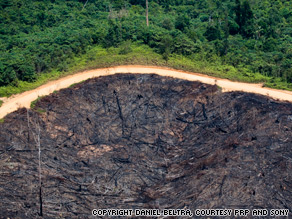
Gisele Bundchen Blasts Brazil Over Rainforest

Sep 22, 2009
From: TheImproper.com

While husband Tom Brady, quarterback for the New England Patriots was fighting a losing battle against The New York Jets, his wife, Brazilian supermodel Gisele Bundchen, was scoring points of her own for the einvironment.

In her new role as United Nations advocate for environmental awareness, the pregnant supermodel blasted the president of Brazil, her home country.

Bundchen urged him to do more to halt the deforestation of the Amazon, considered a significant contributor to global warming.

In a meeting with reporters in New York, Bundchen said that Brazilian President Luiz Inacio Lula da Silva should propose better laws to stop the pervasive slashing and burning of trees in the world's largest rain forest.

Brazilian newspapers quickly jumped on her comments as she, which she made when she was named a goodwill ambassador for the U.N. Environment Program in a ceremony at Washington Square Park, near the United Nations.

Silva responded by saying that his new proposal to limit sugarcane production in the Amazon and other ecologically sensitive areas demonstrates his commitment to curb destruction of the Amazon.

Bundchen, who is expecting in December, met with local students to explain her support for environmental causes.

“The environment has always been my passion,’’ Bundchen said. “I grew up in a small town and I had the opportunity to live surrounded by nature. I couldn’t have asked for a better childhood.

We must act now, so future generations have the same opportunity. Mother Earth is our fundamental life-support system, and by becoming aware and responsible now, we can assist in preserving the planet.’’

Home Business & Finance News U.S. Politics International Technology Entertainment Sports Lifestyle Oddly Enough Health Science Special Coverage Video

Mon Sept 21, 2009
From: Reuters

BETHESDA, Md., Sept. 21 /PRNewswire/ -- Marriott International (NYSE: MAR) is
participating in Team Earth, a worldwide sustainability movement that unites
businesses, non-profit organizations, and individuals to address five critical
environmental issues: climate change, water, health, waste and food. The
initiative urges individual actions and presents easy solutions to ensure a
more sustainable world.

"We are proud to join Team Earth, because we believe that protecting the
environment is part of our mission to provide people around the world with the
rewards of travel, not just today, but in the years to come," said Bill
Marriott, Chairman and CEO of Marriott International.

Team Earth is represented by three non-profit organizations: Conservation
International, Rocky Mountain Institute and Prince's Rainforest Project.
Founding companies include Dell, Harrah's, SC Johnson, Starbucks, and Wrigley,
and PepsiCo China, ePals and Marriott International are also participating.

"We feel strongly that a stable climate, fresh water resources, a sustainable
food supply and a healthy environment are vital for our survival and we must
therefore share the responsibility of taking specific actions toward the
earth's protection," said Chairman and CEO of Conservation International Peter
Seligmann.

Team Earth is committed to recruiting individuals to save the world's forests,
a vital element in preventing climate change, by signing up for the Prince's
Rainforest Project campaign at the Team Earth beta site, www.teamearth.com.
The Prince's Rainforest Project, established by The Prince of Wales, calls for
emergency action and funding in order to achieve a fast and significant
reduction in tropical deforestation by helping rainforest nations to focus
instead on alternative, more environmentally friendly (low carbon) economic
development activities. By signing up, Team Earth members add their voice to
the many calling for urgent action to fight climate change by saving forests.

The official Team Earth web site will launch in November 2009 and will include
social networking functionalities, educational content, environmental impact
measuring tools and more.

In 2008, Marriott announced its environmental strategy to help protect the
environment and address climate change. The plan calls for the company's $2
million commitment to help protect 1.4 million acres of Amazon rainforest in
Brazil. Guests can also make donations. To learn more, visit
www.marriott.com/savetherainforest and www.marriott.com/spirittopreserve.

Hotel Chain Marriott Joins Team Earth

Monday Sep 21,2009
From: GreenPacks

Team Earth is a worldwide sustainability movement for businesses, non-profit organizations, and individuals looking to address five critical environmental issues like climate change, water, health, waste and food. The latest to adhere to the sustainable world vision, hotel chain Marriott has just announced that they are trying to prove their greenness by joining the Team Earth bandwagon.

Either a marketing stunt or just their way of catering to the green minded, Bill Marriott, Chairman and CEO of Marriott International said: “We are proud to join Team Earth, because we believe that protecting the
environment is part of our mission to provide people around the world with the rewards of travel, not just today, but in the years to come.”

Led by three non-profit organizations that include the Conservation International, the Rocky Mountain Institute and Prince’s Rainforest Project, Team Earth is committed to recruiting individuals to save the world’s forests for a more sustainable food supply, a healthier environment and to prevent climate change.

Last year Marriott has already announced their environmental strategy that involves spending $2 million to help protect 1.4 million acres of Amazon rainforest in Brazil.

Tuesday, September 22, 2009

Gisele Bundchen UN Ambassador: Takes On Brazil President Over

09/21/09
From: Huffington Post

Her comments were published Monday in major Brazilian newspapers that covered her comments as she was named a goodwill ambassador for the U.N. Environment Program.

Silva said Monday that his new proposal to limit sugarcane production in the Amazon and other ecologically sensitive areas is proof of his commitment to Amazon preservation. It was unveiled last week.

Monday, September 21, 2009

St Vincent: Sail fast, live slow in these Caribbean islands

21 Sept 2009
From: Telegraph.co.uk

I'm sitting on the rim of a volcano, my feet dangling beneath me. La Soufrière on the Caribbean island of St Vincent is still active; it last erupted in 1979, clouds of grey ash showering the island and the neighbouring island of Bequia, nine miles away, for days.

Thankfully, no one was killed. Now, the crater is covered in lush green vegetation and only a whiff of sulphurous steam escaping from the side of the vast lava dome hints at the power beneath.

It's been a three-and-a-half-hour hike to reach the summit, through creaking bamboo groves with canes as thick as a man's leg, and humid rainforest, overtaken by sure-footed, machete-carrying marijuana farmers crossing the mountains to tend their crops. Slowly we've moved ever upwards into scrubland and the final, almost vertical, haul over old lava flows, scree tumbling with each step.

But now my blisters and breathlessness are forgotten. I feel euphoric – 4,048ft high and on top of the world. Our guide, Ellroy Brown, rummages in a small plastic bag and hands out yellow mangoes picked from his garden that morning. Gazing at the lush view below us, we bite into them greedily, sweet juice coating our chins and hands. Delicious.

Softly spoken Ellroy is a man of numbers and a man who, quite rightly, takes pride in his country's beauty. He tells us St Vincent is home to 12 different sorts of avocado, more than 100 different mangoes, three types of humming bird, 700 St Vincent Amazon parrots and a human population of 110,000. He urges us to recognise the sound of a whistling warbler, marvel at the vines gradually strangling its palm tree host and the discarded trumpet tree leaves like piles of crumpled newspaper.

I want to descend the rickety rope ladder into the crater's depths, but within minutes the summit is cloaked in a thick, wet mantle of cloud. We turn back, bouncing down the path, the humidity enveloping us as we descend. This time it takes just 40 minutes.

Our taxi driver for the week, the loquacious Herb, greets us in a glade below with chilled bottles of Coke. A picnicker hands out freshly barbecued chicken from a plastic bucket. Once again, it's delicious.

At the Wallilabou Anchorage we feast on yet another memorable meal: creole chicken, rice and peas, plantain and callaloo (a bit like spinach) fritters. We eat outside at trestle tables overlooking Wallilabou Bay, transformed into the busy and supposedly Jamaican port of ''Port Royal'' during filming of Pirates of the Caribbean. Discarded props make for a slightly surreal ghost town-cum-tourist shrine: wooden building façades left to moulder, stacks of hay bales revealed as polystyrene blocks and rows of wooden coffins as light as plywood.

My visit to St Vincent and the Grenadines provided just such a weird mix of the wonderfully memorable and the frustratingly not quite what it set out to be. More of the latter later. Definitely memorable were the stunningly verdant landscape, banana groves with each nearly ripe bunch encased in a blue plastic bag, aquamarine seas, spectacular waterfalls reached by rocking bamboo bridges, smartly pressed and smiling schoolchildren, vibrant markets and brightly coloured houses with single cows or goats mournfully tethered.

Twenty-one miles long and 11 miles wide, St Vincent is the largest of the 32 islands and cays – only seven of which are inhabited – that make up St Vincent and the Grenadines. Most people will have heard of Mustique, favourite tropical island of Princess Margaret, Mick Jagger and David Bowie. But few will have heard of its near neighbours Bequia and Canouan. The islands stretch in a 60-mile line 100 miles west of Barbados. One downside is there are no direct flights to any of the islands, although transfer time from Barbados is just 40 minutes.

Travel becomes an experience in itself once on St Vincent, with cars and pickup trucks double-beeping each other around the hairpin bends, near misses with chickens, goats and sauntering pedestrians (pavements do not exist on the single main road that snakes around St Vincent) and Herb's impromptu stops to haggle over a yam or a roadside takeaway.

Entry to the upmarket hotel Young Island is magical; stand on the mainland jetty and a boat sets off from the island 200 yards offshore to collect you and chug back gently to the fairy-lit island.

The ''express ferry'' to Bequia, the closest island to St Vincent, is a rocking hour-long ride for £7.25 return, sharing bench space with office workers and parcels. Known as Big Little Island, Bequia is only seven square miles but boasts lush views from the hillsides down to the white-sand beaches (St Vincent's are sparkling greyish black volcanic sand) and its busy capital Port Elizabeth. The market is touristy but fun with good-humoured haggling for tiger shark necklaces and T-shirts emblazoned with the St Vincent motto ''Sail Fast, Live Slow''. The Blue Tropic Café at the Bequia Beach Hotel provides a corner of calm with agreeably simple food.

The island of Canouan is an exhilarating 12-minute flight from St Vincent in a six-seater plane. A return trip costs just £11.25, but it still seems slightly bonkers to take a plane to the beach. The tiny three-square-mile island is a bizarre mix of the sophisticated – it's home to the five-star Raffles Resort, the Trump International Golf Club and the Tamarind Beach Hotel – and the basic. When the hotels first arrived, the island had no fresh water supply or electricity. The manager of the Tamarind Beach Hotel, which boasts mahogany rooms with terraces leading directly onto the beach, recalled how her first flight to the island was delayed by a goat on the runway. The ''international airport'' now has a fence and the Tamarind has a reputation for the best pizza in the West Indies (it's not unknown for the rich and famous to send their private planes from islands nearby to pick up a takeaway).

Tobago Cays – a nature reserve of five minuscule, uninhabited islands and the surrounding coral reefs – is only accessible by boat. Private yachts and hired catamarans bob inside the shallow lagoon where I snorkelled, nose to nose with endangered green turtles in the sea grass. The Cays are a 90-minute power boat ride from St Vincent or 15 minutes from Canouan. We docked at nearby Mayreau Island – picture postcard white sands and coconut trees – for a hamburger and chips at the Saltwhistle Bay Club, admiring the view from straw-roofed tables. A beach doze followed before the long power boat trip back to the main island, our driver Jonah expertly steering the boat through the swells.

So, for natural beauty and relaxation with occasional flurries of activity, St Vincent and the Grenadines make a good holiday destination. But there are a few problems in paradise: service can be surly, hot water occasionally proves to be a request too far and – in a misplaced bid to appeal to tourists – menus are frequently pretentious.

Beachcombers Hotel in St Vincent is a case in point. It looks fabulous: bougainvillea tumbling over orange, yellow and blue buildings, humming birds and tree frogs in the tropical gardens and splendid views over the bay. But my stay there was so disappointing it was almost funny. My room was a depressing brown, dimly lit, with a choice between stuffy or ear-splitting air-con, the shower failed to provide any hot water for three days (I had to beg to use the shower in the ''spa'') while eye-rolling and teeth sucking was on the menu every morning.

Still, despite the odd grumble, nothing could spoil that memory of sitting on the summit of a volcano and silently watching parrots crashing into the forest treetops as dusk fell. Magical.