The Malaysian government's federal land agency (FELDA) is now denying its well-documented plan to develop oil palm plantations in the Amazon rainforest, reports Ecological Internet, a forest advocacy group that carried out a campaign against the project.
"In a positive yet puzzling development, a spokesperson for the Malaysian government's federal land agency (FELDA) now denies plan for Malaysian government controlled oil palm development in the heart of the Amazon ever existed," Glen Barry, founder of Ecological Internet and organizer of the campaign, wrote via email. "Wan Zaleha Wan Embong, from FELDA's Public Relations Department, has been responding to our network's protest emails, disavowing the plans."
Barry speculated that the apparent change of plans could be "an attempt to save face" in response to more than 100,000 protest emails, economic difficulties caused by a dramatic fall in the price of palm oil, or simply an attempt to mask the government's involvement by reorganizing the project with private, rather than government, capital.
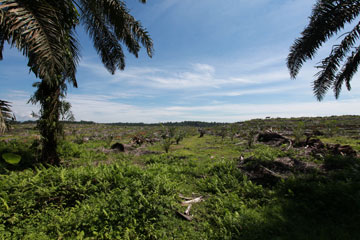 Oil palm plantation in North Sumatra in May 2009 |
"As a start, 20,000ha in Tefe will be opened for oil palm planting. After that, between 3,000ha and 5,000ha will be opened yearly," he said. "Felda wants to emulate Petronas as a global player," he added, referring to Malaysia's national oil company.
At the time FELDA said it would partner with Braspalma, a local company, to form Felda Global Ventures Brazil Sdn Bhd. FELDA would have a 70 percent stake in the venture.
The deal appeared to still be in the works up until at least late March 2009, according to a post on the from Palm Oil Truth Foundation, a web site run by a palm oil marketing firm. But now, per the comments from FELDA's spokesman, the deal has been shelved.
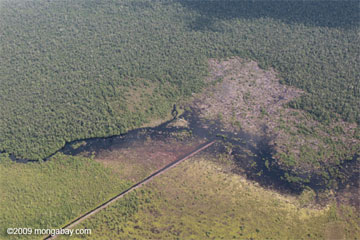 Clearing and draining of peatland for oil palm in Central Kalimantan in May 2009 |
Barry says he won't be surprised to see the project re-emerge under a different name without direct government involvement of the Malaysian government.
Ecological Internet and other environmental groups have been campaigning against the conversion of natural forests for oil palm plantations, which in recent years has become a significant driver of deforestation, especially in Malaysia and Indonesia.