Wednesday, June 30, 2010

Amazon Rainforest Faces New Threat from Brazilian Lawmakers

June 29, 2010
Source: ecopolitology

Major Changes in Brazilian Forest Law Could Undo Decades of Work Trying to Protect the Amazon

Brazilian legislators tight with agribusiness interests are looking to "drastically weaken conservation requirements of the country’s Forest Law," which would have a devastating effect on the Amazon rainforest, the World Wildlife Fund (WWF) reported yesterday.

Today, following submission of a parliamentary special commission report which claims the laws are holding back economic prosperity, a so-called "ruralist bloc" is expected to push for "flexibilization" of the country's key forest laws through a Special Committee on Forest Law Change.

"If the Special Committee accepts the report, it will then go to the parliament for a vote which is expected to be favourable. The president has the option of signing or vetoing any amendments, but a veto is considered unlikely in the charged atmosphere of Brazilian presidential and legislative elections," WWF says.

There was hardly any consultation with the scientific community in the preparation of this report and WWF-Brazil is strongly opposed to it since it would completely undermine important requirements for environmental and sustainable production reserves on private land. These reserves and other components of the Forest Law are a major reason why Amazon deforestation has been reduced in recent years.

Increase Productivity through Sustainable Practices, Scientists Say

Counter reports have involved the scientific community and one such report, by the respected agricultural college of the University of Sao Paulo (USP/ESALQ), found that Permanent Preservation Areas had a negligible impact of about 1.5% on agricultural production in some of Brazil’s leading coffee, grape, rice and fruit producing areas.

Scientists say that much more could be gained from increasing productivity through sustainable integration of agriculture and ranching and improved pasture management than from taking down more of the Amazon forest.

Amazon Burning Again?

If the proposed changes are made to Brazil's Forest Law, we could go back to rates of Amazon destruction we saw decades ago. WWf reports:

"If the amendments are signed into law, effective control of deforestation will pass from strong Federal legislative control to a piecemeal state by state approach. Under this scenario, a strong upsurge in deforestation is expected, raising the spectre of 'the Amazon is burning' past which became a celebrated cause internationally and helped form the basis of a structure of international environmental conventions and institutions."

Additionally, if this happens, Brazil's action plan on climate change will be nearly impossible to implement, since it relies heavily on ongoing reductions in deforestation related emissions.

Calculations by independent bodies estimate that Brazil's emissions could be several times what they've promised if these amendments to the Forest Law are passed.

Belo Monte Dam Will Change Way of Life on Xingú River

Jun 29, 2010
Source: Inter Press Service

At dawn, the "captain" fired on the village leader and the shooting began. "The forest trembled," says one survivor: the local indigenous people fled, leaving their dead behind. Only one young girl remained. But she sank her teeth into the chest of one of the assailants with such force that they slit her throat to pull her off him.

Five decades later, Benedito dos Santos remembers the killings in which he participated as a "seringueiro", or rubber tapper, in Brazil's Amazon jungle.

In the late 19th century, rubber tappers began encroaching on the forests of the Xingú River Basin in the northern Brazilian state of Pará, either clashing with local indigenous groups, or living and intermarrying with them.

"Bião," as Santos is known, is now 67. He had 26 children with 14 women. Currently he works as a boatman in a family-run company that has eight boats and a dock in Altamira, the largest city on the banks of the Xingú, home to 100,000 people.

He has lived through the ups and downs of the river basin's extractive economy since he arrived when he was nearly five, with his widowed mother and three younger siblings. They came from the Mojú River, 350 km to the east.

When asked about the transformations that will result from the Belo Monte hydroelectric plant, which will dam the Xingú River in two places, flooding islands, forests and farmland, Bião says he is "neutral."

The decision belongs to "the powerful," and the debate between the mega-project's supporters and opponents doesn't matter, he says.

He just hopes it will generate income for the local people who are unemployed, and says the role of the forest has changed, and is no longer what people rely on to survive.

"I was raised on tree milk," he jokes, pointing out that he was very young when he learned to extract latex from the rubber tree (Hevea brasiliensis), known here as "seringueira", in addition to helping his mother and stepfather with farming, and collecting Brazil nuts.

He became a seringueiro at 14, plunging into the jungles of the Middle Xingú with three different rubber-tapping groups. His girlfriend was already expecting his first child.

The attack on the village was in reprisal for the murders of a number of seringueiros committed by indigenous people to obtain firearms, said Bião. "In Isaac's group alone they killed more than 40," he said.

Killings happened on both sides. But the non-indigenous outsiders added a macabre twist: they stuffed rocks in the bodies of the victims so they would sink to the river's depths and avoid detection by the government's Indigenous Protection Service.

Bião grew increasingly fearful, worried also about internal conflicts. One afternoon, a shoot-out erupted amongst the seringueiros in the camp, and several were killed. He avoided the disputes and enjoyed the protection of his bosses because of his ability to bring in bush meat and fish.

The day of the attack in question, seringueiros surrounded the indigenous village after a nine-day hike. Ten of the 35 men deserted the group during the trek. The "captain" put Bião "behind an embaúba tree, so skinny that it wasn't going to stop any bullets," he recalls. Frightened, he spent the entire night digging a trench "using my fingernails like hoes."

Many indigenous people were killed, but only two seringueiros were injured, and the village was burned down, Bião says.

After nine years in the rubber tree forest, he returned to the "good life" of Altamira, already a father of four. There was little future in the dangerous rubber tapping trade.

The Brazilian Amazon, where some made their fortunes in the rubber boom of the late 19th and early 20th centuries, lost its global market dominance in natural latex to Malaysia starting in 1920, where rubber tree plantations achieved higher yields.

Bião and his fellow rubber tappers benefited from strong post-World War II prices, but Brazil had already fallen to the status of secondary exporter, relying on subsidies and awaiting jumps in demand for natural latex, as occurred during WWII, when Japan blocked exports from Southeast Asia.

Hunting jaguars and other animals with prized pelts went from being occasional work to Bião's main source of income. "That was when I earned the most money," enough to buy two lots in the city, he says.

"One night I killed 30 jacaré caiman (a member of the crocodile family), but two friends and I couldn't remove all their skins; it's hard work," he said.

Today there are few caimans left near Altamira because "people kill them for food," but they do remain abundant in the Upper Xingú, according to Bião. Although a 1967 law was passed to ban the hunt, there is little enforcement in the rainforest.

He also participated in the haphazard construction of the Trans-Amazonian Highway, begun in 1970. He spent a year tearing down forests to open the way for the 3,000-km project, intended to unite the Brazilian Northeast and the Amazon. The road, left unpaved, has long been nearly impassable along the stretches that serve Altamira.

But the project attracted a new wave of migration to the Amazon region, fuelled by promises of jobs and the distribution of land to farm.

Aparecida Moraes is a child of that process. She was born in 1971, a year after her family migrated from the southern state of Paraná in search of land, and ultimately settled on the banks of the Xingú.

Now she is married to another migrant from Paraná and sells the bananas, papayas and grains they grow at the farmers market in downtown Altamira. The Belo Monte dam will not flood her land.

Sebastião de Castro Silva has no such luck. The 60-year-old father of eight grows cacao and grains on the 100 hectares he bought when he arrived in Altamira in 1977, coming from the central state of Goiás. "I'll leave the Amazon if they build the dam," he said, because it would flood 40 percent of his farm and he would be unable to keep his 32 family members together.

While the invasion of the Middle and Lower Xingú by colonists was occurring in the 1970s, Bião joined the "garimpo" boom, the informal mining of gold and precious stones. He went to Venezuela to look for diamonds, but was quickly arrested and deported with many other Brazilian "garimpeiros".

He found gold in Ressaca, near Altamira, in a mine that some of his descendants continue to work today. He then tried several other mining sites and settled on one 1,000 km south of Altamira in the state of Mato Grosso, located in the watershed of the Tapajós River, which runs parallel to the Xingú.

"In the garimpo you can earn a lot, but you can also lose a lot, even your sense of shame, between drinking and prostitutes," he said.

For 18 years, up to 2002, Bião mined several prospecting sites and ran a brothel, while also working for the Marajoara lumber company. Illegal logging still thrived, especially for mahogany, though the extraction of this precious wood has been restricted in Brazil since 1996.

The disputes turned violent. A mahogany forest at the top of a hill where Bião had arrived with his team and tractors awakened the greed of a rival group, whose imminent armed attack was frustrated in an ambush in which more than 20 people died.

Bião had to flee. "My head was worth five kilos of gold," he said. He then returned to Altamira, wanting the safety of being surrounded by family.

But the life of a boatman on a Xingú River scattered with submerged islets and hidden drop-offs in the swollen river also has its risks.

Just two months ago, Bião felt the world "go dark too quickly," when a whirlpool swallowed him and his "voadeira", his small motorboat. He survived by swimming more than an hour and clinging to a tree for another 11 hours.

He is a survivor of a way of life that -- like the Xingú itself -- will be transformed by the construction of the Belo Monte hydroelectric dam over the next five years.

The megaproject will employ 18,700 people and generate another 80,000 indirect jobs, and is expected to attract some 100,000 migrants to towns that currently total fewer than 150,000 inhabitants.

In addition, the Trans-Amazonian will finally be paved, ending the relative isolation of the Middle Xingú.

A businessman from Goiania, capital of Goiás, 2,300 km to the south, recently began buying fish in Altamira, transporting shipments of 600 to 800 kilos by truck, said Gilvan de Almeida, who has been selling fish at the local farmers market for 12 years.

With the paved highway, Altamira will be integrated with the rest of the country, and it is likely that industrial fishing will establish itself in the Xingú, affecting supplies to the local markets and the fish populations in this major river and its tributaries.

Peru: oil spill fouls rainforest communities

Tue, 06/29/2010
Source: World War 4 Report

Some 4,000 people living in communities on the banks of the Rio Marañón in Peru's northeastern Loreto department have been affected by an oil spill that occurred June 19, according to Lilia Reyes, the Loreto representative for the national rights ombudsman, the Defensoría del Pueblo. At least six communities that have been affected by the spill, including Santa Rita de Castilla, Ollanta, and Alfonso Ugarte.

A researcher at the Loreto-based Peruvian Amazon Research Institute (IIAP), Víctor Sotero, has said there are high levels of contamination in the river as a result of the spill. "In Santa Anita, the population provided us with samples collected on Sunday and Monday [June 20 and 21]... All of the samples analyzed in the laboratory show high contamination."

The oil spill was a result of an accident on a ship owned by Argentine oil company Pluspetrol. Mines and Energy Minister Pedro Sánchez said the company was working on cleaning the spill. Environment Minister Antonio Brack added that whoever is found responsible will be fined for the spill.

Large dam project to start in Ecuador

Tuesday 29th June, 2010
Source: Philippines News.Net

Construction of the Coca Codo Sinclair hydroelectric dam is due to begin in Ecuador next month.

China will finance the project to 85 per cent of the cost.

China's state-run Sinohydro Corp has been instrumental in the controversial project which is intended to supply 35 per cent of Ecuador’s power needs by 2016.

The project has been criticised by environmentalists, who have complained the dam will be built in highly sensitive rainforest and waterfall area.

The gigantic dam is being constructed at the foothills of the Andes, in the Amazon rainforest, some 75 kilometres east of the capital Quito.

It will sit on the Coca River, which flows into a tributary of the Amazon River, at a big bend where the water level plunges 600 metres.

Tuesday, June 29, 2010

Peru: President García refuses to sign indigenous rights law

Fri, 06/25/2010
Source: World War 4 Report

President Alan García refused to sign an historic new law that would recognize Peru's international obligation to consult with indigenous peoples before proceeding with resource extraction projects that affect them. Despite broad appeal from the International Labor Organization of the United Nations, human rights groups and indigenous organizations, Garcia sent back the law to Congress with his objections just before the deadline late on June 21.

"President García has missed a huge opportunity to show Peruvians and the world that his government is willing to respect indigenous peoples rights and willing to bring Peru closer in line with international norms," commented Atossa Soltani, executive director of Amazon Watch. "García has taken another step backwards in repairing relations with indigenous peoples and demonstrated yet again his administration's deeply troubling policies towards the country's original inhabitants."

The consultation law, which was approved by the Peruvian Congress on May 19, would require that affected indigenous peoples be consulted in advance of any legislative or administrative measure, development or industrial project, plan or program that directly affects their collective rights.

García objects to the idea that indigenous people can disagree with the government and proposes that the law should be modified to allow the government to override the result of any consultation process. In his letter to the Peruvian Congress he also says that national and regional development projects should be excluded from consultation for fear of holding up infrastructure development and that the law should not apply to "la comunidad Andina"—the indigenous peoples of the Andes. To justify his refusal to honor Peru's international obligations and the result of months of hard work and dialogue, García invokes baseless fears arguing that meaningful prior consultation with indigenous peoples would delay or prevent the economic development of the country.

Alberto Pizango, the President of AIDESEP, the country's national indigenous organization commented that "the consultation law would be a positive step forward though it is still insufficient in protecting our peoples' rights." He further stated that indigenous peoples are not opposed to development but rather object to the "current model of development that destroys the rainforest for profit of a few individuals and companies. We seek development in harmony with the environment."

The law would have brought Peru closer to long overdue compliance with its international legal obligations. In 1994 Peru ratified International Labor Organization (ILO) Convention 169 concerning Indigenous and Tribal Peoples which establishes the right of indigenous peoples to be consulted on matters affecting their territories and way of life. In February 2010, the ILO recommended that the Peruvian government "suspend the exploration and exploitation of natural resources which are affecting [indigenous peoples]" until the government has developed consultation and participation mechanisms in compliance with ILO 169. In a meeting just last week the ILO reaffirmed its concerns over the Peruvian government's failure to implement ILO 169 and urged Garcia to sign the consultation law as an important measure to come into compliance with the treaty.

Last year thousands of indigenous people across the Amazon protested new laws aimed at "development" of the Amazon, which were passed without consultation. The protests came to a tragic end when a police clampdown in Bagua left 34 dead and over 200 injured. As part of the reconciliation process the government committed to developing a consultation law in consensus with indigenous and civil society groups. However the García government continues to ignore indigenous rights and undermine the reconciliation process. The oil and gas leasing arm of the Peruvian government has opened dozens more new oil and gas concessions on indigenous lands without meaningful consultation, and President Garcia last week signed an agreement with Brazil to build six mega-dams in the Peruvian Amazon, many of which will flood indigenous lands in order to sell electricity to Brazil.

"This law represented a critical opportunity for the Peruvian government to demonstrate that it is serious about resolving the kind of social conflict that led to the tragedy in Bagua last summer," stated Gregor MacLennan, Peru Program Coordinator for Amazon Watch. "Now that President Garcia has refused to bring Peru into compliance with the UN Convention, it is up to the legislature to ensure that Peru respects indigenous rights. It has already been sixteen years since Peru ratified ILO 169—how much longer do indigenous peoples need to wait?"

Under the Peruvian constitution, the legislature has the power to enact laws that the president refuses to sign and can override his objections by majority vote. Indigenous and human rights groups are urging Congress to act quickly to make this law official so that it can be implemented without delay and in full consultation with the country's indigenous peoples, as a much needed sign of Peru's commitment to respecting, protecting and fulfilling the rights of indigenous peoples.

The double standards of multinationals

Friday 25 June 2010
Source: guardian.co.uk

Bhopal gas victims hold wanted posters of former Union Carbide chairman Warren Anderson. Photograph: Raj Patidar/Reuters

The $20bn fund that Barack Obama managed to get BP to agree to set up to meet claims for economic losses and environmental costs from the Gulf of Mexico oil spill is impressive, especially since the amount can be increased. The political pressure so evident also caused BP to temporarily suspend paying dividends. This should set a precedence for how host countries of multinationals take stern action, and executives of multinationals respond to meet their responsibilities – even if only partially.

But then the US is a powerful host country indeed, and BP had little choice but to yield given the political pressure and public anger. Developing countries are also host to multinationals that in many cases have poisoned the environment or caused immense loss of life and property. But these multinationals have got away scot free or paid miniscule sums for the harm they caused.

These double standards must change. There should be international co-operation between the host and home countries of multinationals to ensure they compensate for the environmental clean-up as well as pay victims for ecological disasters they cause, wherever they take place. The G20 leaders should talk about it this weekend, and not just focus on bank levies and the shift to fiscal austerity packages.

Though the Mexican Gulf oil spill may be the United States' greatest environmental disaster, worse ecological catastrophes have been caused by international companies in developing countries. Little, if any, compensation has been paid by these companies. And the governments of the countries whose people own the companies usually turn a blind eye. The two most directly related cases – because they also involve oil spills – are in Ecuador and Nigeria. Ecuador's Amazon region has been contaminated by oil and toxic waste in amounts far larger than the Gulf oil spill so far. The oil and waste was discharged by Texaco (bought over by Chevron in 2001) when it operated an oil concession in 1964-1990.

The New York Times reported indigenous people in the area saying that toxic chemicals had leaked into their soils, groundwater and streams, and that some of their children had died from the poisoning. It cited a report of an expert (contested by the company) who estimated that 1,400 people had died of cancer because of oil contamination.

The indigenous groups have taken a court case against Chevron for $27bn in damages. They accuse Chevron of dumping more than 345m gallons of crude oil into the rainforest and another 18.5bn gallons of toxic waste in pits in the forests. Experts claim that the disaster has devastated their lands, income and health to a degree far larger than the BP spill in the Gulf. The company paid Ecuador's government $40m in the early 1990s for clean-up costs, but this amount is seen as far too little given the scale of the damage.

The second case is the Niger Delta in Nigeria, a major oil-producing region in which Shell and other companies operate. A recent article by John Vidal in the Observer entitled "Nigeria's agony dwarfs the Gulf oil spill. The US and Europe ignore it", describes how spilt oil has contaminated swamps, rivers, forests and farmlands in the region. "In fact, more oil is spilled from the delta's network of terminals, pipes, pumping stations and oil platforms every year than has been lost in the Gulf of Mexico," wrote Vidal.

A report by environment groups calculated in 2006 that up to 1.5m tons of oil – 50 times the pollution unleashed in the Exxon Valdez tanker disaster in Alaska – has been spilled in the delta over the past half century. According to Amnesty, in 2009 the equivalent of at least 9m barrels of oil was spilled and it accused the oil companies of a human rights outrage. Life expectancy in the rural communities has fallen to a little above 40 years.

According to Nnimo Bassey, a Nigerian who is chair of Friends of the Earth International: "We see frantic efforts being made to stop the spill in the US. But in Nigeria, oil companies largely ignore their spills, cover them up and destroy people's livelihood and environments."

Then there is the worst eco-disaster of all in Bhopal, where poisonous gas from the US-owned company Union Carbide in 1984 affected half a million people, killing 2,300 immediately, with another 15,000 to 30,000 dying subsequently and many thousands of others maimed seriously. Neither Union Carbide nor Dow Chemical, which bought the firm in 2001, accepted responsibility for the disaster. Union Carbide paid $470m in a deal in 1989 with the Indian government, but this is a small and wholly inadequate amount, given the enormity of the disaster.

These cases show a big contrast between what the US administration is doing to hold a multinational company financially accountable, and how similar companies that cause ecological catastrophes in developing countries are able to get away either freely or with grossly inadequate pay-outs.

Developing countries should learn a lesson from the US and take similar action in line with the "polluter pays" principle.

But these countries just don't have the political clout of the United States. Thus, the governments of the home countries of the multinationals should also act to make their companies accountable for their actions when they operate in other countries, and to compensate adequately when they cause environmental damage.

Natural wonders of the world

Jun 28 2010
Source: TNT Magazine

The world's top natural wonders should be on your list of places to see before you die.

Here are our top five. Do it - book one now!

Angel Falls, Venezuela

Visitors to the world’s highest waterfall have to take a small plane through dense forest to reach Canaima National Park. From the landing strip, the adventurous can reach the 979m high waterfall by dugout canoe and then trudging through the jungle.
BOOK IT: Intrepid Travel (020 3147 7777; intrepidtravel.com) offers a 25-day Northern Amazonia and Venezuela tour for £860.


Amazon rainforest, Brazil

Explore the depths of the Amazon Rainforest to appreciate South America’s vast jungle, alive with a huge variety of wildlife, from caiman alligators to pink river dolphins and everything in between, including tarantulas. View wildlife by boat and camp out on the riverbank.
BOOK IT: Explore (0845 013 1537; explore.co.uk) offers a 15-day Brazil tour for £2148.


Grand Canyon, US

You can hike down to the canyon floor or peer at it from a helicopter, but you’ll be spellbound by its dimensions: 1.6km deep and 446km long.
BOOK IT: Trekamerica (0845 313 2614; trekamerica.co.uk) offers a 14-day Westerner 2 tour for £829.


Victoria falls, Zimbabwe/ Zambia

The mighty waterfall is summed up by its indigenous name, “smoke that thunders”. Take a helicopter ride for a great view.
BOOK IT: Oasis Overland (01963 363400; oasisoverland.co.uk) offers a 31-day Savanna Dawn tour for £575.


Northern lights

Aurora borealis, the dazzling multi-coloured light displays, can be spotted in the night sky during the winter months in Scandinavia, Alaska and northern Canada.
BOOK IT: Exodus (020 8772 3936; exodus.co.uk) offers a seven-day Lapland adventure for £2239.

Competitors in 24v engine class in the schools Greenpower electric car race day at Newquay Airport Picture:Emily Whitfield-Wicks

Tuesday, June 29, 2010
Source: Cornish Guardian


There was no Lewis Hamilton, Jenson Button or Michael Schumacher. The cars were decorated with scrap paper, rather than lucrative sponsorship deal. And there wasn't a single adult amongst the entire teams' pit crews.

Welcome to the world of Formula 24 – where Westcountry school children paired their passion for reducing carbon emissions with ingenuity.

Thousands of youngsters took to an empty runway in Newquay after weeks of hard work, ready to test drive their feats of engineering.

The annual Cornwall College Greenpower event saw environmentally-friendly cars do battle with each other in the Cornish heat of races, desperate to make it through to the nationwide finals.

For the winners, Richard Lander School of Truro, there was no champagne, weekend on a luxury yacht in Monaco, or free entry to the world's most exclusive nightclubs.

Instead, an acre of rainforest was awarded to those judged to have produced the best environmentally-friendly car, built completely from scratch. It was the greenest car, not the fastest, which got the prize of an acre of Amazon rainforest.

Cornish-based rainforest charity, Cool Earth, helped organise the event and agreed to protect an area of endangered tropical forest, in the winning school's name, rewarding them for their sustainable approach to design and technology.

Cool Earth spokesman Matthew Owen said: "All the cars got off to a flying start because they're electric and not gas guzzlers.

"But to get the Cool Earth seal of approval we had to be run a few green checks in the pit stops, such as which cars are made from the most sustainable materials and are they made to last.

"This event was a great way of getting pupils to think about how modern technology impacts on our environment and how they can help shape a more sustainable future."

Despite sharing the same ethos, the vehicles came in wide-ranging shapes and sizes. Some were covered in pieces of scrap paper, another was decorated to look like a Devon and Cornwall Police car. All were powered by a 12 volt battery and made from recycled materials.

Richard Lander School took the top prize with a car built using about 97 per cent biodegradable materials. The car was made from wood, stuck together with traditional glue made from animal hide and bones.

Silk was also used to cover the wood on the outside of the car for extra strength.

Matthew Owen from Cool Earth said: "The car made by Richard Lander School showed a really imaginative use of biodegradable materials with sustainable thinking right at the heart of the design.

"They're now sponsoring an acre of Amazon rainforest stopping it from being destroyed. Not only has this event enthused children about engineering and technology, it's also raised awareness about how new design can have a positive impact on our planet."

The Cool Earth sustainability prize in the Goblin, primary school category went to Gorran School.

Padstow Primary school were awarded second prize as they used 123 recycled plastic bags in their design and St Mewan Community Primary school won third place for sustainability as they charged the battery in their electric car from their own solar panels.

Monday, June 28, 2010

Ending deforestation could boost Brazilian agriculture

June 26, 2010
Source: mongabay.com

Ending Amazon deforestation could boost the fortunes of the Brazilian agricultural sector by $145-306 billion, estimates a new analysis issued by Avoided Deforestation Partners, a group pushing for U.S. climate legislation that includes a strong role for forest conservation.

The analysis, which follows on the heels of a report that forecast large gains for U.S. farmers from progress in gradually stopping overseas deforestation by 2030, estimates that existing Brazilian farmers could see around $100 billion from higher commodity prices and improved access to markets. Meanwhile landholders in the Brazilian Amazon—including ranchers and farmers—could see $50-202 billion from carbon payments for forest protection. The assessment does not account for gains from payments for other ecosystem services, agroforestry, or expansion of oil palm plantations on degraded lands in the region.

"Tropical forest protection can spur better use of existing agricultural lands – such as adoption of superior breeding stock and improved grazing plans in the cattle sector – while also making Brazilian beef more attractive to global consumers looking to ensure the products they consume aren’t tied to deforestation," states the analysis, which notes that the earlier report looked only at the U.S. impact of ending tropical deforestation.

"That report was not an economic analysis of the impact of tropical forest protection on tropical countries such as Brazil and Indonesia, and should not be interpreted as such," says the new analysis.

"A review of the data compiled for this report and other published research shows that Brazilian agriculture, and agriculture in tropical countries more generally, can benefit significantly from protecting tropical forests. Indeed, it's important to note that gains to the United States do not mean losses to Brazil. Instead, protecting tropical forests will benefit both countries."

Brazil is in the midst of an ambitious plan to reduce deforestation 70 percent from 1996-2005 levels by 2018. The plan, which would reduce greenhouse gas emissions by nearly 5 billion tons, calls for raising roughly $20 billion in finance to establish and maintain protected areas, compensate farmers for sparing forests, improve governance and law enforcement, and build sustainable industries in the region.

Amazongate: the missing evidence

26 Jun 2010
Source: Telegraph.co.uk

Information about logging and fire risks in the Amazon ended up in the IPCC?s 2007 report on global warming Photo: Sipa Press/Rex Features

Last week the beleaguered global warming lobby was exulting over what it took to be the best news it has had in a long time. A serious allegation, which last January rocked the authority of the UN’s Intergovernmental Panel on Climate Change, was “corrected” as untrue by The Sunday Times, the newspaper which most prominently reported it. The reputation of the IPCC, it seemed, had been triumphantly vindicated. The growing tide of scepticism over climate change had at last been reversed. But this episode leaves many questions unanswered.

The “correction”, gleefully quoted by everyone from the WWF and The New York Times to The Guardian’s George Monbiot related to what was known as “Amazongate”. This was one of the series of controversies which exploded round the IPCC last winter, when it was shown that many of the high-profile claims made in its 2007 report had been based on material produced by environmental activists and campaigning groups rather than on proper, peer-reviewed scientific evidence.

One example, also reported in The Sunday Telegraph, was the IPCC’s much-publicised claim that climate change, leading to a reduction in rainfall, was threatening the survival of “up to 40 per cent” of the Amazon rainforest. The only source the IPCC could cite for this in its report was a document from the environmental advocacy group WWF. But last week The Sunday Times, in its prominent “correction” to its own story, conceded that the IPCC’s claim was “supported by peer-reviewed scientific evidence” after all. Not identified, however, was the nature of this peer-reviewed evidence. Where is it?

The story of “Amazon-gate” has unfolded through three stages. Step one was the passage in the IPCC report almost identical to one made in a non-peer-reviewed WWF paper of 2000 on forest fires in the Amazon. Specifically the IPCC stated that “up to 40 per cent of the Amazonian forests could react drastically to only a slight reduction in precipitation”. But the only source the WWF in turn had been able to cite to support this was a paper published in Nature in 1999, from a team led by Dr Daniel Nepstad, formerly employed by the WWF but now the “senior scientist” with another advocacy group closely linked to the WWF, the Woods Hole Research Center. Certainly Nepstad’s paper was peer-reviewed: however its subject was not climate change but the impact on the Amazon rainforest of “logging and fire”. It found that “logging companies in Amazonia kill or damage 10-40 per cent of the living biomass of forests”. This had nothing whatever to do with global warming but was cited as the origin of that “up to 40 per cent” figure later used by the WWF and the IPCC.

Step two, when all this was reported last January, was a disclaimer from the WWF, emphasising that its 2000 report did “not say that 40 per cent of the Amazon forest is at risk from climate change”. But it went on to say that the real source for its 2000 paper (which had been “mistakenly omitted”) was another paper, “Fire in the Amazon”. This was also written by Dr Nepstad, as head of yet another advocacy group linked to Woods Hole, the Amazon Environmental Research Institute. Although it was now being suggested that this paper should have been cited as the original source for the IPCC’s claim, it too was not peer-reviewed. Thus, twice over, the IPCC’s claim appears to rest both on non-peer-reviewed science and on studies not related to global warming at all.

So great was the IPCC’s embarrassment over these revelations that the story moved to a third stage. Various scientists, led by Dr Nepstad, suggested further studies which might justify the claim. But an exhaustive trawl through all the scientific literature on this subject by my colleague Dr Richard North (who was responsible for uncovering “Amazongate” in the first place), has been unable to find a single study which confirms the specific claim made by the IPCC’s 2007 report. If one exists we would very much like to see it.

There are several studies based on computer models which attempt to estimate the possible impact of climate change on the Amazon rainforest, but none of these have so far supported that 40 per cent figure. Other researchers in turn have been highly critical of these models, suggesting that they are too crude to replicate the complex workings of the Amazonian climate system and that all observed evidence indicates that the forest is much more resilient to climate fluctuations than the alarmists would have us believe.

Nothing did more to excite attention over the effect of climate change on the rainforest than the exceptional drought of 2005, just when the IPCC’s 2007 report was being compiled. Since then, however, abnormally heavy rainfall in the region has brought disastrous floods to Brazil, both last year and again last week.

In other words there is a real mystery here. Nothing so far made public seems to justify an assertion that the IPCC’s specific claim is “supported by peer-reviewed scientific evidence”. In view of all the controversy this issue has aroused over several months, it might seem odd that, if such evidence exists, it hasn’t been produced before. Is it not now a matter of considerable public interest that we should be told what it is?

AS A PERSONAL footnote to this sorry tale, no one crowed more hysterically over this story last week (or got it more wrong) than The Guardian’s George Monbiot. Inter alia, he accused me and Dr North of having been “responsible for more misinformation than any other living journalists. You could write a book on all the stories they have concocted, almost all of which fall apart on the briefest examination.”

I would remind him that, on the only occasion he tried to do this, boasting that it had taken him just “26 seconds” to catch me out, he was soon forced to apologise to his readers that he had got his point hopelessly wrong, and that I was right. Silly old Moonbat should learn when it is wiser to hold his peace.

Amazongate, raining oil and how climate change could ruin cricket

Jun. 26, 2010
Source: Environmental Expert

Climate change scientists have put up with being misrepresented and misquoted by the world's press for years – but now they are fighting back.

The Sunday Times set the gold standard in corrections this week when it published a 400-word correction detailing how its recent Amazongate story was, how shall we put this, completely wrong.

The paper had originally written a story claiming the United Nation's 2007 Intergovernmental Panel on Climate Change published a report 'grossly exaggerating the effects of global warming on the Amazon rainforest', which is strange because the report did nothing of the sort.

Cue a complaint to the Press Complaints Commission from one of the scientists interviewed for the story and, after several months of evasion, a detailed correction and a slap on the wrist for The Sunday Times and its offending journalist.

Although its not just the content of the newspapers that causes environmental headaches. London Assembly Liberal Democrat environment spokesman Mike Tuffrey has been wondering this week when any mayor will finally deliver on repeated pledges to install recycling points for the capital's 1.5 million daily free sheets.

Small change in forest cover can double malaria rate

25 Jun 2010
Source: Reuters AlertNet

[MONTEVIDEO, URUGUAY] A small reduction in tropical rainforest cover can increase malaria incidence by nearly 50 per cent, a study in the Brazilian Amazon has found.

Open spaces and partially sunlit pools of water, typical conditions of deforested landscapes, provide an ideal habitat in which the Anopheles darlingi mosquito� the main vector of the malaria parasite in the Amazon � can live and lay its eggs, according to the study, published online early in Emerging Infectious Diseases.

The authors, from the University of Wisconsin, Madison in the United States, and Santo Antonio Energia in Brazil, an energy consortium, studied high-resolution satellite data of land cover from 54 Brazilian health districts bordering Peru from 1996 to 2006. They also examined health data collected in the same areas in 2006.

They found that a four per cent change in forest cover was associated with a 48 per cent increase in malaria incidence.

Areas with less deforestation had a lower malaria risk, suggesting a link between conservation practices and health.

"We believe that the small change in deforestation is greatly amplifying the number of mosquito vectors, and thereby increasing malaria risk in humans," said Sarah Olson, lead author of the study.

"Local land management and development policies should weigh this human health risk along with the economic benefits of deforestation."

Kevin Lafferty, an ecologist at the University of California Santa Barbara, who questioned the links between climate change and malaria last year, said:

"Certainly, deforestation can create conditions that favour mosquitoes. Also, human populations tend to move into areas that are recently deforested. If these are migrants that bring malaria with them, they can set off epidemics.

"But it is important to formally quantify the link between deforestation and malaria, whatever the causal chain.

However, he added that "economics trumps climate change [and deforestation] when it comes to determining the future of malaria.

"[Economics] is an overlooked aspect of malaria given the current emphasis on climate change, but there is good evidence that endemic malaria is much more likely in poor countries and that malaria makes poor countries even poorer. It is a vicious cycle." Link to full article in Emerging Infectious Diseases

Saturday, June 26, 2010

Peru's tribal groups chide president for vetoing rainforest law

Thursday 24 June 2010
Source: guardian.co.uk

Indigenous people protest in Bagua last June over the commercial exploitation of the rainforest. At least 30 people died in clashes with police. Photograph: Reuters

Indigenous groups in Peru responded with fury after the country's president, Alan Garcia, blocked a law which would have helped them stop oil, gas and mining projects on tribal land.

Amazon tribes and other groups said the intervention would hinder efforts to protect their way of life and to control the multibillion dollar rush for natural resources in the rainforest.

"It's clear that Garcia doesn't understand or respect the rights of native communities," said Edgard Reymundo, a congressman from the Bloque Popular political group.

In May, congress passed a bill codifying parts of the UN convention on indigenous peoples in an attempt to calm tension after clashes between indigenous groups and security forces last year which left more than 30 dead.

Garcia, a former leftist-turned free market champion, said the legislation would damage the economy and refused to sign it. He sent it back to congress earlier this week on the eve of a recess, meaning it will be months before it can be revived.

The president said the bill would slow down Peru's development of minerals and hydrocarbons.

"The law approved by congress goes beyond the UN convention because it doesn't just include tribal communities in the Amazon but also peasant communities," he said. "So if you want to build a road or gas pipeline and the locals say 'no', then there is no road or electricity."

The legislation could restrict his successors and give some Peruvians more rights than others, said the president. "Peru is for all Peruvians … and, for there to be democracy, we can't place limits on future legislatures or governments."

Campaigners said his decision showed disregard for indigenous rights that have already been slowly eroded.

"In the last few years things in Peru have been getting worse," said David Hill, a researcher with Survival International. "The legal security of indigenous ownership of their territories has been gradually undermined, and Peru's government has carved up more and more of the Amazon between oil and gas companies, without the consent of local people. It's a grim situation."

Foreign demand for its mineral wealth has made Peru one of the world's fastest-growing economies. Chinese, European, north American and Brazilian companies have opened offices in the capital, Lima.

But critics say the boom has not eased widespread poverty nor benefited Amazon or Andean communities, who find their lands scarred by pipelines, pits and earth-moving equipment.

Indigenous leaders said the bill's rejection meant they would not be consulted about — let alone given the chance to veto — big projects. "This means the government can do what it wants on ancestral indigenous lands, even if tribes disagree with an extractive, transnational company going into our communities to deforest Mother Earth," said a statement from Aidesep, an umbrella group representing Amazon tribes.

Relations with the government have been toxic since security forces in helicopters and armoured vehicles clashed with spear-wielding protestors in Bagua last year, a bloody affair which left both sides nursing wounds.

Similar tensions have affected neighbouring countries. In Ecuador, the Shuar and other indigenous groups have donned war-paint and blocked highways over water rights and oil and mining plans. The country's president, Rafael Correa, a leftist who once enjoyed indigenous support, stoked anger by calling them "infantile minorities".

Last year in Chile, the Mapuche seized forests, sabotaged equipment and attacked police in a dispute over land rights, prompting the then president, Michelle Bachelet, to invoke Pinochet-era anti-terror laws.

Clashes between indigenous Bolivian groups and pro-business governments paved the rise of Evo Morales, Bolivia's first Aymara president.

The cost of saving the rainforest

Saturday, June 26, 2010
Source: The Irish Times

Brazil has reversed its decades- long destruction of the Amazon jungle, and raised the hope that the rainforest could be saved. But it has been a messy fight, ruining the lives of local farmers and ranchers, who claim the changed policy has turned them from ‘patriots into criminals’. And it’s not over yet

FROM THE ROAD they look like ruined giant tombstones, the last remains of some ancient graveyard. As you approach the Brazilian town of Castanheira many of the lush green fields contain these charred stumps of giant hardwood trees that have been felled and burned to make way for the cattle that are this town’s lifeblood.

If at any time in the past quarter-century you have seen images of swathes of jungle being bulldozed into huge pyres and burned, there is a good chance they came from somewhere off the stretch of Brazilian highway BR-163 that runs between the city of Cuiabá and the Amazonian port of Santarém, 1,700km to the north.

Since it was built, in the 1970s, the road, which cuts the southern Amazon jungle in half, has been a route into the forest for hundreds of thousands of loggers, miners and ranchers, and out of it for timber, gold and cattle. In the process it has become one of the worst corridors of environmental destruction running through the world’s biggest tropical rainforest, and for environmentalists it is the front line in the battle to save the planet’s green lung.

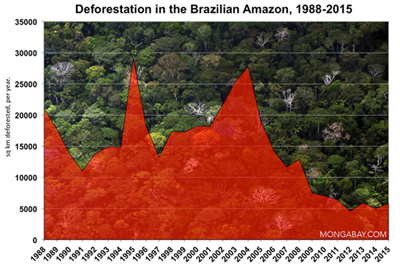
For decades it seemed a losing struggle, as the annual dry season led to the setting of fires that burned away ever more of the jungle’s southern rim. But now there is tentative hope that this decades-long cycle of destruction is drawing to a close. In the past three years Brazil’s government has finally moved to control the region and is clamping down on deforestation. Jungle is still being cleared, but at just half the rate of before. Last year was the Brazilian Amazon’s best since 1988. Even many environmentalists are cautiously hopeful that the rainforest now stands a chance.

The ranchers of Castanheira, 800km north of Cuiabá on the western edge of the BR-163’s corridor of destruction, all agree that times have changed. Today only a foolish or desperate man would burn down a patch of forest without a permit, and the authorities are no longer handing those out. “The government is watching too closely now. If you clear land then you get fined, and the fine is worth more than the land you clear,” says the town’s former mayor Genes Oliveira Rios.

Locals know they have been vilified both elsewhere in Brazil and abroad for their role in clearing the forest. Not that they are apologising – or think they have anything to apologise for. Gathering in the spartan office of the town’s cattle trader to do deals and swap news, they dismiss the green movement as a plot by rich countries to halt Brazil’s march to become the world’s food superpower – and demand to know what other country in the world still preserves as much of its native cover as Brazil.

“If I wanted to hide with Robin Hood in Sherwood Forest today I wouldn’t be able to. It is gone. Here half our lands are still forest while you in Europe have already destroyed most of yours. Yet the European Union is paying for environmental groups to come here and demand we reforest our farms. We should demand that Europe reforest its territory and leave us alone,” says rancher Plinio Queiroz Junqueira. Men like Queiroz resent being branded environmental terrorists, pointing out that they were brought to the region precisely so they would cut down the forest.

Brazilian governments long feared that the largely uninhabited Amazon was vulnerable to covetous outsiders, and in the 1970s the military dictatorship decided it was time to settle it. Under the banners “Integrate or Forfeit” and “A Land without Men for Men without Land” it handed out chunks of the forest for a pittance to anyone who wanted them. The only condition? To secure their claim settlers must clear half their property of jungle.

The scheme sparked a wave of migration from southern Brazil into the interior. Smallholders could sell up in states such as Rio Grande do Sul and Paraná and carve out far larger holdings in Mato Grosso and Pará, farther north. They struggled up the BR-163 and set to work with bulldozers and chainsaws, carving settlements out of the jungle.

“I heard the stories about foreign powers wanting Amazonia, so we felt proud to be securing it for Brazil. We were protecting something that is ours,” says Jorge Marcantonio, a quiet, courteous rancher who takes an afternoon off to show me around Castanheira’s back roads. He is one of the many who sold up his small farm in Paraná and moved to Castanheira. But then in the 1990s he started to hear that burning the forest was harmful. “At first I didn’t believe it; we were making the region fertile.” But gradually it dawned on the region’s settlers that, whatever their own thoughts, the wider world was increasingly frowning on their activities. Now that their government is, too, they feel betrayed – “turned from patriots into criminals”, according to Marcantonio.

And all without breaking the law, say landowners such as former mayor Oliveira. “We understand that half our land must be forest, and in Castanheira most landowners comply with this. But the law is confused, and our biggest preoccupation is that the government could come in and demand that instead of 50 percent we preserve 80 percent. The cost of that would bankrupt us all,” says the owner of almost 7,000 hectares (of which, he is keen to emphasise, half is jungle: “Where in Europe do they preserve as much as we do here?”).

Ranchers are afraid the government will bend to international pressure and order them to reforest chunks of their land. But the government clampdown across the region is probably more driven by domestic disquiet at deforestation and the realisation that forest burning is the single largest source of the country’s carbon emissions, which it has committed to slash as part of the search for a global climate-change agreement.

It is long overdue. In the years of the government’s absence a free-for-all took hold in the Amazon. With the pioneers who founded towns like Castanheira came loggers to whom they would sell the valuable timber on their land before burning the rest. But many unscrupulous loggers did not confine themselves to legal timber and took what they wanted, buying permits for their plunder from corrupt environmental-protection agents.

Many ranchers cleared far more of their land than the 50 per cent required by law. Others cleared areas they did not even have a title for. Then there was a gold rush that saw hundreds of thousands of the poorest Brazilians pour into the region; they used high-pressure hoses to blast away the topsoil in search of the precious metal, creating an environmental disaster viewable from space.

The gold craze has abated, and since the government moved to exert itself illegal logging can no longer be carried out in broad daylight.

On the bus from Castanheira to the city of Sinop, one of the most successful boom towns on the BR-163, we pass a truck hauling a double trailer loaded with massive tree trunks. It is 2am on a dirt road fringed by impenetrable forest, and the truck has its lights off. At the next rest stop we see similar loads parked up: illegal timber is now moved at night, to try to avoid detection. Often these loads have valid permits, but if they can make it to the mill unobserved then the permits can be reused.

Even though illegal logging continues, many law-breaking timber mills have been closed along the BR-163, with towns suffering harsh economic times as laid-off workers move away. Houses with for-sale signs or just boarded up and abandoned are a common site. In the past five years the amount of timber taken from the Brazilian Amazon has halved. Near the border of Mato Grosso and Pará, in the town of Guarantã do Norte, the mill belonging to Antônio Cozer is still open for business, though he, too, has had to lay off workers, as new restrictions have limited the amount of timber he can extract from the forest.

He is clearly suspicious of a foreigner asking questions about his operation, but, given a chance to defend his industry, he is quickly into his stride. “We are being made to carry the blame for what has happened to the forest, but we only take mature trees and leave the forest standing. It is ranchers who raze and burn it, not loggers. We know the forest needs preserving, and so our work is ecologically correct.” That his mill is still open means Cozer can make such a claim with confidence. The same could not be said for many of those that have shut down.

But the Brazilian government is intent on promoting what it says is sustainable Amazonian logging. It plans to license out preservation areas in the region to companies for their sustainable development. This will allow them to take out mature trees for timber, a controversial policy among environmentalists. But locals in Guarantã do Norte are sceptical about whether the scheme will benefit them. “All the companies bidding for these contracts are big outsiders. This is not designed to benefit us here, that’s for sure,” says Cozer.

Leaving Guarantã and heading north, the BR-163 crosses into the state of Pará and becomes a dirt track. Here the jungle feels closer, more omnipresent than in Mato Grosso, where it always seems to be just a presence on the horizon. From the top of the Serra do Cachimbo hills you see it stretch out in front like a dark-green ocean, and for hours the bus rolls through wilderness. It is not surprising to learn that it was here Brazil planned to test its nuclear bombs before abandoning the programme in the 1980s.

And yet the forest breaks again and we reach the cattle town of Novo Progresso, long ranked near the top of Brazil’s deforestation tables and once nicknamed the Queen of Timber. But it, too, is suffering from the region’s new order. Like those of Castanheira, Sinop and Guarantã do Norte, its founders came from the south, modern-day pioneers who saw themselves as planting Brazil’s flag in wilderness and who now wait to see what future their government decides for them.

They have been told that their days of clearing the forest are over, and so they are abandoning their low-intensity farming, which relied on limitless supplies of land, and, like their peers in Castanheira, looking to boost productivity on land cleared already – just 13 per cent of the municipality.

Local officials and ranchers hope a government plan to pave the Pará stretch of the BR-163 will make it easier to export their produce through the port of Santarém; they also hope to have their beef certified as environmentally sound, so it can be sold internationally.

They view it as a quid pro quo for the halt to clearances, but one that would require much re-education abroad, where Amazon beef is associated with environmental catastrophe.

But still the fear lingers that the outside world wants to force them from their homes, an idea reinforced when a leading official in Brazil’s environment ministry once told them that if they wanted to remain cattle ranchers they would have to move out of Amazonia.

“The government doesn’t understand us and Europeans do not know our reality. We are not leaving this land,” says local community leader Lincoln Brasil Queiroz. “We are here now 30 years. Our whole lives are here. We have buried our parents here, and some of us have buried our children. We are linked to this land emotionally. We now are tradition.”

‘We will cut off white man’s arms’

The pioneers along the BR-163 say the Amazon they first encountered was a wilderness, “a land without men for men without land” in the phrase of the military government that encouraged them to settle the region.

But it has been occupied for centuries by indigenous tribes, and today Brazilian Amazonia contains more than half of the country’s native peoples, an estimated 250,000 in 80 ethnic groups, including several still “uncontacted” tribes.

Twenty per cent of Brazil’s Amazon is reserved for them. But, with increased penetration by settlers, conflict has flared up, and Indians have reserved a special hostility for miners, the most daring, desperate and violent of the new arrivals.

In Novo Progresso tribal leaders from the Pucanu people have gathered from their far-flung villages to discuss their dealings with the “white man’s government”. Speaking through a translator, elder Ytum-Ti of the Cubekokre tribe says for now his community is untroubled in the forest.

“From here it is an hour’s flight to my village, so it is hard to reach, and we have no problems with ranchers invading our territory. But I am worried. The young are learning white-man ways, and we hear the paving of the road will bring more people from outside to the area. If one day a white enters our lands and will not leave, we will cut off his arms and send him back to where he came from.”

Rainforest Protection Vital for Human Health

25th June 2010
Source: Cool Earth

Yet another reason to protect rainforests, a new study shows that malaria is severely exacerbated by even low level deforestation. Analysing 2006 data from 54 Brazilian Amazon health districts, the study shows that malaria - the most prevalent vector-borne disease in the Amazon - increased by 48% in response to only a 4.3% rise in deforestation. The Anopheles darlingi mosquito, which carries malaria and enjoys biting people, thrives in pools of water partially exposed to sunlight.

Utilising high resolution satellite imagery and adjusting for factors such as access to health care, health district size and population growth, the University of Wisconsin-Madison report demonstrates a strong statistical link between deforestation and reported cases of human malaria.

"It appears that deforestation is one of the initial factors that can trigger a malaria epidemic," says report author Sarah Olson. The report also suggests that Anopheles darlingi displaces other non-malarial mosquitos when an area is deforested and the risk of contracting malaria is at its highest some 5 to 10 years after the deforestation occurs.

Earlier studies in neighbouring Peru spotted this link, reporting (American Journal of Tropical Medicine, January 2006) from a Stanford University study that the risk of being bitten by a malarial mosquito was 278 times higher in deforested areas compared to areas with 70% or more forest cover.

Preventing deforestation could significantly reduce the negative health impacts of malaria in tropical forest areas.

Peru: Founder of Explorama Lodges passes away in Loreto

24 June, 2010
Source: Living in Peru

Tourism sector in Peru is mourning, since US-born Peter Jensen, founder of Explorama Lodge in the Loreto rainforest, passed away a few days ago.

Jensen arrived in Peru almost 40 years ago and fell in love with Iquitos, the capital of the amazonian region of Loreto, where he and his former partner fixed up a boat to take tourists on trips down the Amazon River.

Since some of their tourists wanted to sleep overnight in the rainforest, Jensen built their first lodge in Yanamono, with only six bedrooms.

That small initiative grew up to become the current 72-room Explorama Lodge, which is still acknowledged as the one which set new, higher standards for tourism offers in the Peruvian jungle.

Ceiba Tops and Explorama Lodge are right along the Amazon River 25 and 50 miles respectively downstream from Iquitos: ExplorNapo Lodge is on the Napo River, 100 miles into the Sususari Nature Reserve.

Jensen was diagnosed with cancer last year. He went to the US to receive treatment, but once he learned that the illness was widespread, his only wish was to return home to spend his last days in his beloved rainforest.

His wish was to be cremated, and to have his ashes scattered from the highest platform on the canopy walkway.

Staff of Explorama has expressed that they will honor his wishes and get on with the job of continuing the work that Jensen started 46 years ago.

Thursday, June 24, 2010

U.S. farms and forests report draws ire in Brazil; cutting down the Amazon does not mean lower food prices

June 24, 2010
Source: mongabay.com

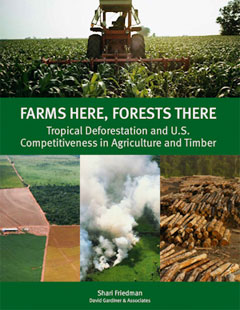
Not surprisingly, a US report released last week which argued that saving forests abroad will help US agricultural producers by reducing international competition has raised hackles in tropical forest counties. The report, commissioned by Avoided Deforestation Partners, a US group pushing for including tropical forest conservation in US climate policy, and the National Farmers Union, a lobbying firm, has threatened to erode support for stopping deforestation in places like Brazil. However, two rebuttals have been issued, one from international environmental organizations and the other from Brazilian NGOs, that counter findings in the US report and urge unity in stopping deforestation, not for the economic betterment of US producers, but for everyone.

"The study has been used in recent days by several Brazilian parliamentarians and rural leaders to defend the idea that forest protection in Brazil is something that runs counter to the national interest," explains a letter from 10 Brazilian NGOs. "With that, they want to justify the need for approving a bill that dramatically changes the Brazilian forest legislation. In this story, however, are American and Brazilian rural leaders are both mistaken."

While the report, entitled "Farms Here, Forests There: Tropical Deforestation and U.S. Competitiveness in Agriculture and Timber" argues that US agricultural producers could save $49 billion between 2012 and 2030 simply by complying with climate change legislation, it pushes revenue from stopping deforestation abroad as the real cache. According to the report, US farmers could gain $141-$221 from less competition abroad due to decreases in illegal forest clearing.

But according to the Brazilian NGOs the US report "ignores the Brazilian reality".

"It is wrong to assume that an end to deforestation around here would stop the expansion of production of agricultural commodities at competitive prices. According to data from University of São Paulo/ESALQ, we have at least 61 million hectares of high potential agricultural land currently occupied by low productivity of livestock and can be quickly converted into areas of agricultural expansion," the rebuttal states, adding that "we could double our production of food without having to bring down new forest and still recovering those areas where reforestation is done needed for their potential to provide ecosystem services."

The Brazilian NGOs, including Conservation International-Brazil and the Institute of Man and Environment in the Amazon (IMAZON), further argue that halting deforestation in the Amazon is for the benefit not of US agricultural producers, but of the Brazilian public.

"The supply of forest products, regulation of water and climate, maintenance of biodiversity, environmental services are all provided exclusively by forests and essential to support national agriculture," the rebuttal reads. In fact, Brazilian business leaders participating in the Sustainable Amazon Fórum (Fórum Amazônia Sustentável) recently voiced support for a national plan to reduce deforestation in order to preserve these ecological services, while leveraging best environmental practices to become competitive in the international marketplace. Their coalition was a key reason why Brazil called for strong action on reducing greenhouse gas emissions during last December’s climate talks in Copenhagen.

According to the letter, some Brazilian politicians are undermining greenhouse gas emission pledges by using the US report to support deforestation throughout the Amazon.

But it's not just Brazilians that found the report misleading at best. Large international and US environmental groups have also released a rebuttal to the report, where they "reject the hypothesis that conservation of tropical forest can provide a competitive advantage for U.S. agriculture against competition from developing countries in agricultural commodities".

According to the rebuttal, signed by Conservation International (CI), Environmental Defense Fund, The National Wildlife Federation, and the Nature Conservancy (TNC), "the report is based on the assumption, totally unfounded, that deforestation in tropical countries can be easily interrupted, and its conclusions are therefore also unrealistic."

The rebuttal further argues that for deforestation to be slowed or stopped cannot mean that one nation (the US) will win out against others, but must "provide economic incentives for developing countries, including the producers, to maintain the native forest". In fact, the strategy currently in place in the UN of paying tropical nations to keep their forests in tact known as REDD (Reduced Emissions from Deforestation and forest Degradation) proposes to do just this.

In addition the rebuttal agrees with Brazilian NGOs that production need not decrease in tropical forests nations if deforestation is stopped.

"Several scientific studies show that to reduce deforestation it is necessary to increase the competitiveness of agricultural production outside the forest frontier. Large tropical countries have large rural areas where underutilized whether to increase the productivity of agriculture without increasing deforestation."

The environmental organizations also chided the US report for failing to point out the nation's own responsibility (long the largest producer of greenhouse gas emissions in the world until superseded by China in 2006) in decreasing greenhouse gas emissions.

"This effort only makes sense when the United States—and developed countries as a whole—begin to substantially reduce emissions from all sectors of its economy. It is for this reason that these organizations support the establishment of a U.S. legislation on climate change with ambitious targets for reducing emissions," the environmental groups write. They note that paying tropical nations to sustain forest cover must be a part of any plan to reduce global greenhouse gas emissions.

The US report was largely aimed at convincing US Republicans and wary rural Democrats to throw their support behind an energy and climate bill, but it has probably provoked a bigger reaction outside US borders. NGOs in Brazil, the US, and worldwide hope that by pointing out the report's gaps abroad, they can re-focus the debate on the importance of saving forests, regardless of US farmers thousands of miles away.

While there has yet to be much reaction to the report in Asia, developers in Indonesia and Malaysia aren’t likely to be happy with its denigration of palm oil. The report calls for replacing palm oil use in the U.S. with domestic vegetable oil substitutes, which have a substantially lower yield, and therefore require more land, than the widely grown oil palm. Palm oil has drawn criticism from environmentalists however when rainforest and peatlands are cleared to establish plantations.

Amazon Defense Coalition: Indigenous Amazon Victims Call for Chevron to End Attempts to Sabotage Court System

June 23, 2010
Source: EON: Enhanced Online News

QUITO, Ecuador--(EON: Enhanced Online News)--Lawyers representing the victims of a massive ecological disaster caused by Chevron’s oil explorations in the Amazon rainforest have called on the company to end its reckless campaign to sabotage the Ecuadoran court system.

In a document submitted to the Ecuadoran court yesterday, the victims also proposed that the court give Chevron and the Amazonian communities a final opportunity to submit material that could assist the court in deciding the case.

“This case is being litigated in Ecuador because Chevron fought to have it moved here from the United States,” said Steven Donziger, a lawyer for the victims. “But instead of defending the case, Chevron has waged war against the legal system, alleging fraud while essentially boycotting the proceedings. Their reckless and improper tactics must stop.”

Donziger said it was ironic that Chevron has attacked the expert report concluding the company is responsible for more than $27 billion in damages because, from the outset, Chevron has refused to participate in the expert’s assessment. Donziger called on the company to submit material to aid the court in reaching its final decision, which is expected soon.

In their submission, the victims said that “even though Chevron failed to participate meaningfully in the damages assessment process in the past, [the victims propose] giving both parties the opportunity to submit this supplementary information will satisfactorily resolve the outstanding controversy … and thereby permit this judicial proceeding to have a normal development leading to the issuance of a final ruling.”

“Because of the catastrophe in the Gulf of Mexico, which has yet to reach the proportions of the vast amount of oil contaminating the Amazon, it’s apparent that cleanup costs can be very large. So it is possible that the $27 billion amount in the expert’s report may be insufficient to remediate the harm in Ecuador,” Donziger said. “Under these circumstances, it’s appropriate that both parties be given one last chance to submit information to the court.”

Chevron has admitted to discharging more than 18 billion gallons of toxic “produced water” into Amazon waterways and forests from 1964 to 1990, when it was the sole operator of a large oil concession. The contamination has decimated indigenous groups and caused an outbreak of cancer that has accounted for at least 1,400 deaths, according to a damages assessment submitted to the court.

The amount of pure crude and contaminated oil discharged in Ecuador far surpasses the size of the BP disaster, Donziger said.

The lawsuit was originally filed in 1993 in U.S. federal court, but it was moved to Ecuador in 2002 on a motion from Chevron. To induce dismissal of the case, Chevron at the time submitted 14 sworn affidavits praising the fairness of Ecuador’s courts.

Silence from media on IPCC apology

Wednesday, 23 June 2010
Source: Crikey

Watch this space for an embarrassing backdown by The Australian over a front-page story attacking the Intergovernmental Panel on Climate Change and the World Wildlife Fund for an “unsubstantiated” claim that 40% of the Amazon rainforest would be wiped out by global warming.

After months of deliberation the story, by Sunday Times journalist Jonathan Leake, was exposed as a sham in a weekend mea culpa published in The Australian’s sister paper and brokered by the UK Press Complaints Commission. The complaint, lodged by Royal Society scientist Dr Simon Lewis, slammed The Times for publishing “inaccurate, misleading or distorted information”.

On February 1 this year, one day after the Murdoch UK flagship splashed with the story, The Australian also decided to adorn its front page with the report, which has now been comprehensively debunked. It stated that the claims of Amazon destruction were based on the views of “green campaigners who had no scientific expertise”.

The “scandal”, dubbed “Amazongate”, was repeated and re-reported across the media, including outlets like ABC’s Radio National (The World Today), 2GB’s Alan Jones and The Sydney Morning Herald and even featured in a Crikey wrap.

In fact, the WWF had simply failed to properly footnote the passage, which was later confirmed to be based on a peer-reviewed study by the Amazon Environmental Research Institute. The Amazon claims in the initial WWF report were later picked up by the IPCC.


Part of the Sunday Times apology reads:

“In fact, the IPCC’s Amazon statement is supported by peer-reviewed scientific evidence. In the case of the WWF report, the figure had, in error, not been referenced, but was based on research by the respected Amazon Environmental Research Institute (IPAM) which did relate to the impact of climate change.”

DMCii launches Global Forest Monitoring service for REDD+

23/6/2010
Source: Technology Newsroom

As the 18th Commonwealth Forestry Conference is about to begin in Edinburgh, DMCii has launched a new service specifically tailored to help in the fight to conserve global forests. DMCii’s Global Forest Monitoring service uses satellite imagery to produce easily-understood maps of forest cover change. Uniquely, the service’s wide-area forest surveys can be updated annually, monthly - or more often still for areas judged most at risk – delivering the timely data necessary for operational management.

This week’s Commonwealth Forestry Conference has the theme of restoring the Commonwealth’s forests. Together the 54 states of the Commonwealth are home to 800 million hectares of forest, representing 20% of the world’s remaining trees. The Conference is discussing conserving current forested areas and restoring lost forests as a means of benefiting regional habitats and communities - as well as tackling global climate change.

The world’s forests form a significant stock of carbon, which is being released as CO2 as forests are impacted by human intervention. The tropical rainforests hold 80% of forest carbon and the destruction of these is responsible for around 20% of anthropogenic carbon emissions. Among the subjects under discussion during the Conference is an UN-led initiative called REDD+ (Reducing Emissions from Deforestation and Degradation), which aims to place a value on intact forests by paying governments to prevent their destruction.

However REDD+ requires reliable and timely information on the state of the forests. Satellite imagery is the only effective way of mapping such vast areas on a regular basis, but it can still take a long while for individual satellites to build up a complete regional picture, especially as tropical rainforests are often covered by clouds. In the past, forest maps could only be updated every five to 10 years, leaving them of limited practical use.

DMCii’s Global Forest Monitoring service is based around a constellation of six satellites known as the Disaster Monitoring Constellation which work together to provide rapid mapping services. Independently owned but collectively coordinated, the satellites have a joint daily repeat imaging capability for anywhere in the world, meaning that even cloudy areas can be imaged frequently enough to achieve full coverage.

The first generation Disaster Monitoring Constellation satellites offer optical imaging at 32m ground sample distance (GSD) with a very wide 650 km swath capable for example of covering the entire UK in a single pass. Last year two new satellites were launched, UK-DMC2 and Deimos-1, with 22m GSD, effectively doubling the number of pixels per hectare and greatly boosting the constellation’s overall imaging capacity. Each Disaster Monitoring Constellation satellite observes in three spectral bands compatible with Landsat - the world’s longest running Earth-observing satellite series – so long term forest changes and many types of degradation can be identified.

Information derived from the satellites is used to provide maps of forest/non-forest regions, clear cut areas, logging roads and forest degradation. The service is also intended as a means of training and building capacity in the use and processing of satellite data, deriving information maps from data and interpretation of forest maps.


“Our new Global Forest Monitoring service is derived from our work partnering with governments and institutions on a number of existing forest initiatives,” said Paul Stephens, DMCii Director Sales and Marketing. “This experience has taught us that high-frequency satellite surveys for operational forest monitoring are required for adequate forest management. With survey gaps of more than six months, forest degradation becomes difficult to detect, and authorities need up-to-date information to target ground surveys. The need for regular information is clearly there – countries without operational forest monitoring programmes will be refused entry to the REDD+ process.”

Since 2005 DMCii has been providing regular multi-temporal coverage of the Amazon basin, focusing on areas most at risk. Brazil’s National Institute for Space Research (INPE) uses the results to identify changes in forest cover, both to calculate the rate of deforestation and also to provide early warnings of illegal clearances which Brazil’s forest agency, the Brazilian Institute of Environment and Renewable Natural Resources (IBAMA), can then investigate on the ground.

DMCii is also supporting the European Commission’s Global Monitoring for Environment and Security (GMES) Africa initiative to map all of sub-Saharan Africa during 2010, including the dense, rarely-charted forests of the Congo Basin, the world’s second largest rainforest ecosystem after the Amazon basin.

Finally DMCii is leading a team including the University of Leicester and the World Resources Institute to combine satellite imagery with other data sources to produce reliable maps and statistics of forest cover changes across Indonesia. The archipelago nation’s forests represent a particularly challenging subject for mapping because they are distributed across many islands, and plagued by peat fires whose smoke can obscure wide areas of territory in the same manner as clouds.

About DMC International Imaging Ltd

DMC International Imaging Ltd (DMCii) is a UK based supplier of remote sensing data products and services for international Earth Observation (EO) markets. DMCii supplies programmed and archived optical satellite imagery provided by the multi-satellite Disaster Monitoring Constellation. DMCii’s data is now used in a wide variety of commercial and government applications including agriculture, forestry and environmental mapping.

In partnership with the British National Space Centre (BNSC) and the other Disaster Monitoring Constellation member nations (Algeria, China, Nigeria, Turkey and Spain), DMCii works with the International Charter: ‘Space and Major Disasters’ to provide free satellite imagery for humanitarian use in the event of major international disasters such as tsunami, hurricanes, fires and flooding.

DMCii was formed in October 2004 and is a subsidiary of Surrey Satellite Technology Ltd (SSTL), the world leader in small satellite technology. SSTL designed and built the Disaster Monitoring Constellation with the support of the BNSC and in conjunction with the Disaster Monitoring Constellation member nations Algeria, China, Nigeria, Turkey and Spain.

Wednesday, June 23, 2010

Brazil's Lula Slams "Gringo" Protests of Amazon Dam

06.22.10
Source: Treehugger

Brazil's proposed construction of what would be the third largest hydroelectric dam on the planet has drawn ire from environmental groups the world over. The planned dam at Belo Monte, protestors say, will flood and destroy much of the region's plant and animal life, as well as displace the indigenous peoples there. So contentious has been this project that even Avatar director James Cameron and rocker Sting have joined the protest, arguing that the entire world has a stake in the Amazon. Brazil's President Lula, however, thinks "gringos" need to stay out of it.

According to a report from Globo, Brazilian President Lula spoke out in support of the controversial dam at Belo Monte project, arguing against the meddling of foreigners in affairs related to the Amazon. In his speech, he presents Brazil as not merely a custodian of the world's largest rainforest, often referred to as the "lungs of the earth," but rather its undisputable owner.

While few projects have generated as much international protest in recent years as the proposed dam at Belo Monte, foreigners have hardly been the loudest voice in opposition to it. Protests have been relentless from several of the nation's indigenous groups, who recently went as far as attempting to storm the Capitol to air their grievances.

Perhaps the most alarming thing about Brazil's apparent new stance against foreigners having vested interested in the well-being of the Amazon is just how contradictory it is to positions in the past. Just last November, President Lula argued that the world was responsible for protecting the rainforests of Brazil and that wealthy nations should pay up.

Despite all the protests, both from inside and outside of Brazil, the dam at Belo Monte--some twenty years in the making--was given the green light to move forward. The repercussions of this apparently anti-foreign protest stance, however, may be greater than the 500 square kilometers to be flooded or the 40 thousand lives to be affected by the dam itself--particularly as plans are made to build 100 similar dams across the Amazon over the next 20 years.

Amazon rainforest, electro-active papers using piezoelectric cellulose

23 June 2010
Source: Zee News

The biggest challenge of the XXI Century is probably the sustainable use of biomass. In this sense, Amazon Rainforest appears as a great source of technological possibilities, especially in Materials Science, where this reality is very clear due, mainly, to the various Cellulose applications. The use of biomass for new materials development can be the "key ecological alternative" in the context of Renewable Energies. Amazon Rainforest puts Brazil in the center of sustainable development and new technologies discussions: the biomass exploitation has stimulated research on the use of vegetable fibers for polymer production, especially with respect to Cellulose.

Cellulose is the most abundant natural polymer on Earth, consisting of glucose-glucose linkages chains. It is almost an infinite source of green materials for sustainable and biocompatible products, and has been utilized in many fields due to its biocompatibility and chirality. Cellulose has long been harvested as commercial fibers from the seed hairs of cotton (over 94% cellulose), as bast fibers (60-80% cellulose) from flax, hemp, sisal, jute and ramie or as wood (40-55% cellulose), which is a common building material and a source for purified cellulose. Wood represents a composite material with cellulose as a major part combined in excellent form with lignin and hemicelluloses, creating a unique high-strength and durable material, and recently came again into focus as a Renewable Energy resource. Cellulose also represents the basic materials in papermaking. Its fibers have high strength and durability. They are readily wetted by water, exhibiting considerable swelling when saturated, and are hygroscopic: they absorb appreciable amounts of water when exposed to the atmosphere. Even in the wet state, natural cellulose fibers show almost no loss in strength. It is the combination of these qualities with strength and flexibility that makes cellulose of unique value for paper manufacturing.
Amazon rainforest
The Amazon Rainforest is the biggest forest in the world, the last big space covered with tropical plants and animals, and also the Earth's biggest cellulose source. Its territory is a tropical rainforest located in the north side of the South American continent and is shared by 9 countries: Brazil, Bolivia, Ecuador, Peru, Colombia, Venezuela, Suriname, French Guiana and Guiana. The largest part of Amazon Rainforest is located in Brazil (60%) and covers almost half of that country. The space covered with the forest is 5.5 million square kilometers (3.4 million square miles).

The "Rain" forest is a nickname that describes the humidity that you find in tropical and equatorial forests, but it doesn't rain all the time. Tropical rainforests are always located near the equator, and are very hot. All this heat associated with great portions of water make a lot of evaporation into the air. The forest also helps to retain water in their branches, roots and soil. All of this makes these forests very humid and there is a well defined rainy season that works towards the establishment of this nickname for tropical and equatorial forests. All this heat, rain and humidity make these forests a very rich ecosystem and a habitat for many organisms. A rainforest has trees, like any other forest, but they are very different from the temperate forest in colder places like in US, Europe and parts of Asia. There are 120 foot trees, thousands of different species of plants, and all sort of rainforest animals.
Polymeric composites with amazonic vegetal fibers
In recent years, a great worldwide interest has emerged for the development of products with less environmental impact. In this context, synthetic plastic materials have received special attention. In order to find a solution for this problem, various researches about polymeric composites have been conducted to ensure environmental preservation. Among of them, natural fibers are especially interesting. Natural fibers are those found in nature and can be used directly or after processing, being divided into animal fibers, vegetable fibers, and mineral fibers.

An emphasis must be given to vegetal fibers, due to the enormous variety of plants available on Amazon. Several natural vegetal fibers are usually referred to as lignocellulosic materials. In Brazil, especially in the Amazon Rainforest, there are plenty of vegetable fibers with different chemical, physical and mechanical properties.
Electro-active papers
Researchers at Inha University in South Korea have demonstrated that cellulose, the main ingredient in paper, can bend in response to electricity. The treated cellulose is lightweight, inexpensive, and has low power requirements, compared with similar electrically active materials. Cellulose has been discovered as a smart material that can be used as sensor and actuator devices. This smart material is called Electro-active Paper (EAPap). EAPap actuator is electrically activated due to a combination of ion migration and piezoelectric effects. Once piezoelectric effect is maximized in EAPap, then this material can be used for many applications such as sensors, microelectro-mechanical systems (MEMS), speakers, microphones, transducers, and especially in energy harvesters.

EAPap material is attractive for biomimetic actuators, flying magic papers and biodegradable MEMS sensors. However, there is a challenge for the development of thin-film electrodes and thin film transistors (TFT) on EAPap materials. Since conventional micro-patterning process and wet process are not applicable, because of EAPap's flexible nature, rough surfaces and hydrophilicity, a non-conventional micro-patterning technique, which is known as micro-transfer printing (MTP), is developed for EAPap material. The MTP technique is very similar to a rubber stamping. By making a rubber stamp that has a micro pattern and depositing a thin metal layer on it, the pattern of the metal layer can be transferred to a flexible paper substrate. This process consists of a master fabrication; PDMS stamp construction, and micro pattern transfer, as described in the Figure below:

Conclusions
The use of biomass can be the "key ecological alternative" for Renewable Energies. Amazon Rainforest puts Brazil in the center of sustainable development discussions, and also in the new materials development for energy harvesters. Cellulose is the most abundant natural polymer on Earth: it is almost an infinite source of green materials. Due to its piezoelectric properties, it can be used in the energy harvesting devices construction. This smart material is termed as electro-active paper (EAPap).Once piezoelectric effect is maximized in EAPap, then this material can be used for many applications such as sensors, microelectro-mechanical systems (MEMS), speakers, microphones, transducers, and in energy harvesting devices. The fundamental challenge is increasing the efficiency of these devices, transforming them in a competitive technology.