Source: mongabay.com
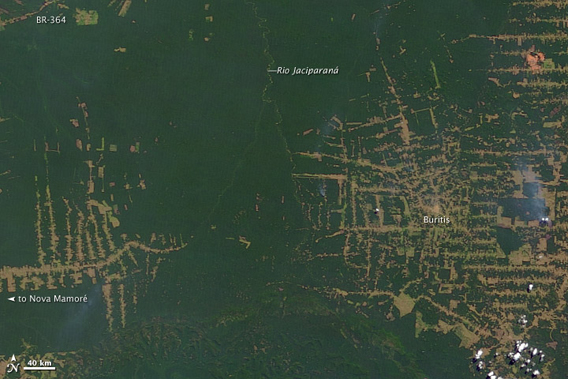
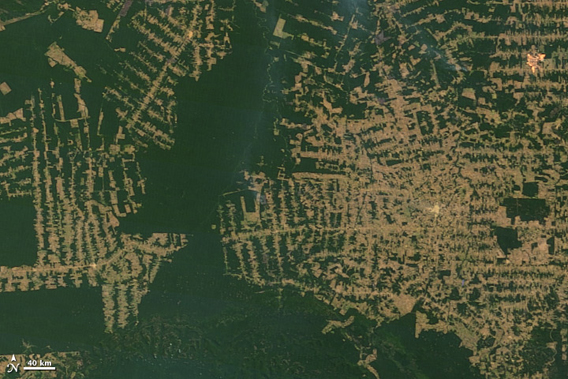 Top image shows deforestation in Brazil's western state of Rondônia in 2000.
 Bottom image shows deforestation as of 2010. Images courtesy of NASA .
The Brazilian state of Rondônia has undergone tremendous change over the past decade as revealed by the NASA's Moderate Resolution Imaging Spectroradiometer (MODIS) on the Terra satellite. A hotspot for recent deforestation, Rondônia was once home to over 50 million acres (208,000 square kilometers of forest). By 2003 nearly a third of the rainforest in the state was gone and deforestation continues although at a slower pace. The state has the dubious honor of undergoing the highest percentage of forest loss in the Brazilian Amazon.
Almost the entirety of the forest loss has occurred recently. Up to the mid-1970s only 1.73% of the forest was gone according to data from Brazil's National Statistics Office (IBGE).
Much of the forest loss in Rondônia has been attributed to small-scale farmers leasing land from the Brazilian government for crops and cattle, according to a recent study. Farmers have repeatedly broken the Brazilian Forestry Code by often clearing far more than 20% of the land. According to the Forestry Code, farmers in the Amazon must leave 80% of the land as natural forest.
'The Forestry Code is no longer realistic for Rondônia', says Luciana de Souza Soler, Dutch PhD student in the Land Dynamics Group at the University of Wageningen, who conducted the study. 'It is more realistic to maintain twenty percent of forest within the projects.'