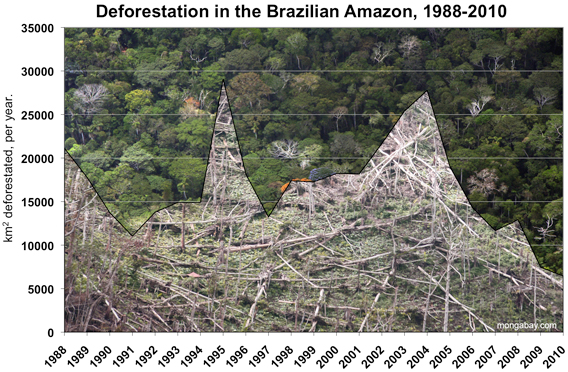
Source: mongabay.com
 Amazon forest clearing. Photo by Rhett Butler 2009
Deforestation has increased sharply in Mato Grosso over the past nine months according to information leaked to Folha.com.
The news, revealed during a lecture last Friday in Cuiaba, is significant because INPE, Brazil's space research agency that tracks deforestation has unusually not provided any updates from its rapid deforestation detection system (DETER) since February, a period during which Brazil's forest code has been hostly debated in Congress. The agricultural lobby is pushing for reductions in the amount of forest farmers and ranchers must set aside for conservation under the forest code. Environmentalists call the proposed changes a weakening of the code and fear it could be used to grant amnesty to deforesters and encourage more forest clearing in the future. Some green groups say there has already been an uptick in clearing in anticipation of amnesty.
According to Folha.com, deforestation in Mato Grosso climbed 43% between August 2010 and April 2011 compared with the same period last year. Mato Grosso, which accounts for the bulk of Amazon deforestation in most years, is a bellwether for deforestation trends in Brazil.
While the data raises concern, INPE officials have long cautioned about making judgements about deforestation trends based on DETER, which has coarser resolution than Brazil's annual tracking system called PRODES. DETER's accuracy can also obscured by cloud cover, which is especially common during the rainier times of the year from November through June.
Brazil is testing a new system to improve the accuracy of its deforestation tracking. Over the past couple of years some officials have expressed concern that deforesters are clearing smaller tracts of land to avoid detection by satellite. While the individual tracts are smaller, the number of cleared areas is greater.