Tuesday, May 31, 2011

Authorities launch stealth operation in Amazon after satellite images reveal deforestation

May 24, 2011
Source: mongabay.com

Cattle pasture and Amazon forest. Photo by: Rhett A. Butler.

Brazil’s environmental enforcement agency busted an illegal logging ring following analysis of satellite imagery, reports Globo.

Illegal loggers managed to clear more than 400 hectares of Amazon rainforest in southeast Pará before authorities spotted the crime using Brazil’s satellite-based deforestation detection system.. Brazil’s environmental enforcement agency, the Institute of the Environment and Natural Resources (IBAMA), responded by dispatching agents to surprise deforesters in the act of clearing rainforest.

In its action, IBAMA officers confiscated a tractor used to haul logs and maintain access roads in the rainforest, two trucks used to transport illegally sourced wood, and 200 liters of diesel. The agency fined the owner of the equipment R$2 million ($1.2 million) for environmental crimes. Based on the equipment found, IBAMA believes that the perpetrators planned to high-grade and then clear-cut at least a thousand hectares of primary forest for cattle pasture.

IBAMA caught three men cutting timber, but as is often the case, a more powerful player—a local landholder wanting to illegally expand his property—had hired the men. Luciano Silva, the coordinator of this IBAMA operation, explained that after the forest has been cleared by workers and converted to pasture, large landholders, known as fazendeiros, will often petition the local Environmental Rural Register (CAR) and attempt to legalize their claims to the newly deforested land. Legally, if the connection between the fazendeiro and the workers clearing land can be proven, he can be fined R$5,000 ($3,100) for each hectare of destroyed forest as an accomplice to environmental crime. Such proof is rarely forthcoming, thus those providing the impetus for deforestation are usually not held responsible.

Also, given IBAMA's extremely poor track record of collecting fines—less than one percent between 2005 and 2010 according to Brazil’s Globo news agency—no one may be held accountable for this instance of Amazon rainforest degradation.

Rainforest destruction up by 500 per cent…and now Brazil relaxes protection laws

31 May 2011
Source: Wildlife Extra

An alarming increase in deforestation in Brazil just as its government has agreed to relax laws protecting the country's forests.

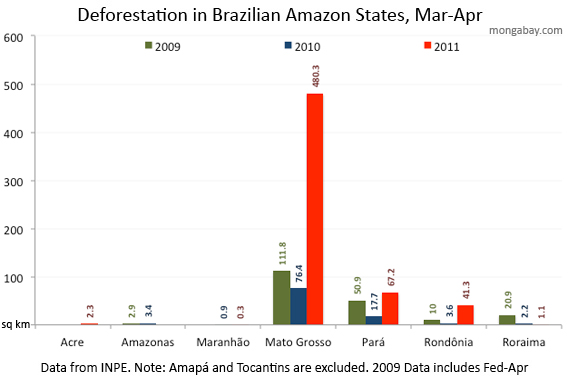
In the Mato Grosso area, 405.6 square kilometres of forest were destroyed in April 2011, more than in the whole of the previous year and a staggering 540 per cent increase in deforestation month on month increase, according to the National Institute for Space Studies (INPE). Worse still, under the new bill, there would be an amnesty for those who illegally cleared forest before July 2008.

Supporters of the new law say Brazil needs land to boost agricultural production, while environmentalists say destruction of the Amazon rainforest will increase. It is not gaining full support, with Brazilian President Dilma Rousseff indicated she would veto any bill that contained an amnesty.

Environment Minister Izabella Teixeira expressed concern over the latest figures, saying: ‘This is a very serious fact, atypical and contradictory. In a single month there has been more deforestation in Mato Grosso than occurred in the whole of last year.

Increase in deforestation anticipated change in law
The proposed amendment to the law by the ‘ruralistas' would make profound alterations to the law, easing restrictions on farmers and requirements about how much they should replant. The changes were proposed by Aldo Rebelo form Brazil's Communist Party (PCdoB), who argued that the existing rules prevented small farmers from making best use of their land to lift themselves out of poverty and supported by groups representing farmers' interests.

Brazil's Forest Law (also known as the Forest Code) was first enacted in 1934 and determines how much a landowner can deforest and how much must be kept as a ‘legal reserve'. Before this month's decision, Brazil's Forest Law requires landowners in the Amazon to allow 80 per cent of a property to remain forested but in the tropical savannah region this falls to just 20 per cent. The final terms of the amended bill are still being debated.

The increase in deforestation is happening in regions where Mato Grosso's agribusiness is expanding, and is thought to be directly linked to the expectation that the amendment to the Forest Law will be approved.

Cleared to make way for soya production
Rainforest is being replaced by lucrative soya fields according to WWF-Brazil's Conservation Director Carlos Alberto de Mattos Scaramuzza: ‘The numbers reflect confidence in the promise made by the "ruralista" faction (representing agribusiness interests) in parliament that there will be a general amnesty for all illegal deforestation brought about by agribusiness.'

Much of the deforestation has been in the soya-growing region of Sinop, driven by spiraling market prices. On average, the profitability of soya is somewhere between 300 and 500 reais (£115 and £190) a hectare. But at the moment that has escalated to 1,000 reais (£380) a hectare, making it extraordinarily lucrative.

‘That assurance of extremely high profits associated with the expectation of generalised impunity as a consequence of the Forest Law amendment, has contributed immensely to stimulating the criminal deforestation we are witnessing in Mato Grosso today,' Scaramuzza said.

Mato Grosso - which translates to ‘Thick Wood' - is home to some of the most biodiverse swathes of rainforest in the country.

Officials meet for rainforest summit

28 May 2011
Source: FRANCE 24

AFP - Top officials from the world's three major tropical rainforest regions will meet in the Democratic Republic of Congo capital on Sunday ahead of a summit to boost cooperation between the areas. The Congo Basin in Central Africa, South America's Amazon Basin and the Borneo-Mekong Basin in South-East Asia make up 80 per cent of the globe's rainforests and contain two-thirds of its biodiversity, experts say.

About 500 decision-makers will take part in the gathering in Brazzaville until June 3.

Organisers said the aim of the inaugural summit was to boost cooperation and sustainable management "... to ensure a greater contribution to the regulation and stabilisation of the planet's climate, to the fight against poverty and the economic development of the countries concerned."

Officials are expected to sign a joint statement on tropical forests, climate and sustainable development ahead of a meeting of the United Nations Convention on Climate Change in Durban, South Africa later this year and the Earth Summit 2012, to be held in Rio de Janeiro, Brazil.

Danube brings visitors to unspoiled Baja, but also threat of pollution

Tuesday 31 May 2011
Source: Guardian Weekly

A stag emerges from the Danube near Baja. Photograph: Attila Kisbenedek/AFP

Three massive carp are floundering in a pool in the middle of the yard as Balazs Barkuti prepares to cut them up, in keeping with the strict rules set for Danube fishers. This evening his family hotel is expecting 17 visitors from Budapest. They will be staying in Baja, overlooking the island of the same name in southern Hungary, 150km from the capital. Here halászlé, or fisherman's soup, is a must, to such an extent that a great stewpot hangs at the entrance to the picturesque town.

In summer, the Baja fish-soup festival attracts hordes of visitors to the town and to the nearby Gemenc national park. People here are said to eat more fish – 66kg a year on average – than anywhere else in Europe.

The nature reserve, with its many islands and quiet inlets, is still in more or less the same state as before the great river was regulated. The park is renowned for its century-old willows and great oaks, its black storks, trees and red deer.

"Ever since I was a child I have dreamt of living here," says Barkuti, 32. "The island hasn't changed in 100 years and I want it to stay the way it is for my two children to enjoy." Barkuti's dream came true five years ago when he left Budapest and a job stuck in front of a computer. "I enjoyed the excitement of the city but after a while I'd had enough," he says. "There aren't many places in the world you can find the peace and quiet we have here on the banks of the Danube."

However, in the course of its 2,850km journey across Europe, from the Black Forest in Germany to the Black Sea in Romania, the river suffers a great deal. Dams and reservoirs have damaged its reputation as a natural waterway, pollution and waste have soiled its water. Last year, toxic sludge was released into the Danube after a dam burst at an alumina plant. "In the morning I hear a series of tiny explosions," Barkuti says. "The reed beds along the river bank trap the plastic bottles as they float past. When the sun heats them up, they go pop!"

In September 2009, Hungary and Croatia agreed to protect the area between the Danube and the rivers Mura and Drava. This set in motion a process that culminated at the end of March when the first two countries were joined by Austria, Slovenia and Serbia. Together they established a trans-border Unesco biosphere reserve to protect Europe's Amazon, a scheme that the green campaigning group WWF had been advocating for about 10 years.

The new protected area extends over five countries, along 700km of river, and encompasses some 800,000 hectares of unique natural and historic landscape. It is Europe's largest riverine protected area.

The reserve is home to white-tailed sea eagles – with Europe's highest concentration of nesting pairs – and other endangered species such as little terns, black storks and sturgeon. It is also a vital stopover for more than 250,000 migrating birds.

"The rare species we see here know nothing about borders," says Tibor Parrag, head of nature conservation at the Danube-Drava national park. "It was essential to create a nature reserve to protect biodiversity. The agreement signed by the five countries will act as a catalyst for all of us."

This seems to suit local residents. Every year some 50,000 visitors flock to Baja (population 40,000). Cross-border protection of the Danube secures the region's future as a tourist destination. "Apart from tropical rainforest, there is no equivalent in terms of biodiversity to these flooded lowlands," says Arno Mohl, the Mura-Drava-Danube biosphere reserve project leader at WWF Austria. "The reserve will also play a key role in promoting eco-tourism. We hope the agreement will put an end to unsustainable schemes to regulate the rivers, as well as sand and gravel dredging, which still threatens this exceptional river ecosystem."

Under the European Union strategy for the Danube, decided on 13 April, which places considerable emphasis on environmental improvements, funding will be redirected to the nature reserve, which has yet to receive the Unesco seal of approval.

Along the riverfront in Baja the cafe terraces are packed. Barkuti is welcoming his guests, who have just arrived. He promises them a candle-lit dinner on the terrace overlooking his garden. "There was a time when we could drink the water from the Danube and use it for making soup," he says.

"I don't know if that'll be possible in the future, but if we stop throwing all our rubbish in the river, the fish will be pleased. And it make no sense dividing up the Danube with borders. The river will have a future if the countries join forces to protect it. The pact they've just signed is a good start."

Monday, May 30, 2011

Assassinations of environmentalists continue in Brazil's Amazon, deforestation rises

May 28, 2011
Source: mongabay.com

Murders tied to land disputes in rural Brazil

A community leader in the Brazilian Amazon was slain Friday just three days after two environmentalists were killed in a neighboring state, reports Reuters.

Adelino "Dinho" Ramos, the president of the Movimento Camponeses Corumbiara e da Associação dos Camponeses do Amazonas, a small farmers association, was gunned down front of his family Friday morning in Rondônia. Brazil's Special Secretariat for Human Rights, an office of the president, said it was unclear who killed Ramos, who had received death threats from loggers. Ramos survived a 1995 massacre in which 13 people were killed.

His killing came just three days after Joao Claudio Ribeiro da Silva and his wife, Maria do Espirito Santo, were killed in an ambush near their home in the state of Pará. Suspicion immediately fell on illegal loggers linked to the charcoal trade that supplies pig iron smelters in the region. Da Silva had been a prominent environmentalist and the recipient of international recognition as well as numbers death threats.

Brazil's President Dilma Rousseff has already ordered a federal investigation into the murder of the da Silvas, which has been widely condemned.

Environmentalists say their death could catalyze further opposition to proposed changes to Brazil's Forestry Code, which would weaken protections for the Amazon rainforest. They cite the 1988 murder of rubber-tapper Chico Mendes, which helped spark global awareness of destruction of the Amazon rainforest, and the 2005 killing of Dorothy Stang, an American nun who opposed illegal logging and land-grabbing, which triggered a crack down by federal agents and the establishment of new protected areas.

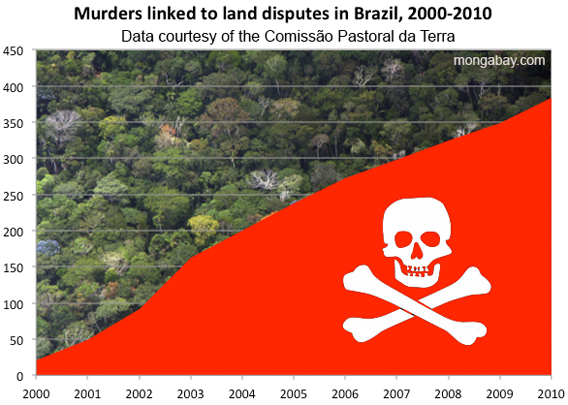
The Brazilian Amazon remains a violent region. According to the Pastoral Land Commission (Comissão Pastoral da Terra) some 393 people were killed in rural land disputes between 2000 and 2010, including 71 murders in Rondonia since 2001. Crimes are rarely solved.

Tensions are presently high in the Brazilian Amazon due to rising commodity prices, which boost land values and exacerbates conflict. The agricultural lobby is pushing for a relaxation of the Forest Code to allow more rainforest to be cleared for crops and pastureland. The present Forest Code requires farmers and ranchers to maintain 80 percent forest cover on their land, although the rule is widely ignored.

Anticipation of amnesty for illegal deforestation under the new Forest Code is thought to be a contributing factor in a sharp rise in deforestation over land year.

More rainforest murder

29 May 2011
Source: Cool Earth

Just days after rainforest conservationist Joao Claudio Ribeiro da Silva and his wife, Maria do Espirito Santo, were killed in Brazil, a third well known environmentalist and community leader has been murdered after receiving death threats from loggers.


Adelino "Dinho" Ramos, president of a small farmers association, was shot in front of his family last Friday in Rondônia, south west Brazilian Amazon. After surviving a massacre in 1995, when some 13 people were killed, Ramos had continued his work representing the rights of small-scale farmers which often brought him into conflict with loggers and ranchers.

Rising global prices for food and commodities have raised the value of land in Amazonia and heightened the tensions between competing interests for land and forested land which can be cleared. The situation has been exacerbated further by the new Forest Code which intends to relax control over deforestation. The new Code - supported by the powerful agricultural lobby - was approved this week by the house of Deputies but has yet to be ratified by Senate and the Brazilian President.

Brazil's rainforest faces new threats

May 29, 2011
Source: GlobalPost

Brazil’s environmental movement suffered two major setbacks last week when a gunman shot and killed a leading rainforest activist and the Congress passed a bill that environmentalists believe will trigger another wave of Amazon destruction.

Jose Claudio Ribeiro da Silva, an activist from the Amazon state of Para who was engaged in the fight against illegal logging, was gunned down on Tuesday morning alongside his wife Maria do Espírito Santo. The two assassins reportedly cut off the couple’s ears as proof they had successfully completed their mission.

Just six months earlier Silva had predicted his own death, telling a conference in Manaus he had received threats from loggers who were preying on the rainforest around his isolated home near the town of Nova Ipixuna.

"I could be here today talking to you and in one month you will get the news that I disappeared,” Silva said. “I will protect the forest at all costs — that is why I could get a bullet in my head at any moment … because I denounce the loggers and the charcoal makers and that is why they think I cannot exist.”

Less than 24 hours after Silva’s murder came another blow: Members of Brazil’s Lower House voted overwhelmingly to approve controversial changes to the country’s forest code, which environmentalists fear will give amnesty to those behind illegal deforestation. The country’s Senate will now debate the bill.

“Brazil woke up today to the news of the murder of an Amazon rainforest defender and went to bed with the news that the majority of our MPs back the murder of our forests,” lamented Greenpeace’s Amazon director, Paulo Adario.

These latest setbacks came just days after new government data released showed that deforestation levels were again on the rise in Brazil’s Amazon.

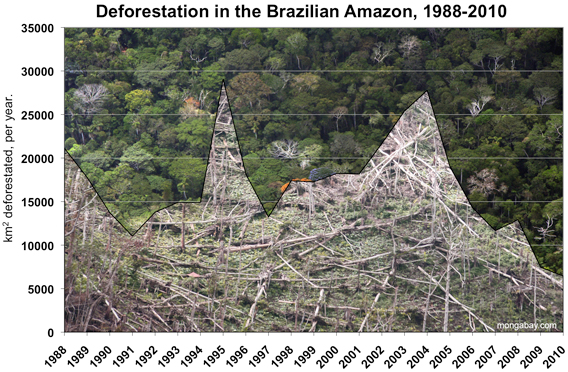
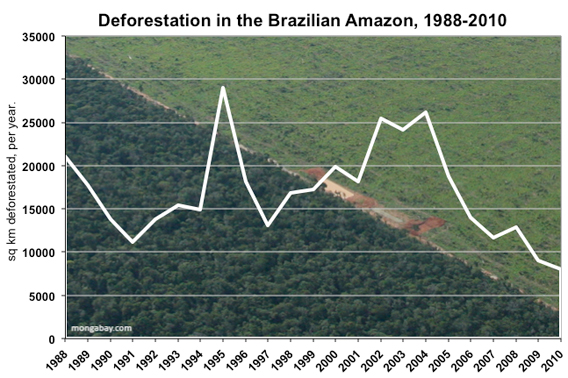
Illegal deforestation has been falling since 2004, from about 27,000 square kilometers to about 6,500 in 2010, partly as the result of a government crackdown on illegal loggers and ranchers.

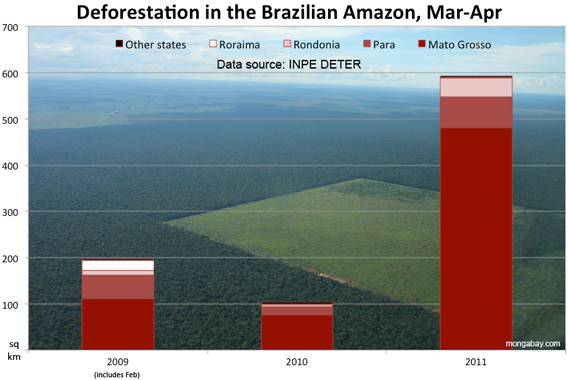
But new satellite images show that in March and April this year nearly 593 square kilometers of forest were razed — an increase of more than 470 percent compared to the same period in 2010.

In a letter to her staff this week, Brazil’s environment minster, Izabella Teixeira, admitted “we are going through a difficult moment in the fight for environmental protection.”

“The best response we can give to those who attack us is to continue working with the same dedication that is bringing us results,” she said.

Of greatest concern was the northern part of the soy-growing state of Mato Grosso, where the highest jump was recorded.

“It was a very quick act — in 20 to 30 days there was an enormous volume of deforestation,” said Curt Trennepohl, the president of Brazil’s environmental protection agency, Ibama.

Trennepohl said he was most concerned about the re-emergence of a particularly destructive form of deforestation: the use of so-called “correntoes.”

Correntoes are tractors or trucks attached to thick metal chains that tear through the base of trees, leveling vast tracts of forest in minutes. The practice has been illegal in Brazil for a decade.

“This year the technique was completely different. They used the rainy period and used heavy tractors attached to big chains … destroying the whole forest,” Trennepohl said. “It was a shock to see the return of such a highly predatory technique.”

After the release of the new figures, the government deployed hundreds of environmental agents to the Amazon city of Sinop, in Mato Grosso state, to sieze illegal timber and equipment. On Thursday, 200 members of the army arrived to reinforce those operations.

“We will throw our whole force at the area,” Trennepohl vowed.

During a visit to Sinop, Teixeira, the environment minister, told reporters she would push for “zero illegal deforestation” in the region.

“I am more than angry,” she said.

Meanwhile, in the neighboring state of Para, police operatives began the search for those behind the killing of Silva and his wife.

“Para state can no longer take this kind of thing,” the state’s governor, Simao Jatene, told the local newspaper O Diario do Para. “The government will react — we will not allow this to keep happening.”

As Jatene spoke, about 2,000 angry and tearful protestors marched through the streets of Maraba, toward the city’s cemetery to witness Silva’s burial.

“He was convinced he would be killed one day,” said Roberto Smeraldi, the head of the environmental group Friends of the Earth in Brazil.

As the coffins were lowered, a group of mourners held up a spray-painted banner.

“The forest cries,” it read.

Officials meet for rainforest summit

May 28, 2011
Source: AFP

A photo released by Brazil's environment ministry shows a deforested area in the rain forest in the southern Para state. (Jefferson Ruddy/AFP/Getty Images)

Top officials from the world's three major tropical rainforest regions will meet in the Democratic Republic of Congo capital on Sunday ahead of a summit to boost cooperation between the areas. The Congo Basin in Central Africa, South America's Amazon Basin and the Borneo-Mekong Basin in South-East Asia make up 80 per cent of the globe's rainforests and contain two-thirds of its biodiversity, experts say.

About 500 decision-makers will take part in the gathering in Brazzaville until June 3.

Organisers said the aim of the inaugural summit was to boost cooperation and sustainable management "... to ensure a greater contribution to the regulation and stabilisation of the planet's climate, to the fight against poverty and the economic development of the countries concerned."

Officials are expected to sign a joint statement on tropical forests, climate and sustainable development ahead of a meeting of the United Nations Convention on Climate Change in Durban, South Africa later this year and the Earth Summit 2012, to be held in Rio de Janeiro, Brazil.

Saturday, May 28, 2011

Shareholders to Chevron: company showing 'poor judgment' in Ecuador oil spill case

May 26, 2011
Source: mongabay.com

After being found guilty in February of environmental harm and ordered to pay $8.6 billion in an Ecuador court of law, Chevron this week faced another trial: this time by shareholders in its Annual General Meeting in California. While Chevron has appealed the Ecuador case and a US court has put an injunction barring the enforcement of the ruling in the US, notable Chevron investors say the company has gone astray in its seemingly endless legal battle with indigenous groups in the Ecuadorian Amazon.

"Chevron has suffered grave reputational damage […]," reads a letter to the company signed by a number of shareholders owning $156 billion in Chevron assets, including New York State Comptroller Thomas DiNapoli, as well as Oxfam America, the Unitarian Universalist Association, and the Catholic religious order, Missionary Oblates of Mary Immaculate.

"Chevron has admitted in sworn legal statements that the company is at risk of 'irreparable injury to [its] business reputation and business relationships' from potential enforcement of the Ecuadorian court judgment. In fact, much injury has already occurred and grows more severe every day that the company delays the adoption of a new approach to this case," the letter continues.

The Ecuador lawsuit contends that poor environmental safeguards from Texaco in the 1970s and 80s led to widespread oil contamination and high rates of diseases, including cancer, among the communities in the Ecuadorian Amazon. In 2001 Chevron purchased Texaco and inherited the legal fight.

"This marks ten years since the shareholders meeting on the eve of Chevron's acquisition of Texaco, when I stood before then Chevron CEO David O'Reilly and warned him that by buying Texaco he was purchasing a multibillion dollar liability," said Atossa Soltani, Executive Director of Amazon Watch, an indigenous rights organization, in a press release. "I hoped that Chevron would take a different path than Texaco's deceptive approach. Instead, Chevron's mismanagement of the crisis in Ecuador has ballooned into an $18 billion guilty verdict."

According to the plaintiffs in the case, Texaco buried toxic oil waste in crude shallow pits that eventually leached into the Ecuadorian Amazon's river system, contaminating drinking water and resulting in the deaths of over 1,000 people. For its part, Chevron has argued that Texaco, which drilled in conjunction with local company Petroecuador, spent $40 million cleaning up oil over three years and in return was released from any possibility of lawsuit. However, the plaintiffs have argued that agreement was illegal.

According to the shareholders' letter Chevron's behavior during the decades-long court case has made them "question whether our Company’s leadership can properly manage the array of environmental challenges and risks that it faces." They say the company has 'displayed poor judgment' in not offering a 'reasonable settlement' to the plaintiffs.

The lawsuit in Ecuador was not the only environmental thorn to surface during the meeting: environmental issues from oil spills in Angola, to contamination in the Niger Delta, to pollution from a refinery in Richmond, California were aired.

In addition, a vote to have Chevron revel the environmental impact of hydraulic fracturing, commonly known as 'fracking,' was defeated. Chevron opposed the measure.

"People are dying," Kenneth Davis, a Richmond resident, told Chevron executives. "That's the reason we all are here. You are a bunch of liars and thieves. You steal from all over the Earth, then you process what you have taken in Richmond."

Davis was prevented by security guards from hand delivering a document to Chevron CEO, John Watson, as reported by the Contra Costa Times.

Chevron is in the top 5 US companies and among the world's top six oil companies. In 2010 Chevron earned $19.02 billion.

"We had a tremendous year," Watson told the meeting.

Destruction of Brazil's Atlantic Forest Falls 55%: Study

May 28, 2011
Source: Jakarta Globe

Rio de Janeiro. The rate of deforestation of Brazil's Atlantic Forest along much of the country's eastern coast fell by some 55 percent between 2008 and 2010, according to a study released Friday.

"The reduction can be explained by more stringent laws and better control" by environmental protection authorities, said Marcia Hirota of the SOS Mata Atlantica foundation, which carried out the study with the mapping surveys of Brazil's National Institute for Space Research (INPE).

Between 2008 and 2010, the forest, which is the country's most devastated ecosystem — second only in the world to the forests of Madagascar — lost 32,000 hectares.

By comparison, deforestation was proceeding at a rate of 34,000 hectares a year in 2000, the group said.

When European colonists arrived in the 1500s, the forest extended along Brazil's entire coastline. But it has lost almost 93 percent of its original size, and its fragmented remains now cover some 28,600 square kilometers.

"At this rate, the forest will be gone by 2050," warned the foundation.

One state, Minas Gerais in the southeast, has been responsible for almost 40 percent of the deforestation, with trees felled to produce charcoal and to be used as fuel for iron and raw steel production.

The Environment Ministry, meanwhile, warned in a statement that reforms to the Forestry Code that were approved by the lower house of Congress earlier this week, "might accelerate" damage to an ecosystem that provides water to some 123 million people, out of the country's total population of 191 million.

But the new law, which still must pass the Senate, would allow huge areas of the country to be farmed if they were illegally logged before July 2008, and it would allow farming along environmentally sensitive riverbanks.

The bill was initially intended to rein in unfettered logging, but was reshaped by farm-based economic interests to ease restrictions that have been in place since 1965, and are credited with curbing deforestation.

Earlier this month the Brazil government announced the creation of an emergency task force to fight deforestation of the Amazon rainforest, after a sharp increase in deforestation in that region was recorded in March and April this year.

Traveling in the Amazon Region of Colombia

May 27, 2011
Source: Washington Times

There’s something about the jungle that both thrills and scares me. The first time I saw a rainforest in Honduras, I was awestruck at the sounds and smells. The ability to spot animals that I’ve only previously seen on TV or in zoos is an experience so amazing to me that I feel like a child every time I venture into the jungle.

But being enveloped by its wildness means getting closer to animals that, frankly, freak me out—like snakes.

Luckily for me, I haven’t yet had a bad experience with jungle-dwelling serpents.

Colombia’s Amacayacu National Natural Park is in the extreme southern corner of the country. Capital city Leticia gave me a beach town vibe, until I showed up on the malecon and got a look at the Amazon River. The chocolate-colored water stretched out in front of me—all the way to Peru.

“See? The bank over there is in Peru. And if you go just a short distance in the other direction, you’re in Brazil,” said my guide, Elvis Cueva from Colombian Amazon Expedition.

A local legend says that the Amazon River was created from the broad branch of a ceiba tree when it fell to the ground. The ceiba, a colossal tree with huge buttress roots and a spreading canopy, is one of the largest trees in the rain forest. As we traveled by boat along the river, I could tell which trees were ceibas. The wide, umbrella-like canopies stretched above all the other trees.

Just focusing on a small piece of this region is difficult to do in only a couple of days, especially since seeing wildlife doesn’t happen on a schedule. If you plan a trip here, make sure you spend the time to truly relax and disappear into the forest.

My first morning, after waking to a chorus of birds far different than those I hear at home, I paddled in a dugout canoe with Elvis among the flooded rain forest that surrounded my lodge, the Yewae Visitor Center. It was the rainy season, so the trails around the center were under nearly 10 feet of water. Our leaf-shaped paddles quietly dipped in the water as we moved silently through the trees.

The excursion allowed us to get close to the trees and animals—especially the broad buttress roots of the gigantic ceibas and a slender green vine snake that hung motionless from a small branch. Flocks of parrots chattered overhead as we moved past flotillas of water hyacinths and bushes that would have been over our heads in the dry season.

Later on, in a different kind of boat (one we didn’t have to paddle), we explored more of the Amazon River and its tributaries. While it’s possible to go deeper into the jungle and get away from the convenient towns of Leticia and Puerto Nariño, it’s also easy to feel lost with less effort by venturing up the Rio Amacayacu (which translates to “River of Hammocks”) and visiting the Ticuna community of San Martín.

Victor Angel Pereira, head of the village of 496 residents, sat with me in the malocca (a community house) and taught me the word for good morning in the Ticuna language: numai. Afterward, I viewed some of the community’s crafts—from arm bands made of chambira (fibers from a palm tree) to beautiful carved wood statues of dolphins.

As we left the community to get a glimpse of some of the living versions of those statues, village children played in the water—jumping off the dock to make kid-size splashes that irritated nearby mothers who were washing clothes.

A short distance from San Martín is Lago Tarapoto—home to Amazon river dolphins. I’d hoped that one of the highlights of my trip would be seeing a pink river dolphin, but instead, I was greeted by a small group of gray river dolphins. It was impossible to be disappointed, however, when the dolphins leaped and twisted in the air all around the boat. It was hard to know which way to turn to spy them, when—splash—there they’d be behind me.

The search for pink wasn’t lost. On the way back to the lodge that night, we stopped the boat in the middle of the river—within view of a stunning pink and red sunset. The only sounds were a breeze on the water and the calls from thousands of birds finding treetop homes for the night.

Want to take an Amazon expedition in Colombia? Contact Colombian Amazon Expedition in Leticia and let Elvis (elcuma@yahoo.com) be your guide.

3rd Environmentalist Killed in Amazon Rainforest

2011-05-28
Source: CRIENGLISH.com

A Brazilian environmentalist was killed Friday in the Amazon Rainforest region, three days after the murders of two other environmental activists in the area, authorities said.

Adelino Ramos, known as Dinho and a leader among local impoverished farmers, was killed Friday morning while selling vegetables produced in the farming settlement in Porto Velho in the state of Rondonia.

He was shot six times by an unidentified man on a motorbike.

Reports said Ramos was receiving threats for denouncing illegal logging in the Amazon region along the border between Rondonia and the states of Acre and Amazonas. He also fought for land reforms in the region.

On Tuesday, Jose Claudio Ribeiro da Silva and his wife Maria do Espirito Santo da Silva were killed in the town of Nova Ipixuna in the state of Para.

The couple was also being threatened for trying to protect the Amazon Rainforest.

Friday, May 27, 2011

Brazil protected areas suffer serious deficiencies, says study

May 25, 2011
Source: mongabay.com

Brazil's conservation units are poorly run and in need of better funding, finds a new study published by Brazil's Ministry of the Environment and the United Nations Environment Program (UNEP). The assessment, released last week, concludes Brazil’s protected areas system should be open to creative management solutions.

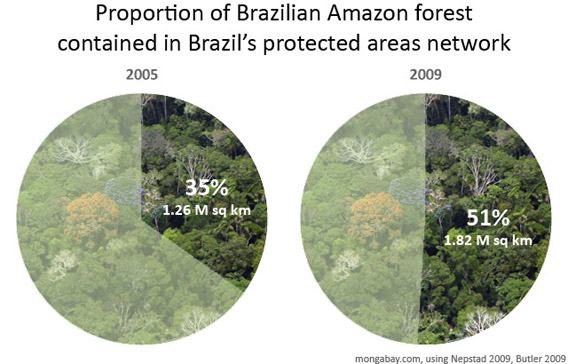
The study reveals that Brazil's protected areas, the majority of which are in the Amazon, operate with sparse workforces and under insufficient budgets. Brazil protects 1,278,190 km² of land, making it the fourth-largest system of preserved areas in the world, but many areas are protected in name only, lacking the resources to ensure their conservation status. According to the Chico Mendes Institute, federal conservation units protect 8.5 percent of Brazil’s land, but Brazil is behind poorer and smaller nations—not to mention the US—in its financial investments in conservation and commitment to the sound management of conservation areas.

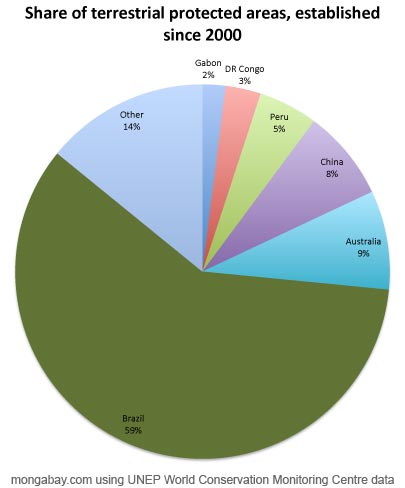
The annual budget for Brazil’s federal conservation units is R$300 million ($185 million)—an amount that has not increased nominally since 2001 , despite Brazil’s addition of 869,360 square kilometers in new protected areas during that time (accounting for more than 60 percent of protected areas established in the period). This funding provides an annual spending of R$4.43 ($2.73) per hectare, enough for one federal official for every 186 km² of protected forestland. In comparison, the United States has an employee for every 21 km² of federally protected conservation areas and spends thirty-five times as much per hectare annually. Even Costa Rica, which has a smaller overall budget than Brazil, has an official for each 26 km² of protected land and spends an average of $R 31.29 ($19.28) per hectare annually.

The study also found a large discrepancy between annual funding for conservation units and the financial resources they generate. Brazil’s conservation areas provide more than R$4 billion ($1.6 billion) to the government through the legal extraction of wood and rubber, as well as tourism in national parks and forests.


Braulio Dias, Secretary of Biodiversity and Forests in the Ministry of Environment, says that Brazil will have to use creativity to improve management and protection of the country’s natural areas. He believes it will be impossible for Brazil to achieve the level of protection existent in the U.S. with current budgeting allocations. Dias suggests that academic institutions and NGOs manage conservation units jointly, a proposal supported by many institutions in Brazil and already in place in two national parks, Serra da Capivara in Piaui and Jaú in Amazonas. Another proposal, from the Chico Mendes Institute for Conservation, is to outsource the management of tourism to ensure that federal employees in protected areas are focused solely on conservation.

Chevron Feels the Heat at Annual Shareholder Meeting

May 26, 2011
Source: Environment News Service

At Chevron's annual general meeting Wednesday, the oil giant's chief executive John Watson, the Board of Directors and shareholders were greeted by over 150 activists, who traveled to San Ramon from throughout the world. They came from Angola, Indonesia, Nigeria, Alaska and Ecuador to share their stories of the human and environmental degradation Chevron had unleashed in their communities.

"We are the human face of Chevron's operations, armed with the memories of our dead relatives, our neighbors, our sick children," declared Carmen Zambrano, a mother from Shushufindi, Ecuador.

On February 14, 2011, in a landmark legal victory for indigenous people and farmers, a court in Lago Agrio, Ecuador ruled in their favor. The judge found that Texaco, which merged with Chevron 10 years ago, destroyed vast tracts of the Amazon rainforest by dumping 18.5 billion gallons of oily waste over several decades, damaging residents' health and degrading the environment, contaminating both soil and water.

"Chevron has been found guilty and we cannot wait any longer," said Zambrano, a plaintiff in the lawsuit. "We are here as living proof that the health crisis in our home is urgent and it will not go away, and we are confronting Chevron in person to demand that the company take responsibility."

The judge ruled that Chevron is responsible for cleaning up the pollution linked to Texaco. He ordered Chevron to pay $18 billion in damages, an amount comparable in size to the $20 billion that BP has placed in escrow for victims of the 2010 Gulf of Mexico oil spill. Chevron has appealed the ruling.

Rainforest Action Network demonstrators send a message to Chevron, May 23, 2011 (Photo by Eric Slomanson/Rainforest Action Network)

Chevron has been feeling the heat this week from a variety of angles. On Monday morning, five environmental activists with the Rainforest Action Network unfurled a 30' x 50' banner off the Richmond Bridge. Dangling 100 feet above the San Francisco Bay and sandwiched between Chevron oil tankers and the Richmond refinery, they sent the oil company a message: "Chevron Guilty: Clean Up the Amazon."

Ginger Cassady, director of Rainforest Action Network's Change Chevron Campaign and coordinator of Monday's banner action told Alternet, "This action puts the spotlight on the fact that Chevron was found guilty by an Ecuadorian court. For over two decades, Chevron deliberately dumped toxins in Ecuador, creating a health and humanitarian crisis. We are calling on Chevron to clean up its toxic mess."

On Tuesday, the True Cost of Chevron, a network of 40 groups, released a report detailing the company's human rights and environmental violations.

Antonia Juhasz, co-editor of the report, "The True Cost of Chevron: An Alternative Annual Report," said it includes accounts by more than 40 authors, who "outline the egregious behavior of Chevron."

Juhasz expressed concern about Chevron's interest in expanding its offshore drilling, given the disasterous BP oil spill in the Gulf of Mexico last year. "Chevron, the nation's third largest corporation and California's largest, is well aware of the dangers of offshore drilling," she said.

Protesters outside Chevron's annual shareholder meeting, May 25, 2011 (Photo by Rainforest Action Network)

At Wednesday's annual general meeting, more than 150 supporters rallied in a colorful protest, bringing pressure on the meeting throughout the day. Arriving attendees were greeted by dancing moneybags, intended to dramatize the greed of oil executives.

Twenty-two indigenous and other affected community members traveled to San Ramon from around the globe, including Angola, Canada, Indonesia and Nigeria, and regions of the United States, such as Alaska and Texas.

Three indigenous and community leaders from the oil-contaminated Ecuadorian rainforests were there to demand that Chevron to fulfill the requirements of the Ecuadorian court ruling.

"My parents both died from cancer due to Chevron's contamination," mourned Servio Curipoma, a cacao farmer from the polluted town of San Carlos in Ecuador's northeast Amazon rainforest. Curipoma's parents built a house on a remediated oil pit in Ecuador. "I am fighting for justice so that no one else will have to suffer the pain they did, and the loss that I have."

Humberto Piaquaje, a leader of the Secoya tribe in the Ecuadorian Amazon said, "We have fought for nearly 20 years to bring Chevron to justice, and finally, we have a court judgment that affirms what we have been saying all this time. The court, which Chevron chose, found them guilty of poisoning our rainforest and our families. With this verdict, we have come north to demand that Chevron cease its lies and pay to clean up the contamination that is choking our communities."

Reverend Kenneth Davis of Richmond, California demands environmental justice outside of Chevron annual shareholders meeting, May 25, 2011 (Photo by Rainforest Action Network)

Residents of neighboring Richmond, California, where Chevron operates a refinery, also attended the meeting, expressing concerns about the refinery's effects on residents' health and the area's environment. They provided a tour yesterday of areas affected by refinery contamination.

When Richmond resident Reverend Kenneth Davis attempted to hand a copy of the "True Cost of Chevron" report to Chevron CEO Watson, he was stopped by private security guards.

Pressure also came from other areas, though, including shareholders in the company, such as the trustee for New York's largest pension fund. New York State Comptroller Thomas DiNapoli, who serves as trustee for the $140 billion New York State Common Retirement Fund. He argued that Chevron should resolve the situation to avoid protracted and costly litigation, stating, "It is time to face reality."

DiNapoli said, "The effects of this horrific, uncontrolled pollution of the Amazon rainforest are still being felt today. Investors don't derive any benefit from this never-ending courtroom drama."

"The entire case is looming like a hammer over shareholder's heads," said DiNapoli. "Chevron should start fresh with a new approach that embraces environmental responsibility ... More legal proceedings will only delay the inevitable."

Shareholders attending the meeting also expressed concern about the effect of hydraulic facturing, or fracking, on the environment. Fracking involves drilling of shale rock in order to extract natural gas. It has been criticized for its devastating effects on the environment, which include, the contamination of ground water though chemicals used in drilling, pollution of air quality, and the creation of toxic waste.

Brazil moves to ease rainforest protection laws

Friday May 27, 2011
Source: New Zealand Herald

Brazil has taken a big step towards passing laws that will loosen restrictions on the amount of Amazon rainforest that farmers can destroy, after its lower house of Parliament voted in favour of updating the country's 46-year-old forest code.

In a move conservationists describe as disastrous, the nation's congress backed a bill relaxing laws on the deforestation of hilltops and the amount of vegetation farmers must preserve.

The law also gives partial amnesties for fines levied against landowners who have illegally destroyed tracts of rainforest.

The legislation, which must be passed by the Brazilian Senate and approved by President Dilma Rousseff, aims to help owners of smaller farms and ranches compete with under-regulated rivals in countries such as the United States and Argentina.

Under Brazil's forest code passed in 1965, 80 per cent of all property in the Amazon basin is supposed to be left as untouched forest. In other parts of the country, that figure ranges from 20 to 35 per cent, depending on the ecosystem of the region.

Farmers breaching the regulations have been required to pay large fines and plant trees to bring their landholdings up to required standards.

But the system is scrappily enforced and only 10 per cent of landowners are believed to be in complete compliance with the rules.

Under the new code, forest illegally cleared between 1965 and 2008 will be exempted from regulation. Farmers will, for the first time, be allowed to count land along rivers and lakes as part of their legal preserves, and strict rules governing deforestation of hilltops and slopes will be relaxed.

"It's a disaster. It heightens the risk of deforestation, water depletion and erosion," said Paulo Gustavo Prado, head of environmental policy at Conservation International-Brazil.

He believes the bill will result in the loss of 10 per cent of Brazil's remaining rainforest.

Philip Fearnside, of the Government's National Institute for Amazon Research, said the "amnesty" for farmers who broke the law before 2008 would result in further illegal deforestation.

"The proposed amnesty upholds a long tradition in Brazil of legalising the illegal."

Two Environmentalists 'Executed' in the Brazilian Amazon

05/24/2011
Source: Treehugger


According to reports from Brazilian media, two environmentalists known for their outspoken opposition to deforestation in the Amazon have been killed in a manner investigators are describing as an execution. José Cláudio Ribeiro da Silva and Maria do Espírito Santo, his wife, were found shot to death near their settlement in the Brazilian state of Para, where they offered firsthand accounts of illegal logging. Just six months earlier Ribeiro da Silva foreshadowed his own demise: "I could be here today talking to you and in one month you will get the news that I disappeared. I will protect the forest at all costs."

Police delegate Marcos Augusto Cruz says that the two Amazon activists were heading back towards their camp early this morning when they were shot and killed by snipers. "The perpetrators were already lying in wait. They waited there for the victims to commit murder," Cruz said in an interview with G1 Globo.

"Absolutely, it was a crime to order, at the behest of someone. The characteristics are typical of an execution," added Cruz.


According to police, no suspects have yet been named in the murders, though in a speech made recently at a TEDx conference, José Cláudio Ribeiro da Silva spoke about the numerous threats he faces for rising in defense of the Amazon rainforest:

I could be here today talking to you and in one month you will get the news that I disappeared. I will protect the forest at all costs. That is why I could get a bullet in my head at any moment ... because I denounce the loggers and charcoal producers, and that is why they think I cannot exist.

[People] ask me, 'are you afraid?' Yes, I'm a human being, of course I am afraid. But my fear does not silence me. As long as I have the strength to walk I will denounce all of those who damage the forest.

Both forest activists had been active in reporting deforestation in the Amazon since 1997, though in recent years they'd come under threat from unknown assailants. According to a family member of the murdered environmentalists, Claudelice Silva dos Santos, the couple's house had been ransacked previously, and guns had been fired near their residence on prior occasions.

"Many people had an interest in his death," says Claudelice.

Brazilian President Dilma Rousseff has issued a full investigation into the murders.

Thursday, May 26, 2011

Amnesty for illegal rainforest loggers moves forward in Brazil

May 25, 2011
Source: mongabay.com


A controversial bill environmentalists say could increase deforestation in the Amazon rainforest moved a step forward to becoming law in Brazil after winning approval in Brazil's lower house of Congress.

The measure, which has been hotly debated for months, next goes to the Senate where it is expected to pass, before heading to President Dilma Rousseff, who has vowed to veto any bill that grants amnesty for illegal deforestation. The bill includes such a measure, although it could be subject to change before a final decision by the president.

The bill aims to reform Brazil's Forest Code, which requires landowners in the Amazon rainforest to maintain 80 percent of their holdings as forest. The Forest Code also mandates forest cover along waterways and on mountain slopes.

While the provisions make Brazil's environmental laws some of the strictest in the world, in practice they are haphazardly enforced and often used as a tool for extracting bribes from farmers and ranchers. As such it is estimated that less than 10 percent of landowners in the Amazon are compliant with the regulation.

The proposed changes include allowing states to set the minimum forest cover requirement, reducing the area of forest that needs be conserved in riparian zones and hilltops, and granting amnesty for illegal deforestation in protected areas and on holdings under 400 hectares (1000 acres). The amnesty would only apply to areas cleared prior to July 2008, but language in the bill suggests that the cut-off date could shift in the future.

The chief architect of the bill, Aldo Rebelo of Brazil's Community Party, says the changes would most benefit poor farmers, although small-holder schemes in the past have been widely abused by barons who subdivide holdings and use peasants as proxies to control and grab land. Landowners who have less than 400 hectares won't be expected to reforest deforested areas.

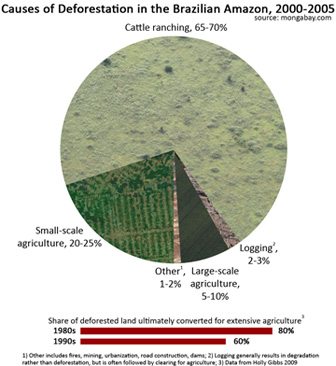
Environmentalists say the changes will increase deforestation in the Brazilian Amazon. They point to a recent surge in clearing in Mato Grosso, Pará, and Rondonia — states that lie on the deforestation frontier and account for much of the Brazil's cattle and soy production — as proof that agricultural interests are preparing to chop down more forest. Cattle pasture is the fate of more than 70 percent of deforested land in the Brazilian Amazon, while industrial soy farms have been a major contributor to forest loss until recently.

The bill's passage through the Chamber of Deputies came just hours after one of Brazil's best-known environmentalists was gunned down. José Cláudio Ribeiro da Silva and his wife Maria do Espírito Santo da Silva were killed in an ambush near their home in Pará. Suspicion immediately fell on illegal loggers linked to the charcoal trade that supplies pig iron smelters in the region. Da Silva had expressed fear of being assassinated on many occasions but refused police protection.

While environmentalists have mostly opposed the measure, some say that the impact could be mitigated through better enforcement of the Forest Code. Some Brazilian states have recently begun requiring landowners to register their holdings in order to qualify for loans and sell product in legitimate markets. However "regularization" process has been slower than expected, partially held up by looming changes to the Forest Code.

Roughly a fifth of the Brazilian Amazon has been cleared in the past four decades, but deforestation rates have slowed considerably since 2004 primarily due to conservation measures, government policy, economic factors, and private-sector initiatives. Last year deforestation reach the lowest point since annual record-keeping began in 1988, but the environmentalists worry that rising commodity prices, new infrastructure projects, and climate change — which has contributed to the two worst droughts on record in the past five years — could put much of the Amazon at risk.


Rainforest Knowledge Grows At Sunrise Drive

May 25, 2011
Source: Patch.com

At Sunrise Drive Elementary School in Sayville, an amazing tropical Amazon forest grew in a second-grade classroom from seeds of knowledge about the Rainforest.

To begin their study of the rainforest, Second-grade teacher Heather Franze-Heuer introduced her class to the different kinds of rainforests and their locations on earth.

Her students learned that most rain forests are tropical rain forests, so they focused their study on the largest tropical rainforest—the Amazon. “The students had a lot of fun strengthening their research and writing skills as they explored the rainforest ecosystem,” Franze-Heuer explained. “Each student researched a rainforest animal and wrote a book report and haiku poem about that animal.”

In addition to creating flip books that gave descriptions of the layers of the rainforest, the students prepared “travel brochures” about the climate, animals, plants and other natural resources as if they were taking an actual trip. They also created “passports” and suitcase portfolios to hold their rainforest information.

“Finally, we expressed our knowledge of the rainforest, Franze-Heuer concluded, “by creating fun art projects to transform our classroom into a tropical rainforest. The students were filled with pride as they brought their families on a trip to our classroom rainforest on Go-to-School Night.”

Brazilian anti-logging activist shot dead

25 May 2011
Source: Index On Censorship

José Cláudio Ribeiro da Silva, an outspoken opponent of illegal burning and logging in the Amazon rainforest, has been shot dead in an ambush near their his home in Nova Ipixuna, in Pará state, about 37 miles from Marabá, Brazil. His wife was also killed in the attack.

Da Silva had received frequent death threats from rainforest loggers. He confessed in a public conference in November that he feared for his life. A 2008 report compiled by Brazilian human rights activists also listed Da Silva as one of those “considered at risk” for assassination. But the couple had allegedly not asked for any police protection. Authorities are now investigating whether the killing was an assassination.

Wednesday, May 25, 2011

Killing in the name of deforestation: Amazon activist and wife assassinated

May 24, 2011
Source: mongabay.com

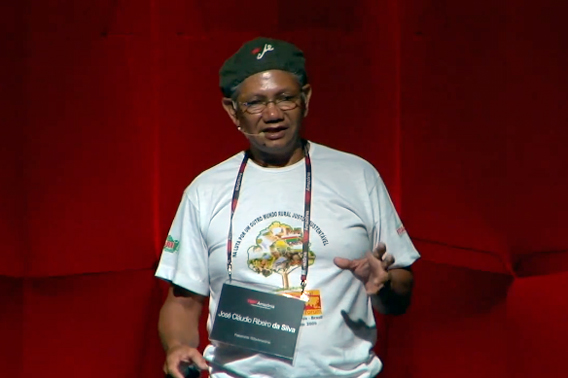
José Cláudio Ribeiro da Silva speaking at TEDx Amazon in 2010

José Cláudio Ribeiro da Silva and his wife, Maria do Espírito Santo da Silva, were gunned down last night in an ambush in the city of Nova Ipixuna in the Brazilian state of Pará. Da Silva was known as a community leader and an outspoken critic of deforestation in the region.

Police believe the da Silvas were killed by hired assassins because both victims had an ear cut off, which is a common token for hired gunmen to prove their victims had been slain, according to local police investigator, Marcos Augusto Cruz, who spoke to Al Jazeera. Suspicion immediately fell on illegal loggers linked to the charcoal trade that supplies pig iron smelters in the region.

José Cláudio Ribeiro da Silva, who also went by the nickname 'Ze Claudio', was a vocal critic of illegal logging in Pará, a state in Brazil that is rife with deforestation. He also worked as a community leader of an Amazon reserve that sold sustainably harvested forest products.

Da Silva had received countless death threats and had frequently warned that he could be killed at any time, however he was refused protection by officials.

"I will protect the forest at all costs. That is why I could get a bullet in my head at any moment … because I denounce the loggers and charcoal producers, and that is why they think I cannot exist," da Silva said in a TED Talks last November, adding "but my fear does not silence me. As long as I have the strength to walk I will denounce all of those who damage the forest."

Clara Santos, the niece of the da Silvas, told BBC that the couple had suffered death threats for 14 years. A report compiled by Brazil's Catholic Land Commission, a human rights group, in 2008 listed Da Silva as one of the environmental activists most likely to be assassinated.

The double assassination comes at a fateful time for the Amazon rainforest. Politicians in Brazil are considering changing to its Forest Law, which would allow ranchers and farmers to cut down a higher percentage of forest on their land. A vote may occur today.

Brazilian environmental journalist, Felipe Milanez, has said the assassination of da Silva has created 'another Chico Mendes'. Mendes was a rubber trapper turned Amazon activist whose 1988 assassination catalyzed efforts to save the Amazon.

Da Silva's killing comes six years after Dorothy Stang, an American nun who fought against deforestation, was slain by gunmen hired by a cattle rancher, also in the state of Pará. Her death was met by a sharp crack-down by the Brazilian against illegal forest clearing.

Nearly 20% of the Brazilian Amazon has been destroyed.

Brazil loosens restrictions on Amazon land use

Wednesday 25 May 2011
Source: guardian.co.uk

Brazil's president Dilma Rousseff has promised to veto a provision for an amnesty from harsh fines on farms that clear more trees than legally allowed. Photograph: Evaristo Sa/AFP/Getty Images

Brazil's lower house has passed legislation that would loosen restrictions on how small farmers use their land in the Amazon forest.

Environmentalists still fear the revision bill would bring increased deforestation, but operators of small-scale farms and ranches defend the measure as a way to let them produce to full capacity and boost Brazil's food output.

The bill, which had been debated off and on in the House of Deputies for nearly two years, easily passed on Tuesday night by 410 votes to 63, but is expected to face a tougher fight when it goes before the Senate.

The bill would let farmers and ranchers with smallholdings to work land closer to river banks and to use hilltops.

It also provides for an amnesty from harsh fines on farms and ranches of any size that cleared more tree cover than legally allowed, but only for cutting before July 2008. President Dilma Rousseff has promised to veto that provision.

While they would be freed from penalties already levied, larger landholders would still have to replant land that they cleared beyond legal limits or buy and preserve the same amount of forested land elsewhere to make up for what they cut. In the Amazon, 80% of property is supposed to remain untouched forest. Elsewhere in Brazil, it ranges from 35% to 20%, depending on the area.

Smaller farmers those with less than 400 hectares (990 acres) of land would not have to replant forest land cleared before July 2008, but would still have to plant trees in areas illegally felled since then.

Legislative leaders dropped a provision that environmentalists feared most which would have removed all limits on preserving trees for small farmers and ranchers.

Environmentalists warn that the changes that remain in the legislation would lead to flooding, silty rivers and erosion and say the full package will inflict severe damage on the rainforest, an area the size of the US west of the Mississippi river that absorbs the greenhouse gas carbon dioxide.

About 20% of the Brazilian rainforest has already been destroyed, and 75% of Brazil's greenhouse gas emissions are estimated to come from forest clearing as vegetation burns and felled trees rot.

Farmers, though, feel betrayed by the tough environmental rules imposed in the late 1990s. Two decades earlier, Brazil's military dictatorship, seeking to speed development, had encouraged them to enter the Amazon, offering them free land if they would clear up to 50% of their land of trees.

Environmentalists and farmers alike say Brazil's government is unable to adequately patrol the vast and inhospitable Amazon region to enforce the laws in any consistent manner.

Congressman Aldo Rebelo, who introduced the measure, said the law makes it impossible for farmers to make a living and almost no one complies with it.

"The environmental ministers are only looking at the environmental side, not mentioning any concern about that fact that almost 100% of farmers are illegal," he said. "Our concern is with the environment, but also with the situation of the farmers in our country."

Brazil's agricultural industry says the environmental laws keep the nation from meeting its economic potential. The country is the world's second larger producer of agricultural products while using just a third of its arable land, and farmers say they could easily surpass the US if they were not shackled by the laws.

Backers say the amnesty for tree-cutting fines is justified because many farmers cleared land well before the tighter limits were imposed, but environmentalists said it sets a bad precedent.

"The proposed amnesty upholds a long tradition in Brazil of legalising the illegal. People believe they can deforest illegally because sooner or later all will be forgiven," said Philip Fearnside of the government's National Institute for Amazon Research.

Satellite images from Brazil's National Institute for Space Research indicated deforestation in the Amazon last year dropped to its slowest pace in 22 years.

Between August 2009 and July 2010 6,450 sq km (2,490 sq miles) of forest were lost, a 14% drop from the year before, and the least since 1988 when the agency began recording the destruction. However, the government last week announced that 590 sq km of deforestation were recorded in March and April, nearly six times more than in the same period last year.

Chevron's critics gather before annual shareholder meeting

24 May 2011
Source: San Francisco Bay Guardian

One of a series of new ads created by the True Cost of Chevron campaign.

Chevron destroys everything, except profits. And by everything, we mean everything. The Amazon rainforest and its indigenous communities? Check. The Boreal Forest in northern Canada and its indigenous communities? Check. The Niger Delta? Check. Indonesia, Texas, and Iraq? Check, check and check. And even San Francisco’s own neighbor, Richmond, the home of one of Chevron’s largest oil refineries in the world? A big, whopping check.

Not that oil companies taking the lives, resources, and spaces of millions of people is something to take lightly. In fact, the opposition to Chevron is strong and growing, with many people across a network of international communities planning to stand up at Chevron’s shareholder meeting tomorrow (Wed/25) in San Ramon to give faces and names to the enormous destruction the company caused, which coincides with the release of the 3rd annual report on the company's many misdeeds, The True Cost of Chevron.

At a press conference this morning (Tues/24) at a Chevron station in San Francisco, activists and representatives from places adversely affected by Chevron’s drilling, dumping, land grabbing, and environmental degradation told stories about losing mothers to cancer, women having miscarriages due to contaminated water, clear-cutting forests used by their ancestors for hunting and farming, and losing one’s sense of home.

“I have personally witnessed this devastation,” Servio Curipoma of the Amazon Defense Coalition in Ecuador said of Chevron’s operations within his country. “And I will fight to the bitter end and never give up,” he said after showing a photo of his mother who died of cancer. After an 18-year lawsuit by the people in Educator against the oil corporation, Chevron was found guilty of massive environmental crimes. But Chevron has yet to take note of its transgressions, and aggressively pursues communities at risk of complete disintegration.

Elias Isaac with the Open Society Initiative for Southern Africa spoke about entire fishing communities in Angola going days without catches as they rely on the waters that Chevron polluted through its operations in the country. “The pollution is effecting livelihoods,” said Isaac. “And it’s getting worse.”

Communities for a Better Environment also understands the nefarious ways in which Chevron puts its stock above its virtue. For example, the company doesn’t pay taxes to extract oil from California. “They had the audacity to ask for an exemption from the law,” said Jessica Tovar of the Oakland based advocacy group. Recently Chevron’s Richmond refinery was denied the possibility to process dirtier, heavier crude oil only after opponents went to court to stop the proposal.

The bitter truth, said Antonia Juhasz of Global Exchange and the co-editor of alternative report, is that no matter where Chevron decides to set up shop, the stories are the same: corporate side-stepping of responsibilities to the community, polluted water, love ones lost, environmental disaster that cannot be undone.

Just like the exploitation Chevron is responsible for through its operations across the globe, its profits are also ever increasing. Last year the company made $20 billion in profits, bolstering its standing as the 11th largest corporation in the world, and the largest in California.

In order to make a dent in its exploitative practices, members of different organizations will be voicing their opposition in Chevron’s shareholders meeting tomorrow, some through legal proxies of current shareholders.

There is a resolution activists hope will be discussed that will appoint a third party with expertise who will oversee operations to further prevent environmental disasters, said Mitchell Anderson, the Corporate Campaigns Director of Amazon Watch, which is based in San Francisco.

“We came to tell them that we disagree with their ads. It’s not a rosy image. It’s a lie,” said Juhasz. “Chevron knows how to do better but chooses to do worse.”

Brazil eases rules on conserving Amazon rainforest

25 May 2011
Source: BBC News

Brazil is one of the world's biggest agricultural producers

Brazil's Chamber of Deputies has voted to ease restrictions on the amount of land farmers must preserve as forest.

The amended law also grants some amnesties for previous deforestation.

Supporters say Brazil needs land to boost agricultural production, while environmentalists say destruction of the Amazon rainforest will increase.

Wrangling over the final bill is likely, as Brazilian President Dilma Rousseff indicated she would veto any bill that contained an amnesty.

After months of at times acrimonious debate, the Chamber of Deputies voted to overhaul the Forest Code, as the legislation is known.
Continue reading the main story
“Start Quote

People believe they can deforest illegally because sooner or later all will be forgiven”

Philip Fearnside National Institute of Amazon Research

Under the current law, 80% of a farm in the Amazon must remain forested; in other areas, the requirement is lower, falling to 20%.

However, in practice, the legislation has not been widely enforced. It is estimated that 20% of the Amazon, the world's biggest rainforest, has been cleared, mainly as a result of logging and farming.

Under the new bill, small-scale landowners, who make up the majority of Brazil's farmers, will be exempt from having to replant deforested land.

Other changes include:

  • allowing the use of previously excluded areas such as hilltops and slopes for some kinds of cultivation
  • reducing the amount of land that must be left intact along the banks of rivers and streams from 30m (100ft) to 15m (50ft)
  • allowing farmers to count forest alongside rivers and lakes on their land as part of their conserved area, so reducing the total amount of land they need to protect or reforest

One of the most controversial elements grants farmers with land of up to 400 hectares (990 acres) an amnesty if they illegally cut down forest before July 2008.

The legislation must now go to the Senate and then to President Rousseff.
Continue reading the main story

Her spokesman said she would veto any legislation that included the amnesty.

The changes were proposed by Aldo Rebelo form Brazil's Communist Party (PCdoB), who argued that the existing rules prevented small farmers from making best use of their land to lift themselves out of poverty.

Farmers' groups backed the changes, saying Brazil, as one of the biggest exporters of soy, beef and sugar, needed to boost food production in times of high commodity prices.

"None of the world's large farm producers that compete with Brazil - the United States, Europe, China, Argentina and Australia - obliges its producers to preserve any forest," the National Agriculture Confederation (CNA) said.

Amazon dream

Philip Fearnside of the National Institute of Amazon Research said the amnesty would "legalise the illegal".

"People believe they can deforest illegally because sooner or later all will be forgiven," he told the Associated Press.

But CNA Vice President Assuero Veronez said the changes would not increase deforestation.

"We do not have to cut down one single tree. We can increase agricultural output in already deforested areas," he told AP.

In the 1960s and 1970s, Brazil's then military government encouraged people to settle in the Amazon as a way of boosting economic development.

Over the past decade, authorities stepped up monitoring and the enforcement of laws, leading to a significant drop in the rate of clearance.

However, last week satellite images showed that deforestation had increased nearly sixfold in March and April compared with the same period last year.

Much of the destruction has been in Mato Grosso state, the centre of soya farming in Brazil.

Tuesday, May 24, 2011

Brazil confirms big jump in Amazon deforestation

May 18, 2011
Source: mongabay.com

New Brazilian government data shows an area of Amazon rainforest 10 times the size of Manhattan was cleared in the past 2 months.


New data from the Brazilian government seems to confirm environmentalists' fears that farmers and ranchers are clearing rainforest in anticipation of a weakening of the country's rules governing forest protection.

Wednesday, Brazil's National Space Research Agency (INPE) announced a sharp rise in deforestation in March and April relative to the same period last year. INPE's rapid deforestation detection system (DETER) recorded 593 square kilometers of forest clearing during the past two months, an area of rainforest 10 times the size of Manhattan and a 473 percent increase over the 103.5 sq km chopped down from March-April 2010.

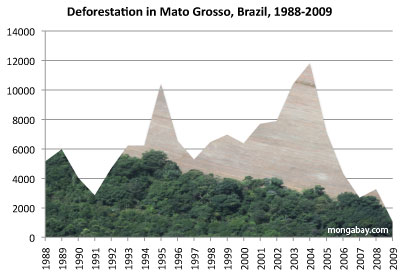
81 percent of the recent clearing occurred in Mato Grosso, the southernmost state in the Brazilian Amazon that has accounted for more than 35 percent of the region's deforestation since 1988.

"The recent deforestation in Amazonia detected by INPE has been concentrated in the agricultural areas of the Mato Grosso state," Gilberto Camara, Director of INPE, told mongabay.com. "Deforestation in these areas was high in the 1990s and early 2000s. From 2005 to 2010, due to increased law enforcement and private arrangements such as the Soy Moratorium, these areas had a substantial reduction on forest clearings."

INPE's announcement comes a day after Imazon, a research institute that also tracks deforestation, reported a big percent increase in clear-cutting. Imazon also found a surge in forest degradation, the logging, burning, and thinning of forest that often precedes deforestation.

The short-term deforestation tracking systems used by INPE and Imazon are used primarily for law enforcement. Both rely on relatively coarse satellite resolution, making them faster but less accurate than the systems used to determine annual deforestation, which is estimated every August. Month-to-month deforestation can be highly variable in Brazil, by clearing usually peaks in the dry season between July and October. High rates of clearing in April is unusual.

Until last month, the trend in the Brazilian Amazon had been very positive, with annual deforestation falling nearly 80 percent since 2004.

The increase in deforestation in April is thought to be linked to the current debate over Brazil's forest code, which requires land owners to maintain 80 percent of their holdings as forest in the Amazon region. Anticipating a weakening in the code that would grant amnesty for deforestation, farmers and ranchers have been clearing swathes of forest. Dry conditions, lingering from last year's worst-ever drought, have exacerbated the situation.

INPE's Camara told mongabay.com that IBAMA, Brazil's environment agency, just sent agents into the region to curb illegal clearing and report on what is causing the increase in deforestation.

Deforestation in the Brazilian Amazon is typically driven by industrial agriculture and land speculation. More than 70 percent of deforested land ends up as cattle pasture. High commodity prices typically create incentives for deforestation.

While only about 20 percent of the Brazilian Amazon has been lost to date, environmentalists fear that rising demand for food and fuel, combined with planned infrastructure projects and the effects of climate change, could doom much of the Amazon.

Brazil's Amazon rainforest farmers debate new land law

24 May 2011
Source: BBC News

Debate over development or conservation of the Amazon has raged for years

The ceiling fans spinning at full speed were not enough to cool the room, but the farmers gathered in Irituia's town hall are used to the oppressive heat of the Amazon.

Most of the plastic seats were empty but the 30 or so people at the meeting in Irituia were paying a lot of attention to discussions about environmentally sound agriculture in their biodiverse part of the world.

"We are not many yet but we notice that little by little more of us are realising that sustainable farming is the only way to go, and that we don't have to be enemies of the environmentalists," said Mauro Lucio Costa, chairman of the Farmer's Union of Paragominas.

Paragominas, like Irituia located in the state of Para, topped the deforestation ranking in Brazil in 2008 - and went on a government blacklist.

But since then sawmills have been closed and farms more strictly monitored.

"It's useless nowadays to cut the trees at night or away from the roads to get away with deforestation because now they are watching us with satellites. I tried that not to long ago and was heavily fined," one farmer told the meeting.
Opposing priorities

But farmers who have tried to adopt a more environmental approach get more raised eyebrows than approving nods here, especially as tensions have been heightened by the debate in Congress over changes to Brazil's Forest Code.
Continue reading the main story
“Start Quote

[Environmentalists] want to rip Brazilian farmers out of the ground as if we were some kind poisonous weed”

Katia Abreu National Agricultural Confederation

This environmental law stipulates that landowners in the Amazon must keep 80% of their terrain forested; that drops to 20% for other parts of Brazil.

Proposals to change the legislation pit those who see development and economic growth as the highest priority (including many farmers, though not all) against those who see conservation as the key issue. That group includes environmentalists and a large part of the scientific community.

"These NGOs are an international mafia that hold businesses as hostages by threatening to soil the names of those who oppose [them]. These groups thrive when there's conflict," says Katia Abreu, head of Brazil's powerful National Agriculture Confederation (CNA).

"They want to rip Brazilian farmers out of the ground as if we were some kind poisonous weed."
Pressure

The reform of Brazil's Forest Code has been debated for more than 15 years.

Just a few weeks ago it seemed that a version of the bill that eases restrictions on the use of forest land would be approved by the Chamber of Deputies.

But environmentalists managed to garner more political and public support to bring the vote to a halt.

"Even though the Forest Code has been under intense discussion for many years it was only recently, after it was approved in congressional committees, that the media took an interest in it," says Paulo Adario, co-ordinator for Greenpeace's Amazon programme.

"I think the pressure from national and international public opinion was essential to stop the approval of the bill the way the farmers wanted it and to get President [Dilma] Rousseff's government to support some of our concerns," said Mr Adario.

Among the proposed changes that worried environmentalists were plans to:

  • exempt small landowners from requirement to preserve 80% forest
  • give an amnesty to landowners who cleared forest before 2008
  • reduce the strip of land that must be left intact along the banks of rivers and streams from 30m (100ft) to 15m (50ft)

The proposals have been the focus of intense wrangling. Deputies were again due to debate and vote on the issue on 24 May.

Environmentalists argue that the proposed changes and loopholes in the legislation pose a big threat to the Amazon rainforest.

"The farmers are trying to leave doors open to allow for the permanence of plantations in highly sensitive areas like slopes and hilltops," says Paulo Barreto, a researcher at of the Amazon Institute for Mankind and the Environment (Imazon).

Many environmentalists believe that a recent reported increase in Amazon deforestation was caused by farmers trying to clear land before the new Forest Code code is approved.

This would mean that their lands could be recognised as established farmland if and when the new bill comes into effect.

Productivity

But Mrs Abreu argues that the environmentalists' concerns have more to do with ideology than with science.

"Just look at the world's history and you'll see that everywhere agriculture developed along the rivers because our activity depends on water, it's quite obvious," she said.

Mrs Abreu was critical of the Brazilian Society for the Progress of Science (SBPC), which has called for more for more research before the forest code is changed.

That view, Mrs Abreu said, was "highly politicised".

Environmentalists say that they understand the need for more food production.

But they argue this can be done by increasing the productivity of existing farmland, not clearing more of the Amazon.

Cattle farms in the Amazon have an average productivity of less than one head per hectare (2.5 acres).

"I have invested in better varieties of pasture and in fertilisers and I have an average of 2.5 cows per hectare in my farm. I also plant corn," says farmer Percio Barros de Lima.

"When I bought this farm in 1974 it still had about half of its area covered with original forest, which was what the law required at the time. Since then we have managed to develop by increasing productivity and without clearing any new areas," says Mr Lima.

"I hope the new forest code will make all rules for our activity clearer so we'll be able to work without so many uncertainties about the future."

Environmentalists rappel off Richmond Bridge to protest Chevron

05.23.11
Source: San Francisco Bay Guardian

This morning, May 23, activists from Amazon Watch and the Rainforest Action Network rappelled off the Richmond Bridge and unfurled a 50 foot banner which read: “Chevron Guilty: Clean Up Amazon.”

Anchored to the bridge deck, three brave souls dangled airborne above the bay alongside the banner, within view of an oil tanker. The banner drop was carried out to draw attention to Chevron’s environmental contamination in the Amazon Rainforest in Ecuador.

In an historic court victory in Ecuador on Feb. 14, Chevron was found guilty of causing $18 billion worth of environmental damage to a Rhode Island-sized swath of the Amazon. The widespread soil and water contamination, caused by decades of toxic dumping by Texaco and Chevron, has been linked to high rates of cancer and birth defects. Amazon Watch has been campaigning to get Chevron to clean up the oil pollution for 18 years.

“Chevron has said they are going to appeal the decision,” noted Paul Paz y Miño, managing director of Amazon Watch. “They’ve said they’ll fight it till hell freezes over.” So activists are keeping the pressure on.

Chevron will hold its annual shareholder meeting on May 25 in San Ramon, and a coalition of environmental organizations are using the occasion to draw attention to environmental problems the company has caused worldwide.

Three community leaders from the impacted Ecuadorian region traveled to California to share their stories and join in protests outside the shareholders meeting.

Their personal stories are moving. Humberto Piaguaje is a leader of the indigenous Secoya people of Ecuador’s northern Amazon rainforest, whose numbers in that region have dwindled from thousands to just several hundred since Texaco arrived in the area nearly 50 years ago.

Carmen Zambrano moved to the Amazonian region affected by Chevron in 1984, and according to her bio, tells stories “of how the company told people that the crude was good for their health, and that the contaminated water was safe to bathe and wash in, to drink from. … Her own children are terminally ill and developmentally disabled. Her sister-in-law suffers from cancer; her brother-in-law has serious heart problems. Her neighbors have died and almost everyone she knows has skin ailments.”

Serbio Curipoma, a cacao farmer from the Orellana province of Ecuador, lost his parents and sister to cancer. According to his bio, “He realized six years ago that the house his family has lived in for 20 years had been built directly atop an unremediated covered oil pit; digging just a few meters into the earth reveals thick crude.”

The trio from Ecuador will be joined by leaders from Chevron-affected communities in Nigeria, Indonesia, Canada, Angola, and Alaska at a teach-in at Berkeley’s David Brower Center May 23 from 7 to 9 p.m. on “The True Cost of Chevron.”

Paz y Miño noted that Amazon Watch is hoping to amass 30,000 signatures for the 30,000 plaintiffs in the Chevron case in a petition the group plans to deliver to company shareholders and executives during the meeting. They are also hoping to raise funds to cover the cost of the delegation.

Micronesia v Czech Republic: other David V Goliath battles

Tuesday 24 May 2011
Source: Telegraph.co.uk

Micronesia has mounted a legal challenge against the Czech Republic's plan to expand a coal-fired power station. Elsewhere in the world, environmental battles are raging between big companies and lone citizens willing to take a stand.

The Xingu River - the proposed location of the Belo Monte hydroelectric dam Photo: Rex Features

Tribesmen in the Amazon are fighting the construction of the giant Belo Monte dam that they claim will wipe out their community, destroy the land and trigger an influx of disease.

Brazil's Xingu live deep in the Amazon rainforest and rely on the river for fish to eat but their home is facing devastation thanks to the massive $11bn hydroelectric project. On their side is James Cameron, the director of Avatar and Titanic, who has taken the fight on and hopes to be able to preserve some of the Xingu's homeland.

Also in South America, green groups are battling to save the pristine Aysen region of Patagonia in Chile, which has been earmarked as the location for five massive new dam projects. Thousands of people have rallied in Santiago against the plan to construct the $3.2bn dam system, which will increase electricity supply by 15 per cent when finished in 2020. But environmental campaigners argue that it will have devastating environmental effects on a largely untouched region that is home to many rare animal and plant species. Conservative President Sebastian Pinera is solidly behind the project.

In Canada, indigenous groups are trying to stop the construction of a new oil sands pipeline that will cut across their land, threatening wildlife and posing the risk of a devastating oil spill. About 40 people marched through Calgary this week against two pipelines that will eventually stretch 727 miles. The $5.5bn project would carry about 525,000 barrels of oil sands crude per day to the coast where it would be loaded onto tankers headed to the US and Asia.

After 30 years of fighting between logging companies, locals and green groups, it was declared earlier this year that Tasmania's pristine forests had finally been saved under a deal that will eventually see and end to logging. But problems remain. The talks agreed on a historic blueprint to end conflict over the island's wild forests, but are yet to fully implement a logging moratorium, months after it was due. A key environmental group has walked out of the talks and the Australian government has warned it can only help if all groups work together.

Last year a British company's plans to mine remote parts of eastern India were rejected after a local tribe complained. In a victory for environmentalists, the government has rejected the plans of British mining company, Vedanta, to extract bauxite in the remote Niyamgiri Hills in eastern India where the Dongria Kondh live. The desperately poor Dongria Kondh consider the hill that had been chosen for the mine as sacred. The government's refusal to let Vedanta mine bauxite in a forest inhabited by poor tribes is seen as an unprecedented action in India. In the past, big corporations have usually had their way.