Source: mongabay.com
While livestock may emit a smaller share of global greenhouse gases than thought, it's overall environmental impact remains significant.
Meat is booming. In the past thirty years, livestock production has increased threefold. In many parts of the world where incomes are expanding, meat, once a delicacy, is now eaten regularly and voraciously. But what are the environmental impacts of this 'livestock revolution'?
Two recent studies look at the global impact of the livestock industry, one alleges that its environmental impacts in relation to greenhouse gas emissions has been overestimated, while the other takes a holistic view of the industry's environmental impact.
Questioning livestock's share of emissions
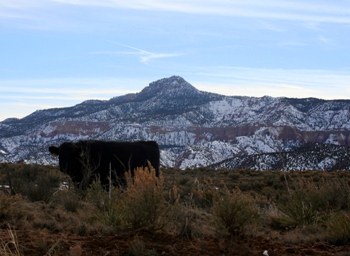 Eating meat and dairy isn't as bad for the climate as recently reported, according to research by air quality expert Dr. Frank Mitloehner from the University of California-Davis. A number of organizations and campaigns have linked meat-eating to higher carbon emissions; however Mitloehner says this is based on faulty data, at least in terms of comparing the importance of cutting down meat consumption to making the transition from fossil fuels to green energy.
"We certainly can reduce our greenhouse-gas production, but not by consuming less meat and milk," said Mitloehner is a press release. "Producing less meat and milk will only mean more hunger in poor countries."
Mitloehner says that an executive summary from a 2006 UN reports, entitled "Livestock's Long Shadow" is partly responsible for the current sense that livestock are a major player in greenhouse gas emissions. According to the report global livestock is responsible for 18 percent of the world's greenhouse gases—more than transportation.
However, Mitloehner says that the study measured the full lifecycle greenhouse gas emissions of livestock, including emissions from growing livestock feed, animals' digestive emissions, and processing meat and milk into food products, whereas, the report only looked at the direct emissions created from transportation, i.e. the burning of fossils fuels.
"This lopsided analysis is a classical apples-and-oranges analogy that truly confused the issue," Mitloehner said.
 He says that instead of focusing on cutting down on meat and dairy, the industrialized world must focus on the way it produces and consumes energy. For example, according to the EPA, in the US livestock emissions are approximately 3 percent of its total greenhouse gas emissions, while transportation is 26 percent, although this percentage gives less weight to carbon emitted due to land use changes than the UN figures.
He advises that "the developed world should focus on increasing efficient meat production in developing countries where growing populations need more nutritious food. In developing countries, we should adopt more efficient, Western-style farming practices to make more food with less greenhouse gas production."
For many people in poor countries, meat when available and affordable is an important source of protein.
Impact still huge
So, livestock may make-up a smaller share of the world's greenhouse gas emissions (an exact percentage was not given), but, on the other hand, livestock production does put a considerable strain on the environment, through pollution, water-consumption, deforestation, and land-use.
A second study conducted by an international team of scientists and policy experts recently looked at the booming livestock industry in a two volume report entitled 'Livestock in a Changing Landscape'.
"The livestock industry is massive and growing," said Harold A. Mooney, co-editor of the report and senior fellow at the Woods Institute for the Environment.
 According to the report, livestock impact on land-use is massive. Currently, a quarter of the world's land is used for 1.7 billion livestock animals. This ongoing shifting from wild lands to pasture has impacted biodiversity and ecosystems worldwide. For example, cattle ranching in Brazil has led both directly and indirectly to deforestation in the Amazon rainforest.
But this isn't even the total land required for the world's livestock. Livestock have to eat, and land—a lot of land—is required to feed everything from cattle to pigs to poultry. The report estimates that one third of the globe's arable land is employed to grow food for livestock. In all, forty percent of the world's agricultural gross domestic product goes to feeding livestock. Yet, according to the UN a record one billion people in the world do not have enough food.
However, the world's poor certainly depend on livestock. "Too much animal-based protein is not good for human diets, while too little is a problem for those on a protein-starved diet, as happens in many developing countries," Mooney said. The study points to a study in Kenya, which showed that children with access to meat-protein had better physical growth, cognitive function, and performed better in school than children who didn't.
It is estimated that one billion poor derive at least some of their living from domestic animals. However, commercialized industrial livestock has reduced employment for many people, especially in countries such as India and China where large-scale industrial livestock production has replaced many small, rural livestock owners.
 "We want to protect those on the margins who are dependent on a handful of livestock for their livelihood," Mooney said. "On the other side, we want people engaged in the livestock industry to look closely at the report and determine what improvements they can make."
Livestock production is an intensive industry consuming large amounts of water, fertilizer, pesticides, and fossil fuels—all of which contribute to global pollution and environmental degradation. Waste from the nearly 2 billion livestock is an additional environmental issue.
"Because only a third of the nutrients fed to animals are absorbed, animal waste is a leading factor in the pollution of land and water resources, as observed in case studies in China, India, the United States and Denmark," the report reads.
Even after tripling in thirty years, the livestock industry is expected to continue growing: the report estimates that the industry could double by 2050.
"Without a change in current practices, the intensive increases in projected livestock production systems will double the current environmental burden and will contribute to large-scale ecosystem degradation unless appropriate measures are taken," said co-editor Henning Steinfeld of the United Nations Food and Agriculture Organization (FAO).
"So much of the problem comes down to the individual consumer," said co-editor Fritz Schneider of the Swiss College of Agriculture (SHL). "People aren't going to stop eating meat, but I am always hopeful that as people learn more, they do change their behavior. If they are informed that they do have choices to help build a more sustainable and equitable world, they can make better choices."
Whether such reports compel people to eat less meat, it is clear that in a world where the human population—and meat-consumption—continues to boom, the environmental impacts of raising (and eating) livestock can no longer be ignored, nor should the focus on livestock and the environment be only on greenhouse gas emissions, but water-consumption, pesticide and fertilizer use, deforestation, waste, biodiversity loss, and land-use.