Wednesday, March 31, 2010

Indonesia to establish rainforest trust fund

March 30, 2010
Source: mongabay.com

Indonesia is preparing to establish a trust fund to reduce deforestation, reports the Jakarta Globe.

The National Forest Trust Fund, which will be raised by the Ministry of Forestry from foreign donors, would be an expansion of a pilot initiative established last year in a debt-for-nature swap between Indonesia and the United States, according to Hadi Daryanto, director general of forest production at the Ministry of Forestry. The money, which would be managed by an independent group, would finance conservation projects and promote sustainable forest management.

Carbon accounting

Hadi also said Indonesia would develop its own forest carbon accounting system, one that would be "less complicated" than that employed by the International Panel on Climate Change, according to the Jakarta Globe.

Hadi told the paper that the methodology would allow concession holders to predict how much they could earn from tree-planting.

"One of the ways to store carbon is to plant trees, and that's why it's important that we control our carbon stock" from planting activities, Hadi was quoted as saying. "This will also help concessionaires predict how much investment they can get in the carbon market."

Forest funds

Southeast Asia remains the only major forest region without a forest fund. In Africa, several countries have established the Congo Basin Forest Fund, while Brazil — which accounts for the bulk of the world's tropical forest cover — has set up the $20 billion Amazon Fund. Both funds rely on donations from rich, industrialized nations, but it remains unclear how these funds will be operate under REDD, a proposed climate change mitigation mechanism backed by the U.N.

Indonesia has the world's second highest rate of forest loss after Brazil. In some years, emissions from forest destruction and degradation of peat swamps make the country the third largest emitter of greenhouse gases after China and the United States.

Chevron wins $764M in Ecuador claim

March 30, 2010
Source: Halfway To Concord

Chevron Oil (NYSE: CVX), based in San Ramon California, announced it has won $764M in its ongoing arbitration battle with the government of Ecuador concerning that government’s claims of massive environmental damage related to past oil operations by Chevron’s subsidiary, Texaco Petroleum Company.

The tribunal, based at The Hague, ruled that Ecuador’s courts violated international law with delays in ruling on commercial disputes between Texaco Petroleum Company and the Ecuadorian government. The tribunal ruled that Ecuador’s strategy of delay had violated bilateral treaties to provide due process for claims and enforcing rights.

Yesterday’s ruling resolves just one of seven claims between Chevron and Ecuador, which is suing Chevron for as much as $29B for damages allegedly caused by Texaco to the Amazon rainforest between 1964 and 1990.

Nestle appoint eco expert for rainforest policy

30th March 2010
Source: Cool Earth

Global food and drink giant Nestle has called on the help of an environmental group to help it fight back against criticism of its eco policies.

According to AFP, the firm has hired Tristan Lecomte, a French environmentalist, as well as his carbon management company, The Pure Project. Nestle has asked the group for help in offsetting its factory emissions by planting thousands of trees in the both the Peruvian and Bolivian Amazon rainforest.

The source claimed that Nestle is aiming to offset some 115,000 tonnes of carbon a year with the planting of 350,000 trees.

Local farmers are to carry out the planting and will be financially rewarded for every tree they put in the ground.

Speaking to the source, Mr Lecomte talked of the impact of so-called "slash and burn" agriculture on the world's tropical forests.

"This has a very bad effect on the water resources, on soil erosion and on biodiversity, of course. People's fields are slipping into the river because there are no big trees and their roots to maintain them," he noted.

Amazon trees a niche market

2010-03-31
Source: News 24

Santa Rosa - In a far-flung corner of the Peruvian Amazon, a multinational company aims to offset carbon dioxide emissions from its factories in France by planting thousands of trees which may also provide an income for local communities.

Amid accusations of greenwashing levelled at big firms trying to clean up their image, Nestle Waters France has hired French environmentalist Tristan Lecomte and his carbon management company, The Pure Project, to execute its plan.

Nestle wants to offset the equivalent of all the annual carbon emissions from its Vittel mineral water plants in France and Belgium - about 115 000 tons of carbon a year.

In order to do this, it is investing €409 000 to fund the planting of a total of 350 000 trees, mostly tropical hardwoods, in an existing project in the Bolivian Amazon and a new one in the jungle of Peru with a view to renewing the same number of trees every year.

For Lecomte it will be working with old friends - cocoa farmers in the remote village of Santa Ana and other communities who live in the dense, high forest alongside the deep brown Huayabamba river, near the town of Juanjui, in Peru's heavily deforested San Martin region, about 600km from Lima.

It's there where Lecomte already works with small cocoa farmers making fair trade and organic chocolate for Alter Eco, France's number one fair trade brand.

The lungs of the planet

"These farmers are organic, they benefit from fair trade and now they plant these trees so they also fight against global warming," he told AFP standing at dusk in the riverside village of Santa Rosa.

"They are at the forefront of the fight against climate change, they see the change in the weather and they want to fight against it for themselves and their children."

His company, The Pure Project, will pay them one Peruvian Sol (around 30 US cents) for every tree seedling they plant on their farmland which can be any number between 85 to 1 111 per hectare.

Once the trees reach the minimum legal diameter to be cut, they can be harvested by the farmer and sold.

Amid the intense green and the constant thrum of living creatures, the saplings grow at an accelerated rate with dinner-plate sized leaves reaching up to the sunlit cracks in the tree canopy.

Trees grow faster in the Amazon rainforest - the lungs of the planet - than anywhere else in the world, and can reach between six to 12 metres in just one year.

"Apart from reforesting we're doing business", said Ozwaldo del Castillo, a cocoa farmer with two adult sons and an 11-year old daughter who lives in Santa Ana.

"We may be old when those trees are ready to be cut down but if you think of the next generation, our children and their children will benefit in the future."

Effect on water resources

But as well as combating climate change and providing a kind of retirement fund for the farmers, the agro-forestry project is a form of sustainable development which can revitalise deforested and unproductive land - the result of slash and burn agriculture.

"Migrants coming from the highlands of Peru on arriving in the Amazon don't know how to cultivate without slashing and burning the plants and trees," Lecomte explained.

"This has a very bad effect on the water resources, on soil erosion, and on biodiversity of course. People's fields are slipping into the river because there are no big trees and their roots to maintain them."

Moreover, the bigger trees such as teak and cedar provide ideal conditions for the smaller cocoa trees which grow best in the shade, while the roots of the bigger trees oxygenate the soil.

The result is that these farmers can double their yield to up to 2 000kg of cocoa beans per hectare per year.

The Peruvian project is awaiting validation by the Voluntary Carbon Standard, or VCS, in July.

The Pure Project is running similar projects in 14 countries with a number of corporate clients including cosmetics firm Clarins, Hugo Boss and French retailer E Leclerc.

It's ambitious in its vision. It plans to plant up to four million trees in the next five years, which could capture 2.3 million tons of carbon over the next four decades. These could be sold on the voluntary carbon market by the company to fund further tree planting.

Niche market

Despite the despondency which followed December's Copenhagen climate change summit, idealists like Lecomte are undeterred.

He's convinced projects like this are the beginning of a much bigger trend and could also be an important niche market for developing nations like Peru.

"Sustainability is not an obstacle to the growth of big companies, quite the opposite it can be a strategic advantage," he maintains.

Projects like these, he says, work as a form of marketing for companies like Nestle but they also have a real impact on the farmers in the developing world.

Tuesday, March 30, 2010

Rate of Forest Loss Has Decreased, But We're Not Out of the Woods Yet

03.29.10
Source: Treehugger

After years of raising awareness about the importance of preserving the planet's forests, the last decade saw an overall drop in the rate of forest loss around the globe--though some regions of the world are still clearing forests with troubling speed. But, with the efforts taken to plant trees and reforest clear-cut sites, the net loss is considerably reduced across Asia and Europe, while Brazil has shown added emphasis on preserving the Amazon by cracking-down on illegal lumber operations and the expansion of plantations into protected area. By no means are we out of the woods yet when it comes to combating forest loss, but clearly global efforts have been making progress--so there still might be woods to get out of one day.

Good Progress, But Still Not Enough
According to a report from the BBC, the UN Food and Agriculture Organization (FAO) found in its Global Forest Resources Assessment 2010 that, while worldwide forest loss may be slowing, it is still a major problem in parts of Africa and South America. Overall, the first ten years of this century saw a drop of nearly 3 million hectares (7.5 million acres) of forest loss per year compared to the decade prior--though with the yearly average now being 13 million hectares (32 million acres) lost, there's still plenty of room for improvement.

Mette Loyche Wilkie, from the FAO, is pleased with the figures, but recognizes that it's still an uphill battle in some places:

This is the first time we've been able to say that the deforestation rate is going down across the world, and certainly when you look at the net rate that is certainly down. But the situation in some countries is still alarming.

Replanting Trees Means Less is Lost
When determining the net loss of forests, factoring in efforts to replant, the overall picture improves. During each of the last ten years, more than 7 million hectares (17.3 million acres) were planted, a significant improvement over the replanting in the 1990s.

The FAO report points out that leading the charge to reforest is China with 3 Million Hectares (7.4 Million Acres) planted in the last decade. Much of the country's efforts have been in response to desertification, and the project will conclude in 2020--at which point the net loss of forests will once again increase.

Challenges Remain Amid Strong Commitments
Forests in Australia are among the most threatened, though not from deforestation. In recent years, droughts in the nation have been devastating to plant life--considered by some to be related to climate change.

While Australia may not be in a position to improve its rates of forest loss, the custodians of two of the world's major rainforests in Indonesia and Brazil can. Wilkie notes, for example, that political will in Brazil is responsible for a reduction in Amazon rainforest depletion.

In Brazil it's spectacular, and that's largely because there is a political goal to reduce deforestation by 80% by 2020 and that's supported by the president.

Seeing the Forest Through the Trees
The effectiveness of programs worldwide aimed at curbing the loss of the planet's forests, which presently cover about 31% of the Earth's land surface, are encouraging early efforts--and more comprehensive plans will likely be even more powerful. Initiatives like Reducing Emissions from Deforestation and forest Degradation (REDD), if implemented, could profoundly improve upon the previous decades trends and preserve the remaining forests that play such a critical role in combating climate change, not to mention the countless organisms that call the forests 'home'.

Peruvian Amazon trees a niche market for carbon trading

29 March 2010
Source: AFP

SANTA ROSA, Peru — In a far-flung corner of the Peruvian Amazon, a multinational company aims to offset carbon dioxide emissions from its factories in France by planting thousands of trees which may also provide an income for local communities.

Amid accusations of greenwashing levelled at big firms trying to clean up their image, Nestle Waters France has hired French environmentalist Tristan Lecomte and his carbon management company, The Pure Project, to execute its plan.

Nestle wants to offset the equivalent of all the annual carbon emissions from its Vittel mineral water plants in France and Belgium -- about 115,000 tonnes of carbon a year.

In order to do this, it is investing 409,000 euros (550,000 dollars) to fund the planting of a total of 350,000 trees, mostly tropical hardwoods, in an existing project in the Bolivian Amazon and a new one in the jungle of Peru with a view to renewing the same number of trees every year.

For Lecomte it will be working with old friends -- cocoa farmers in the remote village of Santa Ana and other communities who live in the dense, high forest alongside the deep brown Huayabamba river, near the town of Juanjui, in Peru?s heavily deforested San Martin region, about 600 kilometers (375 miles) from Lima.

It's there where Lecomte already works with small cocoa farmers making fair trade and organic chocolate for Alter Eco, France's number one fair trade brand.

"These farmers are organic, they benefit from fair trade and now they plant these trees so they also fight against global warming," he told AFP standing at dusk in the riverside village of Santa Rosa.

"They are at the forefront of the fight against climate change, they see the change in the weather and they want to fight against it for themselves and their children."

His company, The Pure Project, will pay them one Peruvian Sol (around 30 US cents) for every tree seedling they plant on their farmland which can be any number between 85 to 1,111 per hectare.

Once the trees reach the minimum legal diameter to be cut, they can be harvested by the farmer and sold.

Amid the intense green and the constant thrum of living creatures, the saplings grow at an accelerated rate with dinner-plate sized leaves reaching up to the sunlit cracks in the tree canopy.

Trees grow faster in the Amazon rainforest -- the lungs of the planet -- than anywhere else in the world, and can reach between six to 12 metres (18 to 36 feet) in just one year.

"Apart from reforesting we're doing business", said Ozwaldo del Castillo, a cocoa farmer with two adult sons and an 11-year old daughter who lives in Santa Ana.

"We may be old when those trees are ready to be cut down but if you think of the next generation, our children and their children will benefit in the future."

But as well as combating climate change and providing a kind of retirement fund for the farmers, the agro-forestry project is a form of sustainable development which can revitalize deforested and unproductive land -- the result of slash and burn agriculture.

"Migrants coming from the highlands of Peru on arriving in the Amazon don't know how to cultivate without slashing and burning the plants and trees," Lecomte explained.

"This has a very bad effect on the water resources, on soil erosion, and on biodiversity of course. People's fields are slipping into the river because there are no big trees and their roots to maintain them."

Moreover, the bigger trees such as teak and cedar provide ideal conditions for the smaller cocoa trees which grow best in the shade, while the roots of the bigger trees oxygenate the soil.

The result is that these farmers can double their yield to up to 2,000 kilograms (4,400 pounds) of cocoa beans per hectare per year.

The Peruvian project is awaiting validation by the Voluntary Carbon Standard, or VCS, in July.

The Pure Project is running similar projects in 14 countries with a number of corporate clients including cosmetics firm Clarins, Hugo Boss and French retailer E. Leclerc.

It's ambitious in its vision. It plans to plant up to four million trees in the next five years, which could capture 2.3 million tonnes of carbon over the next four decades. These could be sold on the voluntary carbon market by the company to fund further tree planting.

Despite the despondency which followed December's Copenhagen climate change summit, idealists like Lecomte are undeterred.

He's convinced projects like this are the beginning of a much bigger trend and could also be an important niche market for developing nations like Peru.

"Sustainability is not an obstacle to the growth of big companies, quite the opposite it can be a strategic advantage," he maintains.

Projects like these, he says, work as a form of marketing for companies like Nestle but they also have a real impact on the farmers in the developing world.

Rhonda the Honda rides south: entry five

30th March 2010
Source: Telegraph.co.uk

In my last entry, David and I had just crossed the border into Bolivia, survived the 'world's most dangerous road' and were en route to a small town called Rurrenabaque in the Amazon basin. A lively place nestled on the banks of the River Beni, Rurrenabaque is a base camp for trips into the pampas, a low lying area of wetlands teeming with wildlife and an entry point to the Amazon rainforest.

Due to various technical problems and other unforeseen events, I was only able to salvage a few shots from our 11-day stint in the Pampas and the Amazon. Despite having no photos of the anacondas, tarantulas and caymans, I would recommend this fantastic experience to anyone.

The image above is of an inquisitive spider monkey in the pampas.

Pew Environment Group praises Quebec

Mar. 27, 2010
Source: Environmental Expert

Mathew Jacobson, manager of the Pew Environment Group's International Boreal Conservation Campaign for Quebec, issued the following statement regarding Vice Premier of Quebec Nathalie Normandeau's announcement today that the Province of Quebec will work to enact legislation protecting 50 percent of its northern boreal region from industrial activity.

'We enthusiastically support Quebec's plan to legislate protection for an area of the boreal roughly equal in size to France. It moves last year's pledge out of the realm of promises and closer to reality.

'We applaud Quebec for an ambitious effort to balance conservation with development on a grand scale.'

Background: The North American boreal forest, stretching from Newfoundland and Labrador to Alaska, is the world's largest intact forest, surpassing the Amazon Rainforest in size, ecological integrity, and carbon storage, holding 22 percent of the carbon on the earth's land surface.

More than 20 percent of the woodlands are located in the province of Quebec. In 2007, 1,500 international scientists recommended that at least half of Canada's boreal forest be protected. In March 2009, Quebec Premier Jean Charest pledged that 50 percent of the land area covered by his 'Plan Nord' would be protected from industrial development, and that industrial activity in the other portions would be held to sustainable standards.

The Pew Environment Group is the conservation arm of The Pew Charitable Trusts, a non-governmental organization that applies a rigorous, analytical approach to improve public policy, inform the public and stimulate civic life. http://www.pewenvironment.org

Monday, March 29, 2010

Just how bad is meat-eating for the environment?

March 28, 2010
Source: mongabay.com

While livestock may emit a smaller share of global greenhouse gases than thought, it's overall environmental impact remains significant.

Meat is booming. In the past thirty years, livestock production has increased threefold. In many parts of the world where incomes are expanding, meat, once a delicacy, is now eaten regularly and voraciously. But what are the environmental impacts of this 'livestock revolution'?

Two recent studies look at the global impact of the livestock industry, one alleges that its environmental impacts in relation to greenhouse gas emissions has been overestimated, while the other takes a holistic view of the industry's environmental impact.

Questioning livestock's share of emissions
Eating meat and dairy isn't as bad for the climate as recently reported, according to research by air quality expert Dr. Frank Mitloehner from the University of California-Davis. A number of organizations and campaigns have linked meat-eating to higher carbon emissions; however Mitloehner says this is based on faulty data, at least in terms of comparing the importance of cutting down meat consumption to making the transition from fossil fuels to green energy.

"We certainly can reduce our greenhouse-gas production, but not by consuming less meat and milk," said Mitloehner is a press release. "Producing less meat and milk will only mean more hunger in poor countries."

Mitloehner says that an executive summary from a 2006 UN reports, entitled "Livestock's Long Shadow" is partly responsible for the current sense that livestock are a major player in greenhouse gas emissions. According to the report global livestock is responsible for 18 percent of the world's greenhouse gases—more than transportation.

However, Mitloehner says that the study measured the full lifecycle greenhouse gas emissions of livestock, including emissions from growing livestock feed, animals' digestive emissions, and processing meat and milk into food products, whereas, the report only looked at the direct emissions created from transportation, i.e. the burning of fossils fuels.

"This lopsided analysis is a classical apples-and-oranges analogy that truly confused the issue," Mitloehner said.

He says that instead of focusing on cutting down on meat and dairy, the industrialized world must focus on the way it produces and consumes energy. For example, according to the EPA, in the US livestock emissions are approximately 3 percent of its total greenhouse gas emissions, while transportation is 26 percent, although this percentage gives less weight to carbon emitted due to land use changes than the UN figures.

He advises that "the developed world should focus on increasing efficient meat production in developing countries where growing populations need more nutritious food. In developing countries, we should adopt more efficient, Western-style farming practices to make more food with less greenhouse gas production."

For many people in poor countries, meat when available and affordable is an important source of protein.

Impact still huge

So, livestock may make-up a smaller share of the world's greenhouse gas emissions (an exact percentage was not given), but, on the other hand, livestock production does put a considerable strain on the environment, through pollution, water-consumption, deforestation, and land-use.

A second study conducted by an international team of scientists and policy experts recently looked at the booming livestock industry in a two volume report entitled 'Livestock in a Changing Landscape'.

"The livestock industry is massive and growing," said Harold A. Mooney, co-editor of the report and senior fellow at the Woods Institute for the Environment.

According to the report, livestock impact on land-use is massive. Currently, a quarter of the world's land is used for 1.7 billion livestock animals. This ongoing shifting from wild lands to pasture has impacted biodiversity and ecosystems worldwide. For example, cattle ranching in Brazil has led both directly and indirectly to deforestation in the Amazon rainforest.

But this isn't even the total land required for the world's livestock. Livestock have to eat, and land—a lot of land—is required to feed everything from cattle to pigs to poultry. The report estimates that one third of the globe's arable land is employed to grow food for livestock. In all, forty percent of the world's agricultural gross domestic product goes to feeding livestock. Yet, according to the UN a record one billion people in the world do not have enough food.

However, the world's poor certainly depend on livestock. "Too much animal-based protein is not good for human diets, while too little is a problem for those on a protein-starved diet, as happens in many developing countries," Mooney said. The study points to a study in Kenya, which showed that children with access to meat-protein had better physical growth, cognitive function, and performed better in school than children who didn't.

It is estimated that one billion poor derive at least some of their living from domestic animals. However, commercialized industrial livestock has reduced employment for many people, especially in countries such as India and China where large-scale industrial livestock production has replaced many small, rural livestock owners.

"We want to protect those on the margins who are dependent on a handful of livestock for their livelihood," Mooney said. "On the other side, we want people engaged in the livestock industry to look closely at the report and determine what improvements they can make."

Livestock production is an intensive industry consuming large amounts of water, fertilizer, pesticides, and fossil fuels—all of which contribute to global pollution and environmental degradation. Waste from the nearly 2 billion livestock is an additional environmental issue.

"Because only a third of the nutrients fed to animals are absorbed, animal waste is a leading factor in the pollution of land and water resources, as observed in case studies in China, India, the United States and Denmark," the report reads.

Even after tripling in thirty years, the livestock industry is expected to continue growing: the report estimates that the industry could double by 2050.

"Without a change in current practices, the intensive increases in projected livestock production systems will double the current environmental burden and will contribute to large-scale ecosystem degradation unless appropriate measures are taken," said co-editor Henning Steinfeld of the United Nations Food and Agriculture Organization (FAO).

"So much of the problem comes down to the individual consumer," said co-editor Fritz Schneider of the Swiss College of Agriculture (SHL). "People aren't going to stop eating meat, but I am always hopeful that as people learn more, they do change their behavior. If they are informed that they do have choices to help build a more sustainable and equitable world, they can make better choices."

Whether such reports compel people to eat less meat, it is clear that in a world where the human population—and meat-consumption—continues to boom, the environmental impacts of raising (and eating) livestock can no longer be ignored, nor should the focus on livestock and the environment be only on greenhouse gas emissions, but water-consumption, pesticide and fertilizer use, deforestation, waste, biodiversity loss, and land-use.
Peru hails Western carbon offsetting programmes

Sunday, 28 March 2010
Source: BBC News

Nestle Waters France wants to offset emissions from its factories in the west by buying trees in a rainforest thousands of miles away.

It is not the first and it will not be the last time a multinational company publicly declares its green intentions.

But the public has become used to greeting such announcements with indifference.

There is widespread scepticism about the genuine green credentials of big firms trying to clean up their image in this way - critics say it is inefficient at best, corrupt at worst.

That may be why Nestle Waters France is betting on the credentials of France's hottest young environmentalist, Tristan Lecomte, and his carbon management company, The Pure Project, to execute its plan.

Mr Lecomte, 36, is on his way to becoming a household name in his native France.

In 1998 he founded the country's best known fair trade company, Alter Eco. Now he is turning his combination of vision and business acumen to tackling climate change.

Planting trees

Nestle Waters France wants to offset the equivalent of all the annual carbon emissions from its Vittel mineral water production in France and Belgium - approximately 115,000 tonnes of carbon a year.

In order to do this, it will fund the planting of 350,000 trees in an existing project in the Bolivian Amazon and a new one in the jungle of Peru with a view to renewing the same number of trees every year.

Taking on this job, Mr Lecomte will be working with old friends; cocoa farmers in the remote village of Santa Rosa and other communities who live in the high forest alongside the deep brown Huayabamba river, near the town of Juanjui, in Peru's heavily deforested San Martin region.

He has already visited this village at least six times to visit the farmers who make award-winning fair trade and organic chocolate for Alter Eco.

"These are some of the best cocoa farmers you can find in the world," he says as the villagers gathered to greet him in the cool of the evening.

"They are organic, they benefit from fair trade and now they will plant trees to fight against global warming."

As he speaks, enormous drowsy beetles resembling children's toys clumsily bump into a generator-powered lightbulb as blackness blankets the forest, still throbbing with the metallic chirrup of cicadas.

It is easy to see how omnipresent the jungle and its biodiversity are in these people's lives.

"They are at the forefront of the fight against climate change," says Mr Lecomte.

"The awareness here in the deep forest is much higher than in our cities because we don't see it, it's just on TV."

Pay per tree

The Pure Project pays the farmers one Peruvian sol, or about 30 US cents, for every tree seedling they plant on their land, which can be any number between 85 to 1,111 per hectare.

The seedlings soon become saplings growing at a tropically accelerated rate, with dinner-plate sized leaves reaching up to the sunlit cracks in the tree canopy.

In just a year they can grow up to six metres.

Once the trees reach the minimum legal diameter to be cut, they can be harvested by the farmer and sold.

"On top of reforesting it's a way of making money," says cocoa farmer Ozwaldo del Castillo, 53.

"We may be old when those trees are ready to be cut down, but our children and their children will benefit in the future," the father of three says.

Greater benefits

As well as providing a kind of retirement fund for the farmers, the agro-forestry is a form of sustainable development that can revitalise deforested and unproductive land - the result of slash and burn agriculture.

Moreover, the bigger tropical hardwoods trees such as teak and cedar provide ideal conditions for the smaller cocoa trees that grow best in the shade.

The result is that these farmers can double their yield to up to 2,000 kilograms of cocoa beans per hectare per year.

"The benefits of reforestation activities are much larger than carbon offsetting only," says Mr Lecomte.

"When you reforest you preserve the water resources and the biodiversity, you increase and diversify the revenues of the farmers and, last but not least, you fight against climate change."

Strategic advantage

In the midst of the despondency that followed December's Copenhagen climate change summit, Mr Lecomte is undeterred.

He is convinced projects such as this one are the beginning of a much bigger trend.

"Multinationals now understand that they have to change their model if they want to be sustainable and small farmers have the key to develop sustainable projects," he says.

"It's a trade.

"Sustainability is not an obstacle to the growth of big companies, quite the opposite it can be a strategic advantage."

Green credibility

While this Peruvian project is awaiting validation by the Voluntary Carbon Standard, or VCS, in July, the Pure Project runs similar projects in 14 countries with number of High Street name clients that inclue cosmetics firm Clarins and fashion firm Hugo Boss.

In this part of the Peruvian Amazon, it plans to plant up to four million trees in the next five years, which could capture 2.3 million tonnes of carbon over the next four decades.

The hope here is that more and more grass roots projects such as this could be lending big corporations the green credibility they increasingly need in the modern marketplace.

Enjoy Amazon Jungle Vacation Packages

March 28, 2010
Source: Boosh News

Take pleasure in a thrilling and exhilarating adventure with family or friends in the miraculous Amazon Rainforest – one of the chief influences on the world’s delicate ecology – with Amazon holiday deals from Ariau Amazon Towers! Scheduled as one of the 1,000 destinations to visit before you leave this world, Ariau Amazon Towers is an experience you will by no means stop thinking about in your life span. Our attitude or viewpoint is to forever think primarily about how we can create your tour exceeding your outlook. This is the reason we have fashioned exclusive comprehensive packages that provide a wide variety of the Amazon and its natural riches and possessions. Whether bumping into resident Indian tribes or swimming with unusual pink dolphins, your Amazon journey will set your soul free.

Ascertain the immaculate beauty of Amazon Rainforest – the biggest tropical rainforest on Earth. You will be overwhelmed by the splendor, magnificence and diversity of the Lungs of the World and enthralled by its untamed, inexplicable wonder. Then you will get on on a tour to the mysterious coastal towns of Rio de Janeiro or Sao Paulo – where the force of Brazil will hypnotize and fascinate your soul.

Brazilians declare that almighty shaped the world in six days and on the seventh formed Rio. Sanctified with tropical white sand beaches, pleasing fishing villages, eye-catching landscapes, harmonious spirit, urban nightlife, spectacular Pao de Acucar (Sugar Loaf Mountain), the imposing and extraordinary Corcovado,figure of Christ the Redeemer, jaded granite peaks, and the undomesticated Carnival, this awe-inspiring town is truthfully one of the most fine-looking and electrifying destinations in the whole world. Walk around Copacabana – the coronet jewel of Brazilian beaches – and Ipanema, a peaceful and relaxing family beach with soft white sand and cool turquoise water.

Discover the arresting coastal town of Sao Paulo, considered to be one of Brazil’s most splendid jewels. With stunning beaches like Santos and Praia do Encanto, Charm Beach, fine-looking art museums, exceptional structural design, magnificent restaurants and shopping malls, outstanding parks, enlightening places of interest, top-notch zoos, diverse vicinities like the Japanese District, and countless of exhilarating pulls, such as Ipiranga Imperial Museum, this glowing and joyful town 45 miles away from the Atlantic Coast is a energetic, Brazilian metropolitan.

With these electrifying and exiting holiday packages, the elegance, panorama, times past and magnificence of Brazil comes to life right before your eyes!

Visit Brazil the Country of Contrasts

Monday, March 29, 2010
Source: SBWire (press release)

When some one hears the word Brazil the first thing comes to mind is, great Amazon Forest. It is not only the Amazon which is the reason of fame for Brazil, fantastic beaches, great soccer players, Carnival time and much more adds to the beauty and importance of Brazil. If you also want to have Brazil flights visit flights to brazil it will provide you with a number of air lines offering discounted air fares for flights to Brazil from UK. Brazil is the world's eighth largest economy by nominal GDP and the ninth largest by purchasing power parity.

Brazil attractions are the motive of creation of burden of flights to Brazil. These attractions are endless yet I would like to mention a few of these here with a small description. Sao Palo, Igussa Falls, Flora and Fauna.

Sao Paulo: it is the largest city of Brazil. Sao Paulo is the capital city in the state of Sao Paulo. Most of the wealthiest people in Brazil live here and the rest of the population comes to visit Sao Paulo at least once a year, that’s the reason behind the load of ticket seekers for flights to Sao Paulo Brazil. Sao Paulo is houses the Sao Paulo Museum of Art, dedicated by Queen Elizabeth II and "Pinacoteca do Estado" art museums, a symphonic orchestra, and a Formula One Grand Prix racing circuit. Its surrounding coastline is graced with many lovely beaches. Its entertainment and nightlife have attracted some of the best performers in the world for years.

Flora and Fauna: Brazil houses several ecosystems, such as the Amazon Rainforest. This is known as greatest biological diversity in the world. It is estimated that the total number of plant and animal species in Brazil could approach four million. Animal species you can see in Brazil if you have a cheap flights to Brazil U.S.A include pumas, jaguars, ocelots, rare bush dogs, and foxes; peccaries, tapirs, anteaters, sloths, opossums, and armadillos, Deer, and New World monkeys. However this natural environment is at danger due to development in this region.

Igussa Falls: It is described as one of the seven wonders of the natural world. It has become center for tourism because of its international fame. You can get up-to-minute information about flights to Igussa Falls Brazil with flights to brazil This will help you in getting cheap flights, and other travel related assistance.

Saturday, March 27, 2010

Spanish oil company develops own rules for contacting uncontacted Amazon tribes

March 26, 2010
Source: mongabay.com

Imagine you're in one of the remotest parts of the Amazon rainforest and suddenly you come across members of an uncontacted tribe. What should you do? The experts say, "Turn around. At all costs, make no attempt at contact."

Repsol YPF, exploring for oil in northern Peru, has taken a different approach. Despite the extreme vulnerability of the tribes to any form of contact, the company suggests that its workers talk to them in certain instances, and even provides specific phrases to use and conversation topics to address.

Some of these are farcical. If violence looks likely, Repsol recommends: "Use a megaphone to inform the natives in the local languages why we are there and that it is not the company's intention to interfere with their activities."

Another: "Explain to them the reason for Repsol's presence in the region and the work they're carrying out... Explain to them their vulnerability to Western diseases and the risk they run of getting ill and infecting others in their group which could kill them."

And if violence does happen? Reach for the megaphone again. "If peaceful contact and understanding can't be reached and the attack continues, try to establish communication using a megaphone," Repsol says.

Other suggestions are equally farcical, if not downright rude. "Try to persuade the person or group to return to their settlements. If it is known they are on their seasonal migration, you should persuade them to continue on their way."

Another: "In any situation, it is important to indicate to the uncontacted person or group that they should return to their settlements until Repsol's work in that particular area has finished. This is in order to avoid accidents."

Repsol seems to be forgetting that the uncontacted tribes are the owners of this land, and that their ownership rights are recognized by both the UN Declaration on Indigenous Rights and the International Labour Organization's Convention 169.

The company also seems not to realize that uncontacted tribes will have no idea what oil exploration is or why unknown diseases might kill them, no matter how carefully it thinks it can explain it to them – megaphone or no megaphone.

All these phrases come from a "contingency plan" presented by Repsol to Peru's Energy Ministry in 2007. The company is now waiting on a decision from the Ministry to hear if it can do more exploration in the region, which could be made any day, and is preparing a new plan.

Is shouting at people through a megaphone what Repsol means by "free, prior and informed consent obtained in good faith", which it claims is part of its "community relations" strategy when working with indigenous peoples? It would seem so.

Survival's recommendation to Repsol is this: scrap the plan and abort exploration in the region altogether. Not doing so violates international law and threatens two of the world's last uncontacted tribes – some of the world's most vulnerable people – with extinction.

Comment: Earth Hour is an annual occult exercise

March 26, 2010
Source: Vancouver Sun

US-born Giant Panda Mei Lan takes a bite at an Earth Hour sticker on her cage, as she was announced as an Earth Hour Global Ambassador, to officially launch the countdown to Earth Hour in Chengdu, southwest China's Sichuan province on March 10, 2010, as the first Chinese city to commit its support to Earth

If previous Earth Hours are any indication, tomorrow's annual ritual will possess a curious blend of contradictory properties. Switching off the lights for an hour will have little effect on climate change, practical or symbolic, yet it will likely follow the established trend of growing participation each year.

All good contradictions deserve an explanation, but the most likely ones in this case don't bode well for our Western liberal Enlightenment tradition.

Earth Hour will not reduce the consumption of resources. Even without the parties, concerts, or candle burning, Earth Hour could only delay consumption, not reduce it.

A more effective way to pursue the goal of Earth Hour would be to calculate one's annual income, divide it by the number of hours in a year and (cleanly) burn that much money -- less money equals less future consumption.

Some might say that misses the point, because Earth Hour is meant to be a symbol. But it won't "send a message" to politicians (at least not the intended one) and its hollowness causes other problems.

As a thought experiment, why isn't it Earth two hours, or a whole day? And how many Earth Hour participants really enjoy sitting in the dark, as opposed to burning candles, playing flashlight tag and attending Earth Hour concerts?

The real messages Earth Hour sends politicians is that people think this fights climate change, and that any policies that actually restrict access to carbon-based energy would be political suicide.

At the same time, Earth Hour dims the image of carbon emission reduction policies by associating them with hardship.

If climate change mitigation policies were sold as policies of sacrifice, they'd be even less popular than they are already.

The best escape route from this charge of sacrifice is that new technologies (which, the story goes, we would have adopted long ago anyway) will make the shift to a low-carbon economy painless. Yet going without light for an hour celebrates sacrifice while renouncing technology.

This is not only the wrong image, it is the wrong policy.

Earth Hour preaches deprivation (in principle, if not in practice) but wealthier countries are better environmental stewards than poor nations. That's because people tend to look after their most basic needs first and the environment second.

Saving the Amazon rainforest as vital carbon sinks is good and well if you live in a country like Canada, but some people in Brazil are so desperate for survival that the army must fight illegal deforestation.

Wealth and technology should be the celebrated hope for solving problems like climate change; instead, Earth Hour symbolically switches them off.

Earth Hour is not just ineffective at promoting carbon emission reduction. Politically and practically, it achieves the opposite. Why would somebody who cared deeply about climate change want to be part of an event so wrong-headed?

The conclusion that Earth Hour is not primarily about climate change -- rather that climate change is a proxy for some other cause -- becomes harder to escape with each passing Earth Hour.

Some argue the other reason for Earth Hour events are to simply have a good time. Coca-Cola is a major sponsor and they know how to back a good festival -- just look at the Olympics.

The festival hypothesis may explain the motives of mainstream participants, but not the chosen theme of the festival.

In contrast, one U.S. think-tank is promoting Human Achievement Hour, designed to coincide with Earth Hour. It's a meditation on economic and technological progress that, since 1800, has doubled life expectancies and fed six times more people than ever before.

Human achievement all but eradicated countless diseases such as polio and tuberculosis; it also puts 300,000 new books on the shelves every year, and so on.

Anyone with the slightest intuition about modern society, though, would bet long odds against Human Achievement Hour being anything more than a fringe event.

Popular culture has moved away from the values that created our prosperous society by choosing a festival that celebrates downplaying or opposing our wealth and technology.

At the most flourishing time in human history, popular culture takes human achievement for granted. Instead, it seeks symbolism that renounces the Enlightenment values of the past 200 years -- quantifiable data, measurable results, reason, and the liberation of humanity and nature from the effects of poverty, which destroys both human souls and nature.

In the broad sweep of history, movements such as Earth Hour are usually described as occult.

David Seymour is a senior policy analyst at the Frontier Centre,

Deadly pipeline threat to uncontacted tribes

March 26, 2010
Source: GroundReport

Anglo-French oil companyPerenco has revealed plans to build a pipeline deep into the heart of uncontacted tribes’ land in the Amazon rainforest.

The pipeline is being builtto transport an estimated three hundred million barrels of oil from the depths of the northern Peruvian Amazon. The company makes no mention of the tribes in its report detailing the potential social and environmental impacts of the pipeline, despite the fact they could be decimated by contact with Perenco’s workers.

‘Failing to mention that they’re working on the land of isolated tribal people is just like what the British did in Australia: make the tribal people invisible so they can claim the land for themselves,’ said Survival director Stephen Corry.

Perenco’s report was recently made public on the Peruvian Energy Ministry’s website. It fails to mention that the pipeline would cut right into the heart of a proposed reserve for the uncontacted Indians.

The Ministry has responded by failing to approve Perenco’s report. It has asked the company to write an ‘anthropological contingency plan’, given the ‘possible existence’ of uncontacted tribes in the region.

The pipeline is projected to be 207 kms long and to connect with another pipeline already built, which will transport the oil all the way to Peru’s Pacific coast. Perenco’s report says it would affect the forest for five hundreds metres on either side.

High-ranking officials in Peru hope the pipeline will help transform Peru’s economy. Survival and many other organizations are lobbying Peru’s government not to build it.

Perenco’s report says that production is expected in 2013. The company, chaired by Oxford University graduate Francois Perrodo, has denied the existence of uncontacted Indians in the region, even though the previous company working in the region admitted contact with them was ‘probable.’

On The Road: Getting to know colourful creatures in the Ecuadorian Amazon

Saturday, 27 March 2010
Source: The Indepemdent

The exuberance of life in the rainforest is beginning to overwhelm us. Our guide José Macanilla has just pointed out a tiny red Dendrobates frog.

It can afford to be garish because it oozes deadly poison, with which the native Huaorani people coat their blowgun darts when they hunt monkeys. Mischievous troops of 10 different primate species live in the canopy overhead and are much prized by the immense Harpy Eagle. With feet as large as a human hand, it flies by at high speed and wrests its prey from the treetops.

Macaws, toucans and parrots share the Harpy's skies, and myriad other birds greet each dawn with a splendid chorus.

On the ground live herds of peccaries, some 200-strong; capybara, the world's largest rodent; and the great cats – jaguars and pumas. Rivers and lagoons teem with fish, giant otter, pink river-dolphin, anaconda and Black Cayman. A single pond can sustain a greater variety of life than all the rivers of Europe.

We are visiting the Tiputini Biodiversity Station, a top-notch research facility surrounded by pristine jungle in the Ecuadorean Amazon. While we explore trails and meet scientists, the Amazon is making headlines. A new study by the World Bank warns that the combined effects of global climate change, deforestation and fires could destroy 65 per cent of the Amazon by 2075, with substantial impacts as soon as 2025. The demise of the Amazon would drive its unique species and peoples to extinction and further accelerate worldwide climatic chaos.

Such tragedy must be averted. Since 2007, the Ecuadorean government has offered to forgo petroleum development in the Ishpingo-Tambococha-Tiputini (ITT) block, downstream from the Biodiversity Station and inside Yasuní National Park. This innovative proposal would leave the local jungle intact, keep 846 million barrels of crude underground, avoid the release of 407 million tons of CO2, and set an important precedent. In exchange Ecuador is asking for US$3.5bn, one half of the expected revenues from ITT petroleum.

Tourism also offers hope for the Amazon by providing an economic alternative for people like José, and encouraging authorities to favour conservation over resource extraction.

Friday, March 26, 2010

Beyond the Malverns: Elgar in the Amazon

Thursday 25 March 2010
Source: guardian.co.uk

Sir Edward Elgar, who remained open to new sights, sounds and experiences. Photograph: Hulton Archive

When the RMS Hildebrand left Liverpool harbour in November 1923 on a six-week journey to Brazil, there was an unexpected passenger aboard: a widower in his early 60s, an extravagantly moustachioed knight of the realm. His face, his name, and his music would have been known to all of the ship's passengers, and to the whole country. Sir Edward Elgar was on his way to the Amazon.

It's one of the least likely journeys ever made by a great composer: music's most famous Edwardian turned into a Heart of Darkness-style explorer. By the 1920s, Elgar had composed the soundtrack of early-20th-century Britain. His orchestral pieces, such as the Enigma Variations and First Symphony, grand choral works such as The Dream of Gerontius, and his series of Pomp and Circumstance marches – including the melody that had the tub-thumping words of Land of Hope and Glory grafted on to it – were the hit tunes of British concert halls, their composer as much a part of Edwardiana as the king, cultural imperialism and gunboat diplomacy.

But by the early 1920s, his music was no longer as popular as it once was. The premiere of his Second Symphony in 1911 was greeted with incomprehension, and his music took a more intimate, darker turn after the first world war, above all in his Cello Concerto. Yet it wasn't a public crisis that prompted Elgar's Amazonian adventure. His wife Alice had died three years previously, in 1920. Sir Edward never fully recovered, and he spent much of the last 14 years of his life in a virtual creative silence.

Unmoored from the central relationship of his life, the grief-stricken Elgar set sail for South America. We know that he travelled to Manaus and its opera house in the rainforest, the Teatro Amazonas, but we don't know much more about how Elgar filled his days on the Hildebrand. It's a hole in his biography that James Hamilton-Paterson has filled with his fanciful novel, Gerontius, in which Elgar hooks up with an old flame, and loses himself in the exuberant fecundity of the Amazonian flora and fauna.

But the simple fact of Elgar's desire to travel to this part of the world at this time of his life is food enough for our imaginations. We still think of Elgar as fundamentally a conservative figure, whose personality and music are bounded by the confines of his historical time, the places he lived, and the landscapes he loved. His music is limited by its associations with Empire, but even more powerfully, it's heard as a sounding realisation of the gentle undulations and soft-focused Englishness of the Malverns and Worcestershire, where he was born and lived for much of his life.

Yet Elgar's music is much bigger than the wee lumps of the Malverns, and it has greater elemental impact than the tilled fields of Worcestershire. I like to think of his 1923 journey to the Amazon as an escape from what he could have felt to be the suffocating horizons of his homeland – musically, emotionally and topographically. Whether he confronted his demons somewhere on the way to Manaus is a moot point. But even if Sir Edward didn't discover his heart of darkness in a Conradian sense, he opened himself to new experiences, new sights and new sounds, at a time when he might have been expected to sit in his house in Worcestershire in nostalgic contemplation of his lost life with his beloved Alice.

You'll look in vain for direct evidence of the effect of the Amazon on Elgar's life after he returned home. But Elgar's journey should be a cue for us not to limit his music in our imaginations. Every time you think of Elgar as a starchy establishment figure – as Land of Hope and Glory is pumped out yet again in some ghastly display of pointless patriotism like the Last Night of the Proms – imagine him instead with a panama hat, squinting into the South American sunlight, taking in the panoply of the rainforest. Elgar, it turns out, belongs as much to Brazil as he does to the Malverns.

Fix the Food Chain

26 March 2010
Source: Sideways News

Hugh Fearnley-Whittingstall called on whoever wins the next general election to Fix the Food Chain yesterday.

His views were released in a video made public by Friends of the Earth (FoE) in support of their Election 2010 campaign. The video shows the chef explaining his reasons for supporting the campaign, before signing a pledge card.

Mr Fearnley-Whittingstall said: “There is an extraordinary amount of food being grown purely to feed animals to create cheap meat, and it involves the destruction of a lot of habitat and the removal of a lot of rainforest.”

The biggest impact comes from soya plantations in South America, the vast majority of which is used to produce the high protein animal feeds needed for factory farming. These are then shipped across the world, further increasing greenhouse gas emissions.

A 2006 Greenpeace report, entitled Eating up The Amazon, states that in 2004/5 Brazil produced over 50 million tonnes of soya across an area the size of Great Britain, around 80% of which was turned into animal feed.

The same report also cites Brazil’s government as saying that 75% of the country’s emissions come from deforestation to make way for agricultural expansion, enough for the country to rank higher than the UK in global climate change tables.

When promoting the Fix the Food Chain campaign last year, Claire Oxborrow, a senior FoE campaigner, said: “What the campaign is about is putting pressure on politicians to change the system and change the deal behind all our meals.”

Fearnley-Whittingstall agreed and encouraged consumers to make purchasing choices based on locally reared livestock, nurtured in high welfare conditions on low environmental impact farms.

The Election 2010 campaign is aimed specifically at driving climate change up the general election agenda and encouraging the main parties to debate its finer policy points.

Arguably its greatest success to date came earlier this week when the Sustainability of Livestock Farming and Food Production (Strategy) Bill was introduced into Parliament by Peter Ainsworth MP.

Though the bill has no chance of becoming law, it indicates a growing political will to listen to the electorates’ views on climate change.

Monkeys taking over as London Zoo allows visitors and primates to interact

March 26, 2010
Source: Times Online

London Zoo's indoor rainforest is Britain's fullest re-creation of an Amazonian ecosystem

Out of the steamy jungle canopy leapt a small South American monkey, which paused for a moment before darting off in the direction of Euston Road.

The monkey is one of the inhabitants of London Zoo’s indoor rainforest, the country’s fullest re-creation of an Amazonian ecosystem.

From Saturday, thousands of visitors will join the monkeys in the “bio-dome” where humans and primates interact freely, with no bars or glass in the way — a model for the rest of the zoo’s exhibits.

The monkey, dashing between our legs, did not seem too concerned. “As you can see, the Golden Headed Lion Tamarins are really not bothered by crowds,” said Tony Dobbs, senior keeper of mammals.

Rain-making machines filled the air with a sticky mist and elsewhere among the trees Red Titi Monkeys and Fu Manchu-moustached Emperor Tamarins leapt from branch to branch. Grey-winged trumpeter birds patrolled the forest floor. A two-toed sloth remained imperiously asleep in the tree canopy.

The zoo is hoping that the animals will start to breed in the artificial jungle, which is kept at about 27C (81F) and 80 per cent humidity, to mimic the conditions of the Amazon rainforest.

“We want people to be immersed in the jungle as soon as they come get off the bus,” said Mr Dobbs. “We are actually letting the animals come out and get close to the public. We think they will be happy running around when the public are in here.”

Although the zoo’s rainforest is much smaller than other indoor jungles such as at the Eden Project in Cornwall, David Field, the zoological director, said that London had one crucial advantage: “animals, animals, animals!”.

Mr Field is evangelical about tearing down the bars and letting the animals roam free.

“You get the animals running around among us, feeling that they will interact with us on their own terms, as another animal in the exhibit,” he said. “The humans are just another animal here — and probably one of the more dangerous ones.”

With rainforests disappearing around the world, Mr Field wants the Rainforest Life area to spur people into action to help stop the habitat loss, which has left most of the monkeys in the exhibit on the endangered list.

“It’s about inspiration. The rainforests are treasures that are fundamental to human wellbeing, but they are being lost,” he said. “We want to make people go ‘wow’, then think ‘I care, what can I do to help?’.”

But free-running monkeys could be just the start. “We can go farther with shared environments, and I think we can get more dramatic,” Mr Field told The Times. “The primates could get bigger and better.”

He is cagey about which animals will be let loose next, but said: “I would like to see people going on an expedition when they come into the zoo. Not just coming round the corner to another enclosure, but being in the forest or the desert, and having to scout for the animals, and feel they are in the field themselves.”

But surely he is not going be letting the tigers stroll freely among visiting school parties? “When you get to predators that might be slightly more difficult,” Mr Field said.

“There are some, like wolves and cheetahs, but there are limits to what we can do with that because of legislation.”

In the rainforest, it is the monkeys who might be in danger. But Mr Dobbs is relaxed. “We keep a close eye on the animals. There is always a risk, but these monkeys will certainly let us know if they are grabbed. They are quite loud when they want to be.”

The animals will not be in any danger from each other, because the predatory big cats have been banished. But Brazilian Salmon Pink Bird Eating Spiders and glow-in-the-dark scorpions remain.

Planned oil pipeline in Peru may pose threat to Amazon tribes

25 March, 2010
Source: Living In Peru

Anglo-French oil company Perenco has revealed plans to build a pipeline deep into the heart of uncontacted tribes’ land in the Amazon rainforest.

The pipeline is being built to transport an estimated three hundred million barrels of oil from the depths of the northern Peruvian Amazon. The company makes no mention of the tribes in its report detailing the potential social and environmental impacts of the pipeline, despite the fact they could be decimated by contact with Perenco’s workers.

"Failing to mention that they’re working on the land of isolated tribal people is just like what the British did in Australia: make the tribal people invisible so they can claim the land for themselves," said Survival director Stephen Corry.

Perenco’s report was recently made public on the Peruvian Energy Ministry’s website. It fails to mention that the pipeline would cut right into the heart of a proposed reserve for the uncontacted Indians.

The Ministry has responded by failing to approve Perenco's report. It has asked the company to write an 'anthropological contingency plan', given the 'possible existence' of uncontacted tribes in the region.

The pipeline is projected to be 207 kilometers long and to connect with another pipeline already built, which will transport the oil all the way to Peru’s Pacific coast. Perenco’s report says it would affect the forest for five hundreds meters on either side.

High-ranking officials in Peru hope the pipeline will help transform Peru’s economy. Survival International and other organizations are lobbying Peru’s government not to build it.

Perenco’s report says that production is expected in 2013. The company, chaired by Francois Perrodo, has denied the existence of uncontacted Indians in the region, even though the previous company working in the region admitted contact with them was "probable."

Thursday, March 25, 2010

Forests expert officially complains about 'distorted' Sunday Times article

Wednesday 24 March 2010
Source: Guardian.co.uk

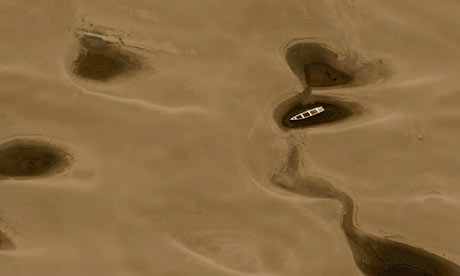
A small boat is trapped in a pond near Santarem, Brazil, after water levels of the Amazon river fell by some two metres. Photograph: Daniel Beltra/Greenpeace

A leading scientist has made an official complaint to the Press Complaints Commission over an "inaccurate, misleading and distorted" newspaper story about a supposed mistake made by the UN's panel on global warming.

Simon Lewis, an expert on tropical forests at the University of Leeds, says the story, published by the Sunday Times in January, is wrong and should be corrected.

He says the story is misleading because it gives the impression that the Intergovernmental Panel on Climate Change (IPCC) made a false claim in its 2007 report that reduced rainfall could wipe out up to 40% of the Amazon rainforest. The Sunday Times story was widely followed up across the world, and, in the wake of the discovery of a high-profile blunder by the IPCC over the likely melting of Himalayan glaciers, helped fuel claims that the IPCC was flawed and its conclusions unreliable.

Lewis said: "There is currently a war of disinformation about climate change-related science, and my complaint can hopefully let journalists in the front line of this war know that there are potential repercussions if they publish misleading stories. The public deserve careful and accurate science reporting."

The Sunday Times piece was originally headlined "UN climate panel shamed by bogus rainforest claim", though this was later changed on the website version. It said the 40% destruction figure was based on an "unsubstantiated claim by green campaigners who had little scientific expertise".

The IPCC report attributed the claim to a report from campaign group WWF, which contained no reference to back the statement.

Lewis said he was contacted by the Sunday Times before the article was published and told them the IPCC's statement was "poorly written and bizarrely referenced, but basically correct". He added that "there is a wealth of scientific evidence suggesting that the Amazon is vulnerable to reductions in rainfall". He also sent the newspaper several scientific papers that supported the claim, but were not cited by that section of the IPCC report.

Lewis says in his PCC complaint (PDF, published by ClimateProgress.org) that he told The Sunday Times "the IPCC statement itself was scientifically defensible and correct, merely that [it used] the incorrect reference... To state otherwise is to materially mislead the reader."

Lewis also complains that the Sunday Times used several quotes from him in the piece to support the assertion that the IPCC report had made a false claim. "Despite repeatedly stating to the Sunday Times that there is no problem with the sentence in the IPCC report, except the reference."

Lewis said he made the PCC complaint, which runs to 31 pages, only after other attempts to raise his concerns failed. A letter to the Sunday Times, he says, was not acknowledged or printed, and a comment he posted on its website was deleted.

"As a professional scientist I have to clear this mess up, it's important to protect my reputation in terms of providing accurate scientific information to the public."

The Sunday Times said it that printed two letters in response to the article. It said it was "currently dealing with Simon Lewis's complaint and hope to resolve the issue".

Deadly pipeline threat to uncontacted tribes

25 March 2010
Source: Survival International

Anglo-French oil company Perenco has revealed plans to build a pipeline deep into the heart of uncontacted tribes’ land in the Amazon rainforest.

The pipeline is being built to transport an estimated three hundred million barrels of oil from the depths of the northern Peruvian Amazon. The company makes no mention of the tribes in its report detailing the potential social and environmental impacts of the pipeline, despite the fact they could be decimated by contact with Perenco’s workers.

‘Failing to mention that they’re working on the land of isolated tribal people is just like what the British did in Australia: make the tribal people invisible so they can claim the land for themselves,’ said Survival director Stephen Corry.

Perenco’s report was recently made public on the Peruvian Energy Ministry’s website. It fails to mention that the pipeline would cut right into the heart of a proposed reserve for the uncontacted Indians.

The Ministry has responded by failing to approve Perenco’s report. It has asked the company to write an ‘anthropological contingency plan’, given the ‘possible existence’ of uncontacted tribes in the region.

The pipeline is projected to be 207 kms long and to connect with another pipeline already built, which will transport the oil all the way to Peru’s Pacific coast. Perenco’s report says it would affect the forest for five hundreds metres on either side.

High-ranking officials in Peru hope the pipeline will help transform Peru’s economy. Survival and many other organizations are lobbying Peru’s government not to build it.

Perenco’s report says that production is expected in 2013. The company, chaired by Oxford University graduate Francois Perrodo, has denied the existence of uncontacted Indians in the region, even though the previous company working in the region admitted contact with them was ‘probable.’

Robin Tauck Joins Marriott's Efforts to Protect Amazon Rainforest

March 24, 2010
Source: PR Newswire

Tauck Romano Innovative Philanthropy (TRIP) is joining Marriott International's ongoing effort to leverage sustainable tourism, conservation and training in Brazil's Amazon Rainforest. TRIP has committed $50,000 to support education and a new Sustainable Agriculture Learning Center within the Juma Reserve in the Brazilian state of Amazonas.

The Learning Center, a project of the Amazonas Sustainable Foundation in Manaus, is now providing local residents with access to a year-long sustainable rainforest permaculture training program that demonstrates how protection of the rainforest's resources can improve the communities' current and long term livelihood.

Travel industry veteran Robin Tauck (TRIP Foundation trustee and President R. Tauck & Partners) believes the Sustainable Agriculture Learning Center is a clear example of how new and innovative programs show promise and build sustainable, positive change. "I am personally proud to be an initial international travel partner joining Marriott and the state of Amazonas in supporting such innovative programs in Juma. The Amazon Rainforest is known as the lungs of the world, and we can all leverage Marriott's leadership via our large, responsible and caring industry," said Tauck.

Juma's home state of Amazonas in northwest Brazil is currently under tremendous land use pressure. Deforestation coupled with unsustainable farming could deplete 30 percent of the forest by 2050. In 2008, Marriott embarked on a four-year plan to protect 1.4 million acres of Juma's endangered forest. One of the plan's key elements included the future development of a learning center dedicated to sustainable forestry. The new learning center will be located in Boa Frente, one of about 30 small communities within the Reserve which is home to more than 3,000 residents (about 400 families) who will benefit from this innovative educational opportunity.

Arne Sorenson, president and COO of Marriott recently expressed his gratitude, "We are truly pleased and proud that Robin Tauck, a travel industry colleague, has joined us and the Amazonas Sustainable Foundation in this important effort to help protect the rainforest and empower the lives of the residents. Through this important project, Robin is making a valued contribution – that will have long-term benefit – to the education and training of families living in 30 communities throughout this vast Juma Reserve." Mr. Sorenson also co-chairs his company's Executive Green Council.

The TRIP Foundation support provides multiple communities with the tools to enhance their traditional farming practices and includes resources such as an onsite laboratory as well as a teaching curriculum focused on the importance of sustainability, permaculture and crop rotation. The Center provides ongoing community training and monitoring.

A Conservational Call to the Travel Industry: Robin Tauck urges industry leaders to consider collaboration in support of conservation efforts. Many opportunities exist to jointly support initiatives, as demonstrated by discussions between Robin Tauck and Ed Fuller, managing director of International Lodging and Mari Snyder, vice president, social responsibility at Marriott. The World Travel and Tourism Council has also recognized Marriott's initiative, with CEO Jean Claude Baumgarten proclaiming it to be one of the leading examples of best practice in sustainable tourism – a worthy winner of one of the 2009 Tourism for Tomorrow Awards.

The Juma Sustainable Development Reservation is a REDD (Reduced Emissions from Deforestation and Degradation) initiative addressing deforestation and the consequential emissions of greenhouse gases. It is also the first avoided deforestation project to achieve Gold Status under the Climate, Community and Biodiversity (CCB) standards.

For information on the Juma/TRIP Sustainable Agriculture Learning Center and other sustainable tourism initiatives, visit www.robintauck.com or www.marriott.com/spirittopreserve.

About Tauck-Romano Innovative Philanthropy (TRIP Foundation):

The TRIP Foundation is a private family foundation (501c3) with a mission to support innovative or newly established programs in sustainable land use and US/International relations by building and sustaining positive change through education, leadership, cross-cultural understanding and teamwork.

About Marriott International, Inc.:

Building on more than 20 years of energy conservation experience, Marriott is committed to protecting the environment. The company's Spirit To Preserve environmental strategy calls for: Greening its $10 billion supply chain; further reducing fuel and water consumption by 25 percent per available room; creating green construction standards for hotel developers to achieve LEED certification from the U.S. Green Building Council; educating and inspiring employees and guests to support the environment; and helping protect the rainforest.

Threatened Amazon tribes fight against the odds

24th March 2010
Source: Sudbury Star

NEW YORK - Facing land theft and even genocide as modern exploiters rush into the Amazon basin and other Brazilian forests, small, isolated Indian tribes are struggling against overwhelming odds. But they are fighting back with increasing vigor; and as they add lawyers to their arsenal of bows and arrows, have begun to score remarkable successes.

In recent weeks, the Brazilian legislature passed a legal landmark (unpaving the way, one might say) to protect one of the planet's most endangered forest regions: the Atlantic Mata along its southern coast. Separately, the governor of Para in the Amazon basin created a new tropical rainforest preserve covering more than 58,000 square miles. In addition, federal courts have sided with tribal claims in several suits involving powerful economic interests. One court voided the land titles of 44 ranches near the Xingu Indigenous Park, saying the land sales were fraudulent. The land, more than 1.3 million acres, reverts to the National Foundation for the Indian (FUNAI), the Brazilian equivalent of the BIA, and the National Institution for Agrarian Reform.

Some of the suits arose from a wave of occupations by tribal militants, sometimes armed with bows, arrows and sticks. The most recent of these, on Dec. 13, shut down a harbor in the state of Espiritu Santo handling the bulk of the exports of the wood-product company Aracruz Celulose. Members of the Tupiniquim and Guarani tribes accuse the company of occupying 26,000 acres of their land.

The decisions can be appealed and reversed, and the legislation might harbor dangerous loopholes, but they are a welcome contrast to the murder-filled rush to exploit Brazil's interior.

Unlike the countries of the Andes, where the indigenous population is a majority and increasingly powerful politically, Indians in Brazil are a small minority, often isolated in inland reserves surrounded by a ''Wild West'' atmosphere of land-clearing and development. Yet they are standing up to some of the country's largest corporations.

In one of the most notable confrontations, two communities of Xicrin Indians on Oct. 17 occupied the Carajas, Para state, open-pit mines of the Companhia Vale do Rio Dolce, the world's largest producer of iron ore. The CVRD, an $11 billion corporation, has extensive international contacts; its well-known CEO, Roger Agnelli, sits on the board of directors of the construction giant ABB Ltd. and the North Carolina utility Duke Energy Corp.

According to the CVRD account, 200 Xicrin Indians from the communities of Catete and Djudjeko invaded their facility ''armed with bows, arrows and sticks.'' They occupied the rail loop and locomotives and took the keys of the company's commuter buses, holding 600 employees hostage for about two hours. In the two days of the occupation, said the company, it lost 500,000 tons of iron ore production.

The origins of the conflict are murky. In February five other tribes tore up tracks of the CVRD-owned Carajas railroad, interrupting its mineral exports. It appears from the charges and countercharges that the tribes feel the company shortchanged it on promised payments in return for use of indigenous land. But the nature of the agreement, or whether there was one, is in dispute. Even the main newspaper in Sao Paolo admitted that it was confused.

Declaring it would not bow to ''extortion,'' however, the company cancelled its annual contribution of more than $4 million to the Xicrin Indians. The case went to court. On Dec. 4, 2006, a federal judge ordered the company to resume its payments, noting that it had just reported record profits.

Agnelli immediately announced he would appeal. He denounced FUNAI for failing to intervene. He stated that CVRD invested heavily in the environment and health services for Indians but questioned direct payments to the tribes. According to a regional paper, he said, ''If you give money to the Indians, then an NGO [nongovernmental organization] comes and says that Indians are dying of heart attacks because with the money you give him, he's buying french fries and his cholesterol level is going up. So I can't give money to an Indian. Fine. So who do I give the money to?''

At least one tribe, however, is seeking to emerge from the conflict with a sustainable economic model. The Xavante people in the southern Amazon basin blockaded a national highway in Mato Grosso state in July to protest the impact of soybean cultivation on the Rio das Mortes watershed. But one Xavante village is also beginning to earn royalties by licensing its traditional hunting chant as a cell phone ring tone.

Jim Adams is a historian at the Smithsonian National Museum of the American Indian.

Wednesday, March 24, 2010

Potent Jungle Vine Brew Has Potential to Treat Addiction

23 March 2010

New research suggests ayahuasca, a jungle vine found in the Peruvian rainforest, can have a powerful effect on the human central nervous system when brewed with other plants. Researchers say one of ayahuasca's most promising uses could be in treating drug and alcohol addiction.

According to the World Health Organization, medicines derived from plants play a major role in the health care of 80 percent of the world's population. Western medicine has synthesized many of these natural drugs, from the painkillers in willow bark to the anti-cancer compounds in the neem tree, and is constantly searching for more pharmaceuticals in the biodiversity of the world's forests.

Ayahuasca is one traditional plant-based medicine that has drawn the attention of investigators. In the South American jungles, it is used in religious ceremonies to induce visions and also as a remedy to cure ills.

Vine of the dead could help improve life

At the Onanyan Shobo spiritual retreat center in the rainforest near Iquitos, Peru, shaman Alfredo Kayruna Canayo shows off a section of the twisting, leafy vine. "What ayahuasca means is vine of the dead," he explains through an interpreter. "Some people call it soul vine."

Ayahuasca is known as a master plant, a very powerful remedy that treats the whole person: body, mind, and soul. "The ayahuasca [can] cure anything you have," the shaman says. "Start with simple things. For example, it's very simple to cure or repel the bad energies from your insides. What is the bad energy? One of them could be the fears, then some wound or injury you have."

Whether the plant is being used for religious or medicinal purposes, ayahuasca is taken only in a ceremonial setting under the direction of an experienced shaman. To turn it into a drink, also called ayahuasca, pieces of the vine are pounded into a pulp and combined with several other plants, then brewed down for eight or more hours into a thick orange liquid.

That combination, shaman Alfredo says, is critical. "Only by itself, this plant doesn't work good, you have to add this with the other plant - the chacruna - which is the help to the ayahuasca. In Shipibo culture, they believe the chacruna is the wife of ayahuasca because they help and work together."

A sophisticated chemical concoction

An international research team is investigating the pharmaceutical potential of ayahuasca, known scientifically as Banisteriopsis caapi. Principal investigator, Dr. Charles Grob, is a professor of psychiatry and pediatrics at the UCLA School of Medicine. His team has done a chemical analysis of the medicinal drink.

While the shaman's characterization of the herbal interaction may be whimsical, Grob says science confirms that the ayahuasca brew is a potent medication. "It's a very sophisticated form of pharmacology, which somehow the native peoples of the Amazon region have figured out. Ayahuasca is generally a decoction of two plants. Each plant if taken separately has no effects on the human central nervous system, but when taken together there's a very powerful synergy."

The active ingredients in the brew are DMT, a naturally occurring brain chemical similar to serotonin, and a natural antidepressant. DMT is inactivated in the human gut, but when combined with the antidepressant, it can be absorbed by the body.

Grob says one of ayahuasca's most promising uses is in treating drug and alcohol addiction. "Number one, it does not appear to be addictive and the individuals do not develop a tolerance, they do not go through withdrawals, and generally speaking, it is very unusual for people to take it on consecutive days over an extended period of time."

The potion also has anti-parasitic properties, which can help prevent malaria. There is also some evidence that it diminishes the symptoms of Parkinson's disease.

An illegal brew, for now

The U.S. Food and Drug Administration classifies the principal active ingredient in ayahuasca as a Schedule 1 controlled substance, which is not considered to have any legitimate medical use. As a result, the ayahuasca brew is illegal in the United States, and most of the pharmaceutical studies are being conducted in South America.

Grob says the studies are important. "There's great potential to learn about the range of ayahuasca and to explore its therapeutic value, but first steps first, and I think first we need to fully understand how it's utilized in South America and then do trials in the U.S. and Europe."

Because many Shamans claim ayahuasca cures a variety of cancers, tumors, and other diseases, the Peruvian jungle has become a popular destination for the medical tourism industry.
Most of the visitors at Onanynan Shobo, where Shaman Alfredo practices, are European, with the remainder coming from the United States, Australia and Asia.
As long as its use in western medicine is illegal, anyone wishing to explore ayahuasca's medical benefits will have to come to the source in South America.