Monday, November 30, 2009

Ethnographic maps built using cutting-edge technology may help Amazon tribes win forest carbon payments

November 29, 2009
From: mongabay.com

A new handbook lays out the methodology for cultural mapping, providing indigenous groups with a powerful tool for defending their land and culture, while enabling them to benefit from some 21st century advancements. Cultural mapping may also facilitate indigenous efforts to win recognition and compensation under a proposed scheme to mitigate climate change through forest conservation. The scheme—known as REDD for reducing emissions from deforestation and degradation—will be a central topic of discussion at next month's climate talks in Copenhagen, but concerns remain that it could fail to deliver benefits to forest dwellers.

Much of the Amazon rainforest remains occupied by tribal groups. While few of these live as conjured in the imagination, the state of the forests in their territories is a testament to their approach to managing lands. But like the Amazon itself, these groups face new pressures from the outside world. For the indigenous, the lure of urban culture is strong—cities seem to offer the promise of affluence and the conveniences of an easy life. But in leaving their forest homes indigenous peoples are usually met with a stark reality: the skills that serve them so well in the forest don’t translate well to an urban setting. The odds are stacked against them; they arrive near the bottom of the social ladder, often not proficient in the language and customs of city dwellers. The lucky ones may find work in factories or as day laborers and security guards, but many eventually return to the countryside. Some re-integrate into their villages, others return in a completely different capacity than when they departed. They may join the ranks of miners and loggers who trespass on indigenous lands, ferreting out deals that pit members of the same tribe against each other in order to exploit the resources they steward. As tribes are fragmented, and forests fall, indigenous culture—and the profound knowledge contained within—is lost. The world is left a poorer place, culturally and biologically.

But there is new hope, embodied by efforts to enable tribes to become more self-reliant through the use of state-of-the-art technology that builds on and leverages their traditional knowledge. These tools can help them better defend their lands and offer the potential for the next generation of Surui, Trio, or Ikpeng to have a future of their determination rather than one dictated to them by a society that values the resources locked in their territories over their forest knowledge and rich cultural history. Through such technology, tribes may be able to avoid a fate in which they become destroyers, rather than protectors, of the basis of their culture—their forest home.

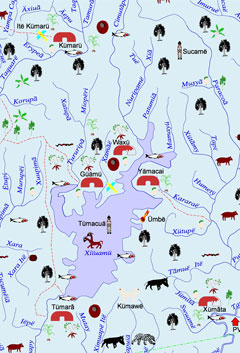
At the forefront of this effort is the Amazon Conservation Team (ACT), a Virginia-based group with field offices in Brazil, Suriname, and Colombia. the Amazon Conservation Team has pioneered geographic information system (GIS) training of indigenous groups in the Amazon to enable them to map their land, not only as a means to demarcate it and win title, but to catalog their cultural links to the land. In building these “cultural maps,” tribes construct maps of their territory that go beyond the topography of the terrain, capturing the underlying richness of generations of human experience, including their interaction with the land and other tribes, and the distribution of plants and animals of nutritional, medicinal, and spiritual significance. In other words, in as much as indigenous culture is a product of the land, the maps capture the essence of these tribes.

But creating a cultural map is no easy task. It can take years of work by the tribe, laying out what the map will contain, determining what communities will participate, and coordinating who in the community will do the actual footwork. Other considerations also come into play, including harvesting cycles and seasons—mapping can’t interfere with the ongoing the activities that sustain the tribe—and the treatment of intellectual property contained in the maps, since these can be used for nefarious purposes in the wrong hands, including exploitation of timber, game, and medicinal plants.
The training itself can also be complex. Indigenous mappers must learn the ins and outs of handheld GPS units, GIS systems, computers, and Internet tools like Google Earth before they can construct maps and monitor their territories for threats and encroachment. But the payoff can be well worth the effort: 20 groups in the Brazilian Amazon have created culture and land use maps of their territories. The maps include 7,500 indigenous names, 120 villages, and thousands of area of cultural and historical significance. In Suriname, the maps are being used to help indigenous groups get government recognition of—and eventually title to—their lands. Some of the indigenous mappers have gone on to become certified as park guards, enabling them to earn an income while working to safeguard their lands.

The new handbook, "Methodology of Collaborative Cultural Mapping," walks readers through the process of establishing community meetings between stakeholders, composing the mapping team, setting up training workshops, conducting fieldwork, developing the map, and finally delivering the map. The guide, which is available in both English and Brazilian Portuguese, comes at an opportune time: interest in tropical forest conservation has never been higher. The reason? Tropical forests are seen as critical in combating climate change, both in terms of their value in sequestering carbon and as a political compromise that could serve as the developing world’s contribution to reducing greenhouse gas emissions. As long-time stewards of tropical forests, indigenous people are effectively forest carbon guardians. But questions remain as to whether they will be recognized as such. Mapping their lands may help indigenous groups demonstrate their critical role in forest conservation efforts, earning them recognition, compensation, and a stronger voice in determining how their resources are managed.

An example can be found in the Surui tribe's carbon project in Rondônia, Brazil, which aims to protect 250,000 hectares of forest. Prior to establishing the carbon project , the Surui worked closely with the Amazon Conservation Team to develop a cultural map of their lands.
"The Surui ethno-graphic (cultural) map has become the key instrument in integrating their traditional knowledge of the forest with the latest technologies in carbon measuring and monitoring," Vasco van Roosmalen, director of the Amazon Conservation Team-Brazil, told mongabay.com. "It is one of the key instruments in translating the necessities of a carbon project to the community and in ensuring that their perspectives are truly integrated into the project design."

Mark Plotkin, president of the Amazon Conservation Team, adds that having completed their map, the Surui are much better positioned to move ahead on their carbon credit project.

"After the mapping process has been completed, some of the indigenous are trained as internationally accredited park guards—meaning the forest protectors are in place, which is a real hurdle for other carbon projects where nobody lives in and protects these forests," he told mongabay.com.

"Ethnographic mapping represents the perfect marriage of ancient shamanic wisdom and 21st century technology," Plotkin continued. "When done right, it results in better protection of the rainforest and enhanced capacity of the Indians to meet the opportunities and challenges posed by the outside world."

(Image1: In Rondonia, Brazil, Surui use ACT-provided laptops to monitor their reserve using Google Earth technology. Photo © Fernando Bizerra Jr.

Image2: A model map created by Indians in Brazil. Image courtesy of ACT.

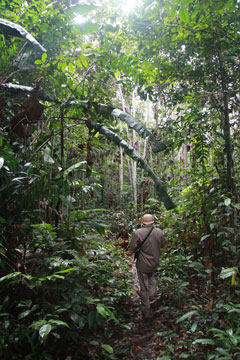
Image3: Indigenous park guards on patrol near Kwamalasamutu, Suriname.)
Preservation and development clash in Brazilian Amazonia - Feature

Mon, 30 Nov 2009
From: Earthtimes


Rio de Janeiro - The battle between preservation and development is red-hot in the Brazilian portion of the Amazon rainforest. In the Xingu region, indigenous communities are getting their war paint ready: they are furious about Brazilian President Luiz Inacio Lula da Silva's decision to build a controversial hydroelectric plant in the area.

For the government, the massive Belo Monte plant is vital to guarantee the power supply in Amazonia, to generate jobs and to secure better living standards for people in the region.

"Don't ask me to make 25 million people living in Amazonia live at the mercy of 'muricocas' (a type of mosquito). Those people want development, they want industrialization, they want to have a car, a television, a phone," Lula said recently.

In recent weeks, Brazil committed to reducing its current emissions of greenhouse gases by up to 38.9 per cent by 2020. Officials hope to attain half of this emissions cut by an 80 per cent reduction in deforestation of the Amazon rainforest.

Significantly, the expansion of hydroelectric energy plants is regarded as another important factor in the effort to cut down the emissions of harmful gases.

For the 15 indigenous nations living in the area where the controversial plant is set to be built, however, Belo Monte represents not the dream of a better life, but rather a major threat, dangerous enough to spur an armed resistance to the project.

In a letter to Lula earlier this month, more than 280 indigenous leaders warned that there will be war in the Xingu region if the project goes ahead as planned.

"We do not accept Belo Monte and we will not allow it to materialize. If the government launches construction, it will have to take responsibility for the safety of its representatives, because there will be clashes and even deaths. There will be a war," warned indigenous leader Poy Kayapos.

Indigenous peoples are not alone in their resistance to Belo Monte.

According to a report drafted by several experts at the request of the non-governmental organization Socio-Environmental Institute (ISA), Belo Monte - the main energy project in Lula's Growth Acceleration Programme (PAC) - is not financially viable and only aims to attract to the region intensively-power-consuming industries.

"It is an extremely complex work, which will at the same time flood land and drastically reduce the supply of water in a 100- kilometre stretch around the Long Turn of the Xingu river, which flows through many communities and through two indigenous reserves," said analyst Francisco Hernandez, an engineer.

The indigenous groups also have the support of organizations like Greenpeace and religious groups like the Missionary Council for Indigeous Peoples (Cimi). They accuse the government of not having consulted with local tribes.

For Agnelo Xavante, a representative of an indigenous nation with the same name, the plant will reduce the volume of water in the Xingu river, which will chase away the fish that are a staple in the diet of indigenous peoples.

He further estimates that Belo Monte will lead to the displacement of around 20,000 people and will attract 100,000 people from outside the region to the area surrounding the plant, which will in turn increase deforestation.

"The government should bear in mind the position of indigenous communities. We are also part of the people, but the government does not consult us and does not talk to us. We reject not just the construction of Belo Monte but also that of any other hydroelectric plant near indigenous land," Agnelo Xavante said.

One of the resistance movement's leaders, Raoni Metuktire, commanded in early November a protest that blocked the way for hours for the huge rafts that take lorries across the Xingu river, between the Brazilian states of Mato Grosso and Para.

"The (only) good thing is to leave the river alone, without dams," Metuktire stressed.

Such complaints have not, so far, prompted the Brazilian government to change plans. The auction for construction firms interested in the project is set to take place in January. The plant is set to be operational by 2014, with a capacity to generate 11,233 megawatts of electricity.

The Brazilian state organ in charge of protecting the interests of indigenous peoples, the National Foundation of Indians (Funai), issued a report in favour of the project in October.

Funai president Mercio Meira controversially said that Belo Monte would not affect indigenous communities in the area that will be flooded to build the plant.

Xingu Bishop Erwin Krautler, however, insists that the hydroelectric plant threatens the communities' very survival.

"We want to prevent the Lula government from going down in history as the government which dictated the extinction of indigenous peoples in the Xingu region," the religious leader said, in a public message addressed to the government.

Shelling out to save the planet

Monday, November 30, 2009
From: Oregon Daily Emerald

Failure depends on one’s definition of success. That’s what I’ve been remembering as the United Nations Climate Change Conference draws near. The conference, set to begin Dec. 7 in Copenhagen, will attempt to forge a new global climate treaty in the wake of the Kyoto Protocol, which is set to expire in 2012.

The word in the news and on the street is that the conference will not result in a comprehensive treaty, but will instead attempt to establish some consensus on the politics of acting on a global scale to address climate change. What will be considered successful to the multifarious stakeholders involved? From the reportedly “drowning” Maldives, to the thriving-but-coal-dependent China, to the hordes of activists who will flock to the street in the name of “climate justice,” everyone in attendance will have both expectations and limits to their concessions, no matter which angle they’re coming from.

And believe me, angles abound. There has been an absolute onslaught of news about which country is promising this or that and who in the world thinks the efforts are great or dismal. There are a few stakeholders at the forefront of the hearsay free-for-all that stand out.

China, for its part, has been under a lot of international pressure to reduce its emissions. As a major developing country that relies heavily on coal, any reduction of emissions in the coming decades are almost out of the question. Rather, the question is about how much it will be willing to reduce the growth of its emissions. Along these lines, China brought its offer to the table late last week saying that by 2020 the country would reduce its emissions 40 percent to 45 percent per unit of gross domestic product from 2005 levels. Although this was hailed as a decisive development by many, including the Obama administration, it’s a paltry effort scientifically.

Knowing that many developed nations will not actually be reducing their emissions, but rather slowing their intensity, Brazil has recognized its upper-hand in being home to one of earth’s largest carbon sinks, the Amazon rainforest. The Associated Press reported on Friday that Brazilian president Luiz Inacio Lula da Silva said the rich Western nations should pay Amazon nations to prevent deforestation, considering the West caused most of the environmental degradation in the first place. In fact, Norway is reportedly already making payments to give Brazil $1 billion by 2015 to continue to “preserve the Amazon rain forest.”

Along the same “you broke it, you buy it” logic that Brazil is touting, there is a growing demand from developing countries for a dramatic financial aid effort from the global north to pay for climate change adaptation and mitigation strategies. The African Union, the coalition of African states to be present at Copenhagen, the Commonwealth nations, a 53-nation intergovernmental body, and the Bolivian government particularly are primary players in the call for climate reparations for countries that are considered to be disproportionately affected by the severe droughts, food shortages and storms caused by a warming climate.

All these countries want something specific in exchange for whatever they’re willing to offer; none of them seems to be addressing the possibility of severe compromises. For example, the African nations walked out of the final preliminary meetings in Barcelona last month demanding that developed countries cut emissions by 40 percent from 1990 levels by 2020, and many countries’ representatives have reportedly considered doing the same if their demands are not recognized at the conference.

Where will the common ground be found? With the global north looking mostly to market-based solutions at the same time as the south is looking for huge amounts of money to be paid for this so-called “climate debt,” will confronting science top the priority list or will the conference be business-as-usual?

“Finance is the key to a deal in Copenhagen,” said Yvo de Boer, the executive secretary of the U.N. Framework Convention on Climate Change. “Money, in fact, is the oil that encourages commitment and drives action,” he said in a conference call recently.

Well, there you have it, from a top organizer himself, it is (as usual) about the money.

The current lack of political will to sign a fair and ambitious treaty after months of preliminary planning and talks seems to speak loudly to the second-place standing of science even before the conference has begun; so whose failures will become others’ successes and what that means for the future of the planet remains to be seen. But more and more it seems that following the money trail will be the best bet for finding out.

Brazil asks for help to stop rainforest razing

November 29, 2009
From: Examiner.com

With only 7 days remaining before the Copenhagen Climate Summit begins, Brazil's President, Luiz Inacio Lula da Silva, is apparently feeling the global pressure to stop the razing of Amazon rainforests.

Silva arranged for an Amazon summit last Thursday to form a unified position on deforestation and climate change for seven Amazon nations. The summit was supposed to end with delegates from these seven nations signing a declaration calling for financial help from the industrial world to halt the deforestation that causes global warming. To Silva's embarassment, the summit was poorly attended.

Regardless of the poor showing at the summit, Silva believes the message of the summit was communicated. "I don't want any gringo asking us to let an Amazon resident die of hunger under a tree," Silva said. "We want to preserve, but they will have to pay the price for this preservation because we never destroyed our forest like they mowed theirs down a century ago."

According to Silva aides the point of the summit was to let the world know that the Amazon is home to 30 million people, most of whom depend on the forest's natural riches to eke out a living. About 25 million people live in Brazil's portion of the Amazon, an area larger than Western Europe.

The Brazilian government has been trying to reduce the burning of the rain forest. Brazil alone has managed to reduce Amazon destruction to about 7,000 square kilometers (2,702 square miles) a year, which is the the lowest level in decades. But to put that into perspective, that still equals burning an area bigger than the state of Delaware every year.

The Brazilians do recognize that the Amazon rainforest is both the single biggest single natural defense against global warming as the forest absorbs carbon dioxide. It is also currently the single biggest contributor of carbon emissions due to the burning and rotting of trees that are dying due to the deforestation.

The dilemma, as stated above is economics. It is hoped for and expected that the Copenhagen summit will provide for a new global climate agreement to reward countries for "avoided deforestation," with cash or credits tradable on the global carbon market.

Norway is already making payments which should total $1 billion by 2015 as long as Brazil continues to try to stop the burning. Brazilian finance ministers are hoping to increase that amount to $21 billion, and more donations are hoped for from Japan, Sweden, Germany, South Korea and Switzerland as they are considering donating to the fund.

Perhaps Brazil would find more support if information was released with how that $21 billion will be spent.

Saturday, November 28, 2009

New promotion material for the state of Amazonas, Brazil

There are two new publications in the link below that outline the major features of the state of Amazonas which make it a good place to invest.

There are two separate publications, one presenting the local economy and the main segments of opportunity such as natural resources, energy, tourism, industry, among others.

The other is an investors' guide to the Manaus Free Trade Zone, with all the opportunities it entails.


As a recognition of the efforts by the state to attract investment and to promote a good business environment, Amazonas has recently been named the 2nd (out of 26) best state in Brazil to invest.

Friday, November 27, 2009

Brazilian president says 'gringos' must pay to protect Amazon

Friday 27 November 2009
From: guardian.co.uk

Brazil's president said today that "gringos" should pay Amazon nations to prevent deforestation, insisting rich western countries had caused much more environmental destruction than the loggers and farmers who cut and burn trees in the world's largest tropical rainforest.

President Luiz Inácio Lula da Silva was speaking before an Amazon summit at which delegates signed a declaration calling for financial help from the industrialised world to halt deforestation, which contributes to global warming.

"I don't want any gringo asking us to let an Amazon resident die of hunger under a tree," Lula said. "We want to preserve, but they will have to pay the price for this preservation because we never destroyed our forest like they mowed theirs down a century ago."

In Brazil, the word "gringo" generally refers to anyone from the northern hemisphere.

Lula convened the meeting to form a unified position on deforestation and climate change for seven Amazon countries before the Copenhagen climate summit. But the only leaders who attended were Guyana's Bharrat Jagdeo and France's Nicolas Sarkozy, representing French Guiana, leaving top Lula aides and environmentalists to admit the gathering will have a muted impact.

Other countries sent vice-presidents or ministers, and the presidents of Colombia and Venezuela embarrassed Brazil by cancelling at the last minute.

Sarkozy supported a recent proposal by Lula to create a financial transaction tax that would be used to build a fund to help developing countries protect their forests. Details will be discussed in Copenhagen.

Despite the lacklustre summit showing, Lula aides said it was important to drive home a message that the Amazon is home to 30 million people, most of whom depend on the forest's natural riches to eke out a living. About 25 million live in Brazil's portion.

"In Europe everyone has opinions about the Amazon, and there are people who think the Amazon is a zoo where you have to pay to enter," said Marco Aurelio Garcia, Lula's top foreign policy adviser. "They don't know there are 30 million who work there."

Brazil has managed to reduce Amazon destruction to about 7,000 square kilometres a year, the lowest level in decades. But that is still larger than the US state of Delaware.

The Brazilian Amazon is arguably the world's biggest natural defence against global warming, acting as an absorber of carbon dioxide. But it is also a big contributor to warming because about 75% of Brazil's emissions come from rainforest clearing, as vegetation burns and felled trees rot.

Brazil has an incentive to protect the Amazon because the new global climate agreement is expected to reward countries for "avoided deforestation" with cash or credits that can be traded on the global carbon market.

Norway will give Brazil $1bn (£600m) by 2015 to preserve the Amazon rainforest, as long as Latin America's largest country keeps trying to stop deforestation.

Norway was the first to supply cash to an Amazon preservation fund which Brazilian officials hope will raise $21bn to protect nature reserves, persuade loggers and farmers to stop destroying trees, and finance scientific and technological projects.

Brazilian environment minister Carlos Minc has said Japan, Sweden, Germany, South Korea and Switzerland are considering donating to the fund.

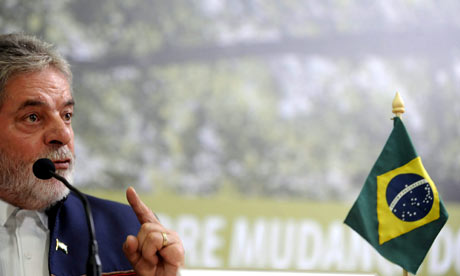
(Image: Brazilian president Luiz Inácio Lula da Silva has said that 'gringos' should pay Amazon countries to protect the rainforest. Photograph: Fernando Bizerra Jr/EPA)

No-shows among South American leaders at Amazon summit

November 27, 2009
From: mongabay.com

A summit between South American leaders to devise a plan to save the Amazon, failed to come up with a "common stance" on deforestation, as five of the eight invited leaders failed to show up to the meeting, reports Al Jazeera.

Guyana's president Bharrat Jagdeo and France's Nicolas Sarkozy attended the meeting in Manaus, which was hosted by Brazil's president, Luiz Inacio Lula da Silva.

Venezuela's Hugo Chavez and Colombian's Alvaro Uribe pulled out of the meeting over a political dispute. Leaders from Suriname and Bolivia, along with Ecuador's Rafael Correa, who has pushed his own rainforest conservation plan, also missed the summit.

Nonetheless the apparent alliance between France and Brazil is significant going into next month's climate negotiations in Copenhagen. France has a central role in the E.U., one the largest producers of carbon dioxide, while Brazil has recently committed to significant reductions in greenhouse gas emissions from deforestation.

The Manaus meeting focused on Brazil's recent success in reducing forest clearing in the Amazon though better policing, new incentives to keep trees standing, and new protected areas. Brazil's state-of-the-art satellite monitoring system for tracking was also highlighted.

Brazil is seeking compensation from industrialized nations for its efforts to curtail Amazon deforestation. Norway has already committed up to a billion dollars to Brazil's Amazon Fund.

Brazil: 'Gringos' must pay to stop Amazon razing

27th Nov, 2009
From: AFP

MANAUS, Brazil — Brazil's president said that "gringos" should pay Amazon nations to prevent deforestation, insisting rich Western nations have caused much more past environmental destruction than the loggers and farmers who cut and burn trees in the world's largest tropical rain forest.

President Luiz Inacio Lula da Silva made the comments Thursday just before an Amazon summit in which delegates signed a declaration calling for financial help from the industrial world to halt the deforestation that causes global warming.

"I don't want any gringo asking us to let an Amazon resident die of hunger under a tree," Silva said. "We want to preserve, but they will have to pay the price for this preservation because we never destroyed our forest like they mowed theirs down a century ago."

In Brazil, the word "gringo" does not only mean American, but generally refers to anyone from the northern hemisphere.

Silva convened the meeting to form a unified position on deforestation and climate change for seven Amazon nations ahead of the Dec. 7-18 Copenhagen climate summit. But the only leaders who attended were Guyana's Bharrat Jagdeo and France's Nicolas Sarkozy, representing French Guiana, prompting top Silva aides and environmentalists to admit the gathering will have a muted impact.

Other nations sent vice presidents or ministers, and the presidents of Colombia and Venezuela embarrassed Brazil by canceling at the last minute.

Sarkozy supported a recent proposal by Silva to create a financial transaction tax that would be used to build a fund to help developing nations protect their forests. Details will be discussed in Copenhagen.

Despite the lackluster summit showing, Silva aides said it was important to drive home a message that the Amazon is home to 30 million people, most of whom depend on the forest's natural riches to eke out a living. About 25 million live in Brazil's portion, which has about 60 percent of the Amazon, an area larger than Western Europe.

"In Europe everyone has opinions about the Amazon, and there are people who think the Amazon is a zoo where you have to pay to enter," said Marco Aurelio Garcia, Silva's top foreign policy adviser. "They don't know there are 30 million who work there."

Brazil has managed to reduce Amazon destruction to about 7,000 square kilometers (2,702 square miles) a year, the lowest level in decades. But that is still larger than the U.S. state of Delaware.

The Brazilian Amazon is arguably the world's biggest natural defense against global warming, acting as an absorber of carbon dioxide. But it is also a big contributor to warming because about 75 percent of Brazil's emissions come from rainforest clearing, as vegetation burns and felled trees rot.

Brazil has an incentive to protect the Amazon because the new global climate agreement is expected to reward countries for "avoided deforestation," with cash or credits tradable on the global carbon market.

Norway is making payments to give Brazil $1 billion by 2015 to preserve the Amazon rain forest, as long as Latin America's largest nation keeps trying to stop deforestation.

The nation was the first to supply cash to an Amazon preservation fund Brazilian officials hope will raise US$21 billion to protect nature reserves, to persuade loggers and farmers to stop destroying trees and to finance scientific and technological projects.

Brazilian Environment Minister Carlos Minc has said Japan, Sweden, Germany, South Korea and Switzerland are considering donating to the fund.

Sarkozy backs ‘encouraging’ CO2 targets

27th Nov, 2009
From: euronews

French President Nicolas Sarkozy has welcomed pledges from China and the US to cut CO2 emissions saying the targets they have set themselves are “extremely encouraging”.

He was speaking at a climate summit in the heart of the Amazon rainforest hosted by Brazilian President Luiz Inacio Lula da Silva.

Sarkozy proposed using some of the money – likely to be pledged at next month’s Copenhagen climate summit by the developed nations to tackle climate change – for preserving the rainforest.

“I propose that 20% of the donations be used to protect the forests, to prevent deforestation. So we shall use 20% of the immediate public credits to put an end to land clearance,” said Sarkozy.

High level delegates from the Amazon basin countries met in the heart of the jungle to forge a “common stance” on deforestation which, ecologists say, is reducing the planet’s capacity to absorb greenhouse gases.

The region is blighted by drought which is killing livestock and turning lush jungle to desert. As farmers seek to create fertile grazing lands, large swathes of the rainforest are being cut, back, burnt and cleared.

As the world’s fourth largest greenhouse gas producer, Brazil has promised to cut its CO2 emissions by up to 39 per cent by 2020.

In the jungle city of Manaus Greenpeace protesters reminded visiting politicians the ambitious target can only be achieved if deforestation is reduced by 80 per cent.

Sarkozy hails US, Chinese climate proposals

Thursday, Nov 26, 2009
From: AFP

French President Nicolas Sarkozy, in Brazil Thursday for a one-day meeting on climate change and Amazon forest conservation, hailed new US and Chinese proposals on combating global warming as "extremely encouraging."

At a press conference, Sarkozy praised US President Barack Obama's "courage" for setting goals that would reduce US carbon emissions by 17 percent by 2020, while also offering positive words for China's proposed moves to reduce carbon emissions.

"The latest statements by Barack Obama and China's leaders are extremely encouraging in making Copenhagen a success," said Sarkozy, who is attending the meeting because France's overseas department of French Guiana is in the region.

The meeting of officials from nations that straddle the Amazon river basin aims to adopt tough measures to combat global warming and preserve rainforests, ahead of the December 7-18 climate change conference in the Danish capital Copenhagen.

Beijing has vowed to cut carbon intensity, measured per unit of GDP, by 40-to-45 percent from 2005 levels within a decade, putting its first-ever emissions targets on the table.

The new proposals by the world's two biggest carbon emitters for curbing pollution may have breathed life into UN climate talks, but fall short of what scientists say is needed to avert serious global warming.

Called by Brazilian President Luiz Inacio Lula da Silva, the one-day meeting convened high-level delegates from Bolivia, Colombia, Ecuador, Guyana, Peru, Venezuela and Suriname in a bid to draw up a "common stance" on saving the Amazon jungle.

The participants will issue a declaration urging next month's UN-sponsored talks to not neglect the preservation of the planet's forests and proposing "sufficient and adequate" funding mechanisms, said Brazilian climate negotiator Luiz Figueredo.

But the meeting's impact was thrown into doubt by the notable absence of two of the region's big hitters -- Venezuelan President Hugo Chavez and his Colombian counterpart Alvaro Uribe, at loggerheads over an agreement granting US access to Colombian military bases.

Beyond Lula and Sarkozy, the only other head of state was Guyana President Bharrat Jagdeo, with other countries dispatching senior officials to what had been billed as a leaders summit.

The centerpiece of the meeting was a Brazilian proposal to fight rampant deforestation throughout the Amazon basin with financial help from rich nations.

"Let no gringo (foreigner) ask us to let an Amazonian starve to death under a tree," Lula said in a speech before the countries met in the planet's largest rainforest.

"We want to preserve (the forest), but they (other countries) have to pay for that preservation."

Lula's chief adviser Marco Aurelio Garcia explained that Brazil was seeking an agreement from Amazon basin countries "because in Europe, everyone thinks the Amazon is a zoo, a botanical garden and does not realize that it is more complex, there are 30 million people living here."

Greenpeace's Amazon official Paulo Adario told AFP that the Lula-Sarkozy alliance was significant "because France has an important leadership role in the European Union and Brazil is also showing growing leadership on the international stage."

The two leaders met two weeks ago in Paris to plan for the summit.

The clearing of wide swathes of jungle for farming and livestock, especially in Brazil, is reducing the planet's capacity to absorb greenhouse gases -- chiefly carbon dioxide -- that contribute largely to global warming and climate change, Greenpeace warned ahead of the summit.

As the fourth-largest greenhouse gas producer, Brazil has promised to cut its CO2 emissions by 36-39 percent by 2020. Half that effort will come from reducing deforestation in the Amazon jungle by 80 percent.

Brazil this year has managed to curb deforestation to its lowest level in 20 years, but 7,000 square kilometers (2,700 square miles) of rainforest still disappeared.

Unusually, non-Commonwealth leaders Sarkozy, UN Secretary General Ban Ki-moon and Danish Prime Minister Lars Loekke Rasmussen are to address a Commonwealth summit Friday as part of an effort to influence the Copenhagen climate talks.

The 192-nation talks backed by the United Nations aim to craft a post-2012 pact for curbing the heat-trapping gases that drive global warming.

Amazon countries, France get ready for Copenhagen

Nov 26, 2009
From: Space Daily

Representatives from eight nations straddling the Amazon basin plus France will meet Thursday in the heart of the Amazon rainforest to lay out a save-the-jungle proposal for next month's climate change summit in Copenhagen.

Called by President Luiz Inacio Lula da Silva of Brazil, the biggest stock holder in the Amazon basin, the one-day meeting includes President Nicolas Sarkozy since France's overseas department of French Guyana extends into the Amazon basin.

Together with high-level delegates from Bolivia, Colombia, Ecuador, Guyana, Peru, Venezuela and Suriname, Lula and Sarkozy hope to draw up a "common stance" for the December 7-18 conference in the Danish capital on saving the Amazon jungle.

Lula, who met with Sarkozy two weeks ago in Paris to plan for the summit, hopes that Thursday's meeting in Manaus will yield "an ambitious message on issues of great relevance to the region," his spokesman Marcelo Baubach told reporters.

"Brazil believes it is crucial for the (Amazon) region to have a converging and cooperative participation" in the Copenhagen summit, he added.

Greenpeace's Amazon official Paulo Adario told AFP that the Lula-Sarkozy alliance was significant "because France has an important leadership role in the European Union and Brazil is also showing growing leadership on the international stage."

The centerpiece of the Amazon governments' initiative at the upcoming summit is Brazil's proposal to fight rampant deforestation throughout the Amazon basin with financial help from rich nations.

The clearing of wide swathes of jungle for farming and livestock, especially in Brazil, is reducing the planet's capacity to absorb greenhouse gases -- chiefly CO2 -- that contribute largely to global warming and climate change, environmentalists said.

As the fourth-largest greenhouse gas
producer, Brazil has promised to cut its CO2 emissions by 36-39 percent by 2020. Half that effort will come from reducing deforestation in the Amazon jungle by 80 percent.

Brazil this year has managed to curb deforestation to its lowest level in 20 years, but still 7,000 square kilometers (2,700 square miles) of rainforest disappeared.

But those hoping for a major South American drive for Copenhagen could have hopes dashed by the news that two of the region's big hitters will not attend Thursday's summit.

Venezuela's Hugo Chavez announced he would not attend the summit as previously planned because he has "many things to do in Caracas," but said he would send his foreign minister instead.

Colombian President Alvaro Uribe, whose country is locked in a diplomatic spat with Venezuela earlier said he would not attend for health reasons.

The talks in Copenhagen, under the 192-nation UN Framework Convention on Climate Change, aim to craft a post-2012 pact for curbing the heat-trapping gases that drive global warming.

The European Union is pledging to reduce its emissions by 20 percent from 1990 levels before 2020, raising the target to 30 percent in the event of an international agreement. Japan has offered 25 percent, with conditions.

US President Barack Obama, whose country is one of the world's two biggest polluters along with China, will offer to curb US emissions by 17 percent from 2005 levels by 2020, less than calls by the EU and Japan but still the first US plan to cut carbon emissions.

Amazon rainforest summit fizzles

Friday, November 27, 2009
From: Aljazeera.net


A summit intended to help save the Amazon rainforest has ended in Brazil without forging a common agenda on deforestation.

The talks in the Brazilian city of Manaus were undermined by the absence of several regional leaders who pulled out of the meeting at the last minute.

Hugo Chavez, the Venezuelan president, and Colombian leader Alvaro Uribe both pulled out of Thursday's summit, as did Rafael Correa, the president of Ecuador.

Brazil's president, Luiz Inacio Lula da Silva, had called the meeting to try to reach an agreement over the protection of the Amazon ahead of next month's global climate change summit in Copenhagen.

The meeting had had been expected to bring together the leaders of the eight nations that have territory inside the huge rainforest region.

But in the end the only leaders to attend were Lula, Guyana's president, Bharrat Jagdeo, and Nicolas Sarkozy, the French president, representing the overseas territory of French Guiana.

Al Jazeera's Gabriel Elizondo, reporting from Manaus, said the meeting had been thrown together at the last minute.

Having failed to reach a common agenda, he said, the Amazon countries will now head to Copenhagen with divergent approaches – threatening to slow progress at a meeting that is already suffering from setbacks and lowered expectations.

"They apparently got some confirmation over the last few days that the heads of state would be coming, but then at the last minute several of them pulled out," he said.

"This is definitely a very embarrassing issue for Lula."

Border dispute

Relations between the leaders of Venezuela and Colombia are poor due to a dispute over Bogota's agreement to allow US forces greater access to military bases in the country.

A series of border incidents, including the destruction of two footbridges by Venezuela, have led Colombia to last week to put its forces on "maximum alert".

"There has been a lot of sabre-rattling been going on between those two countries," our correspondent said.

"So I think once Hugo Chavez said he wasn't going to come, then Uribe decided he was going to go either. I think there was a bit of political one-upmanship."

Environmental activists gathered in Manaus before the talks to urge leadership at the climate summit in Copenhagen.

"We are sending a message to Obama, Lula and Sarkozy. Actually, it is for all world leaders. There is no more time for talks," Paulo Adario, Greenpeace's Amazon co-ordinator, said.

"Either they take on a historic role to fight and make something concrete in Copenhagen and go down in history or they will go to waste."

Thursday, November 26, 2009

Obama to spell out US climate targets in Copenhagen

26/11/09
From: euronews

US President Barack Obama will pledge to cut America’s greenhouse gas emissions when he attends next month’s climate summit in Copenhagen, say White House officials.

The United States is ready to commit to reducing Co2 emissions to around 17 per cent below 2005 levels by 2020. That target will rise to 30 per cent by 2025, with further cuts expected by 2030.

Meanwhile the UN is warning that “action” has to be taken sooner rather than later.

“There is no Plan B for Copenhagen, only Plan A and A stands for Action. Unseasonable storms in Asia and Latin America and protracted drought in Africa are already seriously harming people in the developing world,” said Yvo de Boer, the United Nations’ top climate official.

Today Brazil’s President Luiz Inacio Lula da Silva is holding a meeting of eight Amazon countries
to forge a common stand ahead of the climate summit.

As drought blights the region, killing cattle and destroying crops, ecologists fear there is worse to come. Andre Muggiati, Coordinator of Greenpeace’s Amazon cattle ranching campaign said: “Rising global temperatures will have a significant impact on the Amazon rainforest’s structure, on its biodiversity. Some scientists estimate that large portions of the Amazon will no longer be a dense rainforest like they are now.”

Verdant land and abundant wildlife could soon be a thing of the past says Greenpeace as ranchers clear forest areas in search of fertile grazing land.

Representing French Guiana, French President Nicolas Sarkozy is also expected to attend the Amazon basin nations’ summit in Manaus in the heart of the jungle.

There, where huge swathes of the rainforest are cut down, burnt or cleared each year, he is expected to call for even more ambitious CO2 reduction targets than Obama is planning.

Sting warns of hydroelectric project in Amazon

11/25/2009
From: San Antonio Express

British pop star Sting says Brazil's government should listen to the voices of local indigenous groups before building a massive hydroelectric dam in the Amazon rain forest.

Sting told a news conference Sunday in Sao Paulo the decision to build the Belo Monte dam should be made by all Brazilians, especially the native communities that would be most affected.

The multi-billion dollar project would dam the Xingu River in Brazil's north.

Brazilian officials say the dam is needed to meet the energy demands of its growing economy, while environmentalists say it will swallow rain forest, kill off native fish and displace thousands.

Sting founded the Rainforest Foundation in 1989 after meeting a group of Amazon Indians.

Family Plan for the Amazon Rain Forest

2009-11-25
From: NTDTV

Brazil's Amazon Juma reserve is home to a pioneering scheme. It could play a key role in reducing deforestation emissions and become an example for other nations at the upcoming Copenhagen climate change summit.

Families in this tiny settlement are paid about $30 dollars a month to act as guardians of the forest, the only project of its kind in Brazil.

The monthly stipend is funded by contributions from the Marriott Hotels chain, Coca Cola and the Brazilian bank Bradesco.

Amazonas state Governor Eduardo Braga has more than doubled the protected forest in the state since 2003 to an area the size of Kuwait.

[Eduardo Braga, Amazonas state Governor]:
"What the world needs to understand is that we have done our house cleaning, valued the forest as much as we can, tested good practice and now we need a response or the people will end up pressuring the forest for survival.”

The program could be expanded to 60,000 families by 2014 or about half the population living in the state's vast forest.

In Amazonas, however, not everyone sees Juma as a model to follow.

Brazilian critics say it risks making high levels of Amazon deforestation acceptable. Brazil's government this month trumpeted the lowest deforestation rate in two decades, but the 7,000 square km (2,700 sq miles) cut down in the year to August was still equivalent to six New York cities.

Despite falling deforestation rates, scientists say the forest is still headed for a "tipping point" as early as mid-century. At that point it’s possible that climate change could turn large parts of it into savannah.

Amazon countries, France get ready for Copenhagen

25th Nov 2009
From: AFP

The presidents of eight nations straddling the Amazon basin plus France will meet Thursday in the heart of the Amazon rainforest to lay out a save-the-jungle proposal for next month's climate change summit in Copenhagen.

Called by President Luiz Inacio Lula da Silva of Brazil, the biggest stock holder in the Amazon basin, the one-day meeting includes President Nicolas Sarkozy since France's overseas department of French Guyana extends into the Amazon basin.

Together with leaders from Bolivia, Colombia, Ecuador, Guyana, Peru, Surinam and Venezuela, Lula and Sarkozy hope to draw up a "common stance" for the December 7-18 conference in the Danish capital on saving the Amazon jungle.

Lula, who met with Sarkozy two weeks ago in Paris to plan for the summit, hopes that Thursday's meeting in Manaus will yield "an ambitious message on issues of great relevance to the region," his spokesman Marcelo Baubach told reporters.

"Brazil believes it is crucial for the (Amazon) region to have a converging and cooperative participation" in the Copenhagen summit, he added.

Greenpeace's Amazon official Paulo Adario told AFP that the Lula-Sarkozy alliance was significant "because France has an important leadership role in the European Union and Brazil is also showing growing leadership on the international stage."

Centerpiece of the Amazon governments' initiative at the upcoming summit is Brazil's proposal to fight rampant deforestation throughout the Amazon basin with financial help from rich nations.

The clearing of wide swaths of jungle for farming and livestock, especially in Brazil, is reducing the planet's capacity to absorb greenhouse gases -- chiefly CO2 -- that contribute largely to global warming and climate change, environmentalists said.

As the fourth-largest greenhouse gas producer, Brazil has promised to cut its CO2 emissions by 36-39 percent by 2020. Half that effort will come from reducing deforestation in the Amazon jungle by 80 percent.

Brazil this year has managed to curb deforestation to its lowest level in 20 years, but still 7,000 square kilometers (2,700 square miles) of rainforest disappeared.

The talks in Copenhagen, under the 192-nation UN Framework Convention on Climate Change, aim to craft a post-2012 pact for curbing the heat-trapping gases that drive global warming.

The European Union is pledging to reduce its emissions by 20 percent from 1990 levels before 2020, raising the target to 30 percent in the event of an international agreement. Japan has offered 25 percent, with conditions.

US President Barack Obama, whose country is one of the world's two biggest polluters along with China, will offer to curb US emissions by 17 percent from 2005 levels by 2020, less than calls by the EU and Japan but still the first US plan to cut carbon emissions.

Climate change 'could impact hundreds of millions'

25th November 2009
From: Cool Earth

The impact of ongoing climate change and global warming could have an affect on hundreds of millions of people and cost hundreds of billions, it has been warned.

According to a report released by the WWF and Allianz, failure to take immediate action on global warming and climate change is "likely to take a much more unpredictable turn" and could see changes to the climates of places such as the East Coast of the US and the Amazon rainforest.

The report warned that "if tipping points that are mainly triggered by rising global temperatures were unleashed, the world's diverse regions and ecosystems would suffer from devastating environmental, social and economic changes".

Global warming could cause changes to the climate in California and the monsoon season in India and Nepal, it is warned.

Next month, global leaders are set to meet in Denmark to discuss the issue of climate change and are aiming to come up with a worldwide global warming strategy to replace the Kyoto agreement.

Wednesday, November 25, 2009

British NGO Launches Campaign to Protect Peruvian Amazon

November 22, 2009
From: Latin American Herald Tribune

British environmental group Cool Earth has launched a campaign to get 100,000 Britons to sponsor a tree in the tropical forests of the Ene River Valley, a region in the Peruvian Amazon threatened by illegal logging.

Cool Earth, Europe’s leading avoided deforestation charity, said it was launching the campaign to “halt 3 million tons of CO2 emissions in just three weeks.”

The environmental group said the campaign, which had the support of actor Ricky Gervais and actress Emma Thompson, was aimed at “protecting specific, geo-located hardwood trees on the frontier of deforestation.”

Cool Earth has created a map that pinpoints the locations of 12 unique species of trees in the valley, some of which are located less than three kilometers (1.9 miles) from illegal logging sites.

The environmental group is working with Ashaninka Indians in the Peruvian Amazon to protect trees and wildlife.

“Money raised from the campaign will fund 24/7 patrols by specially trained Ashaninka rangers and full legal support to halt the destruction,” Cool Earth said.

“Halting deforestation with Cool Earth is the biggest climate change win-win. Save rainforest, support communities, halt emissions and protect biodiversity,” Cool Earth director Matthew Owen said.

Cool Earth has been working with Ashaninka leader Javier Dril Bustamante, who plans to attend the Copenhagen climate change summit.

“World leaders travel to Copenhagen to discuss climate change, whilst our people are fighting for their lives to halt the destruction of our rainforest. We depend on our forest for everything. The world depends on it for a stable climate. The U.N. must recognize that supporting our battle is the first step in protecting the planet,” Dril Bustamante said.

How environmental degradation harms humanity

20 Nov 2009
From: Telegraph.co.uk

Do felling forests, slaughtering wildlife, cramming animals into inhuman factory farms, and the general trashing of the natural world make you sick? There's growing evidence that environmental degradation increases the spread of killer diseases and causes new ones.

Indeed, a report concludes that it poses "the greatest public health challenge of the 21st century."

As we approach the end of the first decade, things are already bad. Gro Harlem Brundtland, former director-general of the World Heath Organisation, writing the report's preface, says: "Environment-related illnesses kill the equivalent of a jumbo jet full of children every 30 minutes."

Most of this toll arises from well-known – if largely ignored – causes, such as polluted drinking water and smoke-filled houses in poor third world villages and slums. But the report, Global Environmental Change; the Threat to Human Health, also examines a much more recently investigated phenomenon: the boomerang effect of direct assaults on nature, as infectious diseases wing back to plague the people responsible.

Published by two blue-chip, Washington-based bodies – the Worldwatch Institute and the United Nations Foundation – and written by Dr Samuel Myers, a practising physician who teaches at Harvard, the report concludes that, "more often than not, disruption of historical land cover", such as through deforestation and intensive agriculture, "seems to boost the risk of disease exposure".

Take malaria, which sickens half a billion people every year and kills a million, mainly children. In the Peruvian Amazon, bites from mosquitos that carry the disease are 300 times as common in deforested areas as where forest has been left intact; similar effects have been found in Africa.

This happens partly because cutting down trees produces bigger areas of forest edge, prime mosquito habitat, around the remaining stands, and partly because the cleared areas are hotter, without their shade, enabling the insects to live longer and breed faster. More indirectly, using artificial fertilisers on farms in Belize's hills increased the disease in the lowlands: the nutrients, washing down the rivers, created denser vegetation – a better breeding habitat – downstream.

Then there's schistosomiasis, infecting some 200 million people worldwide, second only to malaria in its devastating effect. An upsurge of the disease in Cameroon was traced to deforestation, because a snail harbouring the parasitic worm that causes it flourished in the cleared habitats. Another big outbreak was spurred on by overfishing in Lake Malawi, depleting the fish that ate a similar snail. And sleeping sickness spread in parts of West Africa because coffee and cacao plantations, which replaced natural forest, provided ideal habitats for the tsetse fly.

Hunting and eating wild animals causes another range of diseases. In Central Africa, about three million tons of "bushmeat" is consumed each year. Ebola outbreaks have been traced to the practice and so has the simian foamy virus, caught from "the blood or body fluid of non-human primates". This, the report goes on, adds further support to the "already compelling hypothesis" that the HIV/Aids epidemic originated in "a mutated simian virus contracted through bushmeat hunting".

Factory farming, where diseases brew among the tightly packed animals, is thought to have played a part in starting the swine flu pandemic; meanwhile, the wholescale use of antibiotics to try to prevent infections sweeping through the hemmed-in herds has caused a proliferation of bacteria resistant to the drugs, an increasing threat to human health. In all, says the report, three quarters of new infectious diseases affecting people have originated in animals.

Global warming is almost certain to make things worse. Many disease-bearing insects flourish better and become more active as temperatures increase. Historically, malaria was also prevalent in temperate Europe, North America and Asia, before being eradicated by the middle of the last century, partly thanks to pesticides. But the disease has risen with the thermometer in the East African highlands. And, as the mosquito breeds in water, the shifting rainfall patterns that accompany climate change will spread the disease to new areas where people are less immune.

Cholera and the algal blooms that make shellfish poisonous also increase with temperature. More carbon dioxide produces more pollen to plague allergy sufferers. "The epidemiological implications of climate change on disease patterns will be profound," concluded The Lancet in May. And, of course, the disruptions it will cause to harvests and water supplies will affect the health of hundreds of millions.

Of course, humanity has increasingly beaten back disease over the last centuries, even as it has subjugated the natural world. But nature now seems to be biting back, showing a sick environment to be an unhealthy place to live.

Climate change quickens, seas feared up 2 meters

Tue Nov 24, 2009
From: Reuters

Global warming is happening faster than expected and at worst could raise sea levels by up to 2 meters (6-1/2 ft) by 2100, a group of scientists said on Tuesday in a warning to next month's U.N. climate summit in Copenhagen.

In what they called a "Copenhagen Diagnosis," updating findings in a broader 2007 U.N. climate report, 26 experts urged action to cap rising world greenhouse gas emissions by 2015 or 2020 to avoid the worst impacts of climate change.

"Climate change is accelerating beyond expectations," a joint statement said, pointing to factors including a retreat of Arctic sea ice in summer and melting of ice sheets on Greenland and Antarctica.

"Accounting for ice-sheets and glaciers, global sea-level rise may exceed 1 meter by 2100, with a rise of up to 2 meters considered an upper limit," it said. Ocean levels would keep on rising after 2100 and "several meters of sea level rise must be expected over the next few centuries."

Many of the authors were on the U.N.'s Intergovernmental Panel on Climate Change, which in 2007 foresaw a sea level rise of 18-59 cms (7-24 inches) by 2100 but did not take account of a possible accelerating melt of Greenland and Antarctica.

Coastal cities from Buenos Aires to New York, island states such as Tuvalu in the Pacific or coasts of Bangladesh or China would be highly vulnerable to rising seas.

"This is a final scientific call for the climate negotiators from 192 countries who must embark on the climate protection train in Copenhagen," Hans Joachim Schellnhuber, Director of the Potsdam Institute for Climate Impact Research, said in a statement.

AMAZON, MONSOON

Copenhagen will host a December 7-18 meeting meant to come up with a new U.N. plan to succeed the Kyoto Protocol beyond 2012. But a full legal treaty seems out of reach and talks are likely to be extended into 2010.

"Delay in action risks irreversible damage," the researchers wrote in the 64-page report, pointing to a feared runaway thaw of ice sheets or possible abrupt disruptions to the Amazon rainforest or the West African Monsoon.

The researchers said global carbon dioxide emissions from fossil fuels were almost 40 percent higher in 2008 than in 1990.

"Carbon dioxide emissions cannot be allowed to continue to rise if humanity intends to limit the risk of unacceptable climate change," said Richard Somerville of the Scripps Institution of Oceanography at the University of California.

In a respite, the International Energy Agency has said emissions will fall by up to 3 percent in 2009 due to recession.

The report said world temperatures had been rising by an average of 0.19 Celsius a decade over the past 25 years and that the warming trend was intact, even though the hottest year since records began in the mid-19th century was 1998.

"There have been no significant changes in the underlying warming trend," it said. A strong, natural El Nino weather event in the Pacific pushed up temperatures in 1998.

Agrifirma Agrees to Fund Trials of Amazon Mining's ThermoPotash Fertilizer

Nov. 24, 2009
From: SYS-CON Media

Amazon Mining Holding Plc (TSX VENTURE: AMZ)("Amazon" or the "Company"), is pleased to announce that the Company has entered into an agreement with Agrifirma Brazil, a United Kingdom based farmland operator and developer, to fund agronomic tests using Amazon Mining's proposed ThermoPotash product, derived from the Cerrado Verde project, Cerrado Verde is a source of potash rich rock from which Amazon plans to produce a slow-release, non- chloride, multi-nutrient, fertilizer product.

Agrifirma plans to test ThermoPotash in real world conditions for use with soybeans, maize and corn. Agrifirma hopes to utilize the slow release characteristics of ThermoPotash to provide a baseload of potash nutrients during the conversion of scrubland and pastureland into fertile farmland for cultivating the crops mentioned above.

Agrifirma endeavours to develop its agricultural land ecologically, to minimize environmental impact. ThermoPotash is expected to be suitable for organic farming not containing environmental pollutants like conventional potash (potassium chloride), known to contaminate groundwater. An off shoot of potassium chloride fertilizer use in Brazil is the use of limestone by farmers to neutralize the acidity created by the chloride left in the soil. This practice releases a large amount of carbon dioxide into the atmosphere and increases the salinity of farm soils. The nature of ThermoPotash should curtail the loss of fertilizer to groundwater and reduce limestone needs, minimizing greenhouse gas emissions. Agrifirma hopes to benefit from these characteristics.

About Agrifirma

Agrifirma is a modern farmland operating and development company, formed in 2008 to buy and convert unproductive scrubland and pastureland into high quality arable land. Currently the company controls 69,112 hectares of land in western Bahia. Brazil currently uses approximately 10% of its potential arable land, estimated at 550 million hectares predominantly in the Cerrado region where its project is located, away from the Amazon rainforest and one of the last major agricultural frontiers still to be developed.

Agrifirma, boasts an impressive management, board and advisory committee that include Donald Coxe, renowned investment strategists and author of "The New Reality on Wall Street"; Jim Rogers author of "Adventure Capitalist" and "Investment Biker"; Julio Bestani, CEO, former CFO of South American agro- industrial giant Adecoagro, funded by George Soros; Ian Watson, Chairman, former Chairman Galahad Gold; and, Roberto Rodrigues, director, former Brazilian minister of Agriculture (2003-2006).

About the Agreement

The memorandum of understanding between Amazon Mining and Agrifirma governs the testing of ThermoPotash product from a proposed pilot plant production. Under the terms of the agreement Amazon will provide ThermoPotash to Agrifirma for use in planting soybeans, maize and corn. Agrifirma will designate a test plot and fund all costs associated with the testing. Argrifirma's investments will include yield comparisons and chemical analysis of nutrient behaviour in the soil, with special attention to barren soils being converted for agricultural use. The companies will jointly define the period in which the fertilizer is employed, and the stages of study. Data from the studies will be jointly owned by Amazon and Agrifirma to be used for development of the product, product marketing and project financing. Agrifirma will have pre-emptive right to the acquisition of 15% of potential ThermoPotash production at market price for a period of 24 months, in the event of successful commissioning of a ThermoPotash production facility by Amazon Mining.

Other Matters

As per press release dated July 27, 2009, 630,000 options were granted to new members of the Board of Directors as well as consultants and staff. These options expire July 23, 2014.

About Amazon

Amazon Mining is a mineral exploration and development company founded by Brazilians in 2005. The company is focused on the development of Cerrado Verde project. Cerrado Verde is source of a potash rich rock from which Amazon plans to produce a slow-release, non-chloride, multi-nutrient, fertilizer product. Amazon Mining is a UK public company with shares listed on the TSX Venture Exchange since November 2007.

On behalf of the Board of Directors of Amazon Mining Holding Plc, Jed Richardson, Vice President of Corporate Development

Cautionary Language and Forward Looking Statements

THIS PRESS RELEASE CONTAINS CERTAIN "FORWARD LOOKING STATEMENTS", WHICH INCLUDE BUT IS NOT LIMITED TO, STATEMENTS WITH RESPECT TO THE FUTURE FINANCIAL OR OPERATING PERFORMANCE OF THE COMPANY, ITS SUBSIDIARIES AND ITS PROJECTS, STATEMENTS REGARDING USE OF PROCEEDS, EXPLORATION PROSPECTS, IDENTIFICATION OF MINERAL RESERVES, COSTS OF AND CAPITAL FOR EXPLORATION PROJECTS, EXPLORATION EXPENDITURES, TIMING OF FUTURE EXPLORATION AND PERMITTING, REQUIREMENTS FOR ADDITIONAL CAPITAL, GOVERNMENT REGULATIONS OF MINING OPERATIONS, ENVIRONMENTAL RISKS, RECLAMATION EXPENSES, TITLE DISPUTES OR CLAIMS, AND LIMITATIONS OF INSURANCE COVERAGE. FORWARD LOOKING STATEMENTS CAN GENERALLY BE IDENTIFIED BY THE USE OF WORDS SUCH AS "PLANS", "EXPECTS", OR "DOES NOT EXPECT" OR "IS EXPECTED", "ANTICIPATES" OR "DOES NOT ANTICIPATE", OR "BELIEVES", "INTENDS", "FORECASTS", "BUDGET", "SCHEDULED", "ESTIMATES" OR VARIATIONS OF SUCH WORDS OR PHRASES OR STATE THAT CERTAIN ACTIONS, EVENT, OR RESULTS "MAY", "COULD", "WOULD", "MIGHT", OR "WILL BE TAKEN", "OCCUR" OR "BE ACHIEVED". FORWARD LOOKING STATEMENTS INVOLVE KNOWN AND UNKNOWN RISKS, UNCERTAINTIES AND OTHER FACTORS WHICH MAY CAUSE THE ACTUAL RESULTS, PERFORMANCE OR ACHIEVEMENTS OF THE COMPANY TO BE MATERIALLY DIFFERENT FROM ANY FUTURE RESULTS, PERFORMANCE OR ACHIEVEMENTS EXPRESSED OR IMPLIED BY SAID STATEMENTS. THERE CAN BE NO ASSURANCES THAT FORWARD-LOOKING STATEMENTS WILL PROVE TO BE ACCURATE, AS ACTUAL RESULTS AND FUTURE EVENTS COULD DIFFER MATERIALLY FROM THOSE ANTICIPATED IN SAID STATEMENTS. ACCORDINGLY, READERS SHOULD NOT PLACE UNDUE RELIANCE ON FORWARD-LOOKING STATEMENTS.

The potential grades detailed in this release are conceptual in nature. There has been insufficient exploration to define a mineral resource and it is uncertain if further exploration will result in the targets being delineated as a mineral resource.

Tuesday, November 24, 2009

Cat Rehab: Teacher raises money for jaguar home

November 23, 2009
From: Winston-Salem Journal

KERNERSVILLE - Jaguars in Bolivia may soon have a more comfortable home thanks to students, parents and teachers at Kernersville Middle School.

Dave Boyer, who teaches science at the school, has a passion for nature. On four trips to the Amazon, he has spent a total of almost a year in the rainforest. He's building a "green" house in Stokes County that will use solar and geo-thermal energy so efficiently it won't require additional energy from such commercial sources as Duke Energy.

Boyer, 31, encourages his students to become more ecologically aware.

"A lot of them don't have that connection to nature," he said.

In 2007, his students raised money for the Paul J. Ciener Botanical Garden in Kernersville.

Animals can be a good door to global awareness, he said. He has offered to match up to $500 whatever money students raise for Inti Wara Yassi, an animal-rehabilitation center in Bolivia that rescues jaguars and other animals confiscated from people illegally selling wild animals. Many are endangered species. If possible, the animals are returned to the wild. If not, they are cared for.

In 2002, Boyer and his friend Crystal Ramsey were lost for six days in the Amazon rainforest. (Their ordeal was dramatized on a Discovery Channel television show called I Shouldn't Be Alive.) Not surprisingly, it was a life-changing experience for both, and, one of the things Ramsey has done since is to volunteer for Inti Wara Yassi.

Last year, Boyer invited Ramsey, who now lives in Southern California, to come and talk about the organization. The presentation made a big impression on student Lizzie Thompson.

"It sparked my interest," said Lizzie, who is now an eighth-grader. "I thought, ‘That is something I would want to help.'"

Working part-time at her grandmother's florist shop, Lizzie earned $50 and donated it to the organization. Altogether, she and other students raised a little less than $250. Boyer rounded up to $250 and matched that to bring the total to $500.

When Lizzie asked Boyer earlier this school year whether Ramsey would be coming back, he said that she had no plans to come but that Lizzie was certainly welcome to invite her. After Lizzie wrote Ramsey a letter, she agreed to come again. She will be speaking to students Dec. 18, the last day before the holiday break.

If the total donated to the organization this year comes to $1,000, it could be used to build enclosures, Boyer said.

"That tends to be one of the biggest needs -- better housing for the cats."

As of last week, students -- and some parents -- had dropped about $130 into a jar that he keeps in the classroom and collected about $40 worth of aluminum cans. Seventh-graders Marcie Moore and Grace Cronin are among the students who have been collecting cans and dropping change from lunch into the jar.

"I think it's a good cause," Marcie said.

"If we don't help some endangered species, they will become extinct," Gracie said.

Students also are raising money in other ways. Lizzie and other members of the school's garden club are getting pledges for picking up trash in the community. People also can donate to the organization through its Web site.

Students said that, when they have been accidentally separated from their families at the mall or at a theme park, it was scary, and that it's hard to imagine what being lost in the jungle must have been like. By no means did Boyer's close call sour him on the Amazon, though. He returned each of the following three years -- once staying for six months.

"It was a revitalizing place," he said.

And it kept him in touch with the lessons that he learned.

"It made me think about how I lived life -- what I had done for others, things I wished I had not done," he said. "It made me want to make positive changes in the world."

Forecast $16bn in Brazil forest carbon credits

Monday, 23 November 2009
From: Carbon Positive

Brazil stands to earn up to $16 billion a year in carbon market payments for protecting the Amazon rainforest, the Brazilian Carbon Markets Association says. The estimated range of the annual value of potential carbon credits that could be generated from avoided deforestation activity is $8bn to $16bn, Flavio Gazani, head of the Association, told Reuters, although the figures would appear to be optimistic.

The UN’s REDD initiative is currently drafting plans for an international payment system to fund forest conservation in developing countries from 2013. Negotiations are advancing slowly, however, as with most aspects of a new global climate change agreement that was to be concluded at Copenhagen next month.

The Brazilian government has set ambitious targets to cut national carbon emissions from industry and land use as its contribution to the UN negotiating process. And the overall emissions reductions target relies heavily on the contribution from the forest sector. Gazani says that carbon credits from protecting standing forests would make the target easier to achieve.

The government has come around to supporting a market mechanism to underpin REDD, after originally favouring a fund-based approach bankrolled by developed world governments, Reuters said.

Gazani says that Brazil should consider the forest carbon opportunities from the existing voluntary carbon market as well as any emerging UN regulated market. The voluntary market is currently providing direction to the design of a huge potential US market in REDD carbon credit offsets, one of the underpinnings of cap and trade laws being debated currently in Congress.

The basis of Gazani’s estimates were not revealed but at industry ballpark estimates of $5 per tonne for REDD carbon credits, it is hard to see how the forecasts billions could be achieved, even if building up to those levels over time. It would require 1.6 billion tonnes of avoided carbon emissions to generate $8 billion in credits, equating to many millions of square kilometers saved from clearing every year. Amazon deforestation was 7000 square kilometres in 2008-09, down from 13,000, according to official figures.

A slowing in deforestation in Brazil reduces the potential size of REDD payments by lowering the national deforestation baseline against which emission savings would probably be calculated.

Climate Tipping Points of No Return

November 23, 2009
From: Allianz Knowledge Partnersite

Climate change won’t be a smooth transition to a warmer world, warns the Tipping Points Report by Allianz and WWF. Twelve regions around the world will be especially affected by abrupt changes, among them the North Pole, the Amazon rainforest, and California.

We tend to think of climate change like the retreat or growth of a glacier, a slow and steady process, almost imperceptible, but following a fairly predictable, perhaps even manageable path.

That is a mistake, warns the Tipping Points Report published by Allianz and WWF. A global temperature rise of 2°C and one slightly in excess of 2°C can have fundamentally different effects.

Or to put it differently, an avalanche is a lot worse than just heavy snowfall, and it does not happen in slow motion. Pressure builds until a threshold, or tipping point is passed, and catastrophe ensues.

Things fall apart

So it is with climate change; a temperature increase ‘slightly in excess of 2°C’ will likely trigger the slow but inevitable death of most of the Amazon rainforest. That would destroy a vital carbon sink and a giant water tap for regional agriculture, hydropower, and drinking.

With global warming a smooth transition into the future is unlikely, says the report. Instead expect step changes as climate tipping points are passed. Economic, social, and political upheaval will likely follow. The impacts on insurers such as Allianz will be profound.

Sea level rises, unpredictable monsoons in India, Amazon die-back, and the desertification of Southwest North America (California and neighboring states) are the most significant climate change catastrophes we face, according to the report’s authors from the Tyndall Centre for Climate Change Research.

In the Southwestern U.S. the tipping point has probably already been passed. The scientists now predict that levels of aridity last seen in the 1930s Dust Bowl will have become the norm by mid-century.

However, in some cases the report offers reassurance. Permafrost melt in Eastern Siberia could release greenhouse gases CO2 and methane. But it would require an extreme 9 degrees Celsius surface warming for the system to tip. Claims that the release of greenhouse gases trapped in the permafrost will lead to runaway global warming are “grossly exaggerated,” the authors conclude.

Points of no Return?

The phrase ‘tipping point’ describes the concept that “a small change can make a big difference” to a particular part of the Earth’s ecosystem.

Tipping points include cases of abrupt climate change, and slow changes that occur over decades or centuries. Such transitions can be both reversible and irreversible. In some cases, passing the tipping point is barely perceptible, but it still makes an impact on the future.

The term "tipping element" describes those ecosystems that could be forced past a tipping point.

The report focuses on 12 of the most urgent or “policy-relevant” tipping elements where human activity could have a decisive influence on whether a tipping point is passed.

It assesses their current status, where their tipping points lie, what it takes to trigger them, and the likely impacts of passing the tipping points.

The elements fall into three categories:

- melting ice and permafrost;
- climate phenomena like El Nino and the ‘Gulf Stream’ that influence other elements;
- changing rainfall patterns in the tropics and sub-tropics

The report then identifies four sets of risks associated with these elements and the impacts they entail.

- sea level rise
- instable monsoon in India
- drought in Amazonia
- drought in Southwest North America

Sea Level Rises

Just one example: Sea level rise as predicted by the Tipping Points study differs largely from the rather conservative findings of the Intergovernmental Panel on Climate Change (IPCC). Melting polar ice sheets, ignored by the IPCC, would make a 0.5 meter rise by 2050 possible, the Tipping Points report finds.

The Greenland ice sheet, for example, contains enough water for up to 7 meters of global sea level rise. With 1 to 4 degrees of global warming above 1980-1999 levels it could tip into irreversible meltdown. While a total meltdown would take several hundred years, half a meter’s worth of melt this century is possible. What is worse, the rise would be bigger locally, hitting the eastern seaboard cities of the United States hardest.

A global half-meter sea level rise would almost double the number of people vulnerable to flooding worldwide, two thirds of them in Asia. It would endanger an extra 3000 billion dollars worth of coastal assets, mostly in China, the U.S., and India. In New York the exposed assets would increase by 23 percent, with major implications for insurers.

Lessons to Learn

Unfortunately, these realities are virtually absent from policymaking and not well reflected in current mitigation or adaptation policy.

By framing policy on a global scale—the 2°C threshold for example—we forget that regional climate changes may be far more extreme, rapid, and far-reaching in their impacts. We are also too dependent on IPCC Assessment Report projections which have in some cases been made redundant by more recent evidence, the Arctic sea-ice melt being a prime example.

And because there has been no concerted effort to reduce carbon emissions we are almost certain to breach the 2°C threshold this century. The climate change lag effect means that we could already be irrevocably committed to tipping points we don’t even know about yet.

Brazil okays Accion’s micofinance plans in Amazon

Tuesday, November 24, 2009
From: Microfinance Focus

Microfinance Focus, Nov. 24, 2009: Brazil President Luiz Inácio Lula da Silva has approved the Accion International’s application to begin microfinance oeprations in Amazon, Brazil’s remote north-eastern state.

Acción International, a global microfinance fund manager, was granted permission last week by President Lula to establish operations in Brazil, said a statement from Accion.

The operations will be a branch of the Accion Global Gateway Fund based in Manaus, the capital of the state Amazonas in Brazil’s remote north-east. Accion says it will be focusing on providing credit and other financial services to promote economic development while protecting the rainforest environment. Operations are expected to begin in early 2010.

Despite a strong ecotourism industry, Amazon is the second poorest state in Brazil. Accion estimates that microfinance has only reached 8-10% of an estimated 1 million micro-entrepreneurs in the state.

The Accion Global Gateway Fund currently holds shares in microfinance institutions in Bolivia, Colombia, El Salvador, Haiti, India, Mexico, Panama, Paraguay, Peru and Venezuela.

Monday, November 23, 2009

Why the Amazon should quit smoking

23 November 2009
From: Planet Earth

Wildfires threaten the Amazon rainforest and may affect the local climate, in turn making future fires more likely. Suzanne Bevan and Peter North describe how satellite data is changing our view of what fire means for this vulnerable but crucially important ecosystem.

Research into the effects of burning biomass - wood, foliage and other plant matter - on rainfall over the Amazon may not seem an obvious topic to choose after my PhD work on using satellite-borne radar to measure how fast glaciers in the Arctic were flowing. But both research topics involve processing large amounts of data collected and transmitted back to Earth by satellites flying thousands of miles a day across the globe.

Over the Amazon, as in the Arctic, local feedback processes can amplify the effects of global climate change on the region. And just like the Arctic, the Amazon is an area so vast and inaccessible that remote sensing from space is the best way to monitor it.

The Amazon is the largest remaining rainforest on Earth and plays a major role in regulating the planet's climate. But tens of thousands of square kilometres of Amazon rainforest are destroyed each year by slash-and-burn practices, which local people use to clear land for farming. As well as this deliberate deforestation, climate modellers fear that climate change will make the Amazon warmer and drier, causing the forest to die back.

These scientists use climate models that include a dynamic vegetation component - they represent the ability of vegetation to grow or die back in response to climate change. The models do not, however, consider the possible feedback effects between smoke from the burning forests and the region's rainfall patterns, partly because we don't understand these interactions well enough.

Aerosols are tiny solid or liquid particles, less than a thousandth of a millimeter across, that float suspended in the atmosphere. Around the world there are many sources of aerosols, such as desert dust, sea spray and industrial pollution, and their concentrations in the atmosphere vary throughout the year and from place to place.

While they remain in the atmosphere, aerosols scatter and absorb sunlight, producing a cooling at the Earth's surface which in some areas may be up to three times greater than the warming caused by increasing greenhouse gases. Aerosols also act as cloud condensation nuclei, providing a seed onto which water vapour can condense to form cloud droplets. This means adding aerosols to the atmosphere can change the properties of clouds, changing their reflectivity, their lifetimes and also their ability to produce precipitation (see p9).

During the rainy season, the atmosphere over the Amazon rainforest is so clean it has been referred to as a green ocean. In contrast, during the dry season in September and October biomass burning pollutes the atmosphere with smoke aerosols. Forest fires in the Amazon do not occur naturally. They happen because people deliberately start them, and in a dry year it's much more likely these fires will 'leak' beyond the area they were intended to burn.
Fire in the forest

The key question is, do these fires intensify or extend the drought by suppressing rainfall? If so, droughts could cause more fires, which would then make further drought more likely - a vicious circle. Answering this question means disentangling cause and effect, and requires repeated observations of rainfall, fires and smoke aerosols over as long a period as possible. Recently, satellite remote sensing has begun to provide the data we need.

Aerosol Optical Depth (AOD) is a measure of the total amount of sunlight scattered or absorbed by aerosols throughout the depth of the atmosphere. This lets us estimate how many aerosol particles are in the atmosphere at a particular moment. But measuring it from space is difficult because satellites, looking down from above the top of the atmosphere, see light from the sun scattered back by both the surface and the atmosphere.

At Swansea we have developed an algorithm to use data from radiometer instruments designed in the UK, which have been flying onboard European Space Agency satellites since 1995. These instruments view the Earth from two different angles and use four different wavelengths (colours), letting us separate light scattered by the Earth's surface from light scattered by atmospheric aerosols. The rainfall observations we used are based on a combination of data from rain gauges and observations from satellite microwave and infrared instruments. The data on fires come from the dates and locations of night-time hot pixels identified in satellite thermal images, showing areas of land that are much warmer than their surroundings.

Using these three collections of data, we found that from 1995 to the 2008 dry-season, AOD was strongly correlated with the number of fires and inversely correlated with the amount of precipitation. In other words, as expected, there were more fires and more smoke in dry years. We also found that the more smoke there was, the later the dry season ended. These results were very interesting but they were compatible with the possibility of a local climate feedback effect rather than proving it. Were the fires suppressing rainfall, or were they just spreading in response to dry conditions?

We know that Amazon forest fires are not a natural phenomenon and, therefore, that the amount of burning is influenced by economics and legislation as well as by climate. For example, when prices of agricultural crops rise, farmers have more incentive to cut down and burn forest to clear land to plant them. With our unique 13-year time series of dry-season AODs we were able to identify trends in biomass burning over several years, and to relate these to external factors.

We found that when land values were increasing, due to worldwide demand for soybeans and beef, concentrations of aerosols in the atmosphere rose. More recently, from 2004 onwards, falling soybean prices, a strong Brazilian currency and active government intervention reduced the demand for land and AODs declined as less forest was burned. 2005 was an exception - aerosols were extremely high, probably because of an unusually severe drought that year.

Our research shows that biomass burning in the Amazon region, driven by local and global economics, can affect the local climate in ways which amplify the regional consequences of global climate change. Now that global demand is rising again for soybeans and beef, and for ethanol to replace fossil fuels, there is a risk that deforestation and burning will begin to rise again and exacerbate the effects that the drying and die back of the Amazon rainforest are predicted to have on the climate.

STING FIGHTS FOR THE RAINFOREST

23 November 2009
From: Contactmusic.com

Eco-friendly rocker STING is urging the Brazilian government to rethink plans to build a new hydro-electric dam in the Amazon rainforest.

The former Police frontman has flown to the country to address the proposals for the megastructure, known as the Belo Monte project, which will be the third largest dam of its kind in the world.

Sting is adamant the project, which will flood large areas of the region, will have a damaging affect on the Amazon's indigenous population, as well as destroying the habitat of many rare animals.

Speaking at a press conference in Sao Paulo, the star teamed up with indigenous leader Raoni Metyktire to urge Brazilian politicians to reconsider their plans.
Sting says, "This is the heart of the Amazon and what happens here affects the whole world. This was my intuition but now the science is backing that up, I mean substantial science is saying this is true. We need to save this forest.

"It is the biggest contribution to greenhouse gases - deforestation. Way beyond industrial pollution, way beyond the burning of fossil fuel for transport, or heating. We are looking to Brazil for leadership here.

"I can't pretend to be an expert on hydro-electric power - that is ridiculous. At the same time I want all the arguments for and against to be heard. This is my only concern - then it is up to the Brazilian people."

Sting previously campaigned alongside Metyktire 20 years ago as they fought to oppose to a hydro-electric project on the Amazon's Xingu River.

Medical research firms await Amazon access

November 22, 2009
From: Calgary Herald

The task of harvesting the secrets of Brazil's vast Amazon rainforest that could help in the battle against cancer largely falls to Osmar Barbosa Ferreira and a big pair of clippers.

In jungle so dense it all but blocks out the sun, the lithe 46-year-old shimmies up a thin tree helped by a harness, a strap between his feet and the expertise gained from a lifetime labouring in the forest.

A few well-placed snips later, branches cascade to a small band of researchers and a doctor who faithfully make a long monthly trip to the Cuieiras river in Amazonas state in the belief that the forest's staggeringly rich plant life can unlock new treatments for cancer.

They may be right. About 70 per cent of current cancer drugs are either natural products or derived from natural compounds, and the world's largest rainforest is a great cauldron of biodiversity that has produced medicine for diseases such as malaria.

But finding the right material is no easy task in a forest that can have up to 400 species of trees and many more plants in a one-hectare area, and in a country where suspicion of outside involvement in the Amazon runs strong.

"If we had very clear rules, we could attract scientists from all over the world," said the doctor, Drauzio Varella, with a mix of enthusiasm and frustration.

"We could transform a big part of the Amazon into an enormous laboratory."

As it stands, though, foreigners are barred from helping oncologist Varella and the researchers from Sao Paulo's Paulista University who are among a tiny handful of Brazilian groups licensed to study samples from the Amazon.

Varella, 66, believes his high profile has helped. He is a well-known writer and television personality who shot to fame in 1999 with a book and subsequent hit movie based on his work as a doctor in a brutal Sao Paulo prison called Carandiru.

But a move by his team in the 1990s to partner with the U.S. National Cancer Institute produced a storm of accusations of "bio-piracy" and for years it has been blocked from the international co-operation and funding that could increase the chances of finding the holy grail of a cancer cure.

Their work has also been regularly delayed by bureaucratic demands, once stopping their collections for two years.

In more than a decade of searching, the group has brought back 2,200 samples from this tributary of the mighty, tea-dark Rio Negro (Black River) to its laboratory in Sao Paulo, of which about 70 have shown some effect against tumours. Just those samples have given the team enough analysis work for 20 years, said Varella, a lanky marathon runner whose younger brother died of cancer.

"If we can find 70, imagine what a big university with international resources could do--they could screen for an absurd amount of diseases," said Varella, who still spends part of his time treating prisoners in Sao Paulo.

"As well as the impact this could have on human health, it could bring resources for preservation and to improve the quality of life of people who live here."

Ironically, it was a foreigner who inspired Varella to begin his search. Robert Gallo, a U.S. researcher and leading AIDS expert who co-discovered the virus behind HIV, asked Varella during a trip to the Amazon in the early 1990s if anyone was researching the medical potential of the forest.

Among the natural products being used to fight cancer today is Taxol, a chemotherapy drug that comes from the bark of the Pacific yew tree.

David Newman, head of the Natural Products Branch of the U.S. National Cancer Institute, said several promising cancer drugs derived from natural sources as varied as deepwater sponges and microbes are going through clinical trials.

Often the natural compounds are tweaked or mimicked to better fight cancer cells.

"It's a detective story and a jigsaw puzzle, but you don't know how many pieces there are or what the picture looks like," he said. "In one teaspoon of soil from the Amazon, you find over a thousand microbes that have never been isolated."

Out of an estimated 80,000 species of flower-bearing plants in the Amazon, only about a fifth have been identified.

Newman said progress in Brazil has been greatly hampered by the inability of companies to patent a natural product under legislation passed in the 1990s, leaving no incentive to invest in research.

He cited the example of a Brazilian viper snake whose venom proved vital to the development of blood pressure drug captopril in the 1970s, a find that might not have happened under today's laws.

Further analysis of the promising compounds found by Varella's team has been held up while the university waits for access to a nuclear-magnetic resonance machine that can isolate the active elements.

"We're still a long way from discovering an actual medicine that could cure a type of cancer, but we have strong signs that some plants have substances that inhibit the growth of tumours," said Mateus Paciencia, a bearded 34-year-old botanist.

Their main hope is that growing concern over the environment and increasing government efforts to slow the destruction of the Amazon by ranchers and loggers will turn the tide in favour of sustainable forest industries, of which they say their work is a prime example.

"There is nothing more sustainable than this," said Paciencia. "We take a kilogram worth of samples from a tree that weighs a tonne and get an extract that lasts 10 years."

As he hung from a tree trunk, Ferreira said his relationship with the forest had been transformed by his job. He used to cut down trees with a chainsaw and sell the lumber in the city of Manaus, about 80 kilometres down river from the research site.

"I think we'll find a medicine, and it won't take too long," he said. "If I deforest, I'm killing not just one plant but destroying a lot of other plants as well. So the job we're doing here is much better."