Saturday, October 31, 2009

Amazon Indians find plane crash survivors

Fri Oct 30, 2009
From: Reuters

Nine people survived a crash landing on a river in Brazil's Amazon rainforest after native Indians alerted authorities who dispatched a rescue mission, the government said on Friday.

The small military plane, which went missing on Thursday, was carrying four crew members and seven health officials on a vaccination campaign in remote areas of the jungle.

"We are happy to be alive. The plane stopped in mid-air and we panicked. The pilot plunged the plane into the river," one of the survivors told UOL news after being airlifted to Cruzeiro do Sul, a city in Acre state.

The C-98 Cessna landed on the Itui river, a tributary to the Javari river, in the far western Amazon region. It was not immediately clear what caused the crash.

Members of the Matis tribe spotted the wreckage and notified local authorities. The site is close to where the borders of Brazil, Colombia and Peru meet.

The area is home to a handful of Indian tribes that have little contact with the outside world.

The Cruzeiro do Sul hospital said the survivors appeared to be unhurt. The Brazilian Air Force said divers continued to search the river for the two missing people.

Indians also located and helped in the retrieval operation of a Boeing 737 operated by Brazilian carrier Gol that crashed into the Amazon in 2006, killing all 154 people on board.

Brazil to support REDD in Copenhagen

October 28, 2009
From: mongabay.com

Brazil will conditionally support a proposed climate change mitigation scheme that would compensate tropical countries for preserving their forests, reports Reuters.

Speaking at a news conference in Brasilia on Tuesday, Brazil's Environment Minister Carlos Minc said that Brazil will back the U.N.'s Reducing Emissions from Deforestation and Degradation (REDD) mechanism at December's climate talks in Copenhagen. But Brazil will push to limit the amount of emissions that an industrialized country can "offset" via REDD to 10 percent of its total emission reduction commitment. Brazil fears that allowing more offsetting would let the world's largest historical polluters "off the hook" for their emissions from industrial activities while limiting economic growth in developing countries.

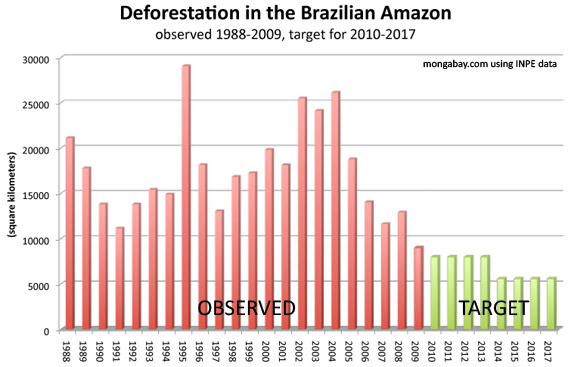
Brazil's proposed targets for reducing deforestation:

# 2006-2009 11,400 sq. km per year (2006-2008 averaged 12,500)

# 2010-2013, 7,980 sq. km per year
# 2014-2017, 5,586 sq. km per year

"Rich countries still have to do their homework," Minc was quoted as saying by Reuters.

Brazil aims to reduce its own emissions by 40 percent by 2020 relative to a business-as-usual scenario. If acheived, the country's emissions in 2020 would be the same as 1994: 1.7 billion tons, or 19 percent below 2005 levels. Roughly half the emissions cuts would come from curbing deforestation in the Amazon. Brazil aims to reduce forest clearing 80 percent from a 1996-2005 baseline of 19,500 sq km (7,528 sq miles) over the next decade. Deforestation accounts for around three-quarters of Brazil's total CO2 emissions and about 17 percent worldwide.

Brazil Moves to Restrict Foreigners’ Land Purchases in the Amazon

30th October 2009
From: Bridges Trade BioRes News Digest

In an effort to combat ‘biopiracy’ and regulate the Amazon rainforest’s occupation by foreigners, the Brazilian House of Representatives approved on 13 October a bill that restricts the purchase of land in the region by non-Brazilians.

The proposed legislation imposes two conditions for foreigners to acquire rural property in the Amazon region: the property must not exceed roughly 1500 hectares, and the potential purchaser must have lived in Brazil for at least ten years.

The legislation also includes a clause that requires purchased property to be productive so that it might fulfil its ‘social function’. Properties acquired before the law’s enactment - even those that exceed the 1500-hectare limit - might be kept, as long as the proprietors can prove the land’s productivity. For this, the government will conduct a survey of all foreign-owned properties in the region. If the latter measure is accomplished, it will mean a great step forward in the monitoring policy for the region.

In a strategic move, the bill also forbids the purchase of land in the Amazon region that borders other countries. The 150-kilometre area in question is critical for monitoring and controlling cross-border activities, especially the trafficking of genetic natural resources.

During a Parliamentary Investigation Commission on biopiracy, Parliamentarian José Genoíno showed his fellow lawmakers an advertisement from a Brazilian real estate agency that was aimed at foreigners. The ad offered large plots of land rich in mahogany, precious minerals, and animal fossils.

Brazil has long been concerned about the threat of bio-piracy - the illegal appropriation of indigenous knowledge about medicinal plants and other resources - but analysts say that previous efforts to regulate the issue have been insufficient. Many amendments and complementary bills have been put forward in the past ten years, but none has been turned into law.

The House-approved bill will now move to the Senate.

What lies beneath the rainforest

Saturday, 31 October 2009
From: Independent

The tropical rainforest in the eastern lowlands of Ecuador assaults the senses: the sunlight dazzles the eyes, the heat is so fierce that within seconds one's clothes are soaked in sweat. Then there are the sounds: a hypnotic symphony of frogs, crickets and other insects and birds which continues unabated day and night. There are sudden glimpses of the jungle's abundant wildlife: a spectacular flash of a blue morpho butterfly at the river's edge, a flock of green parakeets screeching.

This stunning region, which covers more than a third of Ecuador's area, almost the size of England, and which is one of the world's richest biospheres, with a huge diversity of animals and plants, some found nowhere else on Earth, faces a double threat: from the logging industry, which would strip it bare, and from the oil industry, which for nearly 40 years has been exploiting the huge resources of crude beneath the soil. Now, however, Ecuador is betting it can keep what is left of the oil in the ground and hang onto its biosphere into the bargain.

The South American country has learned the hard way that oil brings human misery and environmental devastation along with billions in export earnings. Every new oil field is an invasion that brings tens of thousands of outsiders into the forest's heart, polluting the air, soil and water, destroying wildlife, and assaulting the support systems of indigenous tribes, which can lead to their extermination. And the damage is not confined to the immediate vicinity of the wells.

The Via Auca is the main highway cutting through the Ecuadorean Amazonia region, and it has been a lifeline of the oil industry for nearly 40 years, slicing through the countryside like a badly healed wound, the roadside lined with hellish flares, murky waste pits and corroded pipelines. Accidents involving the pipelines are frequent, and their consequences harrowing. On the far side of the town of Dayuma, which sprang up as an oil workers' shantytown and is still riddled with crime and prostitution, one of the ageing pipelines has ruptured, sending a jet of oil shooting 30 metres into the air, staining the vegetation black all around.

The sickly stench of crude oil is overwhelming in the midday tropical heat. A house and a field across the road have also been soaked by the filthy gusher. Sebastian Ortiz, whose elderly father owns the simple wooden house by the roadside on the edge of the jungle, points out where the oil has drenched the field and seeped into the ground. Petrobel, one of many oil companies now operating in the region, has said it will pay his father US$5,000 (£3,000) towards the clean-up costs. But Ortiz says: "I don't know when he will be paid, or even if it is still safe for him to carry on living here."

Pollution is only one of the many ills that the oil business brings with it. Fernando Moreno, an anthropologist with the Ministry of the Environment, has been monitoring the oil industry's effect on the local community for years. "The people have become beggars" he says. "They have become accustomed to demanding whatever they need and more from the oil companies, just because they are in the same territory. Weighing up the benefits and drawbacks of the oil companies, I think it would be better not to have them. They lead to many bad habits, they make people avaricious, they increase the differences between people – and they are a source of contamination: for the land, the water and the people themselves."

For the last 16 years Ecuador has been embroiled in a bitter battle over a huge $27.3 billion environmental damages claim brought against US oil giant Chevron by 30,000 Amazonian inhabitants. The plaintiffs accuse Texaco (which Chevron acquired in 1993) of dumping more than 18 billion gallons of toxic waste into the rainforest between 1964 and 1990, and claim that 1,400 deaths occurred in the region as a result of the contaminated soil and water, which brought unaccountably high levels of cancer, skin and breathing conditions. The Amazon Defence Coalition, which represents the plaintiffs, says the scale of the pollution makes it the biggest environmental disaster in the world, dwarfing the 1989 Exxon Valdez oil spill and leading some experts to dub it "South America's Chernobyl". It is certainly shaping up to become the world's biggest environmental lawsuit.

Chevron robustly refutes the allegations. It says Texaco spent US$40 million on a clean-up before it handed over operations to the state oil company in 1992. Ecuador's government then signed a release freeing Chevron from any liability for subsequent damages from potential oil contamination.

Whatever the outcome of the legal battle Ecuador is now banking on a new idea to help it shed its poisonous dependency on oil. The Yasuni-ITT Initiative aims to keep the region's remaining oil reserves untapped and underground, in return for financial compensation from the international community and carbon offsets from the carbon markets.

The crux of the scheme is simple: to keep the oil beneath the Yasuni National Park where it is, in perpetuity. Covering nearly 2.5 million acres of primary tropical rainforest, Yasuni is the ancestral territory of the Waorani people and two other tribes, the Tagaeri and the Taromenane. It was named a Unesco biosphere reserve in 1989, and scientists regard it one of the most biodiverse places on earth.

It is also the home of Ecuador's largest oil reserve. But by not extracting the estimated 846 million barrels of oil in the reserve, Ecuador will keep an estimated 410 million metric tons of carbon dioxide from entering the atmosphere, making a big contribution to the fight against global warming.

It will also pledge to respect the territories of the indigenous cultures living in the national park, as well as protecting its flora and fauna. In return, the Ecuadorean Government has asked for compensation of $350 million a year for 10 years, which would be invested in environmental and social development programmes, helping the country move towards a sustainable economy.

After a slow start the plan has begun to attract serious promises of commitment. Amazon Watch, an organisation dedicated to protecting the rainforest and its indigenous inhabitants, calls it "a landmark proposal ... a precedent-setting effort by an oil-exporting nation to preserve a global biodiversity hotspot, protect indigenous rights and set the stage for its own economic and energetic shift away from fossil fuels".

Some big international players agree: Germany has offered $50 million on condition that other nations stump up similar sums. Ecuador's President Rafael Correa, and Yolanda Kakabadse, a senior member of the Yasuni commission, have been in London and continental European capitals this week spreading the word. And in December Ecuador's former chancellor Francisco Carrión, the Government's envoy on the initiative, will present it at the UN Climate Change Conference in Copenhagen.

Among Ecuadoreans themselves, the initiative is welcomed particularly by the flourishing tourist industry. With a spectacular range of natural attractions, from the Galapagos Islands to the snow-peaked Andes, Ecuador has long been a pioneer in ecotourism.

Fander Falconi the foreign minister and one of the founders of the initiative, says the scheme will work on the basis of shared responsibility, locally and globally. "What we are aiming for is global sustainability, but with a distinction drawn between those who harm the environment and those who suffer the consequences of this harm."

Luz Coloma, Yasuni-ITT's press officer, added, "Ecuador has had sad experiences with the exploitation of oil and no one wants any more environmental disasters like the Chevron-Texaco case."

On the banks of the Shiripuno river, to the west of the Yasuni National Park, is the Huaorani Ecolodge run and owned by formerly nomadic hunters who only came into contact with the outside world 50 years ago. Omene Paa, a tour guide at the lodge, tells how oil has been a curse for his people from the time "the path-cutters" first arrived. The "petrolera" companies brought disease and contaminated the water, he claims. One of his cousins died of a lung infection. Now Omene says his people, who first fought off the US oilmen with axes, just want to be allowed to live in peace. "Our battle should continue; we the Huaorani must look after our territory."

Friday, October 30, 2009

Google partners with Amazon tribe

October 29, 2009
From: mongabay.com

The story of an indigenous Amazon tribe that has embraced technology in its fight to protect its homeland and culture is now highlighted as a layer in Google Earth.

Videos, pictures, maps, and information about the Surui, a tribe that was garnered international attention for its battle against loggers and its partnership with Google Inc., is available via Google Earth.

First exposed to the outside world in 1969 — an event that nearly resulted in their extinction due to introduced diseases — the Surui today work with Google and other partners map and monitor their territory using cutting-edge technology. While the use of technology has helped the Surui secure their land, it has unexpectedly strengthened cultural ties between young and old members of the tribe.

"Surui elders provide the traditional knowledge, while the younger generation uses the technology," said Vasco van Roosmalen, director the Amazon Conservation Team in Brazil, an NGO that works closely with the Surui.

Rainforest insect enthusiast educating children

October 29, 2009
From: Cool Earth

An insect enthusiast who has a collection boasting almost 6,000 bugs has told of using his collection to educate local children about the huge amount of different types of species the world offers.

Speaking to the Leader Telegram newspaper, John Hempel, 66, said that "one of his greatest joys" is being able to share his bug collection with youngsters.

Mr Hempel visits local schools in his native Eau Claire, Wisconsin, to give a 40-minute talk on his collection, which includes a "flying walking stick" from Indonesia and a buck moth cocoon.

"It's a neat way to keep mementos of places you've been. Every specimen I have has a tag on it with two important pieces of information ... when and where," he said.

While his collection is already extensive, the collector told the source that his dream find would be the titanus giganteus beetle which lives in the Amazon rainforest and can grow as long as 6.5 inches.

How to protect the fragile eco-system of the Amazon rainforest is set to be on the agenda at the upcoming climate change conference in Copenhagen in December.

Brazil Military Transport Plane Vanishes Over Amazon

October 29, 2009
From: Bloomberg

A Brazilian military plane carrying medical personnel from the national health service disappeared this morning while flying over the Amazon, the Air Force said.

The C-98 Caravan, which has a capacity of 14 passengers and a pilot, was scheduled to land in Tabatinga, along the Colombian border in Amazonas state, at 10:15 a.m. New York time after a two-hour flight from Cruzeiro do Sul. A search mission of two Blackhawk helicopters and two military planes are in the area, the Air Force said in a statement on its Web site.

The plane, made by Wichita, Kansas-based Cessna Aircraft Co., was carrying a nurse and seven assistants from the National Health Foundation in Acre state, CBN Radio reported. They were on their way to administer vaccinations in indigenous communities in the Amazon, CBN said.

The Air Force confirmed there were 11 people on the aircraft. The military will set up a search operation headquarters in Cruzeiro do Sul, the statement said.

Brazil’s Amazon, an area 15 times the size of Germany that’s home to the world’s largest rainforest, has seen several air tragedies in recent years.

In February, 24 passengers were killed when the engine of an EMB 110 Bandeirante aircraft operated by Manaus Aerotaxi failed, causing a crash into a tributary of the Amazon River. In 2006, 154 people were killed when a Gol Linha Aereas Inteligentes jetliner collided midair with an Embraer Legacy executive jet before crashing into the rainforest canopy in Mato Grosso state.

Chevron tried to taint Ecuador toxic waste trial: lawyer

29th October 2009
From: AFP

Videos posted online by US oil company Chevron purporting to show rampant corruption among Ecuadoran officials, are actually a set-up meant to taint an ongoing trial against the energy giant, an attorney in the case alleged Thursday.

"By releasing the videos, in my opinion Chevron is trying to taint a trial process that they knew they were going to lose, with the hope that the case would be dismissed in Ecuador," Steven Donziger, an attorney for Ecuadoran Amazon communities who are suing the oil giant told reporters.

Chevron at the end of August released several grainy videos purporting to show "a three-million dollar bribery scheme implicating the judge presiding over the environmental lawsuit" against the US oil major.

The Ecuadorans allege that Chevron dumped billions of gallons of toxic waste into the Amazon.

But a report released Thursday by the Amazon Defense Coalition found that the individuals said to have produced the video were convicted felons with "a habit of breaking the law" and with longstanding ties to the oil company.

"This report raises serious questions about Chevron's credibility," Donziger said.

He raised the possibility that the videos were an effort by Chevron to "try to create a game-changer to disrupt or derail the trial and get this judge off the case, because it was clear this case was heading towards a conclusion."

The presiding judge on the case recused himself days after the videos were released.

Ecuador Attorney General Washington Pesantez said last month he was seeking action through the US Justice Department against Chevron over the videos.

Chevron is being sued for damage allegedly caused to to the Amazon rainforest between 1964 and 1990 by Texaco, a company it bought in 2001.

Experts estimated in 2008 that Chevron could be liable for damages of up to 27 billion dollars.

Wednesday, October 28, 2009

Crisis averted for now, Peruvian natives will meet with Hunt Oil

October 28, 2009
From: mongabay.com

Indigenous groups in a dispute with Hunt Oil, over the company performing seismic tests their land, have scheduled a meeting with the Texas based oil corporation, according to Reuters.

Prior to this, representatives of the indigenous group had said that they would defend "the protected area with their lives" and the groups were reportedly headed to the town if Salvacion to forcibly remove the company from the area in question known as Lot 76 or the Amarakaeri Communal Reserve.

"There is going to be a dialogue. We have to wait for the result of this meeting before we know about the removal," Maria Gonzalez of FENAMAD (the Native Federation of the Madre de Dios) told Reuters.

Lot 76 is designated as a protected reserve for the conservation of biodiversity and the preservation of headwaters vital to the tribes. The issue is currently in Peruvian court.

The President of Peru, Alan Garcia, is backing the oil company arguing that while the indigenous groups own the land, the government of Peru owns the subsurface rights.

The exploitation of oil reserves in the Peruvian Amazon has become particularly sensitive since a tragic incident in June. Protesting government's plans to extract natural resources from the Amazon, indigenous groups and police clashed. During the ensuing violence, now known as Bagua, twenty-three police were killed and at least ten protestors according to official numbers. Indigenous groups, however, say that hundreds remain missing and have asked for a Truth Commission to investigate the incident.

Peru tribes pressure Hunt Oil to leave Amazon

28 Oct 2009
From: Prdomain Business Register

Tribes in Peru say they want U.S. energy company Hunt Oil to abandon an exploration project in a virgin corner of the Amazon rainforest, and they have filed legal challenges against the government and the company to force it out.

Representatives of the tribes said on Tuesday they would sit down for talks with officials representing Hunt. Earlier this week, the tribes threatened to forcibly remove oil workers from a camp near the town of Salvacion in the Madre de Dios region of southern Peru.

"There is going to be a dialogue. We have to wait for the result of this meeting before we know about the removal," said Maria Gonzalez of the Fenamad indigenous rights group.

The tribes say a government concession to Hunt and Spain's Repsol to look for oil in Block 76 is unlawful because it overlaps the Amarakaeri Communal Reserve, protected ancestral lands that could hold billions of dollars of oil deposits.

As the complaints wind their through the courts, the government of President Alan Garcia contends that the tribes control only surface rights of the reserve, while the government can lease subsoil mineral rights to foreign companies.

Amazon Defense Coalition: Chevron Admits Its Lawyers Present at Key Meeting with Ecuador Man Who Taped Video Scandal

Wed Oct 28, 2009
From: Reuters

In New Letter, Company Refuses to Turn Over Forensic Analysis of Videos;
Confirms Ongoing Payments to Ecuadorian Contractor Who Made Tapes
WASHINGTON--(Business Wire)--
In a stunning admission, Chevron`s top outside counsel on the Ecuador
environmental case has publicly conceded that the company`s own lawyers met with
a Chevron contractor regarding his secret video recordings just days before he
taped a critical meeting in Ecuador about a purported bribe that the company is
trying to use to taint a trial where it faces a $27.3 billion environmental
liability.

The Chevron lawyer, Tim Cullen of Jones Day in Washington, D.C., writing to
Ecuador`s Solicitor General Diego Garcia Carrion in a letter dated Oct. 26, made
it clear that the company is not fully cooperating with Ecuador`s official
investigation into the matter and is refusing to turn over its own expert
forensic analysis of the secret videos. Several people in the taped meetings,
including the judge then presiding over the trial, claim the videos released by
Chevron were doctored in the editing process.

The admission in Cullen`s letter that Chevron`s lawyers were at the meeting with
the Chevron contractor, Diego Borja, contradicts the company`s earlier
statements that it knew nothing about the secret taping until it was contacted
after all four meetings were completed. It also provides additional proof that
Chevron`s U.S.-based officials, in addition to its Ecuadorian counsel, likely
played a role in planning or facilitating the scandal as a sting operation to
derail a trial they expected to lose, possibly in violation of U.S. criminal
laws prohibiting bribery of foreign officials, said Steven Donziger, an American
who advises the 30,000 plaintiffs suing the company.

The underlying lawsuit accuses Chevron of dumping more than 18 billion gallons
of toxic waters into the Amazon when Texaco (now Chevron) operated an oil
concession in the country from 1964 to 1990. The plaintiffs have presented
evidence of soil and water contamination over an area the size of Rhode Island,
leading to hundreds of cancer deaths and the decimation of indigenous groups.
The trial, in Ecuador at Chevron`s request after the company argued it should be
moved from U.S. federal court, started in 2003 and is expected to end within
months.

Cullen`s letter also explicitly confirmed for the first time that Chevron is
helping Borja find employment in the U.S.; that it is paying the legal fees of a
prominent San Francisco-area criminal defense attorney, Cris Arguedes, to
represent Borja; and, that it is making ongoing payments to Borja, including a
salary or stipend, and expenses for transportation and housing.

"Benefits Chevron admits it is providing to Borja and his family are truly
life-altering," said Donziger. "Chevron would not have done this unless it felt
it needed to control Borja, or that it owed him something for a service he
provided."

The Cullen letter also makes it clear that ties between Chevron and Borja are
significantly tighter than previously disclosed by Chevron. When Chevron
disclosed the secret tapes on August 31 by posting them on YouTube, it said its
only relationship to Borja was that he was a former Chevron contractor.

Chevron did not initially disclose that Borja has an office in the same small
building in Ecuador as Chevron`s local counsel and that his "contracting" work
for the company was handled by same the Chevron lawyers litigating the
environmental case in Ecuador where the company faces the $27 billion liability,
facts which have been reported by various journalists.

"Each additional communication by Chevron casts further doubt on the company`s
own credibility and suggests Chevron`s own lawyers in both Quito and the U.S.
played a role in orchestrating possible criminal misconduct to evade a judgment
at trial," said Donziger.

Both the Ecuador government and the plaintiffs have called on the U.S.
Department of Justice to investigate the matter to determine if any U.S. laws
were violated.

"All of Chevron`s lawyers and outside counsel at the June 18th meeting with
Borja need to be questioned under oath to determine if an act of corruption was
planned so an American company could evade a legal obligation to clean up
pollution it caused in the rainforest - pollution that is killing people and
destroying indigenous groups," said Donziger.

Donziger added: "It is clear that Chevron is not fully cooperating with the
Ecuadorian government`s investigation and is withholding critical information
and witnesses that are under its control in U.S. territory. This makes it even
more imperative for U.S. authorities to devote the necessary resources to
determine what happened."

The Cullen letter, a response to a request for information by Ecuador`s
Solicitor General, was posted on Chevron`s website on Tuesday. It contains a
number of additional revelations that suggest Chevron`s hand in creating and
publicizing the videos:

* Chevron refused in the letter to answer the critical question of how Borja
ended up meeting with Chevron`s U.S. lawyers in San Francisco on June 18 and
19th; who arranged the meeting; when the meeting was arranged; who arranged to
pay Borja`s travel expenses; what Borja was promised by Chevron in return for
flying to the U.S. and providing the tapes; whether Chevron promised him
employment; and how much money Chevron has provided him as support and for how
long he will receive that support.
* The letter contradicts Cullen`s initial statement on August 31, in a letter to
Ecuador`s Attorney General, that the videos innocently fell into Chevron`s
hands. Chevron now says Borja was in the San Francisco offices of Cullen`s law
firm on June 18th and June 19th of this year in the presence of Chevron in-house
counsel, just before Borja flew back to Ecuador to tape the critical fourth
meeting on June 22 (the only taped meeting where a bribe was explicitly
discussed). In the letter of August 31, Cullen had said: "The recordings were
made in May and June of this year without Chevron`s knowledge." Chevron repeated
the same claim in a corporate press release the same day.
* Chevron has refused to disclose the names of the Chevron lawyers at the
meeting with Borja, and whether they included Charles James. James, Chevron`s
Executive Vice President who reports directly to CEO David O`Reilly, has been
supervising the legal case and has led the public relations charge to discredit
Ecuador`s judiciary.
* Cullen confirmed in his letter that Chevron is paying the legal fees of Borja
and Hansen to be represented by criminal defense attorneys, another fact it did
not initially disclose. Thus far, these criminal attorneys are refusing to allow
Borja and Hansen to explain their role in the scandal. It now appears the
attorneys were retained by Chevron before August 31 so they could not be
questioned by journalists or be easily available to investigators.
* Cullen said Chevron refuses to turn over the forensic analysis of the secret
tapes it had commissioned from an expert, Dr. Durand Begault. Cullen admitted
the tapes contain "fragments" of video and were edited by Chevron for purposes
of posting them on YouTube. Clearly, if Chevron were cooperating with the
investigation as it claims, it would have no reason to hide its own expert`s
report and would provide the names of the Chevron employees or contractors who
edited the tapes and make them available for questioning, said Donziger.

Chevron`s allegation that a bribe was to take place hinges almost completely on
the video of the fourth meeting, which took place just after Borja met with the
Chevron lawyers in San Francisco, said Donziger. In the first three taped
meetings, there was no explicit connection between any possible bribe and the
judge presiding over the environmental trial. Only in the fourth meeting were a
series of leading questions posed by Borja to third parties that tried to
implicate the judge, who was not present.

On the basis of the fourth meeting, Chevron attempted via a major public
relations campaign to tie the judge to the scandal but provided no supporting
evidence other than questions by its own contractor and answers from a man who
claimed to be an official of Ecuador`s ruling party, but in reality is a car
salesman, according to news accounts.

Judge Nunez, who claimed he was set up by Chevron, later withdrew from the case
to avoid any appearance of impropriety. The plaintiffs have asked that the
investigation by Ecuadorian authorities determine whether Judge Nunez and
Chevron did anything improper.

A final judgment in the trial, now presided over by another judge, is expected
in early 2010.
ECUADOR: Oil Giant Is Gone, Legal and Environmental Mess Remains

Oct 28, 2009
From: IPS News

The story began almost 40 years ago, but when filmmaker Joe Berlinger "saw villagers eating canned tuna fish because the fish in their rivers were too contaminated to eat, [he] knew [he] had to do something".

The product of that realisation is the new documentary "Crude", the latest weapon in an escalating PR war taking place alongside the equally contentious legal war over whether Chevron should be held responsible for the 916 waste pits of crude oil that dot the Amazonian region of northern Ecuador – and the cancer and other health problems that have plagued the Lago Agrio region.

Beyond these hard facts – that a crime was committed and that there are serious and long-lasting health hazards in the area – the rest remains to be definitively decided by the courts of public opinion and Ecuador.

This rest consists of determining whether, in fact, Chevron should or can be held legally responsible, how the damage done to the area and the people there might be remediated, and even whether there is any truth to the doubts that Chevron has tried to cast on there being a direct link between the contamination and disease.

"What happened with the Exxon-Valdez spill was an accident, but what happened in Ecuador wasn't - it was deliberate," said Luis Yanza, part of the Ecuadorian legal team representing the plaintiffs – villagers from the polluted region. He spoke at the Washington premiere of "Crude" on Oct. 23.

"We see the pictures, we see the pollution, it's just not ours," said incoming Chevron CEO John Watson at the U.S. Chamber of Commerce Tuesday. "These are preposterous claims with no basis in science."

In the 1960s, Texaco began drilling in a remote part of the Amazon rainforest, and in the 23 years that it operated the site it spilled 17 million gallons of oil and dumped 18 billion gallons of toxic wastewater, according to Amazon Watch, an organisation promoting the case of the Ecuadorian plaintiffs.

Texaco turned over its operations in the area to state-owned PetroEcuador in the early 1990s. PetroEcuador continues to operate in Lago Agrio today, and up until last year, according to the company, continued to dump wastewater in the surrounding environment.

Chevron, which acquired Texaco in 2001, says the gooey mess is largely PetroEcuador's fault. It says Texaco was absolved of responsibility when it completed, in 1998, a 40-million-dollar cleanup of some of the dump sites, which it had agreed with the Ecuador government three years prior.

But a 2003 report by government auditors said Texaco had failed to properly execute its side of the bargain. Chevron rejects those findings, but in "Crude" villagers describe how they built houses in clearings they later discovered were simply oil pits covered over with dirt.

Watson reiterated Tuesday that Texaco was assigned a share of the remediation and "got full sign-off from the government" that it was completed.

PetroEcuador, Watson said, not only never cleaned up its share but continues to pollute today.

"Many of the practices Texaco used continue to be used today, though PetroEcuador has made many changes since Texaco left in order to operate more responsibly," said Yanza.

"Texaco," he said, "was the sole designer of a system that was designed to pollute and they have the full responsibility."

Another of the plaintiffs' lawyers, Pablo Fajardo, mentions in the film that PetroEcuador is not innocent, however, and suggests they might be taken to court next.

Meanwhile, 1,401 cancer deaths in the region can be tied to the presence of pollution caused by Texaco from 1985 to 1998, according to a report by an independent panel that the court commissioned to assess Texaco's portion of the social and environmental damage in economic terms. The report concludes Chevron owes 27 billion dollars to clean up and compensate the affected communities.

This amount would make the case the largest environmental suit in history, and has thus brought out all number of legal strategies and ploys as one side fights for the money to pay for cancer treatments and clean drinking water and the other to avoid losing more than three billion dollars more than its 2008 profits.

"It will be very expensive to clean up," plaintiffs' attorney Steven Donzinger said Friday, "but far less than the profits they took out of Ecuador."

The legal battle has dragged on for 16 years.

In 2002, a U.S. court eventually agreed with Chevron's argument that the case should be tried in Ecuador's courts, though on the conditions that the company stop using an expiration of the statute of limitations as a defence and that any judgment be enforceable in the U.S.

In the concrete office buildings of Ecuador's courts, a tangle of espionage and accusations has developed in recent months – likely what Chevron had hoped for by sending the case to Ecuador in the first place, according to the plaintiffs' lawyers.

Recordings from bugging devices implanted in watches and pens appear to reveal a bribery scheme involving, at least indirectly, the judge overseeing the case, the sister of President Rafael Correa and an Ecuadorian man hoping to secure clean-up contracts for a U.S. businessman.

The judge, Juan Nuñez, has since recused himself from the case, though he denies any wrongdoing.

The plaintiffs' lawyers contend this whole episode was a ploy by Chevron to distract from the central issues of the case and, especially, to undermine the Ecuadorean court system.

A motion by Chevron last week to annul the previous judge's decisions in the case was rejected by new judge Nicolas Zambrano.

While Nuñez said last year that a decision was likely before the end of 2009, there remains no end in sight.

"If we lose and if enforcement is sought elsewhere, we will fight very vigorously," Watson stated Tuesday.

The issue of responsibility for the pollution is as sticky as the pollution itself. The case seems to reveal an inability of courts to deal with problems such as this, where a transnational corporation appears to be at least partly at fault and has the resources and will to easily fight a decades-long legal battle.

Chevron doesn't "want it in court at all", said Donzinger, referring to the company's efforts to move the case from the U.S. to Ecuador and then to raise questions about the legitimacy of the Ecuadorian courts. "They believe they're beyond the reach of any national system."

Meanwhile, the battle in the court of public opinion is all but won in Ecuador, where the immensely popular left-wing Correa has sided with the plaintiffs after years of more conservative governments in Quito. But Chevron retains its influence in the U.S, where it has worked to portray itself as the most socially conscious of the oil giants.

"At the end of the day, I don't think it's just a money question for [Chevron] but a reputation question," Donzinger said last week.

Chevron's efforts on the PR front, however, may wear down long before their legal efforts, as new campaigns, like that tied to the film, are being launched and awareness of the case is continuing to spread.

Star power, from Sting to Kerry Kennedy to politicians, has also been enlisted on what is being referred to as the David side of this David and Goliath battle.

U.S. Congressman Jim McGovern, a Massachusetts Democrat, who has visited Lago Agrio, said Friday, "As a congressman and an American citizen I feel ashamed."

Chevron owes the villagers a settlement, he said. "They have a moral and, I believe, legal obligation to settle this case."

Will Ecuador's plan to raise money for not drilling oil in the Amazon succeed?

October 27, 2009
From: mongabay.com

Ecuador's Yasuni National Park is full of wealth: it is one of the richest places on earth in terms of biodiversity; it is home to the indigenous Waorani people, as well as several uncontacted tribes; and the park's forest and soil provides a massive carbon sink.

However, Yasuni National Park also sits on wealth of a different kind: one billion barrels of oil remain locked under the pristine rainforest. While drilling for oil has brought huge profits--the commodity is Ecuador's top export--it has also brought environmental destruction and conflicts with indigenous groups, including a legal one between several tribes and Chevorn highlighted by the new film Crude.

In a country where oil extraction has a long, bloody, and contentious past, President Rafael Correa put forth a novel idea, known as the Yasuni-ITT Initiative. He announced in 2007 that he would not touch the oil if the international community compensated Ecuador. He said that leaving the oil would help achieve three international objectives: protecting biodiversity, respecting the rights of indigenous people, and combating climate change, since it is estimated that extracting the oil would release 410 million metric tons of carbon.

"Oil and gas concessions now cover vast swaths of the mega-diverse western Amazon. Ecuador´s revolutionary initiative is the first major government-led effort to buck this disturbing trend," says Dr. Matt Finer from Save America's Forests. Finer is the lead author of a new paper in Biotropica that looks at the viability of Yasuni-ITT, and the hurdles it will have to jump to even be implemented.

The most difficult hurdle is how to get paid for leaving oil instead of selling it. At first Ecuador, with an economy largely dependent on oil, asked international countries for compensation of around 350 million US dollars per year (about half of what could be expected from the oil). However, after several deadlines—and two years—passed without raising the funds, Ecuador has now turned to the burgeoning carbon market by offering 'Yasuni Guarantee Certificates'. Yet as the Biotropica paper points out this means that the initiative would not result in a net less in carbon, since nations and companies would likely offset continuing pollution.

"The best way to minimize the risk associated with the carbon bonds is to encourage supporters to make direct donations," said Remi Moncel of the World Resources Institute. "While less problematic from the point of view of environmental integrity, it is harder to raise money that way."

Yasuni-ITT is an example of just how difficult such donations are. Germany has been the largest verbal supporter of Yasuni-ITT. Numbers have been tossed around, but the nation has yet to put forward any real money and recent reports suggest that Germany may be backing-off original promises. Other European nations have shown interest including Spain and France.

Despite the difficulties facing Yasuni-ITT—including making certain that countries compensating Ecuador won't decide to drill for themselves in the future—the researchers believe that Yasuni-ITT will become a model both for oil and gas drilling in areas where it would lead to environmental degradation, biodiversity loss, or local conflict, that is, should it succeed. As well, the authors say, Yasuni-ITT should be looked at as a creative way to combat climate change.

"The climate conference of Copenhagen is only weeks away. What Ecuador has proposed is a good example of how each country can come up with home-grown, nationally relevant ideas to promote sustainable development," Moncel said.

Dr. Clinton Jenkins of the University of Maryland says that the future of Yasuni national Park will ultimately rest on the value's of global society: "Yasuní is an exceptional place in the world, biologically incredible, home to uncontacted peoples, and yet – perhaps tragically – full of oil. Society faces a test of what we value more, drilling for more oil, or preserving a cherished national park and the people who call it home."

In terms of biodiversity Yasuni National Park supports 150 amphibian species and 121 reptiles (the highest numbers of herpetofauna on earth), in addition to 600 species of bird and 200 mammals. Such numbers are always changing, since new species are discovered frequently.

The reserve is also home to the Waorani people. In the past the warlike tribe often defended their homes violently: they became famous for spearing oil workers, missionaries, and illegal loggers, while the infringement on their territory by the wider world led to several epidemics and cultural upheaval. Tribes—both related and only distantly related to the Waorani—still remain uncontacted in the park today, such as the Tagaeri and Taromenane.

Due to the unique place that Yasuni National Park holds not just for Ecuador (it's the country's only Amazonian park), but for the world, it was designated a Man and Biosphere Reserve by UNESCO in 1989.

(Image: Yasuni National Park in Ecuador. Photo by Matt Finer © Save America’s Forests.)

Rhiza Labs joins Google to help Amazon tribe save its homeland

27 Oct 2009
From: Pop City

The South Side's firm was asked by Google and the Amazon Conservation Team (ACT) to develop a platform that gathers data on "rugged" mobile devices and creates detailed maps, which will be used to chart the Surui territory in Brazil. Armed with the technology, the tech-savvy tribal leaders plan to put the maps on Google Earth to prove irrefutably that illegal mining and logging is taking place on their 600,000 acres.

"For thousands of years this tribe has been known as one of the fiercest in the Amazon," says Josh Knauer, CEO. "They ate their enemies! Cut down by disease, they traded their bows and arrows for laptops. Now they are using the Internet as a tool in the fight to save their rainforest."

The Surui, pronounced su-roo-wee, was 5,000 strong up until the 1960s when it first came into contact with outsiders during a highway construction project. The following decade brought disease, poverty and continual fighting, nearly decimating the population. Today, only 290 remain.

Much of the region around the tribe's 600,000 acres has been cut down and burned by logging companies, says Knauer, who visited the homeland earlier this year. With hundreds of timber mills around them, and thousands of illegal logging jobs at stake, the tribe is under pressure to sell their land.

The elders have tasked Chief Almir, 35, with saving the tribe.

Almir was sent to college where he learned the value of a business plan. The tribe's strategy is to put the homeland on the global carbon offset marketplace where, like cap and trade, a company will pay the tribe to preserve its land for the right to pollute elsewhere.

The tribe stands to make tens of millions, says Knauer.

"We were brought in because we have easy to use tools to help communities collect data," says Knauer. "It has been such a major success that the Amazon conservation tem is bringing us in to do other projects in the Amazon."

Board OKs stadium replacement

October 27 2009
From: Daily Republic

The Mitchell school board gave its unanimous approval Monday to a plan to replace the aging stadium at Joe Quintal Field.

If bond financing goes according to plan, the 1,700-seat football stadium will be ready next September, said Mitchell Superintendent Joe Graves.

The board approved a proposal to select the Puetz Corporation as the provider for architecture and construction management services for a new $2.5 million stadium.

Graves told the board that the time is right to replace the 70-year-old stadium.

“It continues to deteriorate, current construction costs are reasonable and we have two possible lines of credit for the project,” he said.

According to Graves, Monday’s was the first of two agreements. The next step will be to draft the formal documents for architectural and construction management services and then bring those back before the board.

The agreement approved Monday sets the remuneration to Puetz Corporation at 9.8 percent of overall project costs.

As an “at risk” manager, Puetz is essentially assuring the district that it will assume the liability of completing the project on time and within budget parameters. Puetz will be responsible for selecting and managing all subcontractors.

Graves said he will continue to seek a donor for naming rights to the new stadium, but demolition and construction must begin soon if the stadium is to be ready in time for next season.

“The district can’t wait any longer if it is to take advantage of a good construction climate and low bond rates,” he said.

The federal government has authorized the sale of up to $2.5 million in Qualified School Construction Bonds (federal stimulus tax credit bonds) that originally were to have a zero percent cost to the school district. But the tax credit alone has not been attractive to draw the interest of investors, said school district bond agent Thomas Grimmond, senior vice president of Dougherty and Company, of Sioux Falls.

Grimmond, said Graves, recommended the district make the $2.5 million bond offering more attractive to large investors by combining it with a $2.8 million bond offering by Aberdeen Schools and by additionally paying a 2 percent interest rate.

There is no way of forecasting how enticing the bonds will appear to investors, said Graves.

If those QSCB bonds don’t sell, the district has the alternative option of selling Build America Bonds with a 3.5 percent interest rate. The latter bonds have proven more attractive to investors, he said.

Demolition will be completed this winter and construction will begin around April 1, weather permitting. Graves said the stadium won’t be ready for the start of football season. The earliest it will be available is Sept. 1, and the football season begins a week or two before that.

That time-limited reality already has Activities Director Geoff Gross working to reschedule Mitchell’s early home games, he said.

Gross said earlier Monday that a board OK for a new stadium “will be a positive step. A new stadium offers numerous possibilities for our football and track teams, our marching band and other current stadium users.”

The stadium will offer increased seating and accessibility and better facilities for crowd control, Gross said.

Wayne Puetz of Puetz Construction said the threemonth period between demolition and construction will be used to finalize the design of the stadium complex. Financing arrangements also must also be completed before construction can begin.

Graves said the stadium design will essentially follow the original conceptual drawings presented several months earlier by the Puetz Corporation.

“It will be 98 percent of that plan, but there could be some minor changes to accommodate additional storage or other needs,” he said.

Also Monday night, the board approved a memorandum of understanding between Puetz Development LLC, MTI and the MTI Foundation for a lease agreement for student housing.

The agreement states that Puetz Development will build three on-campus student apartment buildings over a five-year period, with an optional fourth building, depending on rental demand.

Middle school social studies teachers Justin Zajic and Kate Kramer and language arts teacher Ann Moege demonstrated to the board some practical laptop applications they use to enhance student learning.

Kramer and Zajic demonstrated how their students use Google Earth, a free Internet program, to learn geography and to understand ecological challenges, such as the deforestation of the Amazon rainforest; rising sea levels that threaten Venice, Italy; and the threat of desertification as the Sahara Desert encroaches into overgrazed land at its borders.

Moege showed how students use the computer programs to improve their writing, communicate with teachers and to share their understanding of literature with classmates and students from other schools.

The board also approved:

• Two home schooling and several enrollment applications from families with children temporarily in the district.

• The selection of Neil Putnam and Dana Price as voting delegate and alternate, respectively, to the Associated School Boards of South Dakota Delegate Assembly. The assembly meets annually to determine which issues should be presented to lawmakers at the upcoming Legislative session.

Board members agreed not to support the ASBSD planks that called for state funding for accredited pre-kindergarten programs, and voluntary common core academic standards. Of the latter, Graves said a common national standard would be lower than current state standards.

• The following personnel items: New hire: Wendy Dirks, food service at the middle school six hours a day at $8.78 an hour, effective Oct. 27. Resignation: Pat Beznik, assistant middle school wrestling, effective for the current school year.

• Change orders for construction at MTI with a net cost of $5,483.

• A lease with building owner Rodney Tuttle for a 5,000-square-foot building that will be used for MTI lab space to accommodate a class on large-engine repair that is part of the agriculture program.

RPT-Peru tribes pressure Hunt Oil to leave Amazon

Tue Oct 27, 2009
From: Reuters

Tribes in Peru say they want U.S. energy company Hunt Oil to abandon an exploration project in a virgin corner of the Amazon rainforest, and they have filed legal challenges against the government and the company to force it out.

Representatives of the tribes said on Tuesday they would sit down for talks with officials representing Hunt. Earlier this week, the tribes threatened to forcibly remove oil workers from a camp near the town of Salvacion in the Madre de Dios region of southern Peru.

"There is going to be a dialogue. We have to wait for the result of this meeting before we know about the removal," said Maria Gonzalez of the Fenamad indigenous rights group.

The tribes say a government concession to Hunt and Spain's Repsol (REP.MC) to look for oil in Block 76 is unlawful because it overlaps the Amarakaeri Communal Reserve, protected ancestral lands that could hold billions of dollars of oil deposits.

As the complaints wind their through the courts, the government of President Alan Garcia contends that the tribes control only surface rights of the reserve, while the government can lease subsoil mineral rights to foreign companies.

Tribes, frustrated by the slow pace of court cases and the government's stance, say Peru's position ignores their rights to autonomy and self-determination under the U.N. charter on indigenous peoples.

Hunt Oil declined requests for an interview about the controversy. In the past, the company has said the exploration work is being undertaken with special care for the environment and that its contract complies with Peruvian law. Besides Block 76, Hunt is part of the Camisea consortium developing Peru's natural gas fields.

Activists have said they wanted to avert violence after a clash between police and indigenous protesters in Peru's northern Amazon in June killed 33 people.

Protesters in that clash -- known as Bagua -- had mobilized to force Garcia to repeal laws that would have made it easier for foreign mining and oil companies to invest in other areas of the rain forest.

Beatriz Huertas, an anthropologist from Fenamad, says the government and Hunt have tried to undermine the legitimacy of her group by ignoring public meetings it held.

Huertas says the government is mainly interested in protecting the investments of foreign companies who want to work in areas of the Harakmbut, Yine and Machiguenga tribes.

"The government isn't interested in indigenous rights," she said. "It hasn't learned a things since Bagua."

Marco Pastor Rozas of Sernanp, the government agency that oversees protected lands, has said Hunt's plan meets environmental guidelines and it enjoys the support of at least four of eight communities near the Amarakaeri reserve.

SEISMIC EXPLORATION

Leaders from two indigenous associations in the area, Fenamad and Coharyima, along with the Amarakaeri reserve, signed a letter this month saying they would "take actions to stop seismic work in the interior of the reserve and even put our lives on the line so that our rights are respected."

Block 76 covers 3.5 million acres and is one of dozens of blocks auctioned in recent years in Peru, which has pushed exploration so that it can become a net petroleum exporter.

Fenamad says maps of Hunt's seismic exploration plan includes putting explosives or other equipment that causes powerful vibrations all along a big circle that sits within the reserve so geologists can map oil and natural gas deposits.

They say the process will cause deforestation in a headwaters area of the Amazon basin.

Tuesday, October 27, 2009

Amazonian natives say they will defend tribal lands from Hunt Oil with "their lives"

October 25, 2009
From: mongabay.com

Indigenous natives in the Amazon are headed to the town of Salvacion in Peru with a plan to forcibly remove the Texas-based Hunt Oil company from their land as early as today. Peruvian police forces, numbering in the hundreds, are said to be waiting in the town.

The crisis has risen over an area known as Lot 76, or the Amarakaeri Communal Reserve. The 400,000 hectare reserve was created in 2002 to protect the flora and fauna of the area, as well as to safeguard watersheds of particular importance to indigenous groups in the region.

Despite its protected status, in 2006 the Peruvian government granted concessions within the reserve to two oil companies, Hunt Oil and the Spanish company Respol.

According to FENAMAD (the Native Federation of the Madre de Dios) protections had been slowly and systematically stripped from the reserve without indigenous groups' input. In addition, FENADMAD contends that Hunt Oil has violated international standards and the Peruvian constitution by going ahead with their operations without approval from the indigenous groups.

Hunt's director of environmental health and safety for Lot 76, Silvana Lay, disagrees. He told the Indian Country Today that “we weren’t going to come in until the Master Plan was approved. We waited two years, and during that period we met with the communities and gave information. We have the signatories of everybody saying the work can go ahead – within the rules, of course. And then we received a call saying the work cannot go ahead.”

However, indigenous groups say that Hunt Oil only met with two communities: the Shintuya and the Puerto Luz, leaving others who use the reserve out in the cold.

A document written by FENAMAD further alleges that the Environmental and Social Impact Study conducted by Hunt Oil and approved by the federal government is "completely irresponsible and [does] not describe any reality for the area. It was approved illegally and unconstitutionally, in spite of the observations made by a group of professionals from civil society in Madre de Dios."

On September 13th of this year representatives of indigenous groups released a statement that said "the entry of Hunt Oil and Respol into the interior of the Amarakaeri Communal Reserve to execute seismic projects is not accepted, a decision that will be respected by the Peruvian State, Hunt Oil and Repsol, who have been present witnesses to this decision."

However, Hunt Oil has continued its seismic surveys inside the reserve. It is their unwillingness to halt activities that has prompted the indigenous groups to travel to Salvacion and, according to statements made by the indigenous groups, forcibly remove the US-corporation from their land.

"The most vulnerable ecological and cultural areas are now being invaded by seismic lines, whose impacts are irreparable. The area of intervention is one of very high biological value from a worldwide perspective and its surface and underground hydrological system have great cultural significance for the Harakmbut, which makes this a vital space for the subsistence of not only the indigenous communities, but the greater population of the Amazon Basin," the document by FENAMAD states. "For that reason, all of the beneficiary communities of the RCA have taken the position of impeding the entrance into the oil block and defending the protected area with their lives."

FENAMAD's statement may be a portent: in June a clash between native peoples and Peruvian police over exploitation of the Amazon turned bloody. Thousands of indigenous people blocked roads to protest new rule changes that made it easier for foreign companies to extract oil, gas, minerals, and timber from the Peruvian Amazon, including tribal lands. During the ensuing clash, twenty-three police were killed and at least ten protestors, according to official numbers. Indigenous groups, however, say that hundreds remain missing and have asked for a Truth Commission to investigate the tragic incident.

Roads harm rainforest species

Monday, 26 October 2009
From: ScienceAlert

Infrastructure such as roads, canals, power lines and gas lines could be the biggest threat for the world’s tropical rainforests, according to scientists at James Cook University and the Smithsonian Institution.

“Clearing wide paths in any forest has a strong effect on the ecosystem, but these impacts are particularly acute in tropical rainforests,” said Professor William Laurance, a biologist at the Smithsonian’s Tropical Research Institute in Panama and recently appointed as a Distinguished Professor at James Cook University.

Professor Laurance coauthored a paper on the impact of roads in the journal Trends in Ecology and Evolution with Dr Susan Laurance and Dr Miriam Goosem.

Dr Laurance is also a biologist from the Smithsonian and a Senior Lecturer in JCU’s School of Marine and Tropical Biology. Dr Goosem is Principal Research fellow in JCU’s School of Earth and Environmental Sciences.

Dr Goosem said the team used dozens of existing studies done in the Amazon, Australasia and Central Africa to emphasize that roads are the number one threat to the world’s tropical rainforests.

“We believe that maintaining large areas of intact forests without roads should be highest priority of conservationists worldwide,” she said.

Biologically, rainforests are characterized by a complex architecture and a uniquely humid, dark stable climate. They sustain many species that are incredibly specialized for the forest’s interior and understory conditions.

“Some species strongly avoid forest edges and are unable to traverse even narrow forest clearings,” Dr Goosem said. “Other tropical species are susceptible to hunting, increased predation, invasive species and being killed by vehicles.”

She said that limiting the width of roads, reducing vehicle speeds and maintaining a continuous forest canopy above roads were ways to reduce the impact on tropical rainforests.

“Bridges over watercourses that include a corridor of unflooded vegetation and natural streambed are especially effective for maintaining connectivity, both for terrestrial and aquatic fauna,” Dr Goosem said.

“Culverts and underpasses can provide effective avenues for movements of many animals, and can be designed to enhance their attractiveness to wildlife and efficacy in reducing road kill.”

However, not building roads in the first place was the best option, the scientists suggest.

“Actively limiting frontier roads is by far the most realistic, cost-effective approach to promote the conservation of tropical nature and its crucial ecosystem services,” said Professor Laurance. “As Pandora quickly learned, it is far harder to thrust the evils of the world back into the box than to simply keep it closed in the first place.”

Tropical rainforests mainly occur in developing nations, many of which are experiencing continued population growth, rapid economic development and intense natural resource exploitation.

“In many of these areas, industrial logging, oil and gas development large-scale agriculture and mining provide an economic impetus for the expansion of road and infrastructure developments, Professor Laurance said.

“The roads and paved highways that this creates play a key role in opening forested regions to exploitation from hunters and miners—exacerbated by often weak enforcement of environmental laws in remote frontier areas.

“New logging roads make forests greatly more accessible to exploitation by hunters, miners and settlers and disease and invasive species generally follow the influx of humans.”

In their paper, the scientists said that easy access for people was not the only effect roads and linear clearings have on tropical rainforests. These areas often act as barriers, greatly affecting water drainage, erosion and fire-maintained tropical woodlands.

Dr Susan Laurance said that animals too see roads as barriers.

“A striking feature of tropical forests is the high proportion of species that tend to avoid even narrow clearings or forest edges. Many species - such as those that are completely arboreal, adapted to flying in dense forests, or depend on specialized food resources - are halted by linear clearings,” she said.

There are those species, however, that do not avoid roads or other such clearings, resulting in what the scientists call “road-related mortality.”

The most obvious form is often vehicle road kill. Anteaters with poor eyesight, slow-moving sloths, and the Australian echidna—whose reaction is to freeze in the path of oncoming vehicles—are some of the many rainforest species that are particularly vulnerable to being struck by a vehicle.

The scientists also found levels of chemical and nutrient pollution to be elevated in areas where roads have been built. Effects of chemical pollution and nutrient runoff are especially serious for streams and wetlands near roads.

The mitigation research in Australia’s wet tropics undertaken by Dr Goosem and Professor Steve Turton has been funded by the Queensland Department of Transport and Main Roads, the former Rainforest CRC and more recently by the Australian Government's Marine and Tropical Sciences Research Facility.

Top Reasons to Buy Acai Berry from Earth Friendly Companies

26 October 2009
From: PRMinds (press release)

There is no doubt that Acai supplements are among the best health and wellness products today. Acai Berry is a wonder fruit packed with large amount of dietary fiber, essential fatty acids, and antioxidants.

There is no doubt that Acai supplements are among the best health and wellness products today. Acai Berry is a wonder fruit packed with large amount of dietary fiber, essential fatty acids, and antioxidants. The fruit is also rich in vitamins and minerals. This fruit from the Amazon may improve your health so you can live happy and healthy. However, there are some aspects in the Acai industry that are not well known. These fruits are sourced from the rainforest. Unabated exploitation of this resource will make production unsustainable. So it is important to buy Acai Berry supplements from earth friendly companies.

You may be wondering why is it important to buy Acai Berry supplements from a supplier that cares for the environment. Besides, all you need is the finished Acai product so you can keep yourself healthy. If you will not consider the nature of the company producing the Acai supplements, then there will come a time when this wonder fruit will be lost forever due to over development and commercialization. In the end, you will also lose because there will be no more Acai berries to help keep you healthy and strong. Excessive harvesting of the Acai fruits and incorrect agricultural practices can have a big impact on the production of Acai supplement.

With this in mind, you should buy Acai Berry that has been produced using organic methods. Organic methods of production can benefit you and the environment. First of all, organic Acai supplements are free from pesticides and chemical fertilizers. So you will not get the harmful traces of these chemicals. The Acai product therefore is 100 percent safe and will not harm your body. At the same time, organic Acai is also friendly to the environment. Because the fruits are not grown using chemical pesticides and fertilizers, the integrity of the soil in the Amazon rainforest can be preserved. Excessive chemicals can make the soil acidic which is not good for the ecosystem of the forest. So when buying Acai Berry product, you have to check if it is certified organic.

Another important thing to consider is the protection of forest cover. If you buy pure Acai Berry supplement, the indigenous growers in the Amazon will earn money. If these growers get a steady source of income from the Acai fruit, then they will stop cutting down trees in the Amazon. You have to bear in mind that once you purchase pure Acai supplements, you are also making a contribution to the preservation of the tropical rainforest. So you will not only improve your health with your purchase. You will also improve the livelihood of the indigenous peoples of the Amazon, and you are preventing the destruction of the rainforest.

These are the most compelling reasons why you have to buy Acai products from a company that supports environment preservation and fairly trading. If you patronize organic farming, you are also helping other people to make a living. Most importantly, you are making a big contribution in the preservation of the rainforest.

Do you want to buy Acai Berry products that promote total wellness? Then visit our website today and choose our best Acai supplements that will keep you fit and healthy.

Now is the time' to save the rainforest

26th Oct, 2009
From: Cool Earth

The time has arrived to save the rainforest, after two decades of hand-wringing, according to Independent columnist Michael McCarthy.

He explains that the late 1980s marked the time when the world began to care more about taking efforts to save the rainforest.

Greater awareness of issues relating to the Amazon rainforest in Brazil and other at-risk areas, such as Indonesia, was a driving force behind this.

But Mr McCarthy claims that, in the past 20 years, little real action has taken place in the global effort to save the rainforest.

"At last, the wreck of the rainforests is being tackled," he writes as part of the publication's Countdown to Copenhagen feature.

This looks ahead to December, when the Copenhagen climate agreement is due to cement international efforts to tackle climate change and to take action on issues such as deforestation.

Also in the Independent recently was a photograph showing regeneration following deforestation in Indonesia.

The publication showed previously cleared sites with signs of new growth following efforts to replant palm oil trees in Kuala Cenaku.

Monday, October 26, 2009

Are Ecuador's plans to leave oil under the Amazon a new model for tackling climate change?

Fri October 23, 2009
From: Business Intelligence Middle East

While the world’s attention may be fixed on Copenhagen, it is in Ecuador that one of the boldest new measures yet taken by a government to combat climate change has been announced.

In a paper published today in Biotropica, experts assess the Yasuní-ITT initiative which aims to prevent millions of tons of carbon emissions from entering the atmosphere by not drilling for oil in the Amazon rainforest.

The Yasuní-ITT initiative is a project launched by the Ecuadorian government which pledges to leave the estimated 850 million barrels of oil locked beneath the renowned Yasuní National Park despite the oil concessions which cover the region.

“This is the first ever offer by a government to forego oil development as a strategy to address climate change,” said Dr Matt Finer from Save America’s Forests. “According to Ecuadorian official estimates not exploiting the oil fields will keep 410 million metric tons of C02 out of the atmosphere. It’s a novel concept that not developing fossil fuels could be used as a tool to address climate change.”

“Yasuní National Park is an exceptional place in the world, biologically incredible, home to uncontacted indigenous people and yet, perhaps tragically, full of oil,” said co-author Dr Clinton Jenkins of the University of Maryland. “This initiative leaves society facing a test of what we value more, drilling for oil or preserving a cherished national park.”

The team also investigates the economic complexities underpinning the potentially precedent-setting initiative. The Ecuadorian economy is highly dependent on oil exports and this initiative will result in a yearly shortfall estimated to be $350 million.

“Ecuador intends to cover this by selling guarantee certificates linked to the value of unreleased carbon,” said co-author Remi Moncel of the World Resources Institute, “However, emissions could result from oil buyers turning to other suppliers.

Also, if the certificates are traded on the European Union’s carbon credits market, the initiative would not result in a net reduction of carbon emissions.”

The alternative is for supporting countries to donate to the initiative directly without claiming a carbon credit to pollute in return.

“The initiative’s trust fund will be activated by early November and will be backed by the United Nations Development Programme,” added Finer.

“Germany will be the first to make a contribution, reported to be US$50 to US$70 million per year.

This is to be followed by a world tour of high-level officials, including President Correa, who will be visiting London on the 27th October. This demonstrates how seriously the government of Ecuador is taking this initiative.”

Historic chance to halt the scourge of deforestation

Monday, 26 October 2009
From: Independent

At last, the wreck of the rainforests is being tackled. One of the key parts of the Copenhagen climate agreement which the international community will try to construct in December is a comprehensive treaty aiming to reduce deforestation rates in the developing countries by at least 50 per cent by 2020.

Not before time. It has been 20 years since we woke up to the reality of large-scale rainforest loss: in the late 1980s, the terrible scale of destruction in regions such as the Brazilian Amazon, and later, in Indonesia and other areas, dawned on the world, but in the time since then, all we have been able to do, in effect, has been to wring our hands.

Deforestation was clearly terrible for wildlife, for the indigenous peoples of the forests, and for the "ecosystem services", as the modern jargon has it, which forests provide, such as climates which bring rain. But the whole process seemed so vast, the huge socio-economic forces behind deforestation in the developing countries so intractable, that it seemed impossible that anything could be done to stop it or even slow it.

Artist battles Bolivian poverty and pain

October 25, 2009
From: Examiner.com

Poverty, pain, and a burgeoning humanitarian healthcare project in the Amazon rainforest inspired artist Sean Anderson's latest show, "Art + Bolivia," http://seananderson.com/home.html opening November 7, 2009, from 6-9 pm at the Anderson Art Collective, 410 Palm Avenue, #A2, in Carpinteria, California.

Anderson helped deliver medical and art supplies by boat to natives in the trackless jungle, and the show features his own work, plus art from some of the 60 children he taught there. Clasically trained at the Academy of Art University of San Francisco, Anderson's first commission was a portrait of SF mayor Gavin Newsom.

Everyone's invited. "Hope you can join us for fabulous art, tapas, wines, music, a wonderful cause and maybe a live feed from the staff in the rainforest of Bolivia," e-mailed Christopher Brady, who has directed the healthcare project www.netzerbrady.org/ since the untimely death of its founder, visionary physician Louis Netzer. The event is open to the public. The artwork will be on display until November 29th, with a closing reception November 28.

The Rio Beni Health Project delivers primary health care, education and training, and potable water to the indigenous people in the upper Amazon rainforest in northwestern Bolivia. Initially a small endeavor to bring mobile health care to a handful of isolated villages along the Beni River, the work now covers over 60 villages in an area of more than 2000 square miles, and is expanding into even more isolated regions and river systems to the extremely poor T'smane ethnic group.

It sprang from the travels of Dr. Lou Netzer, born to immigrant parents in Washington, DC, in 1940. A compassionate latter day Livingstone, he began his practice among the Quinault Indians in the rain forests of the Olympic peninsula, continued it in Borneo and Mexico, and ended it in the Bolivian jungle on a remote tributary of the Amazon called the Rio Beni. He read Joseph Conrad's novels as a boy, sparking a lifetime fascination with the jungle that was to change many lives. Starting in 1997 in a hand built hut, Netzer treated some 50,000 patients in the Rio Beni project alone, many of them among the poorest people on earth.

He had practiced in the Santa Ynez Valley from 1971 to 1997. While carrying on a full time medical practice, he founded the Family School and an elder care facility known as Friendship House, plus an Alzheimer's facility, and a successful coffeehouse known as Side Street Café. He raised a family, moderated discussion forums, was a storyteller in schools, took dance classes. He was the last doctor in the area to do house calls, pulling up in his Mellow Mobile Medical Clinic, a converted Land Rover. He was larger than life, yet a kind, open, approachable soul, and a dervish of humanitarian ideas, many of which he brought to fruition. He once bought a Chinese junk, with plans to sail it around the world as a floating medical clinic.

"My problem isn't that I can't make my dreams come true," Netzer said, "my problem is that I have so many dreams." On the Amazon upriver from Rurrenabaque, he built a grass shack, and laid out some plastic to catch fresh rain water. Then he mailed a letter.

The missive landed in Christopher Brady's mailbox in Mozambique. "I got a letter from Lou Netzer, covered with Bolivian stamps. It said, ‘I've started a health project. Help!’"

Brady has decades in international development, primarily in Latin America and Africa, working with local community groups and non-government organizations. At the age of 13, he spent the summer volunteering with a group assisting poorer families in Sonora, Mexico. "This led to an increased awareness of the struggle the poor face in fulfilling even the most basic necessities of life, and an interest in finding out more about the people involved in this struggle and what could be done," said Brady. He earned a BS in Development Studies from UC Berkeley, and a MA in Intercultural Management and Development Administration from the School for International Training, Vermont.

Christopher Brady's brother Jim, a former Peace Corps volunteer, has headed up numerous educational safaris www.edsafaris.com to the project region. Since 2003, over 70 participants have traveled to Bolivia in support of the health work. Sean Anderson went along in 2004. "That remarkable experience inspired me to return and paint the region and its people," he said.

Praise for the work has come from many. "As the former mayor of Rurrenabaque, and now the Director of the Board for the newly formed Rio Beni Health Foundation, I clearly understand the work that the Project team carries out---its huge support and assistance for poorer, isolated communities and people with less resources," said Dilo Negrette Arze, the former mayor of Rurrenabaque.

Pre-med student Daniel Seible of the University of California, Santa Barbara spent five weeks volunteering with the Rio Beni Health Project, and called it an experience of a lifetime. “Never have I met or been a part of a team of people who give so deeply to the underserved, or love their work so much. Language struggles or situational dilemmas are no barrier to these people, who work together to serve in an effort to meet the challenges of extreme poverty's repercussions in health," he said.

Alejandro Alvarez, lead guide and naturalist at the Chalalan Eco-Lodge in Madidi National Park said, "I would especially like to thank Netzer-Brady International for having had the vision to create an important health project for the isolated and sometimes forgotten communities that the central government does not or cannot attend to, like my community of San Jose de Uchupiamonas, and so many more.”

Direct Relief International www.directrelief.org/WhereWeWork/Bolivia/RioBeni.aspx has been integral to the success of the work in Bolivia. When the health project began in 1998, Direct Relief sent down small amounts of medical material to help the work grow. Since then, Direct Relief has consistently shipped supplies to the Project once or twice a year as needed. To make an online donation, select the link to Direct Relief International's donation web page. Specify the Netzer-Brady International or the Rio Beni Health Project when making your contribution.

Sustainability is the watchword in biofuels

25/10/2009
From: Bangkok Post

For better or worse Thailand, like many other countries around the world, is committed to the promotion of biofuels to relieve the country's dependence on imported fossil fuels. Energy Minister Wannarat Channukul has reaffirmed the present government's commitment to the 15-year development plan for renewable and alternative fuels which was finalised last year.

He said the goal at the end of the 15-year period is for biofuels to replace 460 billion baht in crude oil imports.

Part of the plan is to promote a greater demand for biofuels through subsidies, offering tax incentives to motorists and even attempts to implement regulations requiring the use of biofuel mixtures.

The government's strategy to make biofuels more available and appealing is unwavering, despite the numerous reports of negative and ecologically counter-productive effects of using agricultural products to produce biofuels.

Biofuels are being blamed for everything from higher food prices to hastening the destruction of the Amazon rainforest.

Paiboon Ponsuwanna, chairman of the food industry club of the Federation of Thai Industries, pointed out that many in the food industry are concerned about the possibility of competition in the future between land for growing energy crops and for food.

As biofuels look to be a permanent fixture in Thailand's energy picture, and as more agricultural land is devoted to growing crops for conversion to ethanol, it would be well to take a look at the situation in Brazil, the acknowledged pioneer in the use of biofuels.

In Brazil, by law, all gasoline contains a minimum of 25% alcohol, yet ethanol actually accounts for close to 50% of all vehicle fuel.

Brazilian biorefineries which use sugar cane are able to supply all of the domestic needs with a lot to spare for the export market.

In response to widespread criticism of its biofuels industry, the Brazilian government has prohibited new sugar cane fields in the Amazon region, as well as in a huge wetland area known as the Pantanal.

The government is confident it can meet rising demands without expanding into ecologically sensitive areas, by using degraded agricultural land which is now not in use.

Similarly, in trying to meet the rising demand for biofuels, the Thai government must also strictly enforce existing laws which prohibit encroachment into healthy forests and wetlands.

Another practice the Brazilian government is trying to put an end to is the burning of cane fields to get rid of the leaves, common in Thailand as well as in Brazil. It is estimated that this produces nearly 4,500 kilogrammes of carbon dioxide per hectare.

Not only that, it robs the soil of organic materials for fertilisers.

A major innovation being tried in Brazil which should be incorporated into Thailand's bioenergy production scheme is the rotation of fast-growing food crops, like certain varieties of soybean and peanuts, with the sugar cane (in Thailand cane molasses) used to produce ethanol. This involves direct planting, in which fields are not tilled and the organic waste is allowed to remain as fertiliser.

In some cases food crops are planted alongside the cane and grown concurrently. Through these sorts of practices it is hoped the production of biofuels can be made to be truly ecologically sustainable.

Perhaps the most important steps toward that goal are being taken at experimental operations in which cellulosic material _ the leaves, stems, husks and other non-food portions of plants _ are broken down into their component sugars and then fermented to make ethanol. Proponents believe the process can be made commercially viable and that cars could be running cleanly on a limitless supply of agricultural waste.

Clearly this won't become a reality overnight, and few people believe that even conventional biofuel production can fully substitute for Thailand's oil imports. Nevertheless it is important that the preparations being made to turn the country into a large-scale producer of biofuels take sustainability into consideration at every step of the way.

Saturday, October 24, 2009

Brazil keen to get back into lucrative UK beef market

October 23, 2009
From: Farmers Guardian

DESPITE massive growth in beef sales to Russia, Hong Kong, Egypt and other comparatively ‘new’ markets, Brazil remains anxious to revive its formerly lucrative trade with the UK.


That was the clear message from Prof Marcia Dutra de Barcellos, beef market specialist and associate professor of marketing at Brazil’s University of Rio Grande do Sul, when she addressed the annual Eblex conference this week.

Putting into perspective the ‘Amazon rainforest debate’, she said some 77 per cent of the country’s export beef came not from the Amazon region, but from areas like São Paulo (40.9 per cent), Goiás (13 per cent), Mato Grosso (12.7 per cent) and Mato Grosso do Sul (11.1 per cent).

Already number one in the export of beef, poultry, orange juice, coffee, tobacco and sugar, she said her country had some 91 million hectares (225m acres) of land available for agriculture outside the Amazon region.

Fewer processors

The former director of the Certified Brazilian Angus Beef Program, she said the slaughter industry in Brazil was now in fewer hands and Mafrig - an added value specialist - together with the now merged operations of JBS-Friboi and Bertin, had some 70 per cent of the Brazilian export trade.

The two operators processed almost one third of the 30 million head of cattle killed in Brazil in 2008.

It was significant that these big players had announced a moratorium on the purchase of beef from deforested land.

“The companies also agreed to ban buying of cattle from ranches using slave labour or illegally occupying protected areas and indigenous reserves.

“It is not a definitive solution, but it is a start. Developed countries also need to contribute,” she said.

WWF and Sky help protect the Amazon

23 October 2009
From: WWF-UK

WWF has launched a three-year campaign with Sky to help save one billion trees in the Amazon rainforest. And you can play a vital part.

The new campaign, called Sky Rainforest Rescue, aims to protect rainforest covering over three million hectares in the state of Acre, western Brazil.

The world’s rainforests are crucial for regulating the global climate, and importantly absorbing large amounts of the greenhouse gas CO2. They’re also unique and vital ecosystems, supporting a rich biodiversity.
Sky Rainforest Rescue

But shockingly, in the Amazon alone, an area the size of three football pitches is being destroyed every minute of every day.

Deforestation creates more greenhouse gas emissions than all the planes, trains, ships and cars in the world put together. Loss of tropical forests also threatens the habitats of more than half the world’s species and the welfare of some of the world’s poorest people.

What Sky Rainforest Rescue is all about
Working with the state government of Acre in Brazil, Sky and WWF aim to create economic incentives for the local communities to make the trees worth more alive than dead.

The project will:

* improve monitoring in Acre against threats to the forest such as forest clearance
* help local producers secure fair prices for sustainable goods like Brazil nuts and find new opportunities to sell their produce
* work with local communities to pay them for their role in protecting the forests. This could include supporting community ventures and facilities.


How you can help
Every £10 donated helps to save 500 trees. Donate now or find out more information about Sky Rainforest Rescue.

To kickstart the project, Sky will match donations pound for pound, up to a joint target of £4 million.

A blueprint for forest management
Binho Marques, state governor of Acre, says: “With 88% of Acre covered by rainforest, we are the stewards of a precious global resource.

“Our aim is to ensure we develop a sustainable model for protection which works with the needs of our 2,000 isolated rural forest local communities. Sky Rainforest Rescue is critical to our ability to do that.”

WWF’s chief executive, David Nussbaum, says: “WWF and Sky, together with the help of the public, can take real steps to halt rainforest destruction, benefit communities and provide a blueprint for future forest management.”

Supermodel Lily Cole has been backing the campaign, and at the launch she said: “It’s hard to appreciate the importance of the rainforest because it seems so far away, but it’s vital to the survival of the planet as we know it.

“The destruction of the rainforest is having a huge impact on our climate and on the millions of animal and plant species and the millions of people who live there.

“It’s important we act now, so help make a difference by donating just £10 and help save 500 trees.”


TV schedule
Sky and its channel partners will broadcast a wide range of rainforest-focused programming during the campaign, starting with ‘Rainforest Week’, from Monday 26 October 2009, featuring the likes of ‘Children of the Amazon’ (on Sky 1 and Sky Anytime) and ‘Rivers and Life’ (on Nat Geo Wild HD and Sky Anytime).

Sky1 documentary maker Ross Kemp will make a special visit to the Amazon rainforest to investigate the reality of deforestation for two documentaries to be broadcast on Sky1 HD in Spring 2010.

Sky’s commitments
The Sky Rainforest Rescue project forms part of a new set of commitments from Sky to help tackle climate change, including an overall target to cut its CO2 emissions by 25% across its business by 2020.

Sky has also committed to cut the total energy consumption of newly installed Sky+HD boxes by 30% by 2012, and will be working with 50 of its most carbon intensive suppliers to help them measure their carbon footprint and reduce emissions further.

Diary: Amazon road trip

Saturday, 24 October 2009
From: BBC News

The Brazilian government is seeking to repave the almost impassable BR-319 route between Porto Velho and Manaus. But the plan is controversial because the 900 km (560 mile) road cuts right through the Amazon rainforest.

The BBC's Ben Sutherland is travelling along the BR-319; meeting the people whose lives are set to change as the road is upgraded.

The BR-319 was originally built in the 1970s, but abandoned after a decade - the military government of the time failing in its effort to develop the region.

The major part of what remains is little more than a 900km dirt track.

But this is all set to change - and the BBC is going to find out how and who will be affected.

The federal government is seeking to push ahead with plans to improve the BR-319, seeing it as key to boosting the region's economy.

Manaus is one of the country's most isolated cities, but with a permanent link to Porto Velho and the Latin American countries that lie beyond, there are hopes that some of the poorest areas of the country can be opened up for growth and development.

However, the plan is not without opposition.

Many environmental groups have raised concerns about the potential destruction the road could cause to the rainforest.

This is an area where a total of 130 military police are tasked with preventing illegal logging.

How they go about this task, and how rebuilding the road might change their approach, is just one of the stories we will be looking at once we head into the forest.

I will be travelling with my colleagues Eric Camara from BBC Brasil and Rami Ruhayem from BBC Arabic along the BR-319, documenting the lives of the people who live along it.

Ultimately, we are hoping to build a full archive of life along this hugely controversial piece of highway, before it is changed forever.