Source: mongabay.com
Like all commercial roads through rainforests, the 5,300 kilometer long Rodovia Transamazonica (in English, the Trans-Amazonia), brought two things: people and environmental destruction. Opening once-remote areas of the Amazon to both legal and illegal development, farmers, loggers, and miners cut swathes into the forest now easily visible from satellite. But the road has also brought little prosperity: many who live there are far from infrastructure and eek out an impoverished existence in a harsh lonely wilderness. This is not a place even the most adventurous travelers go, yet Doug Gunzelmann not only traveled the entirety of the Transamazonica in 2009, he cycled it. A self-described adventurer, Gunzelmann chose to bike the Transamazonica as a way to test his endurance on a road which only a few before have completed. But Gunzelmann wasn't just out for adrenaline-rushes, he was also deeply interested in the environmental issues related to the Transamazonica. What he found was a story without villains, but only humans—and the Amazon itself—trying to survive in a complex, confusing world.
"These days, it’s very difficult to be the first or fastest in any endeavor, but this gave me the opportunity to be amongst a few who have completed the route on bike," Gunzelmann told mongabay.com in a recent interview, adding that "the difficulty of this trip intrigued me. There is no real reward on a day to day basis other than to push forward. Maybe that’s why so few people have bothered cycling this road. I wanted to face a punishing journey."
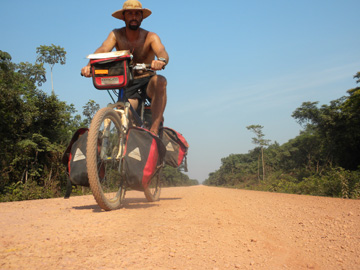
Punishing it was: Gunzelmann faced thousands of miles of roadway through exhaustingly hot forests, endless hills, and then had to cross over the Andes to reach his final destination in Lima, Peru. On his journey, Gunzelmann says that evidence of environmental destruction was everywhere.
"Everyday I would hear the buzz of chainsaws. Charred lots skirted the road the entire length and nearly the entire length of the TransAm is abutted by fazenda, or cattle ranch, 100-200 meters on either side before the tall green jungle is visible. I met miners along the road and saw huge shanty towns and strip mines in Peru. […] It is openly illegal, but there is no one there to enforce these laws."
There are three major environmental issues in the region according to Gunzelmann: deforestation, massive hydrological projects including the infamous Belo Monte dam, and the roadway itself which has opened the region to often unregulated development.
"Roads will bring destruction, no question about it, but how does one meet Brazil’s right to compete and keep the Amazon from being mowed down in the process?"
This became the question Gunzelmann consistently faced during his travels. He realized quickly that the people directly participating in environmental destruction were not 'villains' as they are sometimes categorized, but simply trying to survive.
"The people I met and witnessed poaching and deforesting were good people and very kind to me, at times saving me from potential disaster. Some were completely selfless, giving the shirt off their back when they had so little to give. They were providing for themselves and their families immediate needs. Their alternative options were generally limited," Gunzelmann said. "These people should be no more vilified than the average person from the developed world whose environmental impact is likely to be much more severe over time."
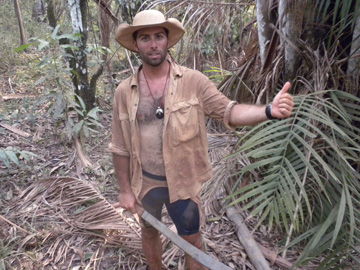
Yet the problem remains: how does Brazil lift its population out of poverty while at the same time safeguarding the forest, which provides intrinsic benefits from carbon sequestration, biodiversity, and clean water?
"I now realize how tightly woven we all are as a global community. We can’t ask Brazil to stop destroying the jungle without asking ourselves to stop consuming and creating the demand for those products," Gunzelmann says. "Brazil is competing in the global market place to create wealth and prosperity for its people. The US has done the same, becoming an economic powerhouse, while wreaking havoc world wide in the process. People should realize the quality of life they enjoy may be a direct result of this attitude toward the environment. If you want a mahogany bedroom set then perhaps realize a road will be cut through the jungle to fell a single tree to meet your demand. Who’s more to blame, the lumber company, the peasant who cut down the tree, or you?"
While there is no simple or easy answer, Gunzelmann says that looking to the past may help bring about a solution.
"Researchers have learned the Amazon Basin supported a huge population in ancient times without destroying the forest. I would think that the possibilities are limited only by ones imagination. The issue is time and effort."
Gunzelmann says that his trip across South America earned him the "right to rest"—at least for a little while. He's looking at options for his next cycling adventure (hint: "it’s more remote, in worse condition, and on the opposite extreme of temperature" as the Transamazonica).
In an October interview Doug Gunzelmnan talked with mongabay.com about his adventures on the Transamazonica (including a run-in with a jaguar), his experiences with loggers and farmers, the challenge for Brazil to balance development while protecting the rainforest, and why the Amazon's survival depends on western consumption patterns.