Source: mongabay.com
A decree issued by President Luiz Inacio Lula da Silva suspends up to $5.7 billion in fines and gives ranchers and farmers in the Amazon two more years to come into compliance with environmental laws aimed to curtain deforestation, reports the Associated Press.
The decree replaces one issued a year ago which had set last Friday as the deadline for complying with anti-deforestation laws.
The Associated Press reports:
Officials said the new decree will give time to implement a program for educating farmers, ranchers and others across Brazil — but principally in the Amazon — on sustainable development and how to increase production without cutting down the forest.
The decree also launches an initiative designed to bring some order to Brazil's countryside by encouraging farmers to formally demarcate and "legalize" their land, chiefly by reforesting areas illegally destroyed.
The initiative will provide loans and environmental education to those who abide by the laws, Environment Minister Carlos Minc said.
 To qualify for the two-year amnesty, landowners will have to sign a contract that they will comply with environmental laws. If they fail to sign the contract, they will be forced to comply with terms set under the previous decree, including payments of fines. Farmers and ranchers that sign the contact but fail to come into compliance during the two-year window, would be subject to fines. The Associated Press reports the "decree takes into account all of the fines incurred since forest laws were first enacted" in 1965.
Under Brazilian law, ranchers and farmers are required to keep 80 percent of their holdings forested, although the rule is widely ignored. Some have proposed setting the limit at 50 percent and allowing landowners to collect payments for forest conservation on any amount above that.
Greenpeace, an environmental group that campaigns for protection of the Amazon, was cool to the decree.
"We think this is a Christmas gift that Lula has given to the farming bloc in Congress and to illegality in Brazil," Marcio Astrini of Greenpeace told the Associated Press. "There is no guarantee that another delay won't happen again in the future."
Last year Brazil unveiled a plan to reduce Amazon deforestation by 70 percent from a 1996-2005 baseline. The scheme would be partially funded by contributions from industrialized countries.
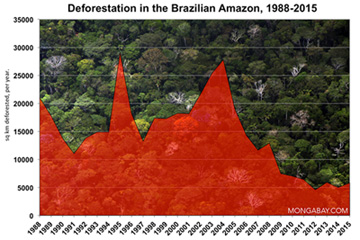
Deforestation in the Brazilian Amazon has slowed markedly since peaking in 2004.