Thursday, December 31, 2009

Q&A: Report on Massacre of Native Protesters in Peru Biased, Says Head of Inquiry

Wednesday, December 30, 2009
Source: Inter Press Service

The coordinator of the commission convened by the Peruvian government to clarify a June massacre of 33 indigenous protesters and police near the Amazonian town of Bagua refused to sign the final report, which he says is biased.

Jesús Manacés, an Awajún leader who coordinated the special commission, told IPS that he did not sign the final report because it does not include the views of everyone involved and does not identify those who were responsible, in the political, police and military spheres.

He said the commission had neither adequate resources nor enough time to clarify what happened on Jun. 2 near the town of Bagua in the Amazon jungle in northern Peru, where a clash between security forces and native protesters left at least 33 people dead, one missing policeman and over 200 people injured.

The killings put an end to a two-month demonstration and roadblock in Bagua by Amerindians demanding the repeal of decrees passed by the government of Alan García that opened up indigenous land in the rainforest to oil, mining and logging companies, in the framework of the free trade agreement (FTA) signed with the United States.

(After the incident, in June, Congress revoked two of the most controversial decrees.)

According to different sources, the local police chiefs and the protesters had reached an agreement for a peaceful lifting of the roadblock at 10:30 AM. But just before 6:00 AM, heavily armed police units arrived and opened fire on the demonstrators, some of whom were still sleeping.

Manacés and religious worker Carmen Gómez, another member of the commission, went public on Dec. 26 with their discrepancies with the report, in a letter addressed to Agriculture Minister Adolfo de Córdova, who heads the Grupo Nacional de Coordinación para el Desarrollo de los Pueblos Indígenas (national coordinating group for the development of indigenous peoples).

In the document, Manacés and Gómez say they will draw up an alternative report to shed more light on what happened that tragic day. IPS correspondent Milagros Salazar sat down with Manacés to discuss the situation. Excerpts of the interview follow:

Q: You note that the commission was unable to question several key figures to clear up what happened in Bagua. Who are you referring to?

A: Several cabinet ministers and others in high-level positions. In some cases, we were unable to arrange the interviews, as in the case of former Prime Minister Yehude Simon. I pointed out the need to talk to him, we wrote a letter, but the request never reached him.

We also asked for a meeting with then Foreign Trade Minister Mercedes Aráoz, who defended the decrees that prompted the protest by our indigenous brothers and sisters. She said that if those decrees were repealed, the FTA with the United States would collapse, and as we know now, that wasn't true.

She made an appointment with us, but we didn't go because the work of the commission was moving along so quickly and we didn't have the resources or assistants to deliver the letters or carry out the interviews.

Q: You met with Mercedes Cabanillas, the then minister of the interior. What explanation did she give you about the violent police crackdown to break up the roadblock by the native protesters who were camping out at the Curva del Diablo (a spot on the highway near Bagua)?

A: She described the events for about half an hour, and then responded to only a few questions.

Q: Didn't you ask her who ordered the operation to break up the roadblock?

A: She said she didn't give the order, that it was the police chief who gave it. She didn't respond as expected. But it's obvious that she was ultimately responsible.

Q: Cabanillas insists that everything was in the hands of the police and that she only received a report after the fact.

A: That response is like saying that as minister, the person who is ultimately responsible, she gave the police free rein to do whatever they wanted. And if that's true, isn't she responsible for what happened?

Q: You said you also weren't given access to important documents like the Interior Ministry's "Report on Internal Security". Who refused you access to that document?
A: I made that request in front of Minister Octavio Salazar (who replaced Cabanillas) in a meeting with him and Gen. Javier Uribe (who was in charge of the negotiations with the indigenous protesters prior to the police operation) in the Special Operations Division headquarters.

The general said he couldn't hand over the document because the case was being appealed, but I insisted that it would be a big help for us to do our job. The minister then agreed to give it to us, but that didn't happen.

Q: Isn't it contradictory that the final report signed by the other members of the commission acknowledges that agreements had been reached by the police and indigenous people to peacefully call off the roadblock, but that no one was found to be responsible for what happened?

A: Yes, but…it was Gen. Uribe who negotiated the peaceful lifting of the traffic blockade, and after that there was a change of command. Who ordered it? Why did they do it? Everyone here knows which authorities were in charge.

That's why I believed responsibilities should have been determined at different levels of the executive branch, the legislature, etc. Now it turns out that so much talking has been done, but nothing has been clarified.

Q: What progress has the commission made in determining who was responsible, in the police and army chain of command?

A: It's clear that the army provided the police with no support, that the situation on the ground was not properly assessed, and that those who took part in the operation after the agreement for a peaceful lifting of the roadblock did so without understanding the magnitude of the protest, that there were between 3,000 and 4,000 demonstrators there.

It was a disproportionate operation conducted without coordination. I'm sure that if it had not been carried out, the people would have left on Jun. 5 at 10:30, as planned. Maybe it was launched to justify the police presence in the area.

Q: You observe that in nearly every paragraph of the report, the version of only one side is presented, rather than conflicting or different versions.

A: That is one of the main reasons that I have not signed the document. It's why I asked for an extension, to complete the information.

With the time pressure, on Sunday Dec. 20 we worked into the wee hours of the morning of the next day, and a few hours later they wanted me to take a final look at the whole thing, in order to sign it.

I refused because I was only given a very short time, but the other members handed the report over to the executive branch. I'm not sure that what was delivered is what I saw on Sunday night.

Q: It has come out that the final report states that legislators of the (opposition) Nationalist Party incited the indigenous groups to protest the decrees. How much of that is true?

A: That isn't true, it's just some seasoning added by the politicians. The idea behind saying that is that we had no idea why we were going to the protests, as if someone had given us some formula to repeat.

Q: You say the report wrongly insists that the origin of the conflict was the lack of communication and failure to explain the positive aspects of the decrees.

A: That's right; they say that because they don't know us. For us it was sufficient that the decrees were approved without consulting indigenous people, as required by International Labour Organisation Convention 169, which means they had no legal standing. It didn't matter if one part was good and another bad.

Q: You reached the Curva del Diablo only minutes after the break-up of the roadblock, like a number of your Awajún companions. Did the fact that you were on the scene on Jun. 5 help you in the search for the truth of what happened there?
A: I was not in the previous meetings that the demonstrators held with the police, because I arrived later. But what I can confirm is that there was a disproportionate use of fire power by the police, because of the 200 people injured, 82 had bullet wounds, and it is the authorities themselves who say that.

Climate Change Mitigation: A Dire Necessity For Latin America And The Caribbean

Weds. Dec. 30, 2009
Source: CaribWorldNews

The recently concluded U.N. Conference on Climate Change in Copenhagen has generated widespread disappointment since it did not deliver tangible results to effectively combat the rapidly encroaching problems generated by global warming.

The conference spent a considerable amount of time to reach a non-binding `Copenhagen Accord` which took shaky steps against global warming even though it pointed to a new start for rich-poor cooperation on climate change. The accord was accepted by consensus after delegates arrived at a compromise decision to `take note`, instead of formally approving it. Overall, the agreement has been spurned by numerous developing countries because it failed to set specific emissions targets for the industrialized countries.

But in general terms, countries agreed to cooperate in reducing emissions, with a view to keep temperatures from rising more than 2 degrees Celsius (3.6 degrees Fahrenheit) above pre-industrial levels.

Further, the developing nations will report every two years, subject to `international consultations and analysis`, on their voluntary actions to reduce emissions. And the developed nations will finance a $10 billion-a-year program for three years to fund poorer nations` projects to deal with drought and other climate-change impacts, and to develop clean energy. The United States along with other rich countries also proposed `mobilizing $100 billion-a-year by 2020` to assist with this purpose. However, none of them made any announcement as to their specific financial contribution to this enterprise.

But even these amounts will be grossly insufficient. Significantly, a World Bank report released in The Hague in September revealed that developing countries will need up to 100 billion dollars (80 billion Euros) a year for 40 years – beginning from the present time – to combat the effects of global warning.

On the other hand, what could be regarded as a positive achievement for the rain forest countries is that the accord allows for a widened `REDD Plus` fund – the mechanism for Reducing Emissions from Deforestation and Forest Degradation – which would enable them to obtain incentives for keeping standing forests.

Guyana`s President Bharrat Jagdeo, long before the Copenhagen conference, actively lobbied to widen the concept from `REDD` to `REDD Plus` to add conservation of forestry to the overall concept of cutting deforestation rates – a position that received much support from both developing and developed countries. Under the original conception of REDD, countries like Guyana could not have received any money since previous international agreements, including the Kyoto Protocol which will end in 2012, did not reward countries that conserve their forests. Unfortunately, the new proposed mechanism was not formally codified in Copenhagen.

Clearly, the conference failed the expectations of a vast majority of countries that a treaty on climate change issues would have been finalized. Cuba`s Foreign Minister, Bruno Rodriguez, said his country as well as many other poor nations would not recognize the agreement because they were not permitted to participate in its development. President Hugo Chavez of Venezuela, on behalf of the ALBA group of countries, also vociferously opposed the `non-transparent` agreement reached at exclusion of the vast majority of developing countries, and he sharply blamed the capitalist system for the global climatic predicament. And in expressing his reservations, Brazilian President Luiz Inacio Lula da Silva sharply criticized the United States, the world`s biggest polluter, for failing to commit itself to concrete carbon-emissions reductions.

In Latin America and the Caribbean (LAC), the problems associated with climate change are regarded with great apprehension. The Economic Commission for Latin America and the Caribbean (ECLAC), in a report released during the conference, warned that the region could bear one of the heaviest costs of climate change. The organization said that up to 40 percent of the biodiversity of some Latin American nations could be wiped out by 2100 if steps are not taken immediately to control carbon emissions.

`Although Latin America and the Caribbean is the second region in the world with the lowest greenhouse gas emissions after Africa, it is nevertheless suffering the effects of global warming more than any other,` the report emphasized. At present, LAC`s `carbon footprint` in the global context is quite modest – about 6 percent of total emissions, according to World Bank estimates – but indicators will change in the next 25 years, as transportation and industrial sectors expand.

The report explained that increases in temperature would lead to a sharp fall in rainfall in the Amazon `causing a substantial deterioration of jungles that are home to one of the world`s largest concentrations of biodiversity.`

It showed that rising sea levels would cause a huge movement of populations and the loss of land, while mangroves on the lower coasts of countries such as Brazil, Ecuador and Guyana might be swamped forever and coastal areas of the Rio de la Plata in Argentina and Uruguay could also be seriously threatened.

In economic terms, ECLAC warned that in the absence of an international climate mitigation agreement, the cost for Latin America and the Caribbean could be equivalent to 137 percent of the region`s current GDP by 2100.

Bolivia, Chile, Ecuador, Paraguay and Peru could be among the countries worst hit, losing up to 60 percent of their arable lands, while water supplies could be drastically reduced, even though the effects of climate change would vary from country to country. For instance, the report intimated that Argentina, Chile or even Uruguay might even see an initial increase in agricultural production if temperatures rise up to 2 degrees Celsius from now until 2050.

The ECLAC report is a stark reminder that 60 major LAC cities situated along coasts as well as the coastal areas of the Caribbean islands and of the low coastal plains of the continental mainland are highly vulnerable to rising sea levels.

Moreover, millions of South Americans who depend on rivers fed by Andean glaciers face the possibility that their primary water source may disappear within the next 15 to 25 years. With a warmer climate now, the glaciers are not regenerated significantly during the winter months. The Andean countries are also highly dependent on hydroelectric energy, and many of the dams need water from the glaciers to operate, especially during the dry season when rains are not refilling reservoirs.

Meanwhile, some 600 million people in Latin America and the Caribbean are experiencing the effects of climate change in a dramatic way, through droughts, floods, melting glaciers, rising temperatures, and new agricultural pests.

Further evidence of climate change is the expansion of disease vectors to areas beyond their normal habitat. This is the case of the Anopheles mosquito, which transmits malaria, and has spread from tropical zones at less than 1,000 meters above sea level to areas higher than 2,000 meters.

In the area of agricultural production, abrupt weather variations – drought, heavy rains, hail and frost – take a toll on agriculture because crops are not always able to adapt, and the associated losses intensify poverty among farmers.

According to the World Bank, the world`s total agricultural production could decrease between 3 percent and 15 percent due to global climate change, but those proportions could be much worse in the agricultural regions of Latin America`s equatorial belt. The Bank says that revenue losses in Latin America`s agricultural sector could range from 12 percent to 50 percent by 2100, even after accounting for a certain level of technological adaptation to climate change.

Meanwhile, some countries in the region are already taking initiatives to confront the long-term effects of climate change. For instance, Guyana is on the verge of implementing its Low-Carbon Development Strategy. Recently the country signed an agreement with Norway by which Guyana will accelerate its efforts to limit forest-based greenhouse gas emissions and protect its rainforest as an asset for the world. Norway, in turn, will initially put US$30 million into Guyana`s `REDD Plus` fund and subsequent payments of up to US$250 million over five years would be contingent with Guyana`s ability in limiting emissions and reducing deforestation, which, currently, is almost negligible. The fund will be used for sustainable development projects and climate change adaptation measures.

Brazil is also making huge efforts to protect its great Amazon rain forest, including a fund to fight deforestation, currently responsible for 70 percent of the country`s greenhouse gas emissions. The huge Amazon basin has lost an average of 19,000 square kilometers (7,336 square miles) in the last 30 years, due to a combination of economic forces, deficient agricultural practices, diluted property rights and to the `savannization` of the Amazon basin, with disastrous consequences for water and carbon cycles. The World Bank supports the Brazilian initiative with a wide range of projects and financial assistance including a loan for sustainable environmental management worth US$ 1.3 billion.

Keeping in mind the growing problems associated with climate change in LAC, regional leaders will have to redouble their efforts to convince especially those of the world`s developed economies that an effective international treaty to mitigate existing and future problems is a dire necessity. There still remains a glimmer of hope that such a treaty can become a reality at the next UN climate conference in Mexico City in 2010.

Amazon Defense Coalition: Chevron Finishing Brutal Year On Ecuador Issue

Wed, 30 Dec 2009
Source: Earthtimes

WASHINGTON - (Business Wire) The signing this week by President Barack Obama of an extension of trade benefits for Ecuador – over strenuous objections from Chevron -- caps a brutal year of legal and lobbying setbacks for the oil giant in its attempts to evade a multi-billion dollar liability for environmental damage in the Amazon rainforest.

Obama’s signature on the trade deal, consummated this week, is the fourth defeat in three years for Chevron’s A-list lobbying team in its effort to cancel trade preferences for Ecuador as “punishment” for allowing indigenous groups to sue the oil giant in Ecuador’s courts. Chevron is charged in a class action lawsuit brought by 30,000 Ecuadorians with dumping billions of gallons of toxic waste when it operated several large oil fields in Ecuador’s Amazon from 1964 to 1990, decimating indigenous groups and causing a spike in cancer rates and other oil-related diseases.

A court-appointed Special Master found 1,401 people had died of cancer due to the contamination and pegged damages at $27.3 billion, with a final judgment expected in 2010. Experts consider the disaster at least 30 times worse than the damage caused by the Exxon Valdez.

If Chevron had succeeded in canceling the trade benefits, Ecuador’s government estimated the country would have lost 350,000 jobs. Similar lobbying efforts by Chevron in prior years met stiff opposition from a number of Senators and Congressmen, and also failed. Chevron’s effort to use the trade preferences as leverage was led by outside lobbyists Wayne Berman, a longtime Republican operative; Mac McLarty, White House Chief of Staff under President Clinton; and Mickey Kantor, the U.S. Trade Representative under President Clinton.

"The extension of the trade benefits to Ecuador is a major setback to Chevron's campaign to undermine the rule of law in the environmental case," said Steven Donziger, an American legal advisor to the plaintiffs.

Chevron’s defeat over trade preferences capped a terrible 2009 for Chevron on the 16-year Ecuador case, both legally and politically, in the media, and among shareholders.

On the legal front, Chevron suffered multiple defeats in U.S. federal court in New York in its attempt to shift the liability for clean-up to Ecuador’s government. Chevron lost a four-year trial, was unanimously denied on appeal, and suffered the added indignity of being rebuffed by the U.S. Supreme Court when it asked for a review of the case.

In the separate environmental case in Ecuador, Chevron lost a number of motions to delay the six-year proceedings, paving the way for a decision in 2010.

Further, two Chevron lawyers are under criminal indictment in Ecuador for lying about the results of a purported remediation to obtain a legal release from Ecuador’s government. In the United States, New York Attorney General Andrew Cuomo opened a probe of Chevron to determine if the company is misleading shareholders over the Ecuador liability.

Separately, the U.S. Department of Justice has been asked by the plaintiffs to determine whether Chevron orchestrated the appearance of a bribery scheme in Ecuador to undermine the trial. If so, the company might be found in violation of the Foreign Corrupt Practices Act.

Several large shareholders made it a tough year for Chevron management. At least $37 billion in company shares voted to defy CEO David O’Reilly over human rights issues, driven partly by the pending Ecuador liability.

On the lobbying front, Chevron suffered a string of embarrassing defeats over Ecuador in Washington. In December, 26 House members – including several members of the leadership -- signed a letter to the United States Trade Representative asking that the agency ignore Chevron’s efforts to use U.S. trade policy to interfere in the Ecuador legal case. In June, four U.S. Senators wrote a similar letter to the USTR, while no Senator or Congressman wrote a letter in favor of Chevron.

Separately, Rep. Linda Sanchez (D-CA) in November blasted Chevron’s lobbying effort against Ecuador in testimony before the House Ways and Means Trade Subcommittee, likening it to “extortion”. “Apparently, if it can’t get the outcome it wants from the Ecuadorian court system, Chevron will use the U.S. government to deny trade benefits until Ecuador cries uncle,” said Sanchez.

Chevron suffered another setback in December when it was sued in U.S. federal court by Ecuador seeking to enjoin the company’s second international arbitration attempt designed to shift liability to Ecuador’s government. The second arbitration, which would take place under the U.S.-Ecuador bilateral investment treaty, was considered one of Chevron’s final legal options to evade liability, but that effort is now in doubt.

In the media, Chevron endured an unflattering 60 Minutes report that clearly demonstrated the company built hundreds of unlined waste pits in Ecuador that were designed to be drained into nearby streams and rivers; that it never kept a list of the locations of its waste pits so as to warn local residents; and that Chevron’s lawyers, in an effort to discredit Ecuador’s courts, are contradicting years of sworn affidavits filed by the company in U.S. federal court praising those courts as fair and competent.

Chevron also reached a low point when a spokesperson, Sylvia Garrigo, became flustered during her 60 Minutes interview and said the pollution in Ecuador was no more harmful than the oil in the makeup on her face.

Chevron also received unfavorable coverage about the case in The New York Times, Washington Post, Forbes, The Associated Press, Bloomberg Markets magazine, and on the editorial pages of the Los Angeles Times. The LA Times characterized Chevron’s attempts to find a new court after arguing the case should be heard in Ecuador as a “shifty shifting of venue”.

Kerry Kennedy, a lawyer who has led more than 40 international human rights delegations and who is President of the Robert F. Kennedy Center for Justice and Human Rights, visited the region and accused Chevron of being complicit in cultural genocide. Her letter to Chevron’s CEO seeking a meeting was ignored.

Rep. James McGovern (D-MA), the only member of Congress to have visited the disaster zone, previously had called Chevron’s pollution a “terrible humanitarian and environmental crisis” in a letter to President Obama.

Finally, Chevron’s Ecuador liability – which could consume more than 20% of the company’s market value -- appears to have accelerated a shift in the company’s management. Thursday is longtime CEO David O’Reilly’s last day on the job, as he announced his surprise departure earlier this year. O’Reilly had spearheaded the purchase of Chevron in 2001 for $31 billion – an asset that now has a potential liability of $27.3 billion due to the Ecuador problem.

Wednesday, December 30, 2009

Visiting the Amazon During Peru Vacations

December 21, 2009
Source: EzineArticles.com


An international campaign to identify the world's Seven Natural Wonders has begun, with places of natural importance from each continent being ranked by voters around the world.

With such attention on some of South America's most spectacular sights, we thought we'd give a Latin America For Less guide to visiting each place that is in contention for the title of South America's most important Natural Wonder.

The Amazon rainforest is currently ranked in first place as South America's most important natural wonder. It is the biggest forest in the world and is home to the single greatest concentration of life on the planet: one tenth of the planet's species are found right here, in the Amazon.

Visiting the Amazon has become increasingly easy in recent years, especially during a Brazil or a Peru vacation, and thanks to the growth of eco-tourism, it's now possible to visit the rainforest while causing minimal disruption to the pristine environment.

Where To Go

There are many options for exploring the Peruvian Amazon, but the three most popular entrance points are Iquitos, Puerto Maldonado and Manu.

Iquitos, the world's largest city not accessible by road, is a genuine frontier outpost deep in the wilderness. You can only get here by air or a long boat journey, but once you've arrived you will discover a truly unique tropical city, with entire neighborhoods of house boats floating on the river, restaurants serving exotic and delicious jungle delicacies, a lively night scene, and plenty of jungle lodges dotted up and downstream, offering a chance to get up close and personal with the wildlife.

Puerto Maldonado meanwhile is a more accessible but somewhat less intriguing town. The appeal of this ramshackle settlement is its proximity to Cusco, another popular Peru vacation destination. Travelers can leave Cusco in the morning and by mid-afternoon be settled in to their tranquil jungle lodge, a long way from civilization.

Finally, the Manu reserve on the eastern flanks of the Andes is some of the most remote and least accessible stretch of jungle in Peru. This is a vast region of protected land, and is a paradise for the jungle's many native species of creatures, especially birds. A visit to Manu offers a genuine taste of jungle life, one of the few remaining places with large populations of large mammals, including jaguars, anteaters and tapirs.

All three destinations offer similar standards of lodges, although the range in Iquitos and Puerto Maldonado is much broader than in Manu.

However, visitors should bear in mind that Iquitos is a large city, with plenty of economic activity focused around the river. Its size and unique atmosphere make it an interesting Peru travel destination in its own right, but also means that the nearby jungle is not a great place for wildlife spotting. You need to journey for several hours, preferably upriver, to get into untouched territory.

Finally, throughout the Amazon, certain restaurants serve questionable produce, including endangered or threatened species such as paiche (an enormous fish), turtle, and caiman. Although it is technically illegal to serve these species, the law is largely un-enforced, but visitors should consult their conscience before indulging.

This guide to visiting the Peruvian Amazon was written by a Peru travel expert from Peru For Less, a specialist in fully customizable Peru vacations.

Museu da Amazônia constrói 'planetário indígena' em Manaus


Equipamento mostra como índios interpretam as constelações.
Astronomia é usada no dia-a-dia dos povos da floresta.
Iberê ThenórioDo Globo Amazônia, em São Paulo
Tamanho da letra
A partir de janeiro, quem visitar a capital do Amazonas poderá enxergar o céu de outra maneira. O Museu da Amazônia (Musa) acaba de construir um planetário para mostrar como diferentes grupos indígenas interpretam as estrelas.

“O mesmo céu era visto de forma distinta por cada etnia. Cada uma tinha seus mitos”, conta o astrônomo Germano Afonso, do Musa, que estuda a relação entre as culturas indígenas e os astros. “Eles faziam a leitura do céu para regular o cotidiano, a caça, a pesca. Pelo céu, eles sabem quando vai haver uma estiagem ou um pequeno período de chuva.”


Foto: Museu da Amazônia/Divulgação

O astrônomo Germano Afonso, do Musa, mostra a constelação que alguns povos indígenas conhecem como Homem Velho. Na cultura greco-romana, o mesmo conjunto de astros é conhecido como Órion, o caçador. (Foto: Museu da Amazônia/Divulgação)

Cinco monitores indígenas já foram treinados pelo museu para explicar como seus povos interpretavam as estrelas. Eles são alunos da Universidade do Estado do Amazonas (UEA) e pertencem aos povos baré, desana, tukano e ticuna. “Como eles vão ser professores, também podem ensinar para as gerações mais novas”, explica Afonso.

Ampliar FotoFoto: Museu da Amazônia/Divulgação

Céu amazônico será projetado dentro de uma sala cilíndrica, que foi instalada na Reserva Ducke, em Manaus. (Foto: Museu da Amazônia/Divulgação)

A sala onde os astros serão projetados tem formato cilíndrico, preparado para mostrar o céu da forma como é visto pelos povos amazônicos, que estão próximos ao Equador. Segundo o astrônomo, todos os equipamentos usados no planetário – incluindo os softwares de projeção – foram desenvolvidos na capital amazonense.

As instalações foram construídas na Reserva Adolpho Ducke, do Instituto Nacional de Pesquisas da Amazônia (Inpa), onde também está sendo construída a sede do Musa.

ENVIRONMENT-CONGO: Defence of Great Apes Begins With Children

Wednesday, December 30, 2009
Source: Inter Press Service

BRAZZAVILLE, Dec 30 (IPS/IFEJ) - "But why do they kill gorillas, why do they trap them and put them in cages? One day, if i'm president, i'll stop all those who kill gorillas, chimpanzees and bonobos," says 11-year-old Judicaëlle, a student at the Holy Sprit of Moungali School in Brazzaville.

Judicaëlle is one of about a hundred students from schools around the Congolese capital who have just attended a session on the protection of gorillas. In groups of five, students are being taught about the protection of gorillas and other great apes. Laetitia, 10, recites what she's learned: "It is forbidden to kill, eat, sell, transport or possess a gorilla."

This course on gorilla protection is being put on by non-governmental organisations in this central African country that is home to an important population of gorillas.

"We are teaching these things to children because they are the ones who will be in charge of humanity tomorrow. They must become aware of these questions now," says Virgile Safoula, one of the course leaders and executive secretary of Environnement développement des initiatives communautaires (EDIC), an environmental NGO based in Brazzaville, the Congolese capital.

"We have to begin at the roots. We can't let parents impose on their children a different idea, that accepts the capture or eating of gorillas. Besides, all children who attend the course are very interested," says Laurent Loufoua, another course leader from the Association for the Protection of Primates in Congo.

In every corner of the room there are pictures of gorillas and posters which forbid harmful actions on encountering these animals. The children listen to stories of the forest, with puppets giving their voice to frogs and tigers who tell of the suffering of gorillas. At the end, the children are asked about what they have seen and heard.

"Here we have a child threatened by a gorilla. That means to say that the gorilla is not a pet, it's not a domestic animal," says one of the children, Safoula, in front of a portrait of one of the threatened apes.

A tenth of the Congo Basin's rainforest is found in Congo-Brazzaville shelters 10 percent of the forests of the Congo Basin. The basin's forests are second in size only to the Amazon forest of South America, and it is here in the Congolese forests, that you find the great apes: the gorilla and the chimpanzee. The third great ape, the bonobo, is found only in the mountains in the east of Congo's neighbour, the Democratic Republic of Congo.

But NGOs and forest rangers report massacres of these primates by poachers and by communities living near protected areas who hunt them for food.

To put an end to this, the Congolese government adopted a new law on wildlife and protected areas in November 2008. "If people commit these infractions, it's because they don't know the law. Through a special programme, we will sensitise people to this law. Step by step, we will get to the point where most people will no longer kill gorillas," says Safoula.

At the same time, Congo is developing a project of reintroducing gorillas at a sanctuary at Lésio-Louna, 170 kilometres north of Brazzaville. In this 170,000 hectare reserve, there are a hundred gorillas. Launched in 1994, the Gorilla Protection Project (its French acronym is PPG) is financed by a British John Aspinall Foundation.

Some of these gorillas were rescued from poachers. Many of them, rescued very young, do not survive their release. "A third, around sixty, have succeeded in surviving after we reintroduced them to the wild," explained Luc Mathot, PPG coordinator.

The Aspinall Foundation has run a similar project in neighbouring Gabon since 1990. The two countries between them had a population of Western lowland gorillas estimated at more than a 100,000, before the appearance of the Ebola virus which affects all primates. The number is far lower today, says Mathot, without being able to provide an exact figure for the decline.

For Roch Euloge N'zobo, from the Congolese Observatory for Human Rights, the protection of gorillas must go hand in hand with the protection of people's rights. "Often, conservationists forget that on the edges of forest reserves, there are people. They chase them out, they forbid them to touch animals to make a living. One must take people's needs into account," he said.

Jacques Ibara, a member of the NGO Environment Protection, feels that gorillas have been on the path towards extinction not simply due to being hunted, but also because of exploitation of forests. "The destruction of forests is also a factor. This destroys gorilla habitat so they can no longer reproduce, forced to spend all their time in flight," he said.

But, underlines Loufoua, "the continued survival of gorillas on the ground shows that the lessons are being learned, not just by children, but also by their parents who live near forest reserves. Not long ago, it was easy to find baby gorillas in the streets of our cities, but today everyone is afraid to do that. The government is cracking down."

In the airports, the railway stations and on the roads, in schools and markets, the authorities have put up posters announcing penalties of five years in prison and $10,000 fines against those who are caught with a a gorilla.

Image: Children at a workshop explaining the importance of protecting gorillas.

Saving the Amazon On Shirt at a Time

December 29, 2009
Source: Boylan Catholic High School

Mrs. Neubauer and the members of the South Shelby Environmental Club have been hard at work selling T-shirts for one of their programs they do every year, Rainforest Rescue. This year they are going to save some acres of the Amazon Rainforest in South America.

Rainforest Rescue is the world's largest in-school conservation organization. At South Shelby, if the members sell 10 shirts, then they help save one acre of the Brazilian Rainforest. The shirts in the catalog are awesome and they also have tote bags.

Mrs. Neubauer said, "The Rainforest Rescue Campaign saves the rainforest by working with people to help them find ways to make a living and sustain the rainforest at the same time."

According to the catalog, which has interesting facts about the beautiful rainforest, the Amazon is the world's biggest rainforest and houses the most magnificant and exotic species in all the planet. The Amazon is said to be the world's "largest absorber of carbon dioxide!"

All of the shirts and the other cool things in the catalog cost $14.00. The due date for all of the orders was December 1.

Brazilian Tribe Might Benefit from REDD, Now Being Debated in Copenhagen

Sunday, 13 December 2009
Source: Brazzil Magagine

A vulnerable Brazilian tribe in the Amazon region owns carbon-trading rights in future global warming deals, according to a new legal opinion by one of the world's largest law firms. This finding could help preserve vast areas of the rainforest in Brazil.

The disclosure, say advocates, should also apply to other indigenous groups in Brazil, home to 40% of the world's rainforests, representing a major step forward in protecting indigenous people's land rights.

The opinion on the carbon rights of the Surui tribe by international law firm Baker & McKenzie was commissioned by Forest Trends, a conservation group based in Washington, D.C., that works to protect forests around the world.

The significance of the finding, said Forest Trends officials, is that when climate change negotiators strike a new deal to reduce harmful emissions, indigenous groups such as the Surui won't be left behind-and, in fact, can benefit and help save vast swaths of the rainforest. Those protected forests will play a major role in absorbing carbon emissions, limiting the release of dangerous gases into the atmosphere.

"This really is a landmark opinion," said Michael Jenkins, President and CEO of Forest Trends. "What we have been able to demonstrate here is that there will be opportunity and a path forward for indigenous groups to participate in emerging markets from a global warming deal. In fact, the indigenous groups would now be part of the solution."

Over the last several years, many indigenous groups have expressed concern that a climate change deal would be yet another international agreement that eroded their rights. In response, Forest Trends asked Baker & McKenzie to research whether Brazilian law would allow the Surui and other indigenous groups in Brazil to claim benefits under any deals involving the Reduced Emissions from Deforestation and Degradation (REDD) arrangements, now being considered as a centerpiece of global warming talks during the UN Climate Change Conference in Copenhagen.

Baker & McKenzie's work was done through its Brazilian-associated office, Trench, Rossi e Watanabe Advogados. Its finding, which is not binding but comes against the political backdrop in Brazil of strong federal government support for indigenous groups, said that under REDD deals, the Surui indigenous group would be able to oversee management of the forest as well as reap any economic benefits from carbon trading arrangements.

The finding said the conclusion was based on the Brazilian Constitution and legislation, which "provides for a unique proprietary regime over the Brazilian Indians land...which reserves to the Brazilian Indians...the exclusive use and sustainable administration of the demarcated lands as well as...the economic benefits that this sustainable use can generate."

Another important element raised by the opinion is the need for the Surui to secure financial returns that are compatible with the environmental services provided by managing the vast forest on Surui land, and to provide transparent and price competitive proceedings for the commercialization of the credits, which will be in alignment with Brazil's overall national sovereign interest.

"This study confirms that we have the right to carbon, and is also an important political and legal instrument to recognize the rights of indigenous people for the carbon in their standing forests," said Chief Almir Narayamoga Surui, leader of the Surui tribe. "It helps in our dialog with the government, businesses, and other sectors, strengthening the autonomy of indigenous peoples to manage our territories."

The finding could be a huge boost to the survival of the Surui tribe, which has endured many threats to its existence. The Surui, with support from Forest Trends and other partners, have developed a project looking to international carbon offset finance to help them preserve their imperiled forest and way of life.

With just 1,200 members overseeing 600,000 acres of land in the Amazon basin-three-quarters the size of the state of Rhode Island - the Surui tribe first came in contact with Brazilians of European descent only 40 years ago, and it resulted in an almost immediate series of tragedies; their population was reduced from over 5,000 to 290 people from disease for which members had no immunity.

In more recent years, illegal loggers invaded the Surui's land threatening the community. And 11 regional indigenous leaders have been assassinated in recent years, killings believed to be directed by logging and mining captains.

But the tribe has organized simultaneous efforts on different political and legal fronts in recent years, winning major support from the Brazilian national government, conservation organizations such as Forest Trends, and through a major mapping project with the Amazon Conservation Team and Google Maps that, in rich detail, documented the natural and human history of the land over the years.

Chief Almir, who has received several assassination threats in the past and for a time fled to the United States for his safety, has been one of several Surui leaders trying to win national and international support on environmental issues.

"This finding should greatly help the Surui and, by extension, other indigenous groups in Brazil," said Beto Borges, Director of Communities and Markets Programs at Forest Trends. "Not only do the indigenous groups have the ethical right for carbon credits projects on their land and because of their stewardship role over the generations, but this finding now means they have the legal right as well. It's a major step forward."

Forest Trends is an international non-profit organization that works to expand the value of forests to society; to promote sustainable forest management and conservation by creating and capturing market values for ecosystem services; to support innovative projects and companies that are developing these new markets; and to enhance the livelihoods of local communities living in and around those forests. We analyze strategic market and policy issues, catalyze connections between forward-looking producers, communities and investors, and develop new financial tools to help markets work for conservation and people.

Cattle Farming Contributes To Brazil's Greehouse Gases

Saturday, 12 December 2009
Source: RedOrbit

Cattle farming is the leading cause of greenhouse gas emissions in Brazil, as it is responsible for four-fifths of the deforestation of the Amazon rainforest and three-fourths of the burning of forests and vegetation throughout the country, besides emitting most of the country's methane, an important greenhouse gas produced in the digestive system of cattle.

João Meirelles Filho, author of two books on Amazon deforestation, told AFP that Brazil's promise to cut polluting gas emissions is not believable because it is based solely on limiting deforestation, without touching the real cause which is extensive cattle farming.

According to this environmental expert - who heads the Peabirú Institute and is an advocate of sustainable and social development for the Amazon region - by failing to address this issue, Brazil is not bringing a policy proposal to the 15th Conference of Parties (COP-15) to the United Nations Framework Convention on Climate Change in Copenhagen, just unrealistic figures and targets.

The country has a total of nearly 200 million heads of cattle - one for every Brazilian - distributed throughout a fourth of the national territory, and occupying a surface area three times as large as the area covered by crops.

It estimates that between 2003 and 2008, the ranchers produced between 812 million and 1.1 billion tons of carbon gases a year, or 50 percent of the national total.

But it is not just a problem of the Amazon region, or even of Brazil. It's a global problem. According to estimates by the United Nations Food and Agriculture Organization (FAO), livestock production occupies 40 percent of the world's agricultural lands, Meirelles said.

The more than 1.2 billion head of cattle that exist in the world consume more food than the world's entire population of 6.8 billion people, half of whom do not even include beef in their diet. A million people don't eat beef for religious reasons, while almost all the rest of the non-beef eaters are just too poor to afford it, he explained.

The increasing trend in beef consumption is unsustainable. Consumption is growing most notably in China, where it's still limited to six kg a year per person, far below the 36 kg consumed in Brazil and the more than 60 kg eaten in Argentina, Meirelles said.

In addition to being an inefficient protein producer, requiring eight kg of fodder for every kg of beef produced, cattle are an environmental and social predator. According to calculations by the association of large agriculture and cattle producers, there are 70 million hectares of degraded pasturelands in Brazil.

Historically, cattle farming was the way into the Mata Atlántica, the extensive coastal forest area in eastern Brazil that has already lost 93 percent of its native forests, and into other ecosystems, such as the Cerrado, Brazil's vast central savannah, half of which has been deforested. This depredation is repeated in the Amazon region, Meirelles warned.

Tuesday, December 29, 2009

Copenhagen climate summit resumes after protests from developing nations

Tuesday, December 15, 2009
Source: Caribbean Net News

President Bharrat Jagdeo, Lars Lovold (far left), Tasos Asevedos (second from
left), and Kjefil Lund (third from left) at the side event hosted by the Norwegian
NGO Bellona in Copenhagen (photo by GINA)

GEORGETOWN, Guyana (GINA) -- Talks at the United Nations climate summit in Copenhagen, Denmark, resumed Monday afternoon after protests from developing nations forced a suspension.

Discussions were limited to informal consultations on procedural issues, notably developing countries' demands for more time on the Kyoto Protocol. Some delegates talked forlornly of the vast amount of negotiating left to be done before the summit concludes, and suggested that the suspension, and the underlying tensions to which it speaks, does not bode well for the chances of any meaningful agreement.

Responding to the day's events, UN Secretary-General Ban Ki-moon warned that time was running out for nations to reach an agreement.

"I appeal to all world leaders... to redouble efforts to find room for compromise," he told reporters.
"Time is running out. There is no time for posturing or blaming."

Heads of State and government have started to arrive for the final segment of talks due to end Friday.
President Bharrat Jagdeo said “there is still a large number of issues to be addressed and this is a matter of major concern.”

Emerging from a meeting with Lord Nicholas Stern, author of the Stern Review on the Economics of Climate Change, President Jagdeo would not be drawn on the details of their discussion, saying only “we discussed the importance of a comprehensive global deal that secures action both on emissions reduction and on the scale of funding that is needed to enable developing countries to combat climate change.”

Earlier, at a side event hosted by the Norwegian NGO, Bellona, President Jagdeo was one of the key speakers.

At the event, Guyana’s Low Carbon Development Strategy (LCDS) and Brazil’s Amazon Fund were outlined as the world’s pre-eminent models for making REDD+ work. (REDD)+ is the United Nations Framework Convention on Climate Change mechanism to create a framework for reducing emissions from deforestation and forest degradation).

The President was joined by Kjefil Lund from the Norwegian Ministry of Finance and Tasso Azevedo, Senior Advisor to Brazil’s Minister of the Environment.

Also speaking at the event was Lars Lovold, Director of Rainforest Foundation Norway, who referred to the potential of the Norway-Guyana partnership to influence other countries around the world.
He lamented the fact that the REDD negotiations at the Copenhagen summit were far behind the initiatives between Norway, Brazil and Guyana, and said that Guyana’s model had the potential to show the world how national scale action, with broad-based multi-stakeholder support, could be
successful.

Lovold gave a technical overview of how the reference level, against which Guyana will receive forest payments, was calculated and outlined how such a reference level was essential to a global solution.
Guyana and Norway last month signed an historic memorandum of understanding under which Norway has pledged US$250M in support for this country’s climate change model over the next five years.

Former Minister of Environment and Energy of Costa Rica, Carlos Manuel Rodriguez said that Guyana and Brazil’s work was “inspiring”.

He said Costa Rica was the first country in the world to reverse historical rates of deforestation and spoke of the key lessons that they had learned.

He said that deforestation was a global market failure, and unless this was addressed, it would be very difficult for REDD to succeed.

At the time of writing, Guyana’s lead negotiator Andrew Bishop was engrossed in the restarted negotiations on REDD which were expected to go late into the night.

'Disappointed' Brazil Has Strong Words for Obama, China Praise

Dec 20, 2009
Source: Treehugger

After the close of COP15 on Saturday, international reaction to the final agreement has been mixed, particularly among two of the conference's biggest players. The most heated criticism for the outcome of the climate talks was directed at US president Obama, delivered by Brazilian Environment Minister Carlos Minc, who said:

"Do something, Obama, or return the Nobel Prize."

The connection Minc was trying to make between the recently awarded Peace Prize and the results of COP15 are unclear, but controversial statements tend to grab people's attention whether they make sense or not.

Disappointment in Brazil
Brazil was seen by many in Copenhagen as a pioneer among developing nations for its ambitious pledges to reduce CO2 emissions, and for so effectively reducing the rate of deforestation in the Amazon rainforest. The expectations of Minc and the Brazil's President Lula were largely unfulfilled by what they sensed as an unwillingness on behalf of the United States to invest sufficiently in the global effort to curb climate change. The compromise of a $10 billion investment, for Minc, "left much to be desired."

Satisfaction in China

The dissatisfaction felt by Brazilian leadership at the close of CO15 wasn't shared by another key player in the negotiations. According to O Estado, China, the world's largest emitter of greenhouse gases, felt the US proposal was "significant and positive." The so-called Copenhagen Agreement proposes an aid of billions of dollars to poor countries adapt to climate change, but does not require the world's biggest polluters make deeper cuts in emissions of gases causing the problem.

The contrast between Brazil's disappointment and China's satisfaction with the agreement made at COP15 highlight the complexities of international politics. And, while interested observers may be equally as divided in their opinion of the settlement, most should concur that it amounts to a step (or nudge) in the right direction.

Countries make rainforest protection pledge

Dec 17, 2009
Source: Cool Earth

A number of countries have come together at the Copenhagen climate change summit to pledge billions to be used to protect endangered rainforests around the world.

Together, the UK, the US, Japan, Norway, Australia and France will donate some $3.5 billion (£2.1 billion) over the next three years to try and reduce the level of emissions from rainforest deforestation in places such as the Amazon.

Commenting, US agriculture secretary Tom Vilsack said that taking steps to protect the world's rainforests is a necessity rather than a luxury.

"This substantial commitment is reflective of our recognition that international public finance must play a role in developing countries' efforts to slow, halt and reverse deforestation," he commented.

The money is set to be used by developing countries to try and reverse the impact of deforestation, which is thought to be responsible for around a fifth of all the world's greenhouse gas emissions.

Copenhagen deals not enough to save planet, says report

12/18/2009
Source: The Low Carbon Economy

Deals currently being offered by delegates at the UN summit in Copenhagen are not good enough to save the planet from climate change.

That is according to a leaked report obtained by the Guardian, which suggests that agreements reached so far would still lead to an average global temperature rise of three degrees Celsius.

With just one day for world leaders to commit themselves to a strong and fair climate deal, concerns are now being raised over the final outcome to emerge form the two week-long conference.

Greenpeace campaigner Joss Garman told the newspaper: "This is an explosive document that shows the numbers on the table at the moment would lead to nothing less than climate breakdown and an extraordinarily dangerous situation for humanity.

"The UN is admitting in private that the pledges made by world leaders would lead to a three degrees Celsius rise in temperatures. The science shows that could lead to the collapse of the Amazon rainforest, crippling water shortages across South America and Australia and the near-extinction of tropical coral reefs, and that's just the start of it."

According to the Stern economic review of climate change for the government, a rise of three degrees Celsius could have devastating impacts on the planet with 50 per cent of the world's species facing extinction.

Monday, December 28, 2009

Why the Amazon rubber 'boom' can still be heard

Monday December 28th 2009
Source: Guardian Weekly

Natives of several tribes march to bring attention to saving the Amazon. Photograph: Vanderlei Almeida/AFP/Getty Images

One hundred years ago the first whiff of a scandal broke in the House of Commons concerning a British company operating in the depths of the Amazon rainforest. A Foreign Office investigation led by Roger Casement, later to become an Irish revolutionary and eventually executed for treason, revealed that 30,000 indigenous people had died gathering rubber for the company.

Casement’s investigation is the subject of a book, just published, entitled ‘The Devil and Mr Casement’ by historian Jordan Goodman. Casement’s conclusions were truly shocking. In order to meet a sudden growth in international demand for rubber, known as the ‘Rubber Boom’, thousands of indigenous people were enslaved, routinely starved, flogged, put in chains and stocks, raped, and murdered.

The owner of the British company, the ‘Devil’ in Goodman’s title, was a Peruvian, Julio César Arana, who moved into a house near Hyde Park during Casement’s investigation. That wasn’t the only British connection. The company was registered in London, almost half of its board was British, it had British shareholders, and the rubber was transported from the Amazon in British ships to British ports where it was worked on by British manufacturers.

Recently I met a descendant of some of the survivors of the ‘Boom’. Her name: Fany Kuiru, a Witoto woman, from what is now Colombia but in the early 20th century was Peru. Fany had travelled all the way from the remote Amazon to Europe to publicise what happened one hundred years ago. The Witoto suffered more than anyone: Casement’s estimate was that 20,000, out of a total of 30,000, died in just a few years.

"I’m here with a message," Fany told me. "A message about what happened in the past and about what is happening now. I’m here at the request of local people."

Fany explained that her trip, organised by FUCAI, an indigenous rights organisation in Colombia, had two main aims. One, to obtain economic assistance for the Witoto and other indigenous groups like the Bora, Okaina and Muinane. Two, to raise greater awareness of what happened during the ‘Boom’ and pressure the British government to formally acknowledge it.

What sort of thing did she have in mind? She said an apology or, perhaps, some kind of monument.

"It’s not history for us. It’s not history for me," she said, making it clear that the legacy of the ‘Boom’ is something the Witoto still have to deal with day in, day out.

Fany is from La Chorrera, a settlement on the River Igaraparana. One hundred years ago it was a rubber collection depot and the scene of some of the worst atrocities. When Casement arrived there, one of the first things he saw was three people with, "broad scars on their bare buttocks – some of them 1.5 or 2 inches broad. Weals for life. This is their wealfare, their daily wealfare. All slaves."

Today, in La Chorrera, attempts are being made to heal scars of a different kind. The site of the historic British rubber company’s offices is now known as the ‘House of Knowledge’ and plans are afoot to convert it into an information centre about the ‘Boom’. The intention, as Fany puts it, is to ‘remind the rest of the world that what happened there should not happen again to anyone else.’

When I told Fany about the publication of Jordan Goodman’s book, a different kind of ‘monument’ to the one she may have imagined, her reaction was an emotional one.

"In the minds of the Witoto and other indigenous people in the Western Amazon words like ‘rubber’, ‘England’ and ‘Julio César Arana’ strike notes of death, slavery and barbarity that lasted more than thirty years,"she said. "It is a truly painful history that we pass on from one generation to the next: an open wound that will only heal when the rest of the world discovers the truth about what happened.

"On behalf of my people, I only ask for respect. The world must know who was responsible for this indigenous Holocaust, which includes the British, Peruvian and Colombian governments, and those who voted for those governments. The descendants of the murderers need to publicly acknowledge their responsibility without feeling ashamed for what happened. They need to promise not to let the same thing happen again."

Why, you might ask, does the ‘Rubber Boom’ matter today? It matters because of its impact on people like the Witoto. It matters because in Peru and other countries, British-registered companies continue to violate indigenous peoples’ rights, seize and exploit their land, and bring violence to regions where they work. It matters because there are intriguing parallels between what happened in the early twentieth century and what is happening now.

Earlier this year, indigenous people blockaded an Amazon tributary so the boats from a London-based company (which was recently permitted by Peru to drill for oil in the Amazon) couldn’t ply further upriver to the area where it is working. The company’s response? To break through the blockade with an escort from Peruvian navy gunboats. One hundred years ago, Peruvian navy gunboats helped the British rubber company throw its weight around too.

Fany’s plea could not come at a more critical time. In Colombia indigenous people are murdered on a weekly basis, while in Peru the government has embarked on a massive drive to open up the Amazon to oil, gas and mining companies. Opponents have been persecuted, forced into exile and killed. The assault on indigenous land and lives continues. Let us, as Fany insists, promise to do all we can to stop it.

Deforestation Increased as World Prepared for COP15

12.27.09
Source: Treehugger

During COP15 earlier this month, Brazil stood out among developing nations for its bold commitments to curbing carbon emissions and reducing deforestation of the Amazon rainforest--and was perhaps the most vocal in its disappointment of the results. Last year, Brazil pledged to reduce deforestation 80 percent by 2020, and it seemed they were on track to fulfill it: the rate of deforestation had dropped to 64% of what it was in 2005. This last November, however, as the world set its sights on the conference in Copenhagen and Brazil prepared to do its part in finding a solution to climate change, 75 square kilometers of Amazon rainforest was destroyed.

The Amazon watchdog group The Institute of Man and Environment (Imazon), was the first to discover the recent devastation, according to a report by Globo. The number of 75 square kilometers is 21% higher than in November 2008, when deforestation cleared 61 square kilometers of rainforest.

Currently, 20 percent of the Amazon rainforest has been destroyed and numerous solutions for saving the remaining 80 percent have been presented. Up until now, much of Brazil's success in curbing deforestation has come from stepped-up enforcement of logging rules and from adding greater oversight of ranching operations. Recently, however, Brazil's President Lula offered amnesty to ranchers from tough new regulations which were intended to take effect this month.

Nevertheless, battling deforestation has long been a priority of the current Brazilian leadership, and how they respond to reports of increasing levels of deforestation will reflect upon their commitment to combating climate change. According to the Government, the decrease in expected rate of deforestation in the Amazon would result in a reduction of emissions in the country of 580 million tons of CO2 per year.

Imazon, which monitors the Amazon via satellite, points out that the figure of 75 square kilometers destroyed in November could actually be quite higher--as it was only possible to monitor 68 percent of the rainforest due to cloud cover.

Rainforest conservation: a year in review

December 27, 2009
From: mongabay.com

2009 may prove to be an important turning point for tropical forests.

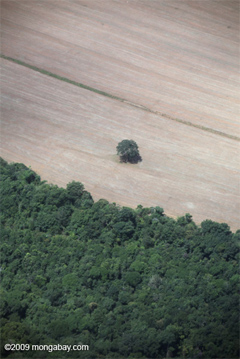
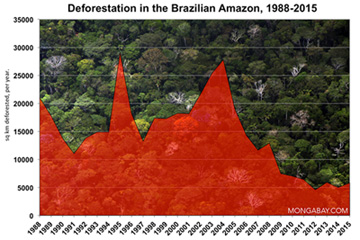
Lead by Brazil, which had the lowest extent of deforestation since at least the 1980s, global forest loss likely declined to its lowest level in more than a decade. Critical to the fall in deforestation was the global financial crisis, which dried up credit for forest-destroying activities and contributed to a crash in commodity prices, an underlying driver of deforestation.

2009 was also notable for progress made on REDD, a proposed climate change mitigation mechanism that would pay tropical countries for protecting their forests. Over the course of the year, world business and political leaders, prominent scientists and conservation groups, celebrities, and other noted figures voiced support for the concept. Momentum carried into climate talks in Copenhagen, where REDD was one of the only areas to see gains. Concerns over REDD now revolve mostly around the details (implementation, financing, governance, and equity) of the mechanism, rather than underlying idea of compensating rainforest conservation as a means to reduce greenhouse gas emissions.

Drivers of Deforestation

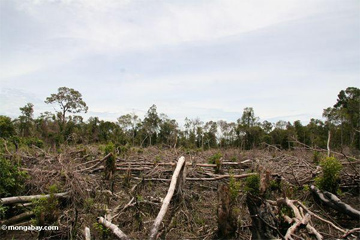
2009 saw major developments reflecting the implications of the shift from poverty-driven deforestation to enterprise-driven deforestation, a trend that continues to accelerate with urbanization and abandonment of government-sponsored colonization projects. While corporations and large landowners have ever-increasing capacity to deforest, the recent shift seems to offer new opportunities for rainforest conservation in that it is easier for pressure groups to target corporations and enterprises rather than tens of millions of poor farmers who are simply trying to put food on the table for their families. Accordingly, major industrial drivers of deforestation — the palm oil, cattle ranching, and logging industries — were significantly affected by activist campaigns in 2009.

In Brazil, the cattle industry was walloped by a Greenpeace report that linked some of the world's most prominent brands — Nike, Toyota, Prada, and others — to destruction of the Amazon rainforest. The fallout from the report was immediate. Some of the world's largest beef and leather buyers suspended contracts with suppliers associated with Amazon forest clearing. The Brazilian government announced a crackdown and fines, raided the offices of powerful cattle companies, and called for a review of loan programs. Government ministers joined the private sector in demanding new chain-of-custody controls for suppliers to ensure that cattle products were not contributing to deforestation. The largest cattle producers and traders soon responded with a moratorium on Amazon deforestation and a promise to implement improved supply-chain tracking mechanisms. The Brazilian cattle industry may now be on the cusp of transitioning from being the world's largest single driver of deforestation to a critical component in helping slow climate change.

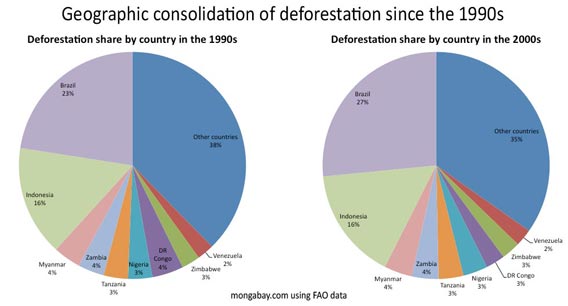
Since the 1990s deforestation has become increasingly concentrated. Recently published research by Matt Hansen of South Dakota State University suggests an even more dramatic shift in recent years. His work, which is based off of high resolution satellite imagery, shows that Brazil and Indonesia accounted for 61 percent of tropical deforestation between 2000 and 2005, rather than the 43 percent reported by the U.N. Food and Agriculture Organization (FAO).


In Southeast Asia, the palm oil industry was stung by the decision by Unilever, the world's largest buyer of palm oil, to suspend its contract with Sinar Mas, the world's second largest producer of palm oil, after an investigation commissioned by the consumer products giant found allegations made by Greenpeace about the palm oil producer's environmental record to be true. The investigation's findings were a blow to the Roundtable on Sustainable Palm Oil (RSPO), which had certified the operations of Sinar Mas as environmentally responsible. Several other prominent palm oil buyers, including Cadbury-New Zealand and Lush Cosmetics, announced they would stop using palm oil in their products following consumer concerns about deforestation. Meanwhile an internal audit by the World Bank's International Finance Corporation (IFC) concluded it had violated its own environmental rules in lending to palm oil companies. Two palm oil companies announced they would forgo development of concessions in carbon-rich areas, instead opting to preserve forests on the land for carbon payments.

In the forestry sector, several large firms severed ties with timber and pulp and paper companies linked by reports from NGOs to questionable logging practices in Indonesia. The United States and Europe stepped up enforcement of laws and regulations (the Lacey Act in the U.S. and FLEGT in Europe) meant to hold importers to environmental laws in timber-producing countries, while a Brazilian federal prosecutor launched an investigation into charges that illegal timber from the state of Pará is being laundered as "eco-certified" wood and exported to markets in the United States, Europe, and Asia. China's Ministry of Environmental Protection draft regulations that would require Chinese companies operating abroad to comply with environmental laws of China and the host country, although it is unclear whether these will actually be enforced.

More Good News

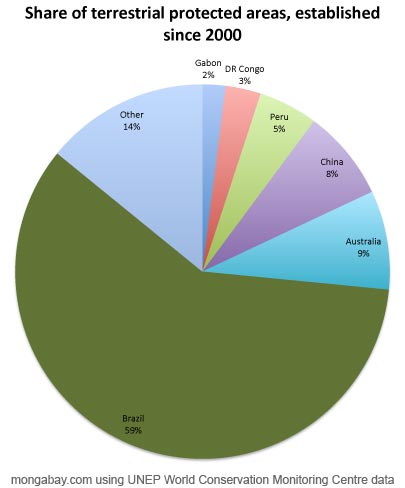
2009 was marked by a number of other hopeful developments for tropical forests. Brazil, Peru, and the Democratic Republic of Congo established massive new rainforest parks, while Papua New Guinea created it first nature reserve. Norway continued to lead industrialized countries in funding rainforest conservation, contributing a quarter of a billion dollars to Guyana and reiterating its billion dollar pledge to Brazil. The United States, Japan, Australia, France, and the United Kingdom also made large financial commitments towards tropical forests.

Indigenous rights in Brazil got a boost after a court victory in a dispute with farmers in Roraima and a legal opinion finding that the Surui tribe owns the carbon rights to the land they inhabit, perhaps leading the way for future indigenous-run forest carbon projects. The Surui also unveiled its partnership with Google in developing tools that will enable the tribe to better monitor their territory for encroachment by loggers, miners, and ranchers. Working with leading scientific institutions and NGOs, Google announced the Earth Engine platform, a system that combines its computing power with advanced monitoring and analysis technologies. The platform promises to enable near real-time monitoring of the world's forests and carbon at high resolution at selected sites before 2011. Meanwhile the Woods Hole Research Institute reported progress on a high resolution global forest map for tracking land cover change.

And Some Bad News

But the good news for tropical forests was tempered by developments including Indonesia announcing its intentions to open up more than 2 million hectares of carbon-dense peatlands to old palm development; the collapse in law enforcement in Madagascar, contributing to an explosion of commercial timber (and lemur) harvesting in that country's spectacular rainforest parks; a breakdown at the RSPO meeting over efforts to reduce greenhouse gas emissions from palm oil production; violent conflict in Peru between government security forces and indigenous groups over land rights and resource extraction; massive foreign land acquisitions in the Congo Basin; dodgy REDD dealings in Indonesia and Papua New Guinea; and large-scale expansion of oil palm agriculture in the Amazon. Brazil moved to grant amnesty to farmers and ranchers who illegally occupy or have illicitly cleared Amazon forest lands, a decision that some say legitimizes past deforestation (others maintain it is a critical step towards improved governance in the region).

Looking forward

While 2009's developments are likely to have long-term implications for conservation, the fate of tropical forests is far from determined. Looking forward, things to watch include: the impact of economic recovery on commodity prices and agricultural expansion for food and biofuels production; large-scale land acquisition by foreign nations and corporations in tropical countries; climate negotiations and the REDD mechanism, including controversies over land rights, "offsetting", forest definitions, and sustainable forest management; the emergence of payments for ecosystem services beyond REDD; the cap-and-trade versus carbon tax schemes; efforts to address the demand side of deforestation — notably consumption; emerging certification systems for agricultural and forestry products; and Brazil's progress in meeting its deforestation reduction targets.