Monday, August 31, 2009

Tim Walker: 'Studios hope that Avatar will herald a new age of 3D cinema. I'm not so sure'

Monday, 31 August 2009
From: Independent

Why would 500 people pile into a cinema at 10 in the morning to watch 15 minutes of a film that won't actually be released for another four months? Because that film is Avatar, James Cameron's long-awaited return from non-fiction filmmaking to Hollywood. And because this was "Avatar Day", obviously. Duh.

A week ago, film lovers (including this one) flocked to hundreds of cinemas worldwide to see footage from Cameron's new sci-fi extravaganza, which was filmed using 3D technology developed by the director himself, and will – if its makers are to be believed – alter the way we see movies forever.

In 3D, at the vast BFI IMAX cinema, the footage certainly looked more spectacular than the flat, two-minute trailer that's online now. Some of the visuals are breathtaking, and I dare say Avatar is less likely to disappoint fans than The Phantom Menace, for example. That said, the plot looks more Titanic than Terminator. In fact, it looks like Aliens-meets-Born on the Fourth of July-meets-Ferngully: The Last Rainforest.

Jake Sully, a wheelchair-bound former marine played by Sam Worthington, travels to Pandora – an untouched tropical planet being colonised by Earthlings, who've found a way to control the bodies of the native "Na'vi" humanoids with their minds. Jake, in control of one of these avatars' lanky blue frames, falls in with the locals and joins their resistance against the planet's human occupation.

The studios hope that Avatar's release will herald a new age of 3D cinema. For animation, or for spectacle-laden blockbusters, maybe. And in Cameron's film, 3D seems to have a narrative, as well as a visual, function: Avatar seeks to introduce us to a whole new world, and to immerse us in it – just as Jake finds himself enveloped in the body of his Na'vi host.

But 3D is a revolution that the film industry has wrongly predicted before. I can't see it improving other genres, like romcoms or ensemble dramas. I can, on the other hand, see it becoming another way for Hollywood to polish turd-like scripts. It won't stop people staying home to download pirated films; and asking audiences to pay extra for the loan of a pair of plastic glasses isn't entirely on.

Newspapers have published reviews and star ratings for the 15 minutes of Cameron's footage we saw, as they would for any full-length film, so essentially pointless events like "Avatar Day" are an effective new weapon in the armoury of the studio marketeer. In this, at least, the film has broken new ground. But will Avatar really change the movies – or just the way they're hyped?

I recently came into possession of a brand new Sony Reader, the Japanese brand's electronic book-reading device. I'm very fond of paper, as you might imagine, but I expect I shall grow to love the thing, despite the dispiriting selection of e-books currently available – and the utterly labyrinthine process of buying a book in digital format, let alone getting it on to your computer, and from there to the Reader device itself.

The new Sony Reader Touch edition is slim and black and about the same weight as a 200-page paperback. While I'd still rather read a regular book in the bath, it'll be great for travelling; I plan to store my holiday reading on it when I go away, freeing up space in my suitcase for extra towels. It sure beats scrolling through Shakespeare on an iPhone. On the other hand, the Amazon Kindle e-reader is expected to launch here in time for Christmas, and there's a distinct possibility it'll crush Sony when it does. With the weight of Amazon's website behind it, the Kindle is as dominant in the US e-book market as Apple's iPod is in digital music.

What really concerns me, though, is not which e-reader I've chosen, but that I'll no longer be able to show off my impeccable taste to pretty girls on public transport. If all I'm reading is a metal box, how will they know that I'm sensitive and hip and engrossed in a US import copy of the new Dave Eggers?

When they start selling 3G-equipped devices in the UK, may I suggest that Sony and/or Amazon develop some sort of Wi-Fi software application that seeks out fellow readers in the vicinity and alerts people who have matching tastes. Oh, and it should also allow us sensitive hipsters to instant message one another, rather than having to make actual eye contact: "Hey, I like Dave Eggers, too! Wanna go get some FairTrade coffee?" Foolproof, no?

New Amazonian reserve saves over a million acres in Peru

August 30, 2009
From: mongabay.com

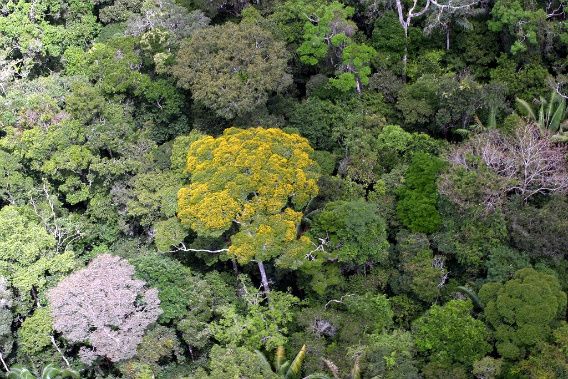
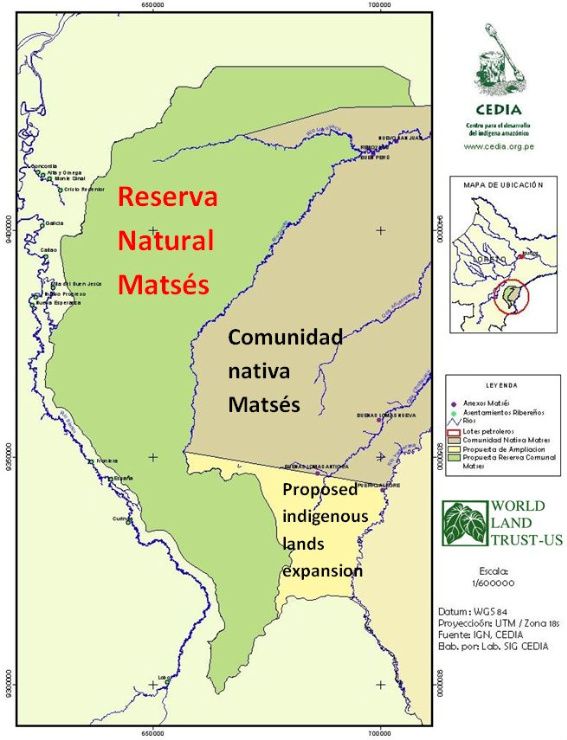
On August 27th Peru's Ministry of the Environment approved the creation of the Matses National Reserve to protect the region's biodiversity, ensure its natural resources, and preserve the home of the Matses indigenous peoples (known as the Mayorunas in Brazil). The park is 1,039,390 acres (or 420,626 hectares) of lowland Amazonian rainforest in eastern Peru.

The park is the culmination of over a decade of work by the local non-profit CEDIA(the Center for the Development of the Indigenous Amazonians) funded in large part by the World Land Trust-US.

"Like so many other remote indigenous peoples, [the Matses] have been forced to defend their homelands from logging and oil companies in a bid to preserve their ancient way of life and protect the amazing Amazon rainforest… These short-sighted commercial activities have worked against indigenous peoples and conservationists to prevent this critical protected area from being established," a press release by the World Land Trust-US stated.

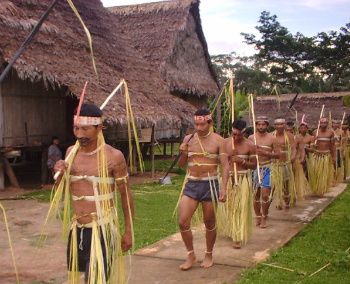
Long unknown to the world, the Matses people were first contacted in 1969 by Christian Missionaries. The indigenous group has since remained in nearly complete isolation, retaining their traditions and living through sustainable hunting and fishing. The preserve protects the Galvez and Yaquerana Rivers, which the Matses people depend on for fishing. The group is eminently skilled with the bow and the arrow—their unique arrows measure two meters in length—which they use for hunting. The Matses group are also known as the 'cat people', because of distinct facial tattoos and piercings worn by the women which resemble the whiskers of a cat.


(Image1: The Matses people. Image courtesy of the World Land Trust-US.
Image2: View of rainforest in the new Matses National Reserve. Photo courtesy of the World Land Trust-US.
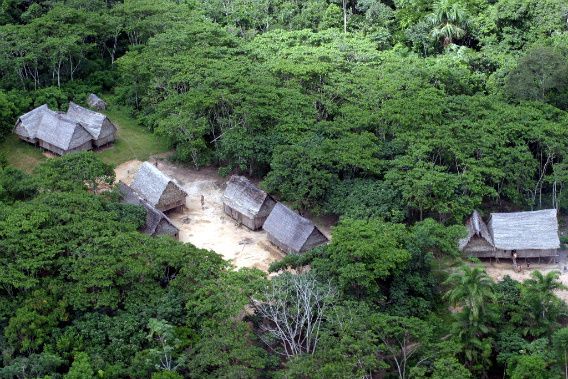
Image3: Remote Matses village. Photo courtesy of The World Land Trust-US.
Image4: Map of the new reserve. Map courtesy of The World Land Trust-US.)

Brazil touts its alternative energy; but look at all this oil

Sunday, August 30, 2009
From: The Online

Brazil, long proud of its push to develop renewable energy and wean itself off oil, has a bad case of fossil-fuel fever.

An enormous offshore field in territorial waters -- the biggest Western Hemisphere oil discovery in 30 years -- has Brazilians saying, "Drill, baby, drill," while environmentalists fear the nation will take a big leap backward in its hunt for crude.

There has been virtually no public debate on the potential environmental costs of retrieving the billions of barrels of oil, a project one expert said will be as difficult as landing a man on the moon.

"The government is whipping Brazil into a euphoria that this is going to be a solution for all our societal problems," said Sergio Leitao, director of public policies for Greenpeace Brasil. "Brazil is no longer seriously looking at alternatives."

Home to the bulk of the Amazon rainforest, Brazil for decades has developed alternative energy as an issue of national security following severe energy shortages in the 1970s. It uses hydroelectric power for more than 80 percent of its energy needs, is the world's largest exporter of ethanol, and nine out of every 10 cars sold in the nation can run on ethanol or a combination of ethanol and gasoline.

A U.N. study found that in 2008, Brazil accounted for almost all of Latin America's renewable energy investment, to the tune of $10.8 billion.

But since the national oil company Petroleo Brasileiro SA, or Petrobras, discovered the massive Tupi field off the coast of Rio de Janeiro two years ago -- estimated to hold 5 to 8 billion barrels -- it is the development of oil fields that has gone into overdrive.

Thirty years ago, more than 85 percent of Brazil's oil came from foreign sources. Today, it is a net exporter.

There have been a series of other discoveries since Tupi -- each lying at least 115 miles (185 kilometers) offshore, more than a mile below the ocean's surface and under another 2.5 miles (4 kilometers) of earth and salt. Estimates of the entire area's recoverable oil range between 50 billion and 100 billion barrels.

Brazilian President Luiz Inacio Lula da Silva hailed the finds as the nation's future, a second declaration of independence and an economic savior for 57 million Brazilians living in poverty -- 30 percent of the population. The military wants new submarines and jets to protect the crude. Leftist groups want it all nationalized.

The enthusiasm also is fanned by Brazil's devotion to Petrobras, routinely listed as one of the most-admired companies in national polls.

Founded in 1953 to fend off an economic crisis and dependency on foreign oil, Petrobras has long embodied Brazilian nationalism and the notion of shielding domestic wealth from foreigners -- particularly the United States and Europe.

In 2008, Brazil's total oil and natural gas production was nearly 2.3 barrels per day. Petrobras was responsible for more than 96 percent of it.

"Most Brazilians think of Petrobras like they think of their soccer stars," said Eric Smith, an offshore oil expert at Tulane University in New Orleans who likened efforts to get at Brazil's oil to a trip to the moon. "Try to find Americans who support Exxon like that."

Petrobras fattens government coffers with more than $30 billion a year in taxes and royalties.

The Cow Turns Green

Aug 28, 2009‎
From: Newsweek

Few creatures would seem as beneficent as the cow. Properly grazed and groomed, it gives us burgers and brie, boot leather and fertilizer. Lately, however, radical green groups and celebrity vegans like Paul McCartney have made cows out to be weapons of mass destruction: not only has their meat caused an epidemic of hypertension and heart disease, but they also trample rainforests, trash the soil, and foul the air with greenhouse gases. Scientists say that every year the average Holstein produces up to 180 kilos of methane, which traps 25 times more heat than does carbon dioxide. All told, bringing meat from the pasture to the griddle produces 18 percent of global greenhouse-gas emissions, according to the United Nations. Last year, Rajendra Pachauri, the chair of the U.N.'s Intergovernmental Panel on Climate Change, called upon everyone to give up eating meat at least one day a week, giving birth to the global meatless Monday. "If anyone wants to save the planet, all they have to do is just stop eating meat," McCartney famously said.

Perhaps. But since 1960, worldwide production of meat has quadrupled to more than 280 million tons a year. Even if everyone in the rich nations swore off meat today, consumption would continue to soar, driven by the protein-hungry rising middle classes of China, Brazil, and other developing nations. For this reason, serious environmental planners have recently focused not on eliminating the meat industry but on turning it green.

It's a tall order. Making beef, pork, or chicken can be an environmentally devastating process, from felling forests for pastures to the fossil fuel required to produce fertilizer for feed crops. Compared with tofu production, meat-making gobbles up 17 times as much land, 26 times as much water, 20 times the fossil fuels, and 6 times as many chemicals, according to Plenty magazine. And among animal proteins, beef is the real hog; producing a kilo of beef takes up seven times more farmland than it does to produce a kilo of chicken and 15 times the area needed for a kilo of pork. Yet scientists, herders, and green groups are convinced they can curb the damage by making adjustments all along the supply chain, changing the way we farm and feed livestock and building a cleaner cow through modern genetics. Suddenly, the search for what food activist and author Michael Pollan calls "green meat" has become a worldwide effort.

The effort starts with the beast itself. When a cow eats, its stomach produces methane as a byproduct. Cows are pretty efficient at eating grass, but the soybeans and corn that most industrial livestock farms feed them make the bovine stomach rumble with excess gas. To fight this, some farms in Vermont and France have begun to roll back the clock. The owners of the Stonyfield Farm in Vermont found they could improve health and boost milk production in the herds, and reduce methane emissions, by eliminating the soybean- and corn-based feed that became popular during the bumper harvests of the Green Revolution. Instead, they give their cows old-fashioned flax and alfalfa, which are packed with nutrients and benign fatty acids. This tactic, widely used in France, is now being replicated elsewhere in the U.S. In Canada, where cattle grazing accounts for 72 percent of total greenhouse-gas emissions, scientists are tinkering with the chemistry of feed—adjusting the balance of key nutrients such as cellulose, ash, fat, sugar, and starch—as another way of lowering the cow's carbon footprint.

The more ambitious projects involve tinkering with the cow's genetic code. Researchers at the University of Alberta are examining the DNA in cows' four stomachs to identify the genes responsible for making them burp and regulating how much gas they produce. In time, they hope to be able to breed cleaner cows, which could reduce emissions from cows by 25 percent, says Stephen Moore, professor of beef-cattle genomics at Alberta. Researchers at Colorado State University have identified DNA markers that they believe will help them selectively breed animals to digest their food more efficiently and so produce less methane.

Cutting down forests to make room for livestock farms is another big reason meat is environmentally unsound. Brazil has in recent years risen as an agricultural power-house, but it now ranks as the fourth—biggest emitter of greenhouse gases, thanks mainly to the destruction of the Amazon rainforest. Though the pace of felling has dropped, 12,900 square kilometers of rainforest (an area larger than Jamaica) were destroyed last year, releasing 160 million tons of carbon into the atmosphere. As national leaders prepare to make a new pact in Copenhagen for curbing climate change this December, international green groups have criticized Brasília for its plans to build roads through the Amazon and for bowing to the farm lobby, which has expanded its frontier to the lip of the rainforest.

Many leaders in business and government are embracing the green agenda. Brazilian meatpackers like Marfrig, food sellers like Wal-Mart, footwear companies such as Timberland, and thousands of ranchers have signed on to a moratorium on using beef from recently deforested areas. "For years, the way to produce cattle was to chop down the forest to plant pastures," says Ocimar Vilela, head of environmental sustainability at Marfrig. "Now customers are demanding we change, and these demands are here to stay."

Still, the livestock industry has a long way to go. Many of the reforms are just getting started and are only being tried at a few farms, and many advances are still in the testing phase. No matter how green the business gets, meat will still weigh heavily on the planet. But going green seems to be the only realistic path. Even if everyone in the rich nations swore off meat today, consumption would continue to soar, thanks to the burgeoning middle classes of China, Brazil, and other nations. Brazilians today eat 89 kilos of red meat and poultry a year, nearly triple the per capita consumption of 15 years ago, while the average Chinese citizen consumes close to two and a half times more meat than he did in 1990. Even India is getting a taste for red meat—its beef consumption jumped 36 percent in the past decade. Overall meat consumption in poorer countries is growing by more than 5 percent a year, twice the world rate, making meat the most coveted agricultural commodity in recent history. The global recession has surely slowed the trend, but appetites once whetted are hard to blunt. Although meat is a health problem in the West, to many poor nations it's a boon. "Even small additional amounts of meat and milk can provide the same level of nutrients, protein, and calories to the poor that a large and diverse amount of vegetables and cereals could provide," concludes a study by the International Food Policy Research Center in Washington. "Who is going to tell the developing world's new consumers, 'Sorry, you can't eat beef'?" says Paulo Adário, an expert in the livestock industry at Greenpeace. Of course, with green beef, you might not have to.

Friday, August 28, 2009

Roads are ruining the rainforests

29 August 2009
From: New Scientist

"THE best thing you could do for the Amazon is to bomb all the roads." That might sound like an eco-terrorist's threat, but they're actually the words of Eneas Salati, one of Brazil's most respected scientists. Thomas Lovejoy, a leading American biologist, is equally emphatic: "Roads are the seeds of tropical forest destruction."

They are quite right. Roads are rainforest killers. Without rampant road expansion, tropical forests around the world would not be vanishing at a rate of 50 football fields a minute, an assault that imperils myriad species and spews billions of tonnes of greenhouse gases into the atmosphere each year. We will never devise effective strategies to slow rainforest destruction unless we confront this reality.

In our increasingly globalised world, roads are running riot. Brazil has just punched a 1200-kilometre highway (the BR-163) into the heart of the Amazon and is in the process of building another 900-kilometre road (the BR-319) through largely pristine forest. Three new highways are slicing across the Andes, from the Amazon to the Pacific. Road networks in Sumatra are opening up some of the island's last forests to loggers and hunters. A study published in Science found that 52,000 kilometres of logging roads had appeared in the Congo basin between 1976 and 2003 (vol 316, p 1451).

As my colleagues and I reveal in a forthcoming article in Trends in Ecology and Evolution, these are just a small sample of the many new road projects slicing through tropical frontiers.

Why are roads so bad for rainforests? Tropical forests have a uniquely complex structure and humid, dark microclimate that sustain a huge number of endemic species. Many of these avoid altered habitats near roads and cannot traverse even narrow road clearings. Others run the risk of being hit by vehicles or killed by people hunting near roads. This can result in diminished or fragmented wildlife populations, and can lead to local extinctions.

In remote frontier areas, where law enforcement is often weak, new roads can open a Pandora's box of other problems, such as illegal logging, colonisation and land speculation. In Brazilian Amazonia, 95 per cent of deforestation and fires occur within 50 kilometres of roads. In Suriname, most illegal gold mines are located near roads. In tropical Africa, hunting is significantly more intensive near roads.

Environmental disasters often begin as a narrow slice into the forest. Rainforests are found mostly in developing nations where there are strong economic incentives to provide access to logging, oil and mineral operations and agribusiness. Once the way is open, waves of legal and illegal road expansion follow. For instance, the Belém-Brasília highway, completed in the 1970s, has developed into a 400-kilometre-wide swathe of forest destruction across the eastern Amazon.

Beyond the forest itself, frontier roads imperil many indigenous peoples, especially those trying to live with limited contact with outsiders. As I write, indigenous groups in the Peruvian Amazon are stridently protesting the proliferation of new oil, gas and logging roads into their traditional territories. The roads bring loggers, gold miners and ranchers who often subjugate the indigenous people. Even worse, the invaders can bring in deadly new diseases.

Throughout the tropics, infections such as malaria, dengue fever, enteric pathogens and HIV have all been shown to rise sharply after new roads are built. Some indigenous groups, such as the Surui tribe of Brazilian Amazonia, have been driven to the edge of extinction by roads and the invading loggers, colonists and diseases they bring.

What can we do to slow the onslaught? First, we must vastly improve environmental impact assessments for planned roads. In many developing nations, EIAs focus solely on the roads themselves, completely ignoring the knock-on effects. In Brazil, for instance, EIAs for Amazonian highways focus only on a narrow swathe along the route, often recommending only paltry mitigation measures, such as helping animals to relocate before building begins. EIAs for certain mines, hydroelectric dams and other large developments focus only on the project itself while ignoring the impact of the roads it will invariably spawn. New roads will continue to drive rainforest destruction so long as the EIA process is so fundamentally flawed.

The second thing we have to do is fight to keep the most destructive roads from being built - the ones that penetrate pristine frontier areas. There is no shortage of battles to wage. A proposed highway between Colombia and Panama, for example, would expose one of the world's most biologically important areas, the Chocó-Darién wilderness, to rampant destruction. Likewise, Brazil's BR-319 highway is threatening to open up the central Amazon like a zipper.

Finally, we need to pressure those promoting these frontier roads. These include timber corporations like Asia Pulp & Paper and Rimbunan Hijau, international lenders such as the Asian, African and Inter-American Development Banks, and massive infrastructure schemes such as Brazil's Programme to Accelerate Growth. In their scramble for tropical timber, minerals, oil and agricultural products, China and its corporations have become perhaps the biggest drivers of destructive road expansion.

Restricting frontier roads is by far the most realistic and cost-effective approach to conserving rainforests and their amazing biodiversity and climate-stabilising capacity. As Pandora quickly learned, it is far harder to thrust the evils of the world back into the box than to simply keep it closed in the first place.

Could Wellington boots save the rainforest?

27 August, 2009
From: Cool Earth

A clothes retailer is claiming that a new line of Wellington boots could help save rainforests around the globe.

Po-Zu's footwear has been launched in partnership with Brazilian brand Amazon Life and the sturdy yet stylish wellies are made out of a wild rubber – copyrighted as Treetap - collected by Kayapo Indians rubber tapers.

By providing jobs for rainforest communities the boots are supporting sustainable trade and the firm works in alliance with the Rubber Tappers Association in Brazil.

It is a fair trade organisation aiming to help those living deep in the Amazon maintain their lifestyles.

The firm says that there are around 200 families and 1,000 people involved with the Rubber Tappers Association.

Bia Saldanha of Treetap says: "People know it is important to preserve the Amazon forest, and therefore, buying our product is a way for them to help keep it alive."

Meanwhile, earlier this month Greenpeace signed a deal with big high street brands Adidas and Timberland.

Both retailers agreed to only use leather made in the Amazon region which had been produced on farms complying with environmental standards.

Irish call for total EU ban on Brazilian beef

28 August, 2009
From: meatinfo.co.uk

The Irish Farmers Association (IFA) has written to the EU Commission calling for an immediate and complete halt on Brazilian beef imports.

IFA president Padriag Walshe wrote to EU Commissioner for Health & Consumer Protection, Androulla Vassiliou, asking her to take action to halt what he described as the “failed Brazilian process” of clearing farms for export to the EU.

Walshe also wrote to Ireland’s 12 new recently elected MEPs requesting that the pursue the matter with the Commission so that action is taken to impose a ban on Brazilian beef into the EU.

In his letter to Commissioner Vasilliou, the IFA president said that the most recent Food and Veterinary Office report revealed a “litany of failures” made by Brazil. He said that half of the holdings inspected by the FVO failed to meet EU standards on registration, traceability and movement controls and repeated accusations that unapproved beef from Brazil has entered the EU.

Walsh also raised the fact that the Brazilian beef industry has come under pressure over the alleged deforestation of the Amazon rainforest. He said if the Commission fails to act on this occasion, it will be guilty of “making a mockery” of EU standards and turning a blind eye to the huge environmental damage caused by illegal deforestation of the Amazon rainforest.

Beef Producers in Amazon Declare Moratorium

28 August 2009
From: Voice of America

Major beef and leather producers in Brazil have agreed not to use cattle raised in recently deforested areas of the Amazon rainforest.

Deforestation is a major contributor to climate change, and Brazil loses an estimated three million hectares of forested land each year, according to the U.N. Food and Agriculture Organization. That's more than any other country in the world. And cattle ranching and deforestation are intimately connected.

The governor of the Brazilian state of Mato Grosso has called on meat producers not to buy cattle raised on recently deforested lands in the Amazonian state. Now, two major beef producers in Brazil, Bertin and Marfrig, have announced they are joining the initiative. Shoe makers Nike and Timberland signed on earlier this month.

Environmental group's report


The moves follow a report issued this June by the environmental group Greenpeace that traced leather products from major global brands back to the meat processors and ranchers in deforested areas of the Amazon.

Greenpeace spokesman Daniel Kessler says the announcements will have a significant impact on protecting the rainforest.

"Mato Grosso, just to give some perspective, is by far the largest producer of leather in all of Brazil," Kessler says, "and the fact that they're having this moratorium is extremely important. Using Bertin as an example, they're the second-largest beef exporter in Brazil. And they're supporting this moratorium. And they're doing the right thing."

The third major meat packer in the Amazon region, JBS, has not announced its plans and did not return calls and emails for comment.

The Brazilian government and independent third-party observers will enforce the moratorium using satellite photographs, aerial fly-overs, and site visits. The meat processors have agreed not to buy cattle from those responsible for newly deforested lands.

Soybean moratorium

Brazil is already using this system to monitor soybean production. The country is a major soy producer, and since 2006 a coalition representing soybean growers, processors, and civil society groups has been cooperating on a moratorium on soy from recently deforested Amazon land.

Cassio Franco Moreira with the environmental group World Wildlife Fund is a member of that coalition. He says soy often follows cattle on recently deforested land.

"You have a huge area of forest and then you deforest it and then you put cattle [on it] because you can take your product walking to the slaughterhouse," he says. "And [for] soy you need roads, you need this kind of thing."

So, he says, limiting cattle ranching in the Amazon is an important step. Greenpeace's Daniel Kessler says he's optimistic about the cattle moratorium.

"The government in Brazil did a great job with soy, so we have full faith that they'll do a great job with leather," he says.

The soy moratorium has just been extended for another year while all the groups involved work out a more permanent method to certify that soybeans do not come from deforested land.

Thursday, August 27, 2009

Brazil's Amazon Rainforest Burns Completely Down

27 August 2009
From: The Spoof (satire)

The world's leading scientists are trying to figure out how in the world Brazil's Amazon Rainforest managed to catch fire and burn completely down to the ground.

Professor Verbicarpo San Lobo of Rio De Janeiro's Amazonia A&M University said that he has been studying the Amazon Rainforest for over 40 years and he has never seen anything come remotely close to this catastrophic event.

He stated that he has ruled out mother nature and the possibility of lightning. He said that the Amazon trees have been hit by lightning hundreds of times before and nothing had ever happened because the trees were so wet from the rain that they could not catch fire and burn.

San Lobo said that the trees would just get a nauseatingly rancid smell and an obnoxiously pungent and putrid odor, much like probably what an NFL locker room must surely smell like.

The professor (and Mary Ann) [WRITER'S NOTE: Sorry, I tried, but I could not pass up the Gilligan's Island reference] was asked by a reporter for Sports Illustrated if perhaps flora or fauna may have had something to do with it.

San Lobo did mention that rumors had filtered back to him that the unmarried 47-year-old pyromaniac Tecolote sisters Flora and Fauna of neighboring Bolivia were being looked at as persons of interest by the Manacapuro Police Department.

MPD Police Chief Vernon Carapeluda checked with Twitter and they verified that at the time that the Rainforest caught fire neither sister was in Brazil or even South America for that matter.

Fauna Tecolote was up in Canada with her maternal grandmother attending The Yearly Saskatoon Founders Day Icicle-Eating Contest and Reindeer Neutering Finals.

And Flora Tecolote was in room 17 of The Lady Godiva Motel in Yuma, Arizona with a married tattoo ink salesman named Bubba Slim Chunderbock.

Professor San Lobo said that he plans to fly to Portsmouth, England and meet with Sir Spoofer Skoob, who is the world's foremost authority on things of a scientific nature.

Sir Spoofer has researched, studied, and analyzed such scientific questions as why when black widow spiders mate does the wife almost always immediately eat the husband; Is he really all that bad?

Another in depth study involved the question as to what do laughing hyenas do when they get depressed; maybe not laugh as much or perhaps just giggle a little bit?

And a third study dealt with the age old question of why exactly is it that when duck pond ducks cough one never ever sees any tiny little bubbles pop up to the lake's surface beside the little feathered darlings.

Professor San Lobo says that he recently read a very informative book on the subject of the Rainforest which was written by the highly esteemed, highly respected, and highly gifted* Sir Spoofer entitled, I Met Her On The Shifting Sands of The Kalahari Desert, And We Fell In Love In The Permanent Puddles of The Amazon Rainforest.

This explicitly graphic and graphically explicit book as well as other books by Sir Spoofer Skoob including his award winning literary compilation entitled the "Inbred Mutant Hoody Zombie Teen Stalk 'N' Slash Massacre - Parts 1-10 (Part 1)" are all available by simply going on the Internet and logging on at www.booksandbeer.mmm

* Gifts that Sir Spoofer received from his vivaciously lovely wife last Christmas include a brand new Rolex computer mouse, a 517-year-old fountain pen that once belonged to Christopher Columbus (the Christopher Columbus), season's tickets to The Manchester United F.C. Red Devils home games, and a gift certificate for a year's supply of the beverage of his choice.

The president of Brazil, Sancho Ventana plans to ask President Barack Obama for a stimulus package bailout to help buy seeds, fertilizer, insecticides, and hundreds of water hoses in order to replant the Amazon Rainforest.

President Ventana informed President Obama that the loss in tourism to the Brazilian economy alone is going to probably amount to somewhere around $65,725 just through the end of the year.

(Image: A photo of the Amazon Rainforest taken a few days before it mysteriously burned down )

For Ecuador’s indigenous nations: A new constitution and familiar problems

Aug 28, 2009
From: Indian Country Today

Decades of activism by Ecuador’s indigenous peoples have earned them considerable political power, and last year the government approved a constitution that incorporates many of the rights and concepts they long demanded. Yet, some indigenous leaders complain that little has changed in practice and that their people face the same threats they did under previous governments.

Ecuador’s current constitution, which was drafted by an assembly that included ample indigenous representation, was approved by popular vote in September 2008. It was a project of President Rafael Correa, a socialist allied with Venezuelan leader Hugo Chavez and whose País Party dominated the constitutional assembly that produced the document.

The new constitution strengthens government control of the economy, but also recognizes the rights of nature and states that Ecuador is a “pluri-national state” composed of various ethnic groups, which should open the door for greater indigenous participation.

But according to Luis Yampis, a Shuar Indian and one of the directors of the Confederation of Indigenous Nationalities of Ecuador (CONAIE), the new constitution has done little to change the government’s relationship with indigenous peoples. He complained that delegates from the País Party overruled most of CONAIE’s proposals to the constitutional assembly and that the Correa administration has since approved oil and mining concessions on or near indigenous land without proper consultation.

“The government should consult with the leaders of our indigenous organizations, but instead they want to choose certain people with whom to negotiate,” Yampis said. “We don’t want the recognition of a pluri-national state to be nothing more than words on paper. We demand that the government fulfill that promise. We demand our right to prior consultation.”

Ecuador, which comprises parts of South America’s Pacific Coast, Andes Mountains and Amazon Rainforest, is home to more than a dozen indigenous nations that constitute between 20 and 40 percent of the country’s population. Those ethnicities include a Kichwa-speaking majority, who are descendents of peoples who formed part of the Incan empire five centuries ago, the Awa and Chachi, who are related to tribes in Colombia’s Pacific lowlands, and various Amazonian ethnicities related to the Jibaro and other peoples in Peru. The country’s population of more than 14 million also includes a small Afro-Ecuadorian minority, the descendents of colonists from Spain and other European nations and a mestizo majority with a mix of indigenous and European heritage.

CONAIE, Ecuador’s largest indigenous organization, has traditionally allied itself with unions, farmers groups and leftist parties to pressure the government to repeal laws it opposed, or to force unpopular presidents from power. In recent decades, CONAIE has led massive protests that shut down the Ecuadorian capital of Quito and forced three presidents to resign.

In 1996, CONAIE created the political party Pachakutik, which has won various mayoral and congressional races. But in recent years, many indigenous and labor leaders have joined Correa’s País movement, which has diminished CONAIE’s political power.

Yampis complained that while Correa celebrates Ecuador’s ethnic diversity, his administration has weakened intercultural health and bilingual education programs that indigenous leaders spent years fighting for.

Dr. Rosa Alvarado, an Amazonian Kichwa and vice president of the international Coordinator of Indigenous Organizations of the Amazon Basin, noted that while the Correa administration has improved rural health care in much of the country, it has done a poor job in the Amazon region, where it abandoned an intercultural health program she helped create. Alvarado, a public health specialist, said the intercultural system combines Western and indigenous medicine, and uses local health promoters to provide care in remote communities.

“The current administration wants just one health system and one education system.”

Yampis said Amazon indigenous communities are threatened by illegal logging, hydroelectric projects that could reduce the flow of the rivers they depend on, and exploitation of new oil concessions.

He said CONAIE opposes a new mining law and a proposed gold mine in the Cordillera del Condor, a mountain range along the border between Ecuador and Peru that holds the headwaters of rivers Shuar communities depend on.

According to Esperanza Martinez, Ecuador coordinator for the international environmental group Oil Watch, indigenous leaders have legitimate concerns. She said Correa is trying to move Ecuador away from its dependence on oil exports, which account for more than one-quarter of the country’s gross domestic product, but in order to finance economic diversification, he wants to exploit new oil reserves. She said there are 20 oil concessions in the country’s Amazon region, most of which overlap indigenous territories.

Yampis said one of CONAIE’s priorities is the consolidation of indigenous territories, noting that the government has given title to colonists who invaded indigenous lands, but has resisted indigenous demands for collective title.

Ecuador’s Amazonian indigenous groups won legal recognition of vast territories through a series of marches, road blockades and other protests in the 1980s and 1990s, but according to Yampis, much of their ancestral territory has yet to be titled.

“This government doesn’t want to legalize our communal lands. We are demanding the legalization of indigenous territories, as is guaranteed by the constitution.”

CONAIE is formulating a series of proposals for the government, including measures for autonomy of indigenous territories. Yampis said if the Correa administration doesn’t respond, CONAIE may organize national protests.

Though Alvarado echoed Yampis’ concerns, she expressed hope that the country’s indigenous organizations can take advantage of the new constitution to lobby for laws and development models that respond to their needs. “The advantage of the new constitution is that it respects our rights and our cosmovision; so it can be seen as an opportunity to propose projects to the government.”

Angel Medina, a Saraguro Kichwa leader Correa appointed executive secretary of the Development Council of the Nationalities and Peoples of Ecuador, said the constitution’s recognition of a pluri-national state is a result of decades of organizing and protests. He said it opens the door for indigenous organizations to propose mechanisms to make the government more inclusive.

“We have won rights, but we haven’t abandoned our struggle. We demanded the recognition of a pluri-national state, and it is now up to us to decide what needs to be done to make the pluri-national state a reality. We need to fight to make ourselves part of this state.”

Corporation Responsible for Worst Oil-Related Disaster on Earth Sponsors Nonprofits Conference

August 27, 2009
From: Commondreams.org

SAN FRANCISCO - August 27 - Chevron, a company facing widespread criticism by many Bay Area organizations for human rights abuses and environmental destruction, is the primary sponsor of CompassPoint's "Nonprofit Day". CompassPoint Nonprofit Services is a consulting, research, and training organization, that provides tools to the very same non-profits fighting the likes of Chevron. Chevron's donation is the latest in a string of good-will gestures intended in deflecting attention from a $27 billion dollar lawsuit in Ecuador. Amazon Watch called upon Compasspoint and all the non-profits participating in the event to demand that Chevron fund a full-scale clean up of its toxic waste in the rainforest.

In a letter sent to Compasspoint, Amazon Watch voiced concern towards Compasspoint's conflicting relationship with Chevron:

"We believe that as Chevron's very prominent sponsorship of the event publicly associates your name with Chevron's corporate brand and image, you should know what the Chevron brand has come to represent in the Ecuadorian rainforest and beyond.

"Your organization represents the best of the Bay Area. We hope that you will join us in using Chevron's association with Nonprofit Day as an opportunity to press the company to do the moral thing in Ecuador."

"Our concern is not in the intention of Compasspoint, rather that Chevron's participation in Non-profit day dilutes the mission of the organization. This is typical Chevron spin, throwing peanuts to a good cause, while throwing punches at communities where they operate," said Paul Paz y Miño, Managing Director at Amazon Watch. "This is the very same corporation that attacked last year's Goldman Environmental Prize winners with a full page ad in the San Francisco Chronicle." The Goldman Prize and its associated family fund are two of the most respected non-profits in the San Francisco Bay area.

Chevron has seen a wave of negative press in the past months primarily focused on the company's dumping of more than 18 billion gallons of toxic waste water into Amazon waterways and abandonment of more than 900 unlined waste pits filled with oil sludge. In the past months Chevron has launched it PR crisis team at new levels hiring online bloggers, paying for blogger to attend Chevron chaperoned trips to Ecuador, and just last week hiring three giants in the PR world, Edelman, Sard Verbinnen & Co., Hill & Knowlton to develop a crisis plan for the company.

A verdict in the $27 billion lawsuit in expected later this year or early 2010.

Hunting down hidden treasures with GeoCaching

Thursday 27th August 2009
From: Swindon Advertiser

A GLOBAL treasure-hunting game is the latest craze to hit Swindon.

GeoCaching is a challenge whose participants use orienteering skills to find coins, puzzles, toys and other items.

Navigational skills are used to hide and seek containers known as caches.

There are 14 different types of challenge, ranging from finding caches through standard co-ordinates to cracking cryptic puzzles to gather vital data.

The hider can leave treasure anywhere in the world, ranging from, say, the Amazon Rainforest to Swindon’s own Magic Roundabout if they wish.

A seeker can log on to their computer at home to obtain co-ordinates for their Global Positioning System before the hunt begins.

Enthusiast Sam Vaughan, 22, of Gartons Road, in Middleleaze, West Swindon, said: “This is a game for any age group from five to 95.

“It’s a contemporary version of the old pirate treasure map where X marks the spot.

“From locating the treasure on your computer to locating it in person via your GPS, it’s a fun way get out and about and explore areas that you may not have been to.”

There are currently 883,674 caches hidden all over the world, with about 400 of those waiting for discovery in Swindon.

Some of the caches contain Geo-Coins, which are specially manufactured for the game and have individual serial numbers.

Sam said: “If you find a coin you never know where it has been until you log it on the computer.

“While GeoCaching in Lydiard Park I found my first coin, which came from Staines in Berkshire. I also know of people whose coins have come all the way from the Bahamas and were found in Swindon.

“Each trackable item has its own mission set by the hider.

This could be anything from a toy dolphin seeing all the oceans to a Lego man visiting each area of Swindon.

“Trackables and coins are moved on once found to different cache sites.

This is after they are logged on the computer and accounted for, so people can monitor their progress.”

Sam advises those who are seeking treasure to be discreet, as people who are not in on the game could spoil missions for other GeoCachers by “Muggling.” This is a term used to describe non-GeoCachers.

GeoCaching is described as “using million dollar satellites to locate Tupperware pots.”

GeoCaching began in America in 2000 and has now spread round the world, attracting about half a million participants.

If you would like to take part or learn more, visit the website at www.geocaching.com.

Wednesday, August 26, 2009

Acai Berry Free Trial: Weight Loss That Actually Works!!

I am sure you have probably heard of the little Acai berry that is helping so many of us loss those trapped in extra pounds. This little berry has been sweeping the nation and entering our homes in records numbers. It is no wonder this superfood from the Amazon rainforest is packed with so many benefits, to include aiding our bodies in loosing trapped in fat. This little berry has natural fat fighting chemicals in it, so it is helping millions get their body back that they have otherwise not been able to obtain with any other diet. Since every body is uniquely designed and looses body fat with boost or diets in so many different ways. The Acai berry hit the market and it has been the answer for so many benefits to both men and woman. It is a super energy booster, aids the body for extreme fat loss, and so much more. Click here for a Limited time offer of One FREE Bottle of Acai Berry Select on select packages, plus free weight management club and two FREE gifts here.

We all wonder so how does this little berry have so many powerful benefits and exactly how does it helps us to loose weight at such an extreme way. I had to dig a bit deeper to get this answer for myself too. Dr. Perricone wrote a New York best seller on why the acai berry is the answer for weight loss and should be a choice considered by us. This is a quote by: "Acai is good for weight loss because it contains cyanidin, a highly antioxidant phytochemical compound." This claim is based on a Japanese research report that found evidence that cyanidins work by reducing fat absorption and "draining body fat".

Acai Berry is ranked by many as the #1 Superfood because it contains some of the most important elements needed for humans to live healthy. So, can it help with your weight loss efforts? Yes it can and it is providing results to people while you are reading this. It is not some kind of new found magic fat loss product, it has been used in the Amazon jungle for decades, it is only within the past decade that it came to the united states. There are so many great super foods that are living in the Amazon this is why I want to spread the word to help save the Amazon forest.

Rapid Weight Loss With Acai Free Trial Offer

Do you know the energy that your body will get charged with when you eat or drink the Acai Berry. It is providing us with unstoppable energy for our entire body. The Acai Berry packs nutrition, antioxidants and astringent properties for the body. The "Acai Berry" is a superfood that comes from the Amazon Jungle. The all natural energy booster for your body. This little berry is providing amazing benefits to the human body, that have otherwise never been seen in people before the Acai berry came to America from the Amazon.

The acai berry is a little magical fruit that packs alot of nutrition to the body, mind and soul. It is a little purple fruit that comes from the Amazon Rainforest. There are seven different species of palms that deliver this amazing fruit for us. The palms grow in the floodplains and swaps in the Amazon rainforest. There is a rising global demand for this amazing little fruit.
Buy Acai Berry To Jump Start Your Metabolism Quickly

The Hollywood stars are also raving about this little miracle berry known as Acai. If you watch Oprah I am sure you have seen the award winning Dr. Oz share his opinion on this little berry. This is the quote on exactly what Dr. Oz has to say about Acai: It is the single most effective Natural Weight Loss Product of the year! It may become known as the most single effective weight loss supplement of the decade without any harmful side effects. You can even receive a risk Free trial of Acai select today, so you simply can not go wrong if you need to loose weight or you need some extra bounding energy. You may have also seen Rachel Ray do her show on Acai on that show she says that Monavie may be known as one of the healthiest drinks ever. Then you have the endless magazines that have written about this amazing berry. Click here if you want to try Acai Berry Select on the Risk Free Trial basis so that you can make the decision if this super berry is right for you and your body and how you may reap the benefits that so many already are getting from it.

Amazon River among top 14 in natural wonders contest

Aug. 25, 2009
From:
Andina

The Amazon River and Rainforest is among the fourteen most voted Candidates competing to be one of the New Seven Wonders of Nature, according to the latest ranking of contest organizer, the New 7 Wonders Foundation. This week the ranking shows the finalists ranked by total votes received until now, in two groups: the top 14 and the bottom 14, listed alphabetically.

Among the top 14 are Amazon, Angel Falls, Bay of Fundy, Dead Sea, Galapagos
Grand Canyon, Great Barrier Reef, Halong Bay, Iguazu Falls, Jeita Grotto, Komodo, Maldives, Puerto Princesa and Vesuvius.

While the bottom 14 include Black Forest, Bu Tinah Shoals, Cliffs of Moher, El Yunque, Jeju Island, Kilimanjaro, Masurian Lake, Matterhorn/Cervino, Milford Sound, Mud Volcanoes, Sundarbands, Table Mountain, Uluru and Yushan.

The Amazon Rainforest, also known as Amazonia, the Amazon jungle or the Amazon Basin, encompasses seven million square kilometers (1.7 billion acres), though the forest itself occupies some 5.5 million square kilometers (1.4 billion acres), located within nine nations.

The Amazon represents over half of the planet's remaining rainforests and comprises the largest and most species-rich tract of tropical rainforest in the world. The Amazon River is the largest river in the world by volume, with a total flow greater than the top ten rivers worldwide combined. It accounts for approximately one-fifth of the total world river flow and has the biggest drainage basin on the planet. Not a single bridge crosses the Amazon.

(Image: The Amazon River)

Po-Zu Designs Wellington Boots to Save The Rainforest

08.26.09
From: Treehugger

How can a pair of Wellington boots save the rainforest I hear you ask? Well let me tell you about Po-Zu's new Well boots, yes that's Well for Wellington - geddit? Launching as the stars of Po-Zu's A/W 09 collection the Well boots are being produced in collaboration with the super chic Brazilian brand Amazon Life. These sturdy yet stylish boots are made out of 'wild rubber' collected by Kayapo Indians rubber tapers working deep in the Amazon rainforest.

Wild Rubber
As well as Po-Zu's Well boots Amazon Life produce beautiful bags made from 'wild rubber' which is marketed as Treetap®. They work in alliance with the Rubber Tappers Association in Brazil. This fair trade organisation that ensures that indigenous inhabitants of the rainforest can earn a sustainable living whilst preserving their environment and their cultural heritage.

About 200 families, roughly 1000 people, are currently involved in the Rubber Tappers Association. Bia Saldanha of Treetap® says: “People know it is important to preserve the Amazon forest, and therefore, buying our product is a way for them to help keep it alive”.

Chico Mendes Legacy
As we mentioned in our post on Amazon Life from 2006 the brand's founder Maria Beatriz Saldanha "was inspired to work with rubber tappers after the death of the Brazilian rubber tapper and environmental activist Chico Mendes." and she is dedicated to helping protect over 900 000 hectares of the Brazilian rainforest from exploitation.

Leather or Vegetarian Styles
We're delighted that two such great ethical fashion brands have teamed up to make Well boots. These sturdy comfortable waterproof boots come in three perfect autumnal colour combinations: Mocha or Chocolate vegetable tanned leathers, and Grey Felt as the vegetarian option. They'll be available to buy from The Natural Shoe Store and from Ascension (previously Adili) from September and are at least one good reason to look forward to autumn!

Eurojersey enters 5-year rainforest plan

August 25, 2009
From: Cool Earth

Knit fabrics brand Eurojersey has signed a five-year plan with the World Land Trust to help preserve the endangered Atlantic rainforests of Misiones, Argentina.

The firm, which supplies lingerie to well-known high street brands such as Victoria's Secret and Triumph, has pledged to save at least one metre of threatened woodland for each metre of its Sensitive fabric.

Fabrics that are part of the scheme will be sold with the claim "one metre of fabric for one metre of forest", as of the initiative's official launch in Paris on September 5th, reports Ecotextiles.

Eurojersey launched its popular Sensitive brand in 2007 in a bid to raise the profile of environmental fabric manufacturing and the company has also invested in new machinery to reduce its energy consumption.

Earlier this month, Adidas and Timberland signed an agreement with Greenpeace that they would refrain from using leather produced in Brazilian farms contributing to the deforestation of the Amazon.

Are Princes cornering the market in Amazon destruction?

25 August 2009
From: Greenpeace

Food manufacturer Princes are 'big in corned beef' - that food cupboard staple with a use-by date sometime in the next millennia. In 2007, they were the third largest canned food supplier to the UK.

We've come across Prince's in the past because they sell a lot of canned tuna, but they also sell a lot of corned beef. With all of the Amazon cattle work we've been doing lately we've developed a keen interest in where they get it from, and tins of Princes corned beef are rapidly multiplying around the forest campaign team's office space.

Princes have previous form over dodgy sustainability standards. Last year, along with John West, they came bottom in a league table evaluating the environmental credentials of tinned tuna - mostly as a result of them depending on large-scale fishing methods which also kill lots of non-target species like sharks and turtles. So when we saw that that on cans of Princes corned beef it now says: "Princes Brazilian beef is sourced from long established ranch areas and not cleared Equatorial Rain Forest regions," we were, naturally, intrigued.

We were particularly interested because, as the Slaughtering the Amazon report showed, Princes is buying beef from JBS - one of the big three Brazilian cattle companies that we identified as key players in driving rainforest destruction. In 2008, Princes put 8,000 tonnes of JBS beef into cans, and sold it to the British public.

It gets even more interesting because at the moment, JBS is the villain of the Amazon beef campaign. As a result of our work the other two big beef companies - Marfrig and Bertin - have both agreed to stop buying beef from ranches implicated in rainforest destruction. But JBS has done nothing.

While Princes may think that the beef they're buying doesn't come from deforested areas, they're buying from a company that continues to get cattle from illegally deforested areas of the Amazon. That calls into question Princes' claim to be environmentally sustainable.

From our experience with soya, we know that moratoria - where companies agree to not buy products that have helped drive deforestation - make a real difference in stopping it happening. If companies buying beef and leather from Brazil want to be doing the right thing, they need to be supporting a moratorium.

Nike, Timberland, Clarks, Bertin, Marfrig - there's now a long list of companies that have agreed to do so. They've engaged with the problem and done something about it. Why is it so hard for Princes? If they care enough about the rainforest it to put it on their cans, we'd expect them to want to make sure they get this one right.

So where do we go from here? Well it's true, there are sexier issues to campaign on than corned beef, but I guess we're asking ourselves whether the time has come to dress up as cans of the great sandwich staple, and take to the streets. Greenpeace does corned beef? More great moments in forests campaigning? Bring it on...

The hullaballoo and you!

Wed, 08/26/2009
From: The Jackpot Post

Cruising 35,000 feet above India on my way back from Geneva, I stared at the scattered fact sheets on the table in front of me.

I read the headlines partly aloud just to annoy the privacy-invading passenger perched on my right, "In the eighteenth, nineteenth and twentieth centuries, harvesting the forests and using the cleared forest land for more productive purposes raised living standards and reduced poverty in Europe and then the United States. An area equivalent to half the Amazon rainforest was cleared to create cropland which fed people and generated wealth.

Massive areas of forest remain in the tropical zone as well as in the Northern hemisphere, in Scandinavia, Russia and North America. Around 25 percent of Europe remains forested and the idyllic landscape so beloved by the English were created as a result of clearance of forest lands." The piece was candidly written by a well-known environmentalist.

I gazed down through the window of the environmentally "friendlier" Airbus A380, which allegedly only leaves behind a trail of 75 gram of CO2 per passenger kilometer in the sky, and saw the cracked earth below.

The land of India. During the G8 Conference in Japan last year, their Prime Minister stated: "The first and overriding priority of all developing countries is poverty eradication... Sustained and accelerated economic growth is, therefore, critical for all developing countries and we cannot for the present even consider quantitative restrictions on our emissions..."

Polar bears losing their playground inch by inch, rising sea levels, dangerously intense storms - Al Gore and the world's greatest scientists say it's all happening because of global warming.

All this hullaballoo, and honestly, how does global warming really affect you? Despite the ruckus made by agenda-laden politicians and some environmental organizations (which are sometimes mistaken as consultants for CDM project, carbon trading or dancing polar bears) who will be attending the United Nations Climate Change Conference COP 15 meetings later this year - how does global warming affect the everyday lives of everyday people?

What will it do to the umbrella boys who always show up in the office lobby during rainy season in Jakarta, how does it impact the life of a teacher, a mother of two, who works tirelessly in Duri district in Sumatra's Riau province, for example?

Some claim that Indonesia is one of the largest emitters of carbon and that this is caused by development of production forests. The numbers however are disputed. Production forests positively impact climate change because they absorb carbon, but this is not counted by those who make these claims.

As the Food and Agriculture Organization (FAO) points out, most land clearing is caused by economic development. The fact remains that Indonesia is a developing country where 35 million of its people are still living in poverty. Many live on less than US$2 a day, which is the equivalent of the price paid for a waffle sold on Ginza Street in Tokyo and the cost of single frank sold at a hotdog joint on Eight Avenue in New York.

In developing countries, we have poverty in one hand and cutting emissions in the other. In developed countries, real poverty is only in their history books. And so, what exactly do developed nations have in their hands?

The fact is, global warming or climate change is taking place not due to current levels of global carbon emissions, but as a result of the cumulative impact of the accumulated green house gas emissions. This is mainly the result of carbon-based industrial activity in developed countries over the past two centuries.

The Kyoto Protocol calls on industrialized economies to cut emissions. They accept their industrial development in the last century is the cause of the larger concentration today of greenhouse gases in the atmosphere. Developing countries do not accept that they should cut emissions as steeply while large numbers of their people remain in poverty.

Yet there are calls for Indonesia and other developing countries to cease converting forest land to other, more productive purposes, despite the fact around one quarter of Indonesia have already been set aside for forest conservation.

For a few seconds, just imagine what might happen if we stop all legal land use change activity in Sumatra. No more chainsaw buzzing, no more excavators and bulldozers leveling earth to make ways for roads. Peaceful. But is it? Can you imagine hearing children laughing during recess at schools in remote location in Pinang Sebatang?

Can you hear the excitement of fathers harvesting palm oil fruits in the field? Can the carbon fund from Reducing Emissions from Deforestation and Forest Degradation in Developing Countries (REDD) and voluntary Clean Development Mechanism (CDM) projects build schools, roads and provide a teaching job for the mother of two in Duri? Not only would the amount of aid provided today have to be more than doubled, but this would turn poor countries into welfare dependents. When for God's sake, would we be able to stand on our own two feet?

Like other developing countries, on a per capita basis, Indonesia is a small carbon emitter. According to United Nations Development Program (UNDP), Indonesia emits 1.7 tons of CO2 emission per capita. Compare this with the emission of our neighboring developed country such as Australia, which is 16.2 ton per capita. Or the US with its 20.6 ton per capita.

In developing countries, poverty alleviation is more the focus than emissions reduction. I just hope that my following message can be heard during COP 15 in Copenhagen in December this year: "poverty alleviation, emissions reduction and adaptation to climate change approach should be planned and implemented in balance".

I am optimistic that it's possible. It's not yet perfect, but all major tropical developing countries have already set substantial forest areas aside for conservation. This was not done in Europe or the US when larger areas of forest were cleared one or two centuries ago, without any precautionary approach implemented.

In Indonesia, many new CDM projects are popping up for registration, large private companies voluntarily are racing to try to reduce their emissions, natural resources such as forests are being managed sustainably or adopting a phased-approach to achieve sustainable management certification. The certification organization itself, such as Indonesian Eco-label Institute is getting stronger and its credibility is more recognized worldwide.

And myself? Well, in addition to switching off my electricity equipment when not in use, sweating my head off supporting sustainable development and forest conservation, today, I am flying an Airbus.

The writer is an expert in sustainability issues. She is also director of Sustainability & Stakeholder Engagement of Asia Pulp & Paper.

Here's Looking @ Earth... Popcorn Over The Amazon

August 25, 2009
From: Stanews Daily

While you may think of a rainforest as being perpetually wet and rainy, the world’s largest rainforest, the Amazon, actually has a dry season when the clouds clear and sunlight drenches the trees. It is during this period, the time without rain, that the forest grows the most. For much of the Amazon Rainforest, the dry season occurs in June, July, and August. During this period, the thick blanket of clouds brought in by large-scale patterns in the atmosphere disappear, and smaller-scale processes that influence the weather become apparent. This image, captured by the Moderate Resolution Imaging Spectroradiometer (MODIS) on NASA’s Aqua satellite on August 19, 2009, reveals how the forest and the atmosphere interacted to create a uniform layer of “popcorn” clouds one afternoon. The clouds formed from water vapor released from trees and other plants throughout the day. Plants convert light, carbon dioxide, and water into sugar and oxygen through photosynthesis. The excess oxygen, a waste product of photosynthesis, exits the leaves through tiny pores. As the plants exhale oxygen, water vapor also escapes, a process called transpiration. During the dry season, the rainforest gets more sunlight. The plants thrive, putting out extra leaves and increasing photosynthesis. The photosynthesizing plants release water vapor into the atmosphere. Water vapor is more buoyant than dry air, so it rises and eventually condenses into clouds like the popcorn clouds shown in this image.

These clouds are almost certainly a result of transpiration. The clouds are distributed evenly across the forest, but no clouds formed over the Amazon River and its floodplain, where there is no tall canopy of trees. While water may evaporate from the Amazon River itself, the air near the ground is too warm for clouds to form. Trees, on the other hand, release water vapor at higher levels of the atmosphere, so the water vapor more quickly reaches an altitude where the air is cool enough for clouds to form. When water vapor condenses, it releases heat into the atmosphere. The heat makes the air even more buoyant, and it rises. The higher it rises, the more the air expands and cools, which allows more water vapor to condense. Eventually, thunderstorms can form. The more concentrated clusters of clouds in the image are likely thunderstorms.

In the Amazon, transpiration may play a significant role in transitioning between the rainy and the dry seasons. Westward-blowing trade winds carry moisture from the Atlantic Ocean over South America year round. Once over the continent, regional winds channel the moist air north or south. When winds blow north, Atlantic moisture goes with it, and the part of the rainforest south of the equator experiences a dry season. When winds shift to the south, the seasons reverse. Tropical climatologist Rong Fu, of Georgia Institute of Technology, believes that the shift in wind direction toward the southern Amazon may be triggered by late dry-season thunderstorms originating from transpiring plants. The widespread thunderstorms carry heat high into the atmosphere. The heated air rises, and air from the north replaces it. This movement of air creates the winds that channel monsoon moisture back to the southern part of the Amazon Rainforest. (NASA image courtesy Jeff Schmaltz, MODIS Rapid Response at NASA GSFC. Caption by Holli Riebeek.)

Tuesday, August 25, 2009

Brazil’s hard-to-tap oil fields raising concerns

Aug. 24, 2009
From: msnbc.com

Brazil, long proud of its push to develop renewable energy and wean itself off oil, has a bad case of fossil-fuel fever.

An enormous offshore field in territorial waters — the biggest Western Hemisphere oil discovery in 30 years — has Brazilians saying, "Drill, baby, drill," while environmentalists fear the nation will take a big leap backward in its hunt for crude.

There has been virtually no public debate on the potential environmental costs of retrieving the billions of barrels of oil, a project one expert said will be as difficult as landing a man on the moon.

"The government is whipping Brazil into a euphoria that this is going to be a solution for all our societal problems," said Sergio Leitao, director of public policies for Greenpeace Brasil. "Brazil is no longer seriously looking at alternatives."

Home to the bulk of the Amazon rainforest, Brazil for decades has developed alternative energy as an issue of national security following severe energy shortages in the 1970s. It uses hydroelectric power for more than 80 percent of its energy needs, is the world's largest exporter of ethanol, and nine out of every 10 cars sold in the nation can run on ethanol or a combination of ethanol and gasoline.

A U.N. study found that in 2008, Brazil accounted for almost all of Latin America's renewable energy investment, to the tune of $10.8 billion.

But since the national oil company Petroleo Brasileiro SA, or Petrobras, discovered the massive Tupi field off the coast of Rio de Janeiro two years ago — estimated to hold 5 to 8 billion barrels — it is the development of oil fields that has gone into overdrive.

Thirty years ago, more than 85 percent of Brazil's oil came from foreign sources. Today, it is a net exporter.

There have been a series of other discoveries since Tupi — each lying at least 115 miles offshore, more than a mile below the ocean's surface and under another 2.5 miles of earth and salt. Estimates of the entire area's recoverable oil range between 50 billion and 100 billion barrels.

Brazilian President Luiz Inacio Lula da Silva hailed the finds as the nation's future, a second declaration of independence and an economic savior for 57 million Brazilians living in poverty — 30 percent of the population. The military wants new submarines and jets to protect the crude. Leftist groups want it all nationalized.

The enthusiasm is also fanned by Brazil's devotion to Petrobras, routinely listed as one of the most-admired companies in national polls.

Founded in 1953 to fend off an economic crisis and dependency on foreign oil, Petrobras has long embodied Brazilian nationalism and the notion of shielding domestic wealth from foreigners — particularly the United States and Europe.

In 2008, Brazil's total oil and natural gas production was nearly 2.3 barrels per day. Petrobras was responsible for more than 96 percent of it.

"Most Brazilians think of Petrobras like they think of their soccer stars," said Eric Smith, an offshore oil expert at Tulane University in New Orleans who likened efforts to get at Brazil's oil to a trip to the moon. "Try to find Americans who support Exxon like that."

Petrobras fattens government coffers with more than $30 billion a year in taxes and royalties.

The company is led by Sergio Gabrielli, a bearded economics professor-on-leave, who was jailed under the nation's military regime for his political activities. He defends the company's environmental record emphatically.

"Our ethanol program, our biodiesel program is still there. Petrobras is allocating $2.8 billion dollars to develop our infrastructure and production capacity for producing ethanol and biodiesel," Gabrielli told The Associated Press at an economic forum in Rio this spring.

The company's record is not untarnished, however.

In January 2000, a pipeline spilled about 350,000 gallons of crude into Rio's Guanabara Bay. Six months later, there was a spill at a refinery near Curitiba in Brazil's south — 1 million gallons of oil flooded two rivers. In March 2001, explosions on what was then the company's biggest offshore platform killed 11 workers. The rig sank, releasing more than 300,000 gallons of oil.

Petrobras quickly initiated a $4 billion investment program to prevent future disasters and Gabrielli says Petrobras can safely develop the difficult offshore fields.

Judy Dugan, a founder of OilWatchdog.org, cautions Brazilians against embracing an oil company as a national benefactor.

She said the track record of global oil companies shows none "truly have the good of the citizenry first in mind. The oil business creates corruption in many governments and large sources of political influence for an oil company's benefit, not for the benefit of citizens."

Brazil's Senate recently opened an inquiry into corruption at Petrobras. Opposition lawmakers say the company failed to pay more than $2 billion in taxes and that it overpays firms with ties to the Silva administration.

Silva swears Brazil will not go the way of a Venezuela or Nigeria, where petro dollars routinely mix with politics.

Instead, he is pushing a version of the Norwegian model, working to set up a government-controlled oil fund for social projects that he argues would operate with transparency. The opposition, however, fears giving the central government control of such a fund would give it massive new political influence.

Leitao, of Greenpeace, wonders if the billions of dollars needed to develop the offshore finds will be worth it should the price of oil fall.

"At the beginning of the 20th century, we were the largest producers of rubber in the world. People were lighting cigars with money," he said. "But the hangover came quickly because the English started producing rubber in Asia. The prices fell and our fortunes ended.

"We're not looking at the lessons our own history has given us."

Researcher Says Global Forest Destruction is Overestimated

August 24, 2009
From: Environmental Leader

Hoping to affect global climate negotiations, a Brazilian researcher says that deforestation results in less than the 20 percent of global carbon emissions, which is a figure being widely used before the Copenhagen climate talks in December.

Gilberto Camara, the director of Brazil’s National Institute for Space Research, which measures Amazon deforestation, told Reuters that the 20 percent figure was based on poor science, and rich countries did not question it because it puts more pressure on developing countries to curb greenhouse gases.

He calculates that the figure is more likely 10 percent for total emissions caused by forest destruction, based on the Amazon accounting for about 25 percent of deforestation globally.

Camara said in the article that the 20 percent figure used by the Intergovernmental Panel on Climate Change was based on calculations from sampling of forests by the United Nations Food and Agriculture Organization (FAO).

A lower estimate for carbon emissions from deforestation would have an impact on the Copenhagen talks, reports Reuters, where preserving forests is a priority in the climate treaty draft. The new treaty could introduce forest credit trade to cut developing nation deforestation, although environmental group Greenpeace says awarding credits to countries that reduce deforestation could worsen global warming and result in plunging carbon prices.

Although Camara said in the article that he believes Brazil’s deforestation rates remain too high, recent calculations by his institute using detailed satellite data showed clearing of the world’s biggest forest accounted for about 2.5 percent of annual global carbon emissions. He also said the satellite shows that new deforested areas are about half the size they were in the previous year, when total deforestation was 12,000 square kilometers.

Yet about four times as much Brazilian rainforest was cleared in June than in May, according to AFP.

In recent months, Greenpeace has called for shoe manufacturers, including Nike, Reebok, Adidas, Timberland and Clarks, to cease sourcing shoe leather from areas of the Amazon that have been converted from rainforest to cattle land. Nike and Timberland, among others, have pledged to do so.

Environmental disappointments under Obama

August 24, 2009
From: mongabay.com

While the President has been bogged down for the last couple months in an increasingly histrionic health-care debate—which has devolved so far into ridiculousness that one doesn't know whether to laugh or cry—environmental decisions, mostly from the President's appointees have still been coming fast and furious. However, while the administration started out pouring sunshine on the environment (after years of obfuscated drudgery under the Bush administration), they soon began to move away from truly progressive decisions on the environment and into the recognizable territory of playing it safe—and sometimes even stupid.

Logging in the Tongass National Forest

Since taking power this January, the Obama administration has made very few decisions that are completely illogical—one might even say simply stupid—but a recent decision by the new Secretary of Agriculture, Tom Vilsack, to allow the clear-cutting of 381 acres of primary rainforest in Alaska falls under this heading.

It’s as though Vilsack has not come up to date both on Obama's pledge for green jobs—which clear-cutting isn’t—and on the direct link between deforestation and climate change. Everything about this decision goes directly against Obama’s speeches and pledges to date.

The argument for proceeding with chopping down this part of the Tongass is jobs. But cutting 381 acres, which is not a large plot, is only going to create very temporary work. Why not instead hire people in reforestation projects? Certainly, there was enough money in the stimulus to cover such a ‘green job’ scheme.

Furthermore, although the decision doesn’t technically contradict the Roadless Rule (which the Obama administration just reinstated) since this particular area of Tongrass was an exemption, it certainly undermines it making environmentalists fear that the Roadless Rule means little more than good publicity to the new administration.

The decision is made even more ridiculous when contrasted with a recent speech where Vilsack laid out his vision for America's forest land (this after he approved the clear-cutting in Tongass). Here is a sample of Vilsack’s speech: "A healthy and prosperous America relies on the health of our natural resources, and particularly our forests. America's forests supply communities with clean and abundant water, shelter wildlife, and help us mitigate and adapt to climate change. Forests help generate rural wealth through recreation and tourism, through the creation of green jobs, and through the production of wood products and energy. And they are a national treasure – requiring all of us to protect and preserve them for future generations."

The speech is very nice—he also talks at length about the importance of restoration—but it is also hypocritical. Vilsack’s current actions go against everything he said. One could at least say for the Bush administration that their hostility to the environment was evident: they never tried to sugarcoat their disdain for regulation or conservation.

Mountaintop Removal

Despite opposition from a multitude of corners, despite the complete destruction of mountain peaks (that’s not something you hear too often), despite the damage to watersheds and rivers, and despite the continued contribution coal is playing in speeding up climate change, the Obama administration continues to approve mountaintop removal mining for coal.

The administration has even started to give the go ahead for new mines without a public announcement; I suppose they hope the media will miss it (and they usually do).

The Environmental Protection Agency (EPA) approved a major mountaintop removal site (one of six) at CONSOL Energy Inc.'s Peg Fork Surface Mine near Chattaroy, West Virginia, despite saying in May that it opposed all of the six proposed major mines since they threatened nearby rivers with contamination. No one knows exactly what deal was made between the EPA and CONSOL, since the copies of permit documents regarding the new mine have not yet been made public.

In March Lisa Jackson, administrator of the EPA, announced that the Obama administration would be tougher on mountaintop mining. Two months later she cleared dozens of valley fill permits where the mining waster from the mountaintop is dumped.

Then a court struck down the Obama administration's attempt to overrule a law—put in by the Bush administration—that made it easier to dump contaminated waste from mountaintop mining near streams. The court's decision leaves the Obama administration at a bit of an impasse—or maybe just a long delay—of how to better regulate mountaintop mining.

At this point, the administration seems loathe to even consider looking at outlawing the practice altogether.

Wolves and other Endangered Species

How the administration has dealt with wolves is a good example of how it has turned toward 'playing it safe' decision-making. In March 2008, the Bush administration took the wolf off the Endangered Species Act (ESA), allowing the species to be hunted. Wyoming began the hunt immediately and within five months killed off a quarter of its wolf population. It was then that a judge overturned the Bush ruling that wolf populations were not yet strong enough to withstand such hunting.

The decision fell next to Obama's Secretary of the Interior Ken Salazar, who decided to remove wolves from the ESA in Montana and Idaho, but keep them protected in Wyoming, citing the state’s lack of a plan to manage the wolf population sustainably.

While there are reports in both Idaho and Montana of increasing trouble between wolves and humans, it is unlikely that the small populations in these states (1,600 wolves in the entire Rocky Mountain region) can really withstand annual hunting, especially when states are putting out quotes from 15-25 percent of the total population for just the first season. I applaud Salazar for stating that his decision was not based on politics, but on science, yet it is clear that the hunting quota are simply unsustainable.

Certainly, a balance needs to be struck with wolf populations near human communities, but large-scale hunting is hardly the way to go. What would have been more progressive would be to allow each state's DNR greater levity to deal with problem wolves, while keeping the ban on hunting for the time being.

Of course, wolves are just one of hundreds—or more likely thousands—of endangered species in the United States. The Obama administration started out swinging when it overthrew a Bush administration decision that would have gutted vital aspects of the Endangered Species Act, but since then it has moved forward slowly on protecting species.

Just yesterday, the U.S. Fish and Wildlife Service stated that twenty-nine species will go on to be considered for protection under the ESA. So, while they are not covered yet, they have made it to the next round. Yet at the same time, it was announced that nine species were dropped from consideration, such as the Ashy Storm-petrel, a sea bird off the West Coast which has already been classified by the IUCN as Endangered. To add to the frustration, in February the U.S. Fish and Wildlife Service turned down protections for a staggering 169 species.

While just considering protecting species under the ESA is a big change from the prior administration, which diluted and ignored the ESA whenever it could, species reviews are backed up and environmentalists are saying they are already unhappy with Ken Salazar's decision-making regarding endangered species. Even if all 29 species now being considered become protected that's only a little more than 7 percent of the original species proposed.

The world is in the midst of a biodiversity crisis—and maybe even a mass extinction—and the United States is no exception. If the world's wealthiest, most powerful nation chooses not to save its dwindling biodiversity what hope is there elsewhere?

Cleaning up Superfund sites

Obama's EPA has announced that over the next two years it will begin clean up less Superfund sites—the nation’s most contaminated places—than any administration since 1991, including the Bush administration (which was consistently criticized for doing too little on Superfunds).

The EPA will only finalize clean up on 42 sites in the next two years. The Bush administration, however, cleaned up on average 38 sites a year. In total 527 sites remain that requirement cleaning-up.

The EPA states that its reasoning behind the decision is simply lack of funds to clean-up these sites. What Obama has done, however, is call for a reinstatement of a tax on large petroleum and chemical companies to pay for more clean-ups: something the Bush administration was opposed to. Instead Bush allowed the source of money for cleaning Superfund sites to dry up, without establishing any way to pay for future clean-ups.

So, if the tax goes through, it may mean that Obama will begin more work on Superfunds. But if doesn't, what then?

Ethanol

President Obama's support of ethanol was a bad idea to begin with and only worsens as time goes on, since corn-based ethanol has proven a social and environmental disaster.

Ethanol was supposed to have saved the world, but that turned out to be a pipe dream: instead the use of large stocks of corn and other crops for fuel (not food) has played an important role in raising food prices, which caused a food crisis that hit developing nations worldwide. And despite less attention on the issue the crisis is hardly over: currently one billion people in the world are estimated to be going hungry. The fact that people starved—in part due to the rush to turn food into fuel—is a moral outrage.

In addition, ethanol has proven to be anything but environmentally-friendly. In Brazil large-scale farming operations for ethanol have taken over arable land, pushing cattle ranchers and subsistence farmers deeper into the Amazon, leading to rampant deforestation. In addition with less food being produced in the United States’ breadbasket, Brazil picked up some of the slack, also at the expense of the Amazon rainforest and climate. Whenever biofuels cause direct—or indirect—deforestation they end up contributing drastically to climate change, rather than mitigating it.

Despite all this, the President continues to stand behind ethanol, bowing to political pressure from lobbyists with powerful agricultural companies and representatives from the Midwest who want subsidies on ethanol, even though science has proven it is inefficient, environmentally destructive, and bad for people and climate change.

The President began his term stating that he will "restore science to its rightful place": he has yet to do this when it comes to ethanol.

Climate Change

The big test for Obama and the environment is yet to come: it will be in December when the world gathers to form a new global treaty on climate change. Make no mistake: all eyes will be on the United States. Obama has promised change on this issue, and countries big and small, rich and poor, powerful and marginalized, will watch to see how the administration conducts itself at this meeting.

A climate change bill, the first ever in this country, has passed United States’ House of Representatives. However, it is a weakened bill, so weakened that some people have actually called for democrats to vote against it. But most environmentalists want to see the bill passed, for if nothing else its passage proves to the world that the United States is finally beginning to take climate change seriously—well over a decade late.

Where I fault Obama is his general reticence to talk about climate change. Now granted, it's not as though the media ever asks him about it. Nor, is it large on Americans' mind (though it's large on the minds' of many other people around the world). But these facts are even more reason for Obama to address the issue, to put it out there with all the seriousness it deserves.

Perhaps, he's wary of the backlash from the large community of 'global-warming deniers'. A backlash—and wariness—I no longer question watching the healthcare town hall meetings where some Americans are actually so enraged—is that the right word?—by Obama's attempt to reform healthcare that they think carrying around assault weapons is a good idea. It's fascinating to see what really drives some Americans crazy: not global poverty, wars of choice, environmental collapse, or injustice, no, instead, it’s the attempt to give more people health care. Well, if health care can drive so many Americans over the brink of sanity than perhaps playing it 'cool' on climate change is the smart move. But is it the right move?

Shouldn't the President be attempting to educate the public where their knowledge is lacking—especially in regards to something as potentially devastating as climate change?

Some Last Thoughts

This essay is not meant to ignore the Obama administration's many positive actions taken on behalf of the environment: overturning Bush’s changes to the ESA, raising the fuel efficiency standard, allowing states to set higher tailpipe emission standards than the federal government, billions in the stimulus for a green economy, revoking a decree that would have allowed drilling near national parks (another leftover from Bush), and giving the EPA the authority to limit carbon emissions under the Clean Air Act, an authority they have yet to employ, but there's no question that it has scared congress into action. When focused and directed, Obama has shown he can make big differences for the environment. However, recently he and his administration have also shown their weakness on environmental issues and their ability to be swayed by political pressure, big business, or both.

I know that some conservationists and environmentalists might not like this article, because of its criticisms of the Obama administration. In general, they approve of Obama—as do I—and they believe enough people are already trying to tear him down. But I would say what Obama told us when he was running for President: he can't do it alone. If we as a nation are expecting broad changes across the board, from war and peace, to health care, to the economy, to the environment then he will need the people's help and apart of that help is to point out mistakes.

After all, even though he's Obama, he’s still just one imperfect man. He's got the weight of the country—and much of the world—on his shoulders, and so from time to time he—as well as the administration—needs reminding.

That is what this essay has been about: an attempt to remind Obama, and even more everyone working under him, about their promises related to environmental policies and to point out, hopefully constructively, places where I believe they have gone awry. Because in voting for Obama, people were not just voting for empty slogans of 'change' and 'hope', people were voting for new ways of thinking, new ways of moving forward. People wanted a president who both acknowledged and tackled the issues facing the world today. We have seen this in fits and starts from the Obama administration, especially in terms of foreign policy relations. But in terms of environmental policy, for the most part it feels like we have moved back to the Clinton age, where decisions were made not because they were right or necessary or based on scientific findings, but because they were safe. Now, going safe isn't always a bad thing. But considering the environmental issues that face America and globe—mass extinction, water crisis, food crisis, pollution, deforestation, and of course climate change—constantly playing it politically 'safe' is no longer a viable option.

Obama has a lot on his plate: there is no question about that. In fact, no President since FDR has probably had so much to deal with at once. But the President should remember that no American President is remembered fondly for environmental destruction or even hem-and-hawing their way through environmental policy. Though some Americans complain about environmentalists, the majority adore conservationists. They love their wilderness and they want their children to grow up with intact ecosystems, thriving species, and clean air, water, and food. Teddy Roosevelt is remembered perhaps most fondly for his environmentalism. Richard Nixon, who is reviled for most of his decisions in office, is still celebrated for signing landmark environmental legislation. Jimmy Carter's views on the environment and energy, decades later, have now been vindicated, and he is increasingly touted for his foresight. If Obama really wants to create 'change' in this country, he should look to their examples.

It is more and more likely that environmental degradation, destruction, and contamination will be the large-scale issue for this century (since this issue underlies food shortages, droughts, water crises, and a hotter world), and if Obama wants to be a president of foresight and wisdom—again one of the many reasons American's elected him—he should not be viewing environmental policy in the short-term, but rather how will what he do affect his children, grandchildren, and great grandchildren.