From: mongabay.com
News Link: http://news.mongabay.com/2009/0701-amazon.html
Responding to allegations that major Brazilian cattle producers are responsible for illegal forest clearing in the Amazon, Brazil's development bank BNDES will soon require processors to trace the origin of beef back to the ranch where it was produced in order to qualify for loans, reports Brazil's Agencia Estado. The traceability program aims to ensure that cattle products do not come from illegally deforested land.
The new regulations triggered by an investigation launched last month by the environmental group Greenpeace. The report, titled Slaughtering the Amazon, linked illegal rainforest destruction to cattle traders that supply raw materials to some of the world's most prominent consumer products companies.
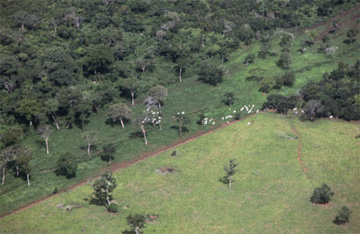 The fallout from the report was immediate for the accused cattle companies. Brazil's three largest supermarket chains, Wal-Mart, Carrefour and Pão de Açúcar, last week announced they would suspend contracts with suppliers found to be involved in Amazon deforestation, while Bertin, the world's largest beef processor, saw its $90 million loan from the International Finance Corporation withdrawn. Marfrig, the world's fourth largest beef trader and one of the firms named in the report, said last week it will no longer buy cattle raised in newly deforested areas within the Brazilian Amazon. Meanwhile a Brazilian federal prosecutor has filed a billion dollar law suit against the cattle industry for environmental damage. Firms that market tainted meat may be subject to fines of 500 reais ($260) per kilo.
Not fraud-proof
The new traceability program from BNDES will rely on ear tags (earrings) to track cattle from ranches to slaughterhouses. But Sergio Abranches, a well-known Brazilian environmental journalist and radio commentator, says that a system based on removable tags can still be gamed.
"The only credible and enforceable traceability tool is a chip," he told mongabay.com via email. "Earrings give no guarantee against fraud."
"The key to this agreement will be the supermarkets. If they are satisfied with 'weak' traceability methods, it will be greenwashing once again. If they force 'strong' traceability that would allow adequate third party verification, the result will be a true change of behavior that will affect the role of cattle as a deforestation agent in the Amazon."
Conversion of rainforest to cattle pasture presently accounts for roughly 80 percent of deforestation in the Brazilian Amazon. More than 38,600 square miles has been cleared for pasture since 1996, bringing the total area occupied by cattle ranches in the Brazilian Amazon to 214,000 square miles, an area larger than France. The legal Amazon, an region consisting of rainforests and a biologically-rich grassland known as cerrado, is now home to more than 80 million head of cattle, more than 85 percent of the total U.S. herd.