Friday, July 31, 2009

Timberland, Adidas Follow Nike’s Lead, Ban Use of Amazon Leather

July 29, 2009
From: Environmental Leader

Feeling the pressure from Greenpeace activists, Timberland and Adidas have agreed to cease using leather imported from cattle raised on former Amazon rainforest lands.

Previously, Greenpeace had succeeded in getting Nike to change its practices. At the time, the activist group said its next targets would be Timberland, Clarks, Adidas and Reebok.

Since then, the group has added to its sights other firms that use or sell Amazon leather, including Wal-Mart, Boss, Gucci, Kraft, Louis Vuitton, Eagle Ottawa (supplier of car interiors to major car companies), Geox, Hilfiger, IKEA and Prada.

The push against leather companies follows the release of a report, “Slaughtering the Amazon.” The report details how much of the leather used around the world comes from cattle that were grazed on former Amazon rainforest lands, land that was cleared specifically to raise cattle. Greenpeace says Brazil’s cattle industry is reponsible for 80 percent of the deforestation.

Timberland has put a moratorium on purchases of leather from the region, according to a press release.

Adidas, too, has unveiled a tough set of supplier standards to address the Greenpeace protests, reports JustStyle.

Greenpeace scored a publicity coup July 28 when it tagged the HP headquarters roof with giant letters spelling out “Hazardous Products.” The activist group has been after computer companies to cease using polyvinyl chloride and brominated flame retardants. HP had originally planned to eliminate the chemicals this year, but recently had backtracked, saying it would delay the move until 2011 because it had not found suitable alternatives to the chemicals.

Timberland announces policy to avoid using leather produced by Amazon destruction

July 29, 2009
From: Mongabay.com

Timberland, a maker of hiking boots and other footwear, today announced it would demand a moratorium on leather produced from newly deforested areas in the Amazon. The move is a direct response to pressure from Greenpeace, which last month released Slaughtering the Amazon, a report that linked some of the world's most prominent brands to illegal clearing of the Amazon rainforest.

Timberland says it will require its leather suppliers to commit to the moratorium on newly deforested areas in the Amazon. Greenpeace says the policy "makes Timberland the industry leader in environmentally and socially responsible Brazilian leather procurement."

"Timberland has raised the bar for environmentally and socially responsible leather sourcing policies in the Amazon," said Lindsey Allen, Greenpeace USA Forest Campaigner. "It has taken an important step by not only committing to avoid leather from cattle raised in newly deforested areas, but by working with existing suppliers like Bertin, to move the Brazilian cattle sector toward supporting a moratorium on any new cattle expansion into the Amazon Rainforest."

Timberland's announcement comes a week after Nike and Geox made similar commitments to not source any leather from the Amazon "until deforestation for cattle expansion is halted," according to Greenpeace. Last month Brazil's three largest supermarket chains, Wal-Mart, Carrefour and Pão de Açúcar, announced they would suspend contracts with suppliers found to be involved in Amazon deforestation.

In the aftermath of the report, Bertin, the world's largest beef processor, saw its $90 million loan from the International Finance Corporation withdrawn, while BNDES, Brazil's development bank that funds many activities that drive Amazon deforestation, announced it will soon require processors to trace the origin of beef back to the ranch where it was produced in order to qualify for loans. Marfrig, the world's fourth largest beef trader and one of the firms named in the report, said last month it will no longer buy cattle raised in newly deforested areas within the Brazilian Amazon. Meanwhile a Brazilian federal prosecutor has filed a billion dollar law suit against the cattle industry for environmental damage. Firms that market rainforest-tainted meat may be subject to fines of 500 reais ($260) per kilo.

Cattle ranching accounts for 80 percent of Amazon deforestation and is therefore one of the largest drivers of global forest loss.

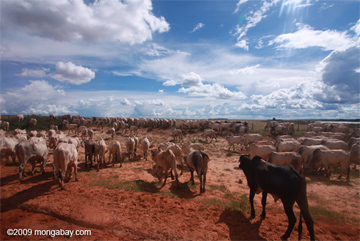
(Image: Cattle herd in the Brazilian Amazon. Photo by Rhett A. Butler.)

Soya industry extends ban to ease Amazon deforestation

July 29, 2009
From: Cool Earth

The Brazilian soya industry has agreed to extend a moratorium on production in newly deforested areas of the Amazon rainforest.

The three-year ban on purchasing soybeans grown in recently deforested areas of the Amazon has been extended for another year.

Major soya processors, exporters and environmental groups, as well as the Brazilian government, have agreed to participate in the initiative, which aims to minimise the effect soya farming has on endangered rainforests.

The moratorium project is expected to be showcased at the Climate Change Conference in Copenhagen this winter in order to achieve more support and funds so producers who help to conserve the rainforest can be adequately compensated.

Carlos Minc, Brazil's environment minister, said that unlike the cattle industry, soya is no longer a major factor in the destruction of the Amazon rainforest but maintained that the figures for Amazon deforestation are still "unacceptable".

He added that the current soya moratorium should serve as "a model for all relevant sectors".

In a report for the Institute of Science in Society, environmentalist Peter Bunyard said deforestation is made worse by large soya producers offering land at "dirt-cheap" prices to foreign farmers.

Thursday, July 30, 2009

Learning from past civilizations

29 Jul 2009
From: Grist

To understand our current environmental dilemma, it helps to look at earlier civilizations that also got into environmental trouble. Our early 21st century civilization is not the first to face the prospect of environmentally induced economic decline. The question is how we will respond.

As Jared Diamond points out in his book Collapse, some of the early societies that were in environmental trouble were able to change their ways in time to avoid decline and collapse. Six centuries ago, for example, Icelanders realized that overgrazing on their grass-covered highlands was leading to extensive soil loss from the inherently thin soils of the region. Rather than lose the grasslands and face economic decline, farmers joined together to determine how many sheep the highlands could sustain and then allocated quotas among themselves, thus preserving their grasslands. Their wool production and woolen goods industry continue to thrive today.

Not all societies have fared as well as the Icelanders. The early Sumerian civilization of the fourth millennium BC had advanced far beyond any that had existed before. Its carefully engineered irrigation system gave rise to a highly productive agriculture, one that enabled farmers to produce a food surplus, supporting formation of the first cities and the first written language, cuneiform.

By any measure it was an extraordinary civilization, but there was an environmental flaw in the design of its irrigation system, one that would eventually undermine its food supply. The water that backed up behind dams built across the Euphrates was diverted onto the land through a network of gravity-fed canals. As with most irrigation systems, some irrigation water percolated downward. In this region, where underground drainage was weak, this slowly raised the water table. As the water climbed to within inches of the surface, it began to evaporate into the atmosphere, leaving behind salt. Over time, the accumulation of salt on the soil surface lowered the land’s productivity.

Shifting from wheat to barley, a more salt-tolerant plant, postponed Sumer’s decline, but it was treating the symptoms, not the cause, of their falling crop yields. As salt concentrations continued to build, the yields of barley eventually declined also. The resultant shrinkage of the food supply undermined this once-great civilization. As land productivity declined, so did the civilization.

The New World counterpart to Sumer is the Mayan civilization that developed in the lowlands of what is now Guatemala. It flourished from AD 250 until its collapse around AD 900. Like the Sumerians, the Mayans had developed a sophisticated, highly productive agriculture, this one based on raised plots of earth surrounded by canals that supplied water.

As with Sumer, the Mayan demise was apparently linked to a failing food supply. For this New World civilization, it was deforestation and soil erosion, likely on top of a series of droughts, that undermined agriculture. Food shortages apparently triggered civil conflict among various Mayan cities as they competed for something to eat. Today this region is covered by jungle, reclaimed by nature.

The Icelanders crossed a political tipping point that enabled them to come together and limit grazing before grassland deterioration reached the point of no return. The Sumerians and Mayans failed to do so. Time ran out.

Today, our successes and problems flow from the extraordinary growth in the world economy over the last century. The economy’s annual growth, once measured in billions of dollars, is now measured in the trillions. Indeed, just the annual growth in the output of goods and services in recent years exceeded the total output of the world economy in 1900.

While the economy is growing exponentially, the earth’s natural capacities, such as its ability to supply fresh water, forest products, and seafood, have not increased. Humanity’s collective demands first surpassed the earth’s regenerative capacity around 1980. Today, global demands on natural systems exceed their sustainable yield capacity by nearly 30 percent. We are meeting current demands by consuming the earth’s natural assets, setting the stage for decline and collapse.

In our modern high-tech civilization, it is easy to forget that the economy, indeed our existence, is wholly dependent on the earth’s natural systems and resources. We depend, for example, on the earth’s climate system for an environment hospitable to agriculture, on the hydrological cycle to provide us with fresh water, and on long-term geological processes to convert rocks into the soil that has made the earth such a biologically productive planet.

There are now so many of us placing such heavy demands on the earth that we are overwhelming its natural capacities to meet our needs. Forests are shrinking. Each year overgrazing converts vast areas of grassland into desert. The pumping of underground water exceeds natural recharge in countries containing half the world’s people, leaving many without adequate water.

Each of us depends on the products and services provided by the earth’s ecosystems, ranging from forest to wetlands, from coral reefs to grasslands. Among the services these ecosystems provide are water purification, pollination, carbon sequestration, flood control, and soil conservation. A four-year study of the world’s ecosystems by 1,360 scientists, the Millennium Ecosystem Assessment, reported that 15 of 24 primary ecosystem services are being degraded or pushed beyond their limits. For example, three quarters of oceanic fisheries, a major source of protein in the human diet, are being fished at or beyond their limits, and many are headed toward collapse.

Tropical rainforests are another ecosystem under severe stress, including the vast Amazon rainforest. Thus far roughly 20 percent of the rainforest has been cleared either for cattle ranching or soybean farming. Another 22 percent has been weakened by logging and road building, letting sunlight reach the forest floor, drying it out, and turning it into kindling. When it reaches this point, the rainforest loses its resistance to fire and begins to burn when ignited by lightning strikes. Scientists believe that if half the Amazon is cleared or weakened, this may be the tipping point, the threshold beyond which the rainforest cannot be saved. Daniel Nepstad, an Amazon-based senior scientist from the Woods Hole Research Center, sees a future of “megafires” sweeping through the drying jungle. He notes that the carbon stored in the Amazon’s trees equals roughly 15 years of human-induced carbon emissions in the atmosphere. If we reach this tipping point we will have triggered a major climate feedback, another step that could help seal our fate as a civilization.

The excessive pressures on a given resource typically begin in a few countries and then slowly spread to others. Nigeria and the Philippines, once net exporters of forest products, are now importers. Thailand, now largely deforested, has banned logging. So has China, which is turning to Siberia and to the few remaining forested countries in Southeast Asia, such as Myanmar and Papua New Guinea, for the logs it needs.

As wells go dry, as grasslands are converted into desert, as fisheries are depleted, and as soils erode, people are forced to migrate elsewhere, either within their country or across national boundaries. As the earth’s natural capacities at the local level are exceeded, the declining economic possibilities generate a flow of environmental refugees.

Countries today are facing several negative environmental trends simultaneously, some of which reinforce each other. The earlier civilizations such as the Sumerians and Mayans were often local, rising and falling in isolation from the rest of the world. In contrast, we will either mobilize together to save our global civilization, or we will all be potential victims of its disintegration.

Brazil extends Amazon soy moratorium

2009-07-29
From: Etaiwan News

A moratorium on the purchase of soybeans grown on illegally logged areas in the Amazon rain forest has been extended for another year, Brazilian vegetable oil producers said on Tuesday.

The Brazilian Vegetable Oils Industry Association announced that the moratorium that went into effect three years ago has been extended until July 2010.

The renewal was signed by Greenpeace and other environmental groups, by Brazil's Environment Ministry and by Brazilian and foreign soy traders such as Cargill Inc., Archer Daniels Midland Co., Bunge Ltd. and Louis Dreyfus Commodities.

"Soy is no longer a significant factor in the Amazon's deforestation," Environment Minister Carlos Minc said as the agreement was signed.

Government figures show a sharp drop in the rate of deforestation, though it is not clear how much of that is due to the soy moratorium.

Between August 2008 and May 2009 a total of 2,957 square kilometers (1,140 square miles) of Amazon rain forest were destroyed, against 6,952 square kilometers (2,685 square miles) the year earlier.

Sportswear giant Nike Inc. said last week it would stop using leather from cattle raised in Brazil's Amazon rainforest as part of the company's commitment to curbing deforestation.

Last month, Brazil's three largest supermarket chains, Wal-Mart, Carrefour and Pao de Acucar, announced that they would suspend contracts with suppliers found to be involved in Amazon deforestation, the Brazilian Association of Supermarkets said on its Web site.

Timberland Leather Won't Come from Amazonian Cattle

Wed Jul 29, 2009
From: Reuters

The policy will issue a moratorium on purchasing any cattle raised in newly deforested areas within the Amazon Rainforest, and it will force all of its suppliers to do the same.

Brazil’s top source of greenhouse gas emissions is currently its cattle industry, and it is also the largest driver of deforestation in the world. Large tracts of the Amazon rainforest are frequently burned to the ground just to open up grazing land for cattle. Thus, a moratorium on cattle expansion might be the single biggest thing Brazil could do to stop deforestation and climate change. But that won’t happen until more companies like Timberland step up and force these policies to be enacted.

Greenpeace spokesperson Lindsey Allen said the following of the monumental agreement: “Timberland has raised the bar for environmentally and socially responsible leather sourcing policies in the Amazon. They have taken an important step by not only committing to avoid leather from cattle raised in newly deforested areas, but by working with existing suppliers like Bertin, to move the Brazilian cattle sector toward supporting a moratorium on any new cattle expansion into the Amazon Rainforest.”

Less than a week ago Nike also announced a similar policy of its own, so now that Timberland is on board, the bar appears to be set for other companies to follow suit. Let’s hope the message has been sent.

Hidden environmental cost of sportswear brands takes a toll on the world's rainforests

Wed Jul 29, 2009
From: Coolearth

Global sportswear brands such as Adidas and Reebok are traditionally associated with fashionable athleticism but many of these well-known labels are actually indirectly contributing to the deforestation of acres of some of the world's most endangered rainforests.
Adidas

Many of these sportswear giants are heavily reliant on leather for the manufacturing of their much sought-after footwear - leather originating from cattle reared in logged regions of the Amazon rainforest.

According to a recent study by Greenpeace, the cattle industry accounts for around 13 per cent of all deforestation around the world every year.

Nowhere is the cattle industry more thriving than in the Amazon. Cattle herding in the industry increased by more than ten per cent between 1995 and 2006, with the states of Mato Grosso and Para alone accounting for nearly two-thirds of the herds in the local region.

Greenpeace's Slaughtering the Amazon report, which was released last month, is the result of an extensive investigation and uncovers a complex chain that begins with the logging of trees in the Amazon rainforest and ends up on high streets across the globe and in the retail outlets of the world's most well-known brands.

The report revealed that manufacturers producing trainers for Adidas, Reebok, Nike and Timberland are being supplied by leather finishers that are direct customers of Bertin - one of the biggest cattle firms in Brazil accused of contributing to the illegal deforestation of Amazon rainforest cover.

Almost 80 per cent of the land deforested in the Amazon between 1996 and 2006 is being used for cattle pasture by firms including Bertin.

Greenpeace's investigations found out that the Tong Hong Group is one of Bertin's major customers via the tanneries KZ Hong in China and Tong Hong in Vietnam. KZ Hong says it supplies Clarks, Adidas, Reebok and Timberland manufacturer ShingTak Footwear and Reebok safety shoe supplier Shenzhen Sheng Feng Footwear.

Meanwhile in Vietnam, Tong Hong supplies leather to Nike manufacturers Chang Sin, Dona Pacific and Tae Kwang.

Amid the growing trend of firms making a concerted effort to promote corporate social responsibility and improve their green credentials, Nike recently stepped forward and announced a ban on leather sourced from the Amazon region from being used in the manufacturing of its goods.

The company said that as well as implementing a blanket hands-off policy on leather linked to deforestation, it supports the establishment of a certification system for all industries associated in the Brazilian meat and leather supply chain.

"Nike Inc shares the widely-held view that climate change is a serious issue requiring immediate and meaningful action across government, industry, consumers and society," the firm said.

"Nike has made cutting greenhouse gas emissions across our operations, incorporating sustainability into the design of our products and reducing our overall environmental footprint a cornerstone of our sustainability efforts."

The company expressed its commitment to taking deforestation in the Amazon basin more seriously, saying it appreciates "how important rainforests are to the health of the planet and the implications deforestation has on climate change and global warming".

Nike's decision to take a stand against the deforestation of the Amazon rainforest is a direct result of increased media coverage about the hidden ways in which the world's rainforests are being destroyed by high-profile consumer goods companies.

As the complicity of global brands in deforestation becomes increasingly highlighted in the media, multinational firms will have little choice but to become more sensitive to the environmental cost of their operations.

Should we pay to keep oil underground?

July 29th, 2009
From:
Telegraph.co.uk

It was the breakfast that almost did not happen, thanks to our ramshackle railways, but I am glad I battled through, because I learned about a new initiative which could turn on its head the way countries react when they strike oil, and is attracting high-level support.

I had arrived reasonably bright and revoltingly early at my small station to find three people checking to make sure I had bought a ticket - but no train. My long-suffering breakfast companion forgivingly assured me that - even though she came from Ecuador - she well knew how bad our railways were. Yolanda Kakabadse, a former environment minister of the country, is an old friend: we serve together on the judging panel of the Goldman Prize, the world’s biggest award for grassroots environmental activists (about which I’ll no doubt be earbashing you in time to come).

But to get (eventually) to the point. Yolanda was in London to push a really revolutionary offer by her government, which has found oil in the Amazon basin under the Yasuni National Park, one of the richest wildlife hotspots in the world. Instead of rushing to pump it out, ruining the area and adding more carbon dioxide to the atmosphere when it is burned, the government is hoping to persuade the world to pay for it to be kept under the ground, and wants eventually to persuade other oil-producing countries to follow suit. She has already got the support of the German Government. I’ll let you know if she pulls it off.

Wednesday, July 29, 2009

Iquitos, Peru: Experience an Amazonian adventure

July 28, 2009
From: Examiner.com

The best way to visit Peru is to visit three areas, Costal, Andes and Amazon and the best way to visit the Amazon is through Iquitos. The largest city in the Peruvian rainforest is the most populous continental city that can not be reached by any roads. It is only accessible by airplane or boat with an exception to the road to Nauta which is a small village about 100 kilometers south of Iquitos. The Capitol of the Loreto region in the northeastern area of Peru is situated on the Amazon River and is a major port in the Amazon basin. The climate is hot and humid all year long with a wet season stretching from November to May.

Getting Around: The most common way to move about the town is via motocarros which is a motorcycle with a rickshaw buggy attached to the back. Taxis are available but with the heat the motocarros offer a very welcoming breeze at a much cheaper price. The drivers are usually very accommodating and excellent tour guides of the city and the surrounding areas. They know the best eateries and sights off the well beaten tourist track so let your inhibitions go and enjoy the ride.


Things to do:
From Iquitos you can organize Amazon tours and take a cruise on the river. There is accommodation in the jungle by night and guided river tours by day with numerous treks. The vegetation and wildlife is unlike anything you have seen or ever will see. There is living species still waiting to be discovered by the scientific world. Learn how nature and people live harmoniously in the Amazon. The rainforest is a flawless machine and everything has its place and duties. Relax on the boat and watch dolphins play and swim. See alligators from arms length. Hold an anaconda larger than Life, and tarantulas the size of a grown mans hand. No Amazon River trip would be complete with out fishing for piranhas and spending an afternoon with the local Bora natives.

There are numerous villages situated around Iquitos. Belén is a popular tourist spot that is walking distance from the city during the dry season and can be easily accessible by boat during the wet season. Known as the floating city there you can view the local homes. They are built on floating balsa wood so they will rise with the water as the rain falls. There is also an interesting market where you can find local remedies made from the rainforest’s vegetation. The sunsets in the Amazon are as breath taking as the surroundings. The days end with elaborate color and a break from the heat. As the sun falls behind the jungle a vibrant new world awakens with the Amazonian moon.

The adventure is endless, whether you need a little R&R or looking for full on adrenaline pumping excitement.
Iquitos is the place to hang your hat. Come and experience the untouched world of the Amazon. See it up close and personal and take away unforgetable memories that will last a life time.

Battle to save the Amazon rainforest gets boost

Tue 28 Jul 2009
From: click Green

The Ashaninka tribe in the Amazon rainforest has received support from an unlikely source – the UK division of global printing company Brother.

Brother has pledged to help the tribe protect 1,000 acres of Peruvian rainforest as part of a partnership with leading rainforest sustainability charity, Cool Earth.

The UK-based charity buys areas of the rainforest and puts them into local trusts. It employs local people to protect the land and earn a living out of the forest without destroying it.

Brother is the first printing technology firm to commit to the charity and the money will safeguard around 44,000 mature trees, 190,000 saplings, six endangered species of mammal, 322 types of plant and 11,000 species of insect and worm.

The scheme will keep 100,000 tonnes of carbon stored in the trees to help the battle against global warming. Rainforest destruction has a massive impact on climate change and accounts for a staggering six billion tonnes of CO2 emissions every year. So far the charity has secured over 50,000 acres of rainforest and 15 million tonnes of carbon.

Local communities will also receive resources such as classrooms and solar-powered internet as part of the partnership.

The Brother UK scheme is likely to be more successful than rivals Ricoh, which is currently considering developing a new environmental scheme in Africa to replace its disastrous current programme.

A recent Ricoh trip to tree-planting projects in the east African nation Tanzania, funded by the company through a previous carbon offsetting initiative, revealed that many of the trees had been stolen or died.

The company had agreed to supply charity Seeds for Africa with cash to plant a tree every time a customer printed 100,000 pages using a Ricoh printer.

However, Ricoh admitted that the scheme had appeared to encourage some customers to print more, while many of the planted trees had subsequently died.

The firm said it was now considering remodelling the scheme so that donations are made based on how many printer cartridges customers recycle, rather than how many pages are printed out.

Cool Earth Director Matthew Owen said: “Only 10 percent of our resources go towards Cool Earth administration. We try to help the locals to help themselves by paying them guaranteed salaries to protect the rainforest. However, we are careful not to allow them to be dependant on us.

“Cool Earth tries to increase the value of any harvesting of fruit and nuts, which the villagers have done for many years, and ensure they are paid a fair price for them.”

“The area we have saved over the last two years would have been destroyed within 18 months. We protect strategic areas, which protect many acres of rainforest from loggers and cattle ranchers.”

Owen was pleased to work with a large company such as Brother, and he hopes that larger companies working with Cool Earth can convince others that small changes can make a big difference to the fight to save the rainforests.

The Managing Director of Brother Europe, Yuji Ishiguro, commented: "Our partnership with Cool Earth demonstrates our wider commitment to the environment, as we make global efforts to reduce our environmental impact and CO2 emissions.

“Our aim is to build a long-term relationship with the charity and we are looking at ways we can develop Brother Europe's Cool Earth initiative to provide further protection for the Amazon."

Phil Jones, Sales and Marketing Director, Brother UK, said: “We have a pro-active environmental ethos at Brother, and our partnership with Cool Earth demonstrates our wider commitment to the environment, as we help to reduce climate change, as well as sustaining biodiversity.

“The four square kilometres of rainforest that we are protecting is a vast area that equates to the size of approximately 600 football pitches. Our aim is to form a long-term relationship with the charity, and we are working with them to develop some exciting customer incentive and employee reward schemes.”

Brazilian soy industry extends moratorium on Amazon deforestation

July 28, 2009
From: mongabay.com


The Brazilian soy industry has agreed to extend a moratorium on soy production in newly deforested areas in the Amazon rainforest, reports Greenpeace. The moratorium has been in place since 2006.

Carlos Minc, Brazil's environmental minister, announced the extension during a press conference in Brasilia.

"Soya is no longer a significant force in the destruction of the Amazon rainforest. However, we cannot say the same about cattle. The soya moratorium is a model for all relevant sectors," said Brazil’s Environment Minister Carlos Minc.

Cattle ranching is the biggest driver of deforestation in the Brazilian Amazon, accounting for about 80 percent of new clearing, but the industry is now under pressure to follow the lead of soy producers. Already Marfrig, the world's fourth largest beef trader, has said it will no longer buy beef produced on newly deforested lands, while other buyers are showing interest in an emerging certification scheme that would ensure beef comes from responsibly managed ranches. Certification standards are also being developed for the soy industry.

"We want to ensure that our actions help protect the Amazon rainforest. The moratorium has been a positive step in helping us control and monitor the soya used in our supply chain and we will continue to participate in efforts to stop deforestation in the Amazon," said Denis Hennequin, McDonald's Europe president.

The certification system may include some form of ecosystem services payments to encourage landowners to conserve forest on private lands.

"Compensation for environmental services would be a great incentive to the rural producer to stop deforesting. The industry expects that by the end of the year, in Copenhagen, the governments of different countries will commit to put a fund together for forest protection which will include compensation," said Carlo Lovatelli, President of the Brazilian Association of Vegetable Oils Industries.

Soy moratorium shows success

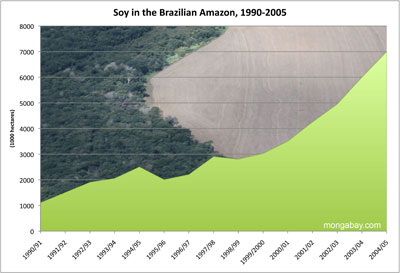
A satellite-based study released earlier this year showed that only 12 of 630 sample areas (1,389 of 157,896 hectares) deforested since July 2006 — the date the moratorium took effect — were planted with soy. While the sample was small — covering 157,896 hectares in a region where individual soy farms can extend over thousands of hectares — it provided a hopeful sign that soy producers are abiding by the moratorium, which was established as a response to environmentalists who said that soy was driving Amazon rainforest destruction. Producers feared they would lose access to international markets.

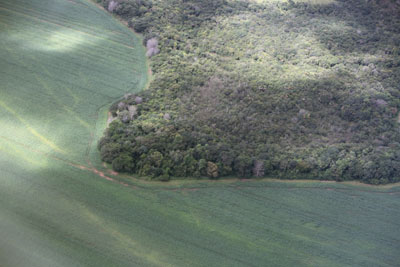
Soy production in the Amazon exploded in the early 1990s following the development of a new variety of soybean suitable to the soils and climate of the region. Most expansion occurred in the cerrado, a wooded grassland ecosystem, and the transition forests in the southern fringes in the Amazon basin, especially in states of Mato Grosso and Pará — direct conversion of rainforests for soy has been relatively limited. Instead, the impact of soy on rainforests is generally seen by environmentalists to be indirect. Soy expansion has driven up land prices, created impetus for infrastructure improvements that promote forest clearing, and displaced cattle ranchers to frontier areas, spurring deforestation.

The Brazilian soy industry argues that it receives an unfair share of the blame for Amazon forest loss. It notes that producers in the legal Amazon face some of the most stringent environmental laws in the world, with landowners required to maintain 80 percent forest cover on their holdings. By comparison there are no legal forest reserve requirements for U.S. farmers.

(Image1: Soy expansion in the Legal Amazon (Amazônia). Enlarge image.

Soy's impact in the Amazon has been less direct than ranching, with lands already cleared for pasture being converted to soy farms. Further, investments to facilitate soy expansion — including road development and ports — have promoted deforestation.

Image2: Soy fields and transition forest in Mato Grosso, Brazil)

After protests, Peru's Garcia raises social spending

Tue Jul 28, 2009
From: Reuters

Peruvian President Alan Garcia vowed on Tuesday to push ahead with his pro-business agenda but increase social spending to calm a wave of protests that forced him to reshuffle his cabinet.

He also urged Peruvians frustrated by a slowing economy to reject the leftward shift of other Latin American countries.

In a nationwide address on Independence Day, Garcia said free trade and foreign investment would help cut Peru's poverty rate from 36 percent at present to 30 percent by the time he leaves office in 2011.

Garcia promised to extend universal health care to all Peruvians and improve a lackluster public education system.

"I have two big objectives for this year: defending the rule of democracy and saving Peru from the global crisis by strengthening social programs," he said.

Garcia has struggled since June, when 34 people died in clashes between police and indigenous protesters opposed to laws that would have opened up their lands in the Amazon rainforest to foreign mining and oil companies.

In the worst crisis of his presidency, Garcia replaced his prime minister with Javier Velasquez, a member of his APRA party, to try to breathe new life into his government and lift approval ratings that plunged as low as 21 percent.

A fervent advocate of free markets, Garcia said Peru is in a race against time to raise living standards or risk falling further behind in a globalized world.

"It's my duty to effect change as fast as possible," he said. "If sometimes this appears intolerant, tough or distant, I apologize, but we are in a battle and we need to win it."

Garcia said the best way to avoid social protests is for the state to spend money on infrastructure, and he threatened to punish demonstrators who form roadblocks to demand the government boost wages or build schools.

Critics say Garcia's government is being held back by a weak civil service and will struggle to deliver reforms. A universal health care bill was passed in April, yet so far it has only been implemented in three of 25 regions.

NO CLEAR SUCCESSOR

"There's not much time left to begin new reforms. It's more of a question of trying to keep their heads above water until 2011," said political analyst Augusto Alvarez-Rodrich.

Alvarez-Rodrich said Garcia's new cabinet will likely have a short shelf life and need to be reshuffled again as social protests mount in the run up to elections.

The ruling APRA party has no clear successor to make a bid for the presidency in 2011. Garcia, who cannot run again, has said he will work to prevent leftists from winning office.

But an economy seen braking to 3 percent growth this year from a 10 percent expansion last year could play into the hands of the opposition.

Ollanta Humala, a left-wing nationalist and ally of Venezuelan President Hugo Chavez, spooked financial markets when he nearly won the 2006 race against Garcia, and he is planning to run again.

Some analysts say Garcia may end up throwing his weight behind Luis Castaneda, the major of Lima, or legislator Keiko Fujimori, daughter of former president Alberto Fujimori.

Fujimori was convicted this year of human rights crimes stemming from his two terms as president in the 1990s, when Peru was battling the Maoist Shining Path insurgency. (Writing by Terry Wade, editing by Anthony Boadle)

Tuesday, July 28, 2009

28 finalists in the running to be among 'New 7 Wonders of Nature'

July 26, 2009
From:
SunSentinel.com

Worldwide poll results will be announced in '11

The Grand Canyon, the Matterhorn and the Great Barrier Reef are competing with 25 other spectacular natural landmarks in the final phase of the global poll to choose the "New 7 Wonders of Nature."

The Amazon rain forest, the Dead Sea, Mount Kilimanjaro in Africa and Ecuador's Galapagos islands are also among the finalists, according to the organization New 7 Wonders led by Swiss adventurer Bernard Weber.

People can vote at www.new7wonders.com, with winners announced in 2011, sharing in the glory already enjoyed by the seven man-made wonders chosen two years ago.

More than 1 billion people are expected to join in the voting, Weber said.

"This campaign should contribute to the appreciation — to the knowledge — of our environment and not just the one in our country but worldwide," he told The Associated Press. "If we or our children want to save anything, we should first appreciate it."

The finalists also include Azerbaijan's Mud Volcanoes, Lebanon's Jeita Grotto, Ireland's Moher Cliffs and Germany's Black Forest.

A panel of experts chose the finalists among the 77 nominees that gained the most votes in an early round of polling. People had suggested 261 landmarks in countries all over the world.

The panel headed by Federico Mayor, former chief of UNESCO, the U.N. Educational, Scientific and Cultural Organization, picked the finalists depending on geographical balance, diversity and the importance to human life.

Weber said he was happy the nominees included places that lie in more than one country, such as the Dead Sea or the Amazon rainforest, which makes people work together across borders.

High voter participation has come from Asian countries, including Indonesia, India, Bangladesh and Vietnam, as well as from Latin America, he said. "U.S. voters' participation is always quite high," he added.

Weber declined to give any specific numbers of votes so far. But the organization plans to release details about voter profiles later. Registration on the Web site aims to prevent people from voting twice.

An Amazon Culture Withers as Food Dries Up

July 24, 2009
From: The New York Times

XINGU NATIONAL PARK, Brazil — As the naked, painted young men of the Kamayurá tribe prepare for the ritualized war games of a festival, they end their haunting fireside chant with a blowing sound — “whoosh, whoosh” — a symbolic attempt to eliminate the scent of fish so they will not be detected by enemies. For centuries, fish from jungle lakes and rivers have been a staple of the Kamayurá diet, the tribe’s primary source of protein.

But fish smells are not a problem for the warriors anymore. Deforestation and, some scientists contend, global climate change are making the Amazon region drier and hotter, decimating fish stocks in this area and imperiling the Kamayurá’s very existence. Like other small indigenous cultures around the world with little money or capacity to move, they are struggling to adapt to the changes.

“Us old monkeys can take the hunger, but the little ones suffer — they’re always asking for fish,” said Kotok, the tribe’s chief, who stood in front of a hut containing the tribe’s sacred flutes on a recent evening. He wore a white T-shirt over the tribe’s traditional dress, which is basically nothing.

Chief Kotok, who like all of the Kamayurá people goes by only one name, said that men can now fish all night without a bite in streams where fish used to be abundant; they safely swim in lakes previously teeming with piranhas.

Responsible for 3 wives, 24 children and hundreds of other tribe members, he said his once-idyllic existence had turned into a kind of bad dream.

“I’m stressed and anxious — this has all changed so quickly, and life has become very hard,” he said in Portuguese, speaking through an interpreter. “As a chief, I have to have vision and look down the road, but I don’t know what will happen to my children and grandchildren.”

The Intergovernmental Panel on Climate Change says that up to 30 percent of animals and plants face an increased risk of extinction if global temperatures rise 2 degrees Celsius (3.6 degrees Fahrenheit) in coming decades. But anthropologists also fear a wave of cultural extinction for dozens of small indigenous groups — the loss of their traditions, their arts, their languages.

“In some places, people will have to move to preserve their culture,” said Gonzalo Oviedo, a senior adviser on social policy at the International Union for Conservation of Nature in Gland, Switzerland. “But some of those that are small and marginal will assimilate and disappear.”

To make do without fish, Kamayurá children are eating ants on their traditional spongy flatbread, made from tropical cassava flour. “There aren’t as many around because the kids have eaten them,” Chief Kotok said of the ants. Sometimes members of the tribe kill monkeys for their meat, but, the chief said, “You have to eat 30 monkeys to fill your stomach.”

Living deep in the forest with no transportation and little money, he noted, “We don’t have a way to go to the grocery store for rice and beans to supplement what is missing.”

Tacuma, the tribe’s wizened senior shaman, said that the only threat he could remember rivaling climate change was a measles virus that arrived deep in the Amazon in 1954, killing more than 90 percent of the Kamayurá.

Cultures threatened by climate change span the globe. They include rainforest residents like the Kamayurá who face dwindling food supplies; remote Arctic communities where the only roads were frozen rivers that are now flowing most of the year; and residents of low-lying islands whose land is threatened by rising seas.

Many indigenous people depend intimately on the cycles of nature and have had to adapt to climate variations — a season of drought, for example, or a hurricane that kills animals.

But worldwide, the change is large, rapid and inexorable, heading in only one direction: warmer. Eskimo settlements like Kivalina and Shishmaref in Alaska are “literally being washed away,” said Thomas Thornton, an anthropologist who studies the region, because the sea ice that long protected their shores is melting and the seas around are rising. Without that hard ice, it becomes difficult, if not impossible, to hunt for seals, a mainstay of the traditional diet.

Some Eskimo groups are suing polluters and developed nations, demanding compensation and help with adapting.

“As they see it, they didn’t cause the problem, and their lifestyle is being threatened by pollution from industrial nations,” said Dr. Thornton, who is a researcher at the Environmental Change Institute at the University of Oxford. “The message is that this is about people, not just about polar bears and wildlife.”

At climate negotiations in December in Poznan, Poland, the United Nations created an “adaptation fund” through which rich nations could in theory help poor nations adjust to climate change. But some of the money was expected to come from voluntary contributions, and there have been none so far, said Yvo De Boer, the executive secretary of the United Nations Framework Convention on Climate Change. “It would help if rich countries could make financial commitments,” he said.

Throughout history, the traditional final response for indigenous cultures threatened by untenable climate conditions or political strife was to move. But today, moving is often impossible. Land surrounding tribes is now usually occupied by an expanding global population, and once-nomadic groups have often settled down, building homes and schools and even declaring statehood.

The Kamayurá live in the middle of Xingu National Park, a vast territory that was once deep in the Amazon but is now surrounded by farms and ranches.

About 5,000 square miles of Amazon forest are being cut down annually in recent years, according to the Brazilian government. And with far less foliage, there is less moisture in the regional water cycle, lending unpredictability to seasonal rains and leaving the climate drier and hotter.

That has upended the cycles of nature that long regulated Kamayurá life. They wake with the sun and have no set meals, eating whenever they are hungry.

Fish stocks began to dwindle in the 1990s and “have just collapsed” since 2006, said Chief Kotok, who is considering the possibility of fish farming, in which fish would be fed in a penned area of a lake. With hotter temperatures as well as less rain and humidity in the region, water levels in rivers are extremely low. Fish cannot get to their spawning grounds.

Last year, for the first time, the beach on the lake that abuts the village was not covered by water in the rainy season, rendering useless the tribe’s method of catching turtles by putting food in holes that would fill up, luring the animals.

The tribe’s agriculture has suffered, too. For centuries, the Kamayurá planted their summer crops when a certain star appeared on the horizon. “When it appeared, everyone celebrated because it was the sign to start planting cassava since the rain and wind would come,” Chief Kotok recalled. But starting seven or eight seasons ago, the star’s appearance was no longer followed by rain, an ominous divergence, forcing the tribe to adjust its schedule.

It has been an ever-shifting game of trial and error since. Last year, families had to plant their cassava four times — it died in September, October and November because there was not enough moisture in the ground. It was not until December that the planting took. The corn also failed, said Mapulu, the chief’s sister. “It sprouted and withered away,” she said.

A specialist in medicinal plants, Ms. Mapulu said that a root she used to treat diarrhea and other ailments had become nearly impossible to find because the forest flora had changed. The grass they use to bound together the essential beams of their huts has also become difficult to find.

But perhaps the Kamayurá’s greatest fear are the new summer forest fires. Once too moist to ignite, the forest here is now flammable because of the drier weather. In 2007, Xingu National Park burned for the first time, and thousands of acres were destroyed.

“The whole Xingu was burning — it stung our lungs and our eyes,” Chief Kotok said. “We had nowhere to escape. We suffered along with the animals.”

(Image: A woman and a child of the Kamayurá tribe in the Amazon bathed in a lake on the evening of June 6. Members of the tribe usually bathe three times each day.)
World-first reportage

Monday 27 July 2009
From: guardian.co.uk

The defining issue of our generation will be humanity's response to the challenge of climate change. That belief underpins the decision by Guardian News and Media (GNM) to place sustainability firmly at the top of our editorial agenda, and to invest accordingly.

Climate change, and the related issues of water, food, energy, poverty, social justice and health, presents the one truly existential issue of our age. This December [2009], world leaders are convening in Copenhagen for what the economist Lord Nicholas Stern has called the "most important gathering since the second world war". The task will be to seal a global deal to reverse the increasing amounts of pollutants being pumped into the atmosphere, and to help all citizens to adapt to the already inevitable impact.

In this year of all years, GNM's greatest asset – our ability to report and influence – will be deployed to maximum effect. We now have in place what we believe to be the most powerful reporting team in the world. In addition to six dedicated editing and production staff, we have six full-time environment correspondents: three of the UK's most eminent green writers, John Vidal, Juliette Jowit and David Adam; the first green technology reporter, Alok Jha; and, crucially, world-class reporters in China, Jonathan Watts, and the US, Suzanne Goldenberg. The latter are key, as the US and China are the world's biggest polluters and, as the UN secretary general told the Guardian, without those two nations on board a global climate deal is impossible. Furthermore, our new integrated internal structure ensures other members of GNM's 800-strong editorial team can contribute, with particularly strong input from our business, economic, political, diplomatic, foreign and consumer affairs teams.

Alan Rusbridger, editor-in-chief of GNM, says the benefit of our approach is already being felt: "The feedback I am receiving from scientists working in this area and politicians is that the Guardian has transformed the way it is regarded by the people who are doing the heavy-lifting in terms of thinking about policy around climate change." Exclusive stories illustrating our editorial approach (see below) include: the UK environment department's chief scientist telling us that the world must prepare for 4C of warming, while still hoping for 2C; a series of articles revealing how UK officials sought to weaken environmental targets being agreed by the EU; an investigation revealing the vast gap between the pledges of funds to help developing nations and the actual money delivered; and the revelation of a vast, undiscovered forest in Mozambique, filled with an astonishingly rich variety of new fauna and flora.

To improve our ability to inform, debate and promote action, we have been completely rebuilding our environment website. We intend to become the central place for the brightest thinking on environmental and sustainability issues. In the summer of 2009 we ran the Manchester Report, at the Manchester International festival, at which ideas for tackling global warming were examined by a panel led by Lord Bingham.

The new website will add to our traditional strengths of reportage and comment by nurturing a community of users to further broaden the debate. The Guardian Environment Network already highlights content from a number of the best environment sites on the web, including Grist, Nature, Inhabitat and the World Resources Institute. There will also be a renewed focus on multimedia – we have already created original video from the tar sands of Alberta to the disappearing Amazon rainforest. New web tools will enable users to understand their impact on the planet in original and significant ways, and to easily access and compare critical data on the state of the Earth.

At GNM, we believe that informing our readers and hosting debates on the issues should be followed by action by individuals. Our annual readers' survey shows that readers say our coverage of sustainability issues has influenced their behaviour (see here for reader survey details). One practical example is our Green Your Home project where Alok Jha and five different homeowners have been blogging and videoing their eco-home projects, supported by expert advice and information sharing. The project was also taken to the Hay festival. Green experts Leo Hickman and Lucy Siegle provide regular advice and reviews through blogs and videos. We have also supported action groups taking positive steps for change, such as Sandbag.org.uk.

Our editorial approach has four tracks:

• Report the latest scientific and social predictions and the impact of climate change from the Arctic to Australia.

• Hold those in positions of power to account for their as yet inadequate reaction to the crisis we face.

• Reflect the human face of environmental change and celebrate the beauty of the natural world for its own sake.

• Give readers the unbiased and authoritative information they need to navigate the complex choices involved in living a green and sustainable life.

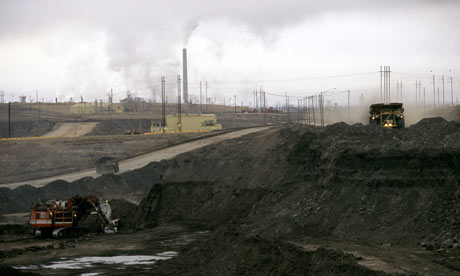
(Image: Tar sand mining at the Suncor Millenium plant in Fort McMurray, Canada. Photograph: Greg Smith/Corbis)

Global Biofuel Market to Top One-Quarter Trillion

Fri Jul 24, 2009
from: Reuters

The dream of cellulosic ethanol powered vehicles and biorefineries is slowly coming to life, climbing through contentious issues of fuel versus food, low petroleum oil prices and sustainability. Brazil is growing quickly alongside the expanding biofuel market with predicted long term demand.

A recently released biofuels report by the Pike Institute held a positive outlook for biofuels, which will be supplemented by increasingly advanced feedstocks, but will eventually face competition from drop-in fuels like "green gasoline and renewable diesel."

The Pike report also predicts the world biofuel market to surpass $280 billion by 2022, due in no small part to national biofuel consumption mandates. These consumption mandates result in impressive global evolution rates, with the worldwide compound annual growth rate for biodiesel from 2009 to 2022 to be 15 percent, according to Pike Research.

Big oil is also making forays into biofuel, such as BP, which has already pledged over a billion to biofuel projects. In a report commissioned by the American Petroleum Institute, oil and gas companies were found to have invested $58.4 billion between 2000 and 2008.

One of the top three biofuel markets, though dwarfed by its EU and US competitors, Brazil already provides more than 50% of the fuel by volume in vehicles with gasoline engines. With Brazil's increasing presence as an oil power, the current administration has worked on increasing renewable energy output alongside growing oil reserves.

The report's author, Robert McDonald, explained that the long term trend for ethanol to replace gasoline has continued in Brazil, as ethanol is affordable for flex fuel-friendly consumers. "Global policies to reduce the greenhouse gas footprint are also contributing to the trend for increasing biofuels demand in Brazil," he added.

McDonald said in response to Brazil's recent oil sales to China, "My personal view is that Brazil will continue its long-term biofuels trends and that the future will see it exporting both crude petroleum and biofuels. Brazil's increasing role as an oil power can coexist with its biofuel policies."

With rainforest destruction being one of the greatest accelerants of climate change, will the search for acceptable biomass land lead to deforestation? Deforestation has previously accounted for the majority of Brazil's emissions, however this year Amazon deforestation dropped to lower than ever recorded, per Monga Bay.

With new microcrops in development and new biomass on the way, the Pike report predicts a series of "growth spurts" due to feedstock advances, starting with low-grade greases, followed by jatropha oil (which has been met with mixed opinions) and finally algal oil.

The biofuel market is one that presents tremendous opportunity, supported by global efforts towards emissions reduction and an increasing Big Oil presence. The path ahead may be hampered by feedstock availability, production capacity and infrastructure compatibility, but the future remains bright for biofuels, a market valued at $100 billion-plus per year.

Sunday, July 26, 2009

NOEL MURPHY: Bungle in the jungl

July 27th, 2009
From: Geelong Advertiser

IT'S not quite jungle drums booming a message through the dark continent, not in this day and age, for even the deepest Amazon can find access to email and regular satellite access to send it to exotic, faraway Australia.

But the timing of the Peru e-missive - just as some three dozen Indians and police died in a protest firefight over development in the jungle - highlighted precisely what activists the world over have been warning of for years. Strangely, this seemed to miss their radar.

Deep in the Amazon, a trans-continental highway is being built to connect the east and west coasts of South America. Not surprisingly, it augurs for all manner of development - mining, industry and, to many living in the jungle, exploitation. Together with presidential decrees easing restrictions on mining, oil drilling, wood harvesting and farming in the Amazon rainforest, the auguries have been deemed a threat to life as it was known.

And recently, jungle Indian fears about Peru's political ambitions to boost these oil, gas, logging, mineral and biofuel prospects turned to violence in the country's northeast jungle. Peru is renowned for its industrial activism but this was different. Some 2500 Indians, many armed with spears and machetes, took on 400 police. And 35 died, officially, maybe more, before the government suspended the decree.

It was more than enough to resurrect fears of the Shining Path Maoist horrors of the 1980s and 1990s in which disenfranchised villagers across Peru, many all but starving, were easy recruits for the so-called terrorists. Up to 70,000 deaths, little known in the West, unfolded in the bitter civil war that ensued.

As the latest bloody riots unfolded, the good folk at Posada Amazonas on the Tambopata River, near Puerto
Maldonado, further south in the Madre de Dios region, emailed to remind me they're at the world capital of biodiversity. And that this was worth protecting but that their hold on everything was tenuous.

The jungle in this part of the Amazon basin is isolated, remote, dangerous, poverty-stricken, primitive, environmentally threatened and scary. It's also beautiful, diverse, enlightened, even mystical. It's sultry. Leaves are so dripping in condensation you'd swear it's raining.

It hosts creatures such as red howler monkeys, jaguars, giant river otters, terrifying caimans and bushmaster snakes, fire-ants, the hoatzin, the horned screamer, brilliantly-coloured macaws, woodpeckers, toucans, jacaras, piranha, squirrel and saddle-back monkeys, butterflies galore. The rainforest is full of nocturnal screeching and bellowing in foliage high overhead, leafcutter ants and stinging trees to which, local folklore has it, adulterers are tied as punishment.

Naked children play on riverbanks, shamans grow psycho-tropic drugs, riverside gold-mining operates from makeshift canoes. Jaguars, taipirs, parrots and more parrots, waterways rise 12 metres plus in flood. It's diversity in spades.
But, as those at Posada Amazonas tell me, all this and much more needs broad support from around the world - starting with the region's indigenous tribes.

More than 7000 of them live in 18 communities, many remaining in the jungle only because they can work within the local ecotourism industry. Which, development fears notwithstanding, has been booming. Even graduates are coming into the area from Lima, in small numbers admittedly, to work there - reversing, albeit in small terms, a nationwide trend towards the capital.

This ecotourism industry is sustained by 25 lodges in the Madre de Dios region that draw some 35,000 tourists a year and generate several million dollars a year. It's the second most important industry, working up 14 per cent of the local gross income. The biggest is gold, spinning $120 million a year, mainly extracted from the Madre de Dios river, which subsequently cuts a bright-orange serpentine path through the never-ending green.

The government of Alan Garcia, a resurrected president earlier ousted from office for crooked dealings, was accused of the worst slaughter of these people in the last 20 years by the Indian leader Alberto Pizanges, before the national legislature voted 59-49 last month to suspend Decree 1090, also known as the "Law of the Jungle".

It's fair to say Peruvians have sustained their fair share of conquest down the ages - from the murderous conquistadors of the Cortez brothers who tore the Incas to bloody pieces in the 16th century right through a long and chequered political history to corruption allegations against the likes of Garcia and his successor/predecessor Alberto Fujimoro scarring any and every democratically-elected government.

"Welcome to South America," locals smile, resignedly. But they're a hardy lot who strike long and hard against any form of injustice. Boulders across highways and railroads, aimed at the nation's critical tourist trade, are regular and effective tools. But the most recent have been quite deadly. And given what the jungle people have seen of mining and resource exploration, it's not especially surprising.

How will the jungle folk survive the ever-growing pressure of development? How will the jungle survive? As one colleague quipped to me: "Sounds like a job for the Phantom." It will take all of that and more.

(Image: Peruvian natives angered at government easing of land use restictions.)

Nonfiction review: Conquest of the Useless

July 26, 2009
From:
Richmond Times Dispatch

NONFICTION
In 1979, the German filmmaker Werner Herzog set out to make "Fitzcarraldo," a feature film about a man obsessed with building an opera house deep in the Amazon rainforest. Famously, Herzog's undertaking itself became a seemingly impossible, monomaniacal project.

While filming on location in the jungle, Herzog lost his lead actor through a combination of illness and bad nerves, replaced him with a raging, emotionally unstable actor, faced Indian attacks and braved shipwreck and a variety of injuries in the name of art.

He also pulled a 320-ton steamship over a large hill in the middle of Peru, despite studio demands that he instead film a plastic model ship in a studio or possibly shoot the scene in a botanical garden in Los Angeles or a hothouse in San Diego.

As he writes in his hugely entertaining daily journals, newly published as "Conquest of the Useless: Reflections from the Making of Fitzcarraldo," Herzog told studio executives that it "had to be a real steamship being hauled over a real mountain, though not for the sake of realism but for the stylization characteristic of grand opera."

As Herzog notes, "The pleasantries we exchanged from then on wore a thin coating of frost."

It was the last frost Herzog was to see for a while; even the beer in South America is warm -- at least the bottles that Herzog found. But warm beer was a minor nuisance compared to what the jungle had in store for Herzog.

"The jungle is obscene," he writes in one journal entry. "Everything about it is sinful, for which reason the sin does not stand out as sin."

Later, while trying to pull the steamship over the hill, he writes, "In the face of the obscene, explicit malice of the jungle, which lacks only dinosaurs as punctuation, I feel like a half-finished, poorly expressed sentence in a cheap novel."

Even the jungle's survivable insults have a way of scratching away at one's sanity. After traveling for two weeks, Herzog returns to his jungle cabin and discovers that his bookshelf is "encased in a termite mound." His most recent journal is among the destroyed items. After peeling it out of the mound, he finds only a single passage has survived. It reads like something out of Joseph Conrad's "Heart of Darkness": " . . . broods a storm. Hate is seething over the rain forest. Where in the depths of history has the word 'reprobate' gone missing?"

Presumably, Herzog didn't write these journals with a wider audience in mind, and "Conquest of the Useless" shouldn't be approached as a detailed account of the making of a film. ("Burden of Dreams," Les Blank's documentary about the making of "Fitzcarraldo," is a great source for that.) As Herzog writes in the book's brief preface, these are journals only "in a very general sense. They might be described instead as inner landscapes, born of the delirium of the jungle."

In fact, "Conquest of the Useless" is as much an account of angst-ridden suffering as it is the story of monomaniacal determination. In one journal entry, Herzog gazes up at the starry sky and writes, "[I]t seemed as alien to me as I do to myself."

In another, he describes searching for a man who has drowned in the river. "In defiance of all reason I kept diving in the dark, so the others would not see how depressed I am," he writes. "The river is as amorally beautiful as ever."

At least Herzog faces his sufferings, both physical and mental, with admirable stoicism. Francis Ford Coppola, seen briefly in the book's opening pages, doesn't fare as well. On a visit to San Francisco, Herzog disdainfully makes note of the "Godfather" director's recovery from a hernia operation.

"Coppola did not like the pillows and complained all afternoon about the various kinds that were rushed to the spot; he rejected every one," Herzog writes.

Jason Robards Jr., the first Fitzcarraldo, fares even worse. Herzog had cast Robards in the film's title role, but the jungle soon proved too much for him. Herzog declares the actor to be a coward, and Robards's final scene in Herzog's journals is scathing.

"I had seen Robards at the crack of dawn, when it was actually still quite dark, hurrying through the camp without his dentures, his hair flying and his eyes crazed, like King Lear through the deserted chambers in his castle," Herzog writes.

The jungle is at best amoral, at worst actively murderous, Herzog suggests. But that doesn't justify flight -- much less toothless flight. After all, Herzog didn't flee -- and he has a cinematic masterpiece to show for it.

Nature notes

July 26, 2009
From: Daily Press

One of the most amazing ecosystems in the world is the Amazonian rainforest, and at its heart lies the Amazon River. There, fantasy and fiction seem to meld: tales of man-eating fish, pink fresh water dolphins, and natives with little or no contact to the outside world. The Amazon is indeed a rich and unique place, but a real place indeed, governed by the laws of nature and encroached upon by the real world.

Comprising over 1.5 billion acres, the Amazon basin spans nine countries across the northern portion of South America. Home to the greatest plant diversity on Earth, it is believed that a single kilometer may contain up to 75,000 types of trees and 150,000 species of higher plants, which drive the Amazon's ecosystem. The rainforest is intensely humid due to its high moisture levels: each tree alone transpires (loses water from leaves) an estimated 200 gallons of water annually, equaling nearly 20,000 gallons for every acre of canopy trees. This moisture generates its own cloud cover and is responsible for up to three quarters of the annual rainfall (at least 80 inches of rain … over 400 inches to some areas … each year).

More than half of the world's estimated 10 million species of plants, animals and insects live in rainforests. The Amazonian rainforest supports over 2.5 million scientifically classified insect species and thousands of animal species: currently over 1,200 birds, 400 mammals, and nearly 1,000 amphibians and reptiles. And then there's the mighty Amazon River itself, which supports almost 3,000 species of fishes and contains nearly one-fifth of the world's fresh water, draining nearly a quarter of South America.

Seasonal forest flooding creates entirely new environments to be exploited, opens new habitats and increases river volume. Also, much more food becomes accessible as vegetation, animals and insects previously unreachable to fishes become available. Predatory fishes such as the infamous piranha, capable of devouring animals to the bone, large seed-eating pacu, the acrobatic arowana, and even the playful pink river dolphin, all thrive in the Amazon. The native South American lungfish can even survive the dry season by aestivating, or burrowing in the mud and going dormant until the rains come again.

But as many real-life stories go, the circumstances concerning the Amazon and its native animals and peoples are complex and the fates of those involved have yet to be determined for good or bad. Deforestation for farmland development and timber is reducing tree cover at an alarming rate; the Amazon rainforest will be half its size in a mere 30 years. The interests of the local sustenance populations and native species are increasingly at odds with outside forces. As their world changes, so does ours. It may seem a world away, but the problems of this seemingly fantastical place seem all too familiar.

The Virginia Living Museum's summer exhibit "Amazon Voyage: Vicious Fishes and Other Riches" tells much of the story of the Amazon.

As Trees Fall In The Amazon, Culture Withers, Food Dries Up

2009-07-25
From: Free Internet Press

As the naked, painted young men of the Kamayura tribe prepare for the ritualized war games of a festival, they end their haunting fireside chant with a blowing sound - “whoosh, whoosh” - a symbolic attempt to eliminate the scent of fish so they will not be detected by enemies. For centuries, fish from jungle lakes and rivers have been a staple of the Kamayura diet, the tribe’s primary source of protein.

But fish smells are not a problem for the warriors anymore. Deforestation and, some scientists contend, global climate change are making the Amazon region drier and hotter, decimating fish stocks in this area and imperiling the Kamayurá’s very existence. Like other small indigenous cultures around the world with little money or capacity to move, they are struggling to adapt to the changes.

“Us old monkeys can take the hunger, but the little ones suffer - they’re always asking for fish,” said Kotok, the tribe’s chief, who stood in front of a hut containing the tribe’s sacred flutes on a recent evening. He wore a white T-shirt over the tribe’s traditional dress, which is basically nothing.

Chief Kotok, who like all of the Kamayura people goes by only one name, said that men can now fish all night without a bite in streams where fish used to be abundant; they safely swim in lakes previously teeming with piranhas.

Responsible for 3 wives, 24 children and hundreds of other tribe members, he said his once-idyllic existence had turned into a kind of bad dream.

“I’m stressed and anxious - this has all changed so quickly, and life has become very hard,” he said in Portuguese, speaking through an interpreter. “As a chief, I have to have vision and look down the road, but I don’t know what will happen to my children and grandchildren.”


The Intergovernmental Panel on Climate Change says that up to 30 percent of animals and plants face an increased risk of extinction if global temperatures rise 2 degrees Celsius (3.6 degrees Fahrenheit) in coming decades. But anthropologists also fear a wave of cultural extinction for dozens of small indigenous groups - the loss of their traditions, their arts, their languages.

“In some places, people will have to move to preserve their culture,” said Gonzalo Oviedo, a senior adviser on social policy at the International Union for Conservation of Nature in Gland, Switzerland. “But some of those that are small and marginal will assimilate and disappear.”

To make do without fish, Kamayurá children are eating ants on their traditional spongy flatbread, made from tropical cassava flour. “There aren’t as many around because the kids have eaten them,” Chief Kotok said of the ants. Sometimes members of the tribe kill monkeys for their meat, but, the chief said, “You have to eat 30 monkeys to fill your stomach.”

Living deep in the forest with no transportation and little money, he noted, “We don’t have a way to go to the grocery store for rice and beans to supplement what is missing.”

Tacuma, the tribe’s wizened senior shaman, said that the only threat he could remember rivaling climate change was a measles virus that arrived deep in the Amazon in 1954, killing more than 90 percent of the Kamayurá.

Cultures threatened by climate change span the globe. They include rainforest residents like the Kamayura who face dwindling food supplies; remote Arctic communities where the only roads were frozen rivers that are now flowing most of the year; and residents of low-lying islands whose land is threatened by rising seas.

Many indigenous people depend intimately on the cycles of nature and have had to adapt to climate variations - a season of drought, for example, or a hurricane that kills animals.

Worldwide, the change is large, rapid and inexorable, heading in only one direction: warmer. Eskimo settlements like Kivalina and Shishmaref in Alaska are “literally being washed away,” said Thomas Thornton, an anthropologist who studies the region, because the sea ice that long protected their shores is melting and the seas around are rising. Without that hard ice, it becomes difficult, if not impossible, to hunt for seals, a mainstay of the traditional diet.

Some Eskimo groups are suing polluters and developed nations, demanding compensation and help with adapting.

“As they see it, they didn’t cause the problem, and their lifestyle is being threatened by pollution from industrial nations,” said Dr. Thornton, who is a researcher at the Environmental Change Institute at the University of Oxford. “The message is that this is about people, not just about polar bears and wildlife.”

At climate negotiations in December in Poznan, Poland, the United Nations created an “adaptation fund” through which rich nations could in theory help poor nations adjust to climate change. Yet some of the money was expected to come from voluntary contributions, and there have been none so far, said Yvo De Boer, the executive secretary of the United Nations Framework Convention on Climate Change. “It would help if rich countries could make financial commitments,” he said.

Throughout history, the traditional final response for indigenous cultures threatened by untenable climate conditions or political strife was to move. But today, moving is often impossible. Land surrounding tribes is now usually occupied by an expanding global population, and once-nomadic groups have often settled down, building homes and schools and even declaring statehood.

The Kamayura live in the middle of Xingu National Park, a vast territory that was once deep in the Amazon but is now surrounded by farms and ranches.

About 5,000 square miles of Amazon forest are being cut down annually in recent years, according to the Brazilian government. And with far less foliage, there is less moisture in the regional water cycle, lending unpredictability to seasonal rains and leaving the climate drier and hotter.

That has upended the cycles of nature that long regulated Kamayura life. They wake with the sun and have no set meals, eating whenever they are hungry.

Fish stocks began to dwindle in the 1990s and “have just collapsed” since 2006, said Chief Kotok, who is considering the possibility of fish farming, in which fish would be fed in a penned area of a lake. With hotter temperatures as well as less rain and humidity in the region, water levels in rivers are extremely low. Fish cannot get to their spawning grounds.

Last year, for the first time, the beach on the lake that abuts the village was not covered by water in the rainy season, rendering useless the tribe’s method of catching turtles by putting food in holes that would fill up, luring the animals.

The tribe’s agriculture has suffered, too. For centuries, the Kamayurá planted their summer crops when a certain star appeared on the horizon. “When it appeared, everyone celebrated because it was the sign to start planting cassava since the rain and wind would come,” Chief Kotok recalled. But starting seven or eight seasons ago, the star’s appearance was no longer followed by rain, an ominous divergence, forcing the tribe to adjust its schedule.

It has been an ever-shifting game of trial and error since. Last year, families had to plant their cassava four times - it died in September, October and November because there was not enough moisture in the ground. It was not until December that the planting took. The corn also failed, said Mapulu, the chief’s sister. “It sprouted and withered away,” she said.

A specialist in medicinal plants, Mapulu said that a root she used to treat diarrhea and other ailments had become nearly impossible to find because the forest flora had changed. The grass they use to bound together the essential beams of their huts has also become difficult to find.

Perhaps the Kamayura’s greatest fear are the new summer forest fires. Once too moist to ignite, the forest here is now flammable because of the drier weather. In 2007, Xingu National Park burned for the first time, and thousands of acres were destroyed.

“The whole Xingu was burning - it stung our lungs and our eyes,” said Chief Kotok. “We had nowhere to escape. We suffered along with the animals.”

Saturday, July 25, 2009

Nike Introduces Leather Sourcing Guidelines

Friday July 24, 2009
From: Footwear News

Nike Inc. announced on Wednesday new leather sourcing guidelines aimed at reducing deforestation in Brazil’s Amazon rainforest.

The policy comes in reaction to a Greenpeace report that identified cattle grazing for meat production — and for leather — as contributors to the destruction of the rainforest.

In a press release, Nike reported that none of its leather comes from the Amazon basin. However, to ensure that it avoids using leather sourced in the Amazon basin, Nike will require suppliers of Brazilian leather to certify in writing that all cattle come from outside the area in question.

Nike will also require all its suppliers to join the Leather Working Group by December 2009 and create an ongoing, traceable and transparent system to ensure by July 1, 2010, that the leather they use comes from outside the Amazon basin.

Oil gone, the devastation of the Ecuadorian rainforest...

Thursday July 23 2009
From: guardian.co.uk

The giant ceibo tree looks strangely out of place among the high grasses, grazing cows and rusty pipelines on the outskirts of Lago Agrio, this ramshackle oil town in the north east corner of Ecuador. Standing at over 40 metres, the ceibo tree was here first, long before the oil industry arrived in the 1960s and perhaps decades before Francisco de Orellana set out on his Amazon expedition in 1542.

To the Huaorani, Secoya, Cofan and several other indigenous peoples inhabiting the Ecuadorian rainforest, the ceibo tree is a mythical giant, itself a micro-ecosystem for thousands of other plants and animals. Nowhere else on earth can you witness more closely the intrinsic link between the world's craving for oil and the fortunes of forest people and their environment.

Under the United Nations Environment Programme, Ecuador is considered one of only 18 megadiverse countries in the world. Its plentiful supply of oil and trees presents it with a crucial economic opportunity at an alarming environmental cost. This is because all of the oil reserves are located in the Oriente, a vast area covering all of Ecuador's rainforest.

Like many developing countries rich in natural resources, Ecuador suffers from low economic growth and high rates of poverty and inequality. While 40% of the country's annual export earnings are gained from oil, providing a vital boost to government revenue, Ecuador has the highest deforestation rate in South America. According to Amazon Watch it is thought to have lost over 20% of its forest and woodland habitat in less than two decades.

Ecuador's President Rafael Correa and his Government have their work cut out. Facing a tough financial situation and with last year's default on international debt repayment fresh in the mind, the Government is under increasing pressure to extend oil exploration and extraction.

In four decades, seismic testing, pipe-laying, road building and toxic waste spillages have devastated the terrain, polluted habitats and severely affected the health and well-being of local communities. As Secoya leader Humberto Piaguaje told Texaco shareholders in 2007 'our struggle is not for money, we want you to repair the damages so our children do not have to continue suffering'.

The process of deforestation is familiar to all remote rainforest areas throughout the world. As new roads penetrate the forests, colonisation follows and settlers extract more timber and introduce cattle and crops.

In recent years the search has been on for a workable strategy that compensates Ecuador for not extracting its oil and instead provides a financial incentive to preserve the forests and improve the standard of living of indigenous communities. Supported by Correa, indigenous and environmental groups, this proposal centres on Yasuni national park, a UNESCO World Biosphere Reserve. It is being seen as a test case for all rainforest countries and could be a key part of the effort to tackle climate change.

In a recent letter to the Government, Huaorani women reinforced their plea, declaring that 'if oil exploitation is not stopped, the companies will continue to destroy our territory, the companies must leave us in peace, we want clean rivers and forests, we want the government to tell these companies of foreign countries to stay away. We don't want oil companies to enter our territory, never again'.

The World Wildlife Fund estimate the economic value of the ecosystem services provided by the Amazon rainforest to be worth a minimum $426 per hectare each year. These services range from biodiversity management, clean water supplies, raw materials and foodstuffs to water circulation and carbon storage. As their recent report on the Amazon Forests declares 'the values offered by the forest must be utilised as much as possible to maintain the Amazon ecosystem and the services it offers humanity'.

So far, progress in securing international support for Ecuador's carbon trading initiative or the Reduced Emissions from Deforestation and Forest Degradation mechanism (REDD), whereby developed nations pay a market value for forest conservation, have been at best patchy, at worst dismal. If progress towards the Millennium Development Goals on trade and development is anything to go by a radical shift in political willpower and economic action is needed to arrest the pace of deforestation and climate change.

In the past, many forest dependent communities have been overlooked in the rush to open up indigenous territory to oil, gas and mining companies. The Forests and European Union Resource Network, FERN, argue in their 2008 report on REDD that recognition of the rights of local people is a pre-requisite for any effective agreement. Calls for stronger governance, respect for land rights and improved cooperation are fundamental, according to the Eliasch Review, an independent report to the UK government on reducing global forest loss.

Recent disputes in Peru's Amazon region provide a stark reminder of how quickly peaceful protests to protect ancestral lands can turn into bloodshed when the financial stakes are high. The Cofan tribe in Ecuador are now well organised after years of disputes which saw huge tracts of land taken from them. 'Now we indigenous people know how to mark our territory' says Toribio Aguinda, former President of the Cofan Federation.

Committing the developed world to an effective international financing agreement is seen as critical to the success of the UN Climate Change summit in December. Individual developed countries are also being asked by environmental groups and indigenous organisations to take greater responsibility for their trade with developing countries. Whether it is soy cultivation in Brazil, oil extraction in Nigeria or industrial logging in Indonesia, national governments and multinationals are being challenged to pursue more sustainable and responsible trading practices.

If deforestation continues at current rates, some conservationists predict that the Ecuadorian Amazon will be completely deforested within 30 years. As the last drop of oil leaves the country's shores the last of its magnificent ceibo trees may already have been cut down. Perhaps only then will minds be concentrated on the consequences of deforestation.

TV Review: Revealed: The Headshrinkers of the Amazon

Friday, July 24, 2009
From: leicester Murcury

Deep in the tropical Amazon rainforest, there's a huge bare patch of nothing among all the green lushness of it all, writes Sian Brewis.

Brown, dusty, barren, it's where the mining companies arrived to extract gold – until they were stopped by warrior Marcela and his mates.

"If you don't get out," they chanted, all 200 of them, "We will fight you and shrink your heads."

Forget chaining yourself to a tree and touchy feely environmental protests – this seems the perfect way of seeing off any big bad conglomerates.

Marcela would have done it, too, he tells an impressed Piers Gibbon, detailing a gruesome ritual which sounds more at home in an H Rider Haggard novel.

Come to think of it, adventure's pretty much the whole tone of Revealed: The Headshrinkers of the Amazon (Five, 8pm).

Piers – who's less chatty and inclined to "get-down-with-the-tribe" than Bruce Parry, but sweet nonetheless – has flown to Ecuador to try to find out whether a film made by an explorer in 1961 really does show a head shrinking ceremony.

We see the film. It's fascinating. And there's even a step by step guide to how to do it, right down to boiling times (30 minutes, in case you were wondering) and the tricky problem of how to sew it up.

Warriors in red and yellow head-dresses, and bamboo sticks through their ears, are chanting, dancing and smiling for the cameras.

Shrunken heads, or tsantas, are really creepy looking things, too – titchy stitched up heads with tufts of hair, like little troll dolls. Collectors pay up to £20,000 for them.

We meet Natalie, curator of a tsanta museum, who strokes the little heads every day and talks to them.

"I'm asking the spirit to stay inside," she explains, stroking another shrivelled little head.

"It doesn't like to be touched by anybody else but me."Piers and his guide head off in search of the headshrinking Shuar tribe, down rivers, through jungles and uncovering tales of murder and assassinations all connected to the little heads.

In a Shuar village, Piers isn't too sure how well the footage is going to go down, what with people seeing ancestors shrinking human heads and all.

He needn't have worried.

People watch fascinated as dead friends and relatives are brought back to life through the flickering film.

He goes to find the oldest man in the village. He doesn't really listen to Piers' questions, he's in his own world, watching the screen.

At first he looks really sad, then he smiles, slowly. "This is my brother," he says, movingly.

Oddly, the headshrinking video wasn't the weirdest bit.

That came in a chat between Piers and an Ecuadorian priest, Padre Siro. Asked whether he'd ever seen a head shrinking ceremony, he said no.

Then he thought for a bit. "I have seen the process on a sloth." The mind boggles.

Brazil: Hanging on until the priest arrives

24/7/2009
From: ACN News

Brazil: Hanging on until the priest arrives

Father Peter Shekelton visits some of the Amazon villages where few priests ever venture

Eva-Maria Kolmann


It takes 10 hours by boat to travel from the town of Itacoatiara to the villages on the Rio Arari, one of the tributaries of the Amazon. The people there had not seen a priest for six years, until Father Peter Shekelton arrived there.

In actual fact Father Peter, who is from England originally, normally works in the notorious Favelas, the slum quarters of São Paulo, where so many young people face a life with little hope and are left to wallow and drown in a morass of crime, prostitution and drug addiction. He spends his time bringing these young people the Good News that they too are loved by God. From him, for the first time, they learn that their life does indeed have meaning.
But in the summer time this young priest sets out for the Amazon region, where he visits villages that have not seen a priest for years. He is generally accompanied by a number of young people from São Paulo who have turned back and found Jesus Christ. Together they travel almost 3000 km. Here, on the banks of the Arari River, the Catholic faithful in over 30 villages are waiting with great longing for this priest and his young missionary companions. For them it has long been a dream that they might, at least once a year, be able to see a priest, join in the celebration of Holy Mass and receive the Sacraments. Now Father Peter comes to visit them each year. The young priest tells us, “When I visit the villages again a year later, I often discover that many of the faithful to whom I gave the sacraments the previous year have since died. Many of them died literally a day after I came. It is almost as though they had been hanging on, unwilling to die, until they had received the Sacraments".

The young missionaries who have accompanied the tireless Father Peter are likewise very active. They help him in every way they can – by giving instruction to the children, young people and adults, preparing for Holy Mass and registering the baptisms and weddings. They also help to give these jungle dwellers, who are almost completely cut off from the outside world, the feeling that they are not abandoned and forgotten. And so these young people from the hell of the favelas have become a symbol of hope for others.

Sadly though, Father Peter has to acknowledge again and again that many of the children whom he baptised just a year ago have since died. The medical provision in the jungle is appalling, and the people live in extreme destitution. Their villages can generally only be reached by boat and there is no one to help or show an interest in them – or at least, hardly anyone.... for in the meantime a growing number of Protestant sects are starting to arrive, in an attempt to woo away the Catholic believers. For the Catholic Church, Our Lord's words remain as true as ever: "The harvest is great but the labourers are few" (Mt 9:37). There is a need for hundreds of priests like Father Peter. But at any rate the seed he has sown with his hard work is beginning to bear fruit, for in the eight years he has now been working in Brazil he has been able to accompany no fewer than 20 young men who are now on their way to becoming priests themselves.

Father Peter Shekelton discovered his own vocation in 1991 as he sat in London's Westminster Cathedral listening to Father Werenfried van Straaten, the founder of the Catholic charity Aid to the Church in Need (ACN), giving one of his famous talks. The cathedral was packed with people listening to Father Werenfried giving one of his inspiring sermons. There was a collection, of course, as there is every time, but then Father Werenfried boldly declared, "I would be willing to renounce this entire collection if just one young man among you were willing to offer his life in the service of Our Lord and proclaim the Kingdom of God as his priest!" At that instant, Peter instinctively knew, "I am that young man!"
Recently, he wrote to ACN, "At that time I didn't dare to ask Father Werenfried for the collection, but today I am asking you for a little of the money from the collection from back then". ACN has promised a grant of over $10,000 so that he and his young missionary companions can once again travel to visit the people on the Rio Arari in Amazonia. For Christ wishes to be living and present among the people in these jungle villages too. And so we in turn must support the priests who have discovered the "vineyard of the Lord" deep in the Amazon rainforest!

Aid to the Church in Need helps with the training of over 14,000 seminarians every year. To help this cause during the Year of the Priest please contact the Australian office of ACN on (02) 9679-1929. e-mail: info@aidtochurch.org or write to Aid to the Church in Need PO Box 6245 Blacktown DC NSW 2148. Web: www.aidtochurch.org