Source: mongabay.com
In 2005 the Amazon rainforest underwent a massive drought that was labeled a one-in-100 year event. The subsequent die-off of trees from the drought released 5 billion tons of CO2. Just five years later another major drought struck. The 2010 drought, which desiccated entire rivers, may have been even worse according to a new study in Science, adding on-the-ground evidence to fears that climate change may inevitably transform the world's greatest rainforest.
Analyzing rainfall across the Amazon during the 2010 dry season, researchers found that the drought covered more territory and was worst than the 2005 event.
"Having two events of this magnitude in such close succession is extremely unusual, but is unfortunately consistent with those climate models that project a grim future for Amazonia," said lead author Dr Simon Lewis, from the University of Leeds, in a press release.
Usually a massive carbon sink that soaks up around 1.5 billion tons of carbon annually, such extreme droughts turn the Amazon rainforest into a carbon source. Researchers have estimated that the die-off of trees in 2005 released nearly as much CO2 as the US did in 2009: 5.4 billions tons. Researchers say 2010 may have released even more.
 "Two unusual and extreme droughts occurring within a decade may largely offset the carbon absorbed by intact Amazon forests during that time. If events like this happen more often, the Amazon rainforest would reach a point where it shifts from being a valuable carbon sink slowing climate change, to a major source of greenhouse gasses that could speed it up," said Dr. Lewis.
At this point, scientists are uncertain just how much carbon was released due to last year's drought.
"It could be that many of the drought susceptible trees were killed off in 2005, which would reduce the number killed last year. On the other hand, the first drought may have weakened a large number of trees so increasing the number dying in the 2010 dry season," explained Dr Brando, from Brazil's Amazon Environmental Research Institute (IPAM). Field studies of tree mortalities will provide scientists with a better idea.
While there has been some confusion in the media about the possible impacts of climate change on the Amazon rainforest, tropical biologists have reasserted that there are consistent lines of evidence that if the climate warms enough it could 'flip' nearly half of the Amazon (over 40%) from rainforest into savanna.
"Considerable uncertainty remains surrounding the impacts of climate change on the Amazon," Lewis cautions, but says that "his new research adds to a body of evidence suggesting that severe droughts will become more frequent leading to important consequences for Amazonian forests. If greenhouse gas emissions contribute to Amazon droughts that in turn cause forests to release carbon, this feedback loop would be extremely concerning. Put more starkly, current emissions pathways risk playing Russian roulette with the world's largest rainforest."
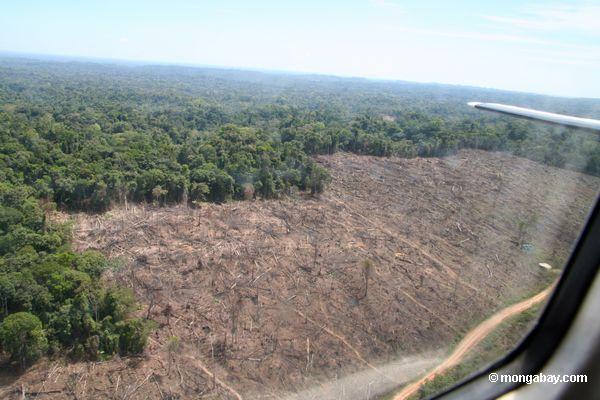
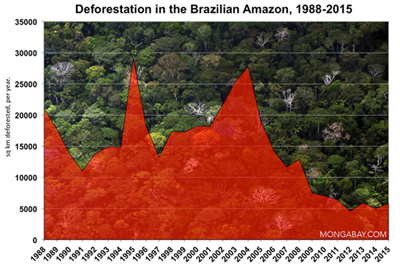
Scientists also warn that climate change isn't occurring in a vacuum in the Amazon rainforest. Logging, clearing, fragmentation, and human-started fires are common occurrences in parts of Amazonian. Already 16-17% of the Amazon has been lost to deforestation, and although deforestation has slowed recently, it has not stopped. Combined with climate change, these on the ground changes could further push some regions to large-scale forest die-off.