Major international companies are unwittingly driving the deforestation of the Amazon rainforest through their purchases of leather, beef and other products supplied from the Brazil cattle industry, alleges a new report from Greenpeace.
The report, Slaughtering the Amazon, is based on a three-year undercover investigation of the Brazilian cattle industry, which accounts for 80 percent of Amazon deforestation and roughly 14 percent of the world's annual forest loss. Greenpeace found that Brazilian beef companies are important suppliers of raw materials used by leading global brands, including Adidas/Reebok, Nike, Carrefour, Eurostar, Unilever, Johnson & Johnson, Toyota, Honda, Gucci, Louis Vuitton, Prada, IKEA, Kraft, Tesco and Wal-Mart, among others.
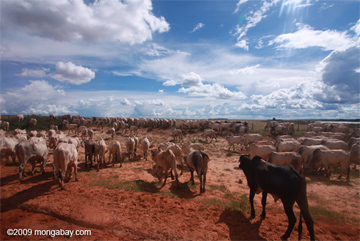 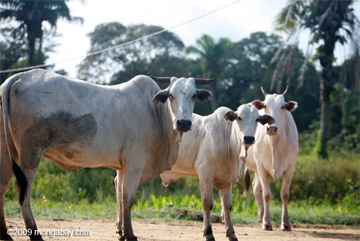 Cattle herd in the Brazilian Amazon. Photos by Rhett A. Butler. |
Greenpeace's investigation also revealed that Brazilian government is a major stakeholder in three of the country's top cattle producers - Bertin, JBS and Marfrig. Given this "vested interest" and the role cattle ranching plays in forest loss, the report highlights an inherent conflict between in the government's aim to expand beef while simultaneously reducing deforestation under its climate plan.
“By bankrolling the destruction of the Amazon for cattle, President Lula’s government is undermining its own climate commitments as well as the global effort to tackle the climate crisis,” said Andre Muggiati, Greenpeace Brazil, Amazon campaigner.
“If it wants to be part of the climate solution, Lula’s government must get out of bed with cattle industry, and instead commit to ending Amazon deforestation. Otherwise it will be culpable in the global climate catastrophe that will ensue."
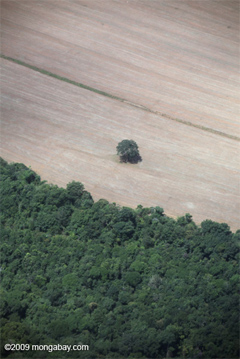 Forest clearing in Mato Grosso. Photo by Rhett A. Butler. |
Still at the same time that Lula is promoting the Amazon Fund, Brazilian lawmakers are weighing bills that would significantly expand industrial activities in the Amazon rainforest. The proposed legislation would underwrite extensive infrastructure projects, grant legal title for illegally deforested Amazon land, and scale back environmental protections for forest reserves on private land. Greenpeace notes that the government has offered $41 billion in credit to farmers to boost production, or nearly twice the entire amount of the proposed Amazon Fund.
Full of accusations, short on solutions
Slaughtering the Amazon urges international companies to suspend buying from tainted cattle suppliers and calls for an immediate moratorium on further Amazon deforestation. The report also demands support for a strong climate treaty at the December 2009 U.N. climate talks in Copenhagen. Greenpeace says that any climate deal must include a mechanism to fund forest protection.
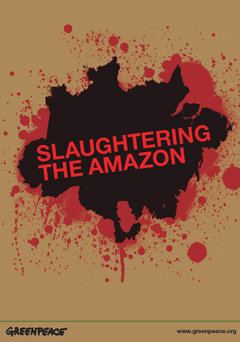 Download: Slaughtering the Amazon |
The report may be used to justify intensification of cattle production in the Amazon. Intensification would reduce the need to clear more land for pasture, but would carry environmental costs, including increased pollution and the need to boost supplemental feeding of livestock. Presently a selling point for Brazilian beef in some markets is that it is generally not associated with industrial feedlots.
Others will seize upon the report as another justification to reduce beef consumption. A 2006 report by the United Nations Food and Agriculture Organization (FAO) found that meat production generates more greenhouse gas emissions (14-22 percent of global emissions) than either transportation or industry. Of meats, beef is the most carbon-intensive with the production of a 1-pound paddy resulting in roughly 36-pounds of CO2 emissions or 13 times the emissions from chicken.