Source: mongabay.com
Soy expansion in areas neighboring the Amazon rainforest is contributing to loss of rainforest itself, reports a new study published in Environmental Research Letters.
The research, which analyzed changes in forest cover across the 761 municipalities in the Brazilian Amazon, found that "deforestation in the forest frontiers of the basin is strongly related to soy expansion in its settled agricultural areas, to the south and east."
The results indicate that indirect land use change (ILUC) is having a substantial impact on the Amazon rainforest. As mechanized soy farms encroach onto existing cattle pastures, ranchers are displaced into frontier forest areas, triggering deforestation.
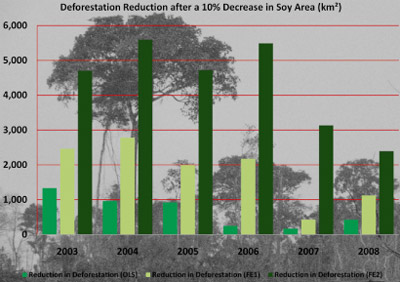 The authors show that a relatively marginal increase in soy production in former pasture areas has caused a disproportionate amount of forest loss. Cattle ranching displaced by soy tends to be low-intensity and therefore requires large areas of land to be viable.
"Between 2003-2008 soy production expanded in Brazil by 39,000 square kilometers," said Marcelus Caldas, an assistant professor of geography at Kansas State University who was a co-author of the study. "Of this 39,000 square kilometers, our study shows that reducing soybean production by 10 percent in these pasture areas could decrease deforestation in heavily forested counties of the Brazilian Amazon by almost 26,000 square kilometers -- or 40 percent."
The findings suggest that the Brazilian soy industry's moratorium on new deforestation for soybean production — a result of a campaign by Greenpeace — may not be as effective as hoped.
 "The results thus call into question the effectiveness of the soy moratorium in reducing deforestation, and suggest that environmental policy in Brazil must recognize land use linkages in the agricultural sector of the economy," the study states. "The results also suggest that supply chains crossing international boundaries may stimulate Amazonian deforestation via ILUC. That is, as global demands for Brazilian agricultural commodities grow, Amazonian deforestation may result by virtue of the process identified in this letter. Consequently, global efforts to reduce greenhouse gas emissions by substituting biofuels for petroleum products must proceed with care, in order not to intensify processes of Amazonian deforestation via ILUC, thereby undermining Brazil's REDD objectives."
Efforts to curtail deforestation in the Brazilian Amazon may similarly displace forest clearing to surrounding countries. Both Paraguay and Bolivia saw huge jumps in soy acreage during the study period.

