Source: mongabay.com
Protected areas now cover nearly 44 percent of the Amazon — an area larger than Greenland — but suffer from encroachment and poor management, reports a new study by Imazon and the Instituto Socioambiental (ISA).
The report, published in Portuguese, says that by December 2010, protected areas in the Brazilian Amazon amounted to 2,197,485 square kilometers. Conservation units like national parks accounted for just over half the area (50.6 percent), while indigenous territories represented 49.4 percent.
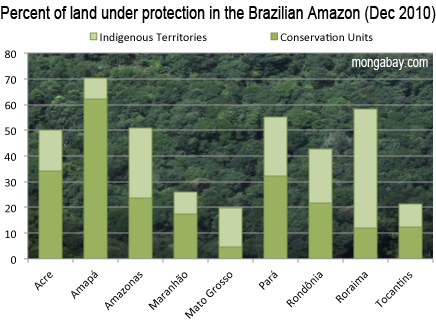 But while the extent of protected zones on paper is substantial, the report found significant human impacts in many areas. Between 1998 and 2009 12,204 square kilometers of forest within these areas was cleared. Damage was heaviest in designated "sustainable use" reserves.
The report faulted poor management as a contributing factor in degradation of protected areas. Half of protected areas in the Brazilian Amazon have no approved management plan and 45 percent has no management council. Staffing in some protected areas is very low — the state of Pará has only one officer per 1,817 square kilometers of forest.
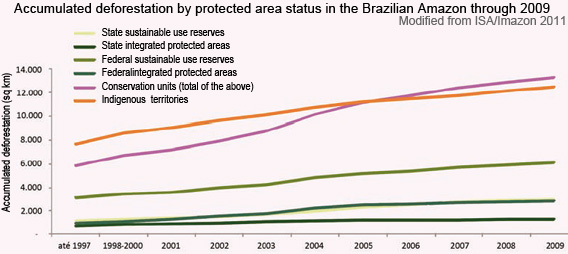 Accumulated deforestation by protected area status in the Brazilian Amazon through 2009
The report cites illegal logging and mining as threats to protected areas. It notes that 1,338 mining titles have been granted in protected areas, while 10,348 are awaiting approval.
The report comes as Brazil has been experiencing a decline in deforestation. Annual clearing is down more than 75 percent since 2004.
Brazil set aside more land in protected areas than any other country during the 2000s, accounting for nearly 60 percent of total terrestrial conservation during the decade. But research indicates that protected areas were responsible for only a portion of the reduction.
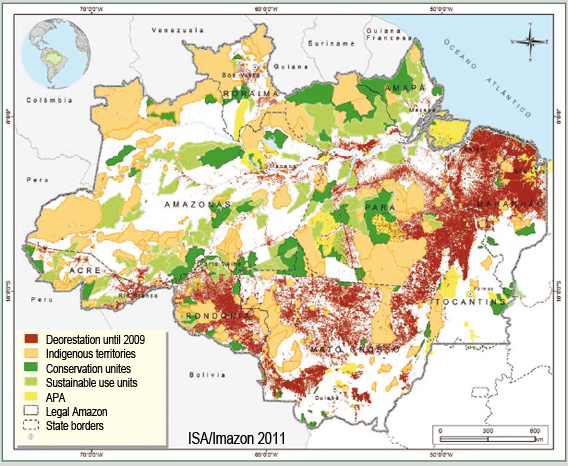 A 2010 study published in Proceedings of the National Academy of Sciences estimated that 37 percent of the recent decline in deforestation in the Brazilian Amazon can be attributed to newly established protected areas. Brazil designated some 709,000 square kilometers (274,000 sq mi) of Amazon forest — an area larger than the state of Texas — between 2002 and 2009 under its Amazon Protected Areas Program (ARPA).
Brazil has set ambitious deforestation reduction targets under its national climate change program.