Source: mongabay.com
Sustainable development seems to have left the realms of institutional debate in Brazil and has emerged into a reality for businesses to remain competitive in their markets.
It is also being used as a tool to stimulate the country’s economic growth.
A notable example of this is hydroelectricity, as the country has strived for many years to generate electricity in innovative ways, rather than relying on the use of fossil fuels. Companies are also voluntarily signing up and engaging in Brazil’s GHG Protocol Program with a view to reduce carbon emissions and businesses large and small are leading on sustainable business practices.
While Brazil has received a lot of respect for this forward thinking approach to sustainability, they have also been heavily criticized for hydro projects since the 1980s; in recent months the target has notably been the decision to move forward with the plan to build 3 dams on the Xingu River, which lies in the Amazon Basin.
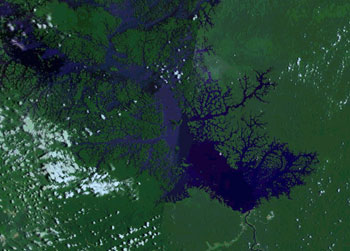
The most infamous now and the principle one, ‘Belo Monte’, will continue Brazil’s provision of hydroelectric energy, but will also potentially turn tributaries of the world's largest river into 'an endless series of stagnant reservoirs', explains the new short film released by Amazon Watch and International Rivers, narrated by Sigourney Weaver. The film is made via a Google Earth 3-D tour and reveals the potential impact of the dam, as well as the consequences for the indigenous peoples in the area.
“Their way of life will disappear," said the actress.
Hydroelectricity provides 80 per cent of the power that Brazil generates and Belo Monte will generate a further 11,000 MW and will be the third largest dam in the world, adding almost 20 per cent to Brazil’s electric power capacity. Indigenous tribes, as well as environmentalists, have protested strongly against the project for over 30 years. Belo Monte’s reservoirs threaten to flood 668 square kilometers, push more than 20,000 people out of their homes and reduce the flow of the Xingu to merely a trickle during parts of the year. Water supplies will be put at risk; endangering people and animal species, as fish migrations will be blocked causing devastating consequences for the local fisheries that depend on the river for their subsistence and the aquatic creatures within the river that depend on it for the survival of their species.
 It is difficult to comprehend how unrest around such a massive project could be disregarded, enough so that the project has been allowed to proceed to this stage, for such a long stretch of time. As far back as 1989, a Kayapó woman warrior held her machete to the face of José Antônio Muniz Lopes, who was the president of the state electricity company that holds the contract today, Eletrobrás. Her drastic measures were emphasis of the indigenous tribes’ fear around the dam being built and those fears have continued and have grown to this day and are now supported by many environmental organizations, as well as the Brazilian people.
It is hard to imagine the extent of the damage building the dam will do when you haven’t stood yourself in the Amazon and seen her beauty and magnitude and seen how the people and the animals live interdependent with her forest’s lush green; words fail to encapsulate it also. Thousands of tiny and large rivers run through the forest and water is a major part of the ecosystem itself which is why if the Belo Monte project is undertaken, it will be a disaster. Building this series of dams is considered to be a key turning point for the Amazon and not in a positive way – it will be the end of life as they know it now for the thousands of people and species living there and the beginning of many more projects like Belo Monte as Brazil tries to meet the energy demands of its country in an economic way. The flooding of the forest to accommodate the dam will provoke a massive release of methane from the vegetation rotting beneath it, millions of years worth of a stored greenhouse gas 25 times more potent thanCO2 and the risk of malaria in surrounding areas will increase also as the insects are attracted to the stagnant water. If past experience of dam projects in the Amazon is any model, Belo Monte will give local people no other choice but to join the many loggers already active in the Amazon, as they can no longer earn income from fishing or their traditional livelihoods like hunting, which will contribute to further large-scale devastating deforestation.
This development cannot be considered sustainable if you add to this the introduction of electricity grids, transmission lines and access roads that will put further pressure on this precious rainforest.
 The Amazon’s lesser known sister forest, the Atlantic has already suffered similar destruction, caused by human development, in fact there is only 7% of this precious forest left. In spite of this, it is one of the five richest forests in the world as well as being one of the most highly threatened. What makes the Atlantic forest so special is its biodiversity – in terms of plants and birds and animals, especially primates and amphibians. It is distinguished from many other forests by the high levels of endemicity – species that are only here, and nowhere else. It has maybe 20,000 plant species of which about 6,000 are endemic, for example, of the Atlantic forest’s 25 primate species, 20 are endemic and 14 threatened with extinction. As for its struggle for existence, it didn’t really become a cause until about 30 years ago, long after people had been expressing concern about the destruction of the Amazon. Many people simply didn’t see it, because it didn’t feature in the news: there was not a lot of research on what it holds, even now, and around it being the biggest center of population in Brazil – nearly all of its people live in the Atlantic Forest. Two people in particular are battling hard for its survival.
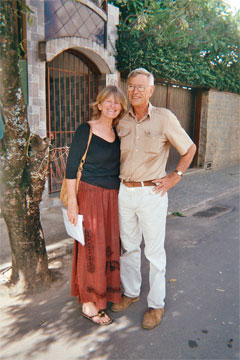
Robin Le Breton and his wife, Binka, are well accustomed with the notion of ‘sustainable development’. They are Directors of a Research Center in a little town called Rosário da Limeira, in the south-east of the state of Minas Gerais.
I spent a month working with Robin and Binka in January this year, within the beautiful Brazilian Atlantic Rainforest, known locally as the Mata Atlântica and every day since my thoughts around the subject of what can be considered sustainable have dramatically changed. The environment in which they live is typical of many others throughout this breathtaking forest, degraded through the development of agriculture to meet the country and the world’s needs for coffee, amongst other things.
Their research focuses on two things: sustainable land management technology to ensure the future of this forest and its people and the development of alternative products from the forest’s land that can generate income for them and provide an incentive for forest conservation in Brazil.
 The Belo Monte dam does not directly impact upon the Atlantic rainforest, but the whole subject does give rise to questions regarding the sustainability of this form of generating electricity and I wanted to know what this incredible couple, who have devoted the last 10 years of their life working to protect what is left of the Atlantic think about hydroelectricity.
Do they feel that it is sustainable? Or, is it an example of a positive idea born out of needing to do things in a different way, which hasn’t been thought through thoroughly enough. Or are there wider implications, considering the project is being driven by the Brazilian Government.
I also wanted to know what he thought the impact of climate change would be upon the long term future of the dams, considering our unpredictable climate and the predicted population rise anticipated for the years to come. The Intergovernmental Panel on Climate Change (IPCC) has predicted a devastating range of impacts from climate change upon Brazil, including an increase in the intensity and number of extreme weather events. The region’s huge geographical diversity means that patterns of vulnerability to climate change are extremely varied, which admittedly also makes modeling difficult, but the possibility of less rain can’t be ruled out and would affect Brazil’s capability to generate electricity via hydropower and would also impact supplies of drinking water compared with demand. Will all the destruction planned for the short-term prove to be a waste in the long-term?

