Source: Luxury Travel Magazine
 Avatar has a real world model in the Ecuadorian rain forest! Visit the Sacha Lodge and view the world from atop a giant Kapok tree. Who says magic is only in the movies...
For years the lure of the Galapagos has brought travelers to Ecuador, but too few stay to travel this small country (about the size of Colorado) and sample its amazing biodiversity. We are determined to avoid this mistake and so turn to Adventure Associates for options and advice. Even with so much information available on the Internet, nothing replaces a top-notch tour operator with offices on-site. From my first conversation with Kristina, I know I am in expert hands. She helps me sort through hotels, boats, internal flights, transfers, and even the shots we need for our trip. After I book, she stays involved, sending information on my destinations and updates on flight time changes.
My husband Bob and I have long dreamed of a rainforest visit and are thrilled to learn that in Ecuador this can be easily combined with a Galapagos cruise. In fact it is an ideal match because of the extraordinary contrast in ecosystems. Adventure Associates works with the Sacha Lodge -- at 4,500 acres, the largest private reserve in the Ecuadorian Amazon. Sacha exemplifies the growing commitment to ecotourism and conservation and provides a sustainable alternative to the hunting, logging, and oil drilling that has already had a devastating impact.
We fly into Quito, Ecuador's capital city. Kristina has arranged for all our transfers, and we are met by an Adventure Associate (known locally as Metropolitan Touring) representative who whisks us into a waiting van, facilitates our hotel check-in, and supplies us with information on tomorrow's transfer. Bright and early he's back in the lobby, ready to transport us to the airport for our domestic flight. It is a spectacular 25-minute leap over the Andes with views of Quito's three largest volcanos, all over 18,000 feet. We land in Puerto Francisco de Orelloana or Coca as it has been conveniently dubbed. Again we are met immediately. A short ride in an open-air bus takes us to the riverfront where we are fed lunch before the 2-hour boat trip.
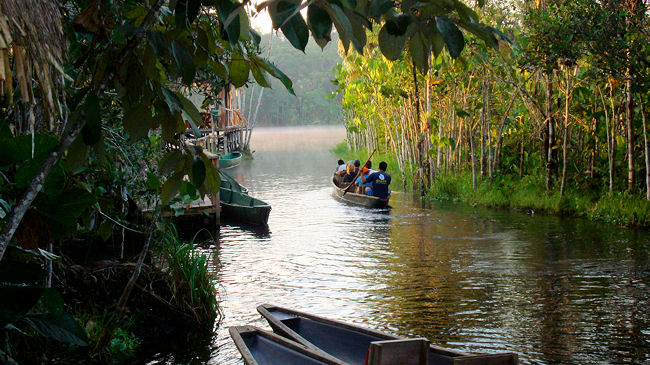
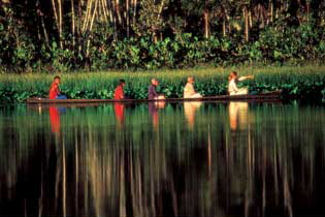
Sacha Lodge can only be reached by water. We travel on a long, narrow shallow-draft boat. Bob and I are very comfortable on the cushioned seat with a row to ourselves. The breeze tempers the heat that radiates from the Napa River banks, and soon we get our first glimpses of the rainforest habitat. For most of the trip we see no more than an occasional dugout canoe and perhaps a cut trail leading to an isolated dwelling. To reach the lodge we disembark and walk inland about 25 minutes along a raised boardwalk to the edge of a lake. There we climb into a canoe paddled by a Sacha guide to cross to the lodge. The water is very dark, rich in tannins from decomposing vegetation. We have found remote!
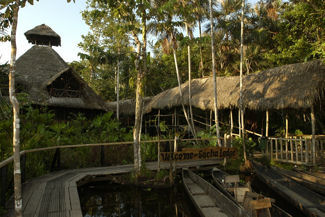
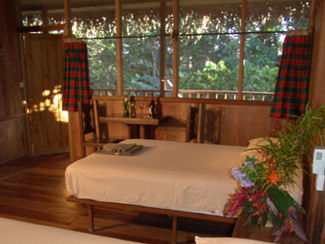
The main lodge and all the cabins are built up above the jungle floor and connected by boardwalks. Each cabin is designed for maximum privacy. All have ceiling fans (no A/C) and a dry box to keep electronics protected from the 90 percent humidity. We step out onto our covered porch and are greeted by a procession of spider monkeys crashing by. They appear to follow each other from branch to branch -- a monkey highway in the trees!
At dinner (all meals are buffet style) we meet our naturalist guide, Daniel from the U.K. We are also introduced to the four other guests with whom we will eat and explore throughout our stay. Three are Aussies (guaranteed good sports!) and the fourth heralds from Minnesota. No sooner have we finished our desserts, than Daniel suggests a night canoe ride. The still air reverberates with a cacophony of night calls. A flashlight scan of the shore reveals pairs of red eyes amidst tangled shore grass. Tiny caimans from the alligator family have emerged from their daytime hideouts to feed. To our amazement, our guide lifts one out of the water and then quickly returns him to the inky waters. It is a memorable outing.
Our first full day begins with a 5:30 wake-up call and 6:00am breakfast. An early start is essential since animals and birds all hide from the mid-day heat and we will follow their example. We begin with an hour-long canoe ride that takes us into terrain otherwise inaccessible—even with the knee-high rubber boots Sacha supplies. We are joined by a native Quichua guide named Angel who shares his knowledge and uncanny spotting abilities. Where I see only tangled vegetation, he finds a three-toed sloth, howler monkeys, and an impossibly brilliant toucan.
Back to: Home >
A Journey to Sacha Lodge in Ecuador's Amazonian Rainforest
- Published: January 17, 2010 by Deb Abraham
Avatar has a real world model in the Ecuadorian rain forest! Visit the Sacha Lodge and view the world from atop a giant Kapok tree. Who says magic is only in the movies...
For years the lure of the Galapagos has brought travelers to Ecuador, but too few stay to travel this small country (about the size of Colorado) and sample its amazing biodiversity. We are determined to avoid this mistake and so turn to Adventure Associates for options and advice. Even with so much information available on the Internet, nothing replaces a top-notch tour operator with offices on-site. From my first conversation with Kristina, I know I am in expert hands. She helps me sort through hotels, boats, internal flights, transfers, and even the shots we need for our trip. After I book, she stays involved, sending information on my destinations and updates on flight time changes.
My husband Bob and I have long dreamed of a rainforest visit and are thrilled to learn that in Ecuador this can be easily combined with a Galapagos cruise. In fact it is an ideal match because of the extraordinary contrast in ecosystems. Adventure Associates works with the Sacha Lodge -- at 4,500 acres, the largest private reserve in the Ecuadorian Amazon. Sacha exemplifies the growing commitment to ecotourism and conservation and provides a sustainable alternative to the hunting, logging, and oil drilling that has already had a devastating impact.
We fly into Quito, Ecuador's capital city. Kristina has arranged for all our transfers, and we are met by an Adventure Associate (known locally as Metropolitan Touring) representative who whisks us into a waiting van, facilitates our hotel check-in, and supplies us with information on tomorrow's transfer. Bright and early he's back in the lobby, ready to transport us to the airport for our domestic flight. It is a spectacular 25-minute leap over the Andes with views of Quito's three largest volcanos, all over 18,000 feet. We land in Puerto Francisco de Orelloana or Coca as it has been conveniently dubbed. Again we are met immediately. A short ride in an open-air bus takes us to the riverfront where we are fed lunch before the 2-hour boat trip.
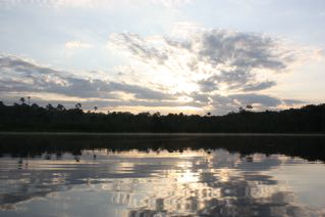 Sacha Lodge can only be reached by water. We travel on a long, narrow shallow-draft boat. Bob and I are very comfortable on the cushioned seat with a row to ourselves. The breeze tempers the heat that radiates from the Napa River banks, and soon we get our first glimpses of the rainforest habitat. For most of the trip we see no more than an occasional dugout canoe and perhaps a cut trail leading to an isolated dwelling. To reach the lodge we disembark and walk inland about 25 minutes along a raised boardwalk to the edge of a lake. There we climb into a canoe paddled by a Sacha guide to cross to the lodge. The water is very dark, rich in tannins from decomposing vegetation. We have found remote!
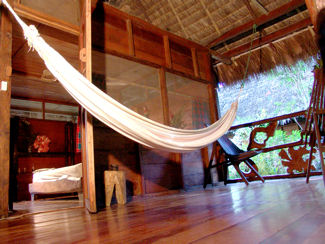
The main lodge and all the cabins are built up above the jungle floor and connected by boardwalks. Each cabin is designed for maximum privacy. All have ceiling fans (no A/C) and a dry box to keep electronics protected from the 90 percent humidity. We step out onto our covered porch and are greeted by a procession of spider monkeys crashing by. They appear to follow each other from branch to branch -- a monkey highway in the trees!
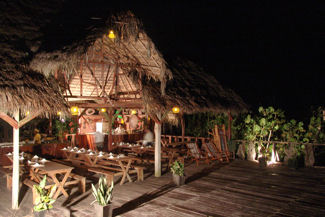
 At dinner (all meals are buffet style) we meet our naturalist guide, Daniel from the U.K. We are also introduced to the four other guests with whom we will eat and explore throughout our stay. Three are Aussies (guaranteed good sports!) and the fourth heralds from Minnesota. No sooner have we finished our desserts, than Daniel suggests a night canoe ride. The still air reverberates with a cacophony of night calls. A flashlight scan of the shore reveals pairs of red eyes amidst tangled shore grass. Tiny caimans from the alligator family have emerged from their daytime hideouts to feed. To our amazement, our guide lifts one out of the water and then quickly returns him to the inky waters. It is a memorable outing.
Our first full day begins with a 5:30 wake-up call and 6:00am breakfast. An early start is essential since animals and birds all hide from the mid-day heat and we will follow their example. We begin with an hour-long canoe ride that takes us into terrain otherwise inaccessible—even with the knee-high rubber boots Sacha supplies. We are joined by a native Quichua guide named Angel who shares his knowledge and uncanny spotting abilities. Where I see only tangled vegetation, he finds a three-toed sloth, howler monkeys, and an impossibly brilliant toucan.
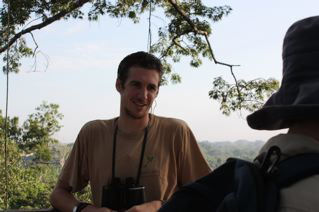
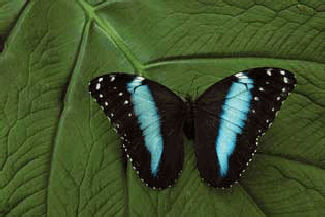
 Leaving the canoe behind, we begin our walk. It has not rained for several days—which is unusual—so the path is soft and mostly dry. Thankfully there are no mosquitoes since they don’t breed in black water. We see our first kapok tree, giants of the rainforest that live 300 to 400 years! Angel identifies poison frogs, cacao (chocolate) trees, and walking palms, but the highlight is his discovery of two roasting roosting owls which we view though the telescope he carries and sets up for us. The walk ends at the Sacha Lodge butterfly tent where butterflies are bred and sent around the world.
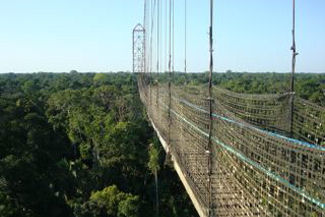
Quiet descends on the rain forest during mid-day. It is time to read, relax, and swim in the lake -- if one is confident in the guides' assurance that caimans and piranha are only active at night! Then at 4:00pm we head back out to visit the "towers" for some bird watching. The lodge has constructed three metal towers that rise above the canopy and are connected by narrow walkways with roped sides. Looking out rather than down is the strategy I use to acclimate to this "bird's-eye view."
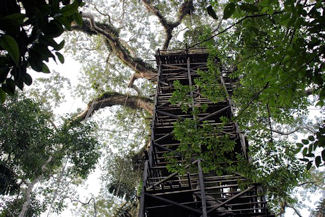
 Day two begins with another early start and a short canoe ride through the forest. This time our destination is another giant kapok tree — one encircled by a series of wooden stairs and platforms. It's roughly a 120-foot climb to the top where a wooden viewing platform looks out onto a mini-ecosystem of branches more than a meter in diameter. Vines, flowers, lizards, frogs all find a hone in this aerial paradise. I am reminded of the tree house in the old Swiss Family Robinson movie while the more up-to-date in our group believe this was the model for the world in the movie Avatar.
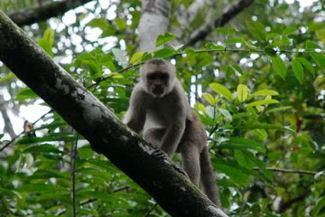
In the afternoon we hike out in search of pygmy monkeys so small they could fit in the palm of a hand. Our guides' ability to find the most reclusive creatures continues to amaze. In no time we check off another species spotted. Angel stops periodically to tell us about the local uses of rainforest plants—many medicinal, some as food sources or cooking aids. Like all habitats, the story here is about both interdependence and competition. We come as spectators but are aware of the potential to undermine a fragile balance. Sacha provides more than an opportunity to learn and experience. It has forged a partnership with the people who call this area home and become a steward for the lands it protects. This form of eco-tourism allows visitors to give back.
 On our final morning we sleep in until 7:00am and then pack up for the return trip. Step by step we reluctantly retrace our steps. Angel paddles us across the lake one last time. Daniel accompanies us for the 2-hour ride upriver back to Coca and the return flight to Quito. Our one consolation is that another Ecuadorian adventure lies ahead, for tomorrow it is on to the Galapagos!