May 20, 2012
Source: mongabay.com
A new model aims to forecast future logging road development by estimating the value of timber stocks across the Brazilian Amazon. The research, published in PLoS One, could help prioritize areas for conservation to protect the maximum area of forest.
Sadia Ahmed and Robert Ewers Imperial College London used data on tree species distribution and price information on commercially valuable timber to develop the model. In aggregate, the areas with the highest value timber were in the northeastern and southeastern parts of the Brazilian Amazon, regions where forest is more easily exploited. The southwestern and western Amazon had the least valuable timber stocks, according to the model.
The findings are noteworthy because most road development in the Brazilian Amazon is the product of logging and logging roads are linked to subsequent deforestation. A separate study, published in 2006 by Greg Asner of the Carnegie Institution's Department of Global Ecology at Stanford University, found that logged areas near roads were two to four times more likely to be deforested than intact forests.
Ahmed and Ewers believe their model could help forecast future road developments, providing an opportunity for conservationists to target high risk areas before construction begins, reducing both logging and deforestation.
Source: mongabay.com
A new model aims to forecast future logging road development by estimating the value of timber stocks across the Brazilian Amazon. The research, published in PLoS One, could help prioritize areas for conservation to protect the maximum area of forest.
Sadia Ahmed and Robert Ewers Imperial College London used data on tree species distribution and price information on commercially valuable timber to develop the model. In aggregate, the areas with the highest value timber were in the northeastern and southeastern parts of the Brazilian Amazon, regions where forest is more easily exploited. The southwestern and western Amazon had the least valuable timber stocks, according to the model.
The findings are noteworthy because most road development in the Brazilian Amazon is the product of logging and logging roads are linked to subsequent deforestation. A separate study, published in 2006 by Greg Asner of the Carnegie Institution's Department of Global Ecology at Stanford University, found that logged areas near roads were two to four times more likely to be deforested than intact forests.
Ahmed and Ewers believe their model could help forecast future road developments, providing an opportunity for conservationists to target high risk areas before construction begins, reducing both logging and deforestation.
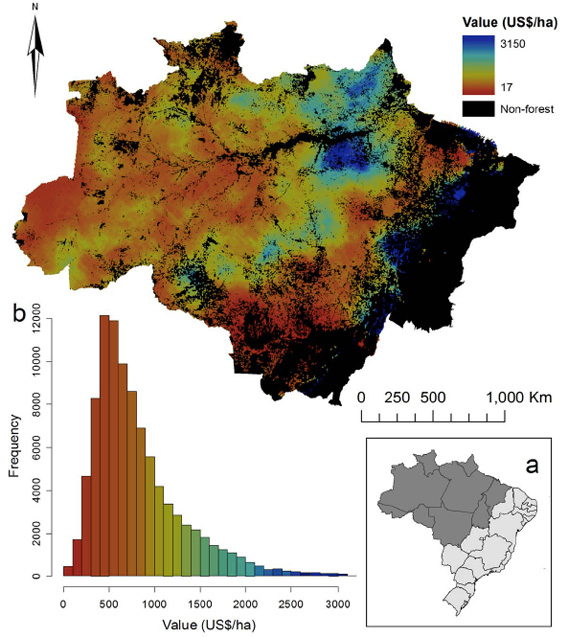 |
| Map of timber value in the Amazon. Values range from low (US$17 per ha) to high (US$3150 per ha). Insets: (a) dark shading shows the spatial extent of the Brazilian Amazon within Brazil, including the state boundaries; (b) frequency distribution of timber values (US$/ha) in the Brazilian Amazon, calculated over 151,073,784 equal-area grid squares of area 0.25 sq km. Image and caption courtesy of the authors. |