Tuesday, May 29, 2012

Tropical dams are a false solution to climate change

May 27, 2012
Source: mongabay.com

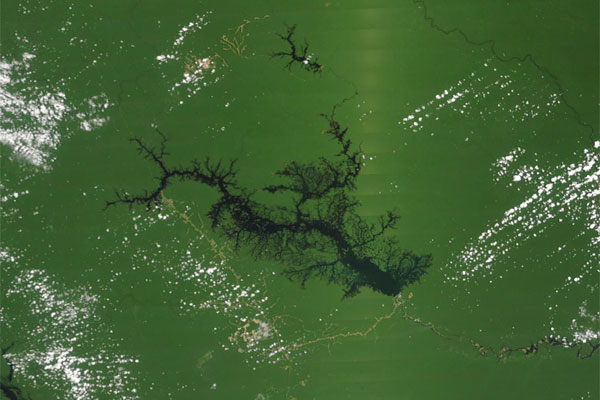
Lake Balbina, a man-made reservoir created to supply hydroelectric power to the city of Manaus in Brazil. The Balbina dam in Brazil flooded some 2,400 square kilometers (920 square miles) of rainforest when it was completed. Phillip Fearnside, author of a new Nature Climate Change editorial, calculated that in the first three years of its existence, the Balbina Reservoir emitted 23,750,000 tons of carbon dioxide and 140,000 tons of methane. (Photo courtesy of MODIS Rapid Response Team, NASA/GSFC)
Tropical dams emit considerably more greenhouse gas emissions than their temperate counterparts yet are being treated as a solution to climate change, warns a report published in Nature Climate Change.

The problem, argue Philip Fearnside and Salvador Pueyo, is the result of errors in calculations by energy companies. The authors single out ELETROBRÁS, a Brazilian energy giant that is in the midst of a dam-building spree in the Amazon.

"Various mathematical errors have resulted in Brazil’s electrical authorities estimating the magnitude of emissions from reservoir surfaces at a level of only one-fourth what it should be," write Fearnside and Pueyo, who note that ELETROBRÁS's estimates should be 345 percent higher.

“The myth can no longer be sustained that tropical dams produce clean energy,” said Fearnside.

Dams in the tropics have two principle greenhouse gas emissions sources: carbon released from soil carbon stocks and dying vegetation when the reservoir is flooded and methane formed where organic matter decays under low oxygen conditions at the bottom of the reservoir. Methane release is facilitated by a dam's turbines, which usually draw from the bottom of the reservoir.

"The reservoir’s function in transforming renewable carbon [from algae and plankton] into methane gives it the role of a methane factory, continuously removing carbon from the atmosphere as carbon dioxide and returning it as methane, with a much greater impact on global warming."

Fearnside and Pueyo highlight the urgency of the issue by noting that Brazil plans to add 30 dams in the legal Amazon by 2020, including the controversial Belo Monte dam which will flood tens of thousands of hectares and displace more than 20,000 people, including indigenous communities. Meanwhile ELETROBRÁS aims to build more than a dozen dams in Peru and other Amazonian countries.

New dams aren't just limited to the Amazon. Countries in the Mekong region are building dozens of dams, while Sarawak in Malaysian Borneo aims to build a series of rainforest dams on lands used by traditional forest people.

It is possible to reduce the climate impact of a tropical dam by minimizing the size of its reservoir and capturing methane emissions. Yet neither of these fixes address social conflict that often arises from forced displacement in dam catchments.
Brazil's leader vetoes portions of new Amazon rainforest law

Friday 25 May 2012
Source: The Guardian

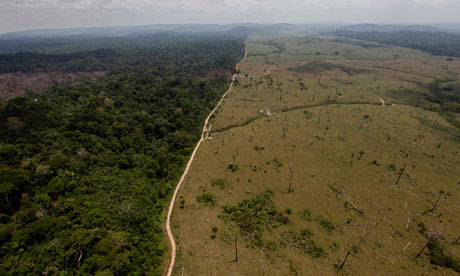
A deforested area of the Amazon rainforest near Novo Progresso in Brazil's northern state of Para. Photograph: Andre Penner/AP/AP
Brazilian president Dilma Rousseff has partially vetoed a bill that would have weakened her country's efforts to protect the Amazon and other forests.

Environmentalists cautiously welcomed the last-minute decision, which came after the most closely watched political debate of the year in Brazil. But they warned that the battle was not yet over because large parts of the bill will still go through.

Last month, legislators in both houses passed a set of revisions to the Forest Code that threatened permanent preservation areas – a key provision in Brazilian environmental legislation – that obliged farmers to keep a proportion of their land as protected forests, particularly on the fringes of rivers and hillsides. This requirement has long been opposed by Brazil's powerful agricultural lobby.

Critics warned that the bill would reverse 20 years of struggle to protect the Amazon rainforest.

One study by São Paulo University suggested the proposed revision could would result in deforestation of an additional 22 million hectares.

WWF, Greenpeace, the Brazilian Academy of Science and the Catholic Church urged Rousseff to completely veto the bill. The global activist group, Avaaz, collected 2 million signatures opposing the legislation.

With Brazil due to host the Rio+20 Earth Summit next month, approval of the bill would also have set a poor example of sustainability ahead of a conference that aims to set a new roadmap for the global environment.

But the bill was popular among powerful landowners, farmers and many business people, who said it would be good for the economy to ease protection measures.

Forced to choose between these diverging forces, president Rousseff compromised by using a line veto to reject 12 clauses – including an amnesty for illegal loggers - and to amend 32 others, such as a requirement for large landowners to reforest illegally cleared land.

"It's the code of those who believe it's possible to produce food and preserve the environment," Agriculture minister Jorge Ribeiro Mendes told reporters in announcing the partial veto.

Reflecting Rousseff's long-stated desire to reduce the pressure on small, poorer farmers, the protection requirements are expected to be watered down for smaller tranches of land.

"The big (farmers) have vast extensions of land and have the means to recover all the areas of permanent preservation," Brazilian environment minister Izabella Teixeira said.

Conservation groups gave cautious praise to the Brazilian president, but withheld a final judgment until the scope of the partial veto is clarified next week.

"President Rousseff has apparently acceded to Brazilian public opinion in vetoing the most flagrantly irresponsible sections of the ranchers' Forest Code, but we're not out of the woods yet," said Jennifer Haverkamp, International Climate Program Director of the US-based Environmental Defence Fund.

"What these vetoes really mean for the future of the forest - and whether the law can be effectively enforced - will depend on the specifics of the executive order that the president will issue on Monday."

The bill now goes back to Congress, and legislators have 30 days to override Rousseff's changes with a simple majority, which is considered unlikely.

About 20% of Brazil's Amazon rainforest has been destroyed. But beginning in 2008, the government stepped up enforcement, using satellite images to track the destruction and send environmental police into areas where deforestation was happening at its quickest pace. Amazon deforestation slowed and hit its lowest recorded level from August 2010 through July 2011, when just 2,410 square miles (6,240 square kilometres) were felled.

However, there are just 1,400 federal environmental police to cover the vast and often impenetrable Amazon along with the rest of Brazil, leading environmentalists to worry that further drops in the destruction may be unlikely and might even return to increasing because the new bill loosens restrictions.

Opponents of the bill also argue that while government enforcement did help slow deforestation, temporary economic factors also played a role that demand for the cattle, soy, timber and iron ore produced in the Amazon fell in the United States and Europe as the global financial crisis took hold. It's feared the appetite for those goods will increase and lead to a resumption in destruction once the world economy recovers.

The most contentious part of the bill passed by Congress was that it scrapped most protections for riverbanks, including maintaining strips of forest 30 yards (metres) to 100 yards (metres) deep along waterways. The version sent to Rousseff mandated only that small rivers maintain 15 yards (metres) of forest along their banks, which are sensitive to rapid erosion that can then reduce water quality, promote flooding and affect the plants and animals that use the rivers to survive.

Teixeira hinted that this could continue by saying protection measures would remain strong in sensitive ecosystems. But this - like other key elements - will not be clear until next week.

Greenpeace blocks Brazil port over Amazon law

27 May 2012
Source: France24

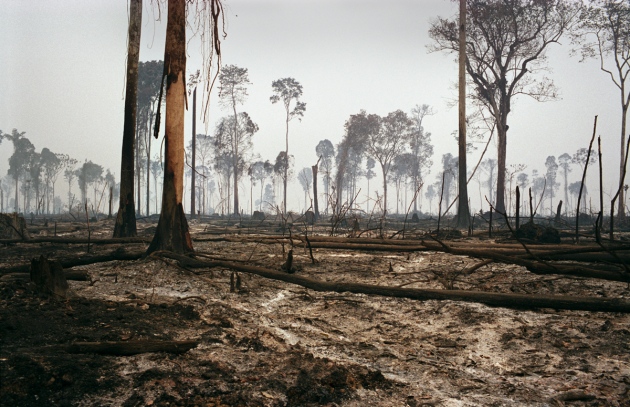
This file photo shows a burnt tree lying down on a road along the Amazon rainforest in northen Brazil, in 2008. Greenpeace on Saturday temporarily blocked a freighter from being loaded at a northern Brazilian port in protest over a partial presidential veto of a land-use bill seen as harming the Amazon.

Greenpeace temporarily blocked a freighter from being loaded at a northern Brazilian port in protest over a partial presidential veto of a land-use bill seen as harming the Amazon.

The environmental group said on its website on Saturday that activists ferried by its Rainbow Warrior vessel occupied a giant pile of pig iron on the dock while another team scaled two cranes to stop them from loading the raw material of iron and steel onto the US-bound Clipper Hope.

The activists then unfurled banners proclaiming "Amazon Crime" and "Dilma's dirty secret," in protest at President Dilma Rousseff's partial veto Friday of 12 controversial articles of the new code regulating the use of land on rural properties.

"The Amazon turns to Charcoal, Brazil Stop the Chainsaw," said a huge banner tied to a crane by the activists.

Pig iron requires large amounts of charcoal to be produced and this often comes from rainforest trees logged from indigenous lands.

But they suspended the protest eight hours later after the deputy governor of Maranhao state, Washington Luiz de Oliveira, intervened and promised to facilitate talks with the pig iron industry.

A meeting was set for Monday between Greenpeace and industry representatives, Maranhao state officials, the national Bar Association and cargo shipment owner Viena.

The modified forestry policy bill, which is pending ratification from Congress, maintains a requirement to protect 80 percent of the forest in rural areas of the Amazon and 35 percent of the sertao, or arid hinterland of northeastern Brazil.

But it eases restrictions for small landowners who face difficulties in recovering illegally cleared land.

The reform of the 1965 forestry law approved by Congress a month ago had been seen as a victory for a powerful agri-business lobby after years of feuding with environmentalists alarmed at the risk of further deforestation in the Amazon.

Environmentalists who had pushed for a full veto have slammed Rousseff's move.

Greenpeace has linked the pig iron industry to slave labor and forest destruction in the Amazon.

"In the wake of Dilma's failure we are taking action and demanding action from the Brazilian government," Greenpeace said.

It called on Rousseff to "redeem herself by supporting the 80 percent of Brazilians who opposed the changes in the Forest Code."

NASA predicts milder Amazon fires

27 May 2012
Source: Cool Earth


The first ever formal prediction by NASA's new fire severity model suggests that the Amazon rainforest will be less vulnerable to forest fires in 2012.  There will be fires in the Amazon, but the model predicts that they won't be as likely in 2012 as in some previous years.


The model compared none years of satellite based fire data with sea surface temperature records and established a connection with fire activity in South America. According to the model, with sea surface temperatures in the Central Pacific and North Atlantic currently cooler than normal,  patterns of atmospheric circulation are predicted to increase rainfall across the southern Amazon in the months leading up to the fire season.

The researchers believe that the precipitation pattern during the end of the wet season is very important.  This is when soils are replenished with water.  When sea surface temperatures are higher, precipitation lessens across most of the region.  As a consequence, soils contain less water to start the dry season which makes trees and undergrowth more vulnerable to fire.

Amazon forests are highly biodiverse so their vulnerability to fires is particularly worrying.  The Amazon also stores large amounts of carbon that is released back to the atmosphere with naturally spontaneous or man-made fires.

Thursday, May 24, 2012

Brazil fights illegal logging to protect Amazon natives

22 May 2012
Source: AFP

Brazil's National Indian Foundation estimates that there are 77 isolated indigenous tribes scattered across the Amazon (AFP/File, Antonio Scorza)
RIO DE JANEIRO — Brazil said Monday it was working hard to stop illegal logging in Amazon rainforest land inhabited by the ethnic Awa people, a group said to be threatened with extinction.

"The Brazilian state must accomplish this task with the utmost determination and we are working hard on it," Maria do Rosario, the minister in charge of human rights, told foreign reporters.

A Brazilian government survey estimates there could be "up to 4,500 invaders, ranchers, loggers and settlers" occupying just one of the four territories inhabited by the Awa, whose total population stands at no more than 450.

Last month, Survival International, a leading advocate for the rights of tribal people worldwide, launched a major campaign spearheaded by Britain's Oscar-winning actor Colin Firth to focus attention on the plight of the Awa, saying they were threatened with "genocide" and "extinction."

According to Survival, there are roughly 360 Awa who have been contacted by outsiders, many of them survivors of massacres, along with another 100 believed to be hiding in the rapidly-shrinking forest.

Do Rosario said Brazil's National Indian Foundation (FUNAI) was conducting surveillance operations on lands traditionally occupied by the Awa.

"There are joint operations with the police to protect the rights of these people," she said.

FUNAI estimates that there are 77 isolated indigenous tribes scattered across the Amazon rainforest. Only 30 such groups have been located.

Indigenous peoples represent less than one percent of Brazil's 192 million people and occupy 12 percent of the national territory, mainly in the Amazon region.

Dilma Rousseff must veto Brazil's devastating new forest code

Wednesday 23 May 2012
Source: guardian.co.uk

Dilma Rousseff's land-use law is protested in front of Planalto Palace. The poster reads: 'Forestry Code – Dilma Veto'. Photograph: Ueslei Marcelino/Reuters
A new land-use law proposed by a faction controlled by parochial and rural interests and passed by Brazilian legislators in April threatens to reverse 20 years of struggle to protect the Amazon rainforest.

Not only will it allow deforestation to increase by allowing marauding developers in, Brazil's new forest code will also provide an amnesty for illegal deforestation committed in the past.

The only hope is for the president, Dilma Rousseff, to stick by her public pledge to protect the Amazon and use her veto powers to block the pending legislation.

But time is swiftly running out – Rousseff has until Friday to make up her mind, maintain her authority and honour her responsibilities both to the Brazilian people and the globe.

The prospect of her failing to veto the law is not only heartbreaking, it is potentially devastating for the Amazon basin, a region which contains half of the remaining tropical forests on earth.

It will also stain Brazil's reputation after the country had shown in recent years that economic growth could be achieved without the rampant deforestation witnessed for too long in the past 40 years.

The new forest code will put an end to permanent preservation areas, one of the crown jewels of Brazilian environmental legislation that, among other provisions, had protected forests at the edges of rivers and hillsides.

The amnesty for past crimes is also worrying: for the first time in six years, deforestation has increased in certain Amazon states, attributed to the looming environmental impunity enshrined in the new law.

Modelling from São Paulo University indicates that the new law could lead to the deforestation of an additional 22 million hectares.

Brazil's Institute for Applied Economic Research has also estimated that the additional emissions likely to result from the new law would make it impossible for Brazil to reach its reduction target announced in Copenhagen by Brazil's then president, Luiz Inácio Lula da Silva, and his then-chief cabinet minister, Rousseff.

As an agreement to save the climate was collapsing in Copenhagen, President Lula had also pledged to reduce deforestation in the Amazon by 80% by 2020. By 2011, deforestation in Brazil had already decreased to its lowest level since records were first kept in the 1970s.

That sharply reduced rate of deforestation had become a point of pride for Brazil.

I joined Greenpeace in 1992 to help develop a campaign to protect the Amazon in the lead up to the first UN Earth Summit in Brazil.

I still visibly remember being unable to safely depart a ship docked in Belém in the 1990s due to angry mobs that had been organised to oppose our effort to stop deforestation.

But 10 years later, I remember freely walking the beautiful streets of Belém during a world social forum festival with my wife – Zero Deforestation, now supported by the majority of Brazilians.

And just three months ago, I accepted the UN Forest Hero award in New York in what was a proud moment for me as a Brazilian.

As I stood there next to others who worked to protect forests in Indonesia, Cameroon, Russia, and Japan, I thought of my home: the Amazon, and how Brazil had embraced the need to protect it.

Science has shown that the Amazon contains a quarter of all terrestrial plant and animal species on earth. Roughly a fifth of the world's freshwater comes from the Amazon. We also rely on foods, materials and medicines sourced from the Amazon.

But there remain some politicians and companies willing to sacrifice our collective future for their short-term interests.

More so, it is a complete public embarrassment for Rousseff that the forest code is being eroded just weeks before Brazil will host the Rio+20 summit.

Nearly 80% of Brazilians opposed the legislative changes and citizens have been calling on the president to totally veto the amendments and instead commit to achieve zero deforestation in the Amazon by 2015 at Rio+20.

If she does, she would not only become a Forest Hero, but a Brazilian hero for the rest of the world.

Value of timber stocks could predict future logging roads, deforestation in the Amazon

May 20, 2012
Source: mongabay.com

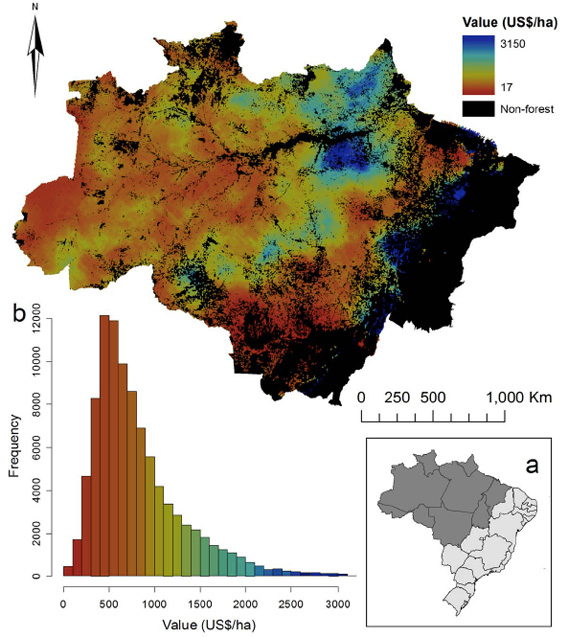
A new model aims to forecast future logging road development by estimating the value of timber stocks across the Brazilian Amazon. The research, published in PLoS One, could help prioritize areas for conservation to protect the maximum area of forest.

Sadia Ahmed and Robert Ewers Imperial College London used data on tree species distribution and price information on commercially valuable timber to develop the model. In aggregate, the areas with the highest value timber were in the northeastern and southeastern parts of the Brazilian Amazon, regions where forest is more easily exploited. The southwestern and western Amazon had the least valuable timber stocks, according to the model.

The findings are noteworthy because most road development in the Brazilian Amazon is the product of logging and logging roads are linked to subsequent deforestation. A separate study, published in 2006 by Greg Asner of the Carnegie Institution's Department of Global Ecology at Stanford University, found that logged areas near roads were two to four times more likely to be deforested than intact forests.

Ahmed and Ewers believe their model could help forecast future road developments, providing an opportunity for conservationists to target high risk areas before construction begins, reducing both logging and deforestation.

Map of timber value in the Amazon. Values range from low (US$17 per ha) to high (US$3150 per ha). Insets: (a) dark shading shows the spatial extent of the Brazilian Amazon within Brazil, including the state boundaries; (b) frequency distribution of timber values (US$/ha) in the Brazilian Amazon, calculated over 151,073,784 equal-area grid squares of area 0.25 sq km. Image and caption courtesy of the authors.

Fungus in Amazon that can consume plastic

May 22, 2012
Source: Times of Oman

Researchers have discovered a fungus in the Amazon rainforest that can break down the common plastic polyurethane, used in billions of discarded plastic bottles.

Their pile-up, amounting to one billion tonnes since 1950s, is threatening to choke many of the eco systems so vital for survival of life. The synthetic material, derived from petrochemicals, degrades very slowly because of its complex chemical bonds.

One of the most widely used plastics, the global consumption of polyurethane raw materials in 2007 was above 12 million tons, with an average annual growth rate in its use of about five percent, the journal Applied and Environmental Microbiology reports.

Researchers from Yale University, Connecticut's Rainforest Expedition and lab educational programme, scoured the Ecuadorian rainforest for plants and cultured the micro-organisms within their tissue, according to the Daily Mail.

"Endophytes were isolated from plant stems collected in the Ecuadorian rainforest. A subset of these organisms was screened for their ability to degrade polyurethane,- the researchers said.

Endophytes are micro-organisms that live within the inner tissues of plants, but do not cause any noticeable disease symptoms in their hosts.

They often play a key role in the decomposition of the plants after death, but never before have they been tested for their ability to degrade synthetic materials.

Monday, May 21, 2012

Brazilian deforestation lower in 2012 to date

May 18, 2012
Source: Mongabay


Deforestation in the Brazilian Amazon is lower in 2012 relative to the same period last year according to satellite-based data released by Imazon, an NGO.

Imazon's Deforestation Alert System (SAD) detected 830 square kilometers of clearing between August 2011 to April 2012, down about 35 percent from the 1268 square kilometers recorded at this time last year. Deforestation in the Brazilian Amazon last year was the lowest since annual record keeping began in the late 1980s.

Imazon's deforestation tracking system also found a sharp decline in forest degradation, which often proceeds outright deforestation. Forest degradation is typically the result of logging and fire.

Brazil measures its annual deforestation at the end of July during the dry season when cloud cover is at a minimum. Final data is typically released in December. Deforestation in the Brazilian Amazon usually peaks in the July-September period.

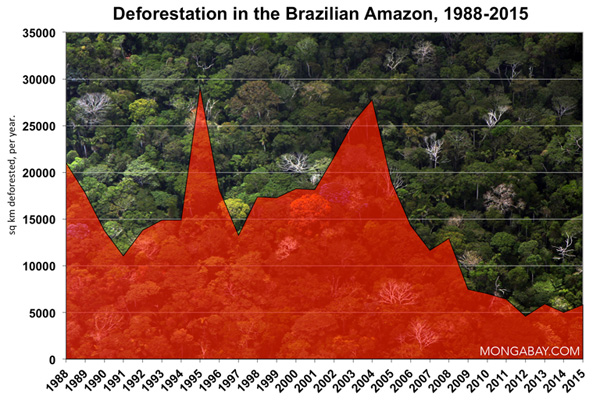
Deforestation in the Brazilian Amazon has fallen nearly 80 percent since 2004. Factors include stepped-up law enforcement, incentives for utilizing already deforested lands, an increase in the extent of protected areas and indigenous reserves, better monitoring of forest areas, emerging payments for ecosystem services programs, and macroeconomic trends that make Brazilian agricultural products more expensive for export, reducing profitability. But environmentalists fear that proposed changes to the country's Forest Code, which mandates how much forest a landowner is required to maintain, could reverse progress in reducing deforestation.

Brazil accounts for more than 60 percent of the Amazon rainforest.

Perenco's environmental consultancy buried evidence of Amazon tribe

Wednesday 16 May 2012
Source: The Guardian

Spears left by an uncontacted tribe in the region where Anglo-French oil company Perenco is working in Peru. Photograph: Marek Wolodzko/AIDESEP
An environmental consultancy working for an oil company withheld evidence of an "uncontacted tribe" where the company is operating in Peru's Amazon, a leaked report obtained by the Guardian reveals.

The leak is acutely embarrassing for Perenco, based in London and Paris, because it has consistently claimed there is no evidence for indigenous people living without contact with the outside world near its operations and cites research by the consultancy, Daimi Peru, as proof.

The report was written by three anthropologists from the National University of the Peruvian Amazon (Unap) who were contracted by Daimi, which in turn was contracted by Perenco. The anthropologists list the evidence they found – "bent branches, footprints, women bathing in the rivers and crossed spears on pathways" – all of which was reported by local people..

"We found evidence of their existence," says Teodulio Grandez, one of the anthropologists. "There were signs. We never said there weren't any."

But when Daimi made its findings public, combining the anthropologists' research with that of academics in other disciplines from another university, none of the evidence listed by Grandez et al appeared.

"No information exists that demonstrates or suggests the recent existence of isolated indigenous people in the area under investigation," Daimi claimed in a final report dated September 2008.

The report obtained by the Guardian is a scanned version of a paper copy, with every page bearing Unap's insignia and signed by the anthropologists. It is addressed to Daimi's general manager, Milton Ortega.

"We verified that this information (about the 'uncontacted' people) was in the paper version," says Jose Moscoso, another Unap anthropologist. "But when the digital version appeared, it wasn't there."

Daimi's final report is now used by Perenco to defend its operations, which have come under fire from indigenous organisations and NGOs including Survival International. Contact between Perenco employees and the "uncontacted" people could decimate the latter because of their lack of immunity to diseases.

"There has been no evidence of non-contacted tribes," Perenco claims on its website, while its Latin American regional manager once compared them to the Loch Ness monster. "Much talk," he said, "but never any evidence."

The news of the leak will not surprise some former Daimi workers who were involved in the research and later disturbed when the final report said no evidence was found.

"This confirms what everyone who knows anything about this region has been saying all along," says Survival's Rebecca Spooner, who said evidence for "uncontacted" people in this region has been collected for years.

Daimi's Milton Ortega did not comment. "I don't want to talk about this by telephone. I'll give you an official answer by email," Ortega said, from Ecuador, but no reply was forthcoming despite several follow-ups by the Guardian.

Perenco, which refused to say whether it had seen a copy of Unap's report, is seeking permission from Peru's energy ministry (MEM) to begin the next stage of its operations, in the north-east of the country near the border with Ecuador. When MEM asked Peru's indigenous affairs department (INDEPA) for its opinion on the company's environmental impact assessment (EIA), INDEPA accused Perenco of completely ignoring the "uncontacted" people and endangering their lives.

Last month an American NGO, E-Tech International, released a highly critical report on the company's plans. "Perenco is following a 1970s-era project design that is totally inappropriate for the Peruvian Amazon," said the report's author, Bill Powers. "If designed and built using current best practices, the impacts would be one-tenth what they will be with the current design."

Peru’s Amazon highway: integrator or decimator?

May 21, 2012
Source: GlobalPost

Road block: Peru's indigenous groups protested in 2009 against former President Alan Garcia's plan to ease restrictions on industries including mining and wood harvesting in the Amazon. That ended in the Andean country's bloodiest conflict in nearly two decades with 35 dead from clashes between protesters and security forces. A new plan to cut a big road through the Amazon likely will be met by a hard fight as well should it pass Congress.
LIMA, Peru — The Peruvian congress is set to debate putting a road through a remote, protected part of the Amazon that is home to some of the last fully isolated indigenous tribes anywhere in the world.

The highly controversial freeway would cut through an indigenous reserve and a national park in the jungle departments of Ucayali and Madre de Dios, on Peru’s southern border with Brazil. It would link the towns of Puerto Esperanza and Inapari.

Environmental and indigenous groups fiercely oppose the road, fearing it will pave the way for illegal loggers, poachers and land squatters to devastate both the rainforest and the native communities who live there.

“It is not illegal to do this in Peru, but it completely contradicts the laws protecting uncontacted tribes, as well as environmental laws,” Rebecca Spooner, of Survival International, a British group that supports tribal peoples around the world, told GlobalPost.

“Officially declaring the road 'a national necessity' is basically exploiting a legal loophole to override the normal protections in place in national parks and reserves, which state that roads should not be built.”

The draft bill appears to have a real chance of becoming law. It has been signed by 30 of the 130 members of Peru’s single-chamber congress. They include Rolando Reategui, the spokesman of the right-wing opposition Fujimorista grouping, the second largest with 37 seats.

It was drafted in April but has flown under the radar of national and international media until now, a relatively common occurrence in Peru thanks to congress’ lack of transparency.

“This shows, once again, the lack of respect towards the culture, rights and stated wishes of the native population of the Peruvian Amazon,” Roger Muro, lawyer of local indigenous federation FECONAPU, told GlobalPost.

The local population is more than 90 percent indigenous and overwhelmingly opposes the road, he added.

But the text of the bill argues that the poverty of local indigenous and settler communities can only be addressed if they are integrated with the rest of Peru by a road link. Currently, the region can only be reached by light aircraft or boat.

The text claims the region of 5,000 people (excluding the isolated tribes) suffers infant mortality at a rate of 32 percent and illiteracy of 34 percent. The bill criticizes green groups for not acknowledging that “in this world there exist national parks such as Yellowstone … which are crossed by super highways that allow millions of visitors.”

It also argues that a road is needed to “consolidate” the border zone with Brazil. The text claims that many local families prefer to cross the frontier to give birth to their children on Brazilian soil. That would allow them better access to certain benefits a Brazilian nationality can offer, including schools and hospitals.

The main driving force behind the proposed road is a Spanish missionary, Father Miguel Piovesan, who has been working in the region for more than a decade.

He declined a phone interview with GlobalPost but, by email, asked: “Is the possible impact of a land connection less than the impact and suffering that the current state of isolation causes?”

Many local indigenous communities reject that argument, as well as the notion that integration with the rest of Peru is even desirable.

“No one can oblige us to draw closer [to the rest of Peru],” Alfredo del Aguila, from the Purus indigenous reserve, told La Republica newspaper recently. In addition to that reserve, the road would also bisect the Alto Purus National Park, the largest in Peru.

More from GlobalPost: Warmer seas are blamed for Peru's bird carnage

If congress approves the bill authorizing the road, it would also appear to violate Peru’s new Law of Prior Consultation, which stipulates that indigenous communities must be consulted before infrastructure projects are built on their land. That measure was signed into law by President Ollanta Humala last year in the highly symbolic location of Bagua, a town in the northern Peruvian Amazon.

In 2009, more than 30 police officers and indigenous protesters are thought to have died during clashes in Bagua. The protesters opposed measures proposed by Humala’s predecessor, Alan Garcia, that they argued would have further opened indigenous land to loggers and oil companies.

Survival International director Stephen Corry described the proposed road as “suspicious,” and implied it would only benefit loggers and others unsustainably ransacking the rainforest for economic gain.

“This ‘we know what’s best for you’ attitude is not only patronizing, it’s deadly, as the last 500 years of colonialism and ‘development’ of indigenous lands has shown,” he said in a statement.

The proposed road is not the first time Peruvian authorities have attempted to skirt protections for reserves and parks in the Amazon in the name of economic development.

In 2007, the Garcia government floated the idea of lopping off 516,000 acres of the massive Bahuaja Sonene National Park to allow gas drilling in the area. The government was quickly forced to back down after a major international outcry.

The fact that Peru was in the process of negotiating a trade treaty with the United States, with members of the US Congress already concerned about the country’s lack of environmental safeguards, is thought to have played a determining role.

Thursday, May 17, 2012

U.S. car manufacturers linked to Amazon destruction, slave labor

May 14, 2012
Source: Mongabay

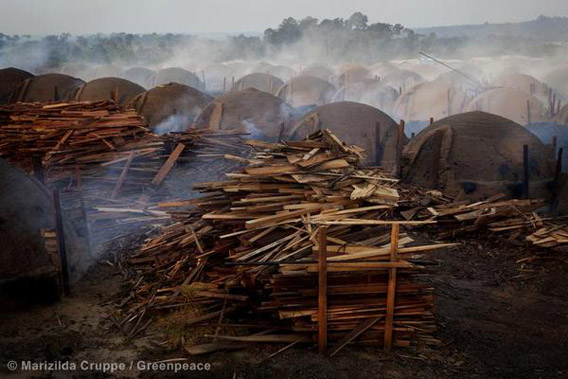
Illegal charcoal kilns in the municipality of Tucuruí. Photo by: Marizilda Cruppe/Greenpeace.

According to a new report by Greenpeace, top U.S. car companies such as Ford, General Motors, and Nissan are sourcing pig iron that has resulted in the destruction of Amazon rainforests, slave labor, and land conflict with indigenous tribes. Spending two years documenting the pig iron trade between northeastern Brazil and the U.S., Greenpeace has discovered that rainforests are cut and burned to power blast furnaces that produce pig iron, which is then shipped to the U.S. for steel production.

"Despite attention to the problem over the years, little has been done and household consumer products in the U.S. can still be traced back to illegalities and forest destruction in the Amazon," the Greenpeace report reads.

Brazil's Carajás region is home to 43 blast furnaces used by 18 different companies, of which Viena is the largest. The blast furnaces depend largely on illegal camps that cut and burn rainforest for charcoal.

"These camps are built in a matter of days, located in difficult to access areas and, if shut down by authorities, frequently spring up again in another location. They are built next to wood sources, including illegally in protected areas and indigenous lands," the report reads, noting that labor conditions in the area are often similar to slavery. Often forced to work seven-days-a-week in hazardous and toxic conditions, workers are fleeced of salaries by imaginary debts.

The massive pig iron production in the region has been actively promoted by the Brazilian government and financed in the past by the World Bank, the European Economic Community, and the Japanese government. However, such promotion has not kept the industry clean as Greenpeace documented several types of fraud, from running an operation without a license to creating fake companies to keep timber sources hidden. Not surprisingly, much of the fuel comes from illegal logging.

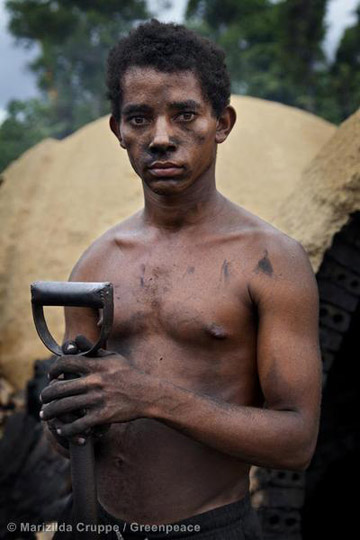
Valdobras dos Santos Castro, 19 years old, works at an illegal charcoal camp in the municipality of Goianésia. Photo by: Marizilda Cruppe/Greenpeace.
Greenpeace linked two of the largest pig iron companies, Viena and Sidepar, to a steel mill in the U.S. run by Severstal and from there to major car manufacturers like Ford, General Motors, BMW, Nissan, and Mercedes. Viena also exports its pig iron to Cargill, Environmental Materials Corporation, and National Material Trading, which in turn sells the steel to John Deere.

"Greenpeace's research found Viena and Sidepar fueling their foundries with illegal charcoal connected to the region’s pandemic illegalities including slavery, illegal logging and deforestation, and invasions into indigenous lands," reads the report.

Around 70-80 percent of the region's forests have been lost already, with the bulk of it since pig iron production began in the mid-1980s. With forest running out in the region, loggers are now entering indigenous lands and conservation areas. Some indigenous tribes, such as the Awá and the Alto Rio Guamá, have lost over 30 percent of their land to the illegal loggers.

"Loggers flagrantly violate the law and bring in multiple trucks for hauling away timber and often enter indigenous lands well armed," reads the Greenpeace report.

Despite this issue being in the media since 2006, companies have taken little action or responsibility according to Greenpeace.

"Most brands,like BMW and Toyota, have not gone on record about the issue. Some companies, such as Ford and General Motors, have spoken about the issue of slavery to the press as recently as 2011. Some companies have vague policies aiming to address slavery, but with no functional mechanisms to monitor progress," the report reads. "No companies have publicly presented efforts to combat illegalities related to forest loss in their supply chains."

As the report was issued, Greenpeace activists worked to draw attention to the problem by occupying a boat with a shipment of pig iron bound for the U.S. The activists demand that the issue be raised at the upcoming Rio+20 UN Summit on Sustainable Development.

"President Dilma is preparing to host the world’s elite in Rio while turning a blind eye to forest crime in her own backyard. Slavery and illegal deforestation have no place in modern Brazil," said Greenpeace Brazil Amazon Campaign Director Paulo Adario. "The Amazon is being thrown into a furnace while President Dilma and the world’s biggest car companies look the other way."

As pig iron producers run out of native forests to burn in the Carajás region, the blast furnaces are being run increasingly by monoculture plantations of eucalyptus trees. This practice poses its own problems including pollution, water resources conflict, biodiversity loss, and land conflict.

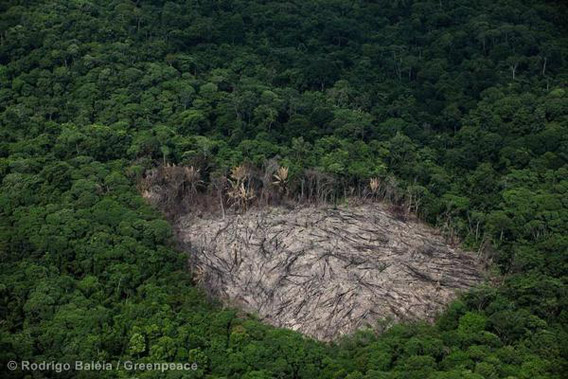
Deforestation in areas neighboring the pig iron cluster in Marabá, Pará state. Photo by: Rodrigo Baliea/Greenpeace.

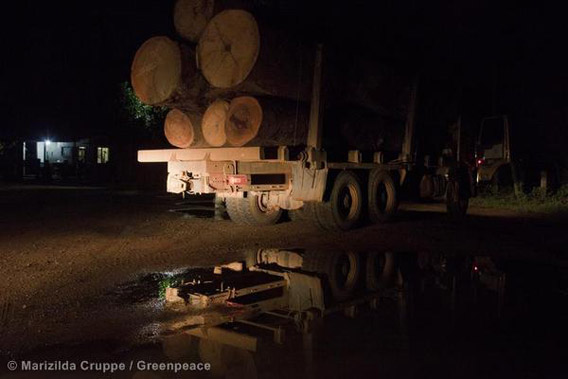
A truck loaded with wood in the municipality of Tucurui. A region with many charcoal camps that use Amazon timber to make the wood charcoal that fuels pig iron blast furnaces. Photo by: Marizilda Cruppe/Greenpeace.

Deforestation in the Brazilian Amazon

As the Clock Ticks, Trees Fall in Brazil’s Amazon

May 14, 2012
Source: National Geographic

 As Brazil braces for president Dilma Rousseff’s forthcoming decision on whether to sign or veto recent legislation that would alter the country’s Forest Code, rights groups are decrying a surge in illegal land grabs that is wrecking environmental havoc and threatening vulnerable tribal populations.

According to the rights organization Survival International, a gold rush mentality seems to have taken hold among loggers, ranchers and settlers in the eastern Amazonian state of Maranhão, as intruders bore their way deeper into reserve areas set up to protect the forests of the Awá tribe. In addition to 355 contacted members of the tribe, about 100 Awá remain uncontacted, making them one of the very last groups of nomads still roaming the forests of the eastern Amazon. The majority of the 60 or more uncontacted tribes that still survive in the Amazon inhabit the more secluded and remote western regions on the vast Amazon Basin.

This aerial photograph shows the boundaries of the Awá Indigenous Land, one of four protected areas where members of the tribe live. More than 30 percent of the reserve has been invaded by loggers, ranchers and settlers. Credit: Survival

Survival has launched a public campaign in recent days that includes a video featuring British film star Colin Firth, best known for his portrayal of a stammering King George in the blockbuster hit “The King’s Speech.” Looking into the camera, an earnest Firth urges supporters to call on Brazil’s Justice Minister to send agents into Maranhão to halt the destruction. “One man can stop this,” says Firth, “Brazil’s Minister of Justice. He can send in the Federal Police to catch the loggers and keep them out for good.”

According to Survival, logging trucks continue to rumble out of Awá land carrying centuries-old trees with astonishing impunity, “continuing the destruction of the rainforest and its most endangered tribe, the Awá.”

Meanwhile, more than 1,000 miles to the west, a climate of fear has gripped a series of communal settlements outside the boom town of Lábrea in the state of Amazonas. According to Amnesty International, activists are facing a wave of intimation, including assaults and death threats. Several communal leaders have gone into hiding amid a campaign aimed at ousting residents of legally-recognized extractive reserves from their land. “Many have fled the region in fear for their lives,” says an AI report.

President Rousseff has until May 25th to act on the changes to the Forest Code passed last month by the Brazilian Congress. One of the most troublesome provisions calls for an amnesty for violators who have been illegally clearing the rain forest to make way for cattle pasture and soy plantations. Environmental groups fear the amnesty will send a message of impunity to those who operate outside the law, triggering a fresh and evermore determined assault on the Amazon. According to the World Wildlife Fund, 55% of the Amazon could disappear in the next two decades at current rates of destruction.

In the view of environmentalists, loosening controls on rain forest clearing would further compound the destruction of huge swathes of the Amazon occasioned by a surge in hydroelectric dams under construction or planned for construction in the coming decade. Brazilian officials say that hydropower represents a cleaner way to produce energy that burning fossil fuels. But the only place left to build dams in Brazil is in the Amazon, and opponents say the Rousseff government is underplaying the environmental and social costs of those projects.

“The Amazon region, which seemed infinite only a few decades ago, is now facing the prospect of extinction,” wrote Brazilian journalist Leão Serva in the New York Times late last year. “Projections that seemed apocalyptic at the end of the 1980s — that the forest would disappear by 2030 — are now coming true.”

According to WWF, the Amazon rain forest contains 90-140 billion metric tons of carbon, playing a critical role in stabilizing the global climate.

Amazon tributary hits record high after rains

Thu, 17 May 2012
Source: 3News NZ

Pedestrians use a makeshift walkway built to deal with the record flooding of the Rio Negro (Reuters)
A mighty tributary of the Amazon River has hit a record high level after weeks of heavy rains.

Brazil's geographical service says on its website that the Rio Negro crested at 29.78 metres Wednesday in the jungle city of Manaus. That's just above the previous record set in 2009, when the river hit 29.77 metres.

Records have been kept on the level of the powerful river since 1902.

The river's waters are flooding the centre of the city of 1.6 million people.

Manaus is located in Amazonas state, where 83 percent of the counties are in a state of emergency because of flooding.

The rains are continuing and officials warn the river could rise even higher.

First Forecast Calls For Mild 2012 Amazon Fire Season

May 11, 2012
Source: RedOrbit

Image Caption: Gauges convey the fire severity forecast for 10 regions in the Amazon Basin where fire activity varies greatly from year to year, and where climate conditions have a significant impact on fire activity. Credit: Yang Chen/UC Irvine
Forests in the Amazon Basin are expected to be less vulnerable to wildfires this year, according to the first forecast from a new fire severity model developed by university and NASA researchers.

Fire season across most of the Amazon rain forest typically begins in May, peaks in September and ends in January. The new model, which forecasts the fire season’s severity from three to nine months in advance, calls for an average or below-average fire season this year within 10 regions spanning three countries: Bolivia, Brazil and Peru.

“Tests of the model suggested that predictions should be possible before fire activity begins in earnest,” said Doug Morton, a co-investigator on the project at NASA’s Goddard Space Flight Center in Greenbelt, Md. “This is the first year to stand behind the model and make an experimental forecast, taking a step from the scientific arena to share this information with forest managers, policy makers, and the public alike.”

The model was first described last year in the journal Science. Comparing nine years of fire data from NASA’s Moderate Resolution Imaging Spectroradiometer (MODIS) on the Terra satellite, with a record of sea surface temperatures from NOAA, scientists established a connection between sea surface temperatures in the Pacific and Atlantic oceans and fire activity in South America.

“There will be fires in the Amazon Basin, but our model predictions suggest that they won’t be as likely in 2012 as in some previous years,” said Jim Randerson of the University of California, Irvine, and principal investigator on the research project.

Specifically, sea surface temperatures in the Central Pacific and North Atlantic are currently cooler than normal. Cool sea surface temperatures change patterns of atmospheric circulation and increase rainfall across the southern Amazon in the months leading up to the fire season.

“We believe the precipitation pattern during the end of the wet season is very important because this is when soils are replenished with water,” said Yang Chen of UC Irvine. “If sea surface temperatures are higher, there is reduced precipitation across most of the region, leaving soils with less water to start the dry season.”

Without sufficient water to be transported from the soil to the atmosphere by trees, humidity decreases and vegetation is more likely to burn. Such was the case in 2010, when above-average sea surface temperatures and drought led to a severe fire season. In 2011, conditions shifted and cooler sea surface temperatures and sufficient rainfall resulted in fewer fires, similar to the forecast for 2012.

Building on previous research, the researchers said there is potential to adapt and apply the model to other locations where large-scale climate conditions are a good indicator of the impending fire season, such as Indonesia and the United States.

Amazon forests, however, are particularly relevant because of their high biodiversity and vulnerability to fires. Amazon forests also store large amounts of carbon, and deforestation and wildfires release that carbon back to the atmosphere. Predictions of fire season severity may aid initiatives – such as the United Nation’s Reducing Emissions from Deforestation and forest Degradation program – to reduce the emissions of greenhouse gases from fires in tropical forests.

“The hope is that our experimental fire forecasting information will be useful to a broad range of communities to better understand the science, how these forests burn, and what predisposes forests to burning in some years and not others,” Morton said. “We now have the capability to make predictions, and the interest to share this information with groups who can factor it into their preparation for high fire seasons and management of the associated risks to forests and human health.”

Thursday, May 10, 2012

Brazil's Congress OKs weakened version of forest law; environmentalists outraged

April 26, 2012
Source: Mongabay

Deforestation in the Brazilian Amazon

Brazil's Congress on Wednesday approved controversial changes to the country's Forest Code, a move supporters argue will simplify environmental laws and ease agricultural expansion, but environmentalists say will spark deforestation and grant amnesty for past illegal logging. The measure needs to be approved by President Dilma Rousseff to become law.

The Forest Code reform legislation — which passed 274-184 — includes amendments that would reduce the amount of land farmers and ranchers are required to preserve as forest and cut reforestation mandates. While details on the new bill are still emerging, it is clear the measure contains weaker protections for forests than a version that passed the Senate in December.

The bill represents a setback to Rousseff's Administration, which had been pushing for the Senate bill. President Rousseff will now need to decide to veto the bill or block certain changes.

Green groups immediately condemned the new bill and called for a veto.

“Brazil has taken a decisive step backwards," said Paulo Adario, Greenpeace Brazil’s Amazon Campaign Director. "The approval of the changes to the Forest Code is a defeat for the Amazon forest and for President Dilma. This new law flies in the face of Dilma’s promises to oppose granting amnesty for past forest crimes and to prevent more forest loss. President Dilma must regain control and veto the new Forest Code.”

“WWF looks to President Rousseff to resist the short-sighted and senseless reform to the forest law that has been passed by the Brazilian House of Representatives today,” said Jim Leape, Director General of WWF International.

The move by Congress puts President Rousseff in a difficult position. Brazil is scheduled to host the Rio+20 conference on sustainable development in less than months and has been hailed as the global leader on the transition toward a green economy, with supporters hampioning a 78 percent decline in deforestation since 2004. But scientists and conservationists warn the new legislation could trigger a rise in forest destruction.

"The government’s vote on the changes to the Forest Code has cast a dark shadow across Brazil’s reputation as a global leader in the fight against deforestation and climate change," said Greenpeace's Adario. "This new law puts at risk the progress Brazil has demonstrated over the last years by growing economically, increasing exports and decreasing forest loss.”

Increased deforestation could hurt the reputation of Brazilian products in key export markets and undermine the services afforded by Earth's largest rainforest. Brazilian agriculture is highly dependent on rainfall generated by the Amazon rainforest.

The reform bill was pushed aggressively by the ruralistas, a bloc of agroindustrial interests. The ruralistas gained ground when in recent years government agencies stepped up crackdowns on illegal deforestation. By weakening the Forest Code, a larger share of deforestation would be legalized. Supporters of the revised Forest Code point out that landowners would need to register their properties and commit to compliance with environmental laws.

But environmentalists note that most landowners would be exempt from fines for past deforestation and wouldn't need to come into compliance with forest cover requirements. Meanwhile large landowners may be able to get around the rules by dividing their holdings into smaller properties under different owners.

In either case, surveys have shown that changes to the Forest Code have been generally supported by big agriculture and opposed by the general public, a discrepancy seized upon by NGOs.

“The rural sector has hijacked the Brazilian political process,” said Greenpeace's Adario. "Far from following the Brazilian public’s desire to see the Amazon protected, the parliament has surrendered to a self-interested few."

“President Rousseff should respect the views of the vast majority of the Brazilian public that wants an end to Amazon deforestation and veto this bill,” added Steve Schwartzman, Director of Tropical Forest Policy of the Environmental Defense Fund.

Nokia helps to grow education opportunities in the Amazon region

May 3, 2012
Source: Nokia Conversations


ANAUS, Brazil – You might not know that Nokia’s biggest single social project in the world is in the city of Manaus in the Brazilian rainforest, where Nokia also has a factory.

The Nokia Teaching Foundation (the Brazilian name is Fundação Nokia de Ensino – FNE) celebrated its 25th birthday last year as the 8th best school in Brazil for secondary and professional education and is a five-time winner of the best professional school in the northern region of Brazil.

So why does Nokia have such a big project in the middle of the Amazon?

A short history lesson

In 1985, the Amazonas State Government and Manaus Free-Trade Zone held a seminar to discuss the lack of skilled labour for data-processing jobs in the region. Until then, no technical school offered such teaching in Manaus and the authorities decided to create, in the short term, an institution that would satisfy this demand. It created the Center for Professional Training in Computer Science (CEPI), offering a data processing course.

In 1987, it received support from Sharp Electronics and was renamed the Matias Machline Foundation. It moved to the premises of a state school near the factory and established a selection test, focusing only on students from the elementary school. In 1992, in another pioneering initiative, 70% of the seats were reserved for students from public schools, a rule that continues today.

In 2001, after negotiations with the State Government, Nokia took over as the school’s maintainer, restructuring the institution to make it more innovative, such as launching the telecommunications course. It was renamed the Nokia Teaching Foundation.

The expansion

The FNE will soon undergo a major expansion to increase its capacity. The project includes the construction of a new 14,000ms campus in the same location of the existing buildings. The construction will incorporate sustainable features; such as solar energy, water reuse and using the wind to cool the building. Over €16m ($21m) will be invested in the FNE expansion, which will support around 3,500 students – 130% more than its capacity today. The number of teachers will more than double, from 27 to 60 professionals.

Niklas Savander, Executive Vice-President of Nokia and the Nokia Teaching Foundation team present the cheque for the expansion.

Niklas Savander, Executive Vice-President of Nokia, was in Manaus to present the FNE with the cheque and said: “There is an explosion of young innovators throughout Brazil who are creating new developer applications, new manufacturing practices and new mobile services.

“As a company with strong ties to the community, we believe it is important for Nokia to continue to foster this growth through investments in educational efforts in Brazil. Therefore, expanding the Nokia Teaching Foundation in Manaus is one of my proudest moments as it helps support the creative students who are fuelling so much great innovation in Brazil and around the world.”

Sustainable construction

The expansion has been designed with the surrounding landscape in mind, and with a view to using the best green technology available. The architect, Marcelo Correia adds: “Everything was made considering the environmental side.”

Controlling the temperature is a major issue, as the average daily temperature is over 30°C all year round. Marcelo explains some of the details of how they do this:

The building design is ‘like Swiss cheese’ – full of holes so the wind can pass through and make it cooler. This also lets the sunlight enter the building in a balanced way, helping to avoid the use of lights.

  • Because Manaus is very close to the equator, the sun is almost directly overhead. The building has been designed so the sunlight is balanced so there is not too much light on one side and none on the other.
  • The halls are external covered balconies, which creates a cooler shadowed area.
  • Solar panels cover the roof, which convert sunlight into electricity.
  • Rainwater is reused and water from the building will go into a modern sewage treatment plant. There is an idea to use special trees that purify water in the treatment. The water will pass through these trees, which help clean the water (please note this is still in the planning stage and not certain to go ahead).
  • Trees planted in the car park create shadows for the vehicles.
  • The school will plant 74 trees throughout the campus.

The building design is cost effective, and some clever extra touches make it almost magical. The yellow corridors you see in the picture are not covered, so when you walk along them you feel you are almost walking in the trees. The sport fields face the protected Amazon forest so students can enjoy being close to nature, and the school’s design was inspired by Greek amphitheatres.

Artist’s impression of the Nokia Teaching Foundation expansion for 2013

The design of the school is that everything is open, integrated and directed towards each other, with a human touch, bringing to mind Nokia’s strapline ‘Connecting People’.

Saturday, May 5, 2012

Oil company Perenco endangering 'uncontacted' indigenous people, says Peru

April 25, 2012
Source: Mongabay

A Perenco boat in the Amazon. Photo courtesy of David Hill


The company hoping to exploit the oil deposits slated to transform Peru’s economy has been declared to be endangering the lives of indigenous people living in "voluntary isolation" by the country’s indigenous affairs department (INDEPA).

Perenco, an Anglo-French company with headquarters in London and Paris, is currently seeking approval from Peru’s Energy Ministry (MEM) to develop its operations in the Loreto region in the north of the country.

MEM has already blocked Perenco once this year by refusing to approve the Environmental Impact Assessment (EIA) of the next stage of its operations. One of the reasons given was the company's failure to obtain INDEPA’s "technical opinion" on its EIA.

That opinion, expressed in a seven page report, was forthcoming on 20 February and sent by MEM to Benoit de la Fouchardiere, Perenco’s general manager in Peru, on 5 March.

Perenco fails to acknowledge "the total superimposition of Lot 67A and Lot 67B by a proposal to create a reserve for indigenous people who live in voluntary isolation," INDEPA says.

"This is concerning, given that the exclusion of this proposed reserve doesn’t allow for the identification of the possible negative social and environmental impacts of the project on the isolated people who live there."

INDEPA is especially critical of Perenco’s Anthropological Contingency Plan, which it says denies the existence of the "isolated" people and thereby increases their vulnerability if contact with them is made.

"No measures to prevent the transmission of illnesses or epidemics are considered, as they should be according to regulations and technical health guides about indigenous people in isolation or initial contact," it says.

INDEPA’s report is potentially embarrassing for Perenco because it has repeatedly claimed there are no "voluntarily isolated," or "uncontacted," people in the region where it is operating. Its Latin American regional manager once compared them to the UK’s Loch Ness monster, declaring, "Much talk but never any evidence."

In defending its claims about the "isolated" people, Perenco usually cites a report by an Ecuadorian environmental consultancy, Daimi, which Perenco paid for and concluded no evidence of them could be found. In its February statement, INDEPA explicitly distances itself from that report.

"Regarding the reference made to the participation of INDEPA in the 'Inter-Disciplinary Anthropological Investigation into Indigenous People in Voluntary Isolation,' it needs to be pointed out that, although one representative of this institution did go into the field with Daimi, this does not mean that INDEPA endorses the conclusions of that investigation," it says.

INDEPA’s report is also potentially embarrassing for other sectors within Peru’s government who want operations in Lot 67 to continue as smoothly as possible. Peruvian officials have expressed hopes that the oil deposits, estimated by Perenco to be 300 million barrels, will transform Peru from being a net importer of oil to an exporter.

When the oil was declared commercially-viable in December 2006, the then president Alan Garcia visited the site and called it an "historic event for our nation." In 2009 Garcia’s government declared operations in Lot 67 a "national necessity."

Perenco refused to comment on INDEPA’s report, which recommends the company should re-write its Anthropological Contingency Plan.

"It's difficult to imagine what could be more of a PR catastrophe for Perenco, except for one of their employees making contact with the 'uncontacted' people and starting some kind of epidemic," says Rebecca Spooner from Survival International.

INDEPA’s report is something of a U-U-turn since it recognized the existence of the isolated people in the Lot 67 region in 2007, changed its mind in a report in 2009, before now appearing to change its mind again.

A second INDEPA report was also sent to Perenco by MEM on 5 March. This considered the company’s EIA from a specifically environmental angle, given the "interdependence between biodiversity and the isolated indigenous people living in the area of the proposed reserve."

Earlier this month an American NGO, E-Tech International, published a report on oil industry best practices in the Amazon that was highly critical of Perenco’s operations in Lot 67.

"Perenco is following a 1970s-era project design format that is totally inappropriate for the Peruvian Amazon," says E-Tech’s Bill Powers, author of the report. "The company is not proposing to use current technology to reduce impact."

Perenco’s operations in Lot 67 have been opposed by indigenous organizations in Peru, such as AIDESEP and ORPIO, for years. It was AIDESEP that proposed the reserve that INDEPA now says Perenco is ignoring.

In total, there are an estimated fifteen indigenous groups living in "voluntary isolation" in Peru, the majority in the south-east of the country.

Chevron seeks bank records in Ecuador environmental suit

Fri May 4, 2012
SOurce: Reuters

A Chevron sign is displayed at a gas station in Buckeye, Arizona October 27, 2011.
Credit: Reuters/Joshua Lott


 (Reuters) - Chevron Corp went to federal court in Miami on Friday seeking to force an Ecuadorean bank to release records of alleged bribes the company says were paid to an independent expert in a multi-billion dollar environmental lawsuit against the oil company.

The company is seeking records of eight bank accounts at the Banco Pichincha, an Ecuadorean bank with a branch in Miami that Chevron says was a conduit for $360,000 in "illicit payments" to the independent expert, Richard Cabrera.

Cabrera was appointed by a court in Ecuador to examine oil exploration pits environmental groups say caused massive pollution to the surrounding rain forest and sickened indigenous residents. Chevron was sentenced by a court in Ecuador to pay $18 billion for environmental damages.

"What we are seeking is a little sunshine," Andrea Neuman, a lawyer for Chevron told U.S. District Court Judge William Turnoff. "We need to know what this money was used for."

Chevron alleges that recent court-ordered discovery of documents have turned up "significant evidence of fraud and collusion" in the case.

"Evidence already obtained by Chevron shows that these accounts were likely used to secretly pay the supposedly independent court-appointed expert Richard Cabrera in furtherance of the plaintiffs' scheme to obtain a corrupt judgment against Chevron," said Chevron Corp spokesman Kent Robertson.

A lawyer for the bank argued that the request, if granted, would violate banking confidentiality laws in Ecuador and could result in the bank facing civil and criminal penalties. "They are asking the bank to violate the laws in Ecuador," said Clinton Losego, a lawyer for Pichincha.

Chevron is engaged in a desperate fishing expedition in a bid to avoid having to pay to compensate indigenous peoples for environmental damages, said Karen Hinton, a spokeswoman for the Amazon Defense Coalition, representing the plaintiffs.

"We won an $18 billion judgment against Chevron for massive oil contamination and are preparing to enforce it," said Hinton.

"This latest court action is nothing more than 11th hour hysteria by a company that has tried and will try every imaginable legal maneuver money can buy to deny justice to suffering people in the Ecuadorian rainforest."

There was nothing unusual about the payments to Cabrera, she said, explaining that the court ordered both the plaintiffs and Chevron to cover the costs of the independent expert's work.

"Chevron was supposed to pay him as well, but they boycotted the process. Now they are trying to make something out of nothing," she said.

The strands of litigation in the case have multiplied in the past three years. Chevron has brought the matter before an international tribunal, claiming Ecuador violated a trade treaty with the United States by not guaranteeing a fair trial for the company.

According to a quarterly financial filing by Chevron on Thursday, the tribunal decided last month it would hear by late November about the late-1990s settlement and release agreements between Texaco and Ecuador over the rainforest pollution, with the remaining issues to be heard later.

The original suit was between Ecuador and Texaco Inc. Chevron acquired Texaco for about $39 billion in 2001.

Rousseff pressed to veto Brazil forestry law

Apr 26, 2012
Source: AFP

View of the Jamanxim river, which crosses the 1.3 million hectares of Brazil's National Forest reserve, in 2009 (AFP/File, Antonio Scorza)
BRASILIA — Brazilian President Dilma Rousseff came under enormous pressure Thursday from environmentalists to veto a new forestry bill they fear will speed up deforestation of the Amazon rainforest.

Brazil's powerful agribusiness sector scored a major victory with congressional approval Wednesday of the forestry code reforms, which Rousseff repeatedly promised to veto while on the campaign trail in 2010.

The current code, which dates back to 1965 and which farmers argue is not respected anyway, limits the use of land for farming and mandates that up to 80 percent of privately-owned land in the Amazon rainforest remains intact.

The new bill would allow landowners to cultivate riverbanks and hillsides that were previously exempt, and would provide an amnesty from fines for illegally clearing trees before July 2008.

Farmers, whose industry represent more than five percent of Brazil's GDP, argue that the existing legislation is confused, putting economic development at risk and costing valuable investment.

They say the new code would promote sustainable food production and bring an end to severe environmental restrictions that have forced many smaller farmers off their land.

Brazil's Chamber of Deputies approved the controversial legislation in a 247-184 vote on Wednesday night. The text now goes to Rousseff for ratification after having been approved by the Senate in December.

Paulo Moutinho of the Amazon Environmental Research Institute (IPAM) warned that if Rousseff did not use her veto, years of successful efforts to rein in the ruination of the Amazon would be jeopardized.

"Without a veto by President Dilma Rousseff, Brazil will lose the gains of the last few years which led the country to curb deforestation. We will lose leadership and credibility," Moutinho said.

Opponents say the bill will mean more deforestation and warn it will embarrass the country ahead of hosting the Rio+20 in June, a UN gathering aimed at addressing global threats to the environment.

"It grants amnesty to loggers and raises the risk of environmental disasters in major cities," opposition lawmaker Ricardo Tripoli said as he left Wednesday night's vote. "Now it is important that the president veto it."

Gilberto Carvalho, secretary-general for the presidency, said Rousseff would weigh the decision "with a lot of serenity, without animosity," adding: "We have a great responsibility toward the country."

A recent study by the University of Brasilia found that the new forestry code would increase deforestation in Brazil by 47 percent by 2020.

Carlos Rittl, a WWF climate expert, called it the "biggest environmental retreat in Brazil in decades," while former environment minister Marina Silva urged the public to join a "VetoDilma" online campaign.

But Assuero Doca Veronez, president of the national environmental commission of the National Farming Confederation, said the present code "has long been incompatible with the changes in Brazilian agribusiness."

The proposed reform threatens 690,000 square kilometers (270,000 square miles) of land and would prevent Brazil from reaching its goal of reducing deforestation by 80 percent, according to the Climate Observatory, a network of 26 non-governmental organizations set up in 2002.

Authorities say key reasons for the deforestation of the world's largest rainforest -- a region of amazing biodiversity that is considered crucial to the fight against climate change -- are fires, the advance of agriculture and stockbreeding, and illegal trafficking in timber and minerals.

Deforestation has slowed since Brazil declared war on the practice in 2004, vowing to cut it by 80 percent by 2020.

Between 1996 and 2005, 19,500 square kilometers (7,530 square miles) of forest was cut down on average, peaking in 2004 when more than 27,000 square kilometers was lost.

Better law enforcement and the use of satellite imaging saw the lowest rate of deforestation in 2011 since records began three decades ago. Just over 6,200 square kilometers was cut, a 78 percent reduction on 2004.

Brazil dam builders strike

Tue 1 May 2012
Source: Socialistworker.co.uk

Workers in Brazil brought a £7 billion Amazon dam building project to a grinding halt when they struck last week.

The 7,000 construction workers built barricades on the road leading to the site in the northern Brazilian state of Para.

The Union of Heavy Construction Industry Workers members are demanding more holidays to visit their families and a higher food allowance. They currently get just £30 a month for meals.

The dam is planned to be the third biggest in the world, after China's Three Gorges dam and the Itaipu dam on the border between Brazil and Paraguay.

The Brazilian government is pushing such massive infrastructure projects across the Amazon rainforest as part of its drive to develop the region's economy.

But the dam has been opposed by indigenous groups and environmentalists. It is expected to displace up to 40,000 people.

Wednesday, May 2, 2012

Brazilian congress adopts controversial land use law

Thursday 26 April 2012
Source: guardian.co.uk

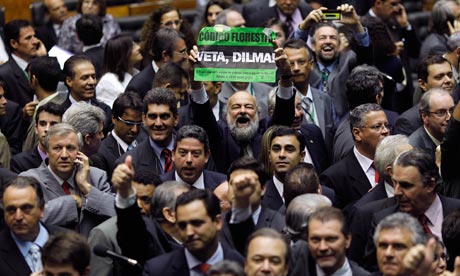
A member of Brazil's Congress protests against the adoption of the country's new Forest Code. The placard reads: 'Forest Code, Veto Dilma'. Photograph: Ueslei Marcelino/Reuters

Brazil's congress voted late on Wednesday to ease rules mandating the amount of forest farmers must keep on their land, delivering a long-sought victory to the country's powerful agriculture lobby and a political defeat for president Dilma Rousseff.

Though the bill will require millions of hectares of already cleared land to be replanted, environmentalists say it makes it too easy for farmers, responsible for much of the deforestation of the Amazon and other swaths of environmentally sensitive land in recent decades, to comply with regulations that stipulate how much forest they must preserve.

Rousseff still has the option to veto the bill, one of the most controversial to pass Brazil's congress in recent years. The bill was supported by some of her party's senators and members of its multi-party coalition, even though the president had previously said she would veto earlier versions of the law that contained provisions perceived as too lenient on farmers who have cleared woodlands for agriculture.

The final law, which was changed dramatically from a hard-bargained version her government was backing, will leave it to federal states to decide how much forest needs to be replaced alongside rivers, making it possible for big farming states to make only minimal demands of farmers.

"The approved bill gives a total and unrestricted amnesty to those who deforested ... and goes against what the government itself had wanted," environmental group Greenpeace said in a statement. "If [Rousseff] doesn't react and veto this text, this future will be her legacy," it said.

Pushing through the more lenient language the farming lobby sought was only possible through a rebellion by senators from within the government coalition.

A big enough majority in Congress could also knock down a veto by Rousseff, should she choose to use it.

"We lost. The government lost," said the leader of Rousseff's Workers party in the lower house of congress. The powerful farming lobby in congress had fought hard to minimise obligations the new law would impose on them.

The bill and its likely future impact have been watched closely in and outside Brazil, home to the world's biggest rainforest and a country considered a reference for how other developing nations manage their woodlands.

In June, Brazil will host the Rio+20 summit, a meeting at which government leaders and policymakers from around the world will discuss global environmental policy.

Head of the national agriculture confederation, Katia Abreu, defended the new law, saying it did "not necessarily" mean states would impose softer rules than the central government would have on mandatory riverside forest coverage. She said it would also allow better made-to-measure rules to be set according to each region's characteristics.

But Abreu hinted the new rules would be less rigid, saying farmers would have been obliged under the previous bill to replant 30 million hectares (74m acres) of forest and sacrifice land on which they grew billions of dollars worth of crops. She said it would only be possible to know how much would now have to be replaced after states had set rules.

A technician consulted on the policy said one drawback of allowing individual states to regulate it was that the process would probably take a year or two. That means replanting would likely be delayed until clear rules were made.

Deforestation in Brazil has slowed in recent years because of greater law enforcement and the use of satellite imagery to track areas with the most troubling rates of tree cutting.

A key provision of the forest code, as it is known, would allow landowners to count woodland on river margins, hilltops and steep inclines towards a total proportion of forest that must be preserved on their land. At present, such land isn't allowed in their calculation. Farmers argue that uncertainty over existing legislation, which has effectively been suspended in recent years, impeded investments. And Brazil's growing output of food crops – and an enviable position as an agricultural powerhouse – could face setbacks if farmers continue to be held back by doubts about how they can use their land.

Brazil is the world's top producer of coffee, sugar, beef and orange juice and a major producer of soy and corn. Agriculture accounts for more than 5% of Brazil's GDP.

Environmentalists say farmers would have to reforest land equivalent to the combined area of Germany, Austria and Italy to fully comply with existing regulations. Advocates of the new bill, however, say it would still result in a net gain of millions of hectares of forest coverage.

Under the terms of the new bill, farmers must sign up for a reforestation programme that will use satellites to track compliance. Those falling foul of the new law could be denied rural finance.

One government official estimated last year that 24m hectares (59 million acres), roughly an area the size of the United Kingdom, would be reforested as a result of the new code. But experts say the area to be replanted will be difficult to gauge until more data is collected about rural properties.

Brazil set to cut forest protection

01 May 2012
Source: Nature.com

Rural pressure has produced a bill that could see increased deforestation in favour of agriculture in Brazil.

The sound of chainsaws in the Amazon rainforest has faded in recent years as deforestation has slowed, last year dropping to less than one-third of its long-term average. But last week, the lower house of Brazil’s National Congress passed a bill that observers say could drastically reduce forest protection.

An organized coalition of rural agricultural interests prevailed in vote after vote during debates, approving amendments that would, for example, scale back forest protections along rivers and hills, give state and local governments more authority over forests, and relieve landholders of the responsibility of reforesting illegally cleared land. The bill would also eliminate a requirement that landowners seeking agricultural loans from the government register their land, document any illegal clearance and submit a plan to come into compliance if they have cleared forests illegally.

Environmentalists hope that pressure from conservation groups and media attention on next month’s United Nations Conference on Sustainable Development (Rio+20) in Rio de Janeiro will influence Brazil’s President Dilma Rousseff to veto the most radical elements of the legislation.

Passed by a 274–184 vote on 25 April, the bill is a revision of the country’s ‘forest code’, which includes a requirement that landowners in Brazil maintain a minimum proportion of native forest on their land, ranging from 20% in the Atlantic forest along the coast to 80% in the Amazon basin.

Although the code has been on the books since 1965, enforcement increased in the past decade under Rousseff’s predecessor, Luiz Inácio Lula da Silva. That enforcement, combined with broader agricultural trends and mounting public pressure, has helped Brazil to reduce deforestation to its lowest level in more than 20 years

“Brazil has justifiably held up its record on deforestation in the Amazon in recent years,” says Steve Schwartzman, director of tropical forest policy at the Environmental Defense Fund in Washington DC. “But the changes proposed in what passed the House are fully capable of reversing that trend.”

The legislation has been working its way through the National Congress since 2010, motivated by a rural backlash against the crackdown on deforestation. The Brazilian Confederation for Agriculture and Livestock, one of the main business groups supporting the bill, argues that the forest code has become too burdensome. Pointing out that around 28% of the country’s 851 million hectares is dedicated to agriculture whereas 61% is forest, the organization says that by approving the law, Brazil’s Congress has chosen “the path of sustainable agricultural production”.

The bill’s fate now rests with Rousseff, whom environmentalists have never fully trusted despite her pledges to maintain the policies of her predecessor, including a commitment to an 80% reduction in the average deforestation rate by 2020. Although Rousseff is predicted to sign the bill, many expect her to use her veto powers to remove its most radical provisions, including one that would grant amnesty to people who violated the forest code before July 2008. Rousseff will have 15 days to make her decision once the legislation reaches her desk.

Last December, Brazil’s Senate passed a more moderate version of the bill, also opposed by environmentalists, and some senators are now making moves to try to vote again on a fall-back version that Rousseff could accept while rejecting the House bill in its entirety. Some speculate that the administration tacitly allowed the ruralistasto advance their agenda in the lower house while planning to veto extreme provisions that were not included in the Senate version, says Paulo Moutinho, an ecologist who heads the Amazon Environmental Research Institute in Brasilia. “The bill is so bad now that the president can use her veto and say, ‘Look, I’m doing the right thing’,” he adds.

That would help Rousseff burnish her green credentials just in time for Rio+20, the twentieth anniversary of the Earth Summit. She has seen her effigy paraded through the streets of Brasilia in recent months, as protesters skewered her record on other environmental issues.

That record includes pushing forward with the controversial Belo Monte dam on the Xingu River in the eastern Amazon, set to be the world’s third largest when complete. Opponents of the project accuse the Rousseff administration of disregarding the rights of indigenous peoples and scaling back protected areas. In March, a dozen social and environmental groups warned that Brazil is in danger of being “both host and villain” at Rio+20.