Saturday, April 30, 2011

World's largest beef company signs Amazon rainforest pact

April 29, 2011
Source: mongabay.com


The world's largest meat processor has agreed to stop buying beef from ranches associated with slave labor and illegal deforestation in the Brazilian Amazon, according to the public prosecutor's office in the state of Acre. The deal absolves JBS-Friboi from 2 billion reals ($1.3 billion) in potential fines and paves the way for the firm to continue selling meat to companies concerned about their environmental reputation.

The agreement is significant because it was signed by prosecutors from other Amazon states including Rondonia, Amazonas, Roraima, Pará, Tocantins, Maranhão and Amapá. Other cattle giants are expected to follow suit.

Under the terms of the deal, JBS agreed to stop buying cattle from areas embargoed by environmental inspection agencies and lands classified as conservation units or indigenous territories, unless the management plans of those areas allow for livestock. Cattle production often occurs illegally in forests zoned for conservation or indigenous use and squatters are used as proxies to grab the land. JBS will also not buy cattle from ranches that have been convicted of labor abuses, including slave labor.

From September 2012, JBS will only buy meat from ranches that have registered their holdings with the government and have the proper environmental licenses.

Any breach of the agreement could result in fines up to 500 reals ($300) per pound of beef.


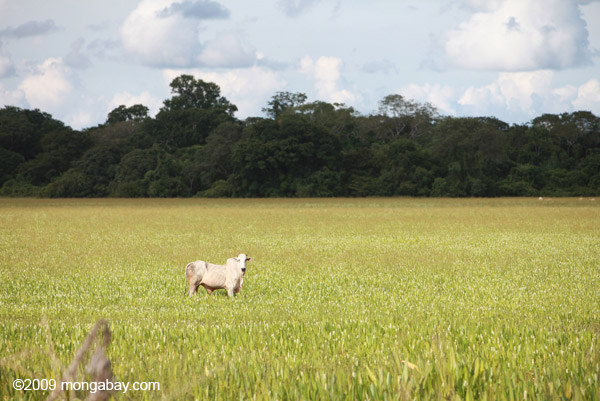
The deal could help curtail deforestation for cattle production — which accounts for the bulk of deforestation in the Brazilian Amazon — but its effectiveness still hinges on local governance, where corruption remains a problem. The government is working to improve the situation by arresting environmental officials linked to graft and increasing the transparency of the registration process by making more information available on the Internet, but some states are further along in the process than others.

The news comes nearly two years after Brazil's biggest meatpackers agreed to a moratorium on new forest clearing for cattle production. The agreement was spurred by a Greenpeace campaign that linked some of the world's most prominent brands — Nike, Timberland, and Adidas — to deforestation in the Amazon rainforest. The companies responded by refusing to buy cattle products unless they were shown to be free of deforestation.

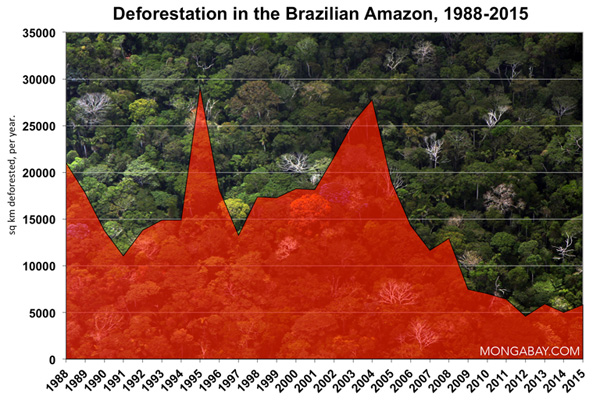
Deforestation continues to ebb in the Brazilian Amazon. Annual deforestation is down by more than three-quarters since 2004 despite a rise in commodity prices. Improved law enforcement, an increase in the number of protected areas, growing sensitivity in the corporate sector to environmental issues, and macro-economic trends are generally credited for the decline.

Activists lament city’s disappointing ‘benchmark’

April 28 - May 4, 2011
Source: The Villager

The environmental activists’ banner floated in front of the Washington Square Arch as Parks Department PEP officers moved to get them to take it down.

Last Friday, Earth Day, a dozen members of the groups Rainforest Relief and the New York Climate Action Group piled out of a U-Haul truck on Washington Square North. It was just after noon as they pulled out three large, helium-filled weather balloons and guided them to the arch. Within minutes the balloons ascended into the breezy afternoon, lifting a 300-square-foot banner reading, “Mayor Bloomberg: Why Was the Amazon Logged for Wash. Square Park Benches?”

The group claims the city is not fulfilling a pledge made by the mayor in 2008 to reduce the city’s use of tropical hardwoods by 20 percent.

“Benches made with Amazon wood continue to appear in newly renovated parks all around the city,” said Tim Keating, executive director of Rainforest Relief. He cited Washington Square Park, as well as Union Square, the High Line and five miles of Hudson River Park, as examples of public spaces that use Amazon ipe (pronounced “ee-pay”) wood for their benches.

“Almost every board of wood that you see in these new designs has been logged from the Amazon Rainforest,” Keating said.

The group said that in order to harvest ipe — only one or two ipe trees grow per acre — an extensive network of logging roads is necessary, further damaging the rainforest.

As the banner floated high enough to block the Washington Square Arch from view, crowds gathered to watch, some cheering, many holding their camera phones aloft. West Villager Tim Doody, the city campaign coordinator for Rainforest Relief, made sure guide ropes securing the banner were taut.

“There’s a world of difference between what Mayor Bloomberg and the Parks Department have pledged and what’s happening on the ground throughout the city,” the activist said.

“In park after park, we continue to strike a blow against the rainforest, when we could instead be setting a global precedent for sustainability by showcasing the latest design materials,” Doody explained.

East Villager JK Canepa of the New York Climate Action Group held one of the balloon ropes.

“The 400 new ipe benches in Washington Square Park are inexcusable,” she said. “We could showcase sustainable alternatives like Kebony, recycled plastic lumber, black locust and salvaged woods.” Kebonization is a process that strengthens common wood, making it as durable as Amazon hardwood.

Ian Dutton, a Soho resident and public member of Community Board 2, happened by the event and stayed to watch with the sizable crowd.

“It was a nondisruptive and informative expression of political views,” the airline pilot and bicycling activist offered. “The points raised concern me and I intend to find out more about this issue.”

Before long, two Park Enforcement Patrol officers approached the group and told them to reel in the banner. As three police cars arrived, the balloons started losing their lift capability and the group eventually pulled the banner back to earth.

Doody and Keating each received a PEP summons for “Failure to comply with directive of officer.” The violation carries a $250 fine.

“We hope that the mayor will see this banner and maybe take this message to heart on Earth Day,” Doody said hopefully.

As he waited for his ticket, Keating was reflective.

“We’ve seen no real reduction in the use of these materials,” he lamented. “We’re going on 16 years and about 100,000 acres of rainforest have been logged for New York City’s materials.”

Last year on Earth Day, Doody and Keating staged a similar action, climbing flagpoles in City Hall Park and dropping a banner reading, “If Bloomberg is so Green, Why is NYC America’s #1 Consumer of Rainforest Wood?”

Miner Vale invests in mega dam

April 29, 2011
Source: UPI.com

BRASILIA, Brazil, April 29 (UPI) -- Brazilian mining giant Vale will pay $1.4 billion for a stake in the consortium building the controversial Belo Monte dam in the Amazon.

Noting that it is already a large investor in hydroelectric plants, including nine plants in Brazil and three in Indonesia, Vale said Thursday that the acquisition of a stake in Belo Monte will increase to 45 percent the portion of the company's global energy consumption met by its own power generation.

The proposed 11,233 megawatt Belo Monte project on the Xingu River would be the world's third largest hydroelectric dam after China's Three Gorges and Itaipu, which Brazil jointly operates with Paraguay. It is slated for completion in 2015, at an estimated cost of $17 billion.

But Belo Monte is opposed by environmentalists, Indian rights groups, social rights activists and others, who say the dam would disrupt the Amazon ecosystem and displace as many as 50,000 people from indigenous Amazonian tribes.

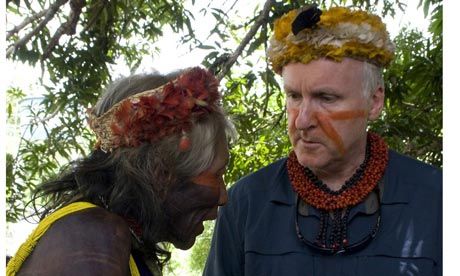
Filmmaker James Cameron has compared Belo Monte's construction on a major tributary of the Amazon River to the environmental destruction depicted in his film "Avatar."

The dam's massive cement wall would flood 195 square miles of jungle.

Brazilian Defense Minister Nelson Jobim earlier this month said the government wouldn't honor an Organization of American States' request that it stop work on the controversial dam.

Jobim said Brazil sets aside close to 11 percent of its national territory for indigenous communities, while noting that efforts to preserve their way of life shouldn't force 20 million people in the Amazon region into underdevelopment.

Infrastructure work on the dam officially began a month ago, starting with the clearing of 588 acres of rainforest and the construction of access roads.

Belo Monte will use a run-of-river, or streaming hydro system, in which the river continues to run rather than being held back by a large dam.

But its power generation is expected to average only 40 percent of its 11,233 megawatt capacity because of huge fluctuations in the Xingu's rate of flow, from a high of 30,000 cubic meters a second during the rainy season, to around 1,000 cubic meters a second during the dry season.

That means the country will have to rely on its coal, oil and natural gas-fired thermal power stations to ensure electricity supplies, leading to a "dirtier" energy mix and driving up the cost of electricity.

Colonial Mapmaking at the Wilton House

April 29, 2011
Source: RVANews


At the end of a suburban side road lies the Wilton House, a gorgeous colonial home that has recently adopted its first outside exhibit since it became a museum in the 1950s. “Get Found: Mapping Place and Time” is a collaborative exhibit that explores the history of mapmaking, dating back the 18th century, when mapmaking required more guesswork than actual measurement, and an incredible amount of artistic ability.

The Wilton House was built in 1753 by William Randolph the III. He and his wife are considered the “Adam and Eve” of colonial Virginia since so many new Virginians sprang from their line. The Wilton house sheltered some big names in its day: George Washington, Thomas Jefferson, and the Marquis de Lafayette – a famous Commander during the Revolutionary War. The house was nearly demolished in the 1930s, but it was bought up the National Society of Colonial Dames of America and acted as the Dames’ club house until 1953 when it was turned into a museum.

In collaboration with an undergraduate, Museum Studies class at VCU, taught by Margaret Lindauer, “Get Found” is an ambitious exhibit designed to trace the evolution of map-making, starting with the Wilton House’s authentic, 18th century maps. “The class went around picking out pieces they liked in the museum,” says Executive Director of the Wilton House, Robert Strohm, and choosing from elements like portraiture, antique furniture, period toys, architecture and more, the students thought the maps from the early-to-mid 1700s had the most potential for creating a compelling exhibit.

The exhibit starts with a map of Virginia, charted by Peter Jefferson (Thomas’s dad), which, without the aid of aircrafts and satellites, looks a bit distorted. The students who designed the exhibit pair Jefferson’s map, as well as others from colonial America, with Google Maps to show how far we’ve come since the days of wooden teeth. The exhibit also features a deforestation map of the Amazon Rainforest and a satellite image of the Vatnajokull glacier — the largest in Europe. These details perhaps hint that the students involved were as environmentally conscious as they were map-minded.

Standing before the same image of Virginia that the founding fathers looked upon, will transport visitors to a disorienting, yet enlightening time when the process of mapping out land masses was far from exact. Imagine not being certain exactly where the Appalachian Mountains are, or just how long the Virginia coastline is? Besides feeling severely displaced, you get an idea of the colonial world that George Washington believed he was fighting, a world that was much bigger and more mysterious than the one we know today.

Friday, April 29, 2011

Brazil’s mining giant buys stake in controversial Amazon dam project

Friday, April 29th 2011
Source: MercoPress

Vale, the world’s second-largest miner by market value, said in a regulatory filing its board approved buying as much as 9% of Norte Energia SA, which will build and operate the Belo Monte dam, from Gaia Energia & Participacoes SA.

The deal comes less than a month after Vale said it would replace Chief Executive Officer Roger Agnelli amid criticism from Brazil’s government, (which has direct and indirect stakes), that it wasn’t doing enough to help generate jobs.

The 25.8 billion-Real dam, which will flood 516 square kilometers of the world’s largest rainforest, is a key piece in the government’s plan to increase energy supplies. Once finished the Belo Monte complex will be the world’s third largest operational dam.

Vale, which failed in a previous bid to buy a stake when the rights to Belo Monte were auctioned last year, joins state- controlled Centrais Eletricas Brasileiras SA as a partner in Norte Energia. Eletrobras, as South America’s largest utility is known, and two of its units hold a combined 49.98 percent, according to its website.

Vale has stakes in other hydroelectric dams in Brazil.

The Organization of the American States requested April 5 that Brazil suspend work on Belo Monte. The OAS echoed protests of “Avatar” director James Cameron, former U.S. President Bill Clinton and former California Governor Arnold Schwarzenegger, who gathered in the Amazon city of Manaus earlier this year to voice concern about the potential environmental impact from the dam. The project will require the relocation of about 1,000 Indians.

Vale announced April 5 that it named Murilo Pinto de Oliveira Ferreira to take over as CEO in May after Agnelli’s mandate expires. Vale has underperformed Brazil’s Bovespa index and BHP Billiton Ltd., the world’s biggest mining company by market value, since mid-January amid concern the government would seek to play a bigger role in management decisions.

Vale plans to finance about 75% of its investments in Belo Monte, estimated at 2.3 billion Real, Vale Marketing Director Jose Carlos Martins said Wednesday on a conference call with journalists. Brazil’s national development bank, known as BNDES, will provide most of the financing, he said.

The investment will eventually allow Vale to generate about 73% of its own energy needs, Energy Director Almir Rezende said on the same call. The project will provide Vale with 400 megawatts, he said.

“Vale is a large consumer of electricity and invests in generation assets based on its consumption needs,” the company said in yesterday’s statement. Vale is “seeking to reduce operating costs on a permanent basis and minimize price and supply risks.”

Photo tour company provides technology to capture Peruvian Amazon

Apr. 28, 2011
Source: Andina

PeruPhotoTours has teamed up with Cognisys, Inc. to ensure that tour participants come back from the jungle with incredibly detailed images of insects, hummingbirds, frogs, and other rainforest creatures.

The rainforests of the Peruvian Amazon harbor some of the highest biodiversity on the planet. However, much of this jungle life is composed of small insects, amphibians, birds, and other creatures whose tiny stature poses challenges to detailed photography.

Technology available from Cognisys Inc. removes such barriers to capturing the exquisite nature of bizarre Amazonian wildlife.

Movements too fast to see with the human eye are captured with the StopShot flash trigger device developed by Cognisys Inc. Even movements as quick as the buzzing wings of jewel-like insects and glittering rainforest hummingbirds are brought to a standstill when StopShot is used with a cross beam sensor.

To document the texture and fine details of iridescent beetles, bird feathers, orchids, and other natural works of art, Cognisys’ StackShot device is employed. This robotic focus stacking tool tool is used in conjunction with a macro lens to take multiple shots of differently focused sections of the subject.

These images are then combined with focus stacking software to generate one, highly detailed, in-depth photo of incredibly high resolution and depth of field.

PeruPhotoTours is providing all participants of its Tambopata rainforest photography tours with such Cognisys technology as well as other photography equipment because they believe that everyone travelling to Peru should have the opportunity to document their trip of a lifetime with professional grade photography.

“Anyone experiencing the intricacies and wonders of the Peruvian Amazon deserves the chance to properly document it with high quality images. However, the problem for the average tourist has always been the high cost for equipment needed to do the Amazon jungle justice,” said Jeff Cremer, the president of PeruPhotoTours.

“Our program combines science, nature and technology to create art and Cognisys Inc. fits this model perfectly. Their technology will help tour participants get amazing images that easily rival those of professional photographers.”

In addition to helping tour participants document biological treasures of the Peruvian Amazon with Cognisys Inc. technology, PeruPhotoTours also provides clients with other top of the line photography equipment, workshops that teach them how to use it, and demonstrate how a book can be made that showcases their work.

Cumbrian man's fund-raising challenge to send him to Ecuador

Thursday, 28 April 2011
Source: Times & Star

Nicky Ford, 20, of Westfield Drive, needs to raise £3,500 for the trip which will also see him work with people who have had little contact with the Western world, spend two days in the Amazon rainforest and complete a trek up Cotapaxi, one of the highest active volcanoes in the world.

The trip has been organised by the charity Challenge Worldwide. Nicky heard about it through his work as an apprentice telephone engineer with BT.

He will be joined by 28 other BT apprentices from around the country.

He said: “In Cockermouth I volunteer at the Evolution Centre and help with youth events at the Kirkgate Centre.

“I like working with children and this opportunity will allow me to help them as well as give me more confidence and help me with my team work.

“I have been on my apprenticeship for the last two years and have heard about the chances to do something like this.

“I thought I am probably not going to get the chance to do this again so have decided to take the opportunity.

“I am quite nervous about it because it is the biggest challenge of my life.”

Nicky has already started fund-raising for the trip and has put £500 of his own money in as well as raising £190 from his colleagues at BT and a few odd jobs.

He will hold a rock night at the Union Jack Club on Senhouse Street, Workington on June 3 and will take part in the Cumbrian Run in Carlisle and Great North Bike Ride in Northumberland. He is also planning a car wash and bag packing event.

Be Green Be Chic

Friday, 29 April 2011
Source: eTravelBlackboard

La Roca Village and Las Rozas Village, Spain?s leading luxury outlet shopping destinations and members of the Chic Outlet Shopping? Collection by Value Retail, announce the launch of the “Be Green Be Chic” environmental awareness campaign as part of Value Retail?s ongoing commitment to environmental responsibility.

The “Be Green Be Chic” campaign 2011 supports the World Wildlife Fund’s aim to protect, manage and restore forest habitats in areas of global importance, including the Amazon, the Amur-Heilong region across Mongolia, north-east China and the Russian Far East, the Atlantic forest on the east coast of South America, Borneo, Colombia, East Africa’s coastal forests, the Eastern Himalayas and the island of New Guinea, host to the largest pristine rainforest in the Asia-Pacific.

"WWF supports initiatives that ask to be respectful with the environment, including the use of the reusable bags. The “Be Green Be Chic” campaign offers us an excellent platform to raise awareness towards responsible consumption ".

Clorinda Maldonado, Marketing Director of WWF Spain

The campaign will run from 4 April to 4 May 2011. Throughout the duration of the campaign visitors to La Roca Village, Barcelona and Las Rozas Village, Madrid will discover limited edition eco products from participating luxury brands including Adolfo Domínguez, Billabong, Home Studio, Imaginarium, L’Occitane, Petit Bateau, Quicksilver, Sita Murt, Textura, The North Face, Vans, Pretty Ballerinas, Camper, and Timberland to name just a few. Visitors too, will be able to purchase the exclusive “Be Green Be Chic” eco-shopping bag – the chicest eco accessory of the season. The bags, produced in India from locally grown 100% organic cotton and jute, will retail at €9, with all proceeds going to the WWF/Adena Forest project.

Headlining the “Be Green Be Chic” campaign 2011 is Mónica Cruz. The Spanish actress, who is a long-term supporter of environmental causes, visited La Roca Village, Barcelona on Wednesday 13 April 2011 to host the official launch.

“I am really pleased to take part in this project which unites two of my big passions; fashion and nature. I am sure that every step, counts. The “Be Green Be Chic” campaign launched by La Roca Village and Las Rozas Village encourages us to use reusable bags and to raise awareness of this important subject.“

Mónica Cruz

The Chic Outlet Shopping? Villages strive to develop and introduce new environmental policies to supplement those already in place across the Collection such as selective waste collection procedures and subsequent recycling, use of halogen-free bulbs, and water consumption reduction measures.

Thursday, April 28, 2011

A Greek Apparel Store Joins the Fight Against Autism

04-28-2011
Source: OpenPR

(openPR) - Seattle, WA --- Designer Greek, a leading greek apparel store, adds Autism Awareness to its Letters For A Cause campaign which is bringing more meaning to the standard greek shirt and greek sweatshirt. Now customers have the opportunity to design fraternity clothing and sorority clothing, while supporting an important issue such as Autism.

How it works – Designer Greek customers design their greek letter shirts and greek letter sweatshirts just like they always have, but now have the opportunity to select from a vibrant Puzzle Piece fabric that is associated with Autism Awareness. Upon purchase, Designer Greek donates 2.5% of the clothing price to an organization dedicated to this cause. In return Designer Greek’s customers receive a piece of meaningful greek apparel. “Customers love the fact that their greek apparel is making a difference, as well as a statement. And, they leave Designer Greek more informed and aware of important issue that deserve attention,” says Stefany Bernard, creator of Letters For A Cause.

Ultimately, whether or not customers decide to choose the Letters For A Cause fabrics like the Puzzle Piece print, Designer Greek hopes that having the information available on their site will raise awareness and inspire individuals to get involved and really make a difference in this world.

Letters For A Cause currently features eight causes: Autism Awareness, The Amazon Rainforest, The Snow Leopard, Marine Debris, Breast Cancer Awareness, African Wildlife, Overfishing, and The Tiger. Any of the LFAC fabrics can be used to create beautiful looking greek letters shirts, sorority letters, fraternity letters, greek jackets, sorority bags, and more.

Wednesday, April 27, 2011

No Justice, No Peace: Canadian Mining in Ecuador and Impunity

Tuesday, 26 April 2011
Source: Upside Down World

On December 2, 2006, 14 paramilitaries armed with 38-caliber guns and pepper spray fired into a group of unarmed Ecuadorian campesinos from a community that has been resisting a copper mining project for over a decade. Thankfully no one was killed, but there were several injuries, not to mention the psychological suffering caused by such a vicious attack.

This assault led three of the local campesinos from Intag, Ecuador to file a lawsuit against the Toronto Stock Exchange (TSX) and Copper Mesa Corporation, the Canadian mining company responsible for hiring the "security firm" that sent the paramilitaries to intimidate the anti-mining residents of the region.

“I ask the noble people of Canada,” said Ramírez when she filed the lawsuit in March 2009, “that you demand from your elected authorities significant changes in your national legislation so that what has happened with Copper Mesa in Intag will never happen again, not in Intag nor in any other part of the world.”

John McKay, a Liberal Member of Parliament from Canada, actually introduced legislation that would have been a concrete first step in holding Canadian mining companies accountable for their behavior overseas. Bill C-300 would have sanctioned the Canadian federal government to investigate human rights and environmental complaints filed against companies with the authority to cancel any governmental funding if found guilty. While some activists and NGO's leveled criticism against the bill for being too tepid, most supported the legislation. Unfortunately the Canadian government, largely perceived to be in the pockets of the mining industry, did not and the bill was voted down. Catherine Coumans, research coordinator for MiningWatch Canada, has charged the government with "aiding and abetting" the industry's inhumane, if not criminal, behavior.

Injustice and Impunity Continues

Last month, when three judges at the Court of Appeals in Canada ruled against the three Intag residents, a lot more than a lawsuit was lost. The court basically said that people overseas have no right to sue a Canadian institution or company for human rights violations in Canadian courts. Their statement to the world reaffirmed what many communities effected by Canadian mining projects in the developing world already know: institutions like the TSX and Copper Mesa will never be held accountable for human rights abuses and environmental destruction they fund and carry out.

"Do Canadians really want to have their legal system on the one hand authorize Canadian mining companies to go abroad to developing countries, and then on the other hand totally absolve the directors in Canada of any responsibility whatsoever for human rights abuses those companies may perpetrate there?" asked Murray Klippenstein, legal counsel for the Ecuadorians, who is also legal counsel for a widow in Guatemala whose husband was murdered by the head of security of a Canadian mining subsidiary because of his outspoken concerns about the activities of the company.

But the ruling also produces another very unsettling effect, or better put, reinforces a widely-held belief in the extractive industry resistance movements overseas: that it is a waste of time, energy and funds to try to use the judicial system in order to have their rights recognized and communities protected. The implications are troubling.

One example to illustrate this point is the infamous Chevron-Texaco case where 18 long years had to pass before the 30,000 Ecuadorian indigenous and campesino plaintiffs got a favorable sentence in an Ecuadorian court for their lawsuit based on the grave health impacts from years of petroleum extraction- and contamination- in the Amazon. The destruction has been such that it's been labeled a "Rainforest Chernobyl". But even now the case could be held up in courts for an additional decade from appeals, meaning that many of the plaintiffs will have died before the possibility of collecting what is due them.

Canadians don't hear too much about the environmental destruction and social upheaval their oil, gas and mining industries are spreading overseas. In spite of countless reports of human rights violations all over the world, Canadian corporations have been very successful at greenwashing the news back home and replacing it by images of the "socially responsible" Canadian corporate citizen bringing wealth and development abroad.

However, if the lawsuit contributed to the company being expelled from the TSX, as it was on February 2010, leads to its bankruptcy, and as a result pressures the judicial system in Canada to open itself up to legitimate lawsuits brought by communities overseas against their extractive industries, then it was very much worthwhile. If, in the long run, it will contribute to bringing about legislative reforms that will effectively reduce or stop the murders of anti-mining activists, like what happened in El Salvador and Mexico, and other human rights, social and environmental abuses, then it will have been a major victory. Much depends on how much information is able to filter through to the average Canadian, and what it will take to get them outraged to demand such changes.

Another Victory for the Mining Industry

Added to this failing of the justice system in Canada, the same week saw the superior court in Quito throw out my (Carlos Zorrilla) lawsuit against film producers working for Ecuacorriente for criminal libel. Unfortunately, this was also no major surprise given the state of the judicial system here. I had initiated a criminal lawsuit against Chinese-owned Ecuacorriente for a 45-minute documentary film paid for by the company where they falsely linked me to anti-mining violence in the south of the country.

The question that begs answering is: When the judicial system so utterly fails to guarantee minimum justice in cases of clear abuses by transnational corporations, or when the litigation is economically so out of reach for the majority of effected people, what other route is there for communities to seek justice? (The costs of the Canadian case was over a $100,000, although luckily it was all pro bono thanks to the law firm Klippensteins in Toronto.)

Communities understand, not only at a gut level but also through experience, that they are politically and legally outmatched by powerful corporations with deep pockets and decades of experience thwarting justice by manipulating the court systems. Rulings such as Ramirez vs. Copper Mesa only reaffirm this belief.

Therefore, many communities could read into the defeat of the lawsuit that their only practical (and affordable) solution to the threats that mining and other extractive industries pose on their rights, land and cultures lies in physically standing up to these projects - even at the risk of being labeled terrorists or saboteurs. Ramirez vs. Copper Mesa will reinforce the idea that direct, physical resistance is the only way to prevent community members from being murdered, indigenous cultures from being annihilated, and the environment from being decimated. This, at a time when special laws are being enacted in countries rich in natural resources, such as Ecuador, to judicially categorize acts of civil disobedience as terrorism. As of today, there are nearly 300 activists in Ecuador facing terrorism and sabotage charges for standing up to mining and other extractive activities that threaten the livelihood, or well-being of communities and the environment. Over half of these targeted activists are indigenous, including the leaders of the most important indigenous groups in the country. Ironically enough, this happens in the context of Ecuador’s progressive Constitution, which recognizes that nature has rights, and that Ecuadorians have the right to a good life (Sumak Kawsay). Take away the only effective tool that communities and indigenous people have to protect these rights from transnational corporations and you have the making of a major, and sustained, human rights nightmare supported by the State.

This is why the court decision in Canada matters, not just in Ecuador, but throughout the world.

Deforestation goes into hyperdrive with rising gold price

27 April 2011
Source: Science a Gogo

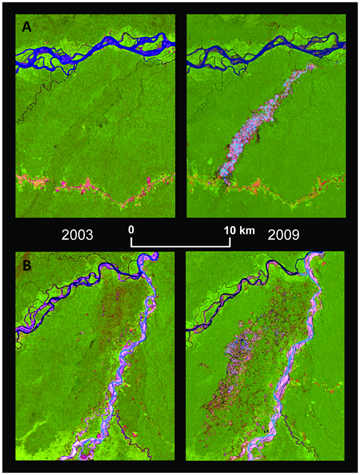
Deforestation around the Amazon River in Peru has increased six-fold in recent years as miners, driven by record gold prices, blast and clear huge tracts of lowland rainforest, according to a Duke University led study.

Published in the journal PLoS ONE, the study used NASA satellite imagery combined with economic analyses of gold prices and mercury imports to document the forces responsible for deforestation in Peru's Madre de Dios region. It reveals that around 15,200 acres of pristine, biologically diverse forest and wetlands were cleared at two large mining sites between 2003 and 2009, with a dramatic increase in deforestation occurring in the last three years.

Duke geospatial specialist, Jennifer Swenson, says that much of the deforestation has been caused by unregulated, artisanal mining by miners who are often among the poorest and most marginalized members of their society. "These are small-time miners; there is no big 'Goliath' mining company to blame," she explains. The miners have limited knowledge of mining's environmental or human health effects and rarely have safeguards to limit the release of the mercury they use to process their gold into the air, soil or water.

Most of the gold mined artisanally in Madre de Dios comes from alluvial deposits in the channels and floodplains of Amazon tributaries. Miners blast away river banks and clear floodplain forests to expose potential gold-yielding gravel deposits and use mercury to process the gold ore.

The mercury contaminates local water and soil, and ravages the nervous system of miners and their families, but the risks extend far beyond the local area, Swenson says. "Small-scale gold mining is the second-largest source of mercury pollution in the world, behind only the burning of fossil fuels. Virtually all mercury imported to Peru is used for artisanal gold mining and imports have risen exponentially since 2003, mirroring the rise in gold prices."

The study acknowledges that it is difficult for Peru's government to monitor and control all small-scale artisanal mining within its borders, but suggests that another approach may be to be start limiting mercury imports.

Secrets Of The Dead

26 April 2011
Source: Arizona Public Media

This program is a modern day quest to find the truth behind one of exploration's greatest mysteries: what happened to famed adventurer Col. Percy Fawcett, who went looking for a city of gold -- the Lost City of "Z" -- in the Amazon in 1925 and disappeared in the jungles of Brazil forever? New archaeological digs, the science behind the discovery of "newly found" jungle cities and clues collected over the years reveal the fate of Fawcett. The program unravels the truth of what really happened to Fawcett and shares surprising finds that are causing experts to re-think the image of a pristine uninhabited Amazon rainforest: a place that before Columbus, may have had large populations living in sophisticated towns and cities. Fawcett may have actually discovered these ruins fueling his fervor to find the city of gold. Cutting between stylized dramatic Fawcett recreations, old films and archival photos, interviews with family members of Fawcett, jungle villagers and scientists at ancient Indian archaeological sites -- the truth about Fawcett and new understandings of life in pre-Columbian America emerge. Trekking along the paths that Fawcett followed, the search for clues ends at a Xinguano-Kuikuro village in the heart of the Mato Grosso: where a new archaeological discovery may reveal the true location of the Lost City of Z.

10 natural wonders to see before they disappear

4/26/2011
Source: msnbc

You've heard the grim timelines: if warming continues, the Great Barrier Reef will be bleached by 2030; glaciers in the Swiss Alps, on Mt. Kilimanjaro, and in Glacier National Park will disappear in under 40 years; and Arctic ice melt will send polar bears into extinction. The immediacy of these timelines prompts flocks of curious eco-tourists to travel to environmentally fragile areas. Tourism is both bane and boon: it can add strain to already distressed areas, but it can also provide income, which in turn can help preserve these wonders. We spotlight 10 areas under threat — some lesser known than others — that can still be visited responsibly. Should you decide to plan a journey, we've recommended our favorite tour operator for each destination. In some cases the price tag may be higher than your average vacation, but consider it an investment in Mother Earth.

Belize barrier reef
One of the most diverse reef ecosystems in the world is home to whale sharks, rays, and manatees, as well as sturgeon, conch and spiny lobsters.

The Threat: Like the Great Barrier Reef in Australia, the Belize Barrier Reef leads a tenuous existence. A section of the nearly 700-mile-long Mesoamerican Reef that reaches from Mexico to Honduras, the Belize reef suffered a severe bleaching in 1998, with a loss of 50 percent of its coral in many areas, including much of its distinctive staghorn coral. Since the bleaching, its decline has continued, due to global warming of the world's seas, agricultural pollution, development, and increasing tourism, which has given rise to more coastal development and an invasion of cruise ships.

Get There: Go with Journeys International, founded by former conservation workers, on an 8-day "Cayo and the Caye" journey into Belize's rainforest that includes kayaking into river caves, a side trip Guatemala, a visit to the Mayan ruins at Tikal, and, finally, a three-day-stay on an island in the reef (from $2,825 per person, excluding airfare).

The Congo Basin
Tropical rainforests like the Congo Basin produce 40 percent of the world's oxygen and serve as a vital source of food, medicine and minerals.

The Threat: At more than 1.3 million square miles, the Congo Basin has the world's second-largest rainforest, after the Amazon's. According to the UN, up to two-thirds of the forest and its unique plants and wildlife could be lost by 2040 unless more effective measures are taken to protect it. Extending across six nations, 10 million acres of forest is degraded each year due to mining, illegal logging, farming, ranching and guerilla warfare. Roads cut by loggers and miners have also enabled poachers and bushmeat hunters to prey on endangered animals like mountain gorillas, forest elephants, bonobos and okapis. As the forest shrinks, less carbon dioxide is absorbed, and rain decreases, adding to climate change.

Get There: Gabon, to the west of the Congo, is considered safe for travel, and tour operator Responsible Travel will pair you with local guides who work with the Wildlife Conservation Fund on an 8-day journey to view elephants, chimpanzees, and gorillas in the wilds of Loango National Park (from $3,430 per person, excluding airfare).

The Dead Sea
It's the lowest spot on earth (1,312 feet below sea level), has 10 times more saline than seawater (so humans float like corks), and is believed to contain therapeutic minerals.

The Threat: In the last four decades, the Dead Sea has shrunk by a third and sunk 80 feet — 13 inches per year! — stranding formerly seaside resorts and restaurants nearly a mile from shore. The Jordan River is the lake's sole source, and as surrounding countries increasingly tap its waters, little reaches the Dead Sea, which could disappear within 50 years. Further pressure is put on the sea by the cosmetic companies and potash producers who drain it for minerals. One proposed solution is the controversial Red-Dead Canal, channeling water 112 miles from the Red Sea, but its environmental impact could be negative (some worry that it would increase seismic activity in the region).

Get There: The Rift Valley on Jordan's side of the Dead Sea is a contrast of sand, red rocks and canyons, with reserves protecting endangered Nubian ibexes, oryxes, and gazelles. Gap Adventures offers an 8-day journey combining a Dead Sea visit with a stop at Wadi Rum, the 6th-century Nabatean ruins at Petra, and an overnight in a Bedouin tent (from $1,099 per person, excluding airfare).

The Everglades
This 2.5 million–acre wetland encompasses cypress swamps, mangroves, sawgrass and pine savannahs. It's the only place in the world where crocodiles and alligators share territory.

The Threat: A host of dangers are putting this fragile wetland at risk: pollution from farms, invasive species, and encroaching development, not to mention the fact that 60 percent of the region's water is being diverted to nearby cities and farms. As a result, The Everglades is now half the size it was in 1900. Worse, this is the sole habitat of the Florida panther, and there are less than 100 of the creatures left in the wild. These big cats may be completely lost within the next 40 years as their habitat disappears (they're not alone, either — at least 20 species in the Everglades are endangered, including turtles, manatees, and wading birds).

Get There: Founded by a former government biologist, Environmental Adventure Company offers intensive 5-day ecotours of The Everglades, starting with two days in the Florida Keys, entering The Everglades by Zodiac inflatable boat, then hiking and touring the waterways by boat (from $1,995 per person, excluding airfare).

Madagascar
More than 80 percent of Madagascar's flora and fauna are found nowhere else on Earth, thanks to millions of years of isolation in the Indian Ocean off of Africa.

The Threat: If nothing is done to save the world's fourth-largest island, its forests will be gone in 35 years (once 120,000 square miles, they're now down to 20,000), and their unique inhabitants along with them. Forest ecosystems are being destroyed by logging, burning for subsistence farms, and poaching. The 20 species of lemurs for which Madagascar is renowned are in danger of disappearing. Though there are game reserves, they're not large (occupying only 5 percent of the island), nor are they contiguous, thus failing to provide corridors for the animals to travel through. Some of Madagascar's endemic species have never even been recorded, and will likely be lost before they can be studied.

Get There: Winner of the Responsible Tourism Award from Conservation International and USAID in 2008, Eastern Tours offers day-tours of the forested east coast ($100 and under). Or go over the top on a once-in-a-lifetime trip with the World Wildlife Fund's official travel provider, Natural Habitat Adventures, on a 14-day in-depth tour of Madagascar (from $10,895 per person, excluding airfare).

The Maldives
The nation is rich in coral reefs and endangered fish — such as the giant Napoleon wrasse, leopard shark and some 250 manta rays (most with wingspans of 10 feet).

The Threat: Few scientists hold out much hope for the Maldives — the world's lowest nation — if global warming continues to melt the ice caps and raise sea levels. Its 1,190 small islands and atolls (200 of which are inhabited) scattered across the Indian Ocean rise a mere 8 feet above sea level. In 2008, the President of the Maldives announced the government would start buying land in other countries, including India, for future homes for citizens displaced by rising waters. In 2009, he held a cabinet meeting underwater to stress the islands' vulnerability.

Get There: Visit the beaches, towns, and fishing villages of the Maldives on a 7-day cruise with Gap Adventures (from $1,349 per person).

The Poles
The natural phenomena here are unique and inspiring: towering icebergs, Aurora Borealis, and majestic animals (penguins, polar bears, whales).

The Threat: The Woods Hole Oceanographic Institute, the world's largest non-profit ocean research group, has predicted that 80 percent of the emperor penguin population of Antarctica will be lost, and the rest in danger of extinction, if global warming continues. In the Arctic, the polar bear is also endangered by the steady loss of sea ice (which has decreased 3 percent per decade since the 1970s). As sea ice disappears at the poles, so do entire ecosystems: the phytoplankton that grows under ice sheets feeds zooplankton and small crustaceans like krill, which are on the food chain for fish, seals, whales, polar bears and penguins. Studies predict that with continued warming, within 20-40 years, no ice will form in Antarctica.

Get There: Tour the arctic with Trans Arctic Circle Treks, or cruise the Antarctic with Adventure Life. Arctic Trek offers a 4-day Arctic Circle tour including Prudhoe Bay, then over the Atigun Pass into open Arctic tundra ($1,638, excluding airfare). Adventure Life has a 10-day cruise through the Drake Passage and along the Antarctic Peninsula on a former oceanographic research vessel. The trip includes viewing many species of penguins, whales and icebergs by Zodiac, and a visit to a scientific station (from $5,290 per person for shared cabins, excluding airfare).

Rajasthan, Ranthambore
One of the best places in the world to see tigers.

The Threat: The world's population of wild tigers has fallen to as few as 3,200, more than half of which live in India. If extreme efforts are not undertaken, the big cat may be extinct within our lifetime — possibly in as soon as a dozen years. (Compare this number to the 100,000 tigers that lived in India in 1900 and you can see just how drastically things have changed in the past two centuries.) Their habitats have been reduced 93 percent, and though there are reserves across Asia, most are small and have no corridors between them for the normally far-roaming felines. It's estimated that a tiger a day is killed for use in Chinese traditional medicine.

Get There: Visit Ranthambore with Indian tour operator Travel Wisely, which also organizes visits to see tigers in Bandhavgarh National Park and Kanha Tiger Reserve. You can take a full 14-day tour including the parks, Agra (and the Taj Mahal), and New Delhi, or select portions (from $85/day per person).

The Tahuamanú rainforest
Parrots and macaws feed off of the world's largest salt lick. They share this pristine wonderland with endangered creatures such as giant armadillos, ocelots, jaguars and giant otters.

The Threat: This magnificent rain forest in Peru's Madre de Dios region holds some of the last old-growth stands of mahogany in South America. But illegal logging is depleting the rainforest — and the U.S. is responsible for buying 80 percent of the mahogany. A single tree can create as much as $1 million worth of furniture. Loggers build roads, allowing farmers and hunters to enter, further crowding the indigenous people and destroying the delicate ecosystem. In nearby areas, gold mining has released mercury into the air and water.

Get There: Visit Tahuamanú with Treks and Hiking Peru, a small Peruvian eco-hiking company headquartered in Cusco that leads five- to six-day visits including the macaw clay lick and journeys upriver to view spider monkeys, deer and birds (from $500 per person, excluding airfare, minimum of four people; all trips are 20 percent off in July 2011).

The Yangtze River basin
Exotic creatures such as giant pandas, dwarf blue sheep, Yangtze finless porpoises, and Siberian cranes call this region home — along with some 400 million people.

The Threat: It's too early to know the exact impact of the creation of China's massive, $24 billion Three Gorges Dam, but many, including the Chinese government, have acknowledged that the Yangtze Basin region is in danger of losing its most distinctive marine and animal life. Deforestation has occurred from clearing land for displaced farmers, and the reservoir has flooded villages, farms, factories, and mines, adding to the Yangtze River's existing pollution from shipping, industry, agriculture and raw sewage. Landslides have also happened, and seismologists wonder if the water pressure above two fault lines might result in a disastrous earthquake.

Get There: The Chinese government maintains 50 reserves in an effort to save the giant pandas from extinction, aided by the World Wildlife Foundation. Go in search of them in the wild on Terra Incognita Ecotours' 12-day journey tracking wild panda in Foping National Nature Preserve, along with a Xi'An city tour, and a visit to the terra cotta warriors (from $5,999 per person, excluding airfare).
Tuesday, April 26, 2011

Washington Square Park Benches May Deplete Rainforest

Apr 25, 2011
Source: The Epoch Times

NEW YORK—Since the 1960s, much of the wood used for the city's park benches, boardwalks, and piers has come from the Amazon rainforest. A tropical hardwood called ipe is particularly popular for its outdoor durability. To access the ipe trees scattered throughout the rainforest, however, foresters must raze large tracts of land.

“Logging of tropical forests to supply timber and pulpwood has contributed to deforestation at a rate of 0.2 percent a year. … This deforestation accounts for approximately 20 percent of the world’s annual man-made greenhouse gas emissions,” reports a 2008 memorandum from Rohit T. Aggarwala, the city's director of Long-Term Planning and Sustainability.

Aggarwala noted that New York City is home to the nation's largest park system and an extensive boardwalk network, making it a leading consumer of tropical hardwoods in the nation.

The city made a commitment in 2008 to phase out tropical hardwoods. Members of an organization called Rainforest Relief call on the city to uphold that commitment by halting the installation of 400 ipe benches in Washington Square Park. The group set up a 300-square-foot banner across the Washington Arch on Earth Day last week that read, “Mayor Bloomberg: Why was the Amazon logged for Wash. Square Park benches?”

In the city’s defense, Philip Abrahmson of the Department of Parks and Recreation wrote in an e-mail, “Due to the historic nature of the benches at Washington Square Park, we used sustainably harvested ipe.”

However, Tim Keating of Rainforest Relief argues that there is no such thing as “sustainably harvested ipe.”

“All ipe coming into the U.S. is coming from forest that is previously unlogged,” said Keating in a phone interview. He considers every acre of tropical old-growth forest to be endangered, and says the certifications that lead consumers to believe the wood they are getting is sustainable are misleading.

The Forest Stewardship Conservancy (FSC) issues certification for ipe wood that is recognized by environmental groups such as World Wildlife Foundation and Rainforest Alliance. However, Keating said his conversations with Rainforest Alliance have revealed that certification hinges on forestry being “well-managed” and stays away from a claim to sustainability.

He points out that certifications are more complicated than your average consumer may realize.

There are two types of FSC certification: one applies to the foresters harvesting the wood; the other is given to the supplier and is called Chain of Custody (COC) certification. A company can be COC certified as long as they sell some certified wood. It does not mean that all of the wood they sell is certified.

Although the city is using ipe wood for the benches in Washington Square Park, Abrahmson stated, “The vast majority of capital work being done by Parks across the city eliminates the use of tropical hardwoods entirely.”

Keating has worked for over a decade to raise awareness about ipe use in city works and was happy to elicit a response from the city. Unfortunately, he said this commitment does not apply to the many private entities that have stewardship over the city's parks.

“Stuyvesant Cove Park Association, Central Park Conservancy, Prospect Park Alliance,” Keating listed off the organizations making many of the decisions about park maintenance.

“If none of this is even going through [the parks department], how are we going to track reduction?” he asked.

David Katz is vice president for marketing and events at Hudson River Park Trust. He says his organization may not be obliged to take the Department of Parks and Recreation's lead, but it has done so anyways.

“We've curtailed the use of any tropical hardwoods, and the new buildings don't have any,” reports Katz.

The alternative wood sources are becoming more readily available as demand grows. Development plans for Hunters Point, for example, use a wood called kebony. It is actually yellow pine from the south treated with a sugar compound to make it more durable and then called kebony. Right now most of the wood is sent to Norway for treatment, but facilities are being built closer to home.

Keating suggests a structural material made of recycled plastic and infused with fiberglass for durability. He says it has largely been rejected because it is often confused with a similar material composed of plastic and sawdust, which is not as durable.

The reinforced structural material has, however, already been used to build two tank bridges and one locomotive bridge and Keating says it's so durable “it will likely last forever.”

Naturex launches Amazonian active for rejuvenation

26 April 2011
Source: Premium beauty

Naturex latest development for the personal care industry is derived from a variety of Dragon’s Blood obtained from the Croton lechleri tree, which is the primary topical aid for skin care in the Amazon rainforest. Injuries of all kinds can benefit from the application of the healing red latex derived from this tree.

Dragon’s blood is a substance known from the Antiquity that can be obtained from various tropical and Mediterranean plants. “It helps to protect the skin, due to its high content of proanthocyanidins, providing a powerful antioxidant activity. Dragon’s Blood extract, standardized to taspine, stimulates the early phase of the wound healing, by stimulation of the fibroblasts. Dragon’s Blood sap helps to protect the cells of the skin and regenerate the whole tissue,” explains the company in a release.

According to the French supplier of natural ingredients, in vitro and ex vivo studies, demonstrate that its Dragon’s Blood extract improves the stratification and quality of the new epidermis and contributes to a complete reparation and regeneration of the tissues, for skin rejuvenation. Furthermore, Dragon’s Blood sap is rich in antioxidant phenols and can protect cells from oxidative stress.

Naturex Dragon’s Blood extract can therefore be used to rejuvenate the skin, to prevent or treat the signs of aging, to protect the skin against environmental aggressions like wind, cold, dry air and pollution, or to normalize stretch marks.

Amazonian renewable resource

“Tropical environment yield many plants that offer benefits to health. The Amazon rainforest provides a wealth of traditional botanicals that demonstrate significant benefits to the skin when topically applied,” told the company.


Naturex has applied its expertise to identify the best sources of certified raw materials that are effective in application whilst also being respectful to the environment. They obtain their Dragon’s blood by cutting the bark in diagonal manner and bleeding the latex. This method is employed by the locals to help preserve the trees, allowing Naturex to supply a renewable resource.

Crops for animal feed destroying Brazilian savannah, WWF warns

Monday 11 April 2011
Source: gaurdian.co.uk

The rising global appetite for meat is contributing to the destruction of enormous wooded grasslands in southern America, WWF warned on Monday.

While satellite data and stronger law enforcement have led to a decline in deforestation in the Amazon rainforest, the Cerrado, a savannah that covers more than one-fifth of Brazil, has experienced ongoing deforestation due to the expansion of soy agriculture, led by demand for soybean to produce feed for factory-farmed animals.

Human activity through agriculture and cattle rearing has devastated 50% of the Cerrado, with only 20% of it still intact.

During her visit to the region last week, UK environmental secretary, Caroline Spelman, said: "The Cerrado is a huge area – as big as France, Germany, Italy, Spain and the UK put together. It's globally important in terms of biodiversity and storing the world's carbon dioxide, but it doesn't receive the same attention from the international community. Because of that, people are not aware of the uncertain future it faces."

Cultivation of the protein rich soybean – used in products such as margarine, cosmetics and meat replacement dishes – is causing the carbon sink, home to 5% of the world's species, to lose its dense vegetation. Nearly one–third of all soybean exports goes to the EU. Brazil, the second largest soy exporter, after the US, has seen soy expansion soar over the last 10 years.

Michael Becker of WWF said: "If you want to make a comparison to the Amazon, it's like the inverted forest. I think that in the last decades, a lot of the attention has been driven to the Amazon region. Now I think we need to look at other biomes in Brazil, such as the Cerrado, the Pantanal and the Atlantic forest, where you have similar patterns that will affect the biodiversity of Brazil in the long-term."

Deforestation in the region runs at around 14.2 square km a year, with the annual rate between 2002-2008 running at 4%.

The Cerrado is also a vital water source, with the rivers generating electricity for nine in 10 Brazilians. There are fears locally that the rising agriculture industry in the region is polluting water supplies.

José Correia Quintal, 52, runs a co-operative near the second largest national park in the Cerrado, the Grande Sertão Veredas, and has lived in the area his whole life. His co-op provides work to local communities, as they use the Cerrado's vegetation to make local medicines and foodstuffs.

"Agrochemicals used in the Cerrado are affecting people's health," he said. "It is also contaminating the rivers. There is a concern that if this keeps the way it is there will be a problem with the water resources, and we will live as the people in the north-east region of Brazil live now, where water is now scarce."

One proposed solution is the Round Table for Responsible Soy (RTRS), an association of industry, civil society and producers focused on environmental, labour and health issues involving soy farmers and industries.

Sainsbury's, Asda, Waitrose and Marks and Spencer have agreed to become RTRS members when the scheme comes into place. However, guidelines are only now being presented to soybean producers.

John Landers promotes responsible farming techniques in the region, and although an RTRS member, says there are difficulties with the scheme.

"There's no premium currently developed for responsible soy ... we have to see a return for the extra effort the farmer has to put in to demonstrate that he is being responsible."

Due to the current lack of a premium – not dissimilar to the Fair trade model – RTRS has yet to make an substantial impact on soy farmers in Brazil. Yet expansion continues: agriculture company SLC Agricola, said it had identified 71m hectares of land in Brazil still available legally for agriculture, including former pasture land.

With illegal and irresponsible agriculture also an issue, the race is on to put RTRS guidelines into place before any further development continues. "Three percent of the Cerrado is protected effectively," Becker added. "The environmental ministry of Brazil has agreed to the UN target of 14% [protection] for the Cerrado. If we reach a 14% protective area, that's an achievement.'

Brazilian Beauty: The Threatened Atlantic Forest

Apr 25, 2011
Source: Our Amazing Planet


Forest interior

It's the most threatened rainforest in Brazil, a global biodiversity hotspot, and contains around one in 12 of all species on the planet. We must be talking about the Amazon, right? Wrong. It's the Atlantic Forest, which used to run in a continuous strip along the 2,000 miles of Brazil's eastern seaboard, up the steep coastal mountain slopes and, in places, far into the interior, reaching parts of Paraguay and northern Argentina.

This stunning image, with morning sunlight streaming through the canopy, gives a sense of the forest's magic and exuberance. In one part of the ecosystem, some 450 species of trees were once found in a single hectare (2.5 acres). Whereas the Amazon has lost around 18 percent of its original extent, barely seven percent of the Atlantic Forest remains, at least in remnants large enough to be considered viable (100 hectares or more).

This state park in the Upper Ribeira Valley, in one of the largest intact patches of the forest, is just half a day's drive from the megacity of São Paulo — and that helps explain why there is so little left. The Amazon is thousands of miles from where most Brazilians live, but the Atlantic Forest has been right in the path of agricultural and urban development for 500 years, and now 130 million people live within its boundaries. Finally, its treasures are starting to be valued. Apr 25, 2011
Source: Our Amazing Planet

Friday, April 22, 2011

Protected areas cover 44% of the Brazilian Amazon

April 20, 2011
Source: mongabay.com

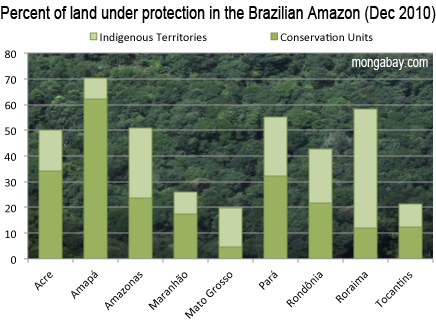
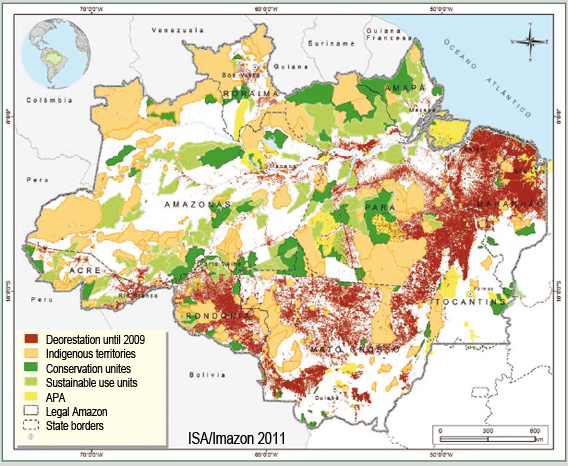
Protected areas now cover nearly 44 percent of the Amazon — an area larger than Greenland — but suffer from encroachment and poor management, reports a new study by Imazon and the Instituto Socioambiental (ISA).

The report, published in Portuguese, says that by December 2010, protected areas in the Brazilian Amazon amounted to 2,197,485 square kilometers. Conservation units like national parks accounted for just over half the area (50.6 percent), while indigenous territories represented 49.4 percent.

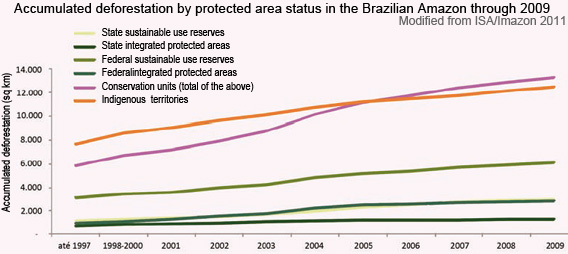
But while the extent of protected zones on paper is substantial, the report found significant human impacts in many areas. Between 1998 and 2009 12,204 square kilometers of forest within these areas was cleared. Damage was heaviest in designated "sustainable use" reserves.

The report faulted poor management as a contributing factor in degradation of protected areas. Half of protected areas in the Brazilian Amazon have no approved management plan and 45 percent has no management council. Staffing in some protected areas is very low — the state of Pará has only one officer per 1,817 square kilometers of forest.

Accumulated deforestation by protected area status in the Brazilian Amazon through 2009

The report cites illegal logging and mining as threats to protected areas. It notes that 1,338 mining titles have been granted in protected areas, while 10,348 are awaiting approval.

The report comes as Brazil has been experiencing a decline in deforestation. Annual clearing is down more than 75 percent since 2004.

Brazil set aside more land in protected areas than any other country during the 2000s, accounting for nearly 60 percent of total terrestrial conservation during the decade. But research indicates that protected areas were responsible for only a portion of the reduction.

A 2010 study published in Proceedings of the National Academy of Sciences estimated that 37 percent of the recent decline in deforestation in the Brazilian Amazon can be attributed to newly established protected areas. Brazil designated some 709,000 square kilometers (274,000 sq mi) of Amazon forest — an area larger than the state of Texas — between 2002 and 2009 under its Amazon Protected Areas Program (ARPA).

Brazil has set ambitious deforestation reduction targets under its national climate change program.

Earth Day Celebrates the International Year of Forests

Friday April 22nd, 2011
Source: Times and Transcript

2011 has been designated the International Year of Forests, so many Earth Day celebrations around the world will focus on the vital role forested regions of the planet have on a healthy environment.

Tropical rainforests in particular are known as the "lungs of the planet" responsible for producing almost a quarter of the earth's oxygen.

Home to plants, insects, and animals with a wide biodiversity, rainforests house over 10 million species which make up complex ecosystems including flora of which up to 70 per cent house anti-cancer properties. In the Amazon rainforest alone, 90 per cent of plants used by the indigenous tribes have not yet been studied by scientists for healing properties.

Unfortunately, the world's forested regions are being decimated at an alarming rate. Logging, urban sprawl, and industrialization are taking a toll on forested regions all around the world.

In the Amazon rainforest, only 54 per cent of total rainforest is left from its original expanse, with 2,700 million acres burned each year. This not only threatens the way of life of the indigenous people, but has dire implications for the entire planet. Local tribes like the Kayapo have fought back against policies by the Brazilian government and the World Bank, but in Indonesia, the loss of forested regions continues unchecked, threatening the delicate balance of nature and displacing peoples and the only home of the great ape known as the orangutan.

Canada is not immune to such problems. No stranger to the spectre of deforestation by huge corporations, Canada has suffered reduced forested regions in places of pristine woodlands like Clayoquot Sound in British Columbia. In 1984, the first conflict to do with logging occurred on islands in the sound with uprisings by "tree huggers" and native activists which eventually resulted in a government decision on environmental protection in 1993.

In New Brunswick, 85 per cent to 90 per cent of the province is still forested in virgin woodland, which helps to retain an unspoiled beauty. Essential to the balance of temperatures in our communities, forested regions help to control air quality and have a spin-off effect on the health of streams, rivers, wetlands, and ultimately oceans and their ecosystems.

Earth Day has traditionally helped to focus on the health of our environment and initiatives to protect the balance of nature in our environment. Founded in 1970 in the United States by Gaylord Nelson, Governor or Wisconsin, and Dennis Hayes, a student at Harvard University, the first Earth Day set into motion an event that would be regarded as the start of the Environmental Movement.

Concerned with the stewardship of the earth to ensure that its valuable resources continue to sustain all living creatures, Earth Day has grown from its grassroots beginnings of teach-ins and group sessions to become a worldwide effort to rescue our planet which is now on the brink of environmental disaster.

In fact, the Earth Day Movement seems even more relevant today than at any other time in earth's history, especially in the face of compelling new evidence of the negative effects mankind has wrought on the environment and the repercussions of these affects on the well-being of the planet for the future.

Earth Day is celebrated on April 22, each year, and it is now acknowledged around the world by over 180 countries. Over 1 billion people, 6 million of them in Canada, take part in events and special projects which address pressing environmental concerns whether they be close to home or across the globe.

A powerful force for change in attitudes and actions, Earth Day has wrought real policy change since its inception, ranging from the U.S. Congress passing of the Clean Air and Water Acts and the establishment of the Environmental Protection Act to research and monitor environmental issues and to enforce laws in the United States, to U.N. mandated guidelines as outlined in the United Nations Summit in Brazil in 1992, and addressed anew at the new Copenhagen Summit which took place in December of 2009.

In 1990, Earth Day became an international event with Canada joining 141 participating countries with 200 million people.

The volume of Earth Day events have become week-long and even month-long celebrations now taking part during the entire month of April, encompassing year-round projects and initiatives aimed at righting environmental wrongs.

Earth Day 2011 marks the culmination of four decades of environmental awareness on a global level as nations all across the world come together to affect real change in the attitudes of every man, woman, and child when it comes to preserving our planet.

Thursday, April 21, 2011

Demand for gold pushing deforestation in Peruvian Amazon

19 April 2011
Source: mongabay.com

Deforestation is on the rise in Peru's Madre de Dios region from illegal, small-scale, and dangerous gold mining. In some areas forest loss has increased up to six times. But the loss of forest is only the beginning; the unregulated mining is likely leaching mercury into the air, soil, and water, contaminating the region and imperiling its people.

Using satellite imagery from NASA, researchers were able to follow rising deforestation due to artisanal gold mining in Peru. According the study, published in PLoS ONE, Two large mining sites saw the loss of 7,000 hectares of forest (15,200 acres)—an area larger than Bermuda—between 2003 and 2009.

"We present recent evidence of the global demand for a single commodity and the ecosystem destruction resulting from commodity extraction, recorded by satellites for one of the most biodiverse areas of the world," the researchers write.

Jennifer Swenson, lead author from Duke University's Nicholas School of the Environment, says in a press release that such mining is "plainly visible from space." There are also "many scattered, small but expanding areas of mining activity across Madre de Dios that are more difficult to monitor but could develop rapidly like the sites we've tracked over time," adds Swenson.

Swenson and her colleagues clearly link the rise in unregulated mining to rising gold prices.

"Over the last decade, the price of gold has increased 360% with a constant rate of increase of [around] 18% per year. The price continues to set new records, rising to over $1400/oz at the time of this article's publication. As a response, nonindustrial informal gold mining has risen in developing countries along with grave environmental and health consequences," the authors write.

Beyond forest loss, the mining also impacts wildlife and people in the region due to mercury pollution. Miners use mercury to amalgamate with the metal, but unregulated the dangerous toxin also poison the ecosystem. According to Peru's Environment Minister fish in the area have mercury levels that are three times higher than the amount approved by the World Health Organization. These toxins make their way up the food chain. People dependent on fish, game animals, and river water in the region are likely to be impacted as well. The miners, who are often poor, uneducated, and marginalized, are most at risk given their direct handling of mercury. After fossil fuel burning, small-scale gold mining is the world's second largest source of mercury pollution contributing around 1/3 of the world's mercury pollution.

The illegal gold trade also produces numerous social problems, according to the BBC, including drug trafficking, indentured labor, and child prostitution.

Recently, Peru has begun a campaign to stamp out these illegal mines. In February, Around a thousand Peruvian soldiers and police officers destroyed seven and seized thirteen boats used by illegal gold miners in the region. The operation aims to destroy 300 pieces of illegal mining. But given the high price for gold its questionable whether this will work in the long-term.

Swenson says Peru should also think outside the box and consider limiting the importation of mercury.

"Virtually all mercury imported to Peru is used for artisanal gold mining and imports have risen exponentially since 2003, mirroring the rise in gold prices," she says. "Given the rate of recent increases, we project mercury imports will more than double by the end of 2011, to about 500 tons a year."

Peru suffers an ‘environmental tragedy’

April 20 2011
Source: Independent Online

Buenos Aires - The rising price of gold has multiplied by six the pace of deforestation in the Amazon rainforest in the Peruvian region of Madre de Dios in recent years, a study published on Tuesday said.

Illegal gold searches using primitive techniques in the years 2003-9 led to the destruction of 7,000 hectares of virgin and extremely diverse rainforest in the two-largest gold-digging areas in the region, Guacamayo and Colorado-Puquiri, Assistant Professor Jennifer Swenson of Duke University said in the online scientific journal PLoS ONE.

Researchers came to this conclusion when they studied satellite images taken by US space agency Nasa and related them to the evolution of the price of gold and to Peru's mercury imports.

“Virtually all mercury imported to Peru is used for artisanal gold mining and imports have risen exponentially since 2003, mirroring the rise in gold prices,” Swenson said.

“Given the rate of recent increases, we project mercury imports will more than double by the end of 2011, to about 500 tons a year,” she said.

The highly poisonous metal is used by poor gold-diggers to wash gold off rock and sand. It is not only harmful to the health of those who handle it, but it also pollutes the region's rivers and air.

Mercury also gets into the food chain and harms local indigenous communities and even those that live further away. Once the gold searchers are done, they leave behind a desert landscape that is poisoned by mercury.

Peruvian Environment Minister Antonio Brack said gold-diggers have already destroyed 32,000 hectares of rainforest in Madre de Dios.

In March, a large joint operation by police and the military targeted tens of thousands of gold searchers, and 32 floating dredges were seized, Brack said. The minister said he was sorry about the death of two prospectors during the raid, although he stressed that the use of force had been justified in the face of an “environmental tragedy.”

However, the problem is far from solved. Police assume that at least 250 floating dredges are in use in the region. According to Brack, it will take at least five years to get those searching for gold to leave.

And yet poverty in Peru continues to push more and more people into searching for gold, as well as into other equally illegal activities like logging or settling in the rainforest. - Sapa-dpa

Naturex launches new natural revitalising ingredient fresh from the Amazon

20-Apr-2011
Source: CosmeticsDesign-Europe.com

French natural ingredients company Naturex has launched its new skin rejuvenation active derived from Dragon’s blood, found in the Amazon rainforest.

Group marketing director Antoine Dauby explained: “Tropical environments yield many plants that offer benefits to health. The Amazon rainforest provides a wealth of traditional botanicals that demonstrate significant benefits to the skin when topically applied.”

“Dragon’s blood (Croton lechleri), called both Sangre de Drago and Sangre de Grado, is the primary topical aid for skin care,” he told CosmeticsDesign-Europe.com.

Treatment for injuries

Dauby explains that injuries of all kinds can benefit from the application of the healing red latex derived from this tree.

Thanks to its antioxidant activity it promotes and protects the skin, by improving each skin layer.

“Proven efficacy, ease of formulation and safety are key characteristics of this new ingredient. Backed by in vitro and ex vivo studies, Naturex Dragon’s Blood extract improves the stratification and quality of the new epidermis and contributes to a complete regeneration of the tissues, for skin rejuvenation,” said Dauby.

Positive reception at in-cosmetics

Naturex says that the active ingredient is fit for all skin care applications, and highlighted the positive feedback from the in-cosmetics show in Milan, where it showcased the new extract.

“This new active was very well received at in-cosmetics as this ingredient is innovative and meets consumers’ requirements in terms of efficacy, traditional use and sustainability,” commented Dauby.

“This increased awareness definitely helps to drive the growing use of natural actives. Naturex has applied its expertise to help identify the best source of certified raw materials that are effective in application whilst also being respectful to the environment,” he added.

Dragon’s blood contains a broad range of naturally occurring compounds, which helps to protect the cells of the skin and regenerate the whole tissue. It also contains taspine, which stimulates the early phase of the wound healing process, by stimulation of the fibroblasts.

Naturex obtain the dragon’s blood by cutting the bark in a diagonal manner and bleeding the latex. This method is employed by the locals to help preserve the trees, allowing the company to provide its customers with a renewable resource.

Gold prices spur six-fold spike in Amazon deforestation

19-Apr-2011
Source: EurekAlert

DURHAM, N.C.--Deforestation in parts of the Peruvian Amazon has increased six-fold in recent years as small-scale miners, driven by record gold prices, blast and clear more of the lowland rainforest, according to a new Duke University-led study.

The study, published today in the online journal PLoS ONE, combined NASA satellite imagery spanning six years with economic analyses of gold prices and mercury imports to document the forces responsible for deforestation in Peru's biologically diverse Madre de Dios region.

Roughly 7,000 hectares, or about 15,200 acres, of pristine forest and wetlands were cleared at two large mining sites between 2003 and 2009, with a dramatic increase in deforestation occurring in the last three years.

"In addition to these two large sites, there are many scattered, small but expanding areas of mining activity across Madre de Dios that are more difficult to monitor but could develop rapidly like the sites we've tracked over time," says Jennifer Swenson, assistant professor of the practice of geospatial analysis at Duke's Nicholas School of the Environment.

Much of the deforestation visible in the satellite images has been caused by unregulated, artisanal mining by miners who are often among the poorest and most marginalized members of their society.

"These are small-time miners; there is no big 'Goliath' mining company to blame," Swenson says. The miners often lack modern technology, have limited knowledge of mining's environmental or human health effects and rarely have safeguards to limit the release of the mercury they use to process their gold into the air, soil or water.

Artisanal mining has occurred in the region since the time of the Incas, but the recent record-setting rise in gold prices, which now exceed $1,400 an ounce, has shifted its pace into hyperdrive, she says. The mining "is now plainly visible from space," Swenson says. "At the two sites we studied, Guacamayo and Colorado-Puquiri, nearly 5,000 acres were cleared in just three years, between 2006 and 2009, largely outpacing nearby deforestation caused by human settlement."

Land cleared for mining has a different spectral signature on satellite images, allowing Swenson and her team to differentiate it from deforestation caused by farming, road-building or other settlement-related activities.

Most of the gold mined artisanally in Madre de Dios comes from alluvial deposits in the channels and floodplains of Amazon tributaries. Miners blast away river banks and clear floodplain forests to expose potential gold-yielding gravel deposits and use mercury to process the gold ore.

The mercury contaminates local water and soil, and ravages the nervous system of miners and their families, but the risks extend far beyond the local area, Swenson says. Small-scale gold mining is the second-largest source of mercury pollution in the world, behind only the burning of fossil fuels. Mercury from artisanal mines can travel hundreds of miles in the atmosphere or in surface waters – eventually settling in sediments and moving up the food chain into fish, fish-eating wildlife and humans.

"Virtually all mercury imported to Peru is used for artisanal gold mining and imports have risen exponentially since 2003, mirroring the rise in gold prices," Swenson says. "Given the rate of recent increases, we project mercury imports will more than double by the end of 2011, to about 500 tons a year."

It's been difficult for Peru's government to monitor and control all artisanal mining within its borders, she says, but another approach, worth considering, may be to be start limiting mercury imports.

Wednesday, April 20, 2011

Amazon proposal clears first hurdle

Wednesday, Apr. 20, 2011
Source: The State

Online retailer Amazon won its first legislative skirmish Tuesday as the Senate Finance Committee approved a five-year sales tax collection exemption that is part of the price the company wants to bring 1,249 jobs to the Midlands.

Some allies predict the exemption faces a bumpy path to approval in the General Assembly, a forecast that came after the panel endorsed it 15-5.

“It’s a big first step forward,” said Randy Halfacre, Lexington mayor and president of the Greater Lexington Chamber of Commerce. “There’s a lot further to go, but we’ve got someone on first base and that improves your chance to score.”

The proposal would allow Amazon to operate without collecting state and local sales taxes for five years on merchandise it sells to S.C. residents from the 1 million-square-foot center being built near Cayce, scheduled to open this fall.

Amazon spokeswoman Mary Osako expressed appreciation for the panel’s endorsement, adding the company “looks forward to working with the full Senate and House to complete work on the legislation.”

The exemption is opposed by other merchants as giving a competitive edge to Amazon in commerce where pennies count. Buyers, they say, perceive untaxed goods as cheaper.

A group representing Midlands store owners and major chains with outlets in the area promised to keep fighting the proposal.

“We are disappointed with today’s decision, but we believe the Legislature will recognize that this sales tax exemption is unfair,” said Brian Flynn, executive director of the S.C. Alliance for Main Street Fairness. “All online or brick-and-mortar retailers operating in South Carolina should play by the same rules.”

Reinforcements are coming from Tea Party adherents and the South Carolina Policy Council, groups that question any state incentives for new development. Those groups plan to outline their objections today, after not being allowed to outline them to the committee.

The Senate panel endorsed the exemption after state Secretary of Commerce Bobby Hitt said the plan is a “good deal” that will bring in more than it costs.

Supporters estimate state and local coffers will net $11 million annually from payroll and property taxes, after a sales tax break estimated at $2.6 million.

But Sen. Danny Verdin, R-Laurens, said the exemption for Amazon takes development incentives “into another realm” that will be troublesome.

“I’m not comfortable the good outweighs the bad,” he said.

Some senators said coming up with a way to collect taxes owed by Amazon customers will be a challenge.

The growing popularity of online shopping “is a game changer,” said Sen. Darrell Jackson, D-Richland.

Others warned that more than the jobs promised by Amazon are at stake.

Rejection of what Amazon sees as an incentive promised to bring its center here would leave “a horrible black eye” on state industrial recruitment, said Sen. John Courson, R-Richland.

The showdown in the panel came after both sides in the conflict bombarded lawmakers during the past 10 days with ad campaigns uncommon for proposals before the Legislature.

The exemption would be on top of a free site, local property tax breaks on equipment and state job creation tax credits. In addition. Lexington County ended long-time restrictions on Sunday morning sales to facilitate Amazon’s round-the-clock operation.

The next challenge for Amazon allies is winning agreement from Senate leaders to put the measure on a fast track to sidestep a series of procedural obstacles that opponents can use to impede progress before the Legislature ends work June 2.

“There’s no question its path is going to be long and difficult,” said Sen. Nikki Setzler, D-Lexington. “We’ve got a lot of work yet.”

Amazon backs daily deals site in Auckland

Wednesday April 20, 2011
Source: National Business Review

LivingSocial, the world's fastest growing coupon site, will launch in Auckland tomorrow with Christchurch and Wellington to follow.

The site recently received $535 million funding from investors including Amazon, taking total backing to more than $900 million.

LivingSocial plans to offer "hyperlocal" deals, a press release for the coupon site said, where daily deals are offered in severeal areas of each city. In Auckland, deals will be divided into four regions: North shore, West, City and South, as well as one "premium" city deal available to everyone.

LivingSocial is currently the second largest daily deals site, the release said, but industry expected it to overtake number one, Groupon, in January 2012.

CEO Colin Fabig said LivingSocial researches the city and area to find out what will appeal to the residents of the city in question.

Brazil puts dent in Bill Gates' Amazon adventure

19 April 2011
Source: AFP

Bill Gates was enjoying cruising around a river in the Amazon basin until Brazil booted his group out of the country

BRASILIA — Microsoft magnate Bill Gates was enjoying cruising around a river in the Amazon basin until Brazil booted his group out of the country because his boat crew did not have work permits, according to police.

While Gates and some friends -- according to local media Microsoft staff -- had proper tourist visas, the crew of the boat on the Rio Negro near the city of Manaus did not have working papers, federal police said.

So Brazilian authorities fined the group and gave them three days to leave the country, which they did on Tuesday.

Gates reportedly has spent vacation time in Brazil's Amazon basin region in 2007 and 2009