Source: WWF-UK
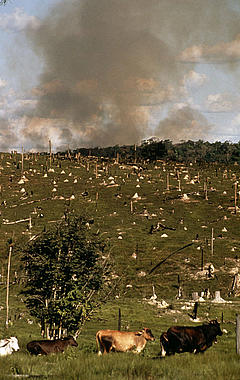 The Amazon rainforest is facing an urgent new threat as we speak. The Brazilian government is under huge pressure right now from agribusiness and landowners to drastically weaken the law that protects the country’s forests.
Brazil’s hard-fought ‘Forest Law’ specifies how much land a landowner can deforest and how much must be kept as a “legal reserve”. At the moment the law states that 80% of a property in the Amazon has to remain forested.
But under new proposals being debated in the Brazilian Congress in the next week, the scale of protected areas could be dangerously reduced.
The so-called “ruralist bloc” – congress members representing powerful agribusiness and landowners – are pushing parliament to make the Forest Law more flexible, claiming that it’s holding back agricultural growth and economic prosperity.
We’ve already concluded that this is not the case, in a report we presented with Greenpeace and other NGOs in May. We believe the ruralist bloc’s proposals are not based on science but on distorted arguments.
In fact, a detailed analysis by the respected agricultural college of the University of Sao Paulo has shown that protected forest reserves have a negligible impact on agricultural production in some of Brazil’s leading coffee, grape, rice and fruit producing areas.
We believe that instead of continuously deforesting new land – much of which is often later abandoned – Brazilian agribusiness needs to increase its relatively low productivity levels. In other words it could use its existing agricultural and cattle-ranching land much more efficiently – even combining the two for more integrated and productive results.
Why Brazil’s Forest Law matters
Brazil’s deforestation record has improved dramatically in the last few years. Even though the enforcement of the Forest Law has been patchy, it’s been credited with playing a major role in reducing Amazon destruction from the levels that horrified the world in the 1980s.
The Forest reserves also perform a crucial job of protecting river and water quality, and reducing soil erosion and risks from landslides and floods.
If the proposed amendments to the Forest Law are agreed by the Brazilian parliament – and a presidential veto is unlikely with elections looming in October – then effective control of deforestation will pass from strong, nationwide federal legislators to a piecemeal state-by-state approach.
We could certainly expect a strong upsurge in deforestation. This would not only be bad for the Amazon and its ecosystems, but would make the country’s promised action plan on climate change impossible, as it relies on continued reductions in deforestation-related emissions
Other lesser-known natural habitats are under threat too if the law is amended, including the endangered Atlantic Forests and high savannah areas of the Cerrado.
There’s already significant opposition being expressed by other legislators, communities, NGOs, scientists and researchers – so we still hope the controversial change to the Forest Law will not be adopted.
We’re also working to protect a large area of the Brazilian Amazon as part of the WWF/Sky Rainforest Rescue project in the Acre region. You can get involved right now by sponsoring an acre in Acre.