Monday, June 29, 2009

Amazon Defense Coalition: U.S. Supreme Court Refuses to Hear Chevron Appeal Over $27 Billion Ecuador Environmental Case

Mon Jun 29, 2009
From: Businesswire
News Link: http://www.businesswire.com/portal/site/google/?ndmViewId=news_view&newsId=20090629005782&newsLang=en

WASHINGTON--(BUSINESS WIRE)--The U.S. Supreme Court today refused to hear an appeal by Chevron of a decision by a U.S. federal trial judge that denied the oil giant’s attempt to shift a $27.3 billion liability for environmental contamination in the Amazon rainforest to Ecuador’s state-owned oil company.

The Supreme Court’s move is the latest of several legal and political setbacks recently suffered by Chevron in the 16-year-old case, considered the largest environmental matter in the world. Experts have dubbed the contamination in Ecuador the “Amazon Chernobyl” and say a clean-up would dwarf any decontamination effort ever undertaken.

The dispute before the Court was between Chevron and Ecuador’s government, but it was spawned by a private lawsuit for environmental damages brought against Chevron by thousands of private citizens in the country’s Amazon region.

Damages in the private lawsuit, expected to end later this year, were estimated in 2008 at up to $27.3 billion by a team of court-appointed experts. Texaco (now Chevron) is accused of dumping billions of gallons of toxin-laden waste water into the Amazon rainforest from 1964 to 1990, when it operated a large oil concession in the area covering a 2,000 square mile area.

Indigenous groups complain their cultures have been decimated, while the Ecuador court report found high cancer rates related to oil contamination have caused roughly 1,400 excess deaths.

Chevron was challenging an order by U.S. federal district court judge Leonard B. Sand that denied its attempt to obligate Ecuador’s government to take part in a binding arbitration over the liability from the private lawsuit based on a provision in a 1965 contract signed by Texaco and Gulf to operate a large oil concession in Ecuador’s rainforest. Last October, a unanimous three-judge panel for the U.S. Court of Appeals for the Second Circuit found Chevron’s argument was “without merit” and denied its appeal, prompting the petition to the Supreme Court.

The narrow legal issue involved whether Ecuador’s government could be subject to an arbitration provision under a contract that it never signed, and whose only signatories were two American oil companies. The implications of any arbitration between Chevron and Ecuador’s government would have been highly significant given the amount of damages, however.

“From the beginning, the attempt by Chevron to tie up the nation’s highest court on a relatively obscure legal issue was more of a delay tactic than anything,” said Andrew Woods, an American legal advisor to the Amazonian communities who brought the underlying legal case.

The private lawsuit originally was filed in U.S. federal court in New York in 1993 against Texaco (now Chevron) and is currently on trial in Ecuador at Chevron’s request. To transfer the case to Ecuador in 2002, the oil company filed 14 sworn affidavits praising Ecuador’s courts and agreed to submit to jurisdiction and be bound by any ruling there.

Once evidence in the Ecuador trial pointed to Chevron’s culpability, the oil company began to claim Ecuador’s courts were biased against it and tried to shift the liability to Ecuador's government. It also launched a public relations and lobbying campaign in Washington to try to convince the U.S. government to pressure Ecuador’s government to quash the case, a strategy that up to this point has backfired.

Among Chevron’s recent setbacks:

* Four Democratic Senators (Wyden, Leahy, Casey, Jr., and Durbin), in a letter sent June 25 to the office of the United States Trade Representative, accused the oil giant of meddling in the private lawsuit by lobbying to cancel trade preferences for Ecuador – a move that could cost Ecuador 350,000 jobs.
* Two Chevron lawyers are under criminal indictment in Ecuador, along with seven former Ecuadorian government officials, for lying about the results of a purported remediation in the mid-1990s. One of those lawyers, Ricardo Reis Veiga, had been supervising the case for Chevron but is now unable to travel to Ecuador.
* New York Attorney General Andrew Cuomo has opened a probe of the company to determine if it is misleading shareholders about its financial risk in Ecuador.
* More than $37 billion in Chevron shares (about 28% of all shares outstanding) voted in May to support resolutions criticizing the company’s human rights record in Ecuador, Myanmar and elsewhere.

If Chevron had won the right to arbitrate, it would have argued that a provision in the 1965 operating contract required Ecuador to indemnify it for all or part of the losses associated with the environmental lawsuit. A second issue – whether Ecuador breached a 1995 release given to Chevron – will now be litigated before Judge Sand in the coming months.

Ecuador was represented by C. MacNeil Mitchel (NY) and Eric W. Bloom (DC) at Winston & Strawn in Washington, D.C. Chevron was represented by Paul Clement of King & Spalding in Washington, D.C., and Thomas F. Cullen and Louis K. Fisher of Jones Day in Washington, D.C.

About the Amazon Defense Coalition

The Amazon Defense Coalition represents dozens of rainforest communities and five indigenous groups that inhabit Ecuador’s Northern Amazon region. The mission of the Coalition is to protect the environment and secure social justice through grass roots organizing, political advocacy, and litigation. Two of its leaders, Luis Yanza and Pablo Fajardo, are the 2008 winners of the prestigious Goldman Environmental Prize.

Rainforests More Fragile Than Estimated

Mon Jun 29, 2009
From: Discovery News
News Link: http://dsc.discovery.com/news/2009/06/29/rainforest-warming.html

The Amazon rainforest, one of the planet's most precious and besieged natural resources, is even more fragile than realized.

If the planet warms even a moderate amount, a new study predicts that as much as 40 percent of it could be condemned to vanish by the end of the century.

A crippled Amazon could hasten global warming. If a significant portion of its trees die off, their vast stores of carbon would be emitted back into the atmosphere as greenhouse gases, pushing the climate further into dangerous levels of warming.

Chris Jones of the United Kingdom's Met Office and a group of researchers ran a computer simulation of Earth's climate that focused on how vegetation reacts to warming. They found that warming doesn't immediately kill off tropical trees -- it can take up to a century for the forests to respond fully.

But even modest warming could have devastating effects. If the planet warmed just 2 degrees Centigrade (3.6 degrees Fahrenheit) above pre-industrial levels, they found that between 20 percent and 40 percent of the forest could die off.

"Our model predicts quite a severe drying in the Amazon, making trees more vulnerable to fire," Jones said. "The additional heat causes stress, too, damaging their ability to grow fully."

"Amazon" explores a garden of natural and medicinal wonders

Mon Jun 29, 2009
From: The Mileford Daily News
News Link: http://www.milforddailynews.com/arts/x1836449375/-Amazon-explores-a-garden-of-natural-and-medicinal-wonders

BOSTON —

In a grainy film resembling a black-and-white newsreel, a white hunter wearing a pith helmet escapes natives with blow guns and shoots flesh-eating piranhas attacking his canoe in the make-believe jungle.

A narrator solemnly intones, "Our perceptions of the Amazon are mostly mythical."

Suddenly, a brilliant green rainforest stretching toward a distant horizon covers the 76-foot dome screen of the Mugar Omni Theater in the Museum of Science.

A snake flicks a forked tongue. Bare feet step carefully along a muddy path. A red-face monkey yammers. The Amazon cuts its winding path through the emerald canopy.

"But in the Amazon," observes actress and narrator Linda Hunt, "reality is more amazing than mythology."

In just 40 minutes, this gorgeous informative IMAX film, "Amazon," proves that claim.

While many big-screen films employ dazzling in-your-eyeballs close-ups, director Kieth Merrill has the good sense and confidence to satisfy viewers' imaginations and intelligence.

Just minutes into the film, Hunt details the natural wonders of the Amazon Rainforest as the camera soars above rushing cataracts and through broadleaf trees to scenes of prowling jaguars and flamboyant toucans.

Encompassing 7 million square kilometers including 1.4 billion acres of rain forest, the Amazon basin hosts "the greatest living variety of life on earth." Located largely in Brazil and Peru with smaller portions in Colombia, Venezuela, Ecuador, Bolivia, Guyana and Suriname, the 55-million-year-old forest supports unequalled biodiversity including 2.5 million insect species, 40,000 plant species, 3,000 species of fish, 1,750 species of birds and mammals representing nearly one-tenth of all plant and animal species on Earth.

As a small plane cruises above the Amazon at tree-top level, Hunt recalls the "timeless land of the Incas" whose doctors used forgotten herbal medicines to keep the royal family healthy.

While most IMAX movies paste spectacular scenery onto sometimes flimsy or didactic plots, "Amazon" successfully melds actual scientific exploration with a believable, though largely fictional plot.

An Incan healer named Julio Mamani sets off to find rare forest plants to help him "cure the illnesses and prolong the lives" of people in his remote Bolivian village in the Andes.

He walks and rides donkeys, buses, boats and a rickety train through scenery of eye-popping natural majesty. On a journey of "200 miles as the condor flies," Mamani passes through forests, over mountains, down rivers, past waterfalls and eventually reaches the great temples of Machu Picchu, a sacred destination which gives his journey an epic quality.

Viewers then meet Dr. Mark Plotkin, a world-famous ethnobotanist who's spent 25 years collecting plants that might "cure diseases Western medicine hasn't conquered."

The author of "Tales of a Shaman's Apprentice," the bearded, ruggedly handsome Plotkin, who plays himself, exudes respect for the local healers he meets and expresses concerns that development, deforestation and environmental degradation threaten the Amazon before it reveals its secrets.

"I'm driven by dread some of these species are disappearing before their lifesaving attributes are found," he said. "The Amazon rainforest is one of the most promising places to look for them."

As Mamani's and Plotkin's paths cross, viewers might sense the promise of two very different healers, each respecting the other's intentions, determined to preserve a natural treasure of measureless splendor and importance.

Like most IMAX movies, "Amazon" dazzles the eyes. But it also makes you care about this vast natural wonderland and that's an even more important reason for seeing it.

THE ESSENTIALS:

The Museum of Science is at 1 Science Park, Boston.

"Amazon: An IMAX Film Experience" can be viewed several times a week in the Mugar Omni Theater through Sept. 6.

Admission to the Mugar Omni Theater is $9 for adults, $8 for seniors (60+) and $7 for children (3-11). Evening Omni discounts are available after 6 p.m: $6.50 for adults, $5.50 for seniors and $4.50 for children.

ANALYSIS-Brazil beef industry yields to Amazon criticism

Mon Jun 29, 2009
From: Thomson Reuters
News Link: http://www.reuters.com/article/latestCrisis/idUSN29452445

SAO PAULO/RIO DE JANEIRO, June 29 (Reuters) - In a victory for conservationists, Brazil's huge cattle industry is bending to demands to curb destruction of the Amazon forest after heavy criticism of its leading role in deforestation.

Reforms by Brazil's big slaughterhouses could move the industry toward increased productivity and away from the practice of burning trees to clear land in the world's largest rainforest, industry officials and conservationists say.

But the creation of a tracking system to ensure that cattle weren't raised on deforested land and the restoration of existing pastures come at a cost, and Brazil beef prices may rise as a result.

In the past month, since the release of a 40-page Greenpeace report detailing links between Brazil's meatpackers and deforestation, the World Bank has withdrawn a $90 million loan to one firm. And supermarket chains said they would stop buying beef from 11 producers in the Amazon state of Para.

Big beef firms announced steps to ensure their cattle come from legal ranches. Beef exporters pledged not to accept meat from illegally deforested areas and to set up an electronic tracing system to guarantee the animals' origin.

"There have been very good decisions," said Andre Muggiati of Greenpeace, whose report used satellite data to show that beef for Brazil's domestic market and exports often comes from farms with recent deforestation.

"Now it is about implementation of deals. You have to monitor these commitments. If not, you lose it."

With multinational firms like JBS (JBSS3.SA), Marfrig (MRFG3.SA) and Bertin, Brazil is the world's largest beef exporter and has the biggest cattle herd of 200 million.

A third of those are in the remote Amazon region. Taking advantage of lax law enforcement, many cattle ranchers have cut and burned forest to illegally expand their pastures.

The government has financed the industry with billions of dollars and aims to double Brazil's share of the global beef export market to 60 percent by 2018.

Following the Greenpeace report, supermarket chains Wal-Mart Stores Inc (WMT.N), Carrefour (CARR.PA) and Pao de Acucar (PCAR4.SA) were among firms who said they would stop buying beef from 11 firms in Para that are being prosecuted for illegal deforestation.

NO EASY SOLUTION

Bertin, Brazil's largest beef exporter, whose loan from the World Bank's financing arm was cut in June, said big meatpackers expect a tracing system using electronic chips in cows' ears will be ready in four years. The chips would show if cows come from areas with illegal deforestation.

"This will give us greater traceability than there is in developed nations," said Fernando Falco, Bertin's executive director.

He said the system, would add an average cost of more than 3.50 reais ($1.75) per calf. But the reforms could open markets that local beef has been shut out of on health and sanitary grounds, he said, something that a reliable tracking system should help.

"We all know that we have to save this forest. We should have no problem increasing output without needing to cut down more area. We need to improve productivity," Falco added.

Degraded pasture in Brazil about the size of Spain could be restored for cattle and other farming uses. But only about 6 percent of public financing of the cattle industry goes toward this, environment groups say.

While Greenpeace's targeting of the big beef producers has paid off, it is unclear if thousands of smaller processors and ranchers will change their ways.

Brazil's big four meatpackers -- JBS, Bertin, Marfrig and Minerva -- make up 70 percent of Brazil's beef export market and are sensitive to their image. But they only account for 30 percent of domestic cattle purchases.

"Unfortunately, environmentalists have vilified the whole sector here. If producers had alternatives, they would do the right thing," said John Carter, a U.S. rancher in Mato Grosso state and head of producer-based group Alianca da Terra.

His group advises farm communities on good land stewardship and is working with the slaughterhouses and beef retailers to find some additional profit margin to cover the increased costs for land conservation and other reforms.

"There is no easy solution to deforestation, that's why nobody gives it," Carter said. "You need an economic stimulus to encourage people to do the right thing, otherwise it won't happen. It never has."

Sunday, June 28, 2009

In need of a clean

June 27th 2009
From: economist.com
News Link: http://www.economist.com/world/unitedstates/displaystory.cfm?story_id=13933204

America’s climate-change bill is a bundle of compromises

THE headline is a big one: for the first time, America’s House of Representatives agreed, by 219 votes to 212, on Friday June 25th to cap emissions of carbon dioxide, the main greenhouse gas. The bill envisions modest reductions of 17% from 2005 levels by 2020, but the cuts get more swingeing over time (under the assumption that technology to mitigate emissions will improve). By 2050 the cuts should hit 83%.

But environmental campaigners have gritted their teeth as the bill has passed through the legislative process. Drafted by Henry Waxman and Ed Markey, with support from the Obama administration, the bill originally envisioned a cap-and-trade system whereby credits conferring the right to emit greenhouse gases would be sold to the highest bidders. The revenue from such an auction would be used to offset increasing energy bills.

But to the ire of the green faithful, the bill will now give away 85% of the permits to emit carbon, while auctioning off the rest. Even in that form, though, the bill looked like it might generate opposition from fiscally conservative Democrats or those that represented states with lots of farmers. The support of those Democrats would be needed to get the legislation past near-unanimous Republican opposition.

To mollify the farmers, Mr Waxman had to agree that “indirect land-use changes” would not affect how American farmers producing crops to make ethanol would be considered under the bill. Farmers had howled that, by the original proposals, planting more crops to produce ethanol would mean less land devoted to food crops. This would clearly cause food prices to rise. Farmers in (say) Brazil might then cut down Amazon rainforest to make up the shortfall in America. That chopped-down Amazon would have counted against the Iowan corn farmer when carbon credits were doled out. Mr Waxman agreed to suspend the provision for five years, so the National Academy of Sciences could further study the subject.

The next big trade-off also came late in the day at the insistence of the farmers. The Department of Agriculture, rather than the Environmental Protection Agency, will determine what counts as a carbon “offset”. This means that farmers who prevent carbon emissions by, for example, planting trees or reducing tillage, would get carbon credits. The EPA is reckoned to be a tough regulator that would make sure farmers did not get credits for doing things that they would do anyway. The Department of Agriculture is expected to be more friendly to farmers.

Many of the mainstream environmental groups-the Natural Resources Defence Council, the Environmental Defence Fund, the Sierra Club and others-have said that the bill is flawed but far better than nothing. More than that, they claim that once in place it can be tightened over time.

But the bill must pass the Senate where farm states have even more clout than in the House (since each state, no matter how sparsely populated, gets two senators). It must go through another clutch of committees, each of which is susceptible to lobbying by special interests with long experience of getting their way. The energy committee, for example, has already passed a bill on renewables that has disappointed greens. The Senate’s majority leader, Harry Reid, wants a vote on the package by mid-September.

With just a few months to go before global talks in Copenhagen on a successor to the Kyoto protocol other big countries are showing their hands on climate change. Russia and Japan have announced targets that are well shy of the goals set by European countries, currently leading the world with their green ambitions. China and India are refusing to countenance any hard ceilings on their own emissions. An American carbon bill is regarded as a necessary step before anything of substance can be agreed in Copenhagen. But a weak bill might mean that the impetus for serious discussions is lacking.

Rainforest squatters get land rights

June 28, 2009
From: gulfnews.com
News Link: http://www.gulfnews.com/world/Brazil/10326857.html

Brasilia: Brazil's President Luiz Inacio Lula Da Silva has approved a controversial law which grants land rights to squatters occupying land in the Amazon.

Rainforest campaigners fear it will result in a further increase in deforestation of the Amazon region.

The law known as "provisional measure 458" is one of the most controversial environmental decisions of Lula's two terms in office.

The government says more than 1 million people will benefit from the law, which covers 67.4m hectares of land. It believes the law will reduce violent conflicts by giving people private ownership of the land they live on.

Brazilian cattle giant declares moratorium on Amazon deforestation

June 25, 2009
From: mongabay.com
News Link: http://news.mongabay.com/2009/0624-marfrig_beef_amazon.html

Marfrig, the world's fourth largest beef trader, will no longer buy cattle raised in newly deforested areas within the Brazilian Amazon, reports Greenpeace. The announcement is a direct response to Greenpeace's Slaughtering the Amazon report, which linked illegal Amazon forest clearing to the cattle producers that supply raw materials to some of the world's most prominent consumer products companies. Marfrig was one several cattle firms named in the investigative report.

Slaughtering the Amazon has had immediate repercussions for the accused cattle companies. Brazil's three largest supermarket chains, Wal-Mart, Carrefour and Pão de Açúcar, last week announced they would suspend contracts with suppliers found to be involved in Amazon deforestation, while Bertin, the world's largest beef processor, saw its $90 million loan from the International Finance Corporation withdrawn. Meanwhile a Brazilian federal prosecutor has filed a billion dollar law suit against the cattle industry for environmental damage. Firms that market tainted meat may be subject to fines of 500 reais ($260) per kilo.

Winner of the Golden Chainsaw Award makes amends

Greenpeace reports that Blairo Maggi, the soy farmer-turned-governor of the Amazon state of Mato Grosso who the green group bestowed with the "Golden Chainsaw award" in 2005 for being "the Brazilian person who most contributed to Amazon destruction", is supporting Marfrig's initiative.

"Blairo Maggi... is supporting Marfrig’s implementation of the moratorium by pushing farmers to map their properties," said Greenpeace in a statement. "Satellite data of the forest cover will be made publicly available so that companies can identify farms engaged in ongoing deforestation and stop buying cattle products from them."

Paulo Adario, Greenpeace Amazon campaign director, said it is now time for other Brazilian cattle companies to follow Marfrig's lead.

“In the absence of leadership from President Lula, Marfrig and Governor Maggi have taken their own steps towards ending deforestation and pushing for climate solutions. The President and the rest of the cattle industry must now follow their example,” said Adario. "This initiative is an important step towards halting Amazonian destruction and the related greenhouse gases emissions."

Cattle ranching is the biggest driver of deforestation in the Brazilian Amazon, accounting for roughly 80 percent of forest clearing. More than 38,600 square miles has been cleared for pasture since 1996, bringing the total area occupied by cattle ranches in the Brazilian Amazon to 214,000 square miles, an area larger than France. The legal Amazon, an region consisting of rainforests and a biologically-rich grassland known as cerrado, is now home to more than 80 million head of cattle, more than 85 percent of the total U.S. herd.

Brazilian miner Vale signs $500M palm oil deal in the Amazon

June 25, 2009
From: mongabay.com
News Link: http://news.mongabay.com/2009/0624-vale_palm_oil_amazon.html

Vale, the world's largest miner of iron ore, has signed a $500 million joint venture with Biopalma da Amazonia to produce 160,000 metric tons of palm oil-based biodiesel per year, reports Reuters.

Vale says the deal will save $150 million in fuel costs starting in 2014, with palm oil biodiesel replacing up to 20 percent of diesel consumption in the company's northern operations. The biodiesel will be produced from oil palm plantations in the Amazon state of Pará.

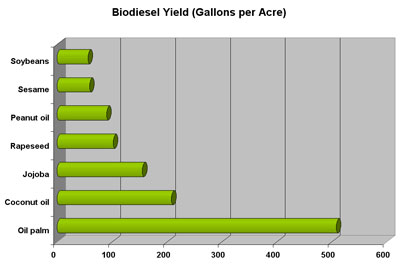
In a statement announcing the venture, Vale's Director of Energy Vania Somavilla noted that "making biodiesel from palm oil is ten times more productive than making it from soy," making it a significantly cheaper source of biofuel.

The move is likely to stir up criticism from environmentalists that fear palm oil production could soon become a major driver of deforestation in the region. Cultivation of oil palm is a leading cause of forest loss across Southeast Asia, but has yet to be widely planted in the Brazilian Amazon, where deforestation is mostly driven directly by conversion for cattle pasture expansion and indirectly by expansion of industrial agriculture, including soy.

Pressure from green groups may have contributed to last month's decision by Felda, Malaysia's land development agency, to pull out of its joint venture with Braspalma to develop 100,000 hectares of oil palm plantations in the heart of the Amazon. The project would have been one of the largest in Brazil. Currently palm oil production is dominated by Agropalma, which accounts for roughly three-quarters of the market, followed by Dendê do Pará S/A (Denpasa), Marborges Agroindústria of Moju, Pará, and other small producers.

According to the U.S. Depart of Agriculture, Brazil presently produces roughly 110,000 tons of crude palm oil per year, but pending legislation would create new incentives for land owners to increase plantings. Brazilian lawmakers are weighing a law that would allow landowners to count plantations as forest towards their legal forest reserve requirement. By law landowners in the legal Amazon must retain 80 percent forest cover on their holdings.

The potential for palm oil plantations in the Brazilian Amazon is vast: scientists at the Woods Hole Research Center estimate that 2.283 million square kilometers (881,000 sq miles) of forest land in the region is suitable for oil palm, an area far greater in extent than that which could be converted for soy (390,000 sq km) and sugar cane (1.988 million sq km), the dominant biofuel feedstocks in Brazil.

In addition to the potential change in the legal reserve requirement, oil palm expansion in the Amazon will likely be facilitated by infrastructure projects currently underway in these region, including road-building, port expansion, and new hydroelectric projects.

Friday, June 26, 2009

A Cloudy Future in Ecuador’s Rainforest

Friday 26 June 2009
From: The Harvard Crimson
News Link: http://www.thecrimson.com/article.aspx?ref=528517

COCA, Ecuador — Over the canopy to the south, Ivan, a Quichua Indian, has spotted three macaws in flight. Moments later, binoculars train to a pair of white-throated toucans, and my group murmurs in excitement. The next item noted by our guide Oscar, however, is not a rare bird, deep in the Amazon rainforest: “Over there, the government has authorized a new, private highway from the coast to here.”

Standing in a metal tower 120 feet over the grounds of Sacha Lodge (an ecotourism jungle lodge down the Napo River from Coca, Ecuador), signs of human occupation and exploitation do not blemish the horizon. Yet, even at this special refuge within the Amazon, Ecuador’s approaching crossroads looms, a shadow over its mostly optimistic outlook. On the motored canoe ride from Coca to the lodge, several major worksites reveal the presence of oil operations in the region; barges laden with trucks drift by. Oil has been instrumental in Ecuador’s expanding economy, but pursuit of petroleum increasingly puts at risk the country’s most vast and irreplaceable resource—the rainforest.

Coca itself evokes an American western boomtown, with the equivalent of saloons and other entertainment for the Halliburton or Texaco employee looking to blow off steam. Across from the canoe dock stands a large military casino, funded by—no surprise—oil. A large amount of oil revenue (the local guides claim 40 percent) is funneled directly into Ecuador’s large military.

With such a reliance on developing oil revenue, Ecuador recognizes that its miles of jungle face unprecedented risk. The planned highway linking the Pacific Ocean to the Napo River will cause damage hard to assess before it strikes. With the large variability and low populations that characterize Amazon eco-systems, separating already-disperse species will have serious consequences.

As a somber mood descends upon our canopy-watchers, however, the guides explain that Ecuador recognizes this threat and wants to protect its forests. Without nearly the requisite funding, however, it has implored the international community to provide help. Germany has volunteered to lead this charge, but other countries—such as the United States—must join the effort if the jungles of Ecuador are to survive.

Lula da Silva to decide on ownership of rainforest

Friday 26 June 2009
From: Business Day
News Link: http://www.businessday.co.za/articles/Content.aspx?id=74229

BRAZILIAN President Luiz Inacio Lula da Silva faced a tough, keenly awaited decision this week about land ownership in the Amazon rainforest.

The president had until yesterday to decide whether to veto parts of a bill designed to transfer an area of public land, mostly Amazon rainforest of about 670000km² , into private hands for agriculture development.

His decision will be closely watched by economists keen to improve the country’s productivity and native groups who have fiercely opposed the transfer of what they consider to be ancestral land to developers.

The government originally introduced what is called Provisional Measure 458 as a way of bringing security to small farmers in the region. But critics said the proposal amounted to an amnesty in a land grab by industrialists and farmers, and that the original measure had been altered by Congress in a way that would only serve to encourage deforestation.

The government’s National Institute for Space Research released a report on Wednesday showing that the pace of deforestation in Brazil’s Amazon had slowed in May compared to the same month last year. It said 124km² was destroyed in May. The institute relies on data from satellites, and only 38% of the Amazon was visible in May because of cloud cover.

The year before researchers reported the destruction of 1096km² of forest — when 54% of the region was visible. The government says new laws and enforcement have slowed deforestation. Sapa-AP

Brazil grants land rights to squatters living in Amazon rainforest

Friday 26 June 2009
From: guardian.co.uk
News Link: http://www.guardian.co.uk/environment/2009/jun/26/amazon-land-rights-brazil

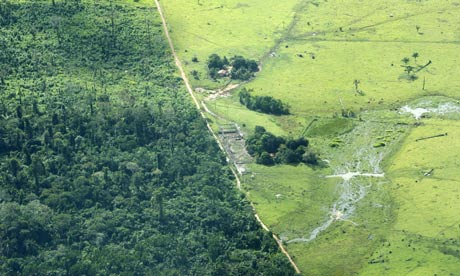
Aerial view of cattle farm in Amazonian deforested jungle close to Maraba

An aerial view of a cattle farm in a deforested area of the Amazon close to Maraba, Para. Photograph: Paulo Whitaker/Reuters

Brazil's president Lula has approved a controversial law which grants land rights to squatters occupying land in the Amazon — campaigners fear it will result in a further increase in deforestation of the Amazon region.

The law – known as "provisional measure 458" – is one of the most controversial environmental decisions of Lula's two terms in office, with the president coming under intense pressure from both environmental groups and the country's powerful agricultural lobby.

Marcelo Furtado, Greenpeace's campaigns manager in Brazil, said the approval of the law showed that Brazil's policy on global warming was contradictory: "On one hand Brazil is setting targets for the reduction of carbon emissions and on the other it is opening up more areas for deforestation."

Brazil's government says more than 1m people will benefit from the law, which covers 67.4m hectares of land, an area roughly the size of France. It believes the law will reduce violent conflicts by giving people private ownership of the land they live on, and will make it easier to track down those illegally felling trees.

But environmentalists – who have dubbed it the "land-grabbers bill" – fear the new rules will offer a carte blanche for those wanting to make money by destroying the Amazon. They say the law effectively provides an amnesty for those who have devastated the Amazon over the last four decades. Around 20% of the Amazon has already been lost, according to environmental campaigners, and deforestation globally causes nearly a fifth of all greenhouse gas emissions.

"This measure perpetuates a 19th century practice [of Amazon destruction] instead of taking us towards a new 21st century strategy of sustainable development," said Furtado.

Furtado said the law – originally intended to benefit impoverished farmers in the Amazon – had been "hacked apart by the agricultural lobby" and now benefited wealthy farmers rather than smaller landholders. The result, he said, was "a law which will not help increase governance [or] social justice but which simply raises the risk of more deforestation."

Under the new law, small landowners who can prove they occupied lands before December 2004 will be handed small pieces of land for free, while large areas will be sold off at knockdown rates. The government hopes this will help bring order to a region where land disputes often result in violent clashes and murder. Brazilian human rights group Justica Global, claims 772 activists and rural workers have been killed in the Amazon state of Para between 1971 and 2004.

Human rights groups also criticised the law, saying unscrupulous Amazon ranchers, who often exploit slave labour, stood to gain from the new rules.

Faced with a vocal campaign against the measure, Lula hit back, accusing "the NGOS [of]… not telling the truth."

In the decision, which came late on Thursday, Lula vetoed two of the most divisive sections of the bill – giving private businesses and absentee landowners the right to regularise their lands. But the Brazilian president gave the green light to one of the most controversial clauses, which will give new landowners the right to resell their properties after three years.

Amazon deforestation in 2009 declines to lowest on record

June 22, 2009
From: mongabay.com
News Link: http://news.mongabay.com/2009/0622-brazilian_amazon.html

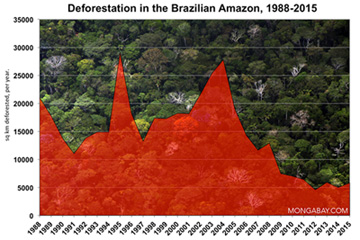
Annual deforestation in the Brazilian Amazon fell below 10,000 square kilometers for the first time since record-keeping began, reported Brazil's Environment Minister Carlos Minc on Sunday.

Minc said preliminary data from the country's satellite-based deforestation detection system (DETER) showed that Amazon forest loss between August 2008 and July 2009 would be below 10,000 square kilometers, the lowest level in more than 20 years. Official figures are due out in August or September.

Falling commodity prices, which have reduced financial incentives to chop down trees and restricted agricultural credit to ranchers and farmers, and government action to crack down on illegal clearing are credited for the decline in deforestation.

Conversion to cattle pasture accounts for roughly 80 percent of deforestation in the Brazilian Amazon. Pasture is used for beef production as well as to speculate on rising land prices.

Nearly 20 percent of the Amazon has been cleared since the 1970s, but the Brazilian government has recently committed to significant reductions in deforestation under its climate change mitigation plan. The country aims to raise more than $20 billion in donations from industrialized countries to fund forest conservation.

Thursday, June 25, 2009

New Development and Ecosystem Service Roadkill

June 25, 2009
From: Ecosystem Marketplace
News Link: http://ecosystemmarketplace.com/pages/article.opinion.php?component_id=6906&component_version_id=10413&language_id=12

Rainforest nations could earn billions in carbon payments by reducing greenhouse gas emissions from deforestation and forest degradation (REDD), but many are pursuing short-term growth strategies that will ultimately cost them – and the world – dearly. A new study says that road development in the Amazon will damage both the global environment and the Brazilian economy.

25 June 2009 | "However unpalatable road-building is, it may be needed if the people who live in the Amazon are to lead a better life."

That's the June 13 Economist referencing a controversial proposal to pave Brazilian federal highway BR-319, a muddy stretch of road between the Amazon cities of Manaus and Porto Velho. The statement reflects the kind of common-sense thinking normally presented as hard-nosed economic reasoning, but it misses a hard-nosed economic fact: namely, that the project's direct costs are greater than its benefits and could squander chances for even greater long-term income in the form of carbon payments generated by reducing emissions from deforestation and degradation (REDD).

That's the conclusion of research recently completed by Conservation Strategy Fund (CSF, see related links, right), which found that for every dollar invested in BR-319, around 33 cents in benefits would be generated. Further, the US$265-million project would directly lead to a better life for only a few hundred people already living near the proposed blacktop. It comes to roughly half a million dollars per person – hardly an efficient way to pull rural people out of poverty.

Indeed, the study found that the road's overall economic loss to Brazil's economy would be around US$150 million in present value terms, and that's not including the lost REDD income.

Killing the Goose


Losing money now is one thing. Losing it forever is quite another, but that's just what roads like this one could mean.

That's because 80% of Amazon deforestation takes place within 30 miles of roads, and many of the carbon-storing trees along the BR-319 will be felled once the road opens. A team led by Britaldo Soares Filho from the Federal University of Minas Gerais estimated that around four million hectares (10 million acres) of forest would be cleared over the next 20 years if the road is built. That would send around two billion tons of CO2 spiraling into the skies.

Seen another way, the inefficient investment in the road creates a distortion in land-use markets by subsidizing products with high transportation costs. These are low value-to-volume goods such as timber, cattle and soybeans. Carbon storage, on the other hand, has transport costs of, well… zero. Indeed, despite the current debate over carbon stored in harvested wood products, REDD credits derive their value from the fact that the trees are not to be transported.

The Coming Carbon Bonanza


The atmospheric environmental service forests could offer might actually compete favorably with forest clearing, but not yet. Tropical forest protection is now squarely on the agenda for the climate protection agreement that will kick in when the Kyoto Protocol expires in 2012. That means that tropical forest countries stand a chance of getting cash – either out of a centralized fund or in market transactions – for bringing deforestation below an agreed upon reference level.

But an agreement is still some ways off, as negotiators hash out the details and hope that enough money will materialize from rich countries to pay for this potentially massive reduction in deforestation. Tropical countries have plenty of work before they're ready: they must estimate how much carbon their forests now store, set targets, get conservation policies in place, and build up monitoring and enforcement capacity.

Irreconcilable Differences?


In the meantime, some officials suggest that BR-319 and other forest roads can be deforestation-free, or close to it. Protected areas are the key, they say, and indeed, state and federal agencies have declared or proposed a total of 28 protected areas all along BR-319's route. Success in blending transportation and conservation on this scale would be a monumental accomplishment.

But that will take money. CSF-Brasil joined an official government-NGO working group to help cost out the protection of those 28 areas. The price: US$233 million in present value terms. The transport ministry has offered up a paltry US$19 million.

Carbon funds could someday help close that gap, paying for protection that benefits biodiversity and – if done right – preserving traditional uses practiced by forest peoples. Indeed, some Amazon states are forging ahead with projects aimed at the voluntary carbon market to do just that. But a comprehensive, national approach will be needed to attract enough money and avoid simply pushing deforestation from the BR-319 corridor to someplace else in the Amazon.

Chevron's Amazon 'fake cleanup' trial

June 25, 2009
From: United Press International
News Link: http://www.upi.com/Energy_Resources/2009/06/25/Chevrons-Amazon-fake-cleanup-trial/UPI-23901245936759/

A report submitted this week to a court in Ecuador finding dangerous levels of contamination at oil wells Chevron says it cleaned up in the 1990s is expected to reinforce a fraud indictment against two Chevron lawyers in a $27.3 billion environmental lawsuit against the oil company.

Seven Ecuadorian officials were also included in the indictment last September for helping the Chevron lawyers orchestrate a fake cleanup of toxic waste at two oil wells in the 1990s.

Chevron dumped more than 18 billion gallons of toxic waste into Amazon waterways from the mid-1960s to 1990.

The disaster was dubbed the "Amazon Chernobyl" by the international media for the extent of destruction of pristine rainforest an area the size of Rhode Island, and which is estimated at 30 times worse than the Exxon Valdez spill.

Texaco entered Ecuador's rainforests in the mid-1960s, and at the time it was the sole operator of the largest oil concession in the rainforest.

Chevron is also accused of creating nearly 1,000 unlined waste pits for toxic sludge that seeped into groundwater that Amazon residents drank.

It is also accused of being responsible for hundreds of oil spills.

Health studies have shown that cancer and other toxic-related health problems have spiked among indigenous Amazon tribes and other communities in the area.

Texaco claimed to have "remediated" the 45 sites in question between 1995 and 1998 with an extensive cleanup.

But Pablo Fajardo, an Ecuadorian lawyer who is representing the communities in the northern Amazon in the class-action lawsuit, said the so-called remediation was little more than the dumping of dirt over a few toxic waste pools.

Independents tests, including from Chevron itself, have shown massive levels of life-threatening toxins still residing in the northern Amazon area where the oil company operated.

Earlier this year Chevron requested eight more inspections, a move that the plaintiffs argued was a last-ditch attempt to delay the end of the trial.

The latest results of two sites that were purportedly "remediated" showed toxin levels several times above permitted levels.

The findings were consistent with all the earlier tests. A damages assessment made last year on all 45 sites showed toxic levels beyond the legal limit, in some cases thousands of times higher.

With damages estimated at between $7.2 billion and $16.3 billion, the lawsuit is expected to result in one of the largest civil judgments in history.

Fajardo was named last December as a CNN "Hero" for leading the fight to hold Chevron accountable.

Chevron claims the trial is a "farce" and "rigged" and in full expectation of an "adverse" decision is preparing to appeal.

In 1992 Texaco turned over its entire operation to Ecuador's state-owned oil company Petroecuador, which, studies show, is continuing to contaminate the environment.

New book seeks truth in the rainforest

June 24, 2009
From: MMD Newswire
News Link: http://www.mmdnewswire.com/joel-harris-5305.html

VENICE, Calif. (MMD Newswire) June 24, 2009 -- Journal: Into the Heart of the Amazon in Search of Truth by Joel Harris is an autobiographical account of the author's journey to a small Shipibo village in Peru on the edge of the Amazon rainforest, where he worked with plant medicines and shamanic healers, encountered his deepest fears, and discovered what he describes as the ultimate truth.

"This is my personal journal that shows the progression of my thoughts and beliefs, first asking questions and then finding answers," Harris says. "I wanted to find the truth about our current problems and I also wanted to know myself better - to understand why I am here."

Intended to serve as a wake-up call to readers, the book discusses the "expansion of consciousness" and inner reflection that, according to Harris, leads to a revelation of personal truth. Featuring actual journal entries from the time the author spent in Peru, the book also offers photographs and original illustrations to depict important events.

For more information or to request a free review copy, members of the press can contact the author at info@joelharrisstudio.com. Journal: Into the Heart of the Amazon in Search of Truth is available for sale online at Amazon.com and other channels.

About the Author
Joel Harris is an independent artist and musician. A former Marine, he once sold everything he owned and traveled to Europe to volunteer on organic farms in France and Spain. Journal, Harris's first published work, recounts his experiences living in the native Shipibo community near Pucallpa in the jungles of Peru. A resident of Venice, Harris paints full-time and showcases his work in numerous galleries.

Johanns joins protest against EPA land use theory

June 24, 2009
From: Biodesel Magazine
News Link: http://www.biodieselmagazine.com/article.jsp?article_id=3564

Sen. Mike Johanns (R-Neb.) sent a letter to EPA administrator Lisa Jackson last Thursday criticizing EPA’s indirect land use modeling, which has an impact on the implementation of RFS2.

“According to this theory, an increase in production of biofuels in the United States results in decreased grain exports to other countries, which in turn leads those countries to cut down their forests to plant more crops,” Johanns stated in an official release. “However, deforestation in the Amazon Rainforest has actually decreased since U.S. [biofuels] production began to increase significantly in 2005.”

Also, Johanns requested that the public comment period regarding implementation of RFS2 be extended by 120 days. “I hope that the outcry from industry helps the cause to modify the implementation of RFS2,” said Debbie Borg, president of the Nebraska Soybean Association. “Sen. Johanns joining in is very welcomed because he is a former Secretary of Agriculture with a lot of experience and credibility in this area.”

“The bottom line is this—the theory connecting [biofuels] production to changes in land use thousands of miles away is fundamentally flawed,” Johanns said. “Even worse, the methods EPA wants to use are unscientific, unsubstantiated and not based on facts. If EPA incorporates indirect land use in this manner when implementing the RFS, it will be very costly for farmers…and could actually increase our dependence on foreign energy."

New book seeks truth in the rainforest

Wednesday, 23 June 2009
From: MMD Newswire
News Link: http://www.mmdnewswire.com/joel-harris-5305.html

Journal: Into the Heart of the Amazon in Search of Truth by Joel Harris is an autobiographical account of the author's journey to a small Shipibo village in Peru on the edge of the Amazon rainforest, where he worked with plant medicines and shamanic healers, encountered his deepest fears, and discovered what he describes as the ultimate truth.

"This is my personal journal that shows the progression of my thoughts and beliefs, first asking questions and then finding answers," Harris says. "I wanted to find the truth about our current problems and I also wanted to know myself better - to understand why I am here."

Intended to serve as a wake-up call to readers, the book discusses the "expansion of consciousness" and inner reflection that, according to Harris, leads to a revelation of personal truth. Featuring actual journal entries from the time the author spent in Peru, the book also offers photographs and original illustrations to depict important events.

For more information or to request a free review copy, members of the press can contact the author at info@joelharrisstudio.com. Journal: Into the Heart of the Amazon in Search of Truth is available for sale online at Amazon.com and other channels.

About the Author
Joel Harris is an independent artist and musician. A former Marine, he once sold everything he owned and traveled to Europe to volunteer on organic farms in France and Spain. Journal, Harris's first published work, recounts his experiences living in the native Shipibo community near Pucallpa in the jungles of Peru. A resident of Venice, Harris paints full-time and showcases his work in numerous galleries.

Brazil's Amazon ownership plans resisted

Tuesday, 23 June 2009
From: United Press International
News Link: http://www.upi.com/Energy_Resources/2009/06/23/Brazils-Amazon-ownership-plans-resisted/UPI-85231245777400/

Brazilian President Luiz Inacio Lula da Silva is under heavy pressure to veto parts of a controversial bill that is intended to transfer an area of Amazon rainforest the size of Texas to small-farm owners to ease tensions over land ownership, but which could spark a new wave of land grabbing.

Critics say the measure will in effect give amnesty to Amazonian land dwellers who hold no legal titles to the land they claim.

But the government thinks the bill, called Provisional Measure 458, is a way to solve violent land disputes in the Amazon area and to prevent illegal deforestation.

Lula has criticized detractors and says he simply wants to settle the uncertainties of hundreds of thousands of small farmers by giving them ownership of land "to see if we can end the violence in this country."

The bill will hand over 259,000 square miles of state-owned Amazon rainforest to private hands.

Rights groups think the move will send a signal that crime goes unpunished in the Amazon.

Critics also say that new amendments to the bill that were inserted by Congress will actually encourage deforestation by allowing buyers to sell on their properties to big landowners and exploitation industries.

Early drafts of the measure stated that the largest territories would go up for auction at market prices, and buyers would be given 20 years to pay. But conservation groups point out that Congress made a later amendment permitting the land to be resold after only three years.

Environmentalists say this will encourage speculators to buy up estates in order to quickly turn them over to the highest buyers, which are likely to be large mineral and logging companies.

They also say that the government's inability to verify the status of buyers or to track real estate deals opens up the possibility that lands will be registered by front companies or middlemen acting on behalf of wealthy landowners.

The measure rules that medium-sized areas will be sold for a token sum, while the smallest parcels of land (less than 100 hectares, or 247 acres) would be given for free.

In a separate plan, specifically meant to slow rainforest degradation, Lula announced last Friday that his government would pay small farmers to plant trees in heavily deforested parts of the Amazon.

Called the "Green Arch" proposal, small farmers will be paid up to $51 per month to reforest degraded lands, he said, without giving further details.

The government claims that it has successfully reduced deforestation to its lowest level in 20 years, but that its target is to reduce deforestation by 70 percent by 2018.

Deforestation in Brazil's Amazon rainforest down 88% in May

Wednesday, 24 June 2009
From: Xinhua News
News Link: http://news.xinhuanet.com/english/2009-06/25/content_11597460.htm

Deforested area in Brazil's Amazon rainforest was 123 square km in May, down 88 percent from the same period last year, according to a study released on Wednesday.

However, the deforestation in May was higher than the monthly average of 65.7 square km for the period from February to April, said the study done by the National Institute for Space Research (Inpe).

The satellites over the Amazon rainforest managed to have visualized only 38 percent of the area in May due to thick clouds.

The midwest Mato Grosso state registered the largest deforested area of 61.2 square km, almost half of the total devastated area, because of higher visibility in the region, said the study.

Rainforest in Rondonia and Para states, which saw the highest deforestation rates in the previous months, contracted by 11.7 and 10.5 square km respectively.

Since August last year, a total of 2,957 square km of rainforest have been lost, according to official figures.

Stunning images of the Amazon rainforest from award-winning photographer

Wednesday, 24 June 2009
From: The Independent
News Link: http://www.independent.co.uk/news/world/americas/stunning-images-of-the-amazon-rainforest-from-awardwinning-photographer-1717557.html


Award winning photographer Daniel Beltrá has released new images of his trip to the Amazon Rainforest.

The Spanish born photographer won a fully funded assignment to document the three major rainforest regions of the world, beginning with the Amazon, after receiving the Prince's Rainforests Project (PRP) prize at the Sony World Photography awards.

Beltrá said of his trip: "Travelling to the Amazon has been an incredible experience and I have been able to capture some powerful images that show the many different elements of the rainforest – the beauty, the wildlife, the local people and also the destruction“

"It has been an eye-opening journey so far and I’m looking forward to photographing the Central African and South East Asian rainforests on the next parts of my trip. I hope the photos I produce will make a strongly persuasive argument for emergency action to preserve the world's tropical rainforests."

Beltrá's images will be on display in a new interactive exhibition on the rainforest opening at Kew Gardens in October 2009.

The Prince's Rainforest Project Award is designed to increase enviromental awareness and has launched its own website, www.rainforestSOS.org, to publicise the problems associated with rainforest destruction.

Wednesday, June 24, 2009

It's Charles and Camilla's economy drive – she even has to wear the same dress twice

Tuesday, June 23, 2009
From: guardian.co.uk
News Link: http://www.guardian.co.uk/uk/2009/jun/23/prince-charles-spending-review

Prince Of Wales And Duchess Of Cornwall Wales

Charles and Camilla walk through the garden at Llwynywermodon. Photograph: Chris Jackson/Getty Images

For a royal who was once rumoured to ask his valet to squirt toothpaste on to his toothbrush for him, the idea of belt-tightening may seem alien. But even the Prince of Wales is feeling the pinch from the recession.

Despite being one of the country's richest landowners, with a £600m estate to bankroll everything from his eco-friendly Aston Martin sports car to ski holidays in Klosters, the heir to the throne responded to the economic crisis by slashing his personal spending last year by £500,000, according to figures published in an annual review.

By ordinary standards, the cutbacks could hardly be described as brutal, but they suggest a prince who is at least attempting to economise. He has, the review revealed, opted to take holidays with his wife at his home in Scotland rather than travelling to Switzerland on expensive ski trips as he has done in previous years. The Duchess of Cornwall did not take a sailing holiday with friends in the Greek islands as she has often done and wears the same dresses several times, a recycling habit also picked up by the prince who said to be getting more wear out of his suits, courtiers said.

With echoes of his mother's rumoured habit of wandering the corridors of Buckingham Palace switching off lights to save money, Charles also clamped down on the use of electricity across his household and installed energy monitors in offices which allow staff to be named and shamed if they use abnormal amounts of power. His sons also felt the tightening of their father's purse strings. Their new joint household was established with just six staff, compared with Charles's retinue of 125.

To anyone who recalls the prince's decision to hire a 245ft superyacht for an official tour of the Caribbean in 2008, or the private jet with its own shower he chartered at a cost of £300,000 to visit the Amazon rainforest earlier this year, the idea of the prince cutting costs might seem improbable. But Sir Michael Peat, the prince's principal private secretary, revealed his personal spending fell from £2.2m to £1.7m in the year to 31 March 2009 as a result of a "salami slicing" exercise in which the amount spent on Charles's personal staff, including an undisclosed number of valets, butlers and cooks, has been reduced.

Aides to the prince said the economy drive has come in direct response to the economic turmoil facing the country and "the difficulties the Duchy of Cornwall [the estate that provided the prince with a £16.5m private income last year] may face at a time of recession".

His finances have been cushioned by careful management of the Duchy of Cornwall's assets, including the crucial decision to sell all its shares in December 2007 before the stock market collapse. He also switched assets into government bonds and cash and sold between £30m and £40m of commercial property before a slump in the market. The moves meant that while other millionaires' fortunes went into freefall, the Duchy's capital account fell just 7% from £647m to £599m.

"The Duchy of Cornwall is a ship that has been built to sail in all weathers," said Peat. "We entered the recession without having a great boom before the recession which means we are not suffering a bust at the moment."

But the prince's private economy drive was not matched in his public life as his cost to the taxpayer jumped 23.5% from £2,454,000 in 2008 to £3,033,000 this year. The main additional cost came from a 48% rise in official travel by air and rail which rose from £1.2m to £1.7m. His major foreign tours, first to Japan, Brunei and Indonesia and then Brazil, Chile and Ecuador cost the taxpayer more than ever at around £500,000 each and came as part of a travel bill that rose 47% to £1.7m.

Publication of the latest accounts, which revealed that the prince's tax bill went down last year while his income rose, was met with calls for greater transparency. Charles paid £3.1m in tax on an income of £16.5m from the Duchy of Cornwall, an effective tax rate of 19%, and received government funding of £3m. He didn't pay tax on £12.5m worth of income because he said he spent it carrying out official duties. His overall tax bill fell by 10% in a year.

"We need to have absolute confidence from the Inland Revenue that the same rules are being applied to Prince Charles as everyone else and I don't think they are," said the Liberal Democrat MP Norman Baker.

Peat said: "It is the law of the land that people's tax returns are private, for the prince and everyone else. To my knowledge, no one else gives as much detail about how he spends private money as the prince does."

Clean heir act

For the second year, the prince has declared the carbon footprint of his ­activities. His results show a drop, from 2,795 tonnes of carbon dioxide to 2,601 – a 24% reduction since he started the measurements.

Charles is therefore on the brink of meeting his stated target, that of ­cutting a quarter from his household's carbon impact by 2012.

The savings came from the use of new energy-efficient condensing ­boilers at Clarence House, and woodchip boilers at Highgrove, his Gloucestershire home, at Birkhall, on the Balmoral estate, and at Llwynywermod, his estate in Wales. Several of the prince's cars run on used cooking oil and his beloved 39-year-old Aston Martin uses as fuel bioethanol made from surplus English wine.

His total CO2 emissions from energy use have fallen from 917 tonnes in 2007 to 530 tonnes today. But the environmental impact of the prince's travelling soared from 962 tonnes of CO2 to 1,253 tonnes. In February, he was criticised for using a private Airbus A319 jet to go on a 16,400-mile round trip to South America where he spoke about the problem of deforestation in the Amazon and global warming. The plane had been converted from a capacity of 134 passengers to carry just 29.

The New Republic: The Lorax Was Right

Tuesday, June 23, 2009
From: NPR.org
News Link: http://www.npr.org/templates/story/story.php?storyId=105799907

Deforestation in the Brazilian Amazon is an ongoing ecological disaster, causing massive biodiversity loss and major carbon-dioxide emissions. But unfortunately, there are also strong economic incentives for rural Brazilians to hack down rain forest. Not only can they make money selling the timber, but they can then raise cattle and plant crops on the cleared land. But here's a question: Has all this deforestation produced any sort of sustained economic growth in Brazil's hinterlands? A recent paper in Science, based on a study of 286 Brazilian municipalities with varying histories of deforestation, has concluded that it has not. Areas that cut down their rainforest do see a short-term boost in per-capita income, life expectancy, and literacy rates. But once the trees are gone, those gains disappear, leaving deforested municipalities just as poor as those that preserved their forests.

It's a stunning find. After all, shouldn't cleared rainforest land that's been converted to farming or ranching continue to produce income more or less indefinitely? As it turns out, no. Soil in the Amazon region is fairly poor and starts to decline in productivity after a few years of farming. This depletion of the soil is a major reason why per-capita income generally ends up dropping to pre-deforestation levels.

So if deforestation in the Amazon is a lose-lose proposition in all but the most shortsighted of timeframes, what can be done to stop it? There's no shortage of proposals for forestry-based carbon offsets and other systems of paying people to leave the forest intact. But in order for these payment systems to work, it's necessary to determine who actually owns which parts of the forest in the first place. In Brazil, that's easier said than done. A recent Economist article cited a study finding that only 14 percent of private land in the Amazon is backed by a secured title. The rest of the privately controlled land in the region is either "owned" on the basis of fake documents or simply occupied by squatters.

The Brazilian legislature recently passed a land-reform law that would attempt to bring some order to this free-for-all by granting formal titles to most of the current occupants of land in the Amazon, while returning the largest squatter-occupied parcels—those in excess of 1,500 hectares—to the government. Brazil's president, Luiz Inacio Lula da Silva, is likely to sign the bill, though he plans on vetoing provisions that would allow corporations and foreigners to receive titles to Amazonian land. Environmental groups are divided on whether land reform is a good idea. On the one hand, it's difficult to regulate land use—or incentivize conservation—in the absence of clear land ownership. On the other hand, giving titles to squatters could encourage others to start squatting on remaining government land even deeper into the Amazon.

The key to making land reform work will be figuring out how to keep these future squatters at bay. It won't be easy: As this New York Times article relates, the Brazilian environmental protection agency is almost comically understaffed for cracking down on illegal logging and settlement in an area as large as the Amazon. But until Brazil can get control of its forest frontier, the environmental devastation will continue, leaving nothing but the same old poverty in its wake.

Tuesday, June 23, 2009

Amazon bill controversy in Brazil

Tuesday, June 23, 2009
From: BBC News
News Link: http://news.bbc.co.uk/2/hi/science/nature/8113952.stm


Rainforest destruction in Brazil
Brazil's disappearing rainforests have long been of concern

Brazilian President Luiz Inacio Lula da Silva is due this week to make one of the most keenly awaited decisions about land ownership in the Amazon rainforest.

The president has to decide by 25 June whether to veto parts of a bill that is due to transfer an area of public land - estimated to be around 670,000 square kilometres (259,000 square miles) - into private hands.

The government originally introduced what is called "Provisional Measure 458" as a way of bringing security to small farm owners in the Amazon region.

But critics say the proposal amounts to an amnesty for land-grabbers, and that the original measure has been altered by Congress in a way that will only serve to encourage deforestation.

Uncertainty over land ownership has long been a cause of violent conflict in the Amazon region, and presented an enormous obstacle for the authorities in their efforts to prevent illegal deforestation.

It was in order to tackle this issue the government introduced the proposal to transfer a vast area of land, roughly the size of France, into private hands.

'Huge pressure'

The so-called "provisional measure" was meant to settle the question of ownership of hundreds of thousands of properties where those who occupied the land before 2004 had never been formally granted legal title.


The smallest areas, of less than 100 hectares (247 acres), would be handed over for free; medium-sized territory would be sold for a symbolic value, while larger estates of up to 1,500 hectares (3,707 acres) would be auctioned at market prices, but with 20 years allowed to make a repayment.

However, changes to the law mean the largest areas could then be sold on after a period of three years instead of 10, and critics fear this will lead to further exploitation of the rainforest.

Environmental groups have also complained that the law may allow lands to be registered by companies or by frontmen acting on behalf of large landowners.

Greenpeace says it was expecting the decision last week, but the fact that it did not come is a sign of division within government, and an indication of the huge pressure on President Lula, who it says is receiving thousands of phonecalls and e-mails on the issue.

"We know that within his government there is a lot of tension between the ministries of agriculture and environment, land reform and strategic studies," Marcelo Furtado, executive director of Greenpeace in Brazil, told the BBC News website.

"If he did not decide on any of the vetoes last week, our reading is that it is a bad indication that eventually the big landowners are actually having an impact on his approach."

"We are extremely concerned."

Mr Furtado says the bill, as it was originally presented, was already deeply flawed "in terms of the areas that would be privatised, in terms of who would have access to the land, in terms of lack of verification from any government authority on the status of the land".

"The problem is what we are finding in the Amazon is either the attitude of 'I am not going do anything because I am sure we will win this fight and change the law and make all the deforestation I have legal'," he said.

"Or the other attitude is that because there is so little governance here, because the government is so absent the truth is that we can just keep cutting down the forest and nothing will happen to us."

"This bill will be a major signal indicating to the people who enjoy impunity that it is worth committing a crime in the Amazon."

Divided society

Not surprisingly, supporters of the measure dispute this assessment, and point as well to other initiatives that are under way in the Amazon.

On Friday, the Brazilian government announced its so-called "Green Arch" proposal in which it will pay small farmers up to $51 (£31) per month to reforest degraded lands in 43 municipal areas where deforestation is a major issue.

The government has also set a target to reduce deforestation by some 70% by 2018, and says the indications from recent months are that it will be at its lowest level in two decades, due in part to an increase in policing measures.

President Lula says non-governmental organisations are "not telling the truth" when they say that the provisional measure will encourage land grabbers.

"What we exactly want to do is to guarantee that people have ownership of land, to see if we can end the violence in this country," he said last week.

"This is what we want to do, and this is what we are going to do," the president insisted.

There is a consensus that the issue of land ownership badly needs to be sorted out in the Amazon - but it seems this bill has not built on that common ground.

The heated debate over the measure has once again highlighted the divide in Brazilian society between a strong agricultural lobby keen to promote development, and environmental groups who fear for the future of the Amazon.

Whatever decision President Lula takes, it is unlikely to be free from controversy.

Meat companies sued over deforestation of Amazon

Tuesday, June 23, 2009
From: Taipei Times
News Link: http://www.taipeitimes.com/News/worldbiz/archives/2009/06/23/2003446883

Brazilian authorities investigating illegal deforestation have accused the suppliers of several UK supermarkets of selling meat linked to massive destruction of the Amazon rainforest. Brazilian firms that supply Tesco, Asda and Marks & Spencer are among dozens of companies named by prosecutors, who are seeking hundreds of millions of dollars in compensation.

The move follows a three-year investigation by Greenpeace into the trade in cattle products such as meat and leather traced to illegal farms across the Amazon region. The Greenpeace report showed that a handful of major Brazilian processors exported products linked to Amazon destruction to dozens of blue-chip companies across the world.

‘DESTRUCTIVE CHAIN’


Daniel Cesar Avelino, the public prosecutor handling the cases, brought by Brazil’s public prosecution office (MPF), said: “We know that the single biggest driver of deforestation in the Amazon is cattle. We want all companies who are part of this destructive economic chain to be responsible for their economic crimes.”

The MPF has started legal action against 21 farms and slaughterhouse companies, including Bertin, which supplies Tesco and Princes Food with processed beef. The MPF said the Brazilian companies could be to blame for deforestation across 150,000 hectares. It is seeking £630 million in compensation for “environmental crimes against Brazilian society.”

Bertin said it was “analyzing the content of the [legal] action to respond later.”

The MPF also warned 69 other firms said to have bought products associated with illegal deforestation, including JBS, which supplies Princes Foods, Asda and M&S.

RESPONSE

JBS would not comment. Several supermarkets in Brazil, including Wal-Mart, have already banned beef from deforested areas.

John Sauven, executive director of Greenpeace, said: “Major supermarkets in Brazil have promised action to remove Amazon beef and leather from their stores, and now it’s time that UK companies did the same ... we need to see British firms canceling contracts with suppliers who are implicated in Amazon deforestation.”

The UK supermarkets said the beef did not come from the Amazon. Tesco and M&S said they had received assurances from their suppliers. Asda said it was sending inspectors to Brazil.

Princes Foods said: “We have contacted both suppliers to discuss the claims in detail, and they are liaising directly with Greenpeace. We will monitor the outcome of these discussions closely.”
This story has been viewed 400 times.

Liberty students raise $500 for Rain Forest Project

Tuesday, June 23, 2009
From: Oregon Live
News Link: http://www.oregonlive.com/news/argus/index.ssf?/base/news/1245783014192440.xml&coll=6

Students from Liberty High School's Rainforest Project have donated a check for $500 to the Amazon Conservation Association, an organization that works to protect the biodiversity of the Amazon.

The goals of the LHS Rainforest Project are to both educate the Liberty High School student body about the Amazon Rainforest and it's indigenous people, as well as to raise money for non-profit organizations such as the Amazon Conservation Assoc. The club works to educate the student body at Liberty, by posting facts of the month about the Amazon Rainforest, sponsoring Rainforest Appreciation Day at school, and making short films and other advertisements that are posted during the morning LTV announcements.

The club members have raised funds by donating their time during lunch periods on what the students like to call "Rainforest Fridays." They sell items such as fair trade jewelry from South America, tree hugger bracelets, hand painted canvas bags and healthy snacks.

The Amazon Rainforest: Worth the Fight?

Tuesday, 23 June 2009
From: Scoop Independent News
News Link: http://www.scoop.co.nz/stories/WO0906/S00323.htm

Brazil is home to one-third of the world’s rainforest and half of the Amazon. Between its vast rainforests and bodies of water, Brazil hit the planet’s natural resource jackpot, although both are rapidly disappearing habitats. Despite its ecological wealth, Brazil has stated that international climate change is a burden that should be shouldered by both the developed and developing worlds. It also shortsightedly contends that each nation should take environmental action based solely on an inventory of its own needs. Among the world’s top ten largest emitters of greenhouse gases, Brazil needs to step up its actions in order to counteract deforestation and climate change. Moreover, this is an international issue that the rest of the world cannot sit idly by and wait for Brazil to join in and do its share in coping with the problem.

Recent Flooding a Wake-up Call to Climate Change
Increasingly severe weather irregularities are making Brazil’s environmental issues of more pressing importance to national and global policies. The existence of climate change no longer appears to be much of a debate for Brazil, in light of the unusual and frightfully destructive flooding in the north this May that killed forty-four people and left more than 180,000 homeless. This is not to say that flooding is not uncommon in the Amazon region given its heavy annual rainfall, but the fact that it came in such unexpected quantities implied that there is climate change already occurring at disturbing magnitudes. This has been compounded by droughts in the south that were the worst Brazil has seen in 80 years. Another side effect of climate change has been the desertification of the northeastern Sertão region, a semi-arid region that suffers from comparatively low rainfall and droughts. Its caatinga scrub-forest vegetation has also suffered similar environmental degradation as it too has been mainly destroyed by cattle farming. “Brazil is feeling climate changes that are happening in the world, when there is severe drought in areas that don’t have drought, when it rains too much in places where it doesn’t rain,” observed Brazilian President Luiz Inácio Lula da Silva in his weekly radio talk after the flooding. This is quite a statement from a known skeptic of environmental matters, as he is only now admitting that the world needs to be more careful with the planet as a whole.

Brazil’s recent bout of flooding has brought to the forefront the fact that the partial destruction of the Amazon rainforest is a significant culprit of global warming. As the rainforest is one of the largest natural resources, when properly functioning, it actually counteracts the global pollution. Presently, Brazil’s contribution to global pollution levels at this point stems almost entirely from the destruction of the rainforest, as 75 percent of Brazil’s contribution to global greenhouse emissions is a result of deforestation. Brazil’s tropical climate is extremely influential to climate change and is particularly delicate in terms of its ability to store carbon and the amount of rainfall produced. Consequently, given the fragile environmental conditions in Brazil, deforestation of hills, slopes, and river banks also contribute to the severity of recent flash floods and landslides.

International Involvement
Climate change does not take borders into account. In spite of Brazil’s concerns over its national sovereignty, the international community needs to recognize that Brazil needs the assistance of the rest of the world in order to police illegal rainforest activities and help create alternative sources for jobs. This would allow Brazil to continue improving its quality of life and prudently develop economically without destroying the rainforest. The international community, through foreign governments, businesses, non-profits and foundations, needs to be involved in preparing funds for enforcement of existing environmental legislation and the introduction of technology that would make better use of the world’s resources in order to protect the rainforest. These funds would be used not only to curb illegal logging, but also finance sustainable development and alternative lifestyles. There needs to be a better way to make use of already deforested land that would bring about a more efficient solution, such as developing agriculture on previously deforested areas, rather than creeping further into the vernal Amazon region.

Some countries and organizations have already heeded the call. Norway has donated $1 billion to the Amazon Fund and Germany is expected to make a substantial donation in the future. Private companies, such as Marriott Hotels, have donated $8.1 million, which is being put to create a state bank system that would allocate money to 6,000 families in exchange for their promise to preserve the trees on their land.

As suggested by its name, the UN Collaborative Programme on Reduced Emissions from Deforestation and Degradation in Developing Countries (REDD) is focusing on combating the deforestation caused by environmental degradation. It recognizes the difficulties for developing countries to choose between saving their natural resources for future generations and exploiting them for immediate profit that could be used for development. Currently, REDD has no incentives to motivate individuals or institutions towards taking the voluntary steps needed to preserve the rainforest. Initiatives are also necessary so the population can personally benefit from maintaining the Amazon rainforest as a coherent ecological entity.

The Domestic Issue
The deforestation of the Amazon is tarnishing Brazil’s reputation as a leader in renewable energy sources. There are certain issues that Brazilians need to take upon themselves, such as by the protection of the forest from cattle ranchers and loggers. The Amazon is estimated to store 80-120 billion tons of carbon, which is released into the atmosphere when each tree is cut down. According to the Brazilian authorities, the cattle industry is responsible for 80 percent of Amazonian deforestation. On average, one hectare of rainforest is destroyed every 18 seconds due to the industry.

The lack of Brazilian government oversight is proving to be a reason why the cattle sector can so easily expand into the rainforest regions illegally. Increased soy bean production began encroaching into the land previously used for cattle farming, pushing ranchers to look for other unoccupied lands to raise their cattle. The easiest and cheapest place for them to look is the Amazon rainforest due to the inability of the Brazilian government to prevent land grabbing of federal lands.
Participation on the state and national levels is needed to achieve the goal of preserving the rainforest. State governments need to enforce the laws through stricter land titles for those that legally inhabit the rainforest, as well as better policing the Amazon region without corrupt forces. Forces undermining their authority show that there must be plans and policies implemented so that ranchers do not encroach on the rainforest region and so that earmarked funds are being funneled in the proper manners.

Brazil has consistently maintained that providing the funds to prevent deforestation would be too burdensome for the Brazilian economy to bear unilaterally. However, Brazil recently proposed lending $10 billion to the International Monetary Fund (IMF), an attempt to prove that developing countries can effectively pay their loans from the IMF and at the same time provide an opportunity for developing countries to receive aid during the economic recession. If Brazil is capable of contributing to the IMF, then the vital $1.5 billion dollar budget for the Ministry of Environment is proving to be an increasingly inadequate amount for the conservation of the Amazon. The donation to the IMF demonstrates Brazil’s determination to becoming increasingly active in global issues and therefore such actions as these will serve as motivation for it to make Brazil’s environmental issues as an international priority.

Alarmingly, the current situation is not looking optimistic for the survival of the Amazon. As of now only 4 percent of Amazon land is privately owned. Bill 458, which would legalize the occupation of large deforested areas of the Amazon by local company, has already been ratified by the Brazilian Senate and is currently in President Lula’s hands. This measure is intended to regulate the situation and facilitate the enforcement of environmental laws. The legislation ignores most of Brazil’s environmental laws and justifies the illegal land-grab for personal gains.
Preventative Measures

Developing countries have come to understand the importance of reducing emissions and taking preventative measures against climate change, since they are heavily dependent on the natural orderly functioning of nature and the challenge of engaging appropriate agricultural pursuits. The deforestation of the Amazon decreases Brazil’s resilience to climate change, with the harshest effects felt by impoverished population, as the food and energy sectors of the affected regions become increasingly shaped by temperature changes.

However, there have been some positive developments to Brazil’s energy sector. As a pathfinder in the bio-fuel industry, the production of sugar cane ethanol has become the energy source for 40 percent of Brazil’s cars. Bio-fuels represent an important strategy against greenhouse gas emissions and global warming. However, such practices may lead to more environmental issues, as the lands that were once used for agriculture, farming and ranching have now become a habitat for development of the energy sector. Large scale production may have significant side effects, including contributing to pollution problems. It is certainly one of the reasons the cattle industry is being pushed further and further into the Amazon rainforest.

Since President Lula’s presidency began in 2002, he has spurred development in Brazil to bolster its position in the international community, an effort that has proved to not be environmentally sound. Only in recent years has he begun to recognize the environmental concerns of his country as an issue of importance. Fear of the erosion of sovereignty over the Amazon due to U.S. influences during the Bush Administration, made Brazil reluctant to receive outside assistance or advice. However, with the change of administration in Washington, there are efforts to reach bilateral as well as multi lateral agreements. The Obama and Lula administrations have been attempting to create the groundwork for a forest-related provision in the global climate treaty scheduled to be signed in December 2009 in Copenhagen.

Solutions
According to the Sustainable Amazon Foundation, the best hope for the Amazon would be to put a “market value” on the rainforest so its value would be officially established and paid for by Brazil, other members of the international community, and big multi-nationals who currently aid in its destruction through their support of the cattle industry. This would indicate that the rainforest was internationally protected and confirm the fact that a global initiative to protect it was now in place. The devastation is a result of business activities, and the strongest protection would be to make it worth more than the mining, farming, lumber, or cattle industries combined which presently help to destroy it, representing a rational protecting mechanism. The companies profiting from the loss of the Amazon due to cattle farms and ranchers need to take a part in paying reparations for the damages caused and to prevent future illegal movements into what should be restricted zones.

For now, Brazil and the rest of the world have to decide how important the preservation of their rainforests is to them and how much they are actually concerned about the future of the planet. The issue is no longer about what people are doing but what they are not doing. Therefore, Brazilian authorities need to be more focused and willing to reorganize their priorities. The government has begun to consider climate change as an urgent global problem that requires an adequate response from the international community, saying that “different countries bear different responsibilities for causing the problem and should face the next steps in the international effort accordingly. We are doing our part and we are ready and engaged to do even more.” If only this meant that Brazil would stop allowing deforestation and the international community would help Brazil enact the necessary measures for the preservation of the world’s greatest natural resources in the fight against global climate change.
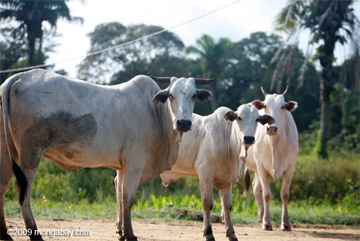
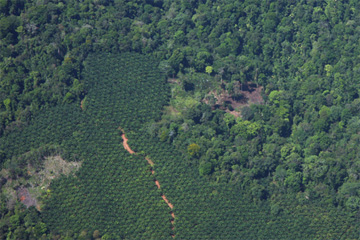
Deforestation generates short-term benefits but fails to increase affluence and quality of life in the long-run

Monday, June 22, 2009
From: Gerson Lehrman Group
News Link: http://www.glgroup.com/News/Deforestation-generates-short-term-benefits-but-fails-to-increase-affluence-and-quality-of-life-in-the-long-run-40624.html

Implications

President Lula is currently debating whether to ratify a bill that would grant legal status to illegal settlers and loggers in the Amazon region. Environmentalists say the bill would increase the rate of land-grabs, with a knock-on rise in illegal logging likely. The Amazon has been a place of violence since at least the arrival of European explorers, and the present is no exception. Violent conflicts between large landowners, poor colonists, and indigenous groups over land are not unusual in the Amazon and may be worsening.

Analysis

In many tropical countries, the majority of deforestation results from the actions of poor subsistence cultivators. However, in Brazil only about one-third of recent deforestation can be linked to "shifted" cultivators. A large portion of deforestation in Brazil can be attributed to land clearing for pastureland by commercial and speculative interests, misguided government policies, inappropriate World Bank projects, and commercial exploitation of forest resources. For effective action it is imperative that these issues be addressed. Focusing solely on the promotion of sustainable use by local people would neglect the most important forces behind deforestation in Brazil The Amazon represents more than half of the planet's remaining rain forests; it is the single largest and most species-rich tract on Earth. Just 1 square km of Amazon rain forest can contain more than 90,000 tons of living plants. The Amazon basin supplies 20 percent of the world's oxygen and nearly one third of its freshwater Historically, hydroelectric projects have flooded vast areas of Amazon rainforest. The Balbina dam flooded some 2,400 square kilometers (920 square miles) of rainforest when it was completed. Phillip Fearnside, a leading expert on the Amazon, calculated that in the first three years of its existence, the Balbina Reservoir emitted 23,750,000 tons of carbon dioxide and 140,000 tons of methane, both potent greenhouse gases which contribute to global climate change. Mining has impacted some parts of the Amazon Basin. During the 1980s, over 100,000 prospectors invaded the state of Para when a large gold deposit was discovered, while wildcat miners are still active in the state of Roraima near the Venezuelan border. Typically, miners clear forest for building material, fuelwood collection, and subsistence agriculture Fires and climate change are having a dramatic impact on the Amazon. Recent studies suggest that the Amazon rainforest may be losing its ability to stay green all year long as forest degradation and drought make it dangerously flammable. Scientists say that as much as 50 percent of the Amazon could go up in smoke should fires continue. Humidity levels were the lowest ever recorded in the Amazon in 2005