Tuesday, June 19, 2012

Protesters dig canal through Belo Monte dam in Brazil (Photos)

June 16, 2012
Source: mongabay.com

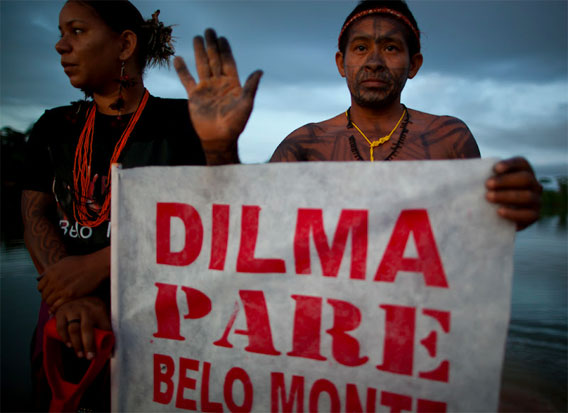
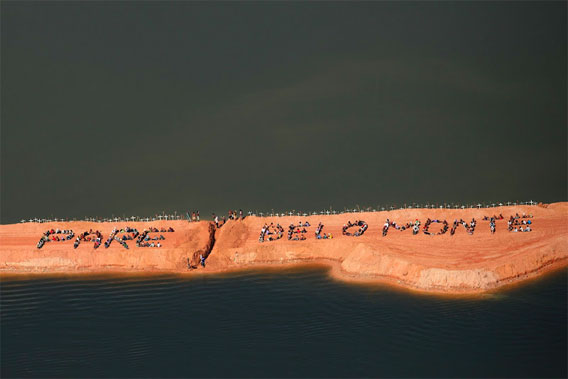
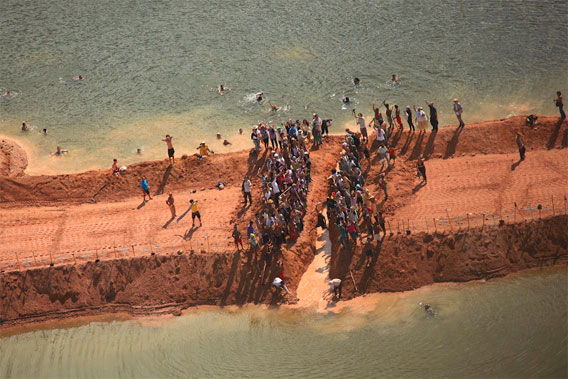
Belo Monte protest. Photo credit: Atossa Soltani/ Amazon Watch / Spectral Q.
In an symbolic protest of the giant Belo Monte Dam, Friday morning some 300 locals dug a channel in an earthen dam that blocks a portion of the Xingu River and serves as the first step for the controversial hydroelectric project, reports Amazon Watch.

"In the early morning hours, three hundred women and children arrived in the hamlet of Belo Monte on the Transamazon Highway, and marched onto a temporary earthen dam recently built to impede the flow of the Xingu River. Using pick axes and shovels, local people who are being displaced by the project removed a strip of earthen dam to restore the Xingu's natural flow," stated a press release.

The stunt was coordinated to draw attention to the project prior to the opening of the Rio+20 conference to be held next week. Demonstrators have gathered in the town of San Antonio and Altamira, a city that will be partly flooded by the dam, for Xingu+23, a multi-day protect against the dam, which was originally stopped 23 years ago by an uprising by environmentalists and indigenous groups.

"This battle is far from being over," said Antonia Melo, the coordinator of Xingu Vivo Movement against the dam. "This is our cry: we want this river to stay alive. This dam will not be built."

"We, the people who live along the banks of the Xingu, who subsist from the river, who drink from the river, and who are already suffering from of the most irresponsible projects in the history of Brazil are demanding: Stop Belo Monte."

Belo Monte will flood more than 40,000 hectares of rainforest and displace tens of thousands of people. The project will impede the flow of the Xingu, which is one of the Amazon's mightiest tributaries, disrupting fish migrations and potentially affecting nutrient flows in a section of the basin.

Environmentalists say the Brazilian government's support of the project is at odds with the green image it projects in international talks and as host of the upcoming United Nations Conference on Sustainable Development. Green groups note that Brazil is planning dozens of dams in the Amazon Basin.
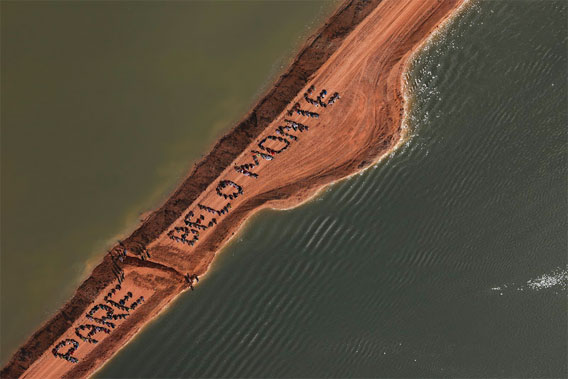
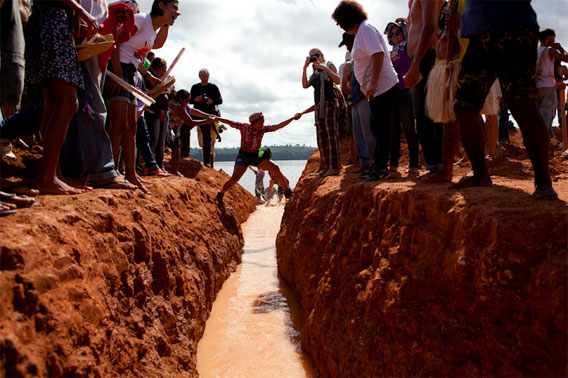
Three hundred indigenous people, small farmers, fisherfolk, and local residents occupied the Belo Monte Dam project, removing a strip of earth to restore the Xingu's natural flow and "freeing the river." Participants gathered in formation spelling out the words "Pare Belo Monte" meaning "Stop Belo Monte" to send a powerful message about the devastating impacts of the dam on the eve of the UN Rio+20 Summit. Their message is that projects that destroys livelihoods and the environment and that violate indigenous rights cannot be called "Clean Energy". They are demanding the cancellation of the $18 billion Belo Monte dam project. Caption courtesy of Amazon Watch. Photo credit: Atossa Soltani/ Amazon Watch / Spectral Q

Forests and caves of iron: An Amazon dilemma

19 June 2012
Source: BBC News

David Shukman takes a look inside the world's largest iron ore mine

In the heart of the Amazon rainforest in Brazil, giant diggers tear into the rock 24 hours a day to extract a dark grey ore rich in the iron on which every modern economy depends.

The Carajas complex is the largest iron ore mine on the planet and at any one time 3,000 people are toiling here in the tropical heat using a fleet of giant machines including trucks the size of houses.

Amid an ocean of lush green jungle, a series of four manmade chasms stretching deep into the rock represents an ugly first step in the long process involved in making steel.

The company operating the mine, the Brazilian giant Vale, often criticised for causing environmental devastation, claims it is planning to restore this landscape to its original state.

The conundrum of Carajas is that we all make use of steel but that comes at a price to the natural world.
Constant struggle

This is the source of a constant struggle between Vale's desire to reach new seams of ore and attempts by the environmental authorities to keep the expansion under control.

It is also at the core of the debate on sustainable development at the Rio+20 summit under way this week.

I reported on a similar contest in the UK last week, over plans for the expansion of Lydd Airport in Kent close to the wildlife reserve of Romney Marsh.

The iron rush here at Carajas was only triggered by a chance discovery.

An American geologist, whose helicopter needed refuelling at Carajas in 1967, reputedly bent down to retie a shoelace and noticed the Amazonian soil littered with chunks of rich ore.

The lumps he found here, almost as black as coal, are surprisingly heavy - I picked one up - because this ore has one of the highest iron contents anywhere in the world.
Huge operation

Nearly half a century later, the mine processes a staggering 300,000 tonnes every day and last year generated an immense total of 109 million tonnes - snapped up by the fast-industrialising economies of Asia.

At first sight the mining operation appears breathtakingly destructive.

For a start the mine is smack in the middle of a National Forest and what was once a landscape of dense vegetation is a now a moonscape of bare cliffs and billowing dust.

The whoops and cries of jungle birdsong are replaced by the constant roar and grind of hundreds of massive engines.

But Vale, like most multinationals these days, is eager to promote the idea that sustainability is embedded in its thinking and points to a series of measures designed to limit the mine's impact.

David Shukman goes inside the lost caves of the Amazon

The operations manager of the mine, Jaymilson Magalhaes, tells me that the mine complex only covers about 3% of the area of the national forest and that before any digging can start, the company has to have a restoration plan to return the area to its original state.

That includes using spoil to fill in the mines once they are exhausted to reshape the topography - a process we witnessed in one small area - and undertake a massive replanting programme using native species.

"I believe we genuinely can restore the forest and we have a strategy to do that," Jaymilson tells me.

"What we do is very careful planning so that when we finish we know exactly the plants we need to replant and we have nurseries with the original vegetation.

"When we grow them we will reposition the soil so the forest can grow back to its original state."

Trying to be green

Vale also highlights its support for an extensive monitoring operation in the forest run by the Brazilian Government's conservation agency ICMBio - so we checked with the agency to get their perspective.

Frederico Drumond Martins of ICMBio is the manager of the national forest and agrees that Vale is trying to be greener - for example, he says, he only has 12 rangers but Vale pays for a further 80, plus cars, boats and the use of a helicopter, all vital to guard against illegal logging and poaching.

"Vale is really trying to operate sustainably but there's a long way to go - for Vale the iron comes first and Nature second or third."

Frederico and his colleagues are locked in a series of disputes with Vale over its plans for new mines in the forest.

"My job," he tells me, "is not to stop the mining - it is good for the economy and it puts Brazil in a good position in the world - but it is to control it."

Precious caves

One of his greatest concerns is to preserve a surprising and recently discovered world beneath the Amazon - a series of caves lurking in the iron ore under the forest floor.

In this one region, some 2,000 caverns have been found and scientists regard them as potentially precious features because of their iron content, unusual biology and archaeological remains.

A cave we descended into hosts four species of bat - only one of them carnivorous, luckily - and excavations in its floor have revealed evidence of human habitation as long as 9,000 years ago.

The air inside was cool and musty and there was a constant squeaking from the bats as they fluttered above our heads.

ICMBio and Vale are surveying the caves to rank their importance - only those granted the highest grade will be saved from mining while some may be destroyed if others are preserved.

The status of the cave we visited has yet to be decided so its fate is unclear.

It lies within a zone identified for potential mining by Vale but any bid to start digging will require a lengthy planning battle.

The rainforest is under assault from a variety of sources and, compared to soya planting and cattle grazing, iron ore mining causes relatively minor damage.

And there's an irony: the vehicles used by the conservation rangers around are made with steel that may have had its origins in this very landscape.

Expansion of the mines would create new jobs and lead to valuable exports. An informal estimate of one planned project is that the ore could yield, at current prices, a staggering $800bn.

Set against that is a growing awareness of the uniqueness of the forest, not only with the ecosystems thriving within and below its canopy, but also a dark and largely unknown realm under the forest floor.

As Frederico of ICMBio puts it: "The iron is for this generation but the forest is for the next generation."

As the host of the Rio+20 summit this week, Brazil faces its own difficult choices over how to define the much-disputed phrase 'sustainable development' and what it means for the jungles and caves of the Amazon.

Pre-Columbian Humans Had Little Effect On Amazon Rainforest

June 15, 2012
Source: RedOrbit

Crystal McMichael and other scientists collect soils in the Peruvian Amazon. Credit: Crystal McMichael
Early inhabitants of the Amazon River Basin had little long-term impact on the forests in the area, overturning the notion that the region was a cultural parkland during pre-Columbian times, claims a new study published in the June 15 edition of the journal Science.

The discovery comes after a team of researchers hailing from the Florida Institute of Technology (FIT), the Smithsonian Institution, Wake Forest University and the University of Florida (UF) conducted the first landscape-scale sampling of central and western Amazonia, according to a Thursday FIT press release.

They discovered that the earliest inhabitants spent most of their time near lakes and rivers, and had such little affect on the areas further inland that it seemed as if they could have been tip-toeing from one body of water to another, they added.

“The research team, led by Florida Tech’s Crystal McMichael and Mark Bush, retrieved 247 soil cores from 55 locations throughout the central and western Amazon, sampling sites that were likely disturbed by humans, like river banks and areas known from archeological evidence to have been occupied by people,” the university explained.

“They also collected cores farther away from rivers, where human impacts were unknown and used markers in the cores to track the histories of fire, vegetation and human alterations of the soil. The eastern Amazon has already been studied in detail,” they added. “McMichael, Bush, and their colleagues conclude that people in the central and western Amazon generally lived in small groups, with larger populations on some rivers.”

Their findings are important, as they shed new light on how the Amazonia — one of the world’s most biologically diverse areas — was impacted by humans during its earliest days. That knowledge can help experts learn more about the ecological processes of tropical rainforests, and could aid ongoing conservation efforts, according to FIT.

“Drawing on questionable assumptions, some scholars argue that modern Amazonian biodiversity is more a result of widespread, intensive prehistoric human occupation of the forests than of natural evolutionary and ecological processes,” Dolores R. Piperno, co-author of the study as well as a senior scientist at the Smithsonian Tropical Research Institute, said in a separate statement.

“Climatologists who accept the manufactured landscapes idea may incorporate wholesale prehistoric Amazonian deforestation, widespread fires and carbon emissions into their models of what caused past shifts in atmospheric carbon dioxide and methane levels. But we need much more evidence from Amazonia before anything like that can be assumed,” she added.

Cocoa remedy for Amazon deforestation?

15 June 2012
Source: Tehran Times

A chocolate factory nestled deep in the Amazonian jungle in Brazil's northern state of Para offers a sweet antidote to rainforest deforestation.

In many areas of the Amazon, cocoa and other crop production have historically contributed to deforestation as farmers wear out the soil and cut further into virgin forest to obtain fresh land for cultivation.

But cooperatives like the one at Medicilandia on the Trans-Amazonian highway aim to preserve biodiversity by replanting on deforested areas in the shade of the canopy, returning cocoa production to its sustainable roots.

"For decades, the Trans-Amazonian has been synonymous with crimes against the environment. We gave an image of Amazon destruction that we now want to change with this initiative," said cooperative president Ademir Venturim.

The bright-yellow "Cacauway" chocolate factory in Medicilandia takes cocoa from 40 small-time producers in the area.

"For us, the factory is an experiment which can be replicated throughout the Amazon region, by promoting Amazon products," Venturim told AFP.

"By creating jobs and revenue, we are fostering the economic, social and environmental development sought by Rio+20," he said, referring to the June 20-22 UN summit on sustainable development in Rio de Janeiro.
Deforestation will feature strongly at the Rio gathering, which aims to steer the planet toward a greener economy that recognizes the need to protect and restore vital natural resources such as the Amazon rainforest.

Deforestation -- caused by logging, agriculture and development -- in the tropics accounts for up to 20 percent of global emissions of carbon dioxide, making it the second largest driver of global warming after the burning of fossil fuels.

Amazonia, the “lungs of our planet”

Amazonia, which environmentalists describe as the "Lungs of our planet" because it produces roughly 20 percent of the Earth's oxygen through photosynthesis, accounts for nearly half of those emissions.

Experts are especially alarmed because the impact cuts both ways: climate change threatens to boost the rate at which the Amazon's delicately balanced rain forest dries up, and could push it to a tipping point beyond which recovery would become difficult or impossible.

The UN's Intergovernmental Panel for Climate Change (IPCC) has warned that rising global temperatures could transform much of South America's rain forests into semi-arid savannah-like areas within five decades.

Located in the southwest of Para, one of the Brazilian states hardest hit by deforestation from agriculture and logging interests, the "Cacauway" chocolate plant began small by marketing its products in local shops.

"We have exceeded our expectations," Venturim said.
Cocoa bags carry the name of the individual producer, such as Enivaldo Andrade Pereira.

The "plant is one of the best things that happened to the region," Pereira said, stressing that the prices now paid to cocoa producers here are 50 percent higher than those offered by the country's big chocolate makers.
Pereira's father arrived in the region in the 1970's when the then military regime encouraged farmers to settle the Amazon.

Like many others, he cleared the jungle to make way for grazing land and to plant sugar cane. Later he switched to cocoa.

The area, surrounded by deforested pasture, has been replanted with 12,000 cocoa saplings interspersed with 400 mahogany saplings and other Amazonian tree species.
"Cocoa needs shade and today we are suggesting alternating its production with that of other Amazonian native trees such as mahogany, the Brazil nut or Ipe trees," said Joao Batista, who works for an NGO promoting family farming.

Organic cocoa is also making inroads here as it fetches much higher prices and can be sold on the lucrative international market for high-grade chocolate.

Darcirio Vronski, a pioneer in a cooperative of 23 families who make organic cocoa sold to the Austrian chocolatier Zotter, told AFP that when he switched from sugar cane to cocoa he was harshly criticized by his peers.

"But those who stuck with sugar cane degraded the land while ours remained incredibly fertile," Vronski said proudly.

Para state is one of the major producers of cocoa, a home-grown Amazonian product that is increasingly being seen as a great opportunity for the crucial region's regeneration.

"Before cocoa, farmers were destroying the forest by planting, now degraded areas are regenerated by planting Amazonian products that bring revenue for the producer," said Sebastiao Augusto, a professor at the Federal University of Para.

Large-scale deforestation has made Brazil one of the world's top greenhouse gas emitters, but the government has vowed to curb it and has made significant strides in the past decade.

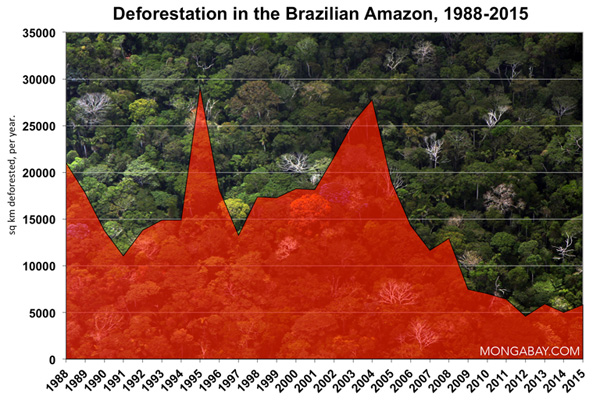
This week, Brazilian authorities confirmed that deforestation fell to a record low of 6,418 square kilometers (2,478 square miles) last year, down from a peak of 27,000 square kilometers (10,000 square miles) in 2004.

Friday, June 15, 2012

Low-carbon farming takes root in Brazil's Amazon

12 June 2012
Source: AFP

Acai trees in a reforested area on Brazilian farmer Manoel Jose Leite's land in Anapu (AFP/File, Evaristo Sa)
Manoel Jose Leite, a small-scale organic farmer, is set to pioneer low-carbon agriculture in Brazil's Amazon rainforest, which for decades has been destroyed by expanding agribusiness.

Finding the right balance between agriculture and environmental protection will be one of the major challenges on the agenda of the UN conference on sustainable development, which opens in Rio on Wednesday.

The issue is particularly pressing for leading grain exporter Brazil, 40 percent of whose huge territory is covered by the Amazon rainforest.

"We have learned a lot from the environment. We have some ideas of what reducing CO2 emissions means and we know that we must protect the Amazon," says Leite, who tills land in Brazil's northern Para state.

He arrived in this northern Brazilian city in 1974 when the then-military government encouraged people to settle the region by opening highways such as the Trans-Amazonian, which cuts through Anapu.

"There was only forest. The government wanted to settle the area. The more we cut trees, the better. If I had known then what I know now, it would have been different. I would have protected the forest," the 62-year-old told AFP as he stood by a spring on his land, which once was used for grazing.

Today he protects the environment with native tree reforesting, including planting Amazon rainforest trees such as cocoa, cupuacu and acai.

Leite is about to join a new project financed by Brazil and Norway that will help 2,600 families rehabilitate deforested areas with low-carbon farming, energy production and efficient use of resources.

"We want to show that you can have low carbon farming that reconciles forest preservation, food production and quality of life in the Amazon, where 25 million people live," said Lucimar Souza, of the non-governmental Amazon Environmental Research Institute (IPAM).

Similar projects are proliferating in the region.

"Between the 1992 Earth summit and the Rio+20, we went from unplanned production based on destruction of the forest to an awareness that this model is not sustainable," said Joao Batista, coordinator of the Live, Produce, Preserve Foundation.

Asked what was needed to make this remote region sustainable, Batista replied with a sigh: "a lot", underscoring the need for programs, technology and funding.

The reconversion coincides with a government commitment to combat the massive deforestation that has made Brazil one of the world's top greenhouse gas emitters.

The pace of deforestation peaked in 2004 at 27,000 square kilometers (10,000 square miles) a year.

But last December, the National Institute of Space Research (INPE) said deforestation had dropped to 6,238 square kilometers (2,408 square miles) per year, the lowest level since monitoring began in 1988.

The Brazilian Institute of Environment and Renewable Natural Resources (IBAMA) has taken action to crack down on 50 deforested zones spotted by satellites and to determine whether timber used in Anapu sawmills is legal.

Such action marks a drastic improvement from 2005, when local big landowners ordered the killing of US missionary Dorothy Stang, who was campaigning for sustainable forest projects in the face of large-scale illegal logging.

"With these sporadic actions we have significantly slowed down the deforestation" in recent years, said Eduardo Lameira, the head of a task force equipped with a helicopter and 4x4 vehicles to raid remote areas.

But challenges remain, and Brazil's dilemma was illustrated by the recent implementation of a new forest code, passed after a bruising congressional battle between the powerful agribusiness lobby and environmentalists.

The new code maintains a requirement to protect 80 percent of the forest in rural areas of the Amazon and 35 percent of the Sertao, the arid hinterland of northeastern Brazil.

But it eases restrictions for small landowners who face difficulties in recovering illegally cleared land.

In 1974, Brazil produced 20 million tons of grain, cereals and oilseeds. Today, it produces 160 million and has become a leading exporter of sugar cane, meat, soybean and timber at the cost of large-scale Amazon deforestation.

"Today we know that we cannot produce the way we did 40 years ago. We have enough deforested areas and the technology to use them for more efficient farming which preserves the environment," said Savio Mendoca, an adviser at the Brazilian Agricultural Research Corporation.

The issue will hotly debated at the Rio+20 conference, which will be attended by more 115 world leaders June 20-22, with the aim of charting a course toward a "green" economy that can balance economic growth with poverty eradication and environmental protection.

Macy's Raises Over $3 Million to Help Protect the Brazilian Amazon Rainforest

Thursday, June 14, 2012
Source: Albany Times Union

Goal to Raise $1 Million Is Tripled to Help Protect Largest, Most Diverse Rainforest on Earth
The Nature Conservancy announced today that Macy’s “Give, Get, and Save the Rainforest” shopping pass promotion has helped raise more than $3 million for conservation efforts in the largest remaining tropical forest on our planet. Macy’s “Give, Get and Save the Rainforest” program launched on May 13 and was part of the retailer’s Brasil: A Magical Journey campaign.

“We are thrilled with the results of this campaign,” said Dr. M Sanjayan, lead scientist for The Nature Conservancy and CBS Network News, Science and Environment Contributor. “Our on-the-ground efforts in the Amazon Rainforest are benefiting greatly from this partnership, and through this promotion, we are substantially raising awareness and support for the environment and our planet."

Macy’s Brasil: A Magical Journey tribute launched this spring with the aim of capturing the spirit of this rich and intriguing culture through specially curated in-store shops, collaborations with well-known Brazilian fashion designers, Brazil-themed events in stores and the fundraising program to benefit The Nature Conservancy’s efforts to protect the Amazon Rainforest. The $3 million was raised through the sales of a $3 shopping pass from May 13-31 in Macy’s stores across the country. Macy’s contributed 100 percent of every $3 to the Conservancy.

In addition, 10 percent of the sale price of every product sold through July 15 within Macy’s “O Mercado”—a specially-curated shop featuring merchandise from Brazil and inspired by Brazil in approximately 300 Macy’s stores nationwide and on macys.com—will also benefit The Nature Conservancy’s work in the Brazilian Amazon.

“We are thrilled with this enthusiastic response from our stores and our customers and are excited to make such a significant contribution to The Nature Conservancy’s important work in the Brazilian Amazon Rainforest,” said Martine Reardon, chief marketing officer for Macy’s.

The Nature Conservancy is a leading conservation organization working around the world to protect ecologically important lands and waters for nature and people. The Conservancy and its more than 1 million members have protected nearly 120 million acres worldwide. Visit The Nature Conservancy on the Web at http://www.nature.org.

Macy's, the largest retail brand of Macy's, Inc., delivers fashion and affordable luxury to customers at more than 800 locations in 45 states, the District of Columbia, Puerto Rico and Guam. Macy's stores and macys.com offer distinctive assortments including the most desired family of exclusive and fashion brands for him, her and home. Macy's is known for such epic events as Macy's 4th of July Fireworks® and the Macy's Thanksgiving Day Parade®, as well as spectacular fashion shows, culinary events, flower shows and celebrity appearances. Building on a 150-year tradition, Macy's helps strengthen communities by supporting local and national charities that make a difference in the lives of our customers.

From fashion to entertainment, take a journey with Macy’s this spring and uncover the magic of Brazil! For more information about Macy’s Brasil tribute, including hi-res images, please visit magicbulletmedia.com/MNR/MacysBrasil/. Macy’s customers can visit macys.com/brasil to shop for the latest Brazilian fashions and locate exciting in-store events.

Saving the Amazon with Raised-Field Farming

Thu, 06/14/2012
Source: GreenAnswers

At a northern point of South America’s vast Amazon rainforest, where the lush jungle landscape meets the sparse savanna region, researchers have found evidence of a unique farming technique employed by the indigenous peoples centuries ago.  Long before the arrival of the Europeans to the continent, bringing with them their destructive slash and burn methods of clearing fields, ancient peoples utilized what is now commonly referred to as raised-field farming.  

For raised-field farming to work, small mounds of dirt would be erected along the outside edge of the forest in order to best form a border between forest and clearer land.  These mounds would serve a dual purpose, providing both an elevated farming area and a type of protection for areas typically known for their floods and droughts.  While the mounds of earth were feats of engineering prowess in themselves, they provided the land and the people that utilized it with a higher quality of harvest and soil.  Set high above the jungle floor, the mounds were perfect for capturing rain and draining it easily to the ground below – keeping the soil in the mounds moist and constantly aerated.

Now compare this with the more invasive slash and burn agriculture and it becomes a wonder why the more eco-friendly method ever disappeared.  While the burning method proves exceptionally successful in clearing large areas of land in order to make way for new crops and harvests, it does little for the land that it touches.  After being set aflame, the land loses valuable minerals and nutrients, causing much more than superficial damage and effectively ruining the internal foundation of the land.

Working at the northern edge of the Amazon in French Guiana, archeologist Jose Iriarte and his team question the likelihood that such a method of raised-field farming could be used today.  His guess is that not only can it be applied in modern times, but it should.  “This ancient, time-tested, fire-free land use could pave the way for the modern implementation of raised-field agriculture in rural areas of Amazonia,” Iriarte explained.  “Intensive raised-field agriculture can become an alternative to burning down tropical forest for slash and burn agriculture by reclaiming otherwise abandoned and new savannah ecosystems created by deforestation.”

What this means for the Amazon now could be a breakthrough in conserving this precious resource.  Covering approximately 2.5 million square miles of landscape, the Amazon contains more than half of what is left of the planet’s rainforests.  The densely forested land is home to about one-tenth of the world’s known species, and sits atop almost 100 billion tons of the world’s stored carbon. Eliminating this forest (or parts of it) would be eliminating the buffer that keeps that carbon load suppressed. If the carbon were to be released than the damaging effects of global would speed up rapidly: putting the planet at higher risk.

By applying methods like the raised-field farming method, it is hoped that the state of the Amazon gains precedence in the global mindset and practices are put into place that would focus on this lands preservation.  “With global warming, it is more important than ever before that we find a sustainable way to manage savannas,” said Iriarte.  “The clues to how to achieve this could be in the 2,000 years of history that we have unlocked.”

Tuesday, June 12, 2012

Low-carbon farming takes root in Brazil’s Amazon

12 June 2012
Source: DAWN.com

An overview of the Carajas National Forest in the Amazon Basin.—Reuters Photo
Finding the right balance between agriculture and environmental protection will be one of the major challenges on the agenda of the UN conference on sustainable development, which opens in Rio on Wednesday.

The issue is particularly pressing for leading grain exporter Brazil, 40 per cent of whose huge territory is covered by the Amazon rainforest.

“We have learned a lot from the environment. We have some ideas of what reducing CO2 emissions means and we know that we must protect the Amazon,” says Leite, who tills land in Brazil’s northern Para state.

He arrived in this northern Brazilian city in 1974 when the then-military government encouraged people to settle the region by opening highways such as the Trans-Amazonian, which cuts through Anapu.

“There was only forest. The government wanted to settle the area. The more we cut trees, the better. If I had known then what I know now, it would have been different. I would have protected the forest,” the 62-year-old told AFP as he stood by a spring on his land, which once was used for grazing.

Today he protects the environment with native tree reforesting, including planting Amazon rainforest trees such as cocoa, cupuacu and acai.

Leite is about to join a new project financed by Brazil and Norway that will help 2,600 families rehabilitate deforested areas with low-carbon farming, energy production and efficient use of resources.

“We want to show that you can have low carbon farming that reconciles forest preservation, food production and quality of life in the Amazon, where 25 million people live,” said Lucimar Souza, of the non-governmental Amazon Environmental Research Institute (IPAM).

Similar projects are proliferating in the region.

“Between the 1992 Earth summit and the Rio+20, we went from unplanned production based on destruction of the forest to an awareness that this model is not sustainable,” said Joao Batista, coordinator of the Live, Produce, Preserve Foundation.

Asked what was needed to make this remote region sustainable, Batista replied with a sigh: “a lot”, underscoring the need for programs, technology and funding.

The reconversion coincides with a government commitment to combat the massive deforestation that has made Brazil one of the world’s top greenhouse gas emitters.

The pace of deforestation peaked in 2004 at 27,000 square kilometres a year.

But last December, the National Institute of Space Research (INPE) said deforestation had dropped to 6,238 square kilometres per year, the lowest level since monitoring began in 1988.

The Brazilian Institute of Environment and Renewable Natural Resources (IBAMA) has taken action to crack down on 50 deforested zones spotted by satellites and to determine whether timber used in Anapu sawmills is legal.

Such action marks a drastic improvement from 2005, when local big landowners ordered the killing of US missionary Dorothy Stang, who was campaigning for sustainable forest projects in the face of large-scale illegal logging.

“With these sporadic actions we have significantly slowed down the deforestation” in recent years, said Eduardo Lameira, the head of a task force equipped with a helicopter and 4×4 vehicles to raid remote areas.

But challenges remain, and Brazil’s dilemma was illustrated by the recent implementation of a new forest code, passed after a bruising congressional battle between the powerful agribusiness lobby and environmentalists.

The new code maintains a requirement to protect 80 per cent of the forest in rural areas of the Amazon and 35 per cent of the Sertao, the arid hinterland of north-eastern Brazil. But it eases restrictions for small landowners who face difficulties in recovering illegally cleared land.

In 1974, Brazil produced 20 million tons of grain, cereals and oilseeds.

Today, it produces 160 million and has become a leading exporter of sugar cane, meat, soybean and timber at the cost of large-scale Amazon deforestation.

“Today we know that we cannot produce the way we did 40 years ago. We have enough deforested areas and the technology to use them for more efficient farming which preserves the environment,” said Savio Mendoca, an adviser at the Brazilian Agricultural Research Corporation.

The issue will hotly debated at the Rio+20 conference, which will be attended by more 115 world leaders June 20-22, with the aim of charting a course toward a “green” economy that can balance economic growth with poverty eradication and environmental protection.

Amazon deforestation at record low, data shows

Thursday 7 June 2012
Source: guardian.co.uk

Truck filled with ilegal wood in the vicinities of Anapu, Para, Brazil. In 2008, Brazil saw a record rate of deforestation in the Amazon - now it has fallen to its lowest level. Photograph: Paulo Fridman/Corbis
Deforestation of the Amazon has fallen to its lowest levels since records began, according to data recently released by Brazil's National Institute for Space Research.

The boost for the environment comes a week after president Dilma Rousseff was criticised for weakening the forest protection measures widely credited for the improvement, and two weeks before Brazil hosts the Rio+20 Earth summit.

Using satellite imagery, the institute said 6,418 sq km of Amazon forest was stripped in the 12 months before 31 July 2011 – the smallest area since annual measurements started in 1988.

The data continues an encouraging trend. Since the peak deforestation year of 2004, the rates of clearance have fallen by almost 75%.

"This reduction is impressive; it is the result of changes in society, but it also stems from the political decision to inspect, as well as from punitive action by government agencies," Rousseff said.

She was speaking at a ceremony on Tuesday to mark the opening of two new nature reserves: the 34,000-hectare (83,980 acres) Bom Jesus Biological Reserve in Paraná, and the 8,500-hectare (20,995 acres) Furna Feia National Park in Rio Grande do Norte.

To mark World Environment Day, the Brazilian president also signed a number of other measures to expand existing parks, protect areas of biodiversity and recognise the land rights of indigenous communities.

Rousseff said Brazil was "one of the most advanced countries" for sustainable development, but its impressive efforts have been undermined by new legislation that reduces requirements on farms created by illegal logging to reforest portions of cleared land.

Under domestic and international pressure, Rousseff vetoed 12 of the most controversial sections of the revised Forest Code, but environmentalists are furious that many other changes will go through.

The Brazilian government insists that the compromise was a realistic balance of agricultural and environmental priorities. Environment minister Izabella Teixeira says 81.2% of the country's original forest remains – one of the highest levels in the world.

But 10 former environment ministers have criticised the measures as a "retrograde step". In an unusual cross-party collaboration, they jointly signed a letter opposing the change to a code that they described as "the single most relevant institutional basis for the protection afforded to forests and all the other forms of natural vegetation in Brazil."


Economic and technological factors have also contributed to the slowing of clearance rates. The rise in the value of the Brazilian currency and the fall of soya and beef prices in the wake of the 2008 global financial crisis eroded the incentive for land clearance for agricultural exports.

Implementing regulations remains extremely difficult in the wild west-like frontiers of the Amazon and the interior forest regions. But enforcement has been strengthened by increasingly precise satellite monitoring by the National Institute for Research in the Amazon.

This November, Brazil plans to launch a new satellite with a resolution of five metres, up from the current level of 250 metres. With close-to-real-time date, the central authorities are able to quickly notify federal police and environment officials about ongoing, illegal land clearance operations.

The government has also responded rapidly and flexibly. After a two-month spurt of clear-cutting in Mato Grosso early last year, it established a task force to strengthen countermeasures and sent 700 inspectors to the region. This year, eight municipalities were added to the list of critical areas, bringing them under closer inspection.

According to local media, the task force has apprehended 325 trucks, 72 bulldozers and 62,000 cubic metres of illegally cut timber and embargoed 79,500 hectares of land in the region.

The environment ministry says further factors in the drop of deforestation are regularisation of land tenure, initiatives to encourage sustainable practices and the expansion of protected areas. According to the UN Global Biodiversity Outlook, Brazil accounts for nearly 75% of the 700,000 sq km of protected areas created around the world since 2003.

Brazilian beef giant on defensive on its Amazon sourcing practices

June 08, 2012
Source: mongabay.com

The sharp contrast between forest and pasture in Mato Grosso. Photo by Rhett Butler.
JBS, the world's largest meat and leather company, is on the defensive after Greenpeace accused it of failing to abide by a 2009 agreement to implement safeguards that would exclude cattle produced on recently deforested lands in the Amazon.

On Wednesday Greenpeace released what it termed a "crime file" [PDF] of evidence which is said shows JBS cannot prove that it is not buying cattle from ranches engaged in forest clearing or labor abuses. Under the terms of a landmark agreement signed in 2009, Brazil's cattle processing giants -- JBS, Mafrig, and Minerva -- committed to improving their sourcing policies to eliminate illegal deforestation from their supply chains.

But JBS quickly refuted Greenpeace's claims, stating that it the ranches in question are not on the government's environmental blacklist. In the case of one supplier, Fazenda Flor da Mata, JBS said it took immediate action once the ranch was blacklisted. JBS also asserted that it has "more than 500 employees directly involved in sustainability activities" and has "the most advanced and sophisticated systems in the area of sustainability in the beef sector in Brazil." JBS added it would take legal action against Greenpeace.

"The Company will legally challenge Greenpeace and will use all available legal channels to repair the material damage caused to the image of the Company through the disclosure of this incorrect information," said JBS in a statement.

Greenpeace told mongabay.com that is is investigating the points raised by JBS but added that it stands by the report.

"Any corrections that may be made will in no way affect the overall conclusion that JBS failed to fulfill its commitments under the 2009 Cattle Agreement," said Greenpeace via email. "None of the slaughterhouses has fulfilled the Cattle Agreement, including JBS. However Greenpeace has not discovered purchases directly or indirectly linked with illegalities in field research on Mafrig and Minerva as we have with JBS. Furthermore, JBS is the only slaughterhouse who has reduced their commitment to the Cattle Agreement from farms with new deforestation to illegal deforestation, thereby undermining the very core of the Agreement."

JBS in turn dismissed Greenpeace's charges.

"JBS is the company with [most] capacity to prove the origin of its cattle in Brazil. Neither [Mafrig nor Minerva] has the system that JBS has to control all business made with our suppliers," JBS told mongabay.com. "Each buy is checked in our control system."

The back-and-forth on the issue reflects a stark change from situation only a few years ago when none of the Brazil's slaughterhouses had policies to exclude beef and leather from recently deforested areas. Today Brazilian cattle giants, along with big supermarket chains, have pledged to phase the most destructive practices out of their supply chains. Some even compete for customers by highlighting their green policies. JBS, for example, closed its response to Greenpeace's report with a statement "[reaffirming] its commitment towards advancing initiatives in the social and environmental field."

A cattle herd wandering in the heart of Mato Grosso. Photo by Rhett Butler.


The 2009 Cattle Agreement was largely a product of a Greenpeace campaign that targeted overseas buyers of Brazilian leather and beef by linking their products to Amazon deforestation. In response, big brands like Nike and Walmart-Brazil demanded their suppliers establish policies to ensure greener sourcing.

Clearing for cattle ranching is the largest driver of deforestation in the Amazon. According to the Brazilian government, cattle pasture is the fate of more than 60 percent of deforested land.

Amazon tribe urges end to logging of its land

9 June 2012
Source: AFP

An illegal woodcutting site at the Trairao Amazonic forest reserve (AFP/File, Lunae Parracho)

A tribe that calls the Amazon rainforest home is urging the Brazilian government to stop the illegal logging of its land, a watchdog said Friday.

In a statement, Survival International said the Awa tribe has made a "desperate appeal" to Brazil's justice minister to "evict loggers from our land immediately... before they come back and destroy everything."

Consisting of just 450 people, the Awa tribe suffers the fastest rate of deforestation in the Amazon, according to the group.

The appeal is part of a campaign launched on April 25 with the help of British actor Colin Firth, who won an Academy Award in 2011 for his performance in "The King's Speech."

It calls on the public to show their support for the Awa by sending protest messages to the justice minister, Jose Eduardo Cardozo. So far, more than 27,000 people have done so, Survival said.

"Brazil's government must stop ignoring the Awa, and put them at the top of its agenda," said Survival's director, Stephen Corry. "The start of the logging season is a critical time. Pressure must not cease."

Brazil's indigenous population makes up less than one percent of the country's 191 million people and lives on 12 percent of the country's territory, mostly in the Amazon rainforest.

Later this month, more than 100 heads of state and tens of thousands of participants from governments, the private sector and NGOs will converge on the Brazilian city of Rio de Janeiro for the Rio+20 United Nations Conference on Sustainable Development.

Ahead of the June 20-22 gathering, Brazil announced this week it planned to preserve an additional 10,000 square kilometers (3,860 square miles) of land and pledged not to let economic woes stop it from implementing other measures to protect the environment.

Friday, June 8, 2012

Brazil finalizes 2011 deforestation data

June 06, 2012
Source: mongabay.com

Brazil's National Institute for Space Research (INPE) on Tuesday finalized its 2011 estimate for deforestation in the Amazon region.

After analyzing 213 satellite images, the agency said 6,418 square kilometers of Amazon forest were cleared entirely between August 1, 2010 and July 31, 2011. While the number is 3 percent higher than the estimate released last December, it nonetheless marks the lowest extent of forest clearing since annual record keeping began in the late 1980s.

Deforestation in the Brazilian Amazon has fallen by 75 percent since last peaking in 2004. The trend appears to be continuing into 2012. Last month Imazon, an NGO, reported a further decline in deforestation this year based on preliminary data. It also noted a fall in forest degradation.

The Brazilian government did not release data on forest degradation caused by selective logging during the 2010-2011 period.

Tesco supplier accused of contributing to Amazon rainforest destruction

Wednesday 6 June 2012
Source: The Guardian

Cattle at an illegal settlement in northern Brazil: such ranches are the leading source of rainforest destruction in the Amazon. Photograph: Antonio Scorza/AFP/Getty Images
British consumers are unwittingly contributing to the devastation of the Amazon rainforest by buying meat products from Tesco, according to Greenpeace.

The environmental group says in a report that canned beef from the supermarket chain has been found to contain meat from ranches that have been carved out of the lands of indigenous peoples, and farms the Brazilian government believes have been sited in illegally deforested lands.

The allegations stem from an 18-month investigation carried out by Greenpeace into the practices of JBS, a big Brazilian supplier of meat and cattle byproducts. The campaigning group claims it unearthed evidence of serious violations of the company's own ethical code, and those of companies it supplies, including Tesco.

Sarah Shoraka, forests campaigner at Greenpeace, said: "Beef farming is the biggest cause of Amazon destruction. Tesco is driving this problem through its beef sourcing. Tesco canned beef supply comes from illegal farms that destroy the Amazon and occupy indigenous people's land. Tesco's supplier JBS refuses to tackle the problem. Tesco needs to take the bull by the horns and stop selling beef that destroys the Amazon."

In response, Tesco said it had begun to terminate its contracts with JBS more than a year ago, but certain products could still be within its supply chain because of the time needed to end the agreements. The company added: "We are committed to tackling rainforest deforestation, including working with other consumer goods companies (through the Consumer Goods Forum) to help end deforestation by 2020.

"The vast majority of the beef we sell, including all fresh beef, is sourced from the UK and Ireland. Canned beef products sourced from Brazil account for less than 1% of total beef sales. We started to cut back our supplies from JBS a year ago and have now ceased sourcing any canned beef products from JBS. Ethics and sustainability remain an important part of our dialogue with suppliers."

Cattle ranches are the leading source of rainforest destruction in the Amazon, as ranchers chop down trees to make room for herds often many thousands strong. These herds have to be moved frequently as the rainforest soil is soon exhausted by their intensive grazing, leading to a pattern of deforestation that threatens one of the world's most important ecosystems.

Much of the beef, leather and other byproducts are sold in the west, often passing through a long supply chain and rebranded many times, so it is all but impossible for consumers to tell where their purchases originated.

The Greenpeace report claims direct links between the widespread destruction of the Amazon for cattle ranches and the sale of products from those ranches in the UK and other countries.

JBS, the focus of the Greenpeace study, is one of the world's biggest food suppliers. It is accused of a series of major violations of its own ethical pledges, including failing to monitor sites and taking products from sites suspected to be illegal or within indigenous areas. Few western consumers will be familiar with the company, but its clients have included many of the world's biggest food brands.

It is understood that several have ceased – or begun to review – their relationships with JBS following warnings from campaigners that the company's practices may violate their policies on ethical sourcing. Companies to have reviewed arrangements are understood to include the retailers Sainsbury's, Asda and Ikea, the footwear company Clarks and food firm Prince's.

Greenpeace's latest investigations follow a groundbreaking study in 2009 that for the first time established a clear chain of responsibility stretching from Amazonian ranches on land cleared illegally to western companies including luxury brands, supermarkets and a variety of "household name" firms using everything from leather, beef and other cattle byproducts to paper packaging.

After that report, a wide range of multinational companies pledged to re-examine their supply chains to ensure no material from illegally cleared forests in the Amazon reached their customers. As part of that effort, the Brazilian companies most heavily involved in the Amazon trade also vowed to clean up their supply chains, going further than the minimum required by Brazilian law.

But this latest study alleges that in the past three years JBS has failed to live up to its pledges. According to evidence amassed by Greenpeace, the company bought animals from at least five farms accused by the Brazilian government of illegal deforestation, between June and December 2011.

According to tThe report says JBS has also failed to monitor its indirect suppliers – contrary to a promise it made after Greenpeace's 2009 investigation – so many of its suppliers are taking goods that do not meet the standard of sourcing JBS and its customers have committed to.

Audits that the company claims to have undertaken have not been made available, and where the company has collected data on the whereabouts of its suppliers' farms – which should in theory show that they are in legal areas – the data has been incomplete, giving just one GPS reference when in fact several are needed to establish the borders of the properties involved. JBS has also, Greenpeace alleges, failed to present evidence that its suppliers are registered with Brazil's environmental authorities.

Greenpeace said it had traced beef from questionable farms from the sources through JBS's processing facilities and from there into cans sold in the UK by Tesco and in the Netherlands.

JBS, whose motto is "In God we trust, Nature we respect" said: "JBS as a leading meatpacking company with relevant operations in Brazil is proud of its track record in leading sustainable initiatives in all its activities. We continue to proactively liaise with NGOs, customers and stakeholders in general towards providing healthy products for a growing global population while forwarding the most sustainable practices."

It said it had written to Greenpeace and its own customers taking issue with the Greenpeace report.

Tesco cancels meat contract over Amazon cattle claims

06 Jun 2012
Source: Telegraph.co.uk

Cattle farming is still the biggest cause of deforestation in the Amazon, driving climate change and loss of species
The environmental charity claims to have tracked cattle from illegal farms in the Brazilian rainforest to slaughter houses and processing plants used by the exporter JBS.

Volunteers in the UK then checked supermarkets and found serial numbers on more than 100 tins of beef chunks, mince and corned beef that show the product came from the same processing plant.

Sarah Shoraka, Greenpeace Forests Campaigner, said consumers would be appalled to think the tins of beef they are buying could be from farms responsible for destroying the Amazon.

JBS has written to Greenpeace and and its own customers, acknowledging its commitment to end the purchase of cattle from deforested land had faced "questions" but saying the company remained "fully committed" to finding meat from farms that are not involved in illegal activities.

Cattle farming is still the biggest cause of deforestation in the Amazon, driving climate change and loss of species.

"Tesco is driving this problem through its beef sourcing," she said.

In response, Tesco say they have now cancelled their contract with JBS.

“We started to cut back our supplies from JBS a year ago and have now ceased sourcing any canned beef products from JBS. Ethics and sustainability remain an important part of our dialogue with suppliers,” said a spokesman.

Ms Shoraka said: "We last met with Tesco over this issue on April 3 - we were very clear at that meeting about what we knew about their connection to JBS. They made no mention at the time of having taken any action or intending to take any, and they have not been in touch with us in the intervening two months to inform us of any action," she said.

"If what they say is true and they have decided to cut ties with JBS, that is great news for the Amazon, but before we could be satisfied this is the case, we'd want to know when they communicated this decision to JBS and why they failed to inform us of the move."

JBS told customers in its letter: "First and foremost, JBS remains fully committed to sourcing livestock from farms that are not involved in any illegal activities, including illegal deforestation, the invasion of indigenous lands or the use of any form of slavery.

"We accomplish these objectives through a monitoring system and control procedures over our supply base.

"JBS is proud to be part of a joint effort with NGOs, government, and other companies that has resulted in meaningful progress in protecting the Amazon through declining rates of deforestation."

Greenpeace says Brazil meatpacker hurting Amazon

Wed, Jun. 06, 2012
Source: Kansas City Star

Greenpeace on Wednesday accused JBS, the world's largest meatpacker, of not honoring a 2009 agreement in which the Brazilian company pledged to protect the Amazon rainforest by not buying cattle from suppliers who raise beef on illegally deforested land.

JBS denied the claim and said it would take legal action against Greenpeace, saying the environmental group's report could potentially cause a loss in sales. JBS didn't indicate what sort of damages it might seek.

Greenpeace said it based its accusations on observations made by its own field investigators and on information obtained in reports from Ibama, Brazil's environmental protection agency.

"In researching JBS's business practices, Greenpeace has found, once again, numerous new cases of JBS purchasing cattle directly and indirectly from farms involved in illegal deforestation, invasion of protected areas and indigenous lands, and also of farms using slave labor," the group said in a statement.

JBS rejected those accusations out of hand.

"The information mentioning JBS in the report are false, misleading, incorrect, and lead society to make wrong judgments," the company said in an emailed statement. "For this reason the company will take judicial action against Greenpeace and search for all legal means to obtain compensation for material damages."

After hours calls to Ibama were not returned.

The Greenpeace report comes just two weeks before the United Nations' Rio+20 sustainable development conference, where preserving the Amazon will be a big topic.

In 2009, JBS SA and three of Brazil's other major meatpackers and leather exporters signed Greenpeace-brokered agreements with officials in some rural states promising to remove from their supply chain any cattle raised in a manner that led to illegal deforestation or relied upon the work of people mired in debt-slavery conditions.

Those agreements came after scathing Greenpeace reports that outlined links Brazil's biggest meat companies had with suppliers relying on illegal practices to raise their herds. Major retailers at the time, such as Nike Inc., Wal-Mart Stores Inc. and Carrefour SA, said they would cut ties with any companies that couldn't clean up their supply chains.

Similar agreements have been struck in recent years with big soy suppliers and traders working in Brazil, such as Cargill Inc., Archer Daniels Midland Co., Bunge Ltd. and Louis Dreyfus Commodities. The clearing of Amazon lands to make way for soy farms is also a top cause of deforestation.

Sen. Katia Abreu, a leading voice of the agriculture caucus and the president of Brazil's National Agriculture and Livestock Federation, said the nation's ranchers and farmers are cooperating with the government to reduce rainforest destruction - and that it is working.

"In 2004, the Brazilian government adopted the commitment of reducing deforestation by 80 percent," Abreu told reporters Wednesday while traveling in Paris. "At the end of last year, eight years before the deadline, we have already almost reached that goal."

Amazon deforestation slowed and hit its lowest recorded level from August 2010 through July 2011, the latest annual period measured, when 2,410 square miles (6,240 square kilometers) were felled.

Monday, June 4, 2012

Andritz named by Jagger over rain forest dam plan

01/06/2012
Source: Austrian Independent

The first wife of Mick Jagger who is now a European goodwill ambassador has come to Vienna to highlight the fact that the Austrian firm Andritz is involved in a controversial project to build a huge dam in the Amazon rainforest.

Bianca met husband to be Mick Jagger at a party after a Rolling Stones concert in September 1970 in France and they married while she was four months pregnant. In May 1978 she filed for divorce on the grounds of his adultery with model Jerry Hall.

In addition to her extensive charitable works, Jagger had a public reputation as a jet-setter and party-goer in the 1970s and early 1980s, and was a close friend of pop artist Andy Warhol.

And she is now a Europe Goodwill Ambassador, Founder and Chair of the Bianca Jagger Human Rights Foundation, Member of the Executive Director's Leadership Council of Amnesty International USA, and a Trustee of the Amazon Charitable Trust which led her to visit Vienna.

She is campaigning against the planned Belo Monte, a project which has been strongly criticized by indigenous people and numerous environmental organizations in Brazil plus organizations and individuals around the world. Belo Monte's 668 square kilometres (258 sq mi) of reservoir and will flood 400 square kilometres (150 sq mi) of forest, about 0.01% of the Amazon forest.

Though argued to be a relatively small area for a dam’s energy output, this output cannot be fully obtained without the construction of other dams planned within the dam complex. The prognosed area of reservoir for the Belo Monte dam and the necessary Altamira dam together will exceed 6500 km2 of rainforest.

While she was here Jagger also left two ministers. He said: "as long as it was a bit of hope that we need to continue to campaign as strongly as possible against  Belo Monte."

Austrian WWF manager Hildegard Aichenberger said there was no doubt the importance of the rainforest to Austria. She said: "The only reason that the climate catastrophe that everyone has been predicting has not happened yet is that we still have the rainforests.

Jagger arrived in Austria to put the spotlight on Andritz which is involved in the project and said that she hoped that investors in the firm would consider putting their money elsewhere until had a more environmentally friendly and responsible policy about projects like the dam.

She did not meet representatives from the firm but she did meet ministers Nikolaus Berlakovich and Michael Spindelegger.

Brazil to boost defence to protect borders, resources

Monday, 04 June 2012
Source: defenceWeb

Brazilian Defense Minister Celso Amorim said the country's growing need to protect its borders, the Amazon rainforest, and massive offshore oil discoveries would lead it to gradually increase defense spending by a quarter to reach roughly 2 percent of Brazil's economy.

During an interview at the Reuters Latin America Investment Summit, Amorim said the country's valuable food, water, and energy supplies could eventually make it the target of a "scramble for natural resources." Given the country's recent economic growth, he added, Brazil must spend more on preparedness and its ability to "react or dissuade any effort to invade our territory."

Brazil has good relations with all 10 of its South American neighbors, and hasn't been to war with any of them since the 19th century, so defense spending has historically been seen as a second-tier priority, Reuters reports.

But President Dilma Rousseff's government has come under public pressure to better defend its borders from drugs and other contraband because of a crack epidemic in Brazilian cities.

At present, Brazil spends about 1.6 percent of its gross domestic product on defense; other countries, including Russia and the United States, spend more than 4 percent, according to the Stockholm International Peace Research Institute. Last year, the figure reached more than 61 billion reais ($30.3 billion), Brazil's defense ministry said.

In the coming years, Amorim said, Brazil should spend closer to 2 percent of GDP, a percentage more in line with that of other big developing nations, such as India and China. The minister gave no time-line for when that target might be reached, but said hypothetically it could take as long as ten years.

Increased spending, Amorim said, would also help nourish a nascent but growing defense industry in Brazil that could supply the weapons and equipment necessary to fulfill the government's defense goals.

Because of strict rules that require Brazilian companies to have a share in defense purchases, either alone or through partnerships with foreign contractors, local industries should benefit from the need for equipment including satellites, helicopters, armored vehicles, and ships. To improve much-needed border patrols, for example, Amorim expects Brazilian companies within four years to have sufficient know-how on their own to supply the country with unmanned drones.

NO TIME-LINE FOR BIG JET ORDER

A career diplomat and foreign minister during the eight-year administration of former President Luiz Inacio Lula da Silva, Amorim helped raise Brazil's profile in global forums like the United Nations, World Trade Organization, and Group of 20 major economies. His success in leveraging Brazil's growing economic might into a role as a voice for developing nations prompted President Dilma Rousseff last year to charge Amorim with seeking similar heft for the armed forces.

Amorim has been working to secure long-sought upgrades to the old and rickety weapons and surveillance systems now used by the military. Chief among planned procurements is a contract for new fighter jets, expected to be worth more than $5 billion when finally awarded.

But procurement in Brazil, even by the slow-moving standards of the defense industry, historically has been stop and go.

The long-pending decision to purchase a new generation of fighter jets, for instance, has been in the works for more than a decade. Though Brazil earlier this year looked set to pick France's Dassault (AVMD.PA) to supply the new aircraft, the government held back on a decision and is still considering jets manufactured by Boeing (BA.N) of the U.S., and Sweden's Saab (SAABb.ST).

Amorim said he hopes a decision will come "soon," but declined to predict whether that meant a matter of months or even years.

A stagnating Brazilian economy, which has come perilously close to recession in recent quarters, isn't expected to impede key defense decisions further, he added. The perceived vulnerability along the borders, around offshore oil fields, and across its farm belt, forests and wetlands will ensure military spending remains a growing priority.

"Even if you bring in less money at home, you can't not pay for a lock on the door," he said.

BRAZILIANS AND NEIGHBORS SHOULDN'T BE WARY

Amorim said the government must work to convince Brazilian society that the ramp-up in spending is worth it, especially because many Brazilians remain wary of the country's armed forces. Brazil's military ruled the country in a dictatorship that lasted two decades, ending in 1985.

Brazil will also work with its neighbors, he added, to ensure that regional cooperation can grow along with military ventures and contracting.

This month, Brazil signed an agreement with Colombia, valued at $10 million, for the purchase of patrol vessels that will be used to monitor the Amazon and its tributaries. Brazilian planemaker Embraer (EMBR3.SA), for its part, works with Argentine partners in the development of a planned cargo aircraft that is expected to compete with other would-be successors to Lockheed Martin's (LMT.N) ageing C-130 Hercules.

Brazilian leader Rousseff's pardon for illegal deforesters condemned

Friday 1 June 2012
Source: guardian.co.uk

Brazilian leader Dilma Rousseff was told she had destroyed her credibility by weakening protection for forest areas. Photograph: Ueslei Marcelino/REUTERS
A coalition of Brazil's leading conservation groups have condemned the country's president Dilma Rousseff for pardoning illegal deforesters, weakening protection of the Amazon and rowing back on efforts to recover land that has been cleared of trees.

The fierce attack on Rousseff's environmental credentials comes just weeks before she is due to host more than 100 world leaders in an Earth Summit in Rio de Janeiro that aims to put global development and economic growth on a more sustainable track.

The Brazil Committee in Defence of the Forests – a coalition of more than 200 civil society entities – said the president had destroyed her credibility by approving changes to the Forest Code, which is the country's most important piece of legislation for protecting the Amazon and other forest areas.

Last week, Rousseff's office announced that she had partially vetoed the proposed revision of the code but as details have subsequently emerged of what went through, the ire of conservationists has risen.

According to the committee, the new Forest Code will waive fines and ease requirements for restitution of areas that were illegally deforested in the past. The bands of tree cover that must be left intact along riverbanks has been reduced by 80% and approval has been granted for the use of non-native species, such as eucalyptus, for restoration projects.

"There will be losses in the quality and quantity of waters, and losses for the conservation of biodiversity. The concept of Areas of Permanent Protection has become meaningless", André Lima, public policies coordinator at the Amazon Environmental Research Institute, was quoted as saying in the group's statement.

Brazilian ministers have said the changes were necessary to balance food production with forest protection.

The campaigners accused legislators and the president of bowing to the powerful agricultural lobby and putting export profits above Brazilian public opinion and global concerns for the environment.

"President Dilma Rousseff has broken her campaign promises and squandered an opportunity to be a global environmental leader. With the eyes of the world on Brazil for Rio+20, we will keep up the pressure to protect our forests. The whole world needs to know of the huge discrepancy between talk and action in Brazil", Kenzo Juca Ferreira, public policies specialist for WWF-Brazil, said.

Friday, June 1, 2012

Sky's battle to save the Amazon

29 May 2012
Source: Guardian.co.uk

Sky has raised funds for sustainability initiatives through its 'adopt a jaguar' campaign. Photograph: Staffan Widstrand/Sky
Sky Rainforest Rescue is campaigning and fundraising to preserve 3m hectares of Brazilian rainforest – an area the size of Belgium.

A three-year partnership between Sky, the World Wildlife Fund and local government in this threatened region began in October 2009 and aims to stop 1bn trees being destroyed.

Sky and WWF are collaborating with the Acre state government in Brazil to reduce deforestation both by fund raising and by helping local people identify markets for forest products and securing a fair price for their goods.

The campaign has ten partnership objectives including a target to raise £2m by October 2012 – a sum that Sky will match – and voluntary land certification for small-scale producers, who receive incentives for managing their land sustainably.

The partnership is funding 37 rubber-tapping units so tappers can produce and sell sheets of rubber for a greater profit.

It is backing local government initiatives, such as monitoring deforestation, and SISA (System of Incentives for Environmental Services), a law recognising the environmental services provided by the rainforest that make it worth more alive than dead.

Sky has raised funds through its 'adopt a jaguar' campaign, supported by direct response advertising. It has also commissioned supporting programming including Ross Kemp: Battle for the Amazon and Rooftop Rainforest.

President Rousseff vetoes some controversial changes to Brazil's Forest Code

May 29. 2012
Source: mongabay.com


Brazilian President Dilma Rousseff on Monday revealed the details of her line-item veto to proposed changes to the country's Forest Code, which governs how much forest landowners are required to preserve. Rousseff vetoed a dozen clauses of the revised Forest Code and modified several others. The bill now goes back to the Chamber of Deputies, followed by the Senate and House, before returning again to Rousseff. A final decision isn't expected until after the Rio+20 UN Conference on Sustainable Development.

Among the dozen clauses vetoed by Rousseff was a blanket amnesty for landowners who illegally cleared forest before July 2008. With the exception of some smallholders representing about a quarter of rural properties (determined on a municipality by municipality basis, depending on several factors), landowners will be required to restore deforested areas up to levels specified by the law, including along waterways. The version of the legislation passed by the House only required a ten meter wide zone of forest along rivers, but Rousseff extended the area to up to 100 meters for large rivers on properties owned by large producers, with more limited protected areas along smaller rivers and for smaller properties. Forests on hilltops and steep slopes must also be protected (deforestation on slopes and mountaintops over 1,800 meters in elevation before 2008 is exempted). Failure to meet Forest Code obligations will result in fines and loss of access to subsidized agricultural loans.

Rousseff maintained a provision that would allow the legal reserve requirement to fall from 80 percent to 50 percent in states where 65 percent of forest is locked up in protected areas and indigenous territories. The legal reserve is the proportion of land a property owner is required to maintain as forest. Controversially, the revised Forest Code allows landowners to plant exotic species like Eucalyptus, pine, oil palm, and coffee restore their legal forest reserve.

Rousseff eliminated a clause that would have exempted urban landowners from maintaining a legal reserve. She also nixed a paragraph that would have left mangroves without protection, although the bill's text still allows opening up some areas for shrimp farms.

The new legislation also codifies the establishment of a land registry, known as the Cadastro Ambiental Rural or CAR, that requires ranchers and farmers to report the boundaries of their holdings to the government, which will enter the coordinates into the national deforestation tracking system. The government will then use satellite imagery on an ongoing basis to determine whether landowners are in compliance with the forest reserve requirement.

Rousseff's version of the Forest Code now goes back to the House and Senate for approval. Her changes can be overturned by Congress by majorities in both chambers, but at present is appears unlikely that the Senate would overturn her line-item vetoes.

The Forest Code revision comes less than a month before Brazil hosts the Rio+20 UN Conference on Sustainable Development. Environmentalists say the proposed relaxation of the Forest Code sends the wrong message ahead of the key environmental meeting and could eventually reverse Brazil's progress in reducing its deforestation rate, which has fallen by 78 percent in the Amazon region since 2004.

"It is disappointing that President Rouseff has chosen not to take the opportunity to respect Brazilian public opinion by putting forward legislation that balances the needs of agriculture and forest protection in the Amazon," Steve Schwartzman of the Environmental Defense Fund (EDF) told mongabay.com. "In spite of her campaign promises, she has accepted amnesty for illegal deforestation and large-scale reductions in forest protection."

WWF added that the partial vetoes, instead of an outright veto, creates unnecessary confusion on the law.

"President Rousseff’s statement today creates an uncertain future for Brazilian forests, considering the Congress could still cut forest protections even further,” said Jim Leape, WWF International Director General.

Scientists fear that continued deforestation could reduce the resilience of the Amazon to climate change, potentially tipping much of the ecosystem from rainforest to savanna and diminishing its capacity to generate rainfall, store carbon, and provide a refuge for wildlife.

Chevron's $18B Ecuador pollution lawsuit comes to Canada

May 31, 2012
Source: CBC.ca

Environmentalist Donald Moncayo shows his glove after conducting a test made on an affected field in Ecuador. (Guillermo Granja/Reuters)
Plaintiffs who won a $18 billion US pollution judgment against Chevron Corp. in Ecuador say they've begun their campaign to collect the money, filing suit against the company in Canada.

Plaintiffs' lawyer Pablo Fajardo says the case filed in an Ontario court Wednesday is the first in a series of lawsuits planned for 30 countries on four continents where Chevron has assets.

San Ramon, Calif.-based Chevron maintains the Ecuador judgment is fraudulent, alleging it resulted from bribery.

The ruling stems from contamination in Ecuador's Amazon region between 1972 and 1990 by Texaco, which Chevron bought in 2001. Chevron contends Texaco fully remediated its share of environmental damage before leaving Ecuador in 1992.

Chevron's $18B Ecuador pollution lawsuit comes to Canada


Brazil’s Controversial Forest Bill on Hold

May 31, 2012
Source: The Epoch Times

A woman raises a banner demanding Brazilian President Dilma Rousseff veto a forest code approved by the congress last month, in Sao Paulo, Brazil on May 5. (Yasuyoshi Chiba/AFP/GettyImages)
Just weeks ahead of hosting a world forum on sustainable development, Brazilian President Dilma Rousseff partially vetoed a controversial forest bill that would loosen environmental responsibility in the Amazon. The bill will now be returned to legislators in a move that local and global environmental groups are greeting with a cold to lukewarm response.

“For the last decade, Brazil has been on a path of economic and environmental progress. President Rousseff’s statement … creates an uncertain future for Brazilian forests, considering the Congress could still cut forest protections even further,” said Jim Leape, WWF International director general in a statement.

This “Código Florestal,” or Forest Code, was passed in December 2011 by the agribusiness-dominated Senate. To go into force, the law needs the president’s consent. Now that Rousseff has vetoed 12 of the bill’s 84 articles, passage is on hold until those 12 points are amended and returned to the president.

Nothing will move ahead now until after Brazil hosts the United Nations Conference on Sustainable Development, Rio+20, at the end of June.

“President Rousseff’s unfortunate decision will make it difficult for her to speak credibly about sustainable development when heads of state gather in Rio next month,” reads the WWF statement.

What’s In, What’s Out

Some of the bill’s most contentious provisions were vetoed or revised, but others were kept.

The president struck down the proposed amnesty for landowners who illegally cleared forest before July 2008. Offending landowners will also have to restore what they destroyed—although this can be done through planting some exotic species and cash crops, which conservationists reject.

She amended the article that allowed farmers and ranchers to cut forest on the sensitive land close to riverbanks and on hilltops. This is considered very risky by environmentalists because it can destroy river habitats, increase the chance of erosion, and lead to deforestation. Loggers usually prefer cutting close to rivers since it offers an easy way to transport the felled trees.

Rousseff increased the size of the buffer of forest that must be left along riverbanks from 10 meters (33 feet) to up to 100 meters (328 feet). However, she kept the controversial provision that decreases the amount of land farmers must preserve as forest.

Another controversial aspect she changed was allowing large landowners and farmers to ignore illegal deforestation activities on their lands. The bill stated that landowners would not be liable to restore forest cleared as a result of illegal activity.

Rousseff and her environment minister are strongly against this aspect of the law.

“The big [farmers] have vast extensions of land and have the means to recover all the areas of permanent preservation,” said Brazil’s Environmental Minister Izabella Teixeira, a strong opponent of the code.

In contrast, Brazil’s Agriculture Minister Jorge Ribeiro Mendes, has been in favor of the bill’s farmer friendly provisions. “It’s the code of those who believe it’s possible to produce food and preserve the environment,” he has said.

Brazil is considered the lungs of Earth, absorbing CO2 and producing oxygen for the whole planet. The Amazon rainforest, due to its density and large amount of wide-leaf plants is also considered by some scientists to be very important factor in slowing down global warming.

In Brazil, around 20 percent of Amazon rainforest has been destroyed. To battle illegal deforestation, in 2008, the government set up environmental police that use satellite images to scan the vast Amazon area and stop any illegal activities. Since then, deforestation has slowed down, reaching its slowest pace from August 2010 through July 2011, when only 2,410 square miles (about five times the size of New York City) of rainforest was illegally cleared.

Currently, there are 1,400 environmental police in Brazil responsible for covering massive tracks of the Amazon approximately equal to the size of United States west of the Mississippi River.