Monday, April 23, 2012

Will mega-dams destroy the Amazon?

April 18, 2012
Source: mongabay.com

150 new dams may destroy connectivity of the Amazon River to the Andes and drive deforestation.
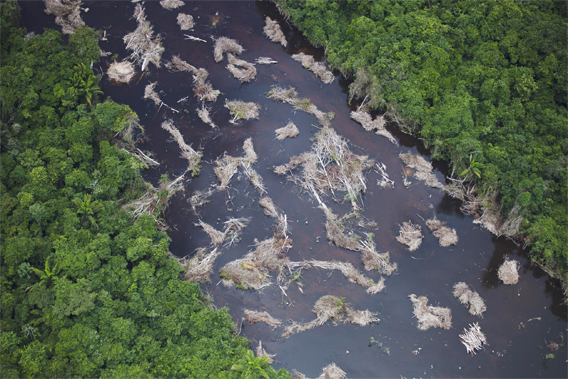
Construction of a canal for the Belo Monte Dam project, near Altamira taken by Daniel Beltrá for Greenpeace. Once completed, the Belo Monte Dam will be the third largest in the world. It will submerge up to 400,000 hectares and displace 20,000 people. Image © Daniel Beltrá / Greenpeace.

More than 150 new dams planned across the Amazon basin could significantly disrupt the ecological connectivity of the Amazon River to the Andes with substantial impacts for fish populations, nutrient cycling, and the health of Earth's largest rainforest, warns a comprehensive study published in the journal PLoS ONE.

Scouring public data and submitting information requests to governments, researchers Matt Finer of Save America’s Forests and Clinton Jenkins of North Carolina State University documented plans for new dams in Bolivia, Brazil, Colombia, Ecuador, and Peru. They found that 40 percent of the projects are already in advanced planning stages and more than half would be large dams over 100 megawatts. 60 percent of the dams "would cause the first major break in connectivity between protected Andean headwaters and the lowland Amazon", while more than 80 percent "would drive deforestation due to new roads, transmission lines, or inundation."

“These results are quite troubling given the critical link between the Andes Mountains and the Amazonian floodplain,” said lead author Finer in a statement. “There appears to be no strategic planning regarding possible consequences to the disruption of an ecological connection that has existed for millions of years.”
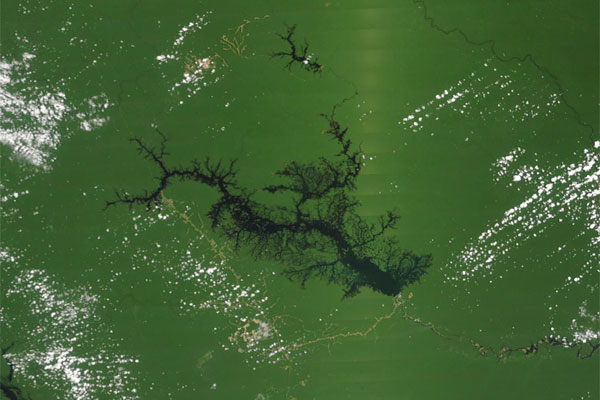
Lake Balbina, a man-made reservoir created to supply hydroelectric power to the city of Manaus in Brazil. (Photo courtesy of Jacques Descloitres, MODIS Rapid Response Team, NASA/GSFC)

Finer and Jenkins note that the Andes are a critical source of sediments, nutrients, and organic matter for the Amazon river, feeding the floodplain that supports the rich Amazon rainforest. The Amazon and it tributaries are critical highways for migratory fish that move to headwaters areas to spawn.

"Many economically and ecologically important Amazonian fish species spawn only in Andean-fed rivers, including a number that migrate from the lowlands to the foothills," the authors write. "The Andean Amazon is also home to some of the most species rich forests and rivers on Earth. The region is documented to contain extraordinary richness for the most well studied taxa... and high levels of endemism for the understudied fishes. Therefore, any dam-driven forest loss or river impacts are of critical concern."

Finer and Jenkins conducted a meta-analysis of river connectivity and infrastructure to produce an "ecological impact score" for all 151 dams. 47 percent of the dams were classified as "high impact" while only 19 percent were rated "low impact". Eleven of the dams would directly affect a conservation area.
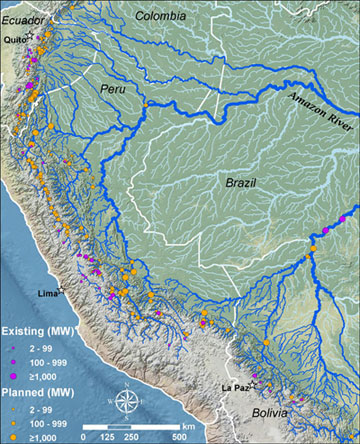
The hydroelectric projects would also have social impacts. Forty dams would be constructed "immediately upstream or downstream" on an indigenous territory.

Worryingly the authors conclude that there is seemingly no basin-wide policy assessment of the potential social and ecological impacts of the dam-building spree.

“We conclude that there is an urgent need for strategic basin scale evaluation of new dams and a plan to maintain Andes-Amazon connectivity,” said study co-author Jenkins in a statement. “We also call for a reconsideration of the notion that hydropower is a widespread low impact energy source in the Neotropics.”

Finer and Jenkins warn that the perception dams in tropical forest areas are a clean energy source could lead to perverse subsidies for the projects via the carbon market.

"Institutions and instruments that support Neotropical dams, such as international financial institutions and the Clean Development Mechanism (CDM), should consider the wide array of factors examined here during project evaluations," they write. "Otherwise, tropical rivers and forests may increasingly be at risk from otherwise well-intentioned strategies to mitigate climate change."

Phil Fearnside, an esteemed researcher at the National institute for Research in Amazonia (INPA) who wasn't involved with the paper but has conducted extensive analysis of greenhouse gas emissions from Amazon dams, agrees.

"The other reason giving these dams CDM credit is bad for climate is that virtually none of them are additional," Fearnside told mongabay.com. "In other words, the dams are being built anyway, and giving them credit both wastes the resources for fighting global warming and allows the countries that purchase the credit to emit more carbon."

The bigger picture

Study author Finer says that governments need to take a hard look at current plans for dam development, which could affect the long-term productivity of the very ecosystems that sustain Amazon rivers.

"As governments of the Andean Amazon region are prioritizing hydropower as the centerpiece of long-term energy plans, strategic planning is needed to mimimize impacts of a planned wave of new dams in the most biologically diverse zone on Earth," he told mongabay.com.

"Up to now all six major connections between the Andes and Amazon have been largely free-flowing. With the construction of the two mega dams on the Madeira we'll soon be down to five. We documented many plans for three more major rivers (Ucayali, Maranon, and Napo), so pretty soon we could be down to two. What will be the implications of that?"

"These dams could have extremely far-reaching impacts on the Amazon, stretching from the high Andes all the way to lowland Brazil," added Jenkins. "The full ecological impacts may be unpredictable and potentially irreversible."
We can save the Awá tribe

Sunday 22 April 2012
Source: guardian.co.uk

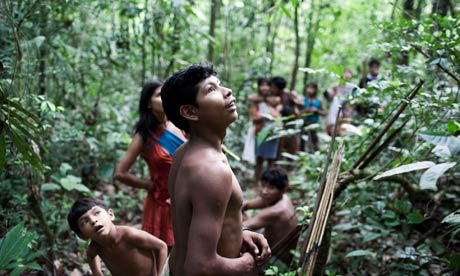
The Awá hunt, fish and gather forest produce such as fruit and nuts. Photograph: Domenico Pugliese/Survival

The Awá of Brazil are the world's most threatened tribe. Years of illegal logging and land grabs have brought them to the brink of extinction. But apart from the loggers and their guns, one of their biggest problems is the fallacy that Amazon Indians must inevitably conform to "modernity".

Although people have been saying it for generations, it isn't true: tribes are destroyed by labelling them backward, and pretending they stand to benefit from "civilisation". It's fundamentally racist, and the evidence points, glaringly, and to our shame, in exactly the opposite direction.

When land is taken, tribes simply don't survive. On the other hand, when it's protected, most of their problems evaporate. That can happen if no one else wants the land, it's inaccessible to outsiders or, most importantly, there's the political will and strength to ensure it remains with the Indians.

On their own territory, they can adapt to change as they wish. Some individuals might leave to explore the outside, but most will return home to its invaluable advantages: free food and housing, as opposed to scraping a living in shantytowns and slums, where life is usually nasty, brutish and short.

The "integration" of these peoples is the theft of their self-sufficiency, and their condemnation to the lowest rung of a steep and greasy ladder – or worse, death. However, we believe, profoundly, that there will still be Amazon Indians at the end of the century. It merely entails respecting the laws and rights which governments claim to uphold. Cynics might argue that it won't happen, that the fast buck will always triumph, but that's really an admittance that we are the savages, unfettered by any rule of law, common decency or humanity.

We have seen tribal peoples' lands protected repeatedly over the last 40 years. The largest little-contacted tribe in Amazonia, the Yanomami, survived because a 20-year campaign secured the protection of their lands in 1992. They remain steadfastly Yanomami.

The Awá will doubtless survive as well, but only if the campaign in defence of their land is similarly vociferous. In the words of Colin Firth, who is supporting our campaign: "One man can stop this: Brazil's minister of justice. He can send in the federal police to catch the loggers, and keep them out for good. But right now it's just not his priority.

"We have to change that before it's too late. We need enough people to message him that he takes notice… You, me, our friends, our families. Everyone counts. But we don't have much time. When the rains stop, the loggers will be back. This is our chance, right now, to actually do something. And if enough people show they care, it will work."

Amazon rainforest in flames?

19 April 2012
Source: Chico News & Review

Warming Atlantic Ocean puts Amazon rainforest at risk of wildfire

Scientists are concerned that wildfires in the Amazon rainforest will cause the area to become a net emitter of carbon rather than a “carbon sink.”

A decade ago, the common belief was that the rainforest in the western Amazon was too wet to burn, but a warming Atlantic Ocean has been drawing moisture away from the area, causing drought and wildfires, according to The Daily Climate.

Major wildfires in 2005 and 2010 released a total of 3.8 gigatons of carbon into the atmosphere, according to a study conducted by the UK’s University of Leeds. In a typical year, the Amazon stores about 0.4 gigatons of carbon, meaning two bad fire seasons could counteract a decade of gain.

Study Predicts Grim Ecological Effects for Proposed Amazon Dams

April 18, 2012
Source: National Geographic

Connectivity between the Amazon and the Andes is being broken with the construction of the Jirau (above) and the Santo Antônio on the upper Madeira River. (Brazilian government photo/Flickr)

Proposals to build more than 150 hydroelectric dams on Andean tributaries of the Amazon River could have catastrophic ecological impacts, causing the first major breaks between the tributaries and the Amazon and leading to widespread forest loss, according to a study published today in the scientific journal PLoS ONE.

The study by researchers at the environmental advocacy group Save America’s Forests, the Center for International Environmental Law, and North Carolina State University found that 47 percent of dams planned for Amazon tributaries in Bolivia, Colombia, Ecuador and Peru would have a high environmental impact, suggesting the need for additional evaluation and increased regional planning.

(Related Photos: “A River People Awaits an Amazon Dam“)

Examples of high-impact dams, according to the study, include the Andaquí dam in Colombia, which would cause the first major break in connectivity for the Caqueta River and would flood a national park; and the Coca Codo Sinclair in Ecuador, which would disrupt downstream sediment flow for a major tributary of the Napo River and would require extensive construction in primary forest for roads and transmission lines. (See a map with impact assessments from the study).

“If there is continued business as usual, 20 years from now we could be looking at a catastrophic scenario where he have cut off the Andes from the Amazon,” said lead author Matt Finer, a staff ecologist at Save America’s Forests, who received a National Geographic Society grant to gather data on proposed dams and other environmental threats to the region. “The current lack of strategic planning has become an important issue.”

Proposals for hydropower dams are rapidly increasing in the region in response to intense and rising local demand for energy and the abundant untapped potential that fast-moving open tributaries present. Peru, for example, faces a projected 7 percent annual increase in domestic energy demand. In 2010, Peru signed a deal to provide additional energy to Brazil. The three other countries also face dire energy needs.

Regional governments have made dams the centerpiece of long-term plans to meet this demand. If built, the 151 planned dams the researchers studied would be a 300 percent increase over the number of existing dams in the region. Over half would be large dams over 100 megawatts, and 40 percent are already in the advanced planning stages.

Hydropower is often sold as a cleaner alternative to thermoelectric power, but Finer said dams would have their own ecological consequences in one of the most diverse ecosystems on the planet.

Rain and melted snow flows from the Andes Mountains foothills to the Amazon through six major tributaries—the Caqueta, Madeira, Napo, Marañon, Putumay, and Ucayali Rivers. The rivers wash into the Amazon, providing the vast majority of sediment, nutrients and organic matter important for the survival of birds, fish and other organisms. Many Amazonian fish species spawn in the tributaries, including a number that migrate all the way to the foothills of the Andes.

Any break in water flow would alter this dynamic. The study, however, found that 60 percent of dams planned across the six major tributaries would cause breaks in connectivity. More than 80 percent would lead to deforestation from flooding, road building, and power transmission lines, a consequence Finer said often escapes consideration by planners. “There is this whole other world of impact that few people are talking about because they are focused on the impacts to the river,” he said.

Beyond the environmental concerns, the study says the high impact dams would directly affect indigenous communities. People living upstream from new dams could be displaced by flooding, while those living downstream may suffer from disruption of the river’s flow.

The study is the first to consider the ecological impacts of proposed dam projects for all major rivers connecting the Andes to the Amazon, and offers a contrary assessment to previous published accounts. Most of the data the researchers used came from government sources. “We dug in,” said Finer, who spent four months in Ecuador, Peru and Bolivia gathering data. The researchers hired help to gather data on dams proposed in Columbia.

Currently, almost two-thirds of the world’s largest rivers are dammed, leaving few major free-flowing river systems, many of which are in South America. With their natural decline in elevation and deep canyon walls, the rivers of the Andean Amazon are ideal for building dams, Finer said. That combined with the explosive need for energy has made it the frontier for the technology.

“There really aren’t a number of other options,” said Finer, who stressed that the study was not designed to show that dams should or should not be built, but rather was meant to be a tool policy makers can use to better understand the consequences of projects. “A lot of these dams are going to happen and they are happening,” he said. “The idea is how can we use more strategic planning to minimize the impacts?”

Among the proposed dams the researches studied, the largest number, 79, were in Peru, which currently has 26 dams, the most among the countries in the study. Ecuador has the second highest number of dams planned at 60, followed by Bolivia with 10, and Colombia with one.

Wednesday, April 18, 2012

Scientists unlock indigenous secret to sustainable agriculture in the Amazon's savannas

April 11, 2012
Source: mongabay.com

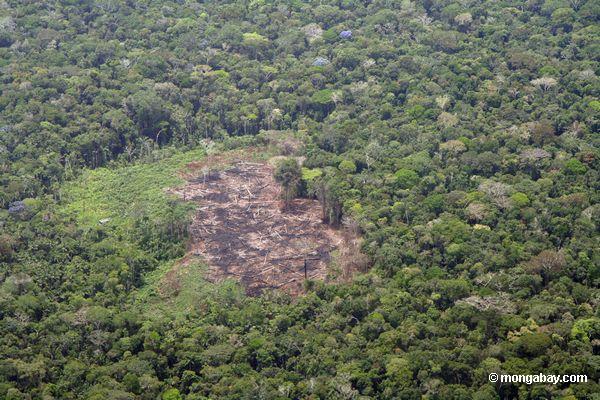
Forest clearing in the Amazon. Photo by: Rhett A. Butler.

Indigenous populations in the Amazon successfully farmed without the use of fire before the arrival of Europeans, demonstrating a potentially sustainable approach to land management in a region that is increasingly vulnerable to man-made fires.

The research, published this week in the journal Proceedings of the National Academy of Sciences, builds on a growing body of evidence showing that pre-Columbian societies practiced advanced farming techniques that were less damaging to the environment than present-day approaches.

"This ancient, time-tested, fire-free land use could pave the way for the modern implementation of raised-bed agriculture in rural areas of Amazonia," said the study's lead author José Iriarte of the University of Exeter, in a statement. "Intensive raised-field agriculture can become an alternative to burning down tropical forest for slash and burn agriculture by reclaiming otherwise abandoned and new savannah ecosystems created by deforestation. It has the capability of helping curb carbon emissions and at the same time provide food security for the more vulnerable and poorest rural populations."

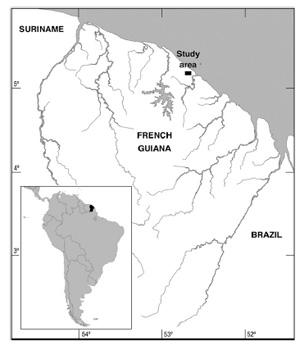
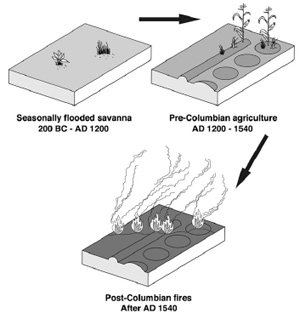
The conclusions are based on analysis of pollen records, charcoal deposits, and other plant remains from soil layers representing a 2,000-year period ending some 800 years ago. The research, which took place in natural savannas in French Guiana, shows that ancient Amazonian populations utilized raised-bed farming, where crops were planted in mounds to protect against flooding and improve soil fertility. Farmers limited the incidence of fire, according to the study.

The findings contrast with the conventionally held belief that native populations relied on fire to convert forest to savanna, as is typically done in the Amazon today.

"Our results force reconsideration of the long-held view that fires were a pervasive feature of Amazonian savannas," said co-author Mitchell Power of the University of Utah.

In fact, the mass death of the indigenous population following the European invasion of the New World may have reduced the long-term productivity of the land.

"These raised-field systems can be as productive as the man-made black soils of the Amazon, but with the added benefit of low carbon emissions," added Stephen Rostain of Centre National de la Recherche Scientifique, referring to rich soils discovered in other parts of the Amazon. These black soils or "terra preta" were formed by an indigenous biochar process that converted poor rainforest dirt into intensely fertile soil. Researchers are now trying to unlock that process to boost the productivity of tropical soils.

At the same time scientists are warning that current practices are putting the Amazon ecosystem at risk. A combination of climate change, selective logging, and deforestation are boosting the Amazon's vulnerability to drought, which turns areas of rainforest usually too wet to burn into tinder for fires that escape from neighboring pasture and agricultural lands. Amazon fires not only cause local pollution and health impacts — they are an important contributor to climate change. Therefore the ancient "no-burn" system could yield environmental dividends.

"Whereas savannas today are often associated with frequent fire and high carbon emissions, our results show that this was not always so," said Doyle McKey of the University of Montpellier. "With global warming, it is more important than ever before that we find a sustainable way to manage savannas. The clues to how to achieve this could be in the 2,000 years of history that we have unlocked."

Rising Ocean Temperatures Prime Amazon Rainforest for Fire

April 9, 2012
Source: Scientific American

MOYOBAMBA, Peru – Karina Pinasco watched in dismay as flames on a hillside at the edge of town lit up the sky one night in October 2010. A farmer had intended to clear a few hectares of land to plant coffee bushes, but the fire – set during an unusually hot, dry spell – quickly got out of hand.

Propelled by winds and high temperatures, it burned for 10 days, charring more than 250 acres of land.

"We realized we weren't prepared," says Pinasco, a biologist who heads Amazónicos por la Amazonía, a local environmental organization. "The firefighters weren't trained. It was the rain that finally put it out."

Scientists used to think the rainforest, especially in the western Amazon, was too wet to burn. But major fire seasons in 2005 and 2010 made them reconsider.

Fires are a major source of carbon emissions in the Amazon, and scientists are beginning to worry that the region could become a net emitter, instead of a carbon sink. New findings link rising ocean temperatures off the northern coast of Brazil to changing weather patterns: As the Atlantic warms, it draws moisture away from the forest, priming the region for bigger fires.

"We are reaching a tipping point in terms of drought, beyond which these forests can catch fire," says Daniel Nepstad, international program director at the Amazon Environmental Research Institute in Brasília, Brazil.

Once-a-century no more
The 2005 drought – considered a once-in-a-century event – resulted in unprecedented wildfires in Acre, the western Brazilian state bordering Peru. Flames scorched the tree canopy, and at one point the front face of the fire stretched nearly seven miles. As many as 1.2 million acres of forests were affected in Acre and the neighboring regions of Pando in Bolivia and Madre de Dios in Peru. Officials estimated upwards of $100 million in economic damages.

But the forest loss wasn't the only concern for the Acre state government, said Foster Brown, a senior scientist at the Woods Hole Research Center and a professor at the Federal University of Acre in Rio Branco, the state capital. Choking smoke spiked respiratory ailments in the region and canceled flights.

Just five years later, another once-a-century drought struck, and fires spread out of control, especially in Acre, Bolivia's Pando region and Brazil's Mato Grosso state. Acre was better prepared, but in Bolivia, smoke from more than 20,000 fires reduced visibility and shut airports in several towns. The Bolivian government declared a state of emergency as more than 3.5 million acres of forest burned. In Mato Grosso, fires destroyed at least 100 homes.

Gigatons of carbon
The 2005 fires added 1.6 gigatons of carbon to the atmosphere, according to a study by Simon Lewis of the University of Leeds, who put emissions from the more widespread 2010 fires at 2.2 gigatons.

In a normal year, the Amazon forests store 0.4 gigatons of carbon a year in the trees and soil, meaning that two bad seasons like 2005 and 2010 could wipe out a decade of gain, according to Lewis' calculations.

And as humans push further into an increasingly drier Amazon, the problem could worsen.

In the western Amazon, humans are the chief source of sparks. With new roads being built and paved through once-inaccessible areas, Peru's Amazonian regions now have some of the country's highest population growth rates. Many of the newcomers clear a little land to farm, and where there are farms, there is fire.

Fire risks
In the Amazon, where weeds and insects run rampant, burning is the most cost-effective way for small farmers to control ticks in cattle pastures and unwanted plants in cassava fields, says Miguel Pinedo-Vásquez, director of international programs for the Columbia University Center for Environmental Research and Conservation, who also works with the Center for International Forestry Research.

Fire will limit development and poverty reduction efforts while increasing greenhouse gas emissions and food insecurity in the region, said Pinedo-Vasquez, who grew up in a small farming community outside Pucallpa, in Peru's Amazon basin. "The risks will increase as we face climate change and demographic shifts, and as land-use changes are becoming more evident."

Drought in the Amazon has long been associated with the large-scale weather pattern known as the El Niño-Southern Oscillation in the Pacific Ocean. During an El Niño year, the winds that usually blow from east to west across the Amazon weaken, so less moisture is carried over the basin. Drier forests pump less moisture back into the atmosphere, exacerbating the effect.

But 2005 and 2010, both record drought years in the western Amazon, were not El Niño years.

Atlantic Ocean is key
Researchers now think the key lies not in the Pacific – or, at least, not entirely – but in the north tropical Atlantic Ocean, off Brazil’s northern coast.

When sea surface temperatures in that area warms, moisture-bearing winds shift northward, said Katia Fernandes of Columbia University’s International Research Institute for Climate and Society. Heavier rains fall in the northern Amazon, while the southwest gets a drought.

Fernandes thinks she can predict those droughts. Looking at droughts over the past few decades, she found that ocean temperatures rose about three months before the dry spell set in – enough time for scientists to issue a warning so governments can prohibit burning during especially dry periods.

That could help farmers tip Amazonian forests back to the carbon sink side of the scale.

In Moyobamba, Pinasco and her colleagues have launched a fire observatory to map hot spots and try to predict high-risk areas. They also teach farmers safer burning techniques, although they would like to see the San Martín region – which has seen an influx of newcomers seeking to cash in on coffee and cacao booms – ban burning altogether.

Pinedo-Vásquez is skeptical about the practicality of going fire free. He and other researchers are studying the behavior of both humans and fire, to make recommendations for better land-use management.

The areas near Moyobamba and Pucallpa are magnets for migrants from the Andean highlands who are new to Amazonian farming. Because escaped fires are most common in areas settled by newcomers, those are the places where fire education should focus, Pinedo-Vásquez said.

From Ancient Farmers, Lessons for Today's Amazon

17 April 2012
Source: Voice of America

South America's Amazon is the largest tropical rainforest and river system on Earth. But the Amazon is disappearing at the rate of about eight hundred thousand hectares a year. This deforestation is caused by an increase in agriculture and cattle ranching and the building of roads and dams. Another cause is the illegal cutting of trees for logging companies.

Now, a new study says ancient Amazonian farming methods could offer valuable lessons for today. The study looks at the pre-Columbian period. Christopher Columbus and other European explorers began arriving in the Americas in the late fourteen hundreds.

The researchers studied a coastal wetland area where ancient farm beds and canals remain unchanged. The site is in French Guyana

A widely held belief is that pre-Columbian farmers used a great deal of fire to manage Amazonian ecosystems. But the scientists say their study calls this idea into question. It shows that raised-field farmers limited their burning to improve agricultural production.

Jose Iriarte from the University of Exeter in England was lead author of the study. Mr. Iriarte says fire results in the loss of important nutrients for crops. When land is not being used for farming, periods without fire are most effective in rebuilding soil organic matter and preserving soil structure. "So in this sense," he says, "we interpreted that they were limiting fires because it was better to grow crops in these raised field systems."

He says this fire-free method by the pre-Columbian farmers helped change the seasonally flooded savanna, or grassland, into productive cropland. Raised fields provide better drainage and soil aeration and also hold moisture during the dry season.

This fire-free method of agriculture would have been labor intensive. It ended when up to ninety-five percent of the native people died from diseases brought by the Europeans. Mitchell Power is curator of the Natural History Museum at the University of Utah.

MITCHELL POWER: "Once the Columbian encounter happens, we don't see that type of agriculture any more. We start to see increased burning and a shift towards dry-land farming. So people were then clearing forests and making their raised beds in the forests. And so, what we think is happening is that there was a huge demographic collapse in this region."

The European colonizers brought slash-and-burn methods of agriculture that remain a threat to the rainforest. Experts say at current rates, more than half of the Amazon's tropical rainforest could be gone by twenty-thirty.

The study is in the Proceedings of the National Academy of Sciences. You can find a link at voaspecialenglish.com. And that's the VOA Special English Agriculture Report. I'm Jim Tedder.

Bolivia 'to end Brazil firm's contract for Amazon road'

10 April 2012
Source: BBC NewsLink

Bolivian President Evo Morales says he is rescinding the contract of a Brazilian firm to build a controversial road through the Amazon rainforest.

He accused the firm, OAS, of not complying with the terms of the deal.

The announcement casts further doubt on a road project that provoked angry anti-government protests last year.

Mr Morales had already suspended the most contentious section which was to pass through an indigenous rainforest reserve known as Tipnis.

Now he is seeking to annul the contract to build the other two sections of the road between Villa Tunari and San Ignacio de Moxos.

"OAS suspended construction in these sections without justification or authorisation," Mr Morales told a news conference in La Paz.

He said the firm had repeatedly ignored instructions and failed to meet various contractual obligations.

Mr Morales did not say if the road project would continue or if OAS would be compensated.

There was no immediate response from the company.

Rival marches

Work on the central section of the road - which was to pass through the Isiboro-Secure reserve (Tipnis) - was suspended last year after a protest march by indigenous tribes.

They said it would destroy their rainforest homeland, opening it up to land grabs by coca farmers.

Mr Morales initially defended the highway saying it was vital for national development, but backed down as the protest gathered nationwide support.

Other communities protested in favour of the highway, saying would bring much-needed economic development to the Bolivian Amazon.

The road project was being funded by Brazil to link the Brazilian Amazon to ports on the Pacific coast of Peru and Chile.

Monday, April 9, 2012

Brazil can eliminate deforestation by 2020, says governor of giant Amazon state

April 05, 2012
Source: mongabay.com

Long seen as a pariah for its high rate of deforestation, the world is starting to look to the Brazilian state of Pará for ideas to protect rainforests.


Brazil can reduce Amazon deforestation to zero by 2020 while boosting rural livelihoods and maintaining healthy economic growth, the governor of Pará told mongabay.com on the sidelines of the Skoll World Forum, a major conference on social entrepreneurship, last week.

Governor Simao Jatene is hopeful that a revolution in land management and governance can turn the tide in Pará, a state that is three times the size of California and has lost more Amazon forest -- 90,000 sq km of Amazon forest since 1996 -- over the past decade-and-a-half than any other in Brazil.

The governor is no treehugger. His motivation comes from a wide-ranging constituency that demands an end to deforestation.

"There is no longer any question that we need to stop deforestation," he said. "The big question is how."


According to the governor, the recipe for success involves shifting from top-down approaches to bottom-up innovations based on multi-stakeholder participation.

"The historical approach was top-down, but top-down has very limited chance for success in Pará, which is 1.25 million square kilometers and has everything from intensive agriculture to the forest frontier to remote areas of pristine forest."

Jatene believes command-and-control efforts have contributed significantly to the 78 percent drop in deforestation in the Brazilian Amazon in recent years, but going further means turning more control over to municipalities, which can adopt policies specific to local conditions within the framework of broader government deforestation-reduction targets.

Jatene sees Pará's CAR (Cadastro Ambiental Rural) as providing the structure under which local initiatives operate. The cadastro is a system that requires ranchers and farmers to register their holdings. Participation in CAR has grown exponentially since it launched in 2009, from 400 in its first year to 40,000 in 2011. The reason is simple: producers can't get credit or sell to mainstream buyers if they aren't registered.

Jatene says Pará aims to have 100,000 producers -- about 50 percent of the total in the state -- registered by 2013.

"A lot of deforestation happened in the Amazon because of a belief on the part of the perpetrators that they wouldn't be punished," Jatene said. "With CAR, land ownership is no longer anonymous."

CAR is a first step for a landowner to get an environmental license. Under CAR, a landowner must have a long-term plan to restore any illegally cleared forestland to required levels.

"If a landowner does not come into compliance, they are punished. The point of CAR is to stop new deforestation."

CAR is good for enforcement and incentives, which Jatene argues are needed to encourage good practices, especially among smallholders, who account for a growing proportion of deforestation as overall clearing declines.

"The challenge is getting smallholders in the cadastro," he said. "We started with big ones that are 80 percent of the problem."

"The carrot for smallholders is infrastructure -- that brings them into CAR."

Jatene asserts that infrastructure includes improved roads, rather than new roads, which decades of research have shown drive deforestation.

"Better roads improve livelihoods because product reaches market faster and in better condition," he said.

Health and education are further carrots.

When the right mix of governance and incentives come together, the transformation can be surprising. Take the case of Parágominas, a municipality in Pará whose deforestation rate was so high it landed on a federal blacklist, restricting its access to credit and markets.

Parágominas turned itself into a "green city", nearly eliminating illegal deforestation by adopting new forest management practices, establishing a local environmental police force, and offering training to ranchers and farmers to increase yields by better utilizing already deforested lands. It was removed from the blacklist last year, becoming a model for other jurisdictions as far away as the Congo and Indonesia.

"Municipalities that are pushing the agenda are seeing the benefits already," he said. "They are trying to replicate Parágominas model."

But the period of transition from a deforestation-driven model to low carbon development can be painful initially.

"The initial transition triggers job loss because the local economy is deforestation-based," Jatene said. "Bridging that transition is the critical moment for government."

"That's why a green education program is important."

Jatene sees the need for substantial investments in education at the municipality level to shift livelihoods away from activities that destroy forests.

"Universal access to education is almost there in Pará," Jatene explained. "The question is quality of the education."

"Low skill jobs tend to be in deforestation industries. That's why they need education."

New industries and innovation require education and training. Jatene says that Pará could triple its agricultural output by making more productive use of poorly utilized and already deforested land. Technology could boost yields even further. But Jatene also sees potential beyond agriculture.

"We need a knowledge revolution," he said. "[We] can generate ground-up knowledge in terms of forest use, including non-wood forest products like açaí and medicinal plants."

The Amazon has great wealth in the form of its biodiversity, which could become the basis of new indigenous industries.

The governor also sees the potential for capitalizing on the value of ecosystem services, like carbon and water.

"The sharp reduction in deforestation in Brazil the last few years was as big a contribution as the Kyoto Protocol," he said. "This was done without international payments for environmental services -- Brazil wasn't paid. This could be a very powerful tool for further reduction."

But locals will need to see direct benefits from reducing deforestation to make such programs effective.

"Additional reduction in deforestation is going to be very difficult," he said. "Locals have to really feel they are part of the solution."

The governor added that social issues are highly variable across different parts of Pará, so "solutions won't be the same in all areas."

"We need to reduce inequality and poverty," he said. "Poor people will need to increase their footprint, while rich people must reduce their footprint."

"And this applies globally," he added, noting the consumption patterns of people in the United States which are many times higher than those in Pará.

Still, he reiterated, there is widespread support in Pará for curbing deforestation.

"The zero net deforestation goal for 2020 goal is not an idea from outside, it's a demand from society. Most are in favor of reducing deforestation. There are some groups that want to continue deforesting but they are in the minority."

He said proposed changes to Brazil's Forest Code wouldn't affect Pará's 2020 commitment.

Jatene also highlighted an overlooked motivation for ending deforestation: an open frontier is expensive for governments.

"It makes sense for the government to push for a closed frontier," he said. "When the frontier is open, the government has to extend services and infrastructure without getting the tax benefits because of illegality."

"There are strong reasons for Pará to commit to zero net deforestation," he said. "Pará can be an example for the rest of the world."

The last leg of the Amazon

04/08/2012
Source: Jerusalem Post


When sailing downriver on the Amazon, the first place one encounters a buoy in the water is at the large port city of Manaus.

Upriver, the change in the level of the river is more acute as the channel is narrower, and bouys are therefore useless. By the time you reach Manaus, where the river is quite broad, there is an actual pier for ships to dock rather than simply a plank of wood cast between the boat and the muddy shoreline; there is a container port; there are oil tankers anchored offshore; there is a more established atmosphere altogether.

Boats sail from Manaus to Belem on Brazil’s Atlantic coast twice a week, and as with all boats along the Amazon, they carry both cargo and passengers.

But it is wise to book a ticket in advance. The operating agency through which I had booked my jungle tour told me I was lucky because on the date I was planning to depart, “the best boat that sails to Belem” is the one which will be sailing.

Another backpacker and I were both planning to do the trip, so together we went to purchase the tickets in advance. We learned of a loophole, so we decided to take advantage of it. Someone who books a cabin can also put up a hammock. So he gave me the money for the cost of his hammock ticket, and I reserved a cabin – partly paid for by his money. In exchange, he could store his valuables in the cabin and not worry about theft and he could use the fridge in the cabin, and I paid less for a cabin ticket.

The other backpacker is David Oliver, a 36-year-old African-American with dredlocks cascading down his back, and he is on a 14-month backpacking trip in South America. He works as a chef in one of the better casinos in Las Vegas, the city where he was born and raised. He also spent time on a submarine in the US Navy. During his time in Colombia, he volunteered for four months at an orphanage, teaching English and improving his Spanish.

The boat ticket clearly indicated embarkation no later than 10 a.m. on departure day, with actual departure set for noon. We were also told that we should come to the boat 24 hours prior to departure in order to choose our cabin in that “class” of ticket, which we did. We were alarmed, however, to see that the cabin they wanted to assign to us was without windows. We indicated that we had paid a lot of money (relatively) and should get a better cabin.

Unfortunately, neither of us speaks Portuguese and we had trouble explaining our preference to the woman taking us around. Finally, she put us into the hands of “Douglas.” It turns out Douglas is originally from Savannah, Georgia, but has lived in Brazil for nearly 30 years. He also happens to be the captain of the boat. CNN has done a story on him as well. Douglas got us the best cabin on board, and during the trip brought us up onto the bridge.

The cabin still lacked a few amenities, to be sure, but it was a far cry from the earlier ones we had been shown. What apparently made this boat “the best” for this route is that it is made of metal and not wood.

Departure day – we showed up around 9 a.m., stored our gear in the cabin and then set off to buy some supplies – oranges, bananas, crackers, bottled water, etc.

When we got back aboard, I decided I had to sleep. I had acquired a bad cold and had not slept well the night before. Dave went off to his hammock.

Precisely at noon, the boat began to move. I got out of bed and went on deck. Looking around, I didn’t immediately see Dave, but the boat is large so I thought nothing of it and went back to sleep. I awoke a few hours later and realized we weren’t moving. Going on deck, I discovered we were still in Manaus, but we had moved to another pier about 400 meters away from the first.

Dave, meanwhile, had met a local Brazilian. They had decided to go ashore and were told the boat would only be leaving at 4 p.m. However, when they returned to the pier, the boat was missing. No one had told them that it was being moved to another pier, and they were sure it had sailed. Only at the last minute did they discover the change and make it back aboard – just in time for departure.

This segment of the Amazon – the 1,600 k.m. from Manaus to Belem – is very different from the Amazon Basin. The river is much wider. The current is stronger.

The towns where we stop are more prosperous. There are actual wharves and piers. Yet the people on board are pure Brazilian – openly curious and friendly, not put off that you don’t speak Portuguese, helpful to tourists but also to each other, and people who like to party.

Every night on the upper deck, there’s music playing, a bit of drinking and dancing, and a lot of laughter – at least until the rain starts! Earlier in my trip, I had asked one of my jungle guides when he last saw a 24-hour period without any rain. The response was a simple “never.” It starts. It stops. People in the streets wander to a place where they can take shelter for a few minutes, and then they go on about their business. Outside of the cities, people just continue whatever it is they were doing. For without the rain, there is no Amazonian rainforest and no mighty Amazon River.

The last day, a newcomer on board, an American from Virginia who plays the fiddle, and a Uruguayan who plays a stringed instrument reminiscent of a small mandolin, gave us a concert which went on for hours.

It was sometimes Irish fiddle music and sometimes Peruvian or Uruguayan, but each learned quickly from the other and lent a particularly festive atmosphere to our travels.

This last day one also sees a huge increase in traffic on the river, with large barges filled with timber heading for the coast and others loaded with cars headed inland. Youngsters along the river paddle out to us in small canoes just to wave, and their parents come alongside selling fruit and occasionally ice cream.

As we approach Belem, the world changes. There are high-rise buildings. The air has a hint of salt due to the proximity to the ocean. There is a formality to the proceedings of disembarking – all very different from Iquitos, Peru, where I began my river journey. I have travelled some 3,000 k.m. along this waterway and revelled in every minute of it.

If you ever have a few weeks to spare and are in the mood for a bit of an adventure, sailing down the Amazon will give you an incredible cornucopia of experiences.

There are “hotel boats” which offer better amenities, but if you are prepared to rough it for a bit, go local and rub shoulders with the Peruvians, Colombians and Brazilians, and the occasional other tourist.

It will provide memories that last a lifetime and perhaps even make you some new friends.

Brazil's Amazon boom pits economic growth versus forest

7 April 2012
Source: BBC News

Manaus is one of the host cities for the 2014 Fifa World Cup in Brazil

Marcelo Gordo is standing in the back garden of a small house in a suburb of Manaus, the capital of Brazil's Amazonas state, hoping to catch sight of a pied tamarin.

These small primates, with white upper bodies and brown bottoms, live only in rainforest surrounding the city and as Manaus grows and expands, they are becoming trapped in isolated patches of forest.

Mr Gordo, a researcher from the Federal University of Amazonas, has been studying these creatures for some 14 years.

He has pinpointed a group of about eight which live in a jungle-covered gully behind this row of houses.

"They have a very strict geographical distribution and in the last few years they've been losing this space," he says.

"If these animals had a very small geographic distribution in a different place, where they weren't competing with humans, there wouldn't be a problem, but they live right where Manaus is."

Located deep in the Amazon rainforest, Manaus would seem an unlikely place for a city.

It flourished originally as the centre of the rubber boom in the late 1870s. Once rubber plantations were developed elsewhere, it lapsed into semi-obscurity once again.

But in the 1960s the military government, installed by a coup, was looking to consolidate its control over the country with economic development and galvanise its control over the Amazon region.

It encouraged businesses to expand into the area by offering generous tax breaks.

Tech companies

Manaus has grown in the ensuing decades. The population is now about 1.8 million, almost doubling in size since 1990.

With Brazil's healthy economy, the city is booming once again.

Many major multi-national technology manufacturers, like LG, Samsung and Philips, have a presence here and their business is swelling the population further.

"It's not easy to find employees with the background that we, the companies, are looking for," says Wilson Perico, director of the Technicolor factory which makes modems and satellite decoders.

"It's why some companies bring experts from other states or countries to help the new guys… to develop their activity here."

The increase in workers in the city led to the decision to build a bridge over the Amazon to open up the south bank of the river to development.

Inaugurated in late 2011, the Rio Negro bridge will give more commuters access to dormitory towns where developers are already building more housing.

Other changes are on the way. Manaus will be one of the host cities when the Fifa World Cup takes place in Brazil in 2014.

Construction is already under way on a 40,000-seater stadium and several new hotels are planned for the thousands of visitors who are expected to descend on the city.

The tournament organisers have vowed the stadium will be environmentally friendly, using energy efficient lighting and harvesting rainwater.

Road building

But even with such "green" credentials, Manaus' expansion is still a threat to the environment that surrounds it.

There are few roads connecting the city with the outside world and most visitors arrive by air or by boat, along the immense Amazon river.

As the city grows, there are concerns that more overland routes will become necessary. Ecologists say where roads are built, destruction of the rainforest is sure to follow.

"A lot of the land that's in the public domain will wind up passing to become private land by people just moving in illegally and just starting to clear," says Philip Fearnside, an American academic who has lived and worked in Manaus for more than 30 years.

"You have this tremendous pressure on land that will move out from any road that is built," he says.

Manaus encapsulates the conundrum facing developing countries whose leaders will be gathering in Brazil in June for the United Nations Conference on Sustainable Development, also known as Rio+20.

They will be pondering the question - how do you provide jobs and growth to eradicate poverty, without destroying the environment?

Amazon Children’s Ward patients all set for an egg-cellent Easter

Friday 6 April 2012
Source: Peterborough Evening Telegraph

Thomas Cook deliver Easter Eggs to the PCH Amazon Childrens Ward Pictured are Kerri Dixon and Trish Hughes from Thomas Cook, with Carmen Powell, Andrew Powell, Anthony Mathias, and Lola Giddings, with the Play Team's Holly Brown. Photo: Alan Storer/Peterborough ET (METP-05-04-12AS019)

A HEART-MELTING grin from a poorly youngster said it all as businesses delivered a cracking donation to a children’s ward.

Wide-eyed Anthony Mathias (7) dressed up as a Power Ranger in between treatments for sickle-cell anaemia to accept a chocolate mountain on behalf of the Amazon Children’s Ward at Peterborough City Hospital yesterday.

Trolleys choc full of eggs, sweet chicks and bunnies were wheeled onto the ward by staff from generous city businesses Office Angels and Thomas Cook.

As a result, children’s nurses will hop from bed to bed this Easter weekend, distributing eggs to every patient.

They have stashed more away as prizes for a ward-wide Easter egg hunt on Sunday.

Zoe Wilkinson, a play services coordinator for the Amazon Ward, said little Anthony polished off his egg after proudly accepting the gifts, which included Easter mugs for children whose conditions rule out sweet treats.

She said: “The egg drop is brilliant.

“It gives the children a boost and a nice treat, because they are often here for blood tests and examinations and they have to keep still and be really good.

“And for parents, it gives them a little bit of reality.”

Alex James and Dawn Trowsdale from Office Angels, in Church Street, delivered the goods to the ward and had spent weeks collecting more than 150 eggs from dozens of city businesses.

Last week Office Angels also delighted children with multiple or profound learning difficulties at the Phoenix School, in Orton Goldhay, by presenting them with chocolate treats before they broke up for the school holidays.

Office Angels branch manager, Alex James said: “We have been absolutely overwhelmed by the generosity of employers in Peterborough who whole-heartedly embraced our idea to put smiles on children’s faces who are either very ill or require special care at Easter.

“The businesses are too many to mention here, but they know who they are.”

Trish Hughes and Kerri Dixon, from Thomas Cook’s headquarters, in Bretton, delivered chocolate and treats to the hospital yesterday.

Trisha said: “Since we launched the appeal, we have been overwhelmed by people’s generosity and contributions and it has been a great success.

“We’re really thrilled to bring some Easter cheer to children who perhaps aren’t able to celebrate it as they’d wish to.”

Amazing Amazon

HIPPO-SHAPED treatment tables and stimulating jungle murals help make hospital visits for sick youngsters in the city more bearable. The Amazon Ward at Peterborough City Hospital is a specially-built, 30-bed ward for children up to the age of 16 who are in need of paediatric medical treatment, surgical emergency services, specialist orthopaedic surgery and ear, nose and throat surgery.

A Rainforest Outpatients’ Department is used by visiting specialists including physiotherapists, dieticians and by specialist consultants, while first port of call for children referred to Peterborough City Hospital by their GP or the emergency department is the ward’s Jungle Assessment Unit.

More than 100 bikers delivered Easter gifts to the Amazon Ward last Sunday during their annual Easter Egg Drop and bike ride. At Christmas, Posh stars including George Boyd, Lee Tomlin, Paul Jones and Paul Taylor wore Santa hats to make a special delivery to the ward of £500 worth of presents from ASDA and Debenhams.

Thursday, April 5, 2012

Researchers launch tool that predicts Amazon deforestation a year before it happens

March 30, 2012
Source: mongabay.com

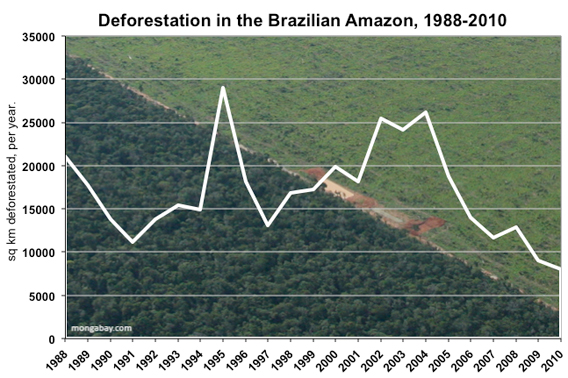
Annual deforestation in the Brazilian Amazon

Researchers have developed a methodology for accurately predicting where deforestation will occur in the Amazon up to a year in advance, enabling law enforcement agencies and officials to take preventative action before trees are actually chopped down, a forestry expert told mongabay.com on the sidelines of the Skoll World Forum for Social Entrepreneurship.

The system, which is based on historical deforestation patterns in the Brazilian Amazon, existing infrastructure and illegal roads, socio-economic drivers and biophysical conditions was developed by Imazon, a Brazil-based group that creates tools to track and analyze deforestation and makes policy recommendations for reducing forest clearing.

"This tool is used for anticipating where forest clearing and degradation is likely to occur in the next deforestation year, which ends in July" said Imazon's Carlos Souza, who won the Skoll Award for Social Entrepreneurship in 2010. "We are using it in conjunction with our near real-time deforestation monitoring system."

Imazon's deforestation detection system — which is known as SAD — provides monthly updates on where deforestation is occurring. It also offers a source of monitoring and reporting that is independent of the Brazilian government's system, fostering transparency.

Data released by Imazon this month showed that deforestation in the Brazilian Amazon is down relative to the same period last year, when deforestation levels were the lowest since annual record-keeping began in the late 1980s. A combination of government policies and macroeconomic trends have contributed to a 77 percent decline in deforestation in the Brazilian Amazon since 2004.

Souza said the deforestation forecasting tool could be useful for prioritizing areas for interventions under a program for reducing emissions from deforestation and degradation (REDD+).

"Funds could go toward conservation interventions in areas where deforestation is highly likely to occur, thereby preventing those emissions" he said.

The drop in Brazil's deforestation since 2004 has resulted in the largest single short-term reduction in greenhouse gas emissions (more than 600 million tons of carbon dioxide) in modern history.

Brazil Defends Credentials as Rio+20 Host

Apr 4, 2012
Source: Inter Press Service

The government of Brazil, which will host the United Nations Conference on Sustainable Development (Rio+20) in June, defended itself from ecologists who lambasted its performance on the environmental front.

"There is no country with better credentials for hosting this conference," Luiz Alberto Figueiredo, subsecretary-general for environment, energy, science and technology at Brazil’s foreign ministry, told foreign correspondents on Tuesday, Apr. 3.

The official was responding to the harsh criticism that 39 local environmental organisations recently expressed to the United Nations about what they described as the "setback" in the environmental agenda since President Dilma Rousseff took office in January 2011.

The environmentalists referred, for example, to the reform of the forestry code winding its way through Congress, which would grant an amnesty to people who illegally cut down forests prior to July 2008. The reform is backed by powerful agribusiness interests.

They also complained that environmental oversight agencies had been weakened, and that the Rousseff administration was following an economic model that promotes the exploitation of natural resources regardless of the consequences for the environment.

"Brazil will host Rio+20 with impeccable credentials, as one of the few countries that has achieved economic growth with social inclusion and a reduction in deforestation never before seen in the history of this country," said Figueiredo.

The official was referring to the accomplishments of former president Luiz Inácio Lula da Silva (2003-2011) and his successor, Rousseff, both of whom belong to the left-wing Workers’ Party.

Figueiredo made his remarks at a news briefing with foreign correspondents, where he discussed the plans for the U.N. conference, to be held Jun. 13-22 in Rio de Janeiro, and for the pre-summit preparatory meetings.

He said civil society – by which he meant environmental, business and scientific organisations – would have significant participation in the summit.

The conference is called Rio+20 because it is taking place two decades after the U.N. Conference on Environment and Development or Earth Summit hosted by this Brazilian city in 1992, which marked a watershed in the evolution of international environmental law and in cooperation on social and environmental issues.

Citing the official U.N. slogan for the conference, the subsecretary said the event would seek to define "the future we want" over the next 20 years: a model of development marked by economic growth, social inclusion and environmental protection, combined in a harmonious fashion.

The summit will focus on two main themes: the green economy in the context of sustainable development and poverty eradication, and the international institutional framework for sustainable development.

But Figueiredo stressed that, unlike the Earth Summit, which gave rise to major commitments such as the climate change and biodiversity conventions and the Agenda 21 action plan, this year’s conference is not being held "to legislate."

The official also responded to complaints by environmentalists that Rio+20 would not set targets. The aim, said Figueiredo, is not to establish goals or to punish countries that do not meet them, but to "help countries reach them and to consolidate the concepts defined up to now."

"What penalties can we apply, for example, to a poor country for failing to meet its environmental goals if it is in such an extreme situation that it was unable to reach them? We have to help countries fulfil the goals," he said.

In Figueiredo’s view, Rio+20 will contribute "a new way of looking at" the international financial and social crisis, which he said was the result of an "inadequate development model that no longer responds to today’s new challenges."

That model is based on an unsustainable form of production "that was not even suitable in the late 19th century, or in the 20th century, and is surely not suitable in the 21st century," Figueiredo said.

As an example of this "exhausted" model, he cited dependence on fossil fuels and referred to the need to seek clean and renewable sources of energy – touching on another sensitive issue for Brazil.

Since the discovery of enormous new reserves of oil located deep below the ocean floor under a thick layer of salt, Brazil has begun to harbour hopes of becoming one of the world’s largest oil producers.

This country is also criticised for the large hydroelectric dams being built in fragile areas like the Amazon rainforest.

But Figueiredo said these reprimands were unfounded. "Brazil is the only country in the world where cars run on at least 20 percent biofuel," he said, referring to the petrol blends that by law must contain at least 20 percent ethanol.

The official mentioned other points that will be debated at Rio+20, such as the need to strengthen the United Nations Environment Programme (UNEP) and to create new agencies as well.

Although he downplayed the frictions caused by the different stances taken by governments, Figueiredo said the goal is to define sustainable development objectives "not just targeting developing countries, but all countries."

Green Sounds Of The Amazon

April 4, 2012
Source: Manila Bulletin

MANAUS, Brazil (dpa) — The neighborhood of Zumbi dos Palmares II lies in the east of the Amazonian metropolis of Manaus. It used to be one of the poorest and most violent areas of this city of 1.8 million people, and it remains a social hotspot to this day.

Zumbi dos Palmares II is the home of Brazil's environmental activist and musical celebrity Rubens Gomes, generally known as ''Rubao'' or big Rubens.

Fourteen years ago, he launched a project that links protection of the endangered rainforest to music, crafts and social commitment: the Oficina Escola de Lutheria da Amazonia (OELA, the Amazonian Work¬shop School for the Construction of String Instruments).

There, youngsters aged 16-21 learn how to make guitars, and above all what wood to use in the effort without overexploiting the rainfor¬est. The materials that are tradi¬tionally used to make instruments, like spruce, cedar or jacaranda, are replaced with wood from Amazo¬nian trees. ''Our guitars have the FSC seal, a certificate that proves a careful and responsible handling of the rainforest,'' says Gomes, with reference to the Forest Stewardship Council.

Gomes is himself a guitar-maker and before the founding of the OELA in late 1997 he used to teach at the Arts Centre of the Univer¬sity of Amazonas. These guitars are bought by many artists in Brazil not just because of the contribution they make to the protection of the environment but also because the instruments are of very good quality in both their finish and their sound. ''Some instruments are real masterpieces,'' Gomes says in praise of his students.

The musician Milton Nascimento has an OELA guitar, and so do Brazilian singers Gilberto Gil and Lenine. However, it is in classical music that the instruments made in Manaus are used the most. The school gets materials as donations from large logging companies that want to have their wood certified. Three guitars are made per day. A basic guitar, for which four types of wood are generally used, costs 1,500 real (832 dollars). But there are also special models with up to 13 strings whose prices are considerably higher.

''It was strange. At the beginning we used to offer guitars at a lower price. Then we established that the threshold lies at 1,500 real because otherwise people mistrust the instrument,'' Gomes says.

Beyond the FSC seal, the trademark of their guitars, mandolins and banjos is the shape of the upper neck of the instrument, where the tension of the strings is adjusted. The tip is made in the shape of the dome of the Teatro Amazonas, which is the symbol of Manaus.

Renato Montalvao started out as a student in the workshop, and he is now a teacher. ''Young people get one year of training here. Many of them want to become musicians,'' says this 28-year-old. The workshop has by now become a well-known place to visit. Prince Charles was there with Camilla in 2009 and Brazil's former president Luiz Inacio Lula da Silva has also visited, as have students from around the world.

Tuesday, April 3, 2012

Government policy contributes to huge drop in Amazon deforestation in Brazil

March 28, 2012
Source: mongabay.com

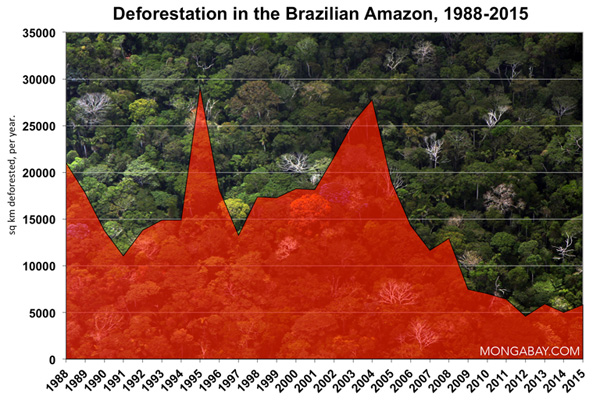
Annual deforestation in the Brazilian Amazon

Roughly half of the 70 percent decline in deforestation in the Brazilian Amazon between 2005 and 2009 can be attributed to policies enacted by the Brazilian government, asserts an analysis published by the Climate Policy Initiative (CPI), a group funded by George Soros. The measures helped avoid 62,000 square kilometers of deforestation and 620 million tons of carbon dioxide emissions that would have otherwise occurred.

The study used regression analysis to isolate the effects of agricultural prices and other macroeconomic factors from policies enacted to slow deforestation, including improved monitoring and enforcement, expanded protected areas, and financial incentives for compliance with environmental laws. These policies were put into motion following a sharp spike in deforestation in 2003 and 2004. In 2008, the federal government strengthened environmental protection by establishing blacklists for municipalities with high deforestation rates. Blacklisted municipalities lost access to low interest credit and faced heightened monitoring. The only path towards getting off the blacklist was establishing a land registry to demonstrate compliance with forest laws and reducing deforestation.

CPI aims to next determine what specific policies were most effective in reducing deforestation, according to co-author Juliano Assunção, director of CPI's Rio de Janeiro branch and professor at the Department of Economics at the Pontifical Catholic University of Rio de Janeiro (PUC-Rio).

The study could have implications for efforts to reduce deforestation elsewhere. Other tropical countries already look toward Brazil as a model for cutting forest loss without sacrificing economic growth. For example, Indonesia recently adopted a national growth plan that includes reductions in deforestation and forest degradation.

But the effectiveness of government policy in reducing deforestation in Brazil has recently sparked a backlash among some agricultural producers in the country, which are now trying to weaken some environmental laws, including the Forest Code, which restricts the amount of forest a landowner is allowed the clear. Last year ruralistas — a coalition of agribusiness interests — attempted to push through a substantially weakened version of the code, although the Senate version of the bill retained some of the original safeguards against forest clearing. Brazilian President Dilma Rousseff is expected to vote on the measure in coming weeks.

The green sounds of the Amazon: rainforest guitars

29 March 2012
Source: Bikya Masr

Manaus, Brazil (dpa) – The neighborhood of Zumbi dos Palmares II lies in the east of the Amazonian metropolis of Manaus. It used to be one of the poorest and most violent areas of this city of 1.8 million people, and it remains a social hotspot to this day.

Zumbi dos Palmares II is the home of Brazil’s environmental activist and musical celebrity Rubens Gomes, generally known as “Rubao” or big Rubens.

Fourteen years ago, he launched a project that links protection of the endangered rainforest to music, crafts and social commitment: the Oficina Escola de Lutheria da Amazonia (OELA, the Amazonian Workshop School for the Construction of String Instruments).

There, youngsters aged 16-21 learn how to make guitars, and above all what wood to use in the effort without overexploiting the rainforest. The materials that are traditionally used to make instruments, like spruce, cedar or jacaranda, are replaced with wood from Amazonian trees.

“Our guitars have the FSC seal, a certificate that proves a careful and responsible handling of the rainforest,” says Gomes, with reference to the Forest Stewardship Council.

Gomes is himself a guitar-maker and before the founding of the OELA in late 1997 he used to teach at the Arts Centre of the University of Amazonas.

These guitars are bought by many artists in Brazil not just because of the contribution they make to the protection of the environment but also because the instruments are of very good quality in both their finish and their sound. “Some instruments are real masterpieces,” Gomes says in praise of his students.

The musician Milton Nascimento has an OELA guitar, and so do Brazilian singers Gilberto Gil and Lenine. However, it is in classical music that the instruments made in Manaus are used the most.

The school gets materials as donations from large logging companies that want to have their wood certified. Three guitars are made per day. A basic guitar, for which four types of wood are generally used, costs 1,500 real (832 dollars). But there are also special models with up to 13 strings whose prices are considerably higher.

“It was strange. At the beginning we used to offer guitars at a lower price. Then we established that the threshold lies at 1,500 real because otherwise people mistrust the instrument,” Gomes says.

Beyond the FSC seal, the trademark of their guitars, mandolins and banjos is the shape of the upper neck of the instrument, where the tension of the strings is adjusted. The tip is made in the shape of the dome of the Teatro Amazonas, which is the symbol of Manaus.

Renato Montalvao started out as a student in the workshop, and he is now a teacher. “Young people get one year of training here. Many of them want to become musicians,” says this 28-year-old.

The workshop has by now become a well-known place to visit. Prince Charles was there with Camilla in 2009 and Brazil’s former president Luiz Inacio Lula da Silva has also visited, as have students from around the world.

For Rubao, the main issue is the social component. “When I came here, young people were killing each other. The state was practically absent. There were drugs, alcohol, violence. Today there is still some of that, but things have improved,” he says.

He left his comfortable flat in the center of Manaus for this social troublespot in the east. “I used to read negative headlines in the paper everyday. It shook me and it really upset me,” he recalls.

Gomes moved to Zumbi, rented a house, then bought it, and he built a workshop and classrooms for his non-profit project. Today, he and his school are a part of the neighborhood. He teaches his students to have a different attitude to the resources of the forest.

“Many know too little about the rainforest. Here, young people learn to appreciate its real value,” Gomes says.

TCS scientists study Amazon Rainforest in Peru

Mar 28, 2012
Source: NorthumberlandView.caLink

On March 10th, seven Trinity College School students and two teachers ventured into the Amazon rainforest in Peru for a two-week biological and conservation management research programme organized by Operation Wallacea in the Pacaya-Samiria National Reserve. The purpose of the trip was to assist in the ongoing compilation of data, specifically during the high water season, for seven different monitoring programmes: fish, caimans, macaws, dolphins, understory birds as well as land and water animals.

The information gathered over the years has enabled scientists to lobby for more forest to be preserved and has helped to establish community-based management techniques with the local Cocama tribes who subsist solely on the land and water. Furthermore, this research has helped to demonstrate the impacts of climate change on the land and water animals in this region and will ideally help to generate strategies to improve the situation. Due to the conservation methods that have been in place for the past 12 years, this region has seen the populations of species such as the howler and woolly monkeys rebound and return to flourishing numbers and it has seen an increase in the black caiman populations from a species on the endangered list to one that is now listed as conservation dependent.

It was an incredible experience for all students involved (Hailey Davis, Alex Jack, Makani Joinville, Max Kaufmann, Hikaru Morishita, Basil Southey, Ryan Williams), as well as the chaperones (faculty members Bruce Craine and Steph Feddery). Exploring a flooded forest in search of “land” proved to be the biggest challenge and “land” turned out to be very elusive. Students had the opportunity to see rare pink river dolphins in the Samiria River and numerous types of macaws, fish and understory birds. During the surveys, students saw a variety of primate species: howler monkeys, tamarins, capuchins and woolly monkeys.

While in the reserve, students lived on a restored ship that was once used during the Amazonian rubber boom between 1880 and 1920. After 12 days on the boat we got to visit a typical Cocama village and it was the first time we’d seen civilization since we embarked on our trip up river to the reserve. While we were unable to play a game of soccer due to the flooded fields, we were able to dance and play with the children of the St. Martin community. Following a group dinner in the city of Iquitos the TCS group returned home on March 24th after a whirlwind experience. Whether you were interested in science before or simply curious for an adventure, this trip opened all of our eyes to the wonders of nature, the power that a concerned group of people can have and the importance of doing all we can to preserve and conserve the environment for future generations.

Greenpeace seeks help to save the Amazon

29 March 2012
Source: Dominican Today

Dear friends,

The Rainbow Warrior is alongside at Santarém right now, on the Amazon River.

Kristin Bauer, who plays Pam in the TV series "True Blood", just sent us this short video message of solidarity to share.

It may be that it's finally spring time where I am right now, but I feel there's a real sense of hope building again for the rainforest!

Our new campaigning ship has begun its journey down the majestic river to the Brazilian coast before making its way to Rio de Janeiro for the UN Rio+20 Summit in June.

The expedition will highlight the beauty and importance of protecting the rainforest, expose the drivers of its destruction and champion the solutions needed to achieve zero deforestation in Brazil.

Please sign up on our Amazon homepage to journey with us, and support the people of Brazil campaigning to save the Amazon.

This is the beginning of an initiative that's not only protesting regressive change like the new Forest Code, but pushing for a hopeful, ambitious new law to save the Amazon for all.

Brazil needs a strong legal framework to make sure they continue to reduce deforestation, and we can help by building the movement to save the Amazon!

With warm wishes (from sunny Amsterdam!),

Eoin Dubsky

Greenpeace International

P.S. The Amazon is humanity's future. Please sign up on our Amazon homepage to journey with us.

Interested in volunteering?

Donate to Greenpeace International