Wednesday, March 28, 2012

Greenpeace calls for zero deforestation globally by 2020

March 22, 2012
Source: mongabay.com
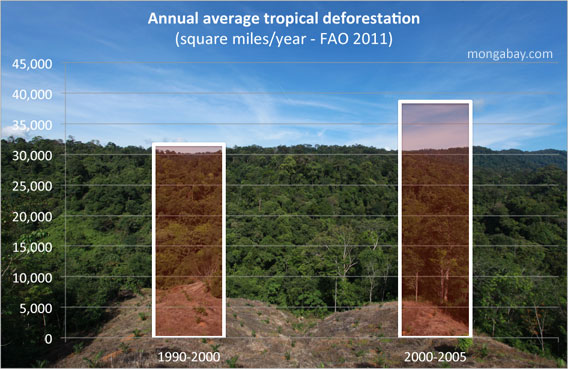
Global deforestation according to the U.N.

Greenpeace reiterated its call for an end to deforestation in Brazil by 2015 and globally by 2020 during its launch of an awareness-raising expedition down the Amazon River aboard the Rainbow Warrior.

"Brazil is now the sixth largest economy in the world, the largest meat exporter and second largest grain exporter. Brazil’s rise to become the world’s sixth largest economy coincided with consecutive years of decline in deforestation in the Amazon,” said Kumi Naidoo Greenpeace International Executive Director. "Brazil must lead as an example of sustainable development without forest destruction for other forest countries like Indonesia and the Congo.”

The Greenpeace voyage is timed to end in Rio around the start of the Rio+20 conference on sustainable development. The conference is expected to attract thousands of business and political leaders, as well as scientists, activists, and academics.

While the annual deforestation rate in the Brazilian Amazon has fallen by nearly 80 percent since 2004, environmentalists fear the country's politicians may backslide on their commitment toward greener economic growth.
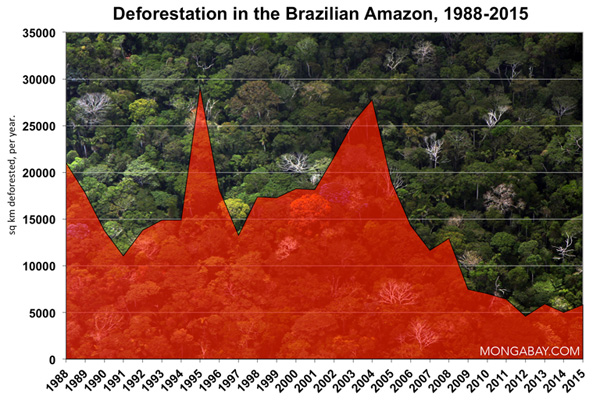
Annual deforestation in the Brazilian Amazon.

“Brazil could be the example of an economic super power that continues to grow without recklessly destroying the forests. However, actions over the past year by President Dilma and the Brazilian congress show that we are at risk of failing to achieve this,” said Paulo Adario, Greenpeace Brazil’s Amazon Campaign Director. “It will only be with a strong legal framework that Brazil will have the necessary tools to continue to fight deforestation.”

Greenpeace has therefore launched a petition calling for a "zero deforestation" law in Brazil. It is seeking 1.4 million signatures of Brazilian voters for the initiative.

"The proposed law is an initiative started after the blatant dismissal of widespread public opposition to the new Forest Code law by the Government in favor of vested agribusiness influence," said Greenpeace in a statement. "Brazil's Amazon Rainforest is currently facing intense pressure from cattle ranchers, the agriculture sector, loggers and large infrastructure projects all threatening to undo legislation that has helped to protect the forests of Brazil for years."

Brazilian lawmakers and President Dilma Rousseff are currently weighing a revision to the country's forest code, which governs how much forest a landowner is permitted to clear. Environmentalists fear the legislation could grant amnesty for landowners who illegally cleared millions of hectares of rainforest. Supporters of the revision say it could make the Forest Code clearer and easier to enforce while allowing Brazil to expand export-driven agriculture deeper into the Amazon.

A vote on the measure is expected in coming weeks. Greenpeace is urging President Rousseff to reject the revision.
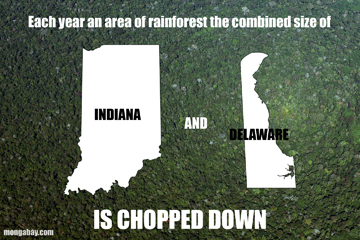
Deforestation remains a critical environmental issue globally. More than half of Earth's terrestrial plant and animal species reside in tropical forests, while deforestation and forest degradation account for 10-15 percent of greenhouse gas emissions. Forests also provide important ecosystem services, including maintenance of rainfall and moderation of local climate, that form the basis of rural and urban economies. For example, roughly 70 percent of GDP in South America is produced within the rain shadow of the Amazon rainforest.

Greenpeace is not alone in its target. WWF, one of the world's largest environmental groups, has a zero "net" deforestation target for 2020.

Lightning kills 4 family members in Brazil's Amazon rainforest, caught in storm picking fruit

March 26, 2012
Source: Minneapolis Star Tribune

SAO PAULO - Four members of the same Brazilian family were killed by a lightning strike during a heavy storm in the Amazon region.

Brazil's national space institute known as Inpe tracks lightning strikes in Brazil.

It says in a Monday statement that one 30-year-old man and three girls died after lightning hit a tree they were standing under in Para state. They had been in the jungle picking fruit.

The newspaper O Liberal reports the man who died was the uncle of two sisters who were killed. The girls were 7- and 9-years-old, and a 13-year-old girl in the group also died. It was not clear how she was related to the others.

Calls to police weren't answered.

Inpe says Brazil has more lightning strikes than any other nation. They register nearly 58 million strikes per year.

Google Street View Now Takes You Into The Amazon

Mar 26, 2012
Sorce: Asian Correspondent


In line with World Forest Day on March 21, Google has unveiled Google Amazon Street View, which takes users into the heart of the protected rainforest.

The new feature allows users to have unprecedented access to parts of the Amazon Basin under preservation by the Brazilian government, including the Rio Negro tributary and the surrounding communities.

The photographic maps were assembled from over 50, 000 still images that were taken with Google’s distinctive 360 degree camera-orb placed atop canoes and their Street View Trike.

The project which was first proposed last year, took nine months in the making and is a collaboration between Google and the Foundation for a Sustainable Amazon.

Just last month too, Google unveiled their ‘Street View’ of The Great Barrier Reef.


Peru: More Transparent Forest Governance In Amazon

March 23, 2012
Source: Eurasia ReviewLink

In Peru, where over half of the national territory is covered by forests and the logging industry is marred by corruption, transparency and good forest management are closely linked.

Twenty government agencies related to forest management were evaluated by a non-governmental institution in 2011 to determine whether they complied with a legal requirement to operate websites and to what degree they provide the public with access to information.

The study found that the number of responses to requests for information has increased yearly. The percentage of requests fulfilled rose from 67 percent in 2010 to 75 percent in 2011. Nevertheless, the percentage of responses provided later than the legally mandated deadline rose from 22 percent to 23 percent over the same period.

Within the national government, the Ministry of Environment showed considerable improvement. However, according to specialists, the steps taken by regional governments were even more significant, because within the framework of decentralization in Peru, it is these agencies which are increasingly responsible for forest governance, particularly in the Amazon region.

Two of the six regions that now are now responsible for controlling, monitoring and granting forest concessions – formerly the excusive domain of the national government – showed the greatest progress: San Martín and Loreto, both in northern Peru.

All combined, these six regions account for 86 percent of Peru’s Amazon rainforest cover.

The “2011 Annual Report: Transparency in the Peruvian Forestry Sector”, presented Mar. 14 in Lima, was produced by the non-governmental organization (NGO) Derecho, Ambiente y Recursos Naturales (Law, Environment and Natural Resources), better known by the Spanish acronym DAR.

DAR has been conducting these evaluations since 2009 as part of an international effort coordinated by the British NGO Global Witness, which encompasses four African countries, Cameroon, the Democratic Republic of the Congo, Ghana and Liberia, and three Latin American countries, Ecuador, Guatemala and Peru.

“Making information more transparent contributes to eradicating bad practices and bad management, because it allows the authorities to organize their information, which makes management much more efficient,” Javier Martínez, lead author of the report and coordinator of the DAR Ecosystems Program, told Tierramérica.

The government of San Martín, for example, operates a special section of its website that provides access to documentation related to logging permits and forest concessions, as well as maps to locate these concessions and determine the tree species that can be legally harvested.

“Over the last year we have managed to post the greatest amount of information possible, but it isn’t easy. There is never enough time, because a great deal needs to be done,” the director of the Department of Natural Resources of San Martín, Miguel Alva, told Tierramérica.

This regional agency earned high praise from DAR for the progress it has achieved. But Martínez noted that they still face the challenge of publishing information on the volume of timber harvested on each concession, so that the public can monitor the sale of this resource.

This would make it possible to confirm “whether logging activity complies with permitted quotas, and can contribute to formalizing the sector,” he explained.

The Amazon region of Loreto in northeastern Peru comprises almost a third of the country’s territory. The regional government’s website features an environmental information system with figures on the volume of timber exported and the areas deforested, among other data.

The public can also report wrongdoings online.

In the coming months, DAR hopes to obtain results reflecting greater transparency in the eastern regions of Madre de Dios and Ucayali, after signing agreements with their respective governments.

But Martínez stressed that the challenges faced vary from one region to another.

Authorities in San Martín and Loreto told Tierramérica that their efforts are constrained by insufficient resources to hire more staff and a lack of equipment.

In San Martín, Alva has a staff of 34 people to supervise 1.5 million hectares of forests with non-stop logging activity, a task that requires at least double that number of personnel.

In Loreto, the director of the Regional Natural Resources Management Program, Abel Benites, told Tierramérica that 87 employees must contend with monitoring 36 million hectares of forest.

In 2010, the Ombudsman’s Office reported that the agencies responsible for supervising the Amazon region were seriously understaffed.

Numerous operational shortcomings were also detected in 38 offices attached to the national Ministry of Agriculture and regional offices in charge of forest governance. Motor vehicles in good condition were found in only three, and just one was equipped with a boat, despite the essential importance of river transportation in the Amazon region, according to the report, “Forestry Policies and the Peruvian Amazon: Advances and obstacles on the path to sustainability”.

This degree of informality has allowed both officials and users to falsify information, with timber transport permits “laundered” to permit the sale of trees harvested in unauthorized areas, it added.

“If resources are scarce, what are the possibilities for these authorities to place priority on transparency? It needs to be demonstrated that more organized and freely available information contributes to making better decisions,” Elena Castro, the commissioner for the environment, public services and indigenous peoples at the Ombudsman’s Office, commented to Tierramérica.

The national government provides the regions responsible for forest management with only 25 percent of the money earned through the sale of rights to the exploitation of forest resources, stressed the governor of Loreto, Yván Vásquez.

Moreover, some municipalities receive very little of the so-called forest levy, the share of income and revenues obtained by the national government for the exploitation of natural resources that is allocated to regional and local governments.

The district of Tres Unidos in San Martín receives an average of two dollars a month through this forest levy, reported Alva.

Representatives of DAR and the Ombudsman’s Office emphasize the need to find ways of increasing the budget available for the colossal task of guarding the forest. One possibility is raising the fees for the rights to forest resource exploitation, which have not been adjusted in over a decade, despite the requirement to do so established by the regulations of the country’s forest law.

Friday, March 16, 2012

Climate change could increase fires, logging, and hunting in rainforests

March 13, 2012
Source: mongabay.com

Forest fire in the Peruvian Amazon. Photo by: Rhett A. Butler.

The combined impacts of deforestation and climate change will bring a host of new troubles for the world's tropical rainforests argues a new study in Trends in Ecology and Evolution. Drying rainforests due to climate change could lead to previously inaccessible forests falling to loggers, burning in unprecedented fires, or being overexploited by hunters.

"Not all tropical forests are going to dry out and warm up, but for those that do, we need to worry about more frequent and intense human-caused fires, as well as increasing accessibility to loggers and hunters," lead author Jedediah Brodie with the University of Montana told mongabay.com.

Researchers call such impacts "synergistic," because the combined effects of climate change and deforestation may be more severe than each considered in isolation. On the one hand, climate change is likely to open up new forests for exploitation, while on-going deforestation makes forests less resilient to climate impacts.

"Viewing climate change and tropical deforestation as unrelated issues will prevent us from addressing either one as efficiently as if we were to also consider the interactions between them," Brodie says.

A rise of fires in tropical forests is of special concern, since many rainforest species are not adapted to fire. In healthy, intact rainforests, non-human started fires are incredibly rare. But climate change-exacerbated droughts is likely to bring more fire incidents.

"We need a massive campaign on fire education, awareness, and control all across the tropics," notes Brodie.

The synergistic impacts of deforestation and climate change will also create a feedback loop, since the destruction and degradation of rainforest emits significant amounts of carbon, intensifying climate change.

"Having fewer trees also means less evapotranspiration and a decline in cloud cover, which could further exacerbate global warming because clouds are important for reflecting solar heat back into space," Brodie adds, noting that, "It is also vital to immediately halt the destruction of tropical peat forests, since this can release huge amounts of carbon to the atmosphere."

Brodie says the forests of Southeast Asia are currently most vulnerable to these impacts since "Southeast Asia has among the highest deforestation rates in the world, and several countries there are doing very little to reduce these rates."

But no tropical forest is immune. Even the Amazon rainforest, the largest in the world, has seen two extreme droughts in the last decade alone. Scientists have long warned that the combination of drought and on-going deforestation in the Amazon could flip nearly half of the ecosystem from rainforest to savannah.

How do we protect rainforests in an age of climate change and on-going deforestation? Aside from cutting greenhouse gas emissions quickly, the study recommends that tropical nations coordinate with one another to create new protected areas and expand existing ones, focusing on areas vulnerable to climate and deforestation impacts. The nascent REDD program (Reducing Emissions from Deforestation and forest Degradation) should be crafted with an eye toward protecting vulnerable species, expanding protected areas, creating corridors between forests, and mitigating expanding agriculture in rainforests. In addition, governments worldwide should drop policies that support the destruction of rainforests.

"We need to convince governments to stop agricultural subsidies that indirectly promote tropical deforestation—such as ethanol subsidies in the US. We also need to ensure that further expansion of agriculture in the tropics is limited to degraded areas, and that intact forests remain (or become) connected into regional-scale protected networks," Brodie says.

Already global average temperatures are 0.8 degrees Celsius (1.44 degrees Fahrenheit) higher than the Industrial Revolution. Depending on how quickly society acts to curb climate change, temperatures are expected to rise another 1.1 degrees Celsius (2 degrees Fahrenheit)—under the best case scenario—or up to 6.4 degrees Celsius (11.5 degrees Fahrenheit)—worst case—by the end of this century.


CITATION: Jedediah Brodie, Eric Post, and William F. Laurance. Climate change and tropical biodiversity: a new focus. Trends in Ecology and Evolution. March 2012, Vol. 27, No. 3. doi:10.1016/j.tree.2011.09.008.

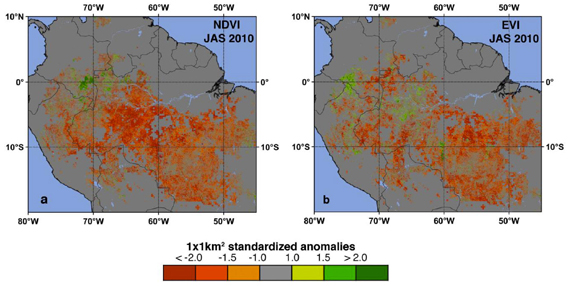
In 2010 drought hit the Amazon hard. Red and orange identify areas where satellite measurements indicated reduced greenness of the Amazon forest during the drought. (Green patches are areas of enhanced greenness.) The maps differ only in the method used for determining vegetation greenness from optical data.

Brazil Slowing Forest Destruction Cuts Greenhouse Gas Burden

March 13, 2012
Source: Bloomberg

Burned trunks are seen in an illegally deforested area of the Jamanxim National Forest, state of Para, northern Brazil.

As world political and business leaders ready for the Rio+20 U.N. sustainability conference in June, Brazil’s leaders are debating policy changes that could jeopardize the leadership it has earned from reducing Amazon deforestation and greenhouse gas emissions.

Since hosting the 1992 “Earth Summit,” which produced the first international agreement on forest protection, Brazil has risen from the ninth- to sixth-largest economy, ahead of the U.K. and just behind France. Deforestation in the Amazon last year fell to the lowest rate since government began monitoring the world’s biggest rainforest in 1988. The rate is down almost 80 percent in six years.

“A decade ago, almost everyone would have said efforts to get Brazil to stop cutting down the Amazon were a total failure,” said Doug Boucher, head of the Tropical Forest and Climate Initiative at the Union of Concerned Scientists. “Thanks to a shift in political dynamics and rise of a strong environmental movement, it became a huge success story.”

Brazil is now in danger of backtracking because of a proposed overhaul to the country’s 1965 Forest Code, which requires farmers to keep as much as 80 percent of their land as forest, environmentalists say. Brazil’s House and Senate have each passed legislation that farmers and ranchers say is necessary to update current law and that activists call unacceptable.

The proposed bills include lowering the amount of forest that landowners must maintain, granting farmers amnesty and exempting them from having to replant areas that were illegally cleared before 2009. The measures still must be reconciled and sent to President Dilma Rousseff for approval.

Rousseff, elected Brazil’s first woman leader in 2010, made a campaign pledge to reject such efforts. She also criticized former President Luiz Inacio Lula da Silva for not doing enough to control deforestation.

Failure to veto the legislation would thwart Brazil’s goal of reducing deforestation by 80 percent by 2020 and hurt the country’s newfound role as global environmental leader, according to some analysts.

Rolling back forest protections would be the “exact wrong message to send to the world,” given the upcoming Rio+20 U.N. conference, said Riordan Roett, head of Latin American studies at Johns Hopkins University’s School for Advanced International Affairs in Washington D.C.

Critics say they will be watching Rousseff closely to see if she uses her line-item veto power to kill any provisions granting amnesty to farmers and ranchers who have broken the law.

Senator Katia Abreu, president of the Brazilian Confederation of Agriculture and Livestock, said in November that Brazil would lose about $100 billion in agricultural output if lawmakers fail to pass legislation that includes amnesty for farmers.

Without such a provision, farmers would be forced to reforest about 70 million hectares (173 million acres) of land currently growing coffee, oranges and other commodities, she said. The amnesty and replanting provisions are fair because many farmers complied with the limits on deforestation, only to see those restrictions then tightened by decree, Abreu said.

Soybeans, Cattle

Since the 1960s, farmers have helped transform Brazil from a food importer into one of the world’s largest exporters of agricultural commodities. Brazil is now the world’s top producer and exporter of coffee and sugar cane and the second-biggest exporter of beef and soy after the U.S. Much of that expansion has been made possible by cutting down the rain forest, not always legally.

Pressure in recent years on Brazilian soybean farmers, and to a lesser extent on cattle ranchers, to stay clear of the forest prompted a self-imposed industry moratorium.

About seven years ago, soybean production was responsible for as much as a fourth of deforestation, according to Boucher. Today, it’s less than 2 percent.

Brazilian Climate Change Secretary Mauro Pires says Brazil’s strategy to fight the problem is two-pronged.

“On one hand, our effort is focused on curbing illegal, predatory deforestation through oversight,” he said. “On the other hand, the effort is aimed at increasing opportunities for sustainable economic activities such as forest management, ecotourism and biotechnology.”

One key monitoring tool the Brazilian government is using in its push to save forestland is satellites, Brazilian lead climate negotiator Ambassador Andre Correa do Lago said in a December interview. Data sales and value-added services from Earth-observation satellites may more than double to $4.5 billion in the decade ending 2020, according to Northern Sky Research.

By combining hundreds of images from satellite coverage with software analysis, experts can analyze patterns of deforestation down to a single tree and calculate the additional emissions that will stay in the atmosphere without trees to pull them down.

Climate Change

Greater political emphasis on sustainability helped drive Brazil’s deforestation rates down as much as other major efforts, such as government monitoring, pressure from environmental groups and the possibility of a global carbon market that pays farmers for saving trees, Boucher said.

That emphasis began with the 2002 election of President Lula, which marked a “major change” in tone, Boucher said.

Lula, whose second term ended in 2010, called for a reduction in Amazon deforestation by 80 percent. It’s part of an effort by Brazil, the fourth largest greenhouse gas emitter, to slash its contribution by as much as 1.3 billion tons in 2020. Seventy-five percent of Brazil’s emissions come from deforestation, which itself is responsible for more than 15 percent of global greenhouse gas emissions.

Brazil has cut emissions 68 percent percent below a 1996- 2005 baseline, the largest reduction of any single country.

“Whether Brazil maintains this leadership could very well depend on the outcome of this fight over the forest code,” Stephan Schwartzman, director of tropical forest policy at the Environmental Defense Fund in Washington, said in an interview. “The fate of the largest, last remaining tropical forest in the world is at stake.”

Amazon rainforest remedy for toothache

March 15, 2012
Source: India Today


A gel from an Amazon rainforest plant could kill the most excruciating toothache in a jiffy and is far more effective than existing drugs and treatments, according to a scientist.

The herbal remedy is so potent that it might even replace uncomfortable anaesthetic shots and provide a natural remedy for teething babies.

Cambridge University anthropologist Francoise Barbira Freedman came across the plant Acmella oleracea more than 30 years ago, when living with a secretive Peruvian tribe of shamans.

During her trip she suffered severe pain in her wisdom teeth. She was given the remedy by the tribe`s medicine men and the discomfort `went away immediately.`

Years later, she was asked to provide Cambridge with some examples of rainforest remedies, and added the plant to the list.

Describing the inclusion as an `afterthought`, she said: "It was added to the bottom of the list, but somehow the list got reversed, and it was the first one tested back in the UK. It was immediately successful and we've never looked back."

Using extracts from the plant, the researchers have developed a gel which blocks the pain receptors found in nerve endings - and could be on the market in only two years` time. In early trials, it helped relieve pain during removal of teeth that were impacted, or stuck below the gum line.

The gel was also considered more efficient than the standard anaesthetic used when patients with gum disease need pain relief for scaling and polishing. The effects lasted longer, and patients were more likely to attend follow-up appointments.

Saturday, March 10, 2012

Brazil delays Forest Code vote

March 07, 2012LinkSource: mongabay.com

Deforestation in the Brazilian Amazon, 1988-2011. Photos by Rhett A. Butler.

Brazil's Congress will delay its vote on a controversial revision to its forest code, which regulates how much forest can be legally chopped down, reports Brazilian state media.

Agencia Brasil said the vote has been rescheduled for Tuesday, March 13, to allow more time to rally support for the bill, which has split lawmakers between a pro-agriculture block known as the ruralistas and those who worry the changes could drive more deforestation and grant amnesty for farmers who illegally cleared forest in the past. The current text has been revised to include greener provisions relative to the original version championed by ruralistas.

Deforestation has fallen by about 80 percent since the Brazilian Amazon since 2004. A combination of macroeconomic factors, increased law enforcement and conservation measures, improved forest monitoring, pressure from environmentalists, and private sector initiatives are credited for the decline. However scientists fear that continuing deforestation, combined with the effects of climate change — including two recent droughts that were the worst on record — could push the Amazon toward a critical tipping point in coming decades.

Overall, forest cover in the Brazilian Amazon, which accounts for more than 60 percent of the Amazon rainforest, declined by nearly 20 percent since 1970.

Brazil's Rousseff urged to veto new forestry code

07 March 2012
Source: AFP

People demonstrate against the new Brazilian Forest Code in front of the National Congress, in Brasilia (AFP, Pedro Ladeira)

BRASILIA — Environmentalists and small farmers marched outside the National Congress Wednesday to urge President Dilma Rousseff to veto changes to the country's forestry code they fear will accelerate deforestation of the Amazon rainforest.

The bill, which is backed by the powerful agribusiness sector, would allow huge areas of the country to be farmed if they were illegally logged before July 2008, and would allow farming along environmentally sensitive riverbanks.

It was initially intended as a bid to rein in unfettered logging, and increase protections of Brazil's forested areas, which play a key role in reducing greenhouse gases.

But farm-based economic interests prevailed, and the bill was reshaped to ease restrictions that have been in place since 1965 and are credited with curbing deforestation.

"We hope that the president will show good sense with respect to the environment, even if it goes against the wishes of major agribusiness producers," said Adson Lima, a member of a mangrove protection non-governmental organization, as he protested outside Congress. Lima wore a t-shirt that read "Slap your veto, Dilma Veto."

"The interests of deputies and agribusiness will destroy nature and harm our people," added Sandro Potiguara, a member of the Potiguara indigenous group of northeast Brazil.

During her 2010 election campaign Rousseff pledged to reject the legislation, which critics said encouraged deforestation.

The new Forestry Code, which was already approved in the Senate, is to be submitted to the lower house of Congress next week after two years of debate. If approved, president Rousseff would then sign the measure for it to become law.

The proposed reform threatens 690,000 square kilometers (some 266,000 square miles) of vegetation, which would prevent Brazil from reaching its goal of reducing deforestation by 80 percent, according to Climate Observatory, a network of 26 groups set up in 2002 to promote civil society participation on climate change issues.

Contacting the “uncontacted”

09 March 2012
Source: Cool Earth

The Amazon rainforest is home to many groups of "uncontacted" or "voluntary isolated" indigenous communities. At the same time, however, the forests and people here are threatened by loggers, oil and mining companies, colonists looking for land for agriculture, fast new highways or freshly opened muddy forestry roads. Even TV and tour companies have recently joined the ranks of destructive exploitation agents in the region.

The Brazilian Suruwaha tribe were recently branded by an Australian TV report as child murderers, a suicide cult from the Stone Age and the worst human rights violators in the world. The broadcast featured ‘adventurer' Paul Raffaele and reporter Tim Noonan visiting Brazil's Suruwaha tribe, but has generated a storm of protests. This new trend of exploiting indigenous groups is not restricted to the Amazon. This week a senior policeman on the Andaman Islands, with the task of protecting the local communities, was criticised for organising human safaris and coercing local Jarawa tribe into posing for visitors.

Survival International's Director Stephen Corry said: "it's freakshow TV at its very worst. The Indians are made out to be cruel and inhuman monsters, in the spirit of 19th century colonialist scorn for ‘primitive savages'. It's clearly designed to have the same effect - to suggest that they don't deserve any rights. The idea that such nonsense is supposed to help tribal children is breathtaking."

According to Survival, back in Peru "unscrupulous tour-guides working in the rainforests of Manu Biosphere Reserve are trying to profit from sightings of "uncontacted" tribal people who have been spotted or made their presence felt in this region several times in the last year, largely thought to be a product of logging and oil prospecting in other areas of their traditional territories.

Rally calls on Brazil President to veto new forest code

March 07, 2012
Source: mongabay.com

Crowd rallies for President Dilma Rousseff to veto changes to Brazil's forest code. Photo by: WWF-Brasil.

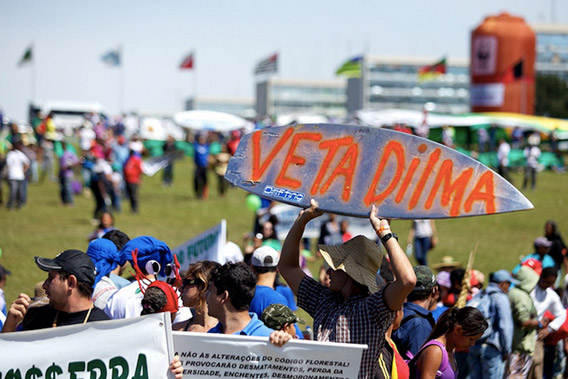
A coalition of 200 organizations, known as the Comitê Brasil in Defense of Forests and Sustainable Development, rallied today in Brasilia against proposed changes to Brazil's Forestry Code. The code, which was supposed to be voted on this week but has been delayed to shore up more support, would make changes in over 40-year-old code that some conservationists fear could lead to further deforestation in the Amazon. Protestors called on the President of Brazil, Dilma Rousseff, to veto the bill as it stands now, holding signs exclaiming, "Veta Dilma!" ("Veto it Dilma!").

"We have to be extremely vigilant to ensure that the interests of small hegemonic groups do not prevail against the wishes of society at large, which is tired of laws that benefit the few to the detriment of the many," WWF-Brasil CEO Maria Cecília Wey de Brito said in a press release, calling both versions of the bill that are currently circulating through the Brazilian legislature "extremely damaging." WWF-Brasil is one of the organizations in the Comitê Brasil in Defense of Forests and Sustainable Development coalition.

Current proposed changes would lessen the amount of forest landowners would need to maintain—a law that has been widely flouted across Brazil—and provide amnesty for some of those who have cut forest illegally in the past. The changes are backed by big agricultural and economic interests in the country who argue the bill would allow agricultural expansion while still protecting the environment.

At stake may be the recent success Brazil has had in combating deforestation in the Amazon: since 2004, deforestation has fallen 80 percent in Brazil's Amazon. Still the Amazon continues to shrink in Brazil and beyond raising concerns with scientists that a combination of on-going forest loss and climate change-linked droughts could push parts of the world's greatest rainforest into savannah.

Thursday, March 1, 2012

'Human safaris' pose threat to uncontacted Amazon tribe

Saturday 25 February 2012
Source: guardian.co.uk

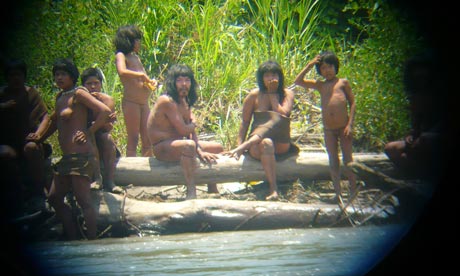
Members of the Mashco-Piro tribe are photographed by one of a Spanish Geographical Society team last year. Photograph: Reuters

New concerns about "human safaris" are being raised in Peru, where tour operators are profiting from the exploitation of indigenous tribes in the Amazon jungle.

An increase in economic activity and tourism in the Manú region has led to a dramatic rise in the number of reported sightings of the Mashco-Piro – one of around 15 indigenous groups in Peru who have no regular contact with outsiders, and one of only 100 or so such tribes left in the world.

Fenamad, the local indigenous rights organisation, has criticised tour operators who have taken advantage of the sightings to take tourists "close to where" the tribespeople were seen. There is growing evidence that travellers and tourists are attempting to make contact. "Uncontacted Indians are not a tourist attraction," said Rebecca Spooner of Survival International, which aims to protect tribal peoples. "So-called tour guides should already know better."

Growing concerns over "human safaris" caused a scandal in India after the Observer revealed how tour operators in the Andaman Islands are colluding with police to offer sightings of an indigenous group, the Jarawa, who have only had contact with the outside world since the late 1990s.

In Peru, the Mashco-Piro live in the Manú national park of the Madre de Dios region, near the Brazilian border. More than a century ago the Mashco-Piro were driven off their land in the upper Manú river by rubber tappers supplying the American and European car and bicycle industries. The tribe was forced to retreat to more remote jungle areas.

After Survival International published photographs of the tribe last month to publicise the need to leave it in peace, a spokesman for Peru's national protected areas department (Sernanp) urged people to steer clear of "communities trying to remain apart from the outside world". However, independent research by the Observer has confirmed that unscrupulous tour guides are flouting that advice.

"The uncontacted peoples have been sighted on the Madre de Dios river in Manú. Let me know how many days you want and I'll suggest a tailor-made programme for your party," said one, contacted anonymously by the Observer with a specific request to seek out the tribe. "We can't be 100% sure we can see the uncontacted. If we are lucky we can see. In 2011 they came out in the months of May and October," said another.

"The best time to see these uncontacted natives is towards the end of the dry season, when the turtles are laying their eggs along the riverbank," said a third operator. "The best chance you would have to see them is between July and September. Along the main rivers is the best place… The tour with the greatest amount of distance covered and the best chance to see the uncontacted natives would be our eight-day/seven-night tour to Manú Biosphere Reserve by bus that starts and ends in Cuzco."

But other tour operators gave a markedly different response. Manú Nature Tours, based in Cuzco, said: "We do not offer any possibility to see [the tribe]. It is very dangerous to attempt any contact with them. A simple cold can kill them all. Any attempt to try to contact this people can put you in jail in Peru and Brazil."

Atalaya Tours said: "It is completely forbidden to contact 'non-contact people'. We have tours to Manú park, but Atalaya fully respects all the laws protecting non-contact natives and we don't agree with the illegal guides or operators that try to commercialise these kinds of visits."

According to Fenamad, "there's great concern because the Mashco-Piro are very vulnerable. In addition to their susceptibility to common diseases and epidemics, the sightings are occurring in an area of open-river transit where there is an intense traffic of commercial and tourists' boats." Glenn Shepard, an anthropologist who has worked in Manú, says tour operators have approached the Mashco-Piro on the riverbank so that tourists can "get photos like they would for a jaguar".

In India, tourists plunge into the heart of Jarawa territory along the Andaman Trunk Road, while in Peru they travel down the Madre de Dios river, where the Mashco-Piro have been seen on the left bank, or up and down the River Manú, where they have been seen on both banks. Video footage of the Mashco-Piro emerged last year that appeared to show travellers "playing a game of cat and mouse with the naked tribesmen" and discussing whether to leave food or clothing for them on the riverbank. None of the trips to Manú advertised by tour operators on their websites openly offers Mashco-Piro sightings, but several acknowledge the presence of "uncontacted" people in the rainforest.

"We need governments to act to protect indigenous communities, tour operators need to follow a code of conduct and tourists need to be educated and informed," said Mark Watson, director of Tourism Concern.

Is Brazil Destroying The Amazon For Energy?

27/2/2012
Source: Forbes

A presidential decree to redistrict the Amazon jungle's conservation areas has environmental groups and Amazon state attorneys general up in arms.

For environmentalists, it’s possibly a deal with the devil. For government conservation groups with boots on the ground in the biggest jungle on Earth, it’s the only compromise to keep the Amazon safe, and expand Brazil’s reliance on clean energy.

The problem is, that in order to build that clean energy, thousands of acres of pristine Amazon rainforest will have to be cut up and inundated with river water to build hydroelectric dams like Belo Monte, currently the largest ongoing hydroelectric project in the world.

Who said women were stewards of the environment? Brazil’s first woman president, Dilma Rousseff wants to eliminate more than 86,000 hectares of protected areas in the Amazon — the equivalent to the area of 161,000 Rio de Janeiro Flamenco, Manchester United and New York Giants stadiums. The immediate reason? To make way for at least two large hydroelectric dams being worked out on paper, including the Tapajos project — an 8,000 megawatt power station the government would like to see built on the border of Para and Amazonas states.

A new provisional measure, known as MP 558 in Brazil, has been challenged as unconstitutional in the Supreme Court by Federal Public Prosecutors who allege that MP 558 signed by Rousseff on Jan. 5 violates the Brazilian Constitution and the country’s environmental laws. They say that the government’s two pet projects, including Tapajos, do not have environmental impact studies in hand. That means nothing can be built. But the government’s Ministry of the Environment says that the reason they don’t have an impact study is because the government’s Energy Ministry wants to build them in conservation areas. There can’t be an impact study done on a project to be build in a protected area because, by law, the project cannot be built. So in order to build them in those conservation areas, the government has to reduce that area. That is exactly what MP 558 does.

”This change signals a growing tendency within the federal government, already visible with Belo Monte, to blatantly disregard environmental legislation in the rush to construct over 60 large dams in the Amazon,” says Brent Millikan, Amazon Program Director at International Rivers, a California-based NGO working with local indigenous groups in Para state to thwart hydroelectric dams whenever they can.

“The (Brazilian) President is backtracking on Brazil’s environmental commitments, and will use any means necessary to push through an agenda of expensive mega-infrastructure projects in the Amazon, reminiscent of the military dictatorship in the 1970s,” Millikan says. “It begs the question, who will protect the Amazon…if not the government?”

What is the Amazon?

For people who have never been to Brazil, the Amazon is a massive jungle full of anacondas, howler monkeys and lost Indian tribes. To the Brazilian government, and to the Brazilian people, it is more than that. In Amazonas state, the largest state in the north Brazil, Manaus city is home to 1.8 million people, nearly half the state’s 3.4 million population, according to the Brazilian census bureau IBGE’s 2010 data. In Para, another large Amazon state, there are 7.5 million inhabitants. That doesn’t count the five other states, including parts of Mato Grosso, that constitute the Amazon biome, Brazil’s largest geographic area bar none. Over six million people live in those five states, and they need to work, they need to eat, and they need electricity. And, their numbers are growing. It is the one part of Brazil where the population is growing fastest. It is the emerging market within the emerging nation that is Brazil. To keep the lights on without burning fossil fuels, Brazil is committed to hydro power.

Hydroelectricity accounts for nearly 85% of Brazil’s electricity. The country currently has a surplus of energy, but that surplus is dwindling and will be in deficit mode by 2015 unless Brazil builds more power plants. Now, they can build more coal fired power plants like Forbes billionaire Eike Batista is doing on the northeastern coast with his Pecem I and Pecem II facilities; they can build more nuclear power plants south of Rio de Janeiro like government owned Angra I and Angra II; or they can do what Brazil has always done: build dams on its overabundance of rivers.

The only place left to build them, is in the Amazon.

Flying over the Amazon is like flying over the ocean…looking left to right doesn’t change the view: it’s green as far as the eye can see, with blue veins of rivers cutting through it. It’s amazing that anybody actually lives there. One look at the map of where Brazil power giant Eletrobras (EBR) hopes to one day build the Tapajos dam and it’s obvious: green and blue. No brown. No urban centers. This is the Garden of Eden. Yet, despite the sparsity of human life, millions still call this place home.