Thursday, February 23, 2012

Bolivia floods: Emergency declared in Amazon region

23 February 2012
Source: BBC News

Bolivia's government has declared a state of emergency in response to flooding caused by heavy seasonal rains.

Around 9,000 families have been made homeless, officials say, and several people are reported dead.

Roads have been cut, and large areas of farmland have been inundated.

Worst hit has been the northern province of Pando, in the Amazon rainforest on the border with Brazil, where the river Acre burst its banks.

Much of the provincial capital, Cobija, is under water and some remote villages are feared to have been destroyed.

Bolivian Defence Minister Ruben Saavedra said the declaration of an emergency would allow local authorities to access special funds.

Bolivia's Amazon lowland plains are subject to flooding every year during the January-March rainy season, but this year's rains have been unusually intense.

Neighbouring areas in the Peruvian and Brazilian Amazon have also been affected.

Monday, February 20, 2012

Humans drove rainforest into savannah in ancient Africa

February 09, 2012
Source: mongabay.com

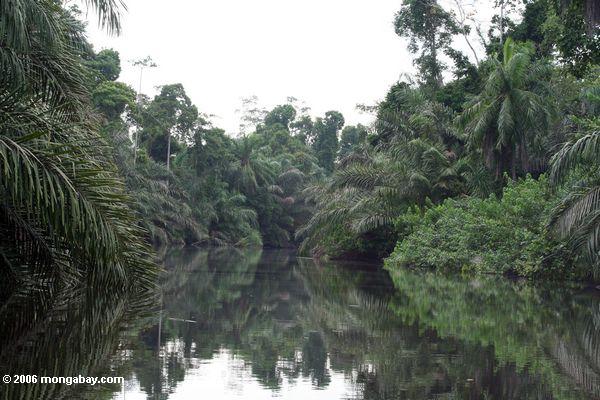
The Congo rainforest today in Gabon. Photo by: Rhett A. Butler.

Three thousand years ago (around 1000 BCE) several large sections of the Congo rainforest in central Africa suddenly vanished and became savannah. Scientists have long believed the loss of the forest was due to changes in the climate, however a new study in Science implicates an additional culprit: humans. The study argues that a migration of farmers into the region led to rapid land-use changes from agriculture and iron smelting, eventually causing the collapse of rainforest in places and a rise of grasslands. The study has implications for today as scientists warn that the potent combination of deforestation and climate change could flip parts of the Amazon rainforest as well into savannah.

"To some extent, this large scale deforestation event shaped the African rain forest into its present-day vegetation patterns," writes the paper's authors, adding that "the consensus is that the forest disturbance was caused by a regional climate change. However, this episode of forest clearance occurred contemporaneously with the migration of Bantu-speaking peoples from near the modern Nigeria-Cameroon border."

Recent archeological evidence has found ceramics, stone tools, and the remnants of domestic agriculture, such as oil palm nuts. Iron-working furnaces, which would have been fueled by felled trees, have also been found. But, the researchers wonder what came first: the savannah or the farmers?

In order to determine if the ancient farmers, who lived during the time when David became King of the Israelites, had impacted the rainforest, researchers turned to the sediments of the Congo River. Retrieving a sediment core going back 40,000 years, the researchers found a sudden intensification of chemical weathering that peaked around 1,500 BCE. The weathering event was higher than anytime over the core's 40,000 record. Chemical weathering is usually connected to natural patterns, such as precipitation and physical weathering, however soil erosion caused by intensive agriculture and deforestation can also cause spikes in chemical weathering. In addition, if climate were solely responsible, researchers would expect to see a drop, not a rise, in chemical weathering due to a drying climate. Instead they found the opposite, pointing to human influence.

The researchers write that they are not yet able to determine to what extent the decline of rainforests was due to human deforestation and how much to climatic changes, but the sudden apex in chemical weathering "clearly suggest(s) that the environmental impact of human population in the central African rainforest was already significant."

Recent research has warned that the Amazon may be undergoing a similar shift as that of the Congo three thousand years ago. A combination of deforestation for cattle ranching and soy, forest degradation due to extractive industry and roads, purposefully-set fires, and climate change appears to be weakening the resilience of the Amazon rainforest. Scientists fear that the combined impacts could lead to dieback in portions of the Amazon ecosystem, turning over 40 percent of the primary rainforest into savannah. This could have drastic impacts on biodiversity, carbon sequestration, and regional weather patterns as the Amazon produces much of its own rain. Already, in 2005 and 2010 the Amazon rainforest suffered unprecedented droughts with warmer temperatures in the Atlantic Ocean reducing rainfall for the Amazon basin.

"Considerable uncertainty remains surrounding the impacts of climate change on the Amazon," Dr. Simon Lewis, who has studied the droughts, said last year; but, he added, there is "a body of evidence suggesting that severe droughts will become more frequent leading to important consequences for Amazonian forests. If greenhouse gas emissions contribute to Amazon droughts that in turn cause forests to release carbon, this feedback loop would be extremely concerning. Put more starkly, current emissions pathways risk playing Russian roulette with the world's largest rainforest."

Amazon defenders face death or exile

Sunday 12 February 2012
Source: guardian.co.uk

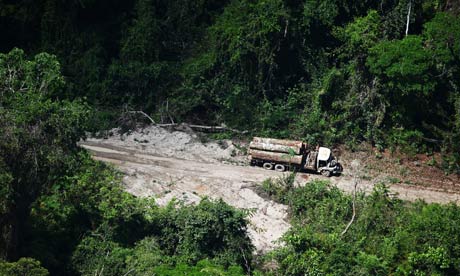
A logging truck enters a deforested area on the outskirts of Novo Progresso, Brazil. Photograph: Rodrigo Baleia/LatinContent/Getty Images

A single shot to the temple was Mouth Organ John's reward for spilling the beans. His friend, Junior José Guerra, fared only marginally better.

Guerra's prize for speaking out against the illegal loggers laying waste to the greatest tropical rainforest on Earth? A broken home, two petrified children and an uncertain exile from a life he had spent years building in the Brazilian Amazon.

"I can't go back," said Guerra, one of the Amazon's newest environmental refugees, three months after his friend's brutal murder forced him, his wife and his two children into hiding. "We've been told that they are trying to find out where I am. The situation is very complicated."

Mouth Organ John, 55, and Guerra, 38, lived along the BR-163, a remote and treacherous highway that cuts from north to south through the Amazon state of Para. They were migrants from Brazil's south who came in search of a better life.

Neither man was a card-carrying environmentalist and both had reportedly been previously involved with environmental crimes. Still, they opted to commit something widely considered a cardinal sin in this isolated corner of Brazil – they informed on criminals allegedly making millions from the illegal harvesting of ipê trees from conservation units in a corner of the Amazon known as the Terra do Meio, or Middle Land.

In a region often compared to the Wild West, betraying those pillaging the rainforest all too often leads to a coffin or to exile.

Mouth Organ John, an amateur musician and mechanic whose real name was João Chupel Primo, met his fate first.

Last October, he and Guerra handed the authorities a dossier outlining the alleged activities of illegal loggers and land-grabbers in the region. Within days two men appeared at Primo's workshop in the city of Itaituba and shot him dead. A bloody photograph of his corpse, laid out on a mortician's slab, made a local tabloid. "There are signs this was an execution," the local police chief, José Dias, told the paper.

Guerra escaped death, but he too lost his life. Told of his friend's murder, he locked himself indoors, clutching a shotgun to ward off the gunmen. The next day, he was spirited out of town by federal police. Since then Guerra has embarked on a lonely pilgrimage across Brazil, journeying thousands of miles in search of support and safety. He became the latest Amazonian exile – people forced into self-imposed hiding or police protection because of their stance against those destroying the environment.

"They will order the murder of anyone who reports them [to authorities]," Guerra said this week over a crackly phone line from his latest hideout. "We thought that … if we reported these crimes they [the government] would do something … But actually João was murdered as a result."

In June Brazil will host the Rio+20 United Nations conference on sustainable development. World leaders will gather in Rio to debate how to reconcile economic development with environmental conservation and social inclusion.

Brazil will be able to trumpet advances in its battle against deforestation – in December the government claimed Amazon destruction had fallen to its lowest level in 23 years. But the continuing threats to environmental activists represent a major blot on its environment credentials.

"What is at stake … is the government's ability to protect its forests and its people," said Eliane Brum, a Brazilian journalist who has won numerous awards for her dispatches from the Amazon. "If nothing is done … the government will be demoralised on the eve of Rio+20."

Guerra is far from the first person to be forced into exile for opposing the destruction. According to government figures 49 "human rights defenders" are currently under protection in Para state, while another 36 witnesses are also receiving protection.

Last year, after the high-profile murders of Amazon activists José Cláudio Ribeiro da Silva and Maria do Espirito Santo, two local families were flown into hiding and given new identities in a distant corner of Brazil. Like Primo and Guerra, they knew too much.

In the neighbouring state of Amazonas, where activists say nearly 50 people run an imminent risk of assassination, rural leader Nilcilene Miguel de Lima was forced to flee her home. "The gunmen and the killers are the ones who should be in prison, but it's me who is under arrest," she told the O Eco website after an attempt on her life drove her into exile.

José Batista Gonçalves Afonso, a veteran Amazon human rights lawyer, said he had seen "countless" families forced into exile for fear of being assassinated. He blamed the situation on "the state's inefficiency in investigating threats and providing security".

"The ones who should leave are the gunmen and their bosses … but it is the workers who end up being punished because of government inertia," he said.

Brum, who brought Guerra's plight to the public eye, said his situation reinforced the idea that "it is not worth informing on organised crime, because informing means dying."

"Is it possible that after what has happened … others will have the courage to rebel and report organised crime in the Amazon?" she asked.

Ramais de Castro Silveira, Brazil's secretary of state for human rights, described Guerra's situation as "extremely serious" and said his concerns were "legitimate". But Guerra had not been included in a federal protection programme for human rights defenders because he did not qualify as a human rights activist, he said. Silveira admitted there was no specific protection for environmental activists, but said Guerra had refused a place in a witness protection scheme in another part of Brazil because of its "restrictions".

"It is my right to live there," Guerra said. "I risked my life to report these crimes, but now I have to leave?"

Silveira said those behind Primo's murder and Guerra's exile would be caught "in the short to medium term". "I don't believe the drama they have gone through and are going through has been in vain," he said.

For now, life on the run is taking a toll on Guerra, his wife and sons, whom he has not been able to enrol in school. "We have to stay strong and to try and cope with all this," he said. "It's the only way."

Rainforest, water ‘dialogue’ decoded

Saturday, 18 February 2012
Source: Business Mirror

RIO DE JANEIRO—An alteration of the relationship between the Amazon rainforest and the billions of cubic meters of water transported by air from the equatorial Atlantic Ocean to the Andes Mountains could endanger the resilience of a biome that is crucial for the global climate, warns a recently concluded two-decade research project.

The Amazon rainforest is a living being that covers an area of 6.5 million sq km, occupying half the territory of Brazil and portions of another eight countries: Bolivia, Colombia, Ecuador, French Guiana, Guyana, Peru, Surinam and Venezuela. It is also home to the planet’s largest reserves of freshwater.

In order to more fully understand this complex ecosystem, scientists from Brazil and around the world created the Large-Scale Biosphere-Atmosphere Experiment in Amazonia (LBA).

After 20 years of research, the conclusions reached from the data collected warn of numerous potential threats.

According to the Brazilian National Institute for Space Research (Inpe), one of the agencies participating in the experiment, unless effective policies are implemented in the coming years to reduce greenhouse-gas emissions, by the end of the 21st century there will be 40 percent less rainfall and average temperatures of up to 8 degrees Celsius higher than normal in the Amazon.

This would convert the rainforest into a source of carbon dioxide emissions instead of a “sink” that contributes to carbon sequestration and storage.

The International Energy Agency estimates that in 2010 the world’s population released a record amount of 30.6 gigatons of carbon dioxide into the atmosphere, primarily through the burning of fossil fuels.

“The research shows us that the rainforest has a great power of resilience, but also that this power has limits,” physicist Paulo Artaxo, chairman of the LBA International Scientific Steering Committee, told Tierramérica.

“If we continue burning so much carbon, the climate scenario for the region will be considerably unfavorable for any resilience that the rainforest could develop. It would be difficult for it to survive such enormous climate stress,” he added.

To gather data for its research, the LBA used, among other instruments, 13 towers measuring between 40 and 55 meters in height, set up in different points throughout the rainforest to measure the flow of gases, the functioning of basic properties of the ecosystem and many other environmental parameters.

The information collected was analyzed by scientists from various fields in order to understand the rainforest as an interrelated system.

“The perception in the scientific community was that studies carried out in individual disciplines were not sufficiently able to explain the Amazon, and this led to the LBA. It was felt that an integrated effort was needed to explain the rainforest from the viewpoint of the physical, chemical, biological and human sciences, and the relationship between them,” explained Brazilian climate expert Antônio Nobre, another participant in the research initiative.

“When I began my studies in the LBA, my part in the project was mainly about carbon. But carbon without water dries out and the forest catches fire. Without transpiration, there is no carbon sequestration, because there is no photosynthesis. I realized that the water and carbon cycles are inseparable,” Nobre told Tierramérica.

This integrated analysis demonstrated that the Amazon rainforest absorbs a small amount of carbon dioxide from the atmosphere, estimated at half a ton per hectare per year.

But the amount of carbon absorbed varies considerably from region to region, depending on environmental alterations. In areas near places where human activity has caused significant degradation, the rate of absorption is reduced, and the Amazon, instead of storing carbon dioxide, is releasing it.

In addition, the rainforest’s absorption of carbon dioxide is counteracted by emissions from deforestation and queimadas, fires intentionally set to clear forested land in order to expand agriculture, stressed Artaxo.

Since the latter practice has declined drastically in recent years, from 27,000 sq km in 2005 to around 7,000 sq km in 2010, “the characteristic feature of the rainforest today is that it absorbs carbon,” he said.

But the changes brought about by the greenhouse effect and rising temperatures in the rainforest have led to a situation where the dry season tends to last longer, creating the conditions for the outbreak of more fires and more carbon dioxide emissions.

“The solid particles released into the atmosphere by queimadas alter the microphysics of clouds and the rainfall regimes,” added Artaxo.

In one of the experiment’s studies, it was observed that the increase in queimadas in the northern state of Rondônia extended the dry season by between two and three weeks, which, in turn increased the incidence of fires and even further aggravated their effect on the functioning of the ecosystem, he explained.

During a very severe drought in 2005, “the Amazon lost a lot of carbon,” he said.

In the event that serious droughts become more frequent, the rainforest could become “an emitter of carbon dioxide and cease to provide an important environmental service,” he warned.

The lengthening of the dry season causes another phenomenon that was also studied in the LBA: the emission of carbon by rivers.

“Small and medium-sized waterways emit significant amounts of gas. This leads to what is called carbon dioxide evasion from bodies of water, and it happens because most of these rivers are saturated with carbon dissolved in their water,” said Artaxo.

As time passes, this carbon “is released into the atmosphere in rather significant quantities. All of the phenomena that alter the Amazon ecosystem have a strong impact on the evasion of gases from the rivers. When the temperature rises, the emission of gases rises as well,” he added.

To illustrate the potential consequences of a lack of equilibrium in the Amazon on the global climate, Nobre referred to the so-called flying-rivers research that begun in the 1970s and was consolidated in the Flying Rivers Project in 2007.

“We discovered that the sun’s action on the equatorial region of the Atlantic Ocean evaporates a large amount of water. This humidity is transported by the wind to the north of Brazil. Around 10 billion cubic meters of water arrive in the Amazon every year in the form of water vapor. Some of it falls as rain, and the rest continues to flow until it runs into the wall of the Andes mountain range,” explained Nobre.

In the Andean region it falls as snow, and when the snow melts, “it feeds the rivers of the Amazon basin. Most of the rain that falls on the rainforest is evaporated again,” he added.

This humidity fluctuates over Bolivia, Paraguay and the Brazilian states of Mato Grosso and Mato Grosso do Sul, in the west, Minas Gerais and São Paulo, in the east and southeast, and even the southern states of Paraná, Santa Catarina and Rio Grande do Sul.

“And it brings most of the rain to all of these regions,” he stressed.

A drought in the Amazon would have a serious impact on these invisible airborne rivers and on the rainfall patterns in these regions, which are very rich in agriculture, Nobre warned.

The LBA is currently a program of the Brazilian Ministry of Science and Technology, coordinated by the National Institute of Amazonian Research, with the support of other agencies.

Its researchers are expanding the initiative into other areas, including agro-pastoral systems and the behavior of carbon dioxide in soybean plantations.

“We have a great deal of work ahead of us to understand the natural processes and the effects of what humans do in terms of the alteration of ecosystems,” Artaxo said.

Thursday, February 9, 2012

New rainforest and indigenous reserve established in Peru

February 07, 2012
Source: mongabay.com

Aerial photo of Peruvian Amazon. Photo by: Rhett A. Butler.

On February 4th, the Peruvian government and a small indigenous group created a new Amazon reserve, dubbed the Maijuna Reserve. Located in northeastern Peru, the 390,000 hectare (970,000 acres) reserve is larger than California's Yosemite National Park and over three times the size of Hong Kong.

Connected to the watersheds of Napo and Putumayo rivers, Maijuna reserve will not only protect primary rainforest in the Loreto Region, but also the culture of the Maijuna people who live in the area with a population of less than 200 people. The reserve—officially created by the Regional Government Program for the Conservation, Management and Sustainable Use of Biodiversity in Loreto (PROCREL)—also connects to two other existing protected areas, creating a total area of over 1.6 million hectares (4 million acres).

According to Nature and Culture International which works with the Maijuna people and has played a role in the creation of the reserve, the forest is home to a wide variety of Amazon wildlife, including giant river otters (Pteronura brasiliensis) and jaguars (Panthera onca), and large populations of widely hunted animals such as Brazilian tapirs (Tapirus terrestris) and Salvin's currasow (Mitu salvini).

"This new conservation area protects a true jewel: a complex of Amazonian high terraces—a habitat unknown until recent biological inventories—that shelters a flora and fauna with a number of new, rare, and specialized species. These terraces and the adjacent lowland forests are underlain by diverse soil types and give rise to seven local drainages, whose waters support the flora and fauna of the area, as well as its human residents," states the Nature and Culture International website.

Chevron Allegedly Using Secret Panel to Avoid Paying up $18 Billion to Ecuador in Damages

February 8, 2012
Source: International Business Times

After a U.S. appeals court rejected an injunction that Chevron Corp had won to avoid paying up $18 billion penalty to Ecuador over pollution to the country's Amazon region, the multinational energy giant has been accused of bringing in a secret panel of private lawyers to thwart the court judgments.

(Photo: REUTERS / Guillermo Granja)
Maria Eugenia Briceno and her son sit in front of her house which is just in front of an oil well in Lago Agrio January 25, 2011. Briceno lives in the affected area in the $27 billion suit brought against Chevron Corp by local farmers who say the U.S. energy giant polluted the rain forest with faulty drilling practices in the 1970s and 1980s. It is the biggest environmental damages suit ever tried. Picture taken January 25, 2011.

Several Latin American advocacy groups have alleged that Chevron is trying to use a controversial private enforcement arbitration under the U.S.-Ecuador Bilateral Investment Treaty (BIT) to interfere with the judiciary of both nations.

Chevron, which operated in Ecuador from 1964 to 1992, under the Texaco brand, had admitted to having dumped more than 16 billion gallons of toxic waste into the streams and rivers used by local inhabitants for drinking, which resulted in dramatically increased rates of diseases including cancer.

After an extended trial conducted over a period of eight years, the Ecuador court ruled against Chevron last year, ordering $18 billion in penalty to clean-up the mess and to restore the Amazon jungle. Chevron turned to the U.S. judiciary to evade penalty, which was granted in the form of an injunction by U.S. District Judge Lewis Kaplan in Manhattan in March 2011.

However, a U.S. appeals court overturned that judgment in January this year, which prompted Chevron to exploit the ambiguity of the bilateral investment treaty signed jointly by the U.S. and Ecuador.

The U.S.-Ecuador BIT allows the U.S. investors to seek monetary damages from the government of Ecuador if they can show unfair treatment. In this case, Chevron has turned the treaty into a tool to try to immunize itself from liability in a private litigation, environment, advocacy groups allege.

Chevron, ranked as one of America's 5 largest corporations by Fortune 500, essentially wants government and people of Ecuador - where the per capita income is $4000 per annum - to fund the cleaning expenses.

Jose Daniel Amado, a specialist in international arbitration, has written a letter to the U.N. Secretary-General Ban Ki-moon, expressing "alarm" about the "egregious misuse" BIT arbitration proceedings to deny dozens of indigenous farmer communities of the Amazonian rainforest their basic human rights.

"Despite its (Chevron's) previous stipulations to U.S. federal courts that it would respect any judgment from Ecuador, Chevron continues to use questionable litigation tactics to deny those injured any forum to seek justice and compensation for their injuries," the letter said.

Amazon Defense Coalition, an Ecuadorian non-governmental organization, has alleged that a secret panel of private lawyers, nicknamed "The Club," has been employed to help Chevron avoid paying anything for its deliberate poisoning of the rainforest.

The environment watchdogs have also claimed that Chevron's arbitration panel has no authority to use a bilateral treaty to direct Ecuador to block the enforcement of $18 billion judgment.

Public Citizen, Amazon Watch and the Rainforest Action Network have announced a protest rally against Chevron's discreet lawyer panel hearing scheduled to be held over this weekend.

Discover the Incas and the Amazon in Peru

03 Feb 2012
Source: Telegraph.co.uk


I stood with mouth agape as Machu Picchu finally came into view. Vast tracts of verdant terracing embraced a plaza of ruins in the shadow of Huayna Picchu, the mighty sugarloaf mountain that seemed so familiar from the pictures I’d collected before my holiday.

Machu Picchu, one of the most famous archaeological sites in all of the Americas, is the reason most visitors come to Peru, but there was so much more that I wanted to learn about this country. So I consulted an expert.

After living in Peru for four years, Luca Newbold returned to the UK and set up Llama Travel with the aim of making high-quality holidays to Latin America more affordable.

Llama Travel offers more time at each destination than other operators and you can design your own trip depending on which areas you want to visit.

My first choice was Cusco, the majestic capital of the Inca Empire, which was laid out in the form of a puma.

Cusco is small enough to navigate on foot, with Inca stone-walled alleys, great cobblestoned plazas and elegant colonial mansions, plus the added bonus of a vibrant bar and restaurant scene. Some eateries are carved out of the Inca rock.

Also on my wish-list was Arequipa, gateway to the Colca Canyon. It’s known as the White City because its grand colonial buildings were built from sillar, a white volcanic rock. In my view, the Plaza da Armas is one of the most beautiful squares in South America, but the Santa Catalina convent was a revelation. Opened to the public in 1970 after 400 years as a cloister, it is a colonial walled town in miniature.

I was amazed to discover the Colca Canyon, with its steep-sided agricultural terraces and traditional villages, is deeper than the Grand Canyon. This is the best spot in Peru for seeing the giant condors that swoop and glide on the thermals. They came so close I could almost feel their wing feathers brush my cheeks.

For beauty, peace and tranquillity, it’s hard to beat Lake Titicaca. At 12,500ft, it is the world’s highest navigable lake, though at 3,000 square miles it seems more like an ocean.

I took a boat ride across deep blue waters to visit its islands. The people of Uros live on floating bundles of reeds while handicrafts are the mainstay of Taquile. Gorgeous light and superb views helped to create some memorable photographs.

I rounded off my Peruvian adventure by staying in an Amazonian rainforest lodge, a surprisingly comfortable base from which to explore the largest expanse of jungle in the world.

Machu Picchu and the Inca ruins are what drew me to Peru. And while they are truly spectacular and worth the trip alone, there is so much more to intrigue and fascinate in this magical, mysterious land.

Friday, February 3, 2012

Group releases close-up photos of 'uncontacted' tribe in Peru

February 01, 2012
Source: mongabay.com

Survival International claims these are most detailed photos ever taken of the isolate Mashco-Piro tribe in Manu National Park, Peru. Photo courtesy of Survival International.

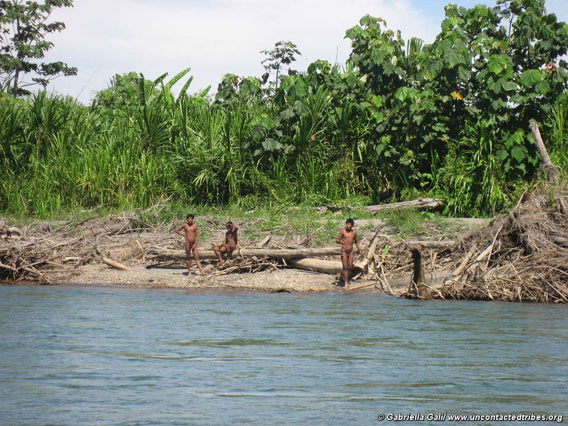
New photos provide visual evidence of just how close the long-isolated tribe of Mashco-Piro people in the Amazon rainforest are to being contacted by the outside world—a perilous moment for tribes highly susceptible to disease and likely to defend their people and territory with weapons. According to indigenous rights NGO Survival International, the Maschco-Piro tribe has been seen more frequently outside of their forest home in Manu National Park in recent years. Some experts blame illegal logging in the park and helicopters used in oil and gas projects for the sightings.

The photos, which were released by Survival International, were reportedly taken by an anthropologist and a tourist. Their release has led the Peruvian government to warn people not to approach the uncontacted tribe.

"They were known to be a peaceful tribe up until 2001 but there has been an increasing level of violence when they started shooting at people with bows and arrows because they started coming under increasing threat as their land became encroached upon," Rebecca Spooner with Survival International, told Al Jazeera.

To date there have been two reported attacks by the Mashco-Piro people. One wounded a forest ranger, while the other led to the death of an indigenous man, Nicolás "Shaco" Flores, who had been leaving food and gifts for a group of Mashco-Piro people for twenty years. He was found with a Mashco-Piro arrow wound. However, authorities have not confirmed this incident.

"In this tragic incident, the Mashco-Piro have once again expressed their adamant desire to be left alone," Glenn Shepard, an anthropologist wrote in Anthropology News [LINK?]. Leaving gifts, such as clothing for the tribe, is discouraged as it could spread disease and speed-up contact.

Last year, Survival International released video of the tribe taken by tourists. The tourists allegedly attempted to get close to the tribe in their motorboat as the tribe walked along a beach. At one point one of the tribal members prepares to fire at the boat with an arrow.

"First contact is always dangerous and frequently fatal—both for the tribe and those attempting to contact them. The Indians’ wish to be left alone should be respected," director of Survival International Stephen Corry said.

This Mashco-Piro man is holding a wooden-handled knife tipped with a capybara tooth. Photo courtesy of Survival International.


Tribe on riverbank. Photo courtesy of Survival International.

Amazon fungus eats polyurethane

3 February 2012
Source: Plastics & Rubber Weekly

Students on a Yale University rainforest expedition have discovered a fungus with an appetite for polyurethane, offering the potential to solve the intractable problem of PU waste.

The Pestalotiopsis microspora fungus is the first to be found which can survive on a steady diet of polyurethane alone. A bonus is that it does this in an anaerobic (oxygen-free) environment similar to ambient conditions at the bottom of landfills.

The students were in the Ecuadorian jungle on Yale’s annual Rainforest Expedition and Laboratory with molecular biochemistry professor Scott Strobel. The mission was to allow "students to experience the scientific inquiry process in a comprehensive and creative way."

The group cultured the microorganisms found within the tissue of jungle plants they had collected, and assayed the bioactivity of the organisms.

The microbe’s remarkable behaviour was recorded by student Pria Anand, and Jonathan Russell isolated the enzymes by which the fungus degrades plastic as its food source. The Yale team conclude that the microbe is "a promising source of biodiversity from which to screen for metabolic properties useful for bioremediation." They speculate that in the future, waste compactors might be replaced by giant fields of voracious fungi.

Wednesday, February 1, 2012

Leave isolated Amazon natives alone, Peru says

31 January 2012
Source: AFP

Partial view of a handout picture released by Survival International organization (AFP/Survival International, Diego Cortijo)

LIMA — Peruvian officials on Tuesday urged outsiders to stay away from isolated Amazon basin rainforest natives after pictures of "uncontacted" tribe members were published online.

Mariela Huacchillo with the Peru's office for Natural Protected Areas (SERNANP) told AFP that even indirect contact with the indigenous people could spread deadly viruses that do not exist in the region. The natives could also be hostile, she warned.

Huacchillo urged outsiders "to never attempt to enter in contact with these (isolated) communities," whose people "are trying to remain apart from the outside world."

The pictures, published on the website of pro-native NGO Survival International, shows a family of "uncontacted" Mascho-Piro people in the Manu National Park, in remote southeastern Peru on the border with Brazil.

The pictures were taken in late 2011 by an archeologist and Survival International sympathizer, the group said.

Huacchillo also urged people to not leave food, clothing or other gifts like locals or tourists sometimes do "with the goal of starting a contact with the isolated natives."

In October a park ranger was lightly wounded by a blunt arrow fired by a Mascho-Piro native for getting too close to the natives. "It was a warning," Huacchillo said.

A similar incident was recorded in 2010, when a teenager was wounded by a spear.

On their website, Survival International mentioned death late last year of one Nicolas "Shaco" Flores, a local resident who had been leaving food and gifts for a small group of Mashco-Piro natives for 20 years.

Flores was "shot by an uncontacted tribe's arrow," the group said.

The incident was never confirmed by Peruvian officials, including from Huacchillo's office.

One year ago Survival International published pictures of an isolated native groups living on the Brazilian side of the border in the same Amazon rainforest region.

There are some 15 uncontacted native groups in Peru's Amazon rainforest, according to government officials.

Survival International says there are 100 uncontacted native groups around the world.

Sightings of the Mashco-Piro have increased in recent months, according to Survival International.

"Many blame illegal logging in and around the park and low flying helicopters from nearby oil and gas projects, for forcibly displacing the indigenous people from their forest homes," the activist group said.

Bolivia march revives Tipnis Amazon road dispute

31 January 2012
Source: BBC News

Clashes broke out as protesters tried to approach the presidential palace

Hundreds of protesters have arrived in Bolivia's main city, La Paz, to demand the government resume the construction of a controversial road through an Amazon reserve.

President Evo Morales cancelled the project last year after a similar protest march by indigenous tribes.

They said the road would destroy their rainforest homeland.

But other communities say the highway would bring much-needed economic development to the Bolivian Amazon.

The protesters in favour of the road through the Isiboro-Secure reserve - known as Tipnis - marched for more than 40 days from their home communities to demand the government change its position.

Clashes broke out as they tried to force their way through riot police blocking the approaches to La Paz's main square, where the presidential palace is located.

"The road means development for San Ignacio de Moxos, where we live in isolation, and development for Bolivia," protester David Ibanez told the AFP news agency.
Political motive?

Opposition groups say the march in favour of the road was instigated by supporters of President Morales.

Some of those marching are coca-growers from the Chapare region around Villa Tunari, where Mr Morales began his political career as a union leader.

They have been accused of backing the road project in the hope of occupying new lands in the Tipnis reserve to grow coca - the raw material for cocaine.

President Morales cancelled the highway last October in the face of a march by indigenous communities from Tipnis that gained widespread support nationwide.

He had previously insisted that it was vital for national development, but backed down as the protest gathered strength.

The road project was being funded by Brazil to link the Brazilian Amazon to ports on the Pacific coast of Peru and Chile.

Deforestation, climate change threaten the ecological resilience of the Amazon rainforest

January 19, 2011
Source: mongabay.com

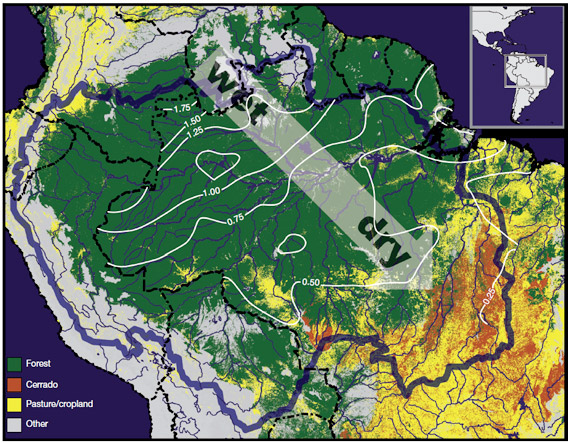
Climatic gradient across the Amazon basin. The hydrologic Amazon basin is demarcated by a thick blue line; the mean daily precipitation during the three driest months of the year are overlain onto four land-cover classes. The arrow emphasizes the trend from continuously wet conditions in the northwest to long and pronounced dry seasons in the southeast, which includes Cerrado (savannah/woodland) vegetation. Image courtesy of NATURE and caption text excerpted and modified from Davidson at al. (2011)

The combination of deforestation, forest degradation, and the effects of climate change are weakening the resilience of the Amazon rainforest ecosystem, potentially leading to loss of carbon storage and changes in rainfall patterns and river discharge, finds a comprehensive review published in the journal Nature.

An international team of researchers examined 100 studies looking at the effects of disturbance and climate change on the functioning of the Amazon Basin. The found that while the Amazon may be resilient to individual disturbances, multiple interacting disturbances — including fire, logging, deforestation, fragmentation, and global and regional climate change — undermines its resilience.

The researchers warn that events like the droughts that affected vast areas of Amazon rainforest in 2005 and 2010 could worsen if deforestation, forest degradation, and climate change worsen. Both deforestation and forest degradation from fire and logging reduce forest transpiration, which accounts for roughly a third of the moisture that forms precipitation over the Amazon basin. Meanwhile warmer temperatures in the Atlantic reduce the amount of moisture that reaches the basin. Drought exacerbates the risk of fire, which further degrades the forest and releases smoke which disrupts rainfall.

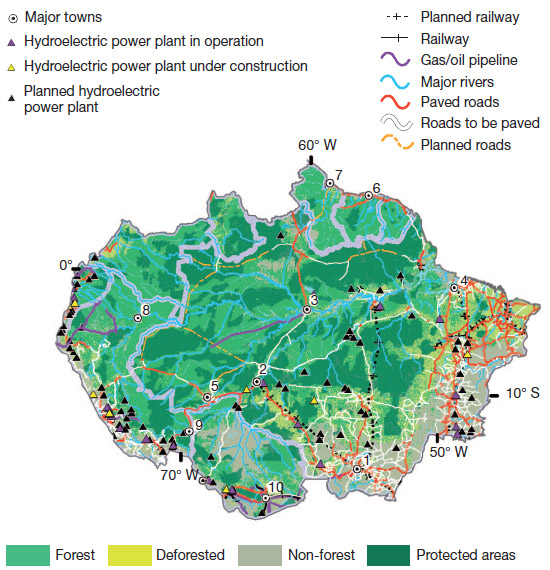
The authors note that current development plans will greatly increase the risk of deforestation and fragmentation across much of the Amazon. Meanwhile a spate of dams could affect the discharge of rivers already impacted by drought.

The Amazon basin today and future fire risks. Image courtesy of NATURE and caption text excerpted and modified from Davidson at al. (2011)

The researchers conclude will a call for further study to better understand "the trade-offs between land cover, carbon stocks, water resources, habitat conservation, human health and economic development in future scenarios of climate and land-use change."

"Brazil is poised to become one of the few countries to achieve the transition to a major economic power without destroying most of its forests," they write. "However, continued improvements in scientific and technological capacity and human resources will be required in the Amazon region to guide and manage both biophysical and socioeconomic transitions."

Amazon may become greenhouse gas emitter

February 1, 2012
Source: Science News

In the struggle against global warming, the Amazon rain forest may be about to switch sides.

Its dense vegetation has long helped cool the planet by removing carbon dioxide from the atmosphere. But mass tree deaths brought about by recent droughts and deforestation may be pushing the region to a point at which it will give off more of the greenhouse gas than it absorbs.

“The Amazon might still be a sink for carbon, but if it is it’s definitely moving towards being a source,” says Eric Davidson, director of the Woods Hole Research Center in Falmouth, Mass. Reporting in the Jan. 19 Nature, Davidson and 14 other researchers from the United States and Brazil weigh evidence that the world’s largest rain forest has become increasingly vulnerable to change.

Thanks to regular measurements of 100,000 trees, scientists estimate that the Amazon was sucking up about 1.5 billion tons of carbon dioxide annually at the turn of the century. Plants absorb the gas during photosynthesis, storing the carbon component as leaves, wood and roots and injecting it into the soil. The entire rain forest is thought to contain about 100 billion tons of carbon, equivalent to 10 years of global CO2 emissions from burning fossil fuels.

It’s clear that much of this carbon is now being released at the Amazon’s southern and eastern edges, says Davidson, in places where forests have been cleared by loggers or burned to make room for cattle and crops.

Not only do these bald patches store little carbon, they also threaten remaining trees by reducing the amount of moisture that is released into the air and by pulling rain away from the surrounding forest.

Dry seasons in the southern and eastern fringes of the Amazon have gotten longer. And when the rains do come, precipitation that would have been captured by forest runs off into rivers instead. A 2003 study in the Journal of Hydrology found that water flowing through Tocantins River in southeastern Amazonia increased by nearly 25 percent as croplands spread to encompass almost half of the land draining into the river.

For now, the impact of this deforestation will probably remain confined to parts of the Amazon. One computer simulation suggested that a surge in deforestation that cleared 40 percent of the Amazon basin could trigger a tipping point, a runaway conversion of forest to savanna. But Davidson’s team argues that the uncertainties are too great to make such a prediction.

Climate change, rather than direct deforestation, may ultimately be the factor that threatens the Amazon as a whole. Rising global temperatures are predicted to warm waters in the Atlantic Ocean and stimulate the El Niño weather patterns that influence how much rain falls on the Amazon, making droughts more frequent and more severe.

“Our work suggests that as the planet gets warmer, places like the Amazon are probably going to lose carbon,” says Kevin Gurney, an atmospheric scientist at Arizona State University in Tempe.

Trees in the Amazon’s interior are naturally resilient against drought. Their roots reach far below the surface, tapping deep water sources that provide sustenance during lean times.

But even deep-drinking trees have their limits. In a study reported in 2010 in New Phytologist, scientists channeled away up to half of the rain falling on small plots of land in eastern Amazonia for seven years. By the third year, tree growth had slowed substantially and tree death had nearly doubled.

A severe dry spell in 2005 pushed many trees beyond what they could handle even faster. Rainfall decreased over a third of the Amazon, by as much as 75 percent in some places. At the time, scientists estimated that the forest released more than 1.5 billion tons of carbon as trees died off, and labeled the devastation a once-in-a-century event.

Then an even worse drought hit in 2010, when an even larger area lost even more carbon. An analysis of satellite images reported last April in Geophysical Research Letters showed the forest turning brown.

“We’ve seen two climatologically unusual droughts in the last few years,” says Oliver Phillips, a tropical ecologist at the University of Leeds in England. But while these droughts are consistent with the expected consequences of climate change, Phillips is quick to point out that they could be just a statistical fluke, a couple of bad years brought on by natural variability. “Distinguishing a trend from a natural cycle is difficult,” he says.

As scientists continue to grapple with understanding what’s happening to the Amazon’s carbon, progress has been made in curbing deforestation in Brazil. Though setting fires to clear land remains a common practice, logging has decreased to less than a fourth of what it was in 2004. Ultimately, the scientists studying the region hope that human beings and the rainforest can find a way to remain allies.

“Brazil has the potential to move from an emerging-market country to a developed country without having destroyed its forests,” says Davidson. “That’s not something that most countries, including the United States, can say.”