Monday, November 28, 2011

Five Peruvian regions team up to promote Amazon attractions

November 27, 2011
Source: Andina

The Peruvian departments of San Martin, Amazonas, Ucayali, Loreto and Madre de Dios will develop a major tourism circuit to promote the Amazon macro-region's attractions.
Cesar Villanueva, governor of San Martin, said the aim is to increase tourist arrivals following the designation of the Amazon River/Rainforest as one of the seven natural wonders of the world.

"Authorities of the five regions are holding talks with the export and tourism promotion agency [PromPeru] to determine the route of the tour," Villanueva stated.

He told Andina that a group of Peruvian officials recently met with representatives from the U.S. Forest Service to work on a forest management project.

"The U.S. Forest Service has great experience in the field of forest management, so we can learn from them and achieve successful results," he added.

Early this month, the Amazon rainforest, Vietnam's Halong Bay and Argentina's Iguazu Falls were named among the world's new seven wonders of nature, according to organisers of a global poll.

The other four crowned the world's natural wonders are South Korea's Jeju Island, Indonesia's Komodo, the Philippines' Puerto Princesa Underground River and South Africa's Table Mountain, said the New7Wonders foundation, citing provisional results.

8 Amazon countries pledge more coordination in rainforest conservation

November 27, 2011
Source: mongabay.com

Eight Amazon countries pledged greater cooperation in efforts to protect the world's largest rainforest from deforestation and illegal mining and logging, reports AFP.

Meeting in Manaus last week, signatories of the 1978 Amazon Cooperation Treaty (OTCA) — Brazil, Bolivia, Colombia, Ecuador, Guyana, Peru, Suriname and Venezuela — focused on the Amazon Fund, an initiative launched by the Brazilian government in 2008 to finance conservation and sustainable development in the Amazon rainforest. Representatives coordinated a position for next June's Rio+20 conference and discussed existing agreements signed to protect the Amazon.

Brazil expressed a desire to strengthen OTCA.

"The Brazilian government is committed to revitalizing the Amazon Cooperation Treaty (OTCA)," said Brazil's Foreign Minister Antonio Patriota. "A stronger OTCA is in the interest of member states."

According to AFP, Brazil also indicated an interest in "expediting the process to implement the Amazon Fund," which has been slow to progress. To date the fund has only received donations of $58 million, well short of the one billion dollar target.

Deforestation in some parts of the Amazon has slowed in recent years, including a sharp drop in Brazil, which accounts for more than 60 percent of the Amazon rainforest. But deforestation monitoring remains poor in neighboring countries. One of the priorities for the Amazon Fund is establishing satellite-based monitoring systems outside of Brazil, which has the world's most advanced system and has recently trained technicians in Democratic Republic of Congo, Indonesia, Mexico, Gabon, Guyana, and Papua New Guinea, among others, in developing their own deforestation tracking platforms.

The world’s original scientists’ observations of climate change

28 November 2011
Source: Survival International


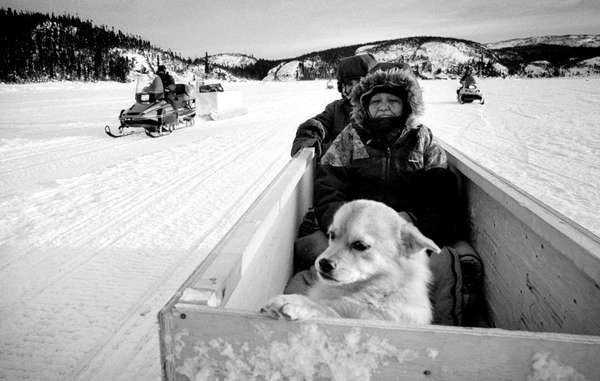
The Innu of northeast Canada say climate change has affected wildlife

As the UN’s climate change conference begins in Durban, Survival calls for the ecological knowledge and insights of tribal peoples to be heeded in global decisions concerning climate change.

From the Amazon to the Arctic, tribal peoples typically have the smallest ecological footprints, having practiced sustainable ways of life for thousands of years, but they are also more vulnerable to climate change than anyone on earth, and bear the brunt of mitigation measures such as biofuels, hydroelectric dams and conservation projects. (Download report, pdf, 3.2MB)

Most tribal peoples have developed an intimate knowledge of their surroundings, and observe minute changes in their ecosystems.

Tribal peoples’ observations include:

  • Inuit hunters of northwest Canada report thinning sea ice, shorter winters and hotter summers, change to the permafrost and rising sea levels.
  • Innu people of northeast Canada report observing birds in Northern Labrador such as blue jays that are typically only found in southern Canada or the U.S., less snow during the coldest months of the year and fewer mosquitoes during the summer.
  • Nenet reindeer herders of Siberia report that frozen rivers are melting earlier in the season, which hinders their reindeer’s spring migration, forcing them to swim instead of walk across the ice. They also report fewer mosquitoes.
  • Tsaatan reindeer herders of Mongolia report that the growth of lichen and moss that nourish their reindeer is being adversely impacted.
  • Yanomami of the Brazilian Amazon report a change in the pattern of rainfall in the rainforest. They urge the world to recognize the vital role of the Amazon in the regulation of the world’s climate, and the contribution of deforestation to global warming.

’Climate change has started in our country,’ says Davi Kopenawa, spokesman for the Yanomami people. ‘The rich countries have burned and destroyed many kilometers of Amazon forest. If you cut down big trees and set fire to the forest, the Earth dries up. The world needs to listen to the cry of the Earth, which is asking for help.’

Brazil's Yanomami have noticed different rainfall patterns.

Sheila Watt-Cloutier, Inuit activist, said, ‘Hunters have fallen through the sea ice and lost their lives in areas long considered safe. The Arctic is considered the health barometer for the planet. If you wish to see how healthy the planet is, come and take its pulse in the Arctic.’

‘Traditional weather reading skills can’t be trusted any more,’ said Veikko Magga, a Saami reindeer herder. ‘In the olden times one could see beforehand what kind of weather it will be. These signs and skills hold true no more.’

‘Tribal peoples are the world’s original scientists,’ said Stephen Corry, Director of Survival. ‘It’s self-evident: where they have been allowed to continue living on their lands, forest cover and biodiversity can be much higher than in other kinds of protected areas. And without their ecological knowledge, many vital medicines might never have been developed.

‘Now it is vital for us all that their knowledge and views are seen as legitimate. Tribal peoples should have a far greater role in policy decisions regarding climate change mitigation, and their right to the ownership of their land needs to be recognised.’Link

Saturday, November 26, 2011

Amazon countries vow to enhance conservation efforts

Friday, 25 November 2011
Source: Ceylon Daily News

Eight South American countries pledged Tuesday to boost cooperation to protect one of the planet’s largest natural reserves from deforestation and illegal trafficking in timber and minerals.

Representatives of Brazil, Bolivia, Colombia, Ecuador, Guyana, Peru, Suriname and Venezuela gathered in Manaus, northern Brazil, also vowed to speak with one voice at next June’s UN conference on sustainable development in Rio.

The Amazon, the world’s largest tropical rainforest, is one of the world’s largest reserves of fresh water.

Tuesday’s meeting involving signatories of the 1978 Amazon Cooperation Treaty (OTCA), focused on the Amazon Fund, a joint initiative launched in 2008 to combat deforestation and support conservation and sustainable development.

“The Brazilian government is committed to revitalizing the Amazon Cooperation Treaty (OTCA),” said Foreign Minister Antonio Patriota as he opened the one-day meeting. “A stronger OTCA is in the interest of member states.”

Also present were his counterparts Ricardo Patino of Ecuador, Suriname’s Winston Lackin, Venezuela’s Ricardo Maduro as well as representatives of other OTCA parties.

They reviewed agreements signed to protect the Amazon and discussed navigation rules on the Amazon river and a joint stance at next year’s Rio conference.

Earlier a Brazilian diplomat, speaking on condition of anonymity, said Brazil, which has the largest tract of Amazon rainforest, was keen on “expediting the process to implement the Amazon Fund.”

The initiative has received donations of nearly $58 million (42 million euros) over the past two years, well short of the initial target of one billion dollars.

It notably seeks to improve satellite tracking of forest deforestation and environmental plans in border areas.

“Sharing forest data among Amazon countries will facilitate the adoption of coordinated policies to combat deforestation and will ensure that we are better prepared for international discussions on sustainable development,” Patriota said.

Last year the Amazon lost 7,000 square kilometers (2,702 square miles), down from the historic peak of 2003-2004, when more than 27,700 square kilometers were deforested.

Officials say Amazon logging mainly results from fires, the advance of agriculture and cattle farming as well as illegal trafficking in timber and minerals.

Ecuador is meanwhile pushing an innovative proposal to combat global warming under which it would not exploit its oil reserves in the Amazon in exchange for international compensation of $3.6 billion dollars over 12 years.

Covering an area of seven million square kilometers, the Amazon is home to 40,000 plant species, millions of animal species and some 420 indigenous tribes, including 60 who live in total isolation.

According to OTCA, 38.7 million people live in the region, roughly 11 percent of the eight Amazon countries’ population. AFP

Mysore zoo to create Amazon habitat for anacondas

November 26, 2011
Source: The Hindu


Mysore zoo is trying to simulate the conditions of an Amazon rainforest in a 40 ft X 20 ft area to house the five anacondas, received as gift from Sri Lanka National Zoo in Colombo.

The non-venomous snakes, which can reach up to a length of 30 ft, have been put up for public display in a temporary enclosure that earlier housed pythons.

More visitors

As the Mysore zoo is the only zoological garden in the country to house the anacondas, the authorities are expecting more visitors in the coming days .

Construction of a permanent enclosure was delayed owing to non-availability of sand followed by the recent sand transporters' strike, and the work has gained pace now.

Sources in the zoo said the enclosure was specially designed to house the creatures, and the civil works were nearing completion.

Conditions

B.P. Ravi, Conservator of Forests and Zoo Executive Director, toldThe Hinduthat the work on simulating the conditions of an Amazon forest, the habitat of the anacondas, in the new enclosure would begin soon. Natural environmental conditions such as water pond and greenery would be provided to make the snakes feel comfortable and move around freely, he added. “It is tough to recreate the natural conditions of Amazon, but we are making efforts to design and develop the enclosure to suit the needs of the reptiles,” Mr. Ravi said.

As Amazon is hot and humid, proper humidity and temperature (not below 20 degrees Celsius) should be maintained in the enclosure.

Mr. Ravi said some plant varieties were being introduced in the enclosure to generate humidity.

Bulbs to be fixed

The zoo plans to fix high voltage bulbs to maintain temperature. There are two separate enclosures, and two viewing points with glass panelling. “By December-end, the new enclosures will be ready,” he added.

The anacondas are 15 months old and 4 to 5 ft long. The snakes attain monumental size when they are four to five years.

Length

In the wild, the snake can reach up to a length of 30 ft (nine metres) and weigh up to 550 pounds (227 kg).

“In captivity, the snake may grow to to a length of 18 to 20 ft because of restricted physical activity inside the enclosure. We are creating a water pond for their swimming needs. The enclosure will be enriched with tree stumps, plants and other flora to create a condition similar to its habitat,” Mr. Ravi explained.

Their lifespan in the wild is about 10 years, and they can live up to 20 years in captivity.

Time to keep promises on protecting the Amazon

25 November 2011
Source: Greenpeace

Deforestation in the Amazon will increase if changes to the Forest Code are passed

Copenhagen, December 2009: amidst the general feeling of disappointment due to the lack of leadership at the UN climate conference, Brazil is responsible for one of the very few rays of hope: the chief of cabinet announces a set of very ambitious environmental targets, including a commitment to a 80 per cent reduction in deforestation by 2020. The chief of cabinet's name? Dilma Rousseff. Her job today? President of Brazil.

Fast-forward to 2011: although only two years have passed, this year has seen the biggest spikes in deforestation in the Brazilian Amazon in recent history. The latest data shows that between August 2010 and April 2011, deforestation increased by 27 per cent compared to the previous year. Unfortunately, it seems like this is only the beginning of an even more disturbing trend: satellite data for March and April 2011 shows that almost 600 sq km of forest (an area larger than the Isle of Man) was lost. This is an increase of 470 per cent compared to the same period in 2010.

Why is this happening now? For years, Brazil has proven that it can grow substantially while at the same time fighting deforestation. President Dilma herself has argued that Brazil does not need to cut down any more trees to increase its agricultural output. She has support from the Brazilian Academy of Sciences and the Brazilian Society for the Advancement of Science (pdf) which both point out that Brazil can grow economically without more deforestation.

In addition, a study published in Science has shown that areas prone to deforestation do not show sustained levels of human or economic development. It therefore makes sense for Brazil to curb its deforestation levels, and its efforts had begun to pay off. All this has somehow been reversed in 2010.

In July 2010, a special commission voted in favour of changes to the law that regulates the use of forests in Brazil. As it stands that law, the Forest Code, requires landowners to set aside 80 per cent of their lands as legal reserves that cannot be deforested. The proposed changes would reduce the area which means much more forest could be cleared. Although the final vote on the changes has not been passed yet, deforestation has spiked since it was introduced.

One of the reasons for this might be that the new bill also includes a clause granting amnesty to environmental crimes like illegal deforestation which occurred before July 2008.

According to Fabio Alves - a scientist working for the Brazilian government’s own research body, the Institute of Applied Economic Research (IPEA) - this has led to some farmers illegally clearing more forest because they hope that the government will simply not be able to find out which parts of the forest were cut down before 2008 and which parts were destroyed afterwards.

On top of that, former environment minister Marina Silva argues that many farmers assume that if they are not charged for their illegal deforestation now, they will be granted another amnesty later.

This is deeply concerning, and threatens Brazil’s commitment to become a world leader on environmental issues. IPEA estimates that if the proposed changes to the Forest Code are passed, an additional 47 million hectares (an area the size of Sweden) could be lost.

With the law getting very close to a final vote in the Brazilian senate, the spotlight is on President Dilma who can still veto the bill. Now is the time for her to speak up and live up to her promises to refuse any law granting amnesty to those who have illegally destroyed pristine Amazon rainforest.

And the Brazilian public is behind her. In a recent poll, an overwhelming 79 per cent supported a presidential veto of the Forest Code revision; 84 per cent even said they would not vote for anyone who had voted in favor of “pardoning illegal deforestation”.

In Copenhagen, Dilma promised to protect rainforest - it's time she lived up to that promise.

Ecotourism isn't bad for wildlife in the Amazon

November 23, 2011
Source: mongabay.com

Ecotourism doesn't hurt biodiversity, and in some cases may even safeguard vulnerable areas, concludes a new study from the Amazon in Mammalian Biology. Surveying large mammals in an ecotourism area in Manu National Biosphere, the researchers found that ecotourists had no effect on the animals. However, the researchers warn that not all ecotourism is the same, and some types may, in fact, hurt the very animals tourists come to see.

Still in the Amazon researchers saw only benefits to ecotourism, cataloging 85 percent of large mammals in the ecotourism area as are found in the entire park.

"We could not find any way in which the richness of species has been affected," explains lead author Salvador Salvador in a press release. "No species sensitive to the presence of humans was lacking and although we were unable to calculate population density, species like the tapir (Tapirus terrestris) or the [white-lipped peccary] (Tayassu peccary) were abundant, even compared to virgin forest areas."

In addition, ecotourism could even support wildlife populations. According to Salvador, ecotourism in the Amazon tends to focus on areas near rivers, preserving some of the forest under the greatest pressure from settlers.

"These areas are home to species that are attractive, spectacular and easily visible such as the alligators, the giant otter and macaw clay licks," explains Salvador.

Salvador cautioned, however, that this study should not be seen to cover other ecotourism options, saying "a [photographic] safari in Kenya is not the same as what we studied in the Amazon rainforest." Most ecotourism in the Amazon is conducted by hiking or in boats.

Thursday, November 24, 2011

Amazon countries vow to enhance conservation efforts

22 Novenber 2011
Source: AFP

Ecuardor's Foreign Minister Ricardo Patino (L) and his Brazilian counterpart Antonio Patriota (AFP, Evaristo Sa)

MANAUS, Brazil — Eight South American countries pledged Tuesday to boost cooperation to protect one of the planet's largest natural reserves from deforestation and illegal trafficking in timber and minerals.

Representatives of Brazil, Bolivia, Colombia, Ecuador, Guyana, Peru, Suriname and Venezuela gathered in Manaus, northern Brazil, also vowed to speak with one voice at next June's UN conference on sustainable development in Rio.

The Amazon, the world's largest tropical rainforest, is one of the world's largest reserves of fresh water.

Tuesday's meeting involving signatories of the 1978 Amazon Cooperation Treaty (OTCA), focused on the Amazon Fund, a joint initiative launched in 2008 to combat deforestation and support conservation and sustainable development.

"The Brazilian government is committed to revitalizing the Amazon Cooperation Treaty (OTCA)," said Foreign Minister Antonio Patriota as he opened the one-day meeting. "A stronger OTCA is in the interest of member states."

Also present were his counterparts Ricardo Patino of Ecuador, Suriname's Winston Lackin, Venezuela's Ricardo Maduro as well as representatives of other OTCA parties.

They reviewed agreements signed to protect the Amazon and discussed navigation rules on the Amazon river and a joint stance at next year's Rio conference.

Earlier a Brazilian diplomat, speaking on condition of anonymity, said Brazil, which has the largest tract of Amazon rainforest, was keen on "expediting the process to implement the Amazon Fund."

The initiative has received donations of nearly $58 million (42 million euros) over the past two years, well short of the initial target of one billion dollars.

It notably seeks to improve satellite tracking of forest deforestation and environmental plans in border areas.

"Sharing forest data among Amazon countries will facilitate the adoption of coordinated policies to combat deforestation and will ensure that we are better prepared for international discussions on sustainable development," Patriota said.

Last year the Amazon lost 7,000 square kilometers (2,702 square miles), down from the historic peak of 2003-2004, when more than 27,700 square kilometers were deforested.

Officials say Amazon logging mainly results from fires, the advance of agriculture and cattle farming as well as illegal trafficking in timber and minerals.

Ecuador is meanwhile pushing an innovative proposal to combat global warming under which it would not exploit its oil reserves in the Amazon in exchange for international compensation of $3.6 billion dollars over 12 years.

Covering an area of seven million square kilometers, the Amazon is home to 40,000 plant species, millions of animal species and some 420 indigenous tribes, including 60 who live in total isolation.

According to OTCA, 38.7 million people live in the region, roughly 11 percent of the eight Amazon countries' population.

Brazilian dam-builder quits Peru project after indigenous protest

November 23, 2011
Source: mongabay.com

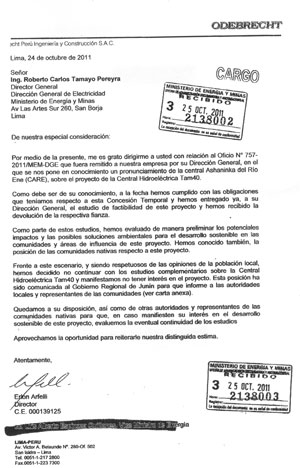
A large Brazilian construction company has pulled out of a Peruvian dam project citing opposition from indigenous communities, reports International Rivers.

In a letter addressed to the Peruvian Ministry of Energy and Mines, Odebrecht said it was withdrawing from the 1278-megawatt Tambo-40 Dam on the Tambo River in the Peruvian Amazon. The company said it would "respect the opinion of local populations" in pulling out of the project, which would have affected some 14,000 indigenous people along the Tambo and Ene Rivers.

Odebrecht reached its decision after meeting with the Ashaninka of the Tambo River.

The move, which leaves the dam without a developer, was welcomed by Manuel Leon, an Ashaninka leader.

"We welcome this decision by Odebrecht to respect our rights," he said. "We hope that other Brazilian dam builders will follow Odebrecht’s lead and make a similar decision."

The Ashaninka will now focus their efforts on Electrobrás — another Brazilian company — which is hoping to build another dam on the Tambo River.

Brazilian dam-builders are targeting dozens of rivers across the Amazon Basin. Much of their funding comes from Brazil's development bank BNDES.

Amazon reclaims site of U.S. cult tragedy

Tue Nov 22, 2011
Source: Reuters


Wilfred Jupiter clears foliage from an oversized gravestone on a site deep in the Guyanese rainforest where more than 900 Americans died.

The 80-year-old is one of few locals in the remote Amazonian nation who recalls the commune set up here by Jim Jones and his Peoples Temple cult in 1974.

Four years later, the cult ended in a mass murder-suicide that was one of the largest ever losses of civilian U.S. life.

"I was shocked," said Jupiter, who had helped clear the thick jungle so Jones and his followers could set up their self-styled Utopia.

"I worked with these people every day ... then they all killed themselves."

Jones took his followers to this remote corner of Latin America, sandwiched between Suriname, Venezuela and Brazil, as U.S. authorities and the media began to scrutinize his activities, threatening the organization's existence.

Just a few rusty remnants remain at the site, which Jones billed as a socialist idyll complete with hospital, workshops and dormitories for the roughly 1,000 followers.

It was left to decay after Jones persuaded almost all his members to kill themselves in the tragedy that also took the life of a U.S. congressman in November 1978.

California representative Leo Ryan had traveled there following reports members of the cult were held against their will, according to media accounts from the time. He had wanted to offer them a chance to return to the United States.

As Ryan arrived at the nearby Port Kaituma airstrip with several defectors in tow, he was killed by Jones' security guards along with four others, according to witnesses, some of whom played dead until the gunmen drove off.

"It was the most horrific thing you'll ever see in your life," said Gerry Gouveia, then a young army pilot who loaded Ryan's body into a bag and flew it to the country's coastal capital Georgetown.

Gouveia had previously flown Jones to the commune and knew it well.

"These people had gone into the jungle and cleared it to create a beautiful living space," he said during an interview in the Guyanese capital Georgetown. "To me, it represented a kind of Utopia."

On November 18, 1978, that dream came to an end as, according to media reports, Jones forced followers to drink cyanide-laced "Flavor Aid" in a "revolutionary suicide" that Jones had forced them to rehearse many times before.

Those who resisted were shot or stabbed to death, according to the reports.

FORGOTTEN TRAGEDY

Local resident Carlton Daniels was present as U.S. troops came to collect the decaying bodies three days later.

"You can tell the (ethnicity) of people from the texture of their hair," said Daniels, 65, as he looked down at the ground where he had seen the bodies, their faces unrecognizable due to the effects of cyanide poisoning.

"The skin was transparent and covered in a grey fluid. Their features weren't there."

In all, according to U.S. authorities, 918 people died that day, 909 in Jonestown, five at the landing strip and a family of four in the country's capital Georgetown, having received orders to commit suicide.

Cheap corrugated plastic signs poke out of the jungle now in a feeble attempt to show the site's layout, pointing out the playground, kitchen and hospital. Despite only having been erected two years ago by local authorities, they are in tatters as the jungle rapidly takes over.

The memorial that Jupiter so fondly clears was built in 2009 though its white paint is already peeling under a relentless sun.

The site is now unrecognizable as that of a massacre.

"It would be nice to remind people of the dangers of cults," said Daniels. "You have to be more careful when you enter these organizations. They tell you one part of it but you've got to think for yourself and see if the truth is there."

Brazil 'risks loss of forest area equal to Germany, Italy and Austria'

23 Nov 2011
Source: Telegraph.co.ukLink

WWF said studies suggest the new legislation could see 175 million acres of forest cleared or not restored following illegal deforestation

Deforestation in the Brazilian Amazon has declined steadily since 2004 and fell to the lowest level on record in the year from August 2009 to July 2010 following improved satellite monitoring and tougher enforcement.

But this year has already seen signs of a resurgence in several areas and environmental groups believe proposed changes to Brazil's Forest Code will exacerbate the problem in the Amazon and beyond.

They warn that the legislation would open up vast swathes of the world's biggest rainforest to uses such as cattle ranching and soy production and end hopes of replanting many illegally cleared areas.

According to WWF, Brazil's efforts to position itself as a "global environmental leader" risk being severely damaged before it hosts the UN Conference on Sustainable Development – known as Rio+20 – in Rio de Janeiro in June next year.

Maria Cecilia Wey de Brito, WWF-Brazil's CEO, said: "We are watching, just before Brazil hosts Rio+20, a clear attempt to dismantle Brazil's environmental legislation. This is something unprecedented in our history." She warned that "input from scientists, researchers, family farmers and social groups has been systematically ignored" by Brazil's upper and lower houses of parliament.

WWF said studies suggest the new legislation could see 175 million acres of forest – an area roughly equivalent to Germany, Italy and Austria together – cleared or not restored following illegal deforestation.

The laws would "likely make it impossible" for Brazil to meet its commitment of reducing deforestation by 80 per cent by 2020 compared to its average rate from 1996 to 2005, the charity said.

The new bill will update the Forest Code, which dates back to 1965 and applies to the nearly 5.2 million farmers and owners of rural land in Brazil, around 90 per cent of whom are considered small landowners.

The current code requires them to keep a certain percentage of their land as untouched forest, varying from 20 per cent in some areas to 80 per cent in the Amazon.

But around nine out of 10 landowners are believed to fall short of full compliance.

The new laws, already passed by Brazil's lower house in May, would see an amnesty from heavy fines granted to landowners who cleared forest illegally between 1965 and July 2008.

They would also see rules on the clearing of hills relaxed and safeguard forest areas bordering rivers to between 100 and 330 feet from the river bank – figures criticised as insufficient by scientists and conservationists.

Agriculture has played an important role in Brazil's economic rise. The country is now the world's leading producer and exporter of coffee and sugar cane, the biggest beef exporter, largest producer of oranges and second largest producer of soy.

Senator Katia Abreu, president of the Brazilian Confederation of Agriculture and Livestock, has led an aggressive campaign for a reduction in environmental regulations on agricultural producers to help further boost food output.

She claimed in a recent interview that Brazil's farmers could lose $100bn if the deforestation amnesty is not passed and they were forced to reforest large areas.

Brazil's Senate is due to vote on the bill before the end of November and it will then be sent back to the lower house before going to President Dilma Rousseff for approval.

Despite minor amendments Ms Rousseff will come under pressure to honour a 2010 election campaign pledge to veto legislation likely to increase deforestation, amid growing concern from conservationists that the bill could become law this year.

Marcio Astrini, of Greenpeace's Amazon Campaign, said: "The president has respected the progress of the bill without commenting, letting it follow its course of destruction.

"In the next phase, she will have to keep her word to veto or break her campaign promises."

Monday, November 21, 2011

Brazil indigenous Guarani leader Nisio Gomes killed

19 November 2011
Source: BBC News

An indigenous leader in southern Brazil has been shot dead in front of his community, officials say.

Nisio Gomes, 59, was part of a Guarani Kaiowa group that returned to their ancestral land at the start of this month after being evicted by ranchers.

He was killed by a group of around 40 masked gunmen who burst into the camp.

Brazil's Human Rights Secretary condemned the murder as "part of systematic violence against indigenous people in the region".

In a statement, Human Rights Minister Maria do Rosario Nunes said the region in Mato Grosso do Sul state was "one of the worst scenes of conflict between indigenous people and ranchers in the country".

She said those responsible must not be allowed to escape with impunity.

Mr Gomes was shot in the head, chest, arms and legs and his body was then driven away by the gunmen, community members said.

His son was reportedly beaten and shot with a rubber bullet when he tried to intervene.

Unconfirmed reports say two other Guaranis were abducted by the gunmen and may also have been killed.

Many of the community's 60 residents fled the camp to hide in the surrounding forest

Tribe defiant

The incident happened near the town of Amambai near the border with Paraguay.

Federal Police and representatives of Brazil's main indigenous organisations have travelled to the area to investigate the killing.

"The people will stay in the camp, we will all die here together. We are not going to leave our ancestral land," one of the Guaranis told the Roman Catholic Indigenous Missionary Council (CIMI) .

CIMI said the community wanted to recover Mr Gomes's body so he could be buried in the land he tried to defend throughout his life.

The group had been camping on a roadside following their eviction until they decided to return to their land at the beginning of November.

The killing has been condemned by the campaign group Survival International, which campaigns for indigenous rights.

"It seems the ranchers won't be happy until they've eradicated the Guarani," Survival's director Stephen Corry said.

"This level of violence was commonplace in the past and it resulted in the extinction of thousands of tribes," he added.

The Guarani are Brazil's largest indigenous minority, with around 46,000 members living in seven states.

Many others live in neighbouring Paraguay, Bolivia and Argentina.

The group suffers from a severe shortage of land in Brazil, which has worsened as a boom in agriculture has led farmers and ranchers to extend their holdings.

Indigenous activists say farmers in Mato Grosso do Sul frequently use violence and threats to force them off their ancestral territory, and that the local authorities do little to protect them.

Ecuador's Amazon 'amazing destination'

17 November 2011
Source: Year Out Group

Those in the process of gap year planning should consider visiting Ecuador and seeing the Amazon for themselves.

Isabel Choat has picked the destination as one of the seven wonders of the natural world and advised travellers to make the trip to see the site.

She warned that the rainforest is disappearing "at a mind-boggling and terrifying rate", meaning that the sooner a journey is made the more likely it is that a visitor will be able to experience the site in all of its glory.

Ms Choat said that those who are concerned about the impact of illegal logging and oil companies' behaviours is to visit the yachana Lodge on the Napo river's banks.

The site works with young people from tribal communities in order to give people the skills to protect the forest through sustainable tourism.

Those doing their gap year planning were recently advised by the Foreign and Commonwealth Office to do their research and to learn local customs before taking their trip, enhancing their experience and ensuring they earn respect in their destination.

Review: Amazon exhibition at Somerset House

18th November, 2011
Source: The Ecologist

Sebastião Salgado and Per-Anders Pettersson’s work offers a compelling insight into a threatened way of life, says The Ecologist's Green Living Editor Ruth Styles

The statistics are shocking. Three football pitch sized areas of pristine Amazon rainforest are lost every minute thanks to logging and the land grabs of local farmers. That’s over a million acres per day. What’s more, industrial scale deforestation is responsible for a staggering 15 percent of global emissions – more than ship, air and car transport combined. But worst of all, deforestation – both in the Amazon and elsewhere – is taking an unacceptable toll on biodiversity and indigenous peoples. Malaria, a non-native disease introduced via human exploration, has killed an estimated 20 per cent of the Yanomani tribe in the Amazon Basin, while at least 26 bird and animal species have been lost altogether thanks to habitat loss and poaching. And it’s statistics such as these that make Somerset House’ new Amazon exhibition all the more poignant, focusing, as it does, on the little that’s left.

Featuring the work of two photographers, Sebastião Salgado and Per-Anders Pettersson, the exhibition offers a pictorial insight into the contemporary realities of the Amazon Basin. Salgado’s works concentrating on the lives of the Alto Xingu and Zo’é tribes are strangely depressing; depicting a threatened way of life in stark black and white. The images are wonderful but their beauty is overshadowed by the precariousness of a lifestyle under threat from the modern world. In some respects, the photos resemble Gauguin’s Tahitian works, with the last gasp of a fading way of life held up for all to marvel at. The stunning aerial shot of the Anavilanhas archipelago in the Negro River is epically beautiful but like its human inhabitants, it is also endangered. The stark beauty of the photos, bringing the tribes’ harmonious relationship with their surroundings into clear focus, is in many ways, an early epitaph for a dying culture and a dying landscape.

By contrast, Pettersson’s work looks at the charity and conservation efforts being made to protect the region’s people, plants and animals in eye-wateringly bright colour. If Salgado’s work is a hauntingly beautiful tribute, Pettersson’s photos are a technicolour documentary looking at the efforts being made by locals with a little help from the WWF, Sky Rainforest Rescue and celebrity champion, Gemma Arterton. ‘This trip gave me a once in a lifetime opportunity to see the work that is being done first hand and help showcase it,’ comments Pettersson in the exhibition guide. The Swede’s collection is almost relentlessly upbeat, with plenty of shots of smiling locals, wild rubber tapping in action and one of Arterton staring wistfully out the window of a plane. Some are irritatingly cheesy – how many times have we seen images of celebs getting involved with locals only to return home and carry on as usual – but many others have real power and slam home the message that many of us miss: without getting local people on side, conservation can’t happen. It’s to the WWF and Sky Rainforest Rescue’s credit that they have recognised this and are directing much of their efforts at the forest’s human occupants.

Saturday, November 19, 2011

At least 141 workers fired at site for Brazil's Amazon dam

18 Novenber 2011
Source: AFP

Brazilian workers (L-R) Jose Evaldo Dutra, Valter Almeida, Josivam Alves and Antonio Cardoso (AFP/File, Lunae Parracho)

BRASILIA — At least 141 workers have been fired at the construction site for Brazil's controversial Belo Monte hydroelectric dam in the heart of the Amazon following a dispute over working conditions, one of them said Friday.

Jose Antonio Cardoso, a representative for the workers, said the consortium in charge of the $11 billion project had promised to help resolve the dispute but instead announced that 134 workers were being fired "without explanation."

"First they fired 134, then four others, including myself, then three more," he added.

Cardoso said the workers were demanding better pay as well as improved working conditions.

Police then escorted the fired workers to the bus station, where they were driven back to the northeastern state of Maranhao from they had been recruited, he added.

A spokesman for the CCBM consortium in charge of the project said only 120 workers were let go.

Last month more than 400 activists occupied the site of what would be the third biggest dam in the world -- after China's Three Gorges dam and the Itaipu dam on the border of Brazil and Paraguay.

Construction of the Belo Monte dam -- which would produce more than 11,000 megawatts, or about 11 percent of Brazil's current installed capacity -- has been the subject of legal wrangling for decades.

The project also has drawn international criticism, including from Oscar-winning movie director James Cameron of "Avatar" fame, who said rainforest indigenous tribes could turn to violence to block dam construction.

But President Dilma Rousseff's government has insisted the project should be allowed to go ahead, making it the centerpiece of government efforts to boost energy production in the rapidly growing economy.

The project is expected to employ 20,000 people directly in construction, flood an area of 500 square kilometers (200 square miles) along the Xingu river and displace 16,000 persons.

The government had pledged to minimize the environmental and social impact of the dam and asserted that no traditional indigenous land was to be affected.

Amazon rainforest splits along geological lines

18 November 2011
Source: Planet earth

From above the Amazon rainforest may look like an endless, uniform sea of greenery, but it turns out there are sharp lines through it separating very different ecosystems with distinct inhabitants. And these lines are drawn by the region's geology.

An innovative study published in Journal of Biogeography and led by Mark Higgins of Duke University is the first to combine large-scale data from satellites with painstaking work on the ground, sampling the plant types found in particular areas.

It shows an abrupt boundary between two distinct kinds of forest, running some 300km through northern Peru. The method also reveals a similarly sharp disjunction in western Brazil, running from north to south for more than 1500km. The researchers suggest this effectively marks the boundary between western and central Amazonia.

The earth is very different on either side of these boundaries. On average the soil on one side contains 15 times as many cations - tiny particles that plants need for nourishment - as that a short distance away on the other side. The plant communities living in these different kinds of soil are almost completely distinct.

'It's a profound difference in soil and plant species,' says Professor Oliver Phillips, a specialist in rainforest ecology at Leeds University and one of the paper's authors. 'We used to think the ecology of the Amazon varied gradually with the climate across the whole basin. But now we can see that it's not a matter of gradual variation - there are really dramatic changes over a few hundred metres.'

Scientists have known for some time that the Amazon isn't as uniform as it looks at first glance, and that it hosts many distinct regions with their own plant and animal communities. Before now, there have been various theories as to why this is - some have argued it's to do with rivers acting as barriers to species' spread, for example. But it now looks like the true causes may operate on an even larger scale.

The research suggests the Andes mountain range strongly influences the plants growing in the Amazon far away, by lifting the ground very slightly. The difference is so subtle you'd barely notice it at ground level, but it means water flows across the raised area more quickly, increasing erosion.

Over hundreds of thousands of years this wears away the relatively nutrient-poor surface soil and exposes the much richer deposits buried underneath. So the areas that are raised up slightly by the distant Andes have more fertile soil and end up with a different mix of plants and animals.

'It's amazing to think that the Andes are driving the ecology of the Amazon forest more than a thousand kilometres away,' says Phillips.

Satellite data meets fieldwork

The scientists looked first at the Peruvian rainforest. They took information from two satellites - Landsat, which senses the visible light and infrared radiation reflected by the forest canopy, providing information on the chemical activity there and how much moisture is present; and the Shuttle Radar Topography Mission (SRTM), which uses radar to create a very accurate picture of the contours of the landscape below.

Combining these two sets of data - one showing different kinds of plant; the other revealing the fine details of the landscape - let the researchers see a line running through the forest that seemed to correspond both to a shift in topography and to a different set of plants.

To check this information against the facts on the ground, they drew both on fieldwork from the 1990s in Peru where Phillips' NERC Fellowship concentrated on sampling different species of forest trees and on newer research sampling ferns and another group of understorey plants called melastomes.

They focused on these plants because trees are so big and so varied that to get a representative sample you need to survey an extremely large area - and also because when they're not flowering or fruiting, rainforest trees can be hard to identify. The ground-level data came from 138 sites distributed along more than 450km of road and river.

The scientists applied the same remote-sensing methods to the rainforest of western Brazil, finding an even longer geological boundary that seems to have caused the forest on either side to diverge.

Phillips says it's striking that as so often, painstaking scientific research has ended up backing up the knowledge of the people who live in the area. 'The locals are well aware of these differences - they know that some areas are much more suitable for farming, so they use various indicator species like particular understorey palms to identify the most fertile areas and clear the forest there,' he says.

Indeed, a map of the results from Peru shows strong similarities to aerial images of local deforestation - the fertile areas are usually the ones cleared for farmland.

Phillips explains that these insights will be important in devising strategies to conserve the Amazon rainforests - it will be important to conserve both types of rainforest, as they are both unique ecosystems and if one is destroyed it won't be repopulated by the plants and animals that live in the other. More fertile areas may need more protection against clearance.

He adds that many of the areas these geo-ecological thresholds run through are so remote that biologists have never got there to do research on the ground. The study predicts that any who went and looked would find similar sharp ecological boundaries here to those described in the studies, but more fieldwork is needed to confirm this.

Monday, November 14, 2011

Amazon rainforest named as one of seven nature wonders

November 14, 2011LinkSource: mongabay.com

Amazon rainforest in Peru. Photo by Rhett A. Butler

The Amazon rainforest has been named one of the "New 7 Wonders of Nature of the World", according to the Swiss group that organized the competition.

The New7Wonders Foundation named Halong Bay in Vietnam; Iguazu Falls in Brazil, Argentina, and Paraguay; Jeju Island in Korea; Komodo island in Indonesia; Puerto Princesa in Palawan, Philippines; and Table Mountain in South Africa as the other six.

The winners emerged after months of voting. Originally some 447 were candidates for the title.

The Amazon is the world's largest rainforest and provides critical services for mankind: 70 percent of South America's GDP is produced in the region fed by Amazon rainfall. Another one of the "New 7 Wonders of Nature of the World" is also powered by the Amazon rainforest: Iguazu Falls.

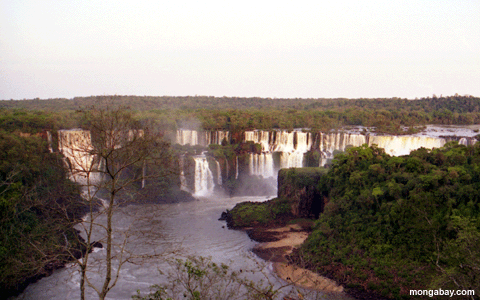
Iguazu falls on the border of Brazil and Argentina. Photo by Rhett A. Butler

Despite the Amazon's importance, its forests continue to fall. While Brazil has made great progress in reducing deforestation in recent years, scientists fear that climate change, combined with continuing forest loss, could put much of the Amazon at risk, leaving it at greater risk of fire and drought. Already some of the forecasts are looking prescient: in the past five years the Amazon experienced the two worst droughts over recorded.

Uncontacted Indians emerge from forest

12 Nov 2011LinkSource: Cool Earth

Over the last few months there have been several sightings of previously "uncontacted" Indians in Manu National Park and Biosphere Reserve located in the Peruvian Amazon an area which borders The virgin forests between Manu and the Brazilian frontier, between 150 and 200 miles to the east, is one of the last regions of the planet where indigenous communities have been able to live in relative peace and isolation during the last 50 years.


According to Roger Rumrill, a Peruvian specialist on the Amazon region and consultant advisor to that country's Ministry for the Environment, the increased sightings are most likely a consequence of pressure from loggers, gold prospectors, and seismic teams exploring for oil and gas. This kind of exploitative pressure has been on the rise over the last 10 years, frequently pushing the voluntary isolated groups from the core of their traditional territory.

Peru's newly appointed government, led by President Ollanta Humala, has a much more positive approach to the so-called "uncontacted" indigenous groups than the previous government which essentially tried to auction off around 70% of the Peruvian Amazon to multinational companies, in most instances, without even attempting to properly consult the legal owners such as indigenous communities. Alan Garcia, the previous President, even dismissed the existence of isolated indigenous groups, suggesting instead, that they were an invention of environmentalists to deter "development" in the region.

This new approach was reflected last month when the Ministry for the Environment released a video shot by tourists showing their close encounter with a group of "uncontacted" Indians on a riverbank in Manu. Ministry of the Environment officials explained that these tourists were irresponsibly tracking the Indians with a motorised canoe. This "game" stopped when the Indians pointed their bow and arrows at the tourists.

The video (www.youtube.com/watch?v=VYaqGiCgoWc) shows the tourists debating among themselves whether to approach the Indians and whether or not they should leave gifts of food or clothing for the Indians to take. The officials issued a strong warning to tourists and others travelling in Peru's rainforests to avoid any contact with isolated groups, including leaving cloths or other items which could very easily transmit illnesses to people who, because of their long term isolation, are immunologically defenceless even against basic ailments like influenza.

Soothsaying the Amazon's fires

Thu, 10 Nov 2011
Source: The Earth Times


A deforestation fire in Mato Grosso, Brazil during the 2006 fire season. (Photo credit: Guido van der Werf)

The last decade has been a tumultuous one for the Amazon rainforest, the green lung of the planet. On the one hand, the hand that wields the ax has been stayed somewhat - with the rates of deforestation last year at their slowest pace in 20 years. On the other, fierce 'once-a-century' droughts have gripped the lush basin not once, but twice. Some see the lurking shadow of global warming behind such an ill-starred run of searing dry seasons. What is for certain is that the planet can ill-afford for this global gobbler of man's CO2 to dry, shrivel and shrink - whether by ax or fire.

Fire season severity for selected years and their relationship to sea surface temperatures in the Pacific and the Atlantic. [Image © Science/AAAS]

But while scientists can't step in to banish these twin threats, they can hold out the promise of foretelling signs of the next gathering drought. That's according to the results of a new study by climate scientists, published in Science today. With advance warning, those tasked with conserving the Amazon may be able to prevent the worst effects of such droughts, by putting a damper on their potential for wildfires.

In order to act as modern-day augurs of these devastating droughts, the team - led by University of California, Irvine (UCI) - cast their eyes far afield, to the waters of the Pacific and Atlantic oceans. By watching the tremors of temperature over some three decades, in waters thousands of miles from the Amazon basin, they were able to pick up subtle signs that predicted the droughts - up to five months before they struck.

Actual and predicted fire season severity in 2010. [Image © Science/AAAS]

In the years when then the temperature of the central Pacific rose by a degree Celsius - and those in the Atlantic by a quarter of a degree - wildfires bloomed across the South American rainforests several months later. The researchers were able to produce models that accurately predicted the devastating fires of the 2010 Amazonian dry season. "We predicted a massive spike in fires in 2010, and it occurred," said James Randerson, one of the paper's authors from UCI.

Because there is a reasonable lead-time for their omen-casting, it gives those on the ground a fighting chance to take action. For example, fire-fighting teams can be placed in known flash points; or controlled burning of conflagration-prone areas can be undertaken - hopefully preventing raging wildfires from taking hold across wider swathes later. "During the 21st century, there are expectations that drought may intensify, and forests may become even more vulnerable. Understanding in advance whether you're going to have an exceptionally bad year will become critically important for managing them."

Given the desperate importance of holding onto those parts of the globe, such as the Amazon, that absorb much of our rising CO2 emissions, the need for such climate-oracles has never been greater. But with the bones also speaking loudly of a wider, more globally-ominous future, are we actually listening?Link

Saturday, November 12, 2011

Google Street View Cameras Map The Amazon

Thursday November 10, 2011
Source: Sky News

Google mounted its panoramic cameras on a modified tricycle

Google has used a pedal-powered tricycle to start photographing the vast Amazon rainforest as part of its global Street View facility.

As a result internet users around the world will only be clicks away from travelling through rivers and remote inhabited areas of Brazil.

The project used a white tricycle equipped with panoramic 3D cameras and a boat to take snapshots of a small stretch of the world's biggest tropical forest.

Navigating down the Rio Negro river, a boat with the tricycle on top took thousands of shots of the jungle and its residents.

Although the pictures will only show a small slice of the gigantic forest, members of the Sustainable Amazon Foundation (FAS) which helped Google carry out the project, hope it will help spread environmental awareness.

Google spokesman Emmanuel Evita said the local communities were receptive towards their photo team.

"Entering these communities we spent a lot of time talking to the people in the communities and making sure that these communities understood what we were doing and agreed with what we were doing.

"I think that in those areas a lot of them feel that even in Brazil, even in the nearer cities, there is not a lot of knowledge about the fact that they exist there and that they live there.

"So they are seeing a lot of the attention that they are receiving as an opportunity to show that they have a local culture and they have many things they can share with potential visitors and tourists."

The Google camera tricycle was taken by boat along the river

Google left their image-capturing gear behind and have trained some local residents to take photos themselves.

He said Google understood that the best people to show their forest were the people who lived there.

The head of FAS in Brazil, Virgilio Vianna, said the foundation decided to support the project because they believe more knowledge of the forest will help save it.

"This is the purpose of this project, this partnership with Google, to allow people to get to know a little more about the forest, the rivers, the communities without leaving their home.

"And who knows, upon this first look at the Amazon they might become interested in getting involved in some way, maybe by visiting or joining projects and other positive initiatives."
Recommended Stories

Ocean temperatures can predict severity of Amazon fires

11 November 11
Source: Wired.co.uk


A Nasa-funded research team at the University of California has created a model that can successful predict the severity and distribution of fires in the Amazon rainforest months in advance by analysing satellite data.

Previous research has shown that human settlement patterns are the main factor driving the distribution of fires in the Amazon. However, the new research shows that environmental factors -- including small variations in ocean temperatures -- intensify human influence and help explain the variability in the number of fires in the region from one year to the next.

Researchers analysed nine years of fire activity data collected by Moderate Resolution Imaging Spectroradiometer Instruments (Modis) on Nasa's Terra and Aqua satellites. They compared these to the National Oceanic and Atmospheric Administration's records of sea surface temperatures and changes in precipitation patterns measured by the Tropical Rainfall Measuring Mission -- a satellite co-managed by Nasa and the Japan Aerospace Exploration Agency.

According to the study -- published in Science -- temperature changes as little as 0.25°C in the North Atlantic and 1°C in the Central Pacific can be used to forecast how severe the fires are will be across the region. Higher-than-normal temperatures tend to precede a severe fire season four to six months later.

The team believes that unusually warm sea surface temperatures cause regional precipitation patterns to shift north in the southern Amazon during the wet season. Co-author of the study James Randerson explains: "The result is that soils don't get fully saturated. Months later, humidity and rainfall levels decline, and the vegetation becomes drier and more flammable."

The findings build on a Columbia University-led study published in July 2011 that showed how sea temperatures in the Northern Atlantic could forecast fire severity across a small section of the western Amazon. The new study considers a broader area of South America and takes into account the temperatures of the Pacific as well as the Atlantic.

The team successfully predicted that there would be a prolonged drought and severe fires in the 2010 fire season, but will have to wait to see whether the model's predictions for 2011 (which haven't yet been published) were also accurate, since the activity peaks in September and November.

They also noticed a pattern emerging: fires in the southern and south-western part of the Amazon were most strongly influenced by sea surface temperatures in the North Atlantic, while fires in the eastern part of the Amazon were affected by sea temperatures in the central Pacific.

The team hopes that the findings may be used to build an early warning system for fires to aid South American authorities prepare for fire seasons.

Amazon Rainforest one of New 7 Wonders of Nature

November 11, 2011
Source: PeruthisWeek.com

Amazon River

The Amazon Rainforest has been named as one of the New 7 Wonders of Nature of the World, said the organizer on Friday.

The other 6 are: Halong Bay, Vietnam; Iguazu Falls, Brazil, Argentina and Paraguay; Jeju Island, Korea; Komodo, Indonesia; Puerto Princesa, Philippines; and Table Mounta, South Africa.

Organizers said the results were provisional, and based on a first count of votes.

A final list of the New 7 Wonders of Nature will be released in 2012.

In Iquitos, the regional president of Loreto, Yván Enrique Vásquez Valera celebrated with local people.

Vásquez said the title meant “thousands of dollars more for the humble people, because the benefit of a tourist's trip is money that goes everywhere: to the taxi driver, the motorcycle taxi driver, the guide in the small boat in the Amazon River, to everyone," he said to local radio RPP.

"The voting calculation is now being checked, validated and independently verified, and the confirmed winners will be announced starting early 2012," organizers said.

"It is possible that there will be changes between the above provisional winners and the eventual finally confirmed winners," they added.

The top 7 were chosen from 28 finalists, that made it to the final round from an initial 477 nominees.

Brazil court refuses to stop work on Amazon dam

10 Nov 2011
Source: AFP


Representatives of indigenous tribes and environmental activists carry out a demonstration against the Belo Monte dam (AFP/File, Yasuyoshi Chiba)

BRASILIA — A federal court on Wednesday rejected an appeal for suspending construction of Brazil's controversial $11 billion Belo Monte hydroelectric dam in the heart of the Amazon until after indigenous people have been consulted.

The court, based in Brasilia, upheld a legislative decree that authorized construction, which is opposed by environmentalists and Amazon Indian tribes who say the dam will cause massive destruction of fauna and flora in the area.

Maria do Carmo Cardoso, a court judge, held that while the indigenous communities are entitled to being consulted, the law does not say that this must be done before approval of the work.

"The consultations are not binding, they are merely informative," she added in remarks carried by the state Brazil agency.

Authorities of the western Para state, who back the call for suspending the work until after the indigenous communities have been consulted, announced that the court ruling would be appealed in the federal Supreme Court.

Last month more than 400 activists occupied the site of what would be the third biggest dam in the world -- after China's Three Gorges dam and the Itaipu dam on the border of Brazil and Paraguay.

Construction of the Belo Monte dam -- which would produce more than 11,000 megawatts, or about 11 percent of Brazil's current installed capacity -- has been the subject of legal wrangling for decades.

The project also has drawn international criticism, including from Oscar-winning movie director James Cameron of "Avatar" fame, who said rainforest indigenous tribes could turn to violence to block dam construction.

But President Dilma Rousseff's government has insisted the project should be allowed to go ahead, making it the centerpiece of government efforts to boost energy production in the rapidly growing economy.

The project is expected to employ 20,000 people directly in construction, flood an area of 500 square kilometers (200 square miles) along the Xingu river and displace 16,000 persons.

The government had pledged to minimize the environmental and social impact of the dam and asserted that no traditional indigenous land was to be affected.Link

Wednesday, November 9, 2011

Peruvian authorities raid illegal gold mining operations

November 07, 2011
Source: mongabay.com

Gold mining in Peru's Tambopata region, Department of Madre de Dios. Photo by Rhett A. Butler.

Peru's Defense Ministry destroyed at least 75 illegal dredges and seized 15 vehicles from gold miners operating illegally in one of the most biodiverse parts of the Amazon rainforest.

The dredges were destroyed along the Inambari, Madre de Dios, Tambopata and Malinowski rivers, tributaries of the Amazon River in Peru's Madre de Dios Department. Illegal gold mining in rampant in the region and has been associated with water pollution, bioaccumulation of toxic mercury in fish, social conflict, deforestation, and bushmeat hunting. Illegal mining has even expanded into protected areas.

The recent action was coordinated with the Public Ministry, the Ministry of Environment, and the Ministry of Interior. The operation, conducted under Emergency Decree 007-2011, involves 1,500 troops and is expected to last 30 days, according to the Defense Ministry. Authorities plan to take control over rivers where illegal mining is occurring.

Two dazzling, yet discrepant sides of the Amazon [AMAZING PHOTOS]

Tue, Nov 8, 2011
Source: ZME Science

A recent art photography exhibition, dubbed Amazon, is currently on display at Somerset House in London, which brings together two remarkable, distinct bodies of photography to highlight the plight of the Amazonian rainforest and the people living within it. Thus, the work of Brazilian Sebastião Salgado depicts the virgin beauty of the largest and most species-rich tract of tropical rainforest in the world, while Swedish photographer Per Anders Pettersson chose to show the less serene side.

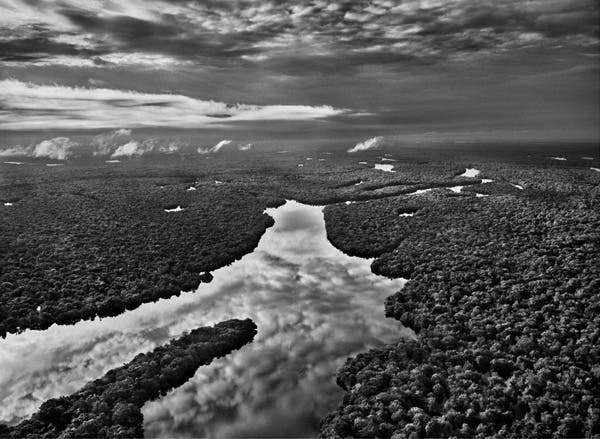
Salgado’s photo from below shows a largely unspoiled region in the state of Amazonas in north-west Brazil, part of his ongoing project called Genesis, in which he tries to capture the pristine beauty of the Amazon and its inhabitants in black and white.


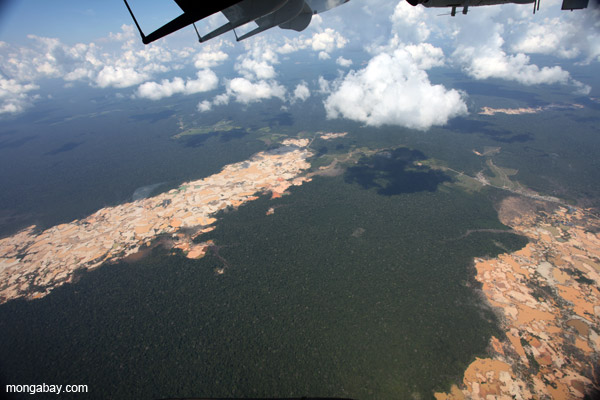
In total opposition, yet still of a retched beauty, Pettersson’s photograph shows a huge heavily deforested area of the rain forest. The photographer captured the sight on 21 June this year,when he flew over the Amazonian rainforest. What’s sad, maybe even stupid if you will, is that much of the deforestation was made to clear way for farmland. The problem is that the soil there is practically unusable, which results in poor crops.

Monday, November 7, 2011

Amazon rainforest photo exhibition

Nov 3, 2011
Source: Cool Earth

A new, stimulating and free photographic exhibition opens today and runs until December 4th at Somerset House, London. Organised by Sky together with the WWF, the exhibition is called Sky Rainforest Rescue.

It was opened by actress Gemma Arteton dressed up as Princess Leia from the Star Wars movies. Photos were taken by the award winning photographers Sebastiao Salgado and Per Anders Pettersson to domument the Amazon rainforest and present threats.

According to Arteton: “It is easy to deforest, it's quick money, so this is about giving people other means to make a living by using the rainforest.”

The photographer Pettersson added: “Some of the images will help visitors understand the deforestation first hand. Others show the reality of life in poor communities of the region. And some show the innovative solutions to deforestation that WWF and Sky are using.”

Most of Petterssons photos were taken recently in the Acre region of Brazil's Amazon which is suffering extreme levels of deforestation and has opened a new trade route road via Peru to the Pacific ocean in the last couple of years.

GM crops cover area larger than Amazon rainforest — 3 billion acres

Nov. 4, 2011
Source: Western Farm Press

As winter approaches in the United States and the rest of the northern hemisphere, here in the southern hemisphere it’s springtime. That means we’ve started planting. And sometime on Friday, Nov. 4, a farmer will put a seed in the ground and make agricultural history: He (or she) will plant the world’s 3 billionth acre of GM crops.

We don’t know exactly where it will happen, so there won’t be any fireworks or parades. It could be in my country of Brazil. It will almost certainly be in South America where an early planting season is now underway. We’re confident about the timing because Truth about Trade & Technology, an American non-profit group, has kept track of the world’s biotech-crop acreage for years, based on official reports from governments around the world.

All this counting up has produced a very, very large number.

How big is 3 billion acres? It’s bigger than the Amazon rainforest. It’s bigger than all of Brazil. It’s big enough to say with absolute certainty that biotechnology is now a thoroughly conventional variety of agriculture.

Brazil Faces $100 Billion Hit If Forest Farming Bill Fails, Senator Says

Nov 3, 2011
Source: Bloomberg


Brazil would lose about $100 billion in agricultural output if the senate rejects legislation that forgives farmers for illegally clearing protected rainforest, said Senator Katia Abreu.

Failure to approve the bill would force farmers to reforest about 70 million hectares (173 million acres) of land currently under coffee, oranges and other commodities, said Abreu, 49, who is president of the Brazilian Confederation of Agriculture and Livestock.

“We would have a brutal reduction in the country’s food production,” she said in an interview at Bloomberg’s headquarters in New York on Nov. 1. “The legal uncertainty we are living in is deeply worrying.”

The Senate vote, scheduled for this month, comes as deforestation increases in the world’s biggest rain forest amid surging demand for agricultural and wood exports, according to the National Institute for Space Research. Environmental campaigners say the amnesty may encourage formers to flout regulations that limit deforestation.

The bill will update the 1965 Forest Code, which requires farmers to keep a certain percentage of their land as forest. That percentage varies from 80 percent in parts of the Amazon to 20 percent in the swampy Pantanal region in western Brazil.

The new legislation would make the current percentages law, eliminating the risk that they may be changed by presidential decree.

Agricultural Giant

Since the 1960s, farmers have helped transform Brazil from a food importer to one of the world’s largest exporters of soft commodities, and they should be allowed to remain competitive, Abreu said.

Brazil is now the world’s top producer and exporter of coffee and sugar cane, the biggest beef exporter, the largest producer of oranges and the second-largest producer of soy after the U.S.

Much of that expansion has been made possible by cutting down the rain forest, not always legally.

The proposed bill would grant farmers amnesty and exempt them from being required to replant areas illegally deforested before 2009. That is fair because many farmers complied with the limits on deforestation, only to see those restrictions then tightened by decree, making them outlaws, Abreu said.

The legislation was approved by the lower house in a 410-63 vote on May 24. Since then, the bill has been altered to address concerns expressed by President Dilma Rousseff, said Abreu, a member of the Social Democratic Party who represents the state of Tocantins. She expects a vote by Nov. 23.

‘Lost Opportunity’

Opponents of the bill say it doesn’t take the opportunity to adapt 1965 rules to current global environmental standards.

“It is a lost opportunity,” said Roberto Smeraldi, founder and director of Amigos da Terra - Amazonia Brasileira, a Sao Paulo-based public interest group that focuses on the Amazon region. “After so many years discussing the Forest Code reform, this proposal doesn’t look to the future.”

Smeraldi, 51, said the focus on forgiving landowners will lead to further logging.

“One thing is to regularize, another totally different thing is to give amnesty,” he said in a phone interview from Sao Paulo. “When the citizen sees there is no difference between who acted in one way or another, he loses interest in the rule.”

Deforestation doubled to 267.9 square kilometers in May from 109.6 square kilometers a year earlier, led by destruction in the central state of Mato Grosso, the National Institute for Space Research said.

While environmental protection is a concern for farmers, the burden shouldn’t lay only with them, Abreu said.

“In Brazil, the environment is a collective good with an individual burden to the landowners,” said Abreu. When the environmental discussions started, in the 80s, “we went to sleep as heroes and woke up as villains,” she said. Link

Wednesday, November 2, 2011

Enjoy the Amazon rainforests... from your armchair

2 Nov 2011
Source: Bizcommunity.com

The armchair traveller can now mosey through the Amazon rainforest, looking at the magnificent sites captured by Google, which has mounted a camera on a boat to capture images from the rivers and waterways. This is according to a report on IOL and on News24.

This is Google's latest Street View venture and it has enlisted the help of local residents to use a trike to cycle through villages alongside the river, taking pictures of different parts of the remote diverse rainforests.

For the first phase of the project, Google teams are floating down a 48km sector of the Rio Negro River, extending from the Tumbira community near Manaus to Terra Preta before heading into the Amazon itself.

Google says its cameras have been welcomed in the Amazon, unlike in Germany, India and Austria that have all sought to ban the Street Views on the basis that it invades the privacy of private individuals.

TNK-BP moves deeper into Amazon basin

Nov 1, 2011
Source: UPI

Russian-British oil joint venture TNK-BP announced it bought a 45 percent stake in a Brazilian oil company working in the Amazon River basin.

TNK-BP Chief Executive Officer at Mikhail Fridman said the company was looking forward to a sustained partnership with Brazilian company HRT O&G.

"The project will give us access to significant new resources in one of the world's fastest growing markets," he said.

Independent audits put the total resource capacity of the 21 oil and gas exploration blocks owned by HRT at around 789 million barrels of oil equivalent. The blocks cover roughly 18,725 square miles.

The reserves in the Solimoes Basin of the Amazon are relatively unexplored because of concerns about the environmental impact of oil and gas exploration in the region. Brazil, the Financial Times reported, is on pace to become of the largest oil producers in the world.

TNK-BP in July announced a similar deal for exploration blocks along the Amazon River through a partnership with Brazil's Petro Energia.

Scientists using historic satellite data determined changing climate and altered rainfall patterns could result in rainforests transitioning to grasslands or woody savannas. This, researchers found, could limit the amount of carbon stored in the rainforest.

Amazonas 2030: Indicators For The Climate Crisis

October 31, 2011
Source: Eurasia Review

“It is great news” that the Colombian government is studying the cancellation of mining titles that have been granted in protected areas and in border zones declared national security areas, anthropologist Martín von Hildebrand, director of the Gaia Amazonas Foundation, told Tierrramérica.

In the Amazon region of Colombia, national parks comprise around seven million hectares of land. The national security areas designated by the Ministry of Defense on the country’s borders encompass another 4.8 million hectares, although they could be redemarcated.

In the Amazon region as a whole there are currently valid mining titles for 138,571 hectares of land. Requests are being processed for titles that would cover a further 5.4 million hectares, according to the Ministry of Mines and Energy.

“Unfortunately,” warned Von Hildebrand, “we also have to keep in mind that while certain areas are being defended, such as national parks and national security areas, the people who are there now looking for minerals will move to other areas without this kind of protection.”

This is why there is a need for strict policies for monitoring and control of other parts of the rainforest, he added.

Sixty percent of the Colombian Amazon is forested area with a certain degree of protection. Mining titles can be granted in these areas, but require an environmental license.

The Ministry of Mines and Energy’s announcement that it is studying the cancellation of mining concessions was made on Oct. 26 at the presentation of the Amazonas 2030 Index, developed by an alliance of the same name which collects social, environmental and economic data on the Colombian portion of this rainforest that constitutes the heart of South America.

The study is innovative in that it grants the same importance to the dimensions of the environment and indigenous communities as it does to economic, social and institutional dimensions. Each has a weight of 20 percent. The lowest possible value for the index is zero (the worst scenario) and the highest is 100 (the best).

The result is a balanced strategic analysis: just the vision required in the face of the environmental crisis and climate change, in contrast to typical studies that emphasize economic considerations.

The key lies in measuring the quality of life of ecosystems. If this were measured in the Amazon according to the index of unsatisfied basic needs, the result would be that Amazon indigenous communities live in extreme poverty, and this is not the case.

By taking into account the environmental component and indigenous communities’ ancestral knowledge of and ties with their territories, it can be objectively verified that the rainforest and culture provide quality of life.

Meanwhile, through dozens of variables that could be classified as “conventional” – such as educational level and public services – the index measures the effects of public policies, in the first place, and private management, secondly.

“The idea is that, for better or worse, this is what the state is dealing with in the Amazon. And then, it is a matter of making it understood that these indicators for the Amazon are developed on other bases,” biologist Natalia Hernández, who coordinated the initial design of the Amazonas 2030 study, told Tierramérica.

“Simply taking into account the cultural, social and environmental dimensions to the same degree as economic and institutional dimensions paves the way for a vision of development from the perspective of the Amazon,” she added.

Amazonas 2030 is an alliance of non-governmental organizations, the private sector and the media aimed at promoting sustainability and quality of life in the Colombian Amazon and positioning the region on national and global agendas.

Its name refers to the fact that, according to the Intergovernmental Panel on Climate change, if the current rate of deforestation continues, by 2030 more than half of the Amazon rainforest will be severely damaged.

Official figures on the Colombian Amazon region are so lacking that the researchers specified that “it was difficult to obtain a large part of the data, especially figures on timber transport permits, ethnic education and the legalization of extractive activities in forest reserves, among others.”

Moreover, the statistics gathered and included in the index correspond only to urban settlements. “The index does not reflect the cosmovision of indigenous peoples, due to the lack of data that could capture it,” the methodological notes indicate.

Perhaps the variables for which the lack of data is most significant are those related to health, which do not take into account the work of shamans, whose impact has never been measured.

The departments assessed are Amazonas, Putumayo, Caquetá, Guaviare, Vaupés and Guainía, which together cover 403,348 square km in south and southeast Colombia.

The Sinchi Amazonic Institute of Scientific Research includes nine municipalities in the department of Meta, one in Vichada, three in Cauca and four in Nariño in its definition of the Colombian Amazon region, leading to a total of 483,164 square km, or 42 percent of Colombia’s entire continental area of 1.1 million square km.

Colombia is home to 17 percent of the rivers in the entire Amazon region, which in turn is the source of 20 percent of the planet’s fresh water. Because of its huge size, the Amazon also contributes significantly to regulating the global climate.

But the geographic size of the Amazon varies, depending on three different ways of defining this area of extraordinary biological and cultural diversity.

One views the Amazon as a region or biome, and includes the Amazon River basin and parts of the basins of the Orinoco and Paraná Rivers. Another encompasses the basin of the Amazon River and its tributaries. And finally there is the political-administrative Amazon region in each individual country, used in terms of planning and development.

Bolivia, Peru and Ecuador, like Colombia, are referred to as “Andean” countries. In reality, however, almost half of their territories falls within the Amazon rainforest region.

Venezuela defines its Amazon region as including only the Amazon River basin, on the southern edge of the southern state of Amazonas. The rainforests in the rest of the state of Amazonas and much of the state of Bolívar, south of the Orinoco River, are officially defined as the Venezuelan Guayana.

The overall result of the Amazonas 2030 Index is 51.4, although it is an average formed out of marked contrasts.

In the department of Caquetá, close to one half of the rainforest has been destroyed, in Putumayo, one quarter, and in Guaviare, one third. These three departments of the northwest Amazon region are characterized by a high proportion of European settlers, very few indigenous communities and reserves (territories under indigenous administration), numerous large cities and highly developed road infrastructure.

On the other hand, the departments of Amazonas, Vaupés and Guainía have very little deforestation, greater ethnic diversity, smaller urban centers, large reserves and national parks, and no road infrastructure.

The differences between these two sub-regions of the Colombian Amazon are clearly reflected in a perception survey conducted among the region’s inhabitants, also released by Amazonas 2030 but only covering urban centers so far.