Thursday, September 29, 2011

Brazil court orders halt to work on $11 bln mega-dam

28 September 2011
Source: AFP

Representatives of indigenous tribes carry out a demonstration in Sao Paulo against the construction of Belo Monte dam (AFP/File, Yasuyoshi Chiba)

SAO PAULO — A federal court in Brazil has ordered a halt in construction at the controversial $11 billion Belo Monte hydroelectric dam, saying it would disrupt fishing by local indigenous people.

The project has drawn international criticism, including from Oscar-winning movie director James Cameron of "Avatar" fame, who said indigenous tribes in the Amazon rainforest could turn to violence to block dam construction.

Para state federal judge Carlos Eduardo Castro Martins on Wednesday barred Norte Energia from "building a port, using explosives, installing dikes, building canals and any other infrastructure work that would interfere with the natural flow of the Xingu River, thereby affecting local fish."

The Belo Monte dam is portrayed by Brazil's government as a key piece of its plan to boost national energy production needed for one of the world's fastest-growing emerging economies.

It would be the third biggest dam in the world, after China's Three Gorges construction and the Itaipu dam on the border of Brazil and Paraguay.

The construction ban should be valid from the date that Norte Energia receives notification, likely next week, a federal justice spokesman said.

If the company fails to comply, it would be fined 200,000 reais (about 109,500 dollars) a day, officials said.

Construction that does not affect local fishing, including home building, can continue, the judge also ruled.

The company still may appeal the ruling.

The government had pledged to minimize the environmental and social impact of the dam and asserted that no traditional indigenous land was to be affected.

But in April, the Inter-American Commission on Human Rights (IACHR) asked Brazil to "immediately suspend the licensing process" for the dam, and called on it to protect indigenous peoples in the Xingu River basin whose lives and "physical integrity" would be threatened.

The dam would divert 80 percent of the Xingu River's flow to an artificial reservoir, "potentially leading to the forced displacement of thousands of people," the Amazon Watch nonprofit, which fights for indigenous peoples' rights and to protect the environment in the Amazon, says on its website.

But in June, the Brazilian government granted an installation license for the dam, clearing the way for construction to start.

Since he finished working on "Avatar," Cameron has made three trips to the region in the Amazon where the dam is to be built to draw attention to the issue. British pop singer Sting has also given his support to the cause.

Greed in the Amazon: Death Toll Rises as Diggers Fight For Amazon Gold

September 28, 2011
Source: Hispanically Speaking News

In 1993, more than 2,000 Yanomami Indians were killed by garimpeiros (independent gold diggers) who entered the Yanomami’s land in the Amazon rainforest along the Brazilian and Venezuelan border during the new gold rush. Today, just like the Yanomami before them, people are dying in the name of gold and greed.

The global economic crisis has caused the price of gold and minerals to skyrocket, and in turn has caught the attention of the money hungry, some of whom have gone so far as to kill anyone they believe stands in their way.

Though the scramble for South America’s undiscovered gold in the Amazon is nothing new, the down turn of the economy has brought out those willing to do anything for it, even murder teens like Elton Thompson, who was bludgeoned to death by a miner.

“There is a direct correlation between the price of gold and what we have to deal with these days,” said Guyanan police commander David Ramnarine to the Demerara Waves news website after a string of gold-related killings in his country, which sits along the northern coast of South America.

The Guardian is reporting that the mineral-rich rainforests of Brazil, Guyana, Peru, Bolivia, Colombia, and Venezuela have seen increases in violence, disease, and overall conflict since both the U.S. and European economies have taken a hit.

As of August 24, 26 murders and numerous armed robberies have occurred in the jungles of South America.

Health coordinator for the Yanomami’s Hutukara association, Dário Vitório Kopenawa Yanomami, said he is worried his people are suffering and that as many as 2,000 illegal miners are operating on the Yanomami reserve.

“The miners are hiring planes to come into the reserve. Their entry is constant. It is dangerous to go where they are. They are all armed.

“If we go near them they will kill us. We are getting information that the invaders are getting close to our lands. The Yanomami are asking for support.”

It is said that the region’ gold prices have risen 40 percent since last year.

Death in the Amazon: Brazil accused of protecting trees but not its people

Wednesday 28 September 2011
Source: guardian.co.uk


Even here, Tuesday is an unusual day to die. At the weekend there is no shortage of bloodletting in this corner of the Amazon. Bar brawls, knife fights, lovers' tiffs, alcohol-soaked arguments, all with the same predictable coda: a slit throat, a shot to the head, a visit from Maraba's over-worked head of forensic science, José Augusto Andrade, and a gory crime-scene photograph splashed across the pages of a tabloid.

Tuesdays, though, are normally quiet. But 24 May this year was an exception.

The call came at about 10.30am, and Andrade was soon racing out of town towards the Praia Alta Piranheira settlement, a rural area about 55 miles from his antiseptic-scented morgue.

At the crime scene two bodies lay beside an earth track. Dozens of people crowded around the victims, who were instantly, predictably, recognisable. They were the rainforest activist José Cláudio Ribeiro da Silva, who had foretold his own death six months earlier at an environmental conference in the Amazon, and his wife, Maria do Espírito Santo.

If Tuesday was an unusual day for a double homicide, what Andrade saw was stranger still: Da Silva's ear had been hacked off, perhaps a trophy taken by the killers as proof their mission had been accomplished. "I'm used to barbarous crimes but not to seeing someone commit a murder, then mutilate a person," Andrade said. "It is not common."

Da Silva, also known as Ze Cláudio, and Espírito Santo were the latest in a string of environmentalists to die for their cause in the Brazilian Amazon. After nearly 15 years of campaigning against illegal loggers, as well as charcoal producers and cattle ranchers, they were gunned down not far from their jungle home on the settlement.

"They were moments that I would give everything to never have gone through," said Espírito Santo's sister, Laisa Santos Sampaio, a primary school teacher who lived on the settlement alongside the murdered couple.

Tears streaming down her cheeks, she repeated her roadside farewell. "I just remember asking: 'My sister, why have you left me?' I didn't know what to do."

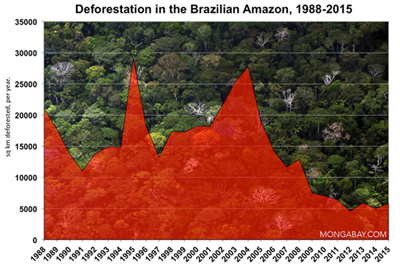
In recent years the Brazilian government has made significant progress in slowing the destruction of the world's largest tropical rainforest, reducing the area of forest lost, from 10,500 square miles in 2004 to just 2,300 square miles last year. But a spate of brutal killings have underscored an uncomfortable truth: the authorities can stop the felling of the trees to some extent, but not the cutting down of environmentalists.

"This is the reality of this country," said Da Silva's youngest sister, Claudelice Silva dos Santos. "There is so much good stuff in Brazil. The Amazon is so beautiful. It has to be preserved. But this is what happens to those who try to protect it."

The murders of Da Silva and Espírito Santo were the highest profile environmental killings in Brazil since the murder of Dorothy Stang, 73. The American-born nun, who worked for the Catholic church's pastoral land commission, was shot in 2005 by two gunmen on a rainforest track in Para state. Among five defendants in the case was a wealthy rancher, Regivaldo Galvão, whose conviction for orchestrating her murder was upheld this month.

Few people believe such deaths will be the last. Many parts of the Brazilian Amazon remain off-limits to environmentalists, while government environmental officials go to certain regions only if escorted by rifle-toting police and helicopter back-up.

"The difference between here and the place where [Da Silva] and Maria were murdered is that this place is more isolated and you don't find rainforest defenders," said Marco Vidal, an environmental officer who had known the couple and was deployed in the region days after their execution.

With an assault-rifle slung around his shoulder, Vidal toured an illegal sawmill recently closed down by his forces. It was in a region known as Middle Land, one of the latest frontlines in the government's battle against deforestation, near the cattle-ranching frontier town of Sao Felix do Xingu.

"The rainforest defenders here were either killed or never made it this far due to the very real threat of being killed," he explained. "If NGOs such as Greenpeace tried to come here they would definitely be eliminated."

Da Silva and Espírito Santo had lived on the Praia Alta Piranheira settlement, on the banks of the Tocantins, in the Amazon state of Para. Founded in 1997 as part of a government land reform initiative, the 22,000-hectare (54,000-acre) settlement was split into plots, which were distributed to poor, landless Brazilians. The idea was that settlers would make a sustainable living from the forest, harvesting fruits and nuts.

It did not work out that way. When the settlement was created, about 85% of its land was pristine rainforest. The area has since been eaten away, its forests hacked down to produce charcoal for the region's pig-iron industry or transformed into huge cattle ranches. Facing financial hardship, many settlers were forced to sell their land or forests to the loggers and charcoal producers.

But Da Silva and Espírito Santo championed sustainability and railed against those people seeking to profit from the forest's destruction. The consequence was persistent death threats.

In a 2004 letter to Brazil's environment minister at the time, the rainforest defender Marina Silva, Espírito Santo issued one of many desperate cries for help. "We would like to inform you that we are being threatened with death because we do not agree with what is happening," she wrote. "Nature's enemies are working night and day."

Espírito Santo had described her two‑page letter as "an SOS", saying: "All we can now do is ask that you help us carry out our mission of preserving the forest … greed and capitalism have always been blind."

The frequent death threats were also registered with José Batista Gonçalves Afonso, a human rights lawyer and friend, who believes the government could and should have done more to protect the couple. "They were abandoned," he said. "They were exposed. And unfortunately they became easy targets for the gunmen of those who were interested in eliminating them."

Over the past 20 years Afonso has seen buried dozens of friends and colleagues – Amazon activists who stood up for the rainforest or the poor.

Nearly four months after Da Silva and Espírito Santo were murdered, police arrested three men in connection with the killings, in a dawn raid on a jungle camp about 32 miles from the Amazon town of Novo Repartimento. One of the men, José Rodrigues Moreira, a small-time cattle rancher, was accused of ordering the murders.

Family members suspect a wider conspiracy. Fearing for their lives, they have not returned to their homes on the settlement. "This is just the tip of the iceberg. There's much more going on here," said Claudelice, after police named their three prime suspects.

Sitting next to her on a sofa in the family's sitting room, Da Silva's elderly mother, Raimunda, said: "I feel like I have been abandoned in the middle of the world. My son meant everything to me. I love all of my children but he was my firstborn." With bloodshot eyes, she wept.Link

Amazon deforestation up moderately in August, but forest degradation falls

September 22, 2011
Source: mongabay.comLink

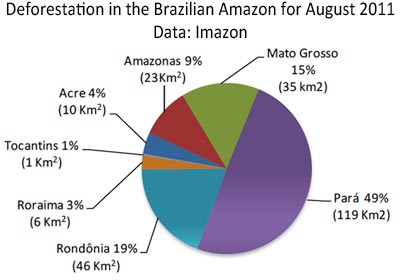
Deforestation in the Brazilian Amazon continues to be slightly higher than this time last year, reports a new bulletin from Imazon, a Brazilian NGO.

Imazon's near-real time deforestation monitoring system (SAD) detected a 15 percent rise in deforestation this past August relative to August a year ago. Overall 240 square kilometers of forest were cleared.

49 percent of deforestation in August occurred in the state of Pará. Rondônia (19 percent), Mato Grosso (15 percent), and Amazonas (9 percent) followed.

Imazon reported a sharp drop in forest degradation over last August, with the area affected by fire, selective logging, and other forms of significant disturbance falling from 1,555 square kilometers to 131 sq km.

INPE, Brazil's National Space Agency, is expected to release its deforestation data for August soon. INPE uses a different system for short-term tracking of deforestation.

The annual estimate for deforestation will be released later this year. The annual estimate is based on higher resolution satellite imagery and is considerably more precise than the near-real time systems.

Deforestation from August 2010-July 2011 is expected to be 10 to 20 percent higher than the year earlier period, when forest loss in the Brazilian Amazon was the lowest since annual record keeping began in 1988.

Wednesday, September 28, 2011

Bolivian president Evo Morales suspends Amazon road project

Tuesday 27 September 2011
Source: guardian.co.uk

Bolivia's president, Evo Morales, has suspended the construction of a controversial Amazon highway a day after violent clashes between police and protesters.

On Sunday, police used teargas and batons to disperse an estimated 1,000 protesters who were marching to the capital, La Paz, to oppose the construction of a 185-mile (300km) road through Bolivia's Isiboro Sécure National Park and Indigenous Territory (Tipnis).

The march, which began on 15 August, was to highlight the social and environmental costs of the road, which campaigners say would wreak havoc on the wildlife-rich park and its indigenous populations.

The police response triggered widespread criticism, even from within Morales's government. The defence minister, Cecilia Chacon, quit in protest. "This is not the way. We agreed to do things differently," she wrote in her resignation letter.

On Monday night Morales finally gave into pressure and promised a referendum on the road's construction.

"While [we conduct] a national and regional debate, construction of the Tipnis road is suspended," he said, according to Bolivia's La Razón newspaper.

The suspension, which many believe will prove only a temporary reprieve, was nevertheless a U-turn for Bolivia's first indigenous leader, who has repeatedly vowed to push ahead with the project. "Whether they like it or not, we will build that road," he said in June.

Anti-road protests have highlighted tensions between his desire to improve infrastructure and boost investment and his image as a champion of indigenous rights and the environment.

"Our Mother Nature feeds us, gives us drinks and we respect her, we value her, we have to look after her," the country's foreign minister, David Choquehuanca, said earlier this year. "Development – the one implemented by western societies – has generated considerable imbalances between people and regions. It has created a million problems."

The road has also underlined resentment over Brazil's increasing role in the internal affairs of neighbouring countries, where it is financing and executing major and sometimes controversial infrastructure projects, including hydroelectric dams and roads in countries such as Bolivia, Peru and Paraguay.

In June, Peru's government cancelled a concession for a Brazilian company to build the controversial Inambari dam in the Peruvian section of the Amazon.

The Bolivian road was being funded with a $332m (£211m) loan from Brazil's development bank, the BNDES, and built by OAS, one of several Brazilian construction firms that operates across Latin America.

Critics complain that Brazil will be the true beneficiary of the road by allowing it to export products from Pacific ports in Chile and Peru. Bolivia, meanwhile, would be lumbered with debt and forced to deal with the resulting environmental destruction.

"The highway is being built for Brazil so that it can export its products to Bolivia," Ernesto Sanchez, one of the protest leaders told the Guardian. "Here we'd only be left with debts because all the benefits go to Brazil."

Brazilian authorities dismiss such criticism and argue that its growing presence in poorer neighbouring countries is part of mutually beneficial "south-south" co-operation.

On Monday, Brazil's foreign ministry released a statement defending its role in the road's construction. The ministry described the road as a "project of great importance for Bolivia's national integration and one which meets the social and environmental standards outlined in Bolivian legislation".

Kathryn Ledebur of the Andean Information Network, a thinktank, said Brazil was slowly replacing the role traditionally played in Bolivia by the US. "Brazil is rapidly replacing US influence and economic might, but in its own unique, Latin American way," she said. Ledebur said there were positive aspects to Brazil's growing role in Bolivia, pointing to increased co-operation in anti-drug trafficking efforts.

"Unlike the contentious history of impositions and the conditioning relationship with the United States, there is a greater degree of trust and collaboration [between Brazil and Bolivia]," she said.

Bolivia's former president Carlos Mesa painted a different picture.

"Bolivia sees Brazil as an expansionist and imperialist country," he said, according to Brazil's Valor Economico newspaper. "This is in the subconscious of Bolivians."

Bloody battle on for Amazon's riches

September 28, 2011
Source: Sydney Morning Herald

An illegal gold dredge burns on a river near the Amazon city of Puerto Maldonado, as officials crack down on rainforest destruction. Photo: Reuters

ELTON Thompson was out drinking when he was bludgeoned to death by a miner called Frank. He was 14. Arturo Balcazar, a shopkeeper, was gunned down on a riverboat as his wife looked on. Alan Welch was 54. He was clubbed to death with tree trunks and branches after being accused of theft.

Three men, three murders but apparently one common cause: the global economic crisis that has sent gold prices through the roof and aggravated a cut-throat scramble for gold in the South American Amazon.

Across the Amazon, soaring gold prices, as investors seek a haven from the US and European economic slump, are adding fuel to a chaotic jungle gold rush. This has brought violence, disease and conflict to the mineral-rich rainforests of Brazil, Guyana, Peru, Bolivia, Colombia and Venezuela.

''There is a direct correlation between the price of gold and what we have to deal with these days,'' David Ramnarine, a Guyanese police commander, told a news website after a string of gold-related killings, including those of Thompson, Balcazar and Welch.

Guyana's top police official, Henry Greene, also linked the price of gold to an upsurge in killings and lynchings in remote mining camps, where prostitution, gun-slinging and drug abuse are also rife. ''It is all related and has a lot to do with the price. A lot more people than normal are going to the interior as there is a lot of money in gold right now,'' he told a website for the Caribbean region.

A story in Guyana's Kaieteur News last month warned of chaos in the ''deadly gold bush'' - the same region where British explorer Walter Raleigh unsuccessfully sought a mythical city of gold in the late 16th century.

''A toxic mix of gold, greed and alcohol has resulted in a spate of brutal murders in the interior,'' the paper reported.

In the Brazilian Amazon, indigenous communities are alarmed at wildcat miners on their lands. Nearly two decades after 2000 Yanomami Indians lost their lives during the last big gold rush, indigenous leaders in Brazil's Roraima state fear history may be repeating itself.

Impoverished miners are pouring on to their lands, leaving a trail of environmental and human destruction.

''I'm worried - my people are suffering,'' said Dario Vitorio Kopenawa Yanomami, health co-ordinator for the tribe's Hutukara association. He believes there could now be as many as 2000 illegal miners operating inside the reserve.

Activists fear the price of gold, which has been as much as 40 per cent higher than last year, is luring more adventurers, who are reactivating illegal airstrips to ferry miners in and out.

In neighbouring countries the effects are also being felt. Colombian President Juan Manuel Santos has claimed that leftist guerillas of the FARC group are turning to gold mining, as a result of a government offensive against its cocaine production. The rising price of gold means mining has become a lucrative alternative source of revenue for the group.

Deni celebrate their forest homeland in the Brazilian Amazon

27 September 2011
Source: IBTimesLink

September 11, 2001 was not only a day of major tragedy in the US that changed the world we are living in, it was also a day of hope for the Deni. The Deni are an indigenous group living in semi-isolation in a very remote part of the Brazilian Amazon rainforest. At that time their land was sold illegally to a logging company without their knowledge.


Credit: Daniel Beltra/ Greenpeace Biruvi Deni demarcating Amazon Deni lands to protect it from illegal logging with help from Greenpeace.

After waiting for more than 10 years for the Brazilian government to recognize their traditional territory, the Deni asked for help from Greenpeace. That day at 10am in the morning, the Greenpeace ship Arctic Sunrise was in Manaus, the capital of Amazonas state. Reporters were on board the ship for a press conference to announce Greenpeace plans to help the Deni people demarcate the 1.6 million hectares of rainforest claimed by them as their homeland. Unfortunately, we had unwittingly chosen the worst media day in the world, September 11 2001, to help the voices of the Deni people be heard by the world.

Despite the difficult start, our support for the Deni continued and we sent a team to live with them and provide training in the use of GPS and other instruments for demarcation. This team included 13 volunteers from all over the world, who faced threats of prison for supporting a remote indigenous peoples in protecting themselves from a multinational logging giant.

Greenpeace campaigners and Deni prepare for the demarcation process in early 2001. Image: Flavio Cannalonga/Greenpeace

Eventually the Brazilian Minister of Justice offered a deal: if Greenpeace volunteers would leave Deni land he would sign a decree recognizing the Deni land rights. We happily complied with this request and moved our boat from one side of the river, that marked the geographic limit of the Deni land, to the other - a move of about 100 meters. After this was done, the minister signed the decree, thereby accepting all the hard work done by the Deni up to that moment.

A company hired by the Brazilian government completed the demarcation and on the 1st of November 2004 Brazilian President Lula signed the official recognition of the Deni land - a fantastic forest area of 1.6 million hectares.

On September 11, 2011, ten years later, our Deni friends held a ceremony on the Xeruan river to launch what they called the Ibure'i hanahanu Ikanade shunu Deni Ihadekha - or the Territorial Management Plan of the Deni Indigenous Land. A fantastic plan led by a proud and strong people.

A few days later I received a beautiful book written in Deni language full of pictures of Deni people, their schools, their smiling kids, their canoes full of fishes, and their plans for a bright future. Together with the book there was a very warm thank you letter written on behalf of the Deni chiefs by the leader of Opan, an NGO working with the Deni.

Inside the Deni book Greenpeace is quoted as being an important support for the community.

The Deni fought hard for many years to protect their homeland. But their amazing efforts are at risk if the current project to change the Brazilian Forest Code is approved, stimulating farmers and land grabbers to invade the areas surrounding their homeland. There are many examples of this concrete risk right now in various indigenous lands in Brazil. For instance, the Parque do Xingu indigenous land in Mato Grosso state is surrounded by soya and cattle farms that contaminate the rivers that run through the indigenous reserve with pesticides and herbicides, while illegal loggers, hunters and fishermen frequently invade the reserve itself.

This week we celebrated the triumph of the Deni people in preserving their homeland, while at the same time watched closely as these threatening changes to the Forest Code continue to be discussed in the Brazilian capital. A final decision has yet to be made, but the risk to millions of hectares of the Amazon rainforest is very real and we are demanding immediate action from Brazilian President Dilma Roussef to protect the rainforest and its amazing biodiversity. During her election campaign she promised not to accept legislation that would increase deforestation or that granted amnesty to those who illegally deforest - the proposed changes to the Forest Code would do exactly these two things. Recent polls indicate that the Brazilian people do not support these changes.

Over the past few years deforestation in Brazil had been steadily decreasing, now there has been a sudden surge in forest loss that has been linked to speculation around these proposed changes to the laws protecting the rainforest. President Dilma must step in and ensure that Brazil is a global leader on action against deforestation - it's time for action in the face of this looming tragedy.

Top Bolivia minister quits over Amazon crackdown

27 Sept 2011
Source: AFP


Sacha Llorenti, Bolivia's interior minister, has resigned over a violent weekend crackdown on protesting Amazon natives (AFP/File, Jorge Bernal)Link

Sacha Llorenti, Bolivia's interior minister and a top official in leftist President Evo Morales' government, resigned over a violent weekend crackdown on protesting Amazon natives.

Llorenti has been the focus of fierce criticism since riot police fired tear gas and arrested hundreds on Sunday when they charged into a camp of activists protesting the planned building of a road through an Amazon rainforest nature preserve.

Llorenti Tuesday's move follows the resignation of defense minister Cecilia Chacon, who left office in disgust on Monday over the incident.

Replacements however were quickly sworn in: Wilfredo Chavez, a Morales loyalist, replaced Llorenti, while Ruben Saavedra, who was defense minister until April, took up his old job again. Morales swore them in late Tuesday.

The protests and fallout from the crackdown present a major challenge for the government of Morales, the country's first elected indigenous president, who has said the 300-kilometer (186-mile) highway was vital for economic development.

Migration chief Maria Rene Quiroga also resigned over the crackdown, blasting it as "unforgivable."

Earlier in the day officials announced that deputy interior minister Marcos Farfan was resigning to be investigated over the incident.

"I'm not abandoning the ship because it was sinking, but to the contrary, I'm stepping aside with the humble goal of allowing the ship of the revolutionary process to advance with more speed," Llorenti told reporters as he announced his resignation.

Llorenti, a former human rights activist, said he was resigning in an attempt to avoid politicizing the incident and to defend himself from criticism over the crackdown.

Llorenti earlier said the police crackdown "had no instruction from the president nor authorization from the interior ministry," and blamed Farfan for the incident.

Farfan oversaw the police force which broke up the protests and acted "at the suggestion of some police officers," Llorenti said.

"He will have to take responsibility for the events of Sunday," the president's chief of staff Carlos Romero told reporters, referring to Farfan.

The Brazil-financed road would run through a nature preserve home to some home to some 50,000 natives from three different indigenous groups.

The road is part of a network linking land-locked Bolivia, South America's only mostly indigenous nation, to both the Pacific through Chile and the Atlantic through Brazil, a key outlet for Bolivian exports.

The government says it would be too costly to build the highway around the preserve.

Amazon natives also fear landless Andean Quechua and Aymara people -- Bolivia's main indigenous groups and Morales supporters -- will flood into the road area and colonize the region.

Morales late Monday suspended plans to build the road, but anger over the crackdown continues to brew. Protests include a national strike on Wednesday called by the Central Obrera Boliviana (COB), the country's powerful labor federation.

The Amazon protesters were among some 1,000 indigenous people who began a march to La Paz one month ago, but they were halted by pro-government Bolivians blocking the road in the town of Yucumo in a bid to stop the march.

The protesters broke through the police blockade on Saturday by forcing the government mediator, Foreign Minister David Choquehuanca, to march with them. The following day police cracked down hard, arresting hundreds.

Pedro Nuni, an indigenous legislator who has been one of the protest leaders, said about 20 protesters remain unaccounted for.

In Washington, the State Department said the conflict "should be resolved peacefully through dialogue and consultation under Bolivian law and established international standards."

Tuesday, September 27, 2011

The United Nations informed that Amazon peoples in danger

25 Sept 2011
Source: Cool Earth

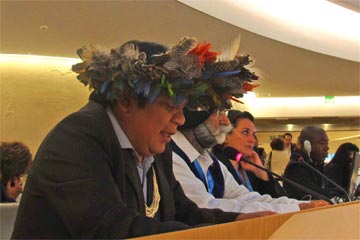
Referring to rainforest deforestation by loggers, cattle ranchers and miners, among others - Almir Suruiu Narayamoga of the Surui tribe stated that Amazonian indigenous peoples and their traditional territories are living under constant threat. In his own words:

"Illegal deforestation - carried out by loggers, ranchers, miners and intruders on indigenous territories - destroys the forest trees, kills birds by destroying their nests, kills animals that live off the fruits that grow there, and threatens indigenous peoples that live in forests and depend on them.

My people, the Surui Paiter, are living proof of what I say. We have long suffered the wrongful acts of loggers that steal our forests and threaten to kill our leaders. These invaders on indigenous territories expelled our people from their land and put our lives in danger. Every Indian leader who faces this model - beneficial only to those who destroy nature - receives death threats, attacks, slurs and suffers all kinds of threats.

The territories and indigenous peoples of Brazil are threatened by large-scale development projects carried out under the PAC (Growth Acceleration Program, an initiative of the Brazilian government). Large hydro power plants like San Antonio and Jirau on the Madeira River in Rondônia state, and Belo Monte on the Xingu River in the state of Pará, are threatening the lives of indigenous peoples living in isolation on a voluntary basis.

The paving of BR-319 (Ed: an Amazonian road), even before starting, had already begun to attract to the region a large number of people who destroy the forest and have a marked impact on indigenous territories. Conflicts between indigenous and those invading their territories has resulted in deaths of indigenous and non-indigenous individuals.

Urgent steps must be taken to provide security and peace in Brazil. We can not remain silent to such destruction. We need the UN observe what is happening and help protect the lives of indigenous peoples in Brazil. I come here to seek their help to protect the Amazon and indigenous peoples, especially those who live isolated on a voluntary basis."

Amazon road protests forces Morales to step in

Tuesday 27 September 2011
Source: guardian.co.ukLink

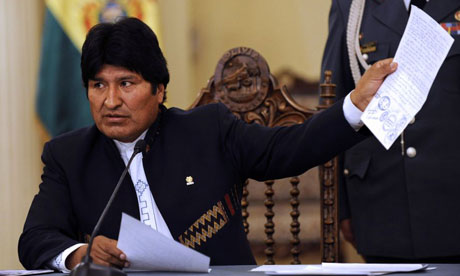
Evo Morales, the Bolivian president, announces the suspension of the contentious Amazon highway. Photograph: Jorge Bergal/AFP/Getty

The Bolivian president, Evo Morales, has halted work on a highway being built in the Amazon in the face of a month-long protest march and a police crackdown on demonstrators.

Morale said work on the 185-mile (300km) highway would not be resumed unless it was approved in a referendum in the two provinces it was to link.

"There needs to be national debate so the two provinces benefited or involved in this can decide. In the meantime the project is suspended," said Morales, criticising the violence used by police to disperse marchers over the weekend.

Police fired teargas and detained protesters when they raided an encampment in the Yucumo region 185 miles north of La Paz late on Sunday, local media said.

The raid was criticised by opposition leaders, the ombudsman and several government officials including the defence minister, Cecilia Chacon, who quit in protest. "This is not the way! We agreed to do things differently," Chacon wrote in her resignation letter, which was published by Bolivian media.

Morales denied giving police the order to break up the march, condemned the "violence, excesses and abuse" and promised an investigation.

Fierce opposition to the road proved especially uncomfortable for Morales because it was led by Indian communities who normally back his pro-indigenous reforms.

Bolivia's first president of indigenous descent, Morales has put the highway at the heart of his drive to boost infrastructure, but that has tested his commitment to conservation.

The dispute over the $420m project has exposed differences within his Movement Toward Socialism (MAS) party. Some MAS legislators expressed support for the demonstration and the demands of the 12,000 residents of the Isiboro Secure Indigenous Territory and National Park, which lies in the path of the planned highway.

Morales is highly popular among the Quechua and Aymara indigenous majority in the Andean highlands but opposition to his policies is strong in the eastern lowlands, even among indigenous groups.

Violent protests are common in Bolivia but tensions that toppled two previous governments have eased since Morales was elected in late 2005.

Repeated burning undercuts Amazon rainforest recovery

September 26, 2011
Source: mongabay.comLink

The Amazon rainforest can recover from logging, but has a far more difficult time returning after repeated burning, reports a new study in mongabay.com's open-access journal Tropical Conservation Science. In areas where the Amazon had been turned to pasture and was subject to repeated burning, Visima trees become the dominant tree inhibiting the return of a biodiverse forest. The key to the sudden domination of Visima trees, according to the study, is that these species re-sprout readily following fires; a capacity most other Amazonian trees lack.

"Throughout much of the Amazon Basin, abandoned pastures are often dominated by species of Vismia because it is the only tree genus capable of regenerating shoots from below ground tissues. Repeated burning of pastures kills other advance regeneration," the paper's authors write.

When left to regenerate, logged Amazon areas see the return of Cecropia trees, which is similar to what happens when the Amazon sees natural disturbance. However, repeated fires suppress Cecropia trees, and favor instead Visima trees: researchers found that 100 percent of Visima trees re-sprouted after fires. But, where Cecropia trees dominate, so does biodiversity: twice as many species were found in these regenerating forests than in the Visima dominated. Visima forests therefore become what researchers dubbed a 'wasteland', while Cercopia forests held the potential to return to biodiverse rainforest.

The scientists further found that seed dispersers did not play a significantly different role in Visima over Cercopia secondary forests, as both forests saw very few species brought in by dispersers.

"Seed dispersal of mature forest species into Vismia-dominated stands is close to nil, but this is no different from dispersal into Cecropia-dominated stands where succession is not arrested. Therefore, the arresting mechanism lies in the early years following abandonment when Vismia, surviving pasture burns, becomes dominant by default," the authors explains. Visima forests can arrest any forest recovery for decades.

Given this knowledge the authors recommend new policies to dissuade burning of the forests. Instead, a logged forest should be allowed to regenerate without additional burning to turn the area into pasture.

"As most of the forest value lies in the timber extracted, clearcuts should be abandoned without conversion to pasture," the authors write, adding that, "in order to avoid extensive forest conversion into unproductive Vismia wastelands in the Amazon Basin, forestry permits for harvesting timber should include restrictions on subsequent anthropogenic degradation, such as conversion to pasture and prescribed burning."

USAID Unveils Results of Amazon Conservation Program

September 23, 2011
Source: USAID

On September 27 the United States Agency for International Development (USAID) and the Smithsonian National Zoological Park, will host a photo exhibit and book launch in the Amazon Science Gallery of the National Zoo to celebrate achievements of the Initiative for Conservation in the Andean Amazon (ICAA).

ICAA, USAID's biodiversity conservation program in the headwaters of the largest river in the world, is working with national and municipal governments and local communities to implement conservation programs in Bolivia, Colombia, Ecuador, and Peru. This event marks the end of the first phase of ICAA (2006 - 2011) and the inauguration of ICAA II.

The book, entitled Andean Amazon: Peoples, Conservation and Development, spotlights the program's achievements and features spectacular pictures from the Amazon by renowned photographer Thomas Müller.

USAID's efforts have resulted in better protection and management of over 8 million hectares of Amazon rainforest, more environmentally-friendly livelihoods for indigenous and other local communities, and the training of over 55,000 people in conservation and resource management.

ICAA is a true community-driven partnership. USAID has successfully mobilized host country governments, universities, NGOs and other USG entities to work together to conserve this biologically and culturally rich landscape. And our partners have matched USAID's $35 million investment with $28 million in additional funding.

"USAID recognizes that our support alone can't preserve the biodiversity of the Andean Amazon. Nor should we be trying to tackle this problem on our own," said Mark Lopes, USAID's Deputy Assistant Administrator for Latin America and the Caribbean. "So we designed the ICAA project as a broad partnership through which the various players could align efforts and channel our combined resources, innovation and know-how toward conservation. And the response has been tremendous. Partnerships of this kind are the way of the future."

The second phase of the program (2011-2016) will support sound landscape planning, sustainable development, environmental governance, capacity-building, climate change mitigation, and ecosystem protection in the four countries.

Friday, September 23, 2011

Tribal leader to the UN: Indigenous peoples of the Amazon are in danger

September 22, 2011
Source: mongabay.com

Amazonian indigenous peoples and their traditional territories are living under constant threat.

Illegal deforestation — carried out by loggers, ranchers, miners and intruders on indigenous territories — destroys the forest trees, kills birds by destroying their nests, kills animals that live off the fruits that grow there, and threatens indigenous peoples that live in forests and depend on them.

My people, the Surui Paiter, are living proof of what I say. We have long suffered the wrongful acts of loggers that steal our forests and threaten to kill our leaders.

These invaders on indigenous territories expelled our people from their land and put our lives in danger.

Every Indian leader who faces this model — beneficial only to those who destroy nature — receives death threats, attacks, slurs and suffers all kinds of threats.

The territories and indigenous peoples of Brazil are threatened by large-scale development projects carried out under the PAC (Growth Acceleration Program, an initiative of the Brazilian government). Large hydropower plants like San Antonio and Jirau on the Madeira River in Rondônia state, and Belo Monte on the Xingu River in the state of Pará, are threatening the lives of indigenous peoples living in isolation on a voluntary basis.

The paving of BR-319, even before starting, had already begun to attract to the region a large number of people who destroy the forest and have a marked impact on indigenous territories. Conflicts between indigenous and those invading their territories has resulted in deaths of indigenous and non-indigenous individuals.

Urgent steps must be taken to provide security and peace in Brazil.

We can not remain silent to such destruction. We need the UN observe what is happening and help protect the lives of indigenous peoples in Brazil.

I come here to seek their help to protect the Amazon and indigenous peoples, especially those who live isolated on a voluntary basis.

More Trouble For Chevron: Company Loses Latest Stage of Amazon Pollution Battle

September 22, 2011
Source: AlterNet

A US court has dealt oil giant Chevron a severe blow after lifting a ban on an $18bn judgment against the firm for contaminating the Amazon.

A New York appeals court has reversed an earlier order freezing enforcement of the record damages award. It is the latest reversal in a nearly two decade-long legal battle over pollution in the Amazon rainforest in Ecuador.

In February, a judge in Ecuador ordered Chevron to pay damages to the plaintiffs, but both Chevron and the residents appealed, and the case has yet to make its way to Ecuador's highest court.

In anticipation of the judgment, however, Chevron had filed court papers asking district judge Lewis Kaplan to freeze any possible enforcement of payment anywhere outside Ecuador. Kaplan, who presides over a chunk of the litigation in Manhattan federal court, issued the now-reversed preliminary injunction in March.

Karen Hinton, spokeswoman for the plaintiffs, said the appeals court order meant it had recognised that Kaplan had acted too fast in issuing an injunction. "Chevron abused the law, and Judge Kaplan rushed to judgment without considering the overwhelming evidence against the oil giant," she said in a statement.

"We can now at least dream there will be justice and compensation for the damage, the environmental crime, committed by Chevron in Ecuador," lead lawyer for the plaintiffs, Pablo Fajardo, told the Associated Press.

In a statement, the company said: "Chevron remains confident that once the full facts are examined, the fraudulent judgment will be found unenforceable and those who procured it will be required to answer for their misconduct."

The Ecuadorian rainforest residents say oil giant Texaco, which was bought by Chevron in 2001, is responsible for hazardous waste dumped on indigenous land in the 1970s and 80s.

Chevron says Texaco cleaned up all waste pits for which it was responsible before turning the sites over to state-owned oil company Petroecuador, which still operates in the area.

An international arbitration tribunal also last month found that Ecuador must pay $96m to Chevron because Ecuador's courts had violated international law through their delays in resolving commercial disputes involving Texaco.

Appeals court judges Gerald Lynch, Rosemary Pooler and Richard Wesley also granted the plaintiffs' request to stop a November bench trial before Judge Kaplan, who was to determine whether to extend his injunction.

Chevron has accused the Ecuadorians and their longtime legal adviser, Steven Donziger, of illegally pressuring the Ecuadorian legal system to render a judgment in their favour.

The oil company has pilloried Donziger for his comments on corruption in Ecuador's judicial system, and his purported efforts to intimidate officials. The remarks came to light in an acclaimed documentary, Crude, and its outtakes, which were subpoenaed in US litigation.

The appeals court order came after the judges heard oral arguments on Friday. The judges said they would issue a full opinion at a later date

Brazilian President to Open UN General Assembly Speeches

September 19, 2011
Source: Indian Country TodayLink


The president of Brazil will be the first woman ever to open the United Nations General Assembly debate among world leaders on Wednesday, September 21, at the world organization’s 66th session, Merco Press reported.

President Dilma Rousseff was the first woman elected as leader of South America’s largest country — and largest economy — last October, succeeding reformist President Lula da Silva.
“On the 21st, the President becomes the first woman since the foundation of the United Nations to address, with her speech, the opening of the General Assembly,” the Brazilian Foreign Affairs ministry said in the report.

Roussef began her almost week-long U.N. activities on Monday at a special summit on chronic diseases chaired by the former Chilean President Michelle Bachelet, the report said. Bachelet is currently the first Under-Secretary-General and Executive Director of UN Women, which was established on 2 July 2010 by the United Nations General Assembly to work on gender equality and the empowerment of women at global, regional and country levels. More than 30 heads of state and government and at least 100 other senior ministers and experts were scheduled to attend the two-day high-level General Assembly meeting for a discussion of a draft declaration calling for a multi-pronged campaign by governments, industry and civil society to set up plans by 2012 to curb risk factors behind the four groups of non-communicable diseases — cardiovascular diseases, cancers, chronic respiratory diseases and diabetes.

While efforts by Roussef and other world leaders to curb chronic non-communicable diseases progress, Brazil’s Belo Monte Dam Project – a massive hydroelectric project in the Amazon approved by Roussef’s administration in June — is drawing more concerns over potential adverse health effects, particularly on the indigenous peoples of the region, but also on the global climate. The dam will flood more than 120,000 acres of the Brazilian rainforest along the Xingu River, a tributary of the Amazon where members of the region’s 24 indigenous tribes live, destroying local settlements and displacing between 20,000 and 40,000 mostly indigenous people. The flooding will destroy a large swath of the Amazon rainforest. Rainforests are called “the lungs of the earth” for their ability to store carbon and battle climate change.

In a September 19 article on the Huffington Post, Philip M. Fearnside, a researcher with the National Institute for Amazon Research in Manaus, Brazil, indicated that the hydroelectric dam, which will be the world’s third largest, may release into the atmosphere significant quantities of methane, a greenhouse gas more potent than CO2. The dam will create a massive reservoir with rotting plant matter along its bottom that will release the greenhouse gas, creating a “methane factory,” Fearnside explained to Deutsche Welle.

Last month, thousands of people demonstrated in 17 countries around the world, following protests in 15 Brazilian cities, to urge Roussef’s administration “to end its assault on the forests and the people of the Amazon,” according to Amazon Watch. The demonstrators called on the government to immediately halt the Belo Monte Dam, a $17 billion project that will divert nearly the entire flow of the Xingu River along a 62-mile stretch.

“These protests solidify our calls to revoke the approval of the Belo Monte hydroelectric dam. Once it is revoked, it will be possible to carry out public consultations to insure the rights of communities who are directly threatened,” said organizer Marco Antonio Morgado of the Brazilian Forests Movement, according to the report. Critics of the dam urged Dilma to use the money to invest in truly renewable energy from wind and solar along with improving energy efficiency, the report said.

Like the protests and revolutions in North Africa and the Middle East, the Belo Monte Dam protests were organized through social media on the Internet. “This is a new chapter in the struggle to defend the Amazon, and everyday more people are getting involved,” said Christian Poirier, Brazil Program Coordinator at Amazon Watch. “The Dilma Rousseff government is at crossroads. The world is calling on her to demonstrate courage and leadership and take immediate actions to safeguard the Amazon for future generations.”

Meanwhile, at the UN Rousseff with have a private meeting with UN Secretary Ban Ki-Moon on Wednesday before opening the round of speeches at the 66th General Assembly, according to Merco Press. “The president is drafting a wide ranging and incisive speech in which she will defend social inclusion and human rights guarantees,” the independent news agency in Brazil said.

Thursday, September 22, 2011

Call to UK saves couple trapped in Amazon rainforest

Thursday 22 September 2011
Source: CBBC Newsround


Britons Bruce Scott and Lesley Norris have been rescued from the depths of the Amazon rainforest - thanks to coastguards in Cornwall.

The couple got into trouble when their motor-home got stuck in a ditch in Brazil in South America after the bridge they were driving across collapsed.

So they rang their family in Eastbourne, who rang Dover coastguards, who contacted Falmouth coastguards, who contacted the navy in Brazil!

The navy then sent a helicopter to rescue the pair, who where unharmed.

After the rescue mission, Mr Scottt said: "As we started to cross it [the bridge], it just crashed down into the ravine."

He added: "I would like to say to all of them [those involved in the rescue] 'Thank you so much for pulling out all the stops'."

Amazon pollution victims ask New York judge to award $8bn Chevron money

Friday 16 September 2011
Source: guardian.co.uk

Victims of what they say is one the world's worst environmental disasters will on Friday ask a New York court to free up billions of dollars in compensation awarded to them in a record ruling earlier this year – and oust the judge who blocked their claim.

The $8bn fine was imposed by an Ecuadorian court in February on oil giant Chevron, on behalf of 30,000 residents of the Amazon basin whose health and environment were allegedly damaged by chemical-laden waste water dumped by Texaco's operations from 1972 to 1990. Chevron bought Texaco in 2001.

Chevron has attacked the judgment as a "fraud." The company has claimed the entire case is an extortion scheme. In March, Chevron secured an injunction from judge Lewis Kaplan against the decision, ahead of a trial set for November.

Chevron spokesman Kent Robertson said the Ecuadorians were guilty of "shocking levels of misconduct." He said: "The fraud that has been uncovered is undeniable."

Humberto Piaguaje, one of the plaintiffs, and a leader of the indigenous Secoya people of Ecuador's northern Amazon rainforest, said: "Chevron is the one that's the criminal here. They came to our lands, they destroyed our lives, our culture and left us in poverty."

He has travelled to New York for the hearing.

The two sides are set to go to court on 15 November, when Chevron will ask a court to reject the ruling from Ecuador. Craig Smyser, the attorney representing the Ecuadorians, said he hoped to have Chevron's case thrown out and to have Kaplan removed from the case if the court decides it should proceed.

"He [Kaplan] has taken a position that indicates bias against my client," said Smyser.

"He has already made up his mind about this case. He has indicated that he thinks this is a game, and that the whole idea of Ecuadorian pollution and contamination is a construct of lawyers'."

Symser said he feared his clients would receive a "show trial" if Kaplan is allowed to hear the case.

Smyser and Chevron's lawyers will appear in court on Friday morning to make their case to the second circuit court of New York. The court's opinion is expected sometime next month.

A spokesman for Kaplan said the judge would not comment on the action.

The legal hearing is the latest twist in the 18-year fight between Chevron and a group of Ecuadorian residents who claim massive pollution has destroyed their lives and their culture in what has been described as the 'Amazon Chernobyl'.

The plaintiffs claim Chevron's operations discharged billions of gallons of toxic waste into Amazon lands, affecting over 1,500 square miles of the Amazon, causing cancer rates to soar, destroying locals' livelihoods and habitats, and killing flora and fauna.

More than 30bn gallons of toxic wastes and crude oil have allegedly been discharged into the land and waterways of Ecuador's Amazon basin, or oriente, according to a report by Sweden's Umeå International School of Public Health.

BP's Deepwater Horizon disaster, by comparison, pumped 205m gallons of oil into the Gulf of Mexico, and 10.8m gallons were spilled in the Exxon Valdez disaster in 1989 in Alaska.

Servio Curipoma, another plaintiff in New York for the hearing, said he had lost both his parents to cancer that doctors had linked to the contamination of local drinking water. "Life for myself and all of us in Ecuadorian Amazon has been very hard," he said.

"All of us who live there live in the midst of the crude oil that Chevron left. Chevron hasn't done anything to deal with the oil."

The Dangerously High Cost Of Amazon Beef

September 21, 2011
Source: Eurasia Review

A delicious 500-gram Amazonian beef steak produced with 7,000 grams of carbon dioxide and 7,000 liters of water, mixed with belched methane, is the ideal recipe for climate change.

By João Meirelles and María José Barney González

The livestock industry, and especially cattle production, is one of the world’s most significant contributors to climate change.

Increased buying capacity is leading many who have historically eaten mainly grains, fruits and vegetables to increasingly add meat and dairy products to their diets. This trend, combined with unsustainable production practices, particularly in the Brazilian Amazon, can lead to the collapse of the Amazon rainforest biome and the environmental services it provides to the planet.

According to a report published by FAO, The State of Food and Agriculture 2009, livestock production is responsible for 18 percent of global greenhouse gas (GHG) emissions and increased deforestation in numerous countries, while contributing less than two percent of global gross domestic product (GDP).

This limited contribution to GDP, however, takes up 26 percent of the earth’s ice-free land surface for grazing, and 33 percent of agricultural cropland for the production of livestock feed.

There is pressure to double beef production from 228 million tons annually today to 463 million tons by 2050, which will mean an increase of more than 73 percent in cattle herds.

Since the 1970s, the Brazilian government has implemented policies and provided subsidies to support cattle ranching. As part of these policies, the Brazilian Development Bank (BNDES) has invested more than 10 billion dollars in the beef processing industry, with approximately 30 percent spent on loans and 60 percent on acquisitions (by companies like JBS/Friboi and Marfrig), while the other 10 percent is kept for future acquisitions.

The traditional slash-and-burn practices used in the Amazon to steal land from the rainforest for use as grazing land means its rich biodiversity is lost as a service to the planet.

These practices also release massive amounts of carbon dioxide, a greenhouse gas, into the atmosphere. Amazon deforestation is estimated to represent five to six percent of the world’s GHG emissions, and contributes 75 percent of Brazil’s sizable carbon dioxide emissions.

By 2009, approximately 74 million hectares or 15 percent of the Brazilian Amazon rainforest – an area equivalent to Germany, Austria and Italy combined – had been deforested. Almost all of this land is now used for cattle pasture.

Beef is considered an expensive food in most of the world. But the price of a beef steak fails to incorporate the real cost of its production footprint: the production of one kilogram of beef leads to the emission of 15 kilograms of carbon dioxide and uses up 14,000 liters of water.

This means that the relatively “cheap” beef arriving on your plate from the Brazilian Amazon is actually extraordinarily costly in terms of its environmental and economic footprint.

Beef production in the Amazon also has serious social impacts. It generates little employment, most of it poorly paid, and on some Brazilian cattle ranches, slavery and child labor are still common practices.

The expansion of cattle production into the Amazon rainforest region over the last 50 years has been greater than at any other time in history.

If we project the growth of the Brazilian cattle herd for the next 20 years based on the 1.7 percent growth registered from 1994 to 2007, the result is 103.7 million head of cattle in the Amazon by 2030, which could lead to the deforestation of 55 percent of region.

All of these factors stand in contradiction to Brazil’s commitment to cut GHG emissions. The key challenge facing the country’s leaders is to respond to the livestock demands of the market in ways that do not endanger social equity, the environment and public health.

Urgent action is needed to transform the cattle and beef production value chain. We must campaign for change by demanding:

  • National and international policies and regulations aimed at socioeconomically and environmentally sustainable cattle and beef production.
  • Control and enforcement of legal standards for all activities in the cattle-beef production chain in Brazil, with an emphasis on the Amazon region.
  • Monitoring systems to ensure the implementation of policies and regulations and the enforcement of laws.
  • Sustainable and inclusive policies geared to the needs of traditional rural communities, peasant farmers and small-scale producers, to increase their capacity to implement more efficient and sustainable production practices, as well as promoting their active participation in the cattle-beef production value chain and access to technical and financial services.
  • Greater awareness among consumers worldwide of the real cost of beef.
  • The development of environmental awareness and promotion of environmentally friendly production practices among traditional rural communities, by involving them in a process of monitoring the impact of cattle production on their livelihoods and diversifying strategies for the valuation of the rainforest, such as the provision of environmental services and sale of other products that contribute to maintaining biodiversity.
  • Research activity in which studies of the cattle-beef production value chain include the environmental and economic impact of this activity on economically and socially excluded communities.
  • Strategies for better production practices that promote more sustainable production technologies, making more efficient use of resources.

Wednesday, September 21, 2011

Meandering river in the Amazon

Sept 18, 2011
Source: mongabay.com

Meandering river in the Amazon. Photo by Rhett A. Butler.

Rivers in lowland Amazonia tend to meander due to the flatness of the basin. For example, the Amazon itself falls only 345 feet (105 m) from the Peruvian river port of Iquitos, a full 2,300 miles from the ocean. Thus the river descends at a rate of only 1.8 inches per mile (2.8 cm/km).

The lazy nature of rivers tends to produce oxbow lakes. An oxbow lake is a crescent-shaped lake formed when a river changes course. In lowland rainforests like the parts of the Amazon where soft alluvial soils dominate, meandering rivers gradually shift due to erosion and sediment deposition. Oxbow lakes typically form when loops in the river become so extreme that the main channel erodes a new straighter route, leaving the river bend apart from the river. As time passes, the oxbow lake becomes increasingly distant from the main channel.

Chevron loses latest stage of Amazon pollution battle

Tuesday 20 September 2011
Source: guardian.co.uk

The plaintiffs say Texaco, which was bought by Chevron in 2001, is responsible for hazardous waste dumped in the Amazon in the 1970s and 80s. Photograph: Guillermo Granja/Reuters

A US court has dealt oil giant Chevron a severe blow after lifting a ban on an $18bn judgment against the firm for contaminating the Amazon.

A New York appeals court has reversed an earlier order freezing enforcement of the record damages award. It is the latest reversal in a nearly two decade-long legal battle over pollution in the Amazon rainforest in Ecuador.

In February, a judge in Ecuador ordered Chevron to pay damages to the plaintiffs, but both Chevron and the residents appealed, and the case has yet to make its way to Ecuador's highest court.

In anticipation of the judgment, however, Chevron had filed court papers asking district judge Lewis Kaplan to freeze any possible enforcement of payment anywhere outside Ecuador. Kaplan, who presides over a chunk of the litigation in Manhattan federal court, issued the now-reversed preliminary injunction in March.

Karen Hinton, spokeswoman for the plaintiffs, said the appeals court order meant it had recognised that Kaplan had acted too fast in issuing an injunction. "Chevron abused the law, and Judge Kaplan rushed to judgment without considering the overwhelming evidence against the oil giant," she said in a statement.

"We can now at least dream there will be justice and compensation for the damage, the environmental crime, committed by Chevron in Ecuador," lead lawyer for the plaintiffs, Pablo Fajardo, told the Associated Press.

In a statement, the company said: "Chevron remains confident that once the full facts are examined, the fraudulent judgment will be found unenforceable and those who procured it will be required to answer for their misconduct."

The Ecuadorian rainforest residents say oil giant Texaco, which was bought by Chevron in 2001, is responsible for hazardous waste dumped on indigenous land in the 1970s and 80s.

Chevron says Texaco cleaned up all waste pits for which it was responsible before turning the sites over to state-owned oil company Petroecuador, which still operates in the area.

An international arbitration tribunal also last month found that Ecuador must pay $96m to Chevron because Ecuador's courts had violated international law through their delays in resolving commercial disputes involving Texaco.

Appeals court judges Gerald Lynch, Rosemary Pooler and Richard Wesley also granted the plaintiffs' request to stop a November bench trial before Judge Kaplan, who was to determine whether to extend his injunction.

Chevron has accused the Ecuadorians and their longtime legal adviser, Steven Donziger, of illegally pressuring the Ecuadorian legal system to render a judgment in their favour.

The oil company has pilloried Donziger for his comments on corruption in Ecuador's judicial system, and his purported efforts to intimidate officials. The remarks came to light in an acclaimed documentary, Crude, and its outtakes, which were subpoenaed in US litigation.

The appeals court order came after the judges heard oral arguments on Friday. The judges said they would issue a full opinion at a later date.

Deforestation said to affect rainfall

Sept 20, 2011
Source: UPI

Deforestation in West Africa, as land use changes from forest to cropland, reduces rainfall over the rest of the forest, British researchers say.

Scientists at the University of Leeds say the agricultural deforestation reduces rainfall over neighboring forest areas by about 50 percent because of changes in the surface temperature, which affects formation of rain clouds.

"We already know from satellite observations that changes in land use can have a big impact on local weather patterns," Leeds researcher Luis Garcia-Carreras said in a university release Tuesday. "Here we have been able to show why this happens."

The forests of West Africa and the Congo Basin are the second-largest in the world after the Amazon rainforest, and have suffered extensive deforestation for agriculture, plantations and other non-forest uses.

In addition to the immediate impact on the forest caused by removal of trees, the study suggests reduced rainfall may have a subsequent serious impact.

"African rainforests already have the lowest rainfall of any rainforest ecosystem on Earth, which could make them particularly sensitive to changes in local weather patterns," Garcia-Carreras said. "Therefore if rainfall is reduced even further as a result of deforestation, it could threaten the survival of the remaining forest by increasing the trees' sensitivity to drought."

Deni celebrate their forest homeland in the Brazilian Amazon

September 18, 2011
Source: Greenpeace International

Greenpeace volunteers helped the Deni, a people indigenous to the Brazilian Amazon, demarcate their homeland: 1,6 million acres of fantastic forest. Image: Greenpeace

September 11, 2001 was not only a day of major tragedy in the US, which changed the world we are living in, it was also a day of hope for the Deni. The Deni are an indigenous group living in semi-isolation in a very remote part of the Brazilian Amazon rainforest, whose land at that time was sold illegally to a logging company without their knowledge.

After waiting for more than 10 years for the Brazilian government to recognize their traditional territory, the Deni asked for help from Greenpeace. That day at 10am in the morning, the Greenpeace ship Arctic Sunrise was in Manaus, the capital of Amazonas state. Reporters were on board the ship for a press conference to announce the Greenpeace plans to help the Deni people to demarcate the 1,6 million hectares of rainforest claimed by them as their homeland. Unfortunately, we had unwittingly chosen the worst media day in the world, September 11 2001, to help the voices of the Deni people be heard by the world.

Despite the difficult start, our support for the Deni continued and we sent a team to live with them and provide training in the use of GPS and other instruments for demarcation. This team included 13 volunteers from all over the world, who faced threats of prison for supporting a remote indigenous peoples in protecting themselves from a multinational logging giant.

Greenpeace campaigners and local people prepare for the demarcation process in early 2001. Image: Flavio Cannalonga

Eventually the Brazilian Minister of Justice offered a deal: if Greenpeace volunteers would leave Deni land he would sign a decree recognizing the Deni land rights. We happily complied with this request and moved our boat from one side of the river, that marked the geographic limit of the Deni land, to the other – a move of about 100 meters. After this was done, the minister signed the decree, thereby accepting all the hard work done by the Deni up to that moment.

A company hired by the Brazilian government completed the demarcation and on the 1st of November 2004 Brazilian President Lula signed the official recognition of the Deni land – a fantastic forested area of 1,6 million hectares.

On September 11, 2011, ten years later, our Deni friends held a ceremony on the Xeruan river to launch what they called the Ibure'i hanahanu Ikanade shunu Deni Ihadekha - or the Territorial Management Plan of the Deni Indigenous Land. A fantastic plan led by a proud and strong people.

A few days later I received a beautiful book written in Deni language full of pictures of Deni people, their schools, their smiling kids, their canoes full of fishes, and their plans for a bright future. Together with the book there was a very warm thank you letter written on behalf of the Deni chiefs by the leader of Opan, an NGO working with the Deni.

Inside the Deni book Greenpeace is quoted as being an important support for the community.

The Deni fought hard for many years to protect their homeland. But their amazing efforts are at risk if the current project to change the Brazilian Forest Code is approved, stimulating farmers and land grabbers to invade the areas surrounding their homeland. There are many examples of this concrete risk right now in various indigenous lands in Brazil. For instance, the Parque do Xingu indigenous land in Mato Grosso state is surrounded by soya and cattle farms that contaminate the rivers that run through the indigenous reserve with pesticides and herbicides, while illegal loggers, hunters and fishermen frequently invade the reserve itself.

This week we celebrated the triumph of the Deni people in preserving their homeland, while at the same time watched closely as these threatening changes to the Forest Code continue to be discussed in the Brazilian capital. A final decision has yet to be made, but the risk to millions of hectares of the Amazon rainforest is very real and we are demanding immediate action from Brazilian President Dilma Roussef to protect the rainforest and its amazing biodiversity. During her election campaign she promised not to accept legislation that would increase deforestation or that granted amnesty to those who illegally deforest – the proposed changes to the Forest Code would do exactly these two things. Recent polls indicate that the Brazilian people do not support these changes.

Over the past few years deforestation in Brazil had been steadily decreasing, now there has been a sudden surge in forest loss that has been linked to speculation around these proposed changes to the laws protecting the rainforest. President Dilma must step in and ensure that Brazil is a global leader on action against deforestation – it’s time for action in the face of this looming tragedy.

Tuesday, September 20, 2011

Brazilian police arrest suspects in Amazon murders of environmentalists

Monday 19 September 2011
Source: guardian.co.uk

José Rodrigues Moreira and his brother Lindon Johnson Silva Rocha are suspected in the murder of two environmental activists. Photograph: Paulo Santos/Reuters

Police in the Brazilian Amazon say they have arrested two men in connection with the murders of two rainforest activists who were gunned down in May.

José Cláudio Ribeiro da Silva and his wife, Maria do Espírito Santo, were killed on 24 May, six months after Ribeiro da Silva had predicted during an international environmental conference that he could be killed at any time.

The activists were known for their vocal stance against illegal loggers, cattle ranchers and charcoal producers operating in Praia-Alta Piranheira, a remote Amazon settlement in Brazil's Para state, where they lived.

On Sunday, nearly four months after the killings, police said they had arrested two of their three prime suspects during a dawn raid on a jungle camp around 32 miles from the Amazon town of Novo Repartimento. Police said they had seized three revolvers and one shotgun during the raid.

"The family's reaction is happiness, happiness, happiness," Ribeiro da Silva's sister Claudelice Silva dos Santos told the Guardian on Monday, as the two suspects were reportedly transferred by helicopter to a prison in Belem, the state capital. "We have been waiting for this news for nearly four months."

Police named the prisoners as José Rodrigues Moreira, who is accused of ordering the killings, and his brother Lindon Johnson Silva Rocha, who allegedly carried out the executions.

"Hidden in a tent in the middle of the forest, the two brothers were armed and even tried to escape as they were being surrounded by police," security authorities said in a statement.

Alberto Lopes do Nascimento, the third man wanted for the assassinations, had not been arrested, family members said.

Ribeiro da Silva and Do Espírito Santo were often threatened with death threats because of their fight to protect the environment, and last November the former told a TEDx conference in Manaus that he expected to be killed. "I will protect the forest at all costs. That is why I could get a bullet in my head at any moment," he said.

Their murders, six months after Ribeiro da Silva's speech, triggered widespread outrage in Brazil and made headlines around the world. The country's president, Dilma Rousseff, ordered a police investigation into the killings and hundreds of paramilitary troops were deployed in the region.

Silva dos Santos, Ribeiro da Silva's youngest sister, described the arrests as the "second step" towards justice. "Now we want convictions," she said.

She said she hoped police investigations would continue, to establish whether the murders were part of a wider conspiracy. "We believe there are more people involved [in the murders]," she said.

On the Wild Side

16 September 2011LinkSource: The Sag Harbor Express


Celine Cousteau created CauseCentric Productions with the goal of promoting the good works of non-profit organizations from around the globe. It is a non-profit film company that creates short documentaries of other non-profits, several of which will be seen at the Hamptons Conservation & Wildlife Film Festival later this month. Cousteau said that the goal of these short films is to help spread the message of solving ecological and societal problems.

“We are visual creatures,” said Cousteau on why film was the best medium to communicate this message. “So I found that I could tell the people through the visual arts about these groups….and that can influence people.”

Since Cousteau started CauseCentric Productions she has already created three films, each of the documentaries has Cousteau following around a non-profit organization, documenting the good works they do in different parts of the world. All three of the films will be shown at the upcoming Hamptons Conservation & Wildlife Film Festival at the Bay Street Theatre, September 23-25.

All of the films that are being presented in the upcoming film festival, well over 50, also highlight global environmental problems and the people trying to solve them. The festival was created last year to highlight environmental issues around the world through short and feature length documentary films.

Cousteau will be personally presenting one of her three CauseCentric films, “Amazon Promise,” at the festival’s fundraising gala on Saturday, September 24.

The film follows around Patty Webster the founder and president of Amazon Promise, a non-profit dedicated to bringing doctors and medical treatment to the remote regions of the Amazon rainforest. Webster used to be an adventure tourism guide in the rainforest, but after witnessing the haphazard and in some cases non-existent state of healthcare in the region; she decided she wanted to do more.

The documentary, filmed in 2008 in the Amazon region of Peru, shows Webster and the Amazon Promise medical team working in remote Peruvian villages, providing basic medical treatment for people in desperate need. The doctors in the film donated their money and time to help provide this medical care. For Cousteau’s part, after she completed the short film, she gave the video to Amazon Promise to use as a fundraising tool for the organization.

“[The film] gives them a tool to communicate, that’s something that a lot of non-profits don’t have the ability to do…I realized that with the ability to do these short films, that I am able to lend a hand to these non-profit organizations.”

After the film, Cousteau will be part of a panel discussion with other film directors and also hold an informal Q&A about the film and her personal experiences following around the doctors in Amazon Promise.

“It is a motivation tool,” she said. “I realized that with the ability to do these short films…that I am able to lend a hand to these non-profit organizations.”

Cousteau’s other two short films scheduled the film festival similarly focus on the charitable works of non-profit organizations. “Green Chimneys” explores the work of Dr. Samuel B. Ross, founder and executive director of Green Chimney, a school in Brewster, New York that deals with behavioral, social and mental disorders through the use of animal assistance therapy.

“Essentially the animals are brought in because they are rescue animals or horses that can’t be ridden any more…and the animals and the people, they heal together,” said Cousteau.

The third film has Cousteau following around Pete Luswata, the founder of the Uganda Rural Community Support Foundation (URCSF). Cousteau traveled to the AIDS-stricken Rakai District in Southern Uganda in 2009, where she documented Luswata and the URCSF training the Ugandans in basic agricultural processes.

A fourth film about the use of medicinal herbs in the tribal regions of Papua New Guinea has already been filmed and is currently in post-production.

“All of these films are stories about heroes,” said Cousteau.

She said that she likes to focus on the people in this world who are making a difference in their communities because they can act as inspiration to other people. Cousteau said the goal of all of her films is to get people involved with the various non-profits.

“Hopefully they will inspire and motivate the audience to do more,” she said. “I would like [the audience] to get a more broad understanding of all of the incredible people who are looking for solutions in our environment and our culture.”

Tickets for a two-hour film session at the festival are $15 for adults and $12 for students and seniors. Tickets for Saturday’s gala are $95, while a full film festival pass are $250. More information and advanced tickets can be purchased through the Bay Street Box office at 725-9500 or by calling 610-896-4776.

African Refugees in the Amazon

Sept 15, 2011
Source: Inter Press Service

Wilson Nicolas, from the Democratic Republic of Congo (DRC), was the first African refugee to find his way to Brazil's Amazon jungle region, and seems to have started a trend.

The 56-year-old Nicolas (not his real name) escaped from the province of Équateur in the northwest of the DRC, in central Africa, fleeing clashes between rival ethnic groups over fishing rights.

According to United Nations figures, since 2010 some 30 refugees from Africa who have requested asylum from the Brazilian government are living in Amazon jungle states. The asylum-seekers are from Cote d'Ivoire, Ghana, Guinea Bissau, Nigeria and Sierra Leone in West Africa, Kenya in East Africa, Zimbabwe in Southern Africa, and the DRC.

Nicolas came to São Paulo in late 2009, following a contact who had offered him a job when he escaped from the DRC. From there he continued on to Boa Vista, capital of the state of Roraima in the extreme north, where he found himself on his own, and discovered that it had been an empty promise.

With assistance he made it to Manaus, capital of the northern state of Amazonas and the largest city in the Amazon, and with the help of the Pastoral do Migrante, a Catholic organisation that serves migrants and refugees, he filed an application for asylum with the Federal Police and the Brazilian National Committee for Refugees (CONARE).

His request was accepted in February and he became the first African refugee living in Brazil's rainforest.

"We are now seeing a new kind of refugee in the Amazon," Luiz Fernando Godinho, spokesman for the local office of the United Nations Refugee Agency (UNHCR), told IPS. "This region, which generally receives more people from South America, like Colombians and Bolivians, has started to see an influx from Africa.

"It is a small and unobtrusive change, but we started noticing it two years ago," he added.

Over the telephone, Nicolas told IPS in short, clipped sentences that he left the DRC "because of the war. Even after the (2003) peace agreement, there were areas in conflict. In the place where I was, there was a fight between two rival tribes who lived in the area."

In 2009, Nicolas had been sent as a geological specialist by the government to the northern city of Dongo, near the Ubangi border river in the province of Équateur, to organise the distribution of land and food.

"When we got there, we tried to bring about reconciliation among the tribes, but a war over land distribution broke out," he said. The conflict quickly escalated, involving heavily armed groups, and Nicolas was accused of being a government spy.

The violence between the Boba and Lobala clans spread throughout Équateur, and more than 100,000 people fled to neighbouring countries, according to the International Committee of the Red Cross.

"We escaped to the jungle," he said. "I walked for days and weeks, my feet were all swollen. There were so many people fleeing, children and mothers with babies."

That particular conflict was just one of a string of wars in the DRC, where four to five million people have been killed since the mid-1990s.

The wars in several countries in the Great Lakes region of Africa have taken the form of ethnic clashes and genocide, but have roots in the multiple international interests vying for strategic control over huge mineral deposits.

While he was hiding in the forest near the border with the Congo Republic, Nicolas lost the notion of time. And he has not seen his family again – his wife, children and siblings – although he receives small amounts of money from them, to help him survive.

Nicolas speaks several languages: Lingala – a Bantu language spoken in northwestern DRC – French, Swahili, English and Portuguese. But the word "saudade" (longing or nostalgia in Portuguese) takes on new meaning for him when he talks about how much he misses his loved ones.

"I have suffered so much from being separated from my family," he says. But he has no means of travelling, and nothing to offer them in Manaus.

He lives on borrowed money and on what he manages to earn teaching French. And he takes advantage of any temporary work he can find. But since he does not have his diplomas, to validate his university studies in Brazil, he cannot find work in his area of expertise: geoinformatics and remote detection.

"I hope to find a job and gain stability in my life," he says.

Brazil's Amazon jungle region is now home to 140 refugees, mainly from Bolivia, and another 700 asylum-seekers of different nationalities who are waiting for a response from the government on their applications. The process takes up to six months.

This country of 192 million people has no quotas for refugees, of which it receives relatively few. According to the country's law on refugees, passed in 1997, entering the country with false documents does not disqualify a foreign national from applying for asylum.

Most of the roughly 4,500 refugees in Brazil are in the southeast, in Rio de Janeiro and São Paulo – the main ports of entry – and in the state of Rio Grande do Sul and the interior of the state of São Paulo.

Sixty four percent of the total – 2,841 – are from Africa. The largest groups are from Angola (1,686), Colombia (634), DRC (462), Liberia (258) and Iraq (203), according to Conare, which is made up of representatives of several ministries, civil society organisations and the UNHCR as an observer.

Nicolas does not plan to go back. "My country has to be at peace and safe, in order for me to return. Today I am a refugee and I'm going to stay in Brazil. Life is always a battle, and you have to struggle hard to survive."