Tuesday, June 28, 2011

New uncontacted tribe discovered in Brazil needs to be protected from outsiders, scientists warn

June 27, 2011LinkSource: International Business Times


Officials from Brazil's Indian affairs agency, FUNAI, have confirmed the existence of more than two dozen 'uncontacted' tribes within previously unknown indigenous group in the rugged folds of the western Amazon.

Brazilian Authorities say the remote group likely numbers around 200 members, living in traditionally built huts, called malocas, surrounded by small farms of nuts, banana, and corn.

According to the National Indian Foundation, (FUNAI), a government organization aimed at preserving the rights of the indigenous, researchers first became aware of the possible existence of an uncontacted tribe after finding several small gaps in the forest while reviewing satellite imagery of the Javari Valley in the western Amazon, near Brazil's border with Peru.

In April, an overflight examination of the region confirmed the presence a settlement composed of three cleared agricultural areas and four malocas.

The expedition coordinator Fabricio Amorim says that confirming such discoveries requires years of careful research, following guidelines geared towards protecting uncontacted tribes.

From the flyover photographs, FUNAI has been able to make certain determinations about the mysterious and remote settlement.

"The crops as well as the malocas are new, dated within a year. The state of straw used in the construction, and size of the corn indicate [its age]. Besides corn, there was a banana and undergrowth that appeared to be peanuts, among other crops," says Amorim in a statement released by FUNAI.

However as Amorim explained, despite the settlement's geographic isolation, these indigenous peoples are not entirely protected from outside activities.

"The main threats to the integrity of these groups are illegal fishing, hunting, logging, mining, agro-pastoralists with large clearings, missionary activities and frontier situations, such as drug trafficking," says Amorim. "Another situation that requires care is the oil exploration in Peru, which could have an impact on Javari Valley."

Around 2,000 uncontacted Indians are said to be in the Javari valley and according to National Geographic the Javari Valley is a dense rain forest area, half the size of Florida.

However, most of the uncontacted Indian tribes fall victims to diseases communicated through contact with outsiders.

Survival International reported that hunter-gatherer nomadic groups known as "Maku" who dwell in headwaters of the northwest Amazon basin have been hit with a respiratory disease. Around 35 Nukak-Maku have been admitted to San José del Guaviare hospital in the southern Colombian Amazon. Most of the tribe members have been living in refugee camps outside San José since being ousted from their rainforest abode by guerrilla armies.

The tribe emerged from the forests in 1988 and since then half of the tribe members have lost their lives.

In order to protect and preserve the newly discovered tribe, FUNAI has thus insisted it does not plan on releasing the specifics as to its location in a region home to approximately 14 other uncontacted tribes accounted for so far.

If Brazil Has to Guard Its Rainforest, Why Does Canada/U.S. Get to Burn Its Tar Sands?

06/27/11
Source: Huffington Post

It was big news in Canada when, in 2008, the country slipped from the top-ten list of the world's most peaceful countries (all the way to eleventh). By this year, it was back in eighth, 74 places above the U.S. and, when liberals in the U.S. feel despairing, what dominates their fantasy life but "moving to Canada?"

And yet, today, you could make an argument that Canada has actually become one of the earth's more irresponsible nations -- namely, when it comes to the environment. Indeed, you could argue that the world would be better off if the government in Ottawa was replaced by, say, the one in Brasilia, which has made a far better show of attending to the planet's welfare. It's a tale of physics, chemistry, and most of all economics, and it all starts in the western province of Alberta.

The Province's Tar Sands cover an area larger than the United Kingdom and contain most of the world's supply of bitumen, a particularly sticky form of petroleum that must be heated or diluted before it can be pumped. Because it's so unwieldy, it's only been in recent years that large-scale development of the tar sands have taken place. The steep rise in global oil prices has set off a boom in the region, with all that naturally follows (prostitutes have reported incomes as high as $15,000 a week).

But this is a boom unlike others. It's the first huge oil play of the global-warming era, the first time we've dangerously stepped onto new turf, even though we understand the stakes.

NASA's James Hansen, the earth's premier climatologist, has laid out these stakes with some precision. His team found in 2008 that, if the atmospheric concentration of CO2 exceeds 350 parts per million, we won't be able to have a planet "similar to the one on which civilization exists and to which life on earth is adapted." We're at 390 parts per million right now, and, what do you know, the Arctic is melting rapidly, the atmosphere is getting steadily wetter, and the oceans are turning sharply more acid. Follow Hansen's math a little further: If we wean ourselves from fossil fuels by 2030, then the earth's CO2 levels will begin to fall, and, by century's end, we'll be back near 350. Damage will be done in the meantime, but perhaps survivable damage. And, conveniently, the world's supply of "conventional," easy-to-get-at oil is starting to dwindle: The deposits in places like Saudi Arabia, which were built long before anyone had heard of climate change, are nearing the autumn of their lives. We could, in other words, use this moment of declining oil supply as a spur to make the leap toward renewable energy -- a gut-wrenching leap, but one that, if we landed successfully, would put us in a new world.

But two things could prolong our addiction to the point where irrevocable damage is assured: coal and unconventional oil. If we keep burning these substances, then the atmospheric level of CO2 will continue to rise steadily. Which brings us back to Alberta, currently gearing up to develop more of that unconventional oil. The province's oil minister, Ron Liepert, recently told the Financial Times that Alberta was going "full speed ahead" in an effort to double production by the end of the century; indeed, he said, technological progress might allow the province to find new ways to extract oil from other formations, further increasing production and moving Canada into the top tier of the world's oil producers, alongside Saudi Arabia and Russia. Liepert said his government was "proceeding all out" to find new markets for the oil, and that he was hopeful not only of building a huge new pipeline to the U.S, but also of selling to China, which he said would "take every drop" of the tar sands oil.

The problem? If you could somehow burn all the oil in Alberta overnight (which, thank God, you can't) Hansen's team calculates it would raise the planet's concentration of CO2 by 200 parts per million -- that is, our current 390 parts per million would become almost 600 parts per million, a level not seen since the Miocene Era, about 25 million years ago. But, forgetting the overnight scenario, even just bringing the tar sands steadily online -- adding a big new stream of carbon to the atmosphere -- would make the already hugely difficult job of phasing out emissions essentially impossible. As Hansen wrote in early June in a letter to fellow scientists, "if the tar sands are thrown into the mix, it is essentially game over." The game, in this case, being the planet.

Several thousand miles away south of Alberta, in the Amazon rainforest, things are different. In some sense, the world "discovered" the Amazon as a precious planetary resource at roughly the same time Canada discovered the commercial potential of the tar sands. When the first Rio summit on the environment was held in 1992, the Amazon was one of the stars: It was, one speaker after another insisted, the "lungs of the planet." "Contrary to what Brazilians think, the Amazon is not their property, it belongs to all of us," a young Senator named Al Gore said in those years. That didn't sit easily with Brazil, which is, after all, a very poor country, with a per capita income of under $3,000; its leaders, one after another, have declared, as one would expect, that the Amazon is theirs.

They have also, however, done fairly remarkable things to keep the forest intact. Consider the State of Acre, a fairly good analogue with Alberta: It has set up a remarkable system of controls on forest clearing, using remote sensing satellites to track down violators. It provides subsidies and tax incentives for forest protection; it's joined together with California to provide carbon credits for those who leave trees alone. None of this was easy -- Acre was the state where rubber tapper Chico Mendes was murdered in the early days of the fight over the Amazon. But, after three decades of hard work, Acre -- in the words of Stephen Kretzmann from the Environmental Defense Fund -- is "a good example of what's most needed in the world: vision, pragmatism, and the conviction and persistence to make change even when it seems impossibly difficult and distant."

Brazil as a whole has made remarkable progress: Between 2006 and 2010, the country reduced Amazon deforestation by two-thirds from the previous decade, reducing about one billion tons of greenhouse gas pollution; the annual damage is measured in Rhode Islands now, not Germanys. It still has huge problems -- in fact, there seems to be a surge of deforestation underway this year, and big agricultural interests are currently pressing to weaken the nation's forestry's law. Much hangs in the balance. But President Dilma Roussef is pledging to reduce deforestation by another 80 percent, and to cut the country's greenhouse gas emissions by 40 percent. And Brazil's voters may give her reason to keep those promises: They gave nearly one-fifth of their votes in the last election to Green Party candidate Marina Silva, the former rubber tapper responsible for much of the pathbreaking work in Acre.

Shouldn't Canada feel the same kind of responsibility to keep carbon safely in the ground that Brazil feels to keep its trees rooted? Absolutely. And another important question: Would the world stand by, as it has more or less done as Canada has accessed its tar lands, if Brazil's president promised to find new markets so that "every splinter" of wood her country produced could be sold? It's hard to imagine so.

Exploiting the tar sands is a crime, pure and simple -- and, given the stakes, it is one of the most staggering the world has ever seen. Not surprisingly, given geography and history, Canada has an accomplice in this crime. Most of the petroleum it produces gets sold in the U.S., still the largest market for oil in the world. Early in the Obama administration, the president approved a pipeline to the Midwest that expanded this trade. This year, the U.S. stands poised to open a much larger spigot, the so-called Keystone XL pipeline, which will carry the heavy Canadian bitumen to Texas refineries.

How crucial is the new pipeline project to the tar sands' future? A couple of weeks ago Canadian oilmen gave the verdict to the Globe and Mail. "Unless we get increased [market] access, like with Keystone XL, we're going to be stuck," said Ralph Glass, an economist and vice-president at AJM Petroleum Consultants in Calgary. And here's the quotable Liepert once more: "If there was something that kept me up at night, it would be the fear that before too long we're going to be landlocked in bitumen," he said. "We're not going to be an energy superpower if we can't get the oil out of Alberta." That is to say, there's no use planning this particular bank robbery if there isn't someone to drive the getaway car.

On the face of it, one would suspect Obama to say "no" to a new pipeline for Canadian oil: He ran, of course, as a staunch foe of global warming and, on the eve of his nomination, promised that, in his administration, the "rise of the oceans would begin to slow and the planet begin to heal." And since even the backers of the Keystone pipeline acknowledge it wouldn't cut gas prices (and, indeed, would probably cause them to rise), there's scant political reason to open the gates. But, of course, there's an awful lot of money to be made, and that money exerts incredible political pressure: Transcanada Pipeline, for instance, the main builder of the project, has hired Hillary Clinton's former deputy campaign director as its chief lobbyist, and the secretary of state has said she's "inclined" to approve the project.

Like any other vast expenditure of money, the Keystone pipeline would create jobs (though, by undercutting the emerging renewables industry, it would cost them, too), and it would make us less dependent on foreign oil, if you don't count Canada as foreign. None of that, however, gets around the essential point: to prevent the planet from overheating, you need to keep carbon in the ground. (You also need to keep coal in the ground; Obama offered a dreadful premonition of this decision earlier this year, when he opened federal land in Wyoming to coal-mining -- there's less carbon in the Powder River Basin than in the tar sands, but that one sale was the equivalent of opening 300 new coal-fired power plants).

Which brings us back to the Amazon, and the double standard we are seeing when it comes to environmental politics. Let's say that President Obama was being asked to sign a certificate allowing a pipeline to carry an endless stream of logs from the Amazon. That, too, would create jobs -- but he wouldn't do it. He wouldn't do it because the world understands how crucial the rainforest is to its future, and because we seem to demand more from Brazil than from Canada (or the U.S., for that matter). Someday, perhaps the world will similarly stop thinking about the oil sands as a source of power and money and instead come to terms with its well-defined dangers. The question is whether we'll reach that conclusion before we pour the carbon into the air, or after.

Last remaining Amazon tribes nearing extinction in Brazilian rainforest

June 26, 2011
Source: International Business Times


With the recent discovery of an uncontacted Amazon tribe in Brazil, our attention goes to the tribal people and Brazilian Amazon rainforest.

The Amazon rainforest was home to approximately six million tribal people before 1500 A.D. During the 20th Century, over 90 tribes are reportedly to have gone extinct from the Amazon.

As the forests are rich in natural resources and can accumulate huge sums of money, much of rain forests have been exploited and thus placed rainforest tribes in danger of further extinction. Increasing global warming also accelerates destruction of the rainforest.

The organization called Survival International has been dedicated to preserving the habitat for current existing tribes. Currently 150 million tribal people live in more than 60 countries across the world. The group believes that tribal people must be protected and their land ownership rights recognized before they, along with the forests, vanish forever.

International Business Times (San Francisco edition) compiled identified Brazilian tribal peoples in Amazon. (The photos, videos, and captions are contributed by Survival International: the movement for tribal peoples.)

Peruvian gold rush causing social tensions

27 June 2011LinkSource: International Business Times

Protests among Peru’s indigenous population against newly planned mining projects are escalating. People are in affected areas are growing increasingly resentful of foreign mining companies, while wider concerns are also growing about illegal gold mining projects in the Amazon basin. The number of illegally operating small-scale prospectors has climbed to 40,000 in the country’s Madre de Dios province. Continuously rising gold prices at the world market have triggered a Peruvian gold rush without equal in the country’s history.

Peru is the fifth largest gold mining country in the world, with 175 metric tons of gold mined there each year. Illegal small-scale prospectors contribute about a fifth to Peru’s total mining output per year. The gold rush in the country’s resource-rich provinces during the last few years has been particularly evident across wide areas of the Amazon basin, and the costs resulting from the environmental damage caused by illegal gold mining activities are rising. As Peru’s environment minister Antonio Brack has pointed out, the rise in gold prices over the last few years has meant that the miners – both legal and illegal – are earning (pre-tax) about $1,000 per ounce mined.

This has encouraged more and more Peruvians to seek work in mines in the Amazon basin – in Peru and well as in neighbouring Brazil and Bolivia. Serious environmental damage is being caused by some of these mines, as large areas of the rainforest are cleared, with highly toxic mercury trickling into the soil, contaminating the local food chain. Small-scale prospectors usually use very rudimentary methods to extract gold from the mined ore. Gold ore is amalgamated with mercury, helping to isolate the pure gold content. The mercury/gold alloy is subsequently heated over fire resulting in an evaporation of the mercury. At the end of the process pure gold remains. This method is also harmful for the health of the small-scale prospectors, since they inhale highly toxic mercury vapours.

Illegal gold mining structures are particularly prevelent in the province of Madre de Dios. These involve a large number of local politicians. The best-organised enterprises have the capital to invest in expensive mining equipment and hydraulic dredges from companies such as Caterpillar and Volvo, thus accelerating the illegal mining activities. Since illegally-mined gold is not subject to tax, the prospectors’ profits are astronomically high. Less than $20,000 was transferred in taxes to Peru’s government last year arising from gold mining activities in the province of Madre de Dios. As in neighbouring Ecuador, police are starting to conduct raids on illegal mines, and are ordered to destroy mining equipment used in illegal activities. But given how profitable these activities are, the financiers of the rogue mines substitute destroyed or confiscated mining equipment straight away in order to continue the mining activities.

While it seems to be difficult for police to stop the activities of small-scale prospectors – despite several casualties after clashes with police – media sources have reported a growing number of violent clashes between miners and the Amazon basin’s Indian natives as well. The Indian natives fear the devastation of their natural environment caused by the gold rush, which has already affected over 180 square kilometers of the basin’s jungle territory. Illegal gold miners are coming under attack from Indians who are armed with guns and other weapons.

Tensions are also rising in the southern province of Puno. Riots broke out following the news that the Canadian firm Bear Creek Mining Corporation wanted to open a new silver mine. Many Peruvians in these areas are hoping that the newly elected leftwing president Humala – who already announced an increase in taxes on foreign mining firms – will crack down on illegal mines, which was an election promise of his.

On Saturday, Humala cancelled Bear Creek’s silver mining license and announced a 36-month moratorium on all planned mining projects after five more people were killed in the course of violent protests on Friday, when protestors attempted to storm a local airport.

Friday, June 24, 2011

Last Nomadic Tribe in the Amazon Faces Extinction

23 June 2011
Source: IDN InDepthNews

SAN FRANCISCO (IDN) - The movement for tribal peoples, Survival International, has raised the alarm that an outbreak of respiratory disease has struck one of the Amazon's last nomadic tribes – whose numbers have already been decimated by flu and malaria.

Some 35 Nukak-Maku, including nine children, have been admitted to San José del Guaviare hospital in the southern Colombian Amazon, Survival said in a media release on June 23, adding that health advisor Héctor Muñoz had told Colombian radio that the hospital was well over capacity, leaving some Nukak with only make-shift beds.

Many members of the tribe have been living in a refugee camp on the outskirts of San José since being pushed out of their rainforest home by guerrilla armies and drug barons. Since they first emerged from the forest in 1988, more than half the tribe has been wiped out, mostly by common diseases caused by contact with outsiders. The Indians are now struggling to adapt to a new sedentary way of life, living on the outskirts of towns and relying on government handouts to survive, informs Survival.

In December 2010 a leader of the Nukak tribe from the Colombian Amazon made a desperate appeal for his people's survival before the country's top human rights committee. "We want to return to our forest," said Joaquín Nuká, "from where the FARC guerrillas forced us out – why, we don’t know."

Unlike most Amazonian tribes, the Nukak-Maku are highly nomadic hunter-gatherers, living in small temporary homes in the deep forest between larger rivers. But for many years the tribe's homeland has been occupied by coca-growers, and Colombia's violent civil war has engulfed their territory, leaving them unable to return home.

"[In the forest] we lived amongst all the food of the jungle," Joaquín told national radio station, Caracol. "The food that they give us here in San José is good, it is white people’s food, but it badly affects the children, we miss our forest foods."

Despite government efforts and an ongoing 'War on Drugs' that has received considerable funding from the United States, coca cultivation for cocaine continues to ravage the region, informs Survival International.

One of the most controversial methods employed to eradicate coca involves spraying deadly pesticides on the crops from planes. This has only served to push the farmers into ever-remote regions in the jungle, provoking violence against the indigenous communities who live there.

Survival has written to Colombia's Health Ministry asking it to act immediately to safeguard the Nukak's health. The organisation's director, Stephen Corry, said: "This is really tragic news. After all these years the Nukak's desperate situation remains the same, with no home, poor health, and little prospect for a better life. What's so frustrating is that this burden, both for the Nukak and the state, wouldn’t exist if only the Nukak could go back to their forest – as they desperately wish to do."

Vice-president of the committee, Senator Alexander López, said: "The forced displacement … especially of indigenous communities such as the Jiw and Nukak, poses a severe threat to their survival as peoples… The Indians should return to their territories immediately and their way of life should be protected with dignity."

The Nukak are one of more than 30 indigenous peoples who face extinction in Colombia according to national indigenous organization, ONIC, and the UN High Commissioner for Refugees. Survival is campaigning for the Nukak's right to return to their reserve, on condition that it is made secure and that they receive proper health care.

At least 64 out of 102 Colombian tribes are facing 'extinction', says leading indigenous organisation ONIC. This was the conclusion of an ONIC report in April 2010 to mark the launch of its campaign to raise global awareness of the situation in Colombia and to save the threatened tribes from being wiped out.

ONIC’s own research found that 32 Colombian tribes face extinction, while the country's Constitutional Court has stated that 34 tribes face a similar fate. Only two, the Nukak and the Guayabero, are considered to be at risk by both ONIC and the court, bringing the total number to 64.

According to ONIC, eighteen tribes number less than 200 people and ten less than 100. One, the Makaguaje, numbers fewer than five people. The reasons given for this desperate situation include:

- Colombia's internal armed conflict which has been going on for more than 50 years and 'disproportionately' affects the indigenous population. Since 2002, more than 1,400 indigenous people have been killed and an estimated 74,000 have been forcibly evicted from their homes.

- A 'model of economic development' that ignores indigenous peoples' rights to free, prior and informed consent and leaves them "more threatened than ever, given the developed world’s appetite for natural resources and raw materials." The biggest threats listed are oil, hydroelectric dams and oil palm plantations.

- The report states that Colombia's indigenous people are the poorest in the country, and that they lack access to adequate health care, education and basic services.

The Nukak are cited as having some of "the most serious" health problems of all Colombian tribes. Since first regular contact just over twenty years ago, an estimated half of the tribe have died from respiratory problems, malaria, measles and other illnesses and infections.

ONIC's report ends with a series of recommendations to the Colombian and international authorities, and two maps listing the 64 tribes threatened with extinction. These include the Arhuaco, Kogui, Embera Katio, Awá, Kofán, U'wa, Huitoto and Cuiva.

Amazon Rainforest Continues to Hold New Discoveries

June 23, 2011
Source: Technorati

In today's world, it isn't uncommon to feel that new geographic or cultural discoveries might be a thing of the past. It seems that every square inch of this world has been discovered, explored and even sometimes exploited. Every once in a while, though, we learn that this just is not the case.

Satellite technology recently detected small forest clearings in a very remote, heavily wooded portion of the Amazon rainforest in Brazil. Straw huts and bananas trees were confirmed via flyover in the cleared area surrounded by heavy jungle.

Fabricio Amorim, regional coordinator for Funai, Brazil's indigenous foundation, believes that about 200 people may consider this village home. They are located in an area close to the Brazil, Peru and Bolivia borders and likely speak a language in the Pano linguistic group.

This region is known as Vale do Javari, and is thought to contain the largest concentration of isolated indigenous groups in the world. Funai confirms at least fourteen uncontacted tribes containing up to 2,000 individuals, but this number could rise as exploration expeditions increase in this area.

It is this exploration that, in addition to identifying new tribes, could also put them at risk. The exploration activity is due to business ventures such as oil exploration, mining, logging and ranching. Additionally, illegal activity such as drug trafficking and poaching of fish and animals is bringing new activity into the region.

The Brazilian government's current policy is to identify the tribes but to avoid contact for the good of the tribe. They feel the less external contact there is, the greater the safety of the tribe. However, if exploration and other human activity continues to increase in the region, the government may determine that contact is inevitable. In this case, the government could choose to reach out to the tribes as it would be considered a better option than contact by many of the others moving into the region.

James Cameron warns of violence over Brazil dam

June 23, 2011
Source: AFP

Natives from the Kayapo tribe dance during a protest in front of the National Congress in Brasilia (AFP/File, Evaristo Sa)

WASHINGTON — Oscar-winning movie director James Cameron on Thursday said tribes in Brazil's Amazon rainforest could turn to violence to block construction of a massive dam.

"The Kayapo are going to fight," Cameron told AFP in Washington, where he was named an explorer-in-residence at National Geographic.

"They're not going to just shrug and walk away. They're the most aggressive tribe in the area" of the Xingu River basin, where the Brazilian government is forging ahead with plans to build the $11 billion Belo Monte dam, in spite of locals repeatedly lodging protests against the project.

"The Brazilian government is not listening to the indigenous community at all," Cameron said.

"They're determined to build this dam, which is going to be the third largest and probably the most inefficient dam in the world," said the director of Avatar, which tells the story of how the peaceful Na'Vi people are forced to fight against strip-miners from Earth intent on destroying Na'Vi culture on the planet Pandora, to get their hands on a precious mineral resource, unobtainium.

Since he finished working on Avatar, Cameron has made three trips to the region in the Amazon where the dam is to be built.

The Brazilian government argues that the dam is necessary to meet Brazil's growing energy needs and to drive strong economic growth, which is raising the standard of living for most Brazilians.

"They could easily solve their energy requirements through efficiency initiatives for a fraction of the cost of building the dam, and they wouldn't have to destroy so much rainforest and displace 25,000 indigenous people," Cameron said.

In April, the Inter-American Commission on Human Rights (IACHR) asked Brazil to "immediately suspend the licensing process" for the dam, and called on it to protect indigenous peoples in the Xingu River basin whose lives and "physical integrity" would be threatened by the project.

The dam would divert 80 percent of the Xingu River's flow to an artificial reservoir, "potentially leading to the forced displacement of thousands of people," the Amazon Watch nonprofit, which fights for indigenous peoples' rights and to protect the environment in the Amazon, says on its website.

But two weeks ago, the Brazilian government granted an installation license for the Belo Monte dam, clearing the way for construction to begin as early as next month.

New Hope For Endangered Bird Species In Rainforests

Thu Jun 23, 2011
Source: Irish Weather Online

View from the edge of a forest fragment; birds regularly move through to recolonize the fragments. Credit: Philip Stouffer/LSU

Bird species in rainforest fragments in Brazil that were isolated by deforestation disappeared then reappeared over a quarter-century, according to research results published today in the journal PLoS (Public Library of Science) ONE.

Scientists thought many of the birds had gone extinct.

The research was funded by the National Science Foundation (NSF), and conducted in cooperation with Projeto Dinâmica Biológica de Fragmentos Florestais, Instituto Nacional de Pesquisas da Amazônia and the Smithsonian Tropical Research Institute in Manaus, Brazil.

Lead author Philip Stouffer, an ornithologist at Louisiana State University and co-authors of the paper–Erik Johnson at the National Audubon Society; Richard Bierregaard at the University of North Carolina, Charlotte; and Thomas Lovejoy at The Heinz Center in Washington, D.C.–measured bird populations over 25 years in 11 forest fragments ranging from 2.5 acres to 250 acres in the Amazon rainforest near Manaus, Brazil.

In the first decade of the long-term study, birds abandoned forest fragments and, ornithologists believed, went extinct. Then in the past 20 years, many bird species returned, while others went extinct or remained extinct.

“Through long-term observations of fragmentation in tropical forests, this study provides verification that local extinction is accompanied by continual recolonization, dependent on habitat size,” said Saran Twombly, program director in NSF’s Division of Environmental Biology, which funded the research. Although species loss following habitat changes can be inferred, long-term observations are necessary to accurately identify the fate of bird populations, said Stouffer.

As the project began, bird populations were tracked before the forests were cut. During the first year after cutting, bird species disappeared in what the researchers call “localized extinction,” meaning a species has disappeared from a particular area. The area was fragmented in “cookie cutter chunks” as a result of policies that encouraged use of the land–mostly for cattle–but required landowners to leave a portion of the area uncleared.

Bird populations were measured before the deforestation process began, then again in 1985, 1992, 2000 and 2007. Now agriculture has diminished, and areas where fragments meet nearby forests are recovering, Stouffer said. “Early on, the small fragments lost most of their understory birds, and the area that was cut had no forest birds at all.”

The Black-banded Woodcreeper is unlikely to survive in fragments, this one notwithstanding. Credit: Philip Stouffer/LSU

Between the time the forest fragments were created and 2007, when the most recent measurements were taken, all fragments lost bird species, Stouffer said.

Losses ranged from below 10 percent in the largest, least fragmented areas to around 70 percent in the smallest, most fragmented spots. Both extinction and colonization occurred in every interval. In the last two samples–taken in 2000 and 2007–extinction and colonization were approximately balanced. The extinction process started with birds leaving or dying out. Now, they’re coming back.

Of the 101 species netted–trapped with a fine-mesh “mist net”–before deforestation, the researchers detected 97 in at least one forest fragment in 2007.

“A handful of species have ‘gone extinct,’ but many more species are in flux,” Stouffer said. “They come and go.”

The project measured only understory, resident birds and not those that live in the forest canopy or may migrate. “Our samples are snapshots in time,” said Stouffer. “They show that forest fragments have the potential to recover their biodiversity if they’re in a landscape that can rebound.

“They’re not doomed.”

The research demonstrates some of the ways birds exist in a human-modified environment, as well as the effects of allowing a forest to regenerate.

“If we consider a balance of abandoned and returned forests–within a 20-year window–birds will begin to treat the fragments as continuous forest,” Stouffer said.

“Although a small subset of species is extremely vulnerable to fragmentation and predictably goes extinct, developing second-growth forest around fragments encourages recolonization.”

Species biodiversity in today’s forest fragments reflects local turnover, not long-term attrition of species, the scientists found. They think similar processes could be operating in other fragmented ecosystems, expecially ones that show unexpectedly low extinction rates.

Thursday, June 23, 2011

Isolated tribe found in Amazon

June 23, 2011
Source: Sydney Morning Herald

RIO DE JANEIRO: The Brazilian government has confirmed the existence of an uncontacted tribe in a south-western area of the Amazon rainforest.

Three large clearings in the area had been identified by satellite, but the population's existence was verified only after aerial expeditions in April gathered more data, the National Indian Foundation said on Monday.

The government agency, known by its Portuguese acronym Funai, uses planes to avoid disrupting isolated groups. Brazil has a policy of not contacting such tribes but working to prevent the invasion of their land to preserve their autonomy. Funai estimates that 68 isolated populations live in the Amazon.

The most recently identified tribe, estimated at about 200 people, live in four large, straw-roofed buildings and grow corn, bananas, peanuts and other crops. According to Funai, preliminary observation indicates the population probably belongs to the pano language group, which extends from the Brazilian Amazon into the Peruvian and Bolivian jungle.

The community is near the border with Peru in the large Vale do Javari reservation, which is nearly the size of Portugal and is home to at least 14 uncontacted tribes.

''The work of identifying and protecting isolated groups is part of Brazilian public policy,'' said the Funai co-ordinator for Vale do Javari, Fabricio Amorim. ''To confirm something like this takes years of methodical work.''

The region has a constellation of uncontacted peoples considered the largest in the world, Mr Amorim said. In addition to the 14 known groups, Funai has identified up to eight more tribes.

That adds up to a population of about 2000 in the reservation, Mr Amorim said.

Their culture was threatened by illegal fishing, hunting, logging and mining in the area, along with deforestation by farmers and drug trafficking along Brazil's borders, Mr Amorim said.

Tropical Birds Return to Harvested Rainforest Areas in Brazil

June 22, 2011
Source: National Science Foundation

Bird species in rainforest fragments in Brazil that were isolated by deforestation disappeared then reappeared over a quarter-century, according to research results published today in the journal PLoS (Public Library of Science) ONE.

Scientists thought many of the birds had gone extinct.

The research was funded by the National Science Foundation (NSF), and conducted in cooperation with Projeto Dinâmica Biológica de Fragmentos Florestais, Instituto Nacional de Pesquisas da Amazônia and the Smithsonian Tropical Research Institute in Manaus, Brazil.

Lead author Philip Stouffer, an ornithologist at Louisiana State University and co-authors of the paper--Erik Johnson at the National Audubon Society; Richard Bierregaard at the University of North Carolina, Charlotte; and Thomas Lovejoy at The Heinz Center in Washington, D.C.--measured bird populations over 25 years in 11 forest fragments ranging from 2.5 acres to 250 acres in the Amazon rainforest near Manaus, Brazil.

In the first decade of the long-term study, birds abandoned forest fragments and, ornithologists believed, went extinct. Then in the past 20 years, many bird species returned, while others went extinct or remained extinct.

"Through long-term observations of fragmentation in tropical forests, this study provides verification that local extinction is accompanied by continual recolonization, dependent on habitat size," said Saran Twombly, program director in NSF's Division of Environmental Biology, which funded the research.

Although species loss following habitat changes can be inferred, long-term observations are necessary to accurately identify the fate of bird populations, said Stouffer.

As the project began, bird populations were tracked before the forests were cut.

During the first year after cutting, bird species disappeared in what the researchers call "localized extinction," meaning a species has disappeared from a particular area.

The area was fragmented in "cookie cutter chunks" as a result of policies that encouraged use of the land--mostly for cattle--but required landowners to leave a portion of the area uncleared.

Bird populations were measured before the deforestation process began, then again in 1985, 1992, 2000 and 2007.

Now agriculture has diminished, and areas where fragments meet nearby forests are recovering, Stouffer said. "Early on, the small fragments lost most of their understory birds, and the area that was cut had no forest birds at all."

Between the time the forest fragments were created and 2007, when the most recent measurements were taken, all fragments lost bird species, Stouffer said.

Losses ranged from below 10 percent in the largest, least fragmented areas to around 70 percent in the smallest, most fragmented spots.

Both extinction and colonization occurred in every interval. In the last two samples--taken in 2000 and 2007--extinction and colonization were approximately balanced.

The extinction process started with birds leaving or dying out. Now, they're coming back.

Of the 101 species netted--trapped with a fine-mesh "mist net"--before deforestation, the researchers detected 97 in at least one forest fragment in 2007.

"A handful of species have ‘gone extinct,' but many more species are in flux," Stouffer said. "They come and go."

The project measured only understory, resident birds and not those that live in the forest canopy or may migrate.

"Our samples are snapshots in time," said Stouffer. "They show that forest fragments have the potential to recover their biodiversity if they're in a landscape that can rebound.

"They're not doomed."

The research demonstrates some of the ways birds exist in a human-modified environment, as well as the effects of allowing a forest to regenerate.

"If we consider a balance of abandoned and returned forests--within a 20-year window--birds will begin to treat the fragments as continuous forest," Stouffer said.

"Although a small subset of species is extremely vulnerable to fragmentation and predictably goes extinct, developing second-growth forest around fragments encourages recolonization."

Species biodiversity in today's forest fragments reflects local turnover, not long-term attrition of species, the scientists found.

They think similar processes could be operating in other fragmented ecosystems, expecially ones that show unexpectedly low extinction rates.

Uncontacted tribe found deep in Amazon rainforest

Wednesday 22 June 2011
Source: guardian.co.uk

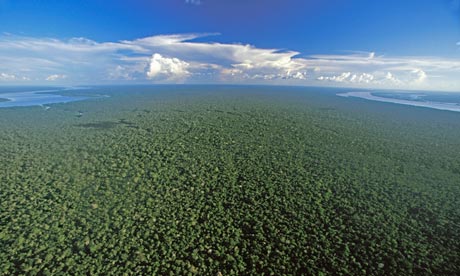
Aerial view of the Amazon rainforest: satellite pictures revealed small clearings where an uncontacted community is living. Photograph: Gerd Ludwig/ Gerd Ludwig/Corbis

Brazilian authorities say they have pinpointed the location of a community of ancient and uncontacted tribespeople in one of the remotest corners of the Amazon rainforest.

Fabricio Amorim, a regional co-ordinator for Brazil's indigenous foundation, Funai, said the indigenous community had been found after three small forest clearings were detected on satellite images. Flyovers were carried out in April, confirming the community's existence.

Four straw-roofed huts, flanked by banana trees and encircled by thick jungle, can be seen in photographs taken during the flyover.

The community is likely to be home to about 200 people, probably from the Pano linguistic group which straddles the border between Brazil, Peru and Bolivia, according to Funai.

Amorim said the region — known as the Vale do Javari — contained "the greatest concentration of isolated groups in the Amazon and the world" but warned of growing threats to their survival.

"Among the main threats to the well-being of these groups are illegal fishing, hunting, logging, mining, cattle ranching, missionary actions… and drug trafficking," he said. Oil exploration over the border in Peru could also have a negative impact on indigenous tribes in region.

Officially, Funai recognises the existence of 14 uncontacted tribes in the Vale do Javari, making up a total of at least 2,000 people. But that number is likely to rise as expeditions to this region of the western Amazon continue.

Government officials currently seek to avoid direct contact with Brazil's uncontacted tribes, instead working to identify and protect their lands from afar. But many believe limited contact may become necessary in order to protect the groups from external threats.

José Carlos Meirelles, a veteran Funai official who has spent more than two decades working in the Javari region, said in 2009: "If this situation continues, contact will become inevitable, and it is better that it happens with us than with loggers or goldpanners."

Ocean Park opens Rainforest area

June 22, 2011
Source: COASTER-net.com

Hong Kong, China - Last week, Ocean Park in Hong Kong unveiled the grand opening of its brand new, Amazon-themed Rainforest area. As reported by the Wall Street Journal, this new 500-square-meter Amazon-themed environment features a jungle raft rapids ride, an aviary, and animal exhibit, including anacondas and capybaras. While anacondas may be well-known as some of the largest snakes, the capybaras may not be as well-known, but are actually the world’s largest rodent. The Wall Street Journal even reported that the chairman of Ocean Park, Allan Zeman, was dressed up in war paint, a headdress, and a grass skirt to commemorate the event.

This newest addition, the Rainforest, is just part of Ocean Park’s roughly $720 million redevelopment plan. With a recent boom of parks opening up in China, especially around major areas such as Hong Kong, parks are having to work to attract more visitors than their competitors, and Ocean Park is showing its intentions.

While competitor Hong Kong Disneyland has struggled to earn a profit in its six years of operation, it had a record attendance last year, and is currently in the middle of its own expansion, including Toy Story Playland set to open later this year, with Grizzly Gulch in 2012, and the haunted Mystic Point in 2013. Another competitor is a new aquarium set to open next year in Sentosa, Singapore, which will be the world’s largest saltwater aquarium with 700,000 fish, paling Ocean Park’s Aqua City aquarium and its 5,000 fish.

The park will also be opening another expansion area later this year to be called Thrill Mountain, which will feature a variety of thrill rides and attractions. The headline attraction here will be Hair Raiser, a custom-layout Floorless coaster from the Swiss duo of Bolliger & Mabillard. The ride, which is currently undergoing testing, will feature a vertical loop, dive loop, zero-g roll, immelmann, and a number of twists, turns, dips, and dives.

For 2012, the Wall Street Journal has reported that the park has planned the re-creation of an old Hong Kong street and the Polar Adventure themed area. What advantage does Ocean Park has over all of this competition? A steady 34 years of operation by the government-owned amusement park, which set its own attendance record of over 5 million visitors last year, and has earned a profit for the last seven years.

Wednesday, June 22, 2011

New Uncontacted Amazon Tribe Discovered in Brazil

06.21.2011LinkSource: Treehugger


In the dense rainforest of the western Amazon, researchers from Brazil's Indian protection agency have identified a new tribe of uncontacted indigenous people. Authorities say the remote group likely numbers around 200 members, living in traditionally built huts, called malocas, surrounded by small farms of nuts, banana, and corn. Although they are isolated from the outside world, therein lie many factors which threaten their mysterious way of life.

According to the National Indian Foundation (FUNAI), a government organization aimed at preserving the rights of the indigenous, researchers first became aware of the possible existence of an uncontacted tribe after finding several small gaps in the forest while reviewing satellite imagery of the Javari Valley in the western Amazon, near Brazil's border with Peru. In April, an overflight examination of the region confirmed the presence a settlement composed of three cleared agricultural areas and four malocas.

The expedition coordinator Fabricio Amorim says that confirming such discoveries requires years of careful research, following guidelines geared towards protecting uncontacted tribes.


From the flyover photographs, FUNAI has been able to make certain determinations about the mysterious and remote settlement.

"The crops as well as the malocas are new, dated within a year. The state of straw used in the construction, and size of the corn indicate [its age]. Besides corn, there was a banana and undergrowth that appeared to be peanuts, among other crops," says Amorim in a statement released by FUNAI.

To preserve the newly discovered tribe, FUNAI does not plan on releasing the specifics as to its location in a region home to approximately 14 other uncontacted tribes accounted for so far. But despite the settlement's geographic isolation, these indigenous peoples are not entirely protected from outside activities.

"The main threats to the integrity of these groups are illegal fishing, hunting, logging, mining, agro-pastoralists with large clearings, missionary activities and frontier situations, such as drug trafficking," says Amorim. "Another situation that requires care is the oil exploration in Peru, which could have an impact on Javari Valley."

Brazil land barons seen behind Amazon killings

19 June 2011
Source: FRANCE 24


AFP - Nearly a month after the murder in Brazil's Amazon of an activist couple believed to have been threatened by land and logging barons, the investigation has gone nowhere.

The killing of the activists, who had denounced illegal logging, was the latest in a string of deadly attacks on environmentalists, murders allegedly linked to powerful corporate interests in the vast South American jungle.

Jose Claudio Ribeiro da Silva, 52, and his wife Maria do Espirito Santo da Silva, 51, were shot dead in an ambush in late May close to their home in Nova Ipixuna, a small town of 15,000 people in the state of Para.

Since their deaths, another three activists have been killed in the state, which is the epicenter of deadly land disputes. A fourth was killed in the state of Rondonia, also in the vast Amazon jungle.

Junior, a 30-year-old agronomist who worked for two years with Silva and declined to give his last name for fear of retribution, said the murdered ecologist had received death threats.

"He was told things like 'Your days are numbered', 'You are going to die' and 'Get ready to be silenced forever'," Junior told AFP, accusing "powerful landowners and forest companies" of contracting the murders.

"They went to his place several times to kill him. He went out to challenge them. They didn't kill him because they wanted to kill his wife as well. In the end, they succeeded," he said, visibly shaken.

The slain couple were part of the National Council of Gatherers, a group that collects natural food from the Amazon. It was founded by an ecologist, Chico Mendes, who was murdered in 1988.

The Para prosecutor's office said the Silvas' murder "had a detail suggesting it was a typical hit: the killers cut off one of Jose Claudio's ears."

"In the Amazon region, hired killers do exist," said Jose Battista, a lawyer for the local branch of the Pastoral Land Commission, a group linked to Brazil's Catholic Church that defends poor rural workers.

Last year, the Commission printed a list of 125 people it said had contracts on their heads. Thirty of them were in the state of Para, and the Silvas were among them.

"Since the start of the year, we already have 20 names" to add to the list of those under threat of murder, Battista said.

Brazilian President Dilma Rousseff vowed the day after the couple's death that the perpetrators would be brought to justice and sent a special military force to the region because of state officials' record of doing nothing in the face of such violence.

But to date, the police have made no progress in the case.

"The absence of government has led to illegal deforestation," said Valdimir Ferreira, a municipal councillor in Nova Ipixuna.

"Jose Claudio started a fight, a war against the loggers and powerful farmers. That's why I can state that his death was ordered by them."

The mayor of the town, businessman Edson Alvarenga, disagrees.

"The murders could be the result of internal conflict in the community," he said. "I've heard that the one who killed him is someone from here, in the community."

Junior allowed that there were local conflicts "because some people want to sell their plot of land."

"But I can assure you that it was loggers or farmers who gave the order to have him killed," he said.

Lab-grown meat offers solution for reluctant vegetarians, study shows

21 Jun 2011
Source: Telegraph.co.uk

Meat production is responsible for about 18 per cent of global greenhouse gas emissions and takes up almost a third of land outside of icebound areas Photo: ALAMY

An Oxford-led study found that cultured tissue could reduce the greenhouse gas emissions from food production by as much as 96 per cent.

The process would use up to 45 per cent less energy than conventional meat, only one per cent of the land and a tiny fraction of the water required, according to a study to be published in the journal Environmental Science & Technology.

Meat production is responsible for about 18 per cent of global greenhouse gas emissions – more than the airline industry and the world’s cars combined – and takes up almost a third of land outside of icebound areas.

With hundreds of millions more people in countries such as China now able to afford meat as part of their daily diet, the world’s resources have come under increasing pressure.

Meat production is being blamed for much of the deforestation in areas such as the Amazon rainforest, water shortages and increasing competition for land.

One alternative source of protein and energy could be the cultivation of a bacterium called cyanobacteria hydrolysate.

Hanna Tuomisto, of Oxford University’s Wildlife Conservation Research Unit, who led an Anglo-Dutch feasibility study, calculated that the first commercial lab-grown meat could be available within five years.

"We are not saying that we could, or would necessarily want to, replace conventional meat with its cultured counterpart right now,” she told The Guardian.

“However, our research shows that cultured meat could be part of the solution to feeding the world's growing population and at the same time cutting emissions and saving both energy and water.

“Simply put, cultured meat is, potentially, a much more efficient and environmentally friendly way of putting meat on the table.”

Catholic Church in Brazil Enters the 'Forest Code' Frey

Jun 21, 2011
Source: allvoices

A powerful coalition in a predominantly Catholic country has weighed in on the side of environmentalists. Brazil's Catholic Church joined the chorus of those opposed to a controversial 'Forest Code' revamping before the country's legislature. It has passed one of the two assembles, but must pass through the nation's Senate body.

The current bill would significantly alter some of the current rules that protect the Amazon. The bill grants amnesty to illegal deforestation that occurred before July 2008 and shifts control over preservation management from the federal level to the state level.

Proponents claim that the bill helps small landowners, erasing existing violations and allowing them to make a profit from their lands. The amnesty provision changes the way that land set aside for preservation is calculated.

Opponents assert that the shift of calculation is an underhanded way to give a greenlight to developers and loggers, who have huge commercial interests and no concern about the Amazon Rainforest.

Last Friday, Brazil's Catholic Church began a drive to circulate a petition among its 12,000 parishes to rebuff the attempt to alter the current law.

"Our main concern is the impact and consequences of a law of this size on people's lives and the environment," the church said in a statement. "We urge our communities to participate in the process of reform of the Forest Code, mobilizing social forces and promoting a petition against the devastation."

Saturday, June 18, 2011

Following the hunting Matis of Brazil

Fri, Jun 17 2011
Source: Mother Nature Network


There are places that you imagine you may return to and people you may meet again and then there are farewells to people and places you assume you will hold as a treasured memories. For me Aurelio village was one of those places; so remote, so distant, one of only two communities where the Matis of Brazil live. Set in the vast indigenous Vale do Javari reserve, it takes several days’ boat ride to reach the village, as well as many months of painstaking preparation. I had first come here to make the series “Tribe” and couldn’t believe my luck when I was asked to make a return trip for “Human Planet”– a rare privilege.


There is good reason to return to this remote corner of the Amazon for Human Planet’s "Jungles" episode. The Matis are true masters of the rainforest. Pete, our endurance fit cameraman, and I are reminded of this on our first filming day. An hour into the hunt we’d come to film, we are up to our knees, even thighs at times in swamp mud, soaked through by the unrelenting rain and all eyes on deadly poisoned darts being fired over our heads! Pete turns to me and asks if it’s all going to be like this?


Luckily it isn’t. Thank goodness, our second hunt is on firmer, drier ground. We follow the hunters into their world, immersed in the sounds and signs of the forest as we track monkeys in the canopy. For all the planning, there are still situations that happen which are unimaginable and that can never be relived. After many hours hunting with no success, we are about to give up when suddenly a troop of monkeys scatters across the trees. The hunters follow, taking aim in the tree tops. The camera’s eye is no match for the trained focus of the hunters. They find their mark fast, and before long, they are tying dead monkeys together to carry them back through the jungle. Exhilarated by the speed and skill of our forest guides, we head back to camp just as the rain starts to fall.

Part of our return journey is by boat. There we sit, the two of us, blowpipes and cameras balanced on benches, monkeys at our feet and a group of hunters devouring the last of the snacks that we brought. Survival in the jungle is about taking the opportunities that it offers – and a camera crew’s rations are as fair game as anything else found in the canopy. Pete turns to me, waving the sandflies from his eyes, and he utters the words no traveller should speak: “Imagine if we got stuck here now”.


At that moment the boats motor clunks and we are indeed stuck – the hungry hunters and us up an Amazonian creek with no paddle! The boatmen, calm as ever, are quick in their evaluation of the situation. The motor is beyond repair but we are not beyond help. Bushe, the Matis translator who I also worked with four years ago, turns to me and instructs me to use the satellite phone to contact the village to arrange a rescue. It will be long soggy bug-filled few hours before anyone can reach us. We ask Bushe what they would do without the BBC’s technological intervention. ”The forest has everything that the Matis need,” he replies, and every Matis knows the paths that wind through the forest to the village.

This is Tupa. She guards and administers frog poison rubbed into the hunters' arms to purify them before the hunt.

We cover ourselves in insect repellent and lie back on the roof of the boat in beautiful resignation to the sunset and our eventual rescue. What passes in the next few hours is one of those gifts of disguised fortune – stolen time and experiences. Floating across the river, the boatmen set nets, and within minutes they have gathered a dozen fish for supper including piranha. Soon, we are back on the bank, in front of a bright fire, stabbed with sticks of fresh fish. We joke around the flames, laughing into the smoke. The fish is quickly eaten with the bizarre addition of fruit flavoured rehydration salts for those who prefer their piranha on the tropical tasting side.


Then we all wash in the river, as our socks dry on sticks over the embers. Laughing still, we clamber back onto our boat. The sunset darkens to a thick sky studded with stars and the sounds of the forest once more. Somewhere in the distance, a motor can be heard but for the moment, the jungle absorbs us entirely. It is so good to be back amongst my Matis friends.

Deforestation in Brazil's Amazon continues to rise; clearing highest near Belo Monte dam site

June 17, 2011
Source: mongabay.com

Deforestation in the Brazilian Amazon from August 2009-May 2011.

Deforestation in the Brazilian Amazon continued to rise as Brazil's Congress weighed a bill that would weaken the country's Forest Code, according to new analysis by Imazon.

Imazon's near-real time deforestation tracking system found that 165 square kilometers (103 square miles) of forest was cleared last month, a 72 percent rise over May 2010. Accumulated deforestation in the period from August 2010 to May 2011 amounted to 1,435 sq km (1090 sq km), an increase of 24 percent over the same time-frame a year earlier. Deforestation in Brazil is typically measured on a calendar year ending in July, when cloud cover in the region is at a low point. Deforestation usually peaks in the Brazil Amazon during the dry season which runs from July through October.

While the increase is significant, deforestation in the region is still well below what it was five years ago. Deforestation has steadily declined since 2004 due to a several factors including macroeconomic trends, improved law enforcement, new protected areas, pressure from NGOs, and private-sector initiatives. But environmentalists and scientists fear that proposed changes to Brazil's Forest Code, which requires landholders in the Amazon to maintain 80 percent forest cover on their lands, could trigger a reversal in deforestation rates. Scientists expect the impact of forest loss and degradation to be amplified by climate change, which is thought to have contributed to the two worst droughts on record, both of which occurred since 2005.

Degradation in the Brazilian Amazon from August 2009-May 2011.

The analysis by Imazon suggests that the Forest Code debate may be a factor in rising deforestation. It found a 363 percent increase in forest degradation — logging and burning of forest that typically precedes deforestation — over the past 10 months, reaching 6,081 sq km. Most of the degradation occurred in major agricultural states: Mato Grosso (42 percent of degradation in May), Para (27 percent), and Rondônia (22 percent). The majority of deforestation also took place in these states: 39 percent in Pará, 25 percent in Mato Grosso, and 21 percent in Rondônia.

More tellingly, two-thirds of clearing occurred on private lands, which are most likely to benefit from changes in the Forest Code. Private landowners — particularly agroindustrial interests — have been pushing Forest Code reform, while small landowners and indigenous groups have generally opposed changes. Accordingly, deforestation over the past 10 months in indigenous territories and areas of agrarian reform (usually small-holder zones) amounted to only 12 percent and 1 percent, respectively. 22 percent of deforestation in May 20111 occurred in conservation areas.

Deforestation in May was highest in the municipality of Altamira, Para, where the controversial Belo Monte dam is to be constructed. Critics say the project will drive deforestation in surrounding areas as well as inundating large areas of forest and displacing thousands of indigenous people. Altamira accounted for 13 percent of total deforestation. It was followed by Porto Velho, Rondonia (8 percent), which serves as a key hub for the newly paved Trans-Oceanic Highway that links the heart of the Amazon to Peruvian ports. The highway will facilitate shipping of agricultural and timber products from the Amazon to China.

Imazon also estimated emissions from deforestation. It figures clearing in May committed 10.3 million tons of carbon dioxide emissions to the atmosphere, an amount roughly equivalent to the annual emissions of Mongolia or the state of Rhode Island.

Deforestation in the Brazilian Amazon is typically driven by industrial agriculture and land speculation. More than 70 percent of deforested land ends up as cattle pasture. High commodity prices typically create incentives for deforestation.

The Amazon rainforest is the world's largest tropical rainforest. More than 60 percent of it lies within the borders of Brazil.

Hydropower protocol aims to put big dams on sustainable footing

Friday, June 17 2011
Source: Recharge

The hydro protocol aims to reduce conflicts with protestors like these in Brazil

The Hydropower Sustainability Assessment Protocol aims to help project developers and governments make an early judgement on the environmental, economic and social effects of large projects, and minimise conflicts with local populations.

The International Hydropower Association is part of an industry council set up to oversee the use of the protocol, which is backed by environmental group WWF.

The nonprofit group International Rivers, however, calls the measures “weak, in that they do not require developers to comply with national legislation nor with international policy standards.”

WWF water security leader Joerg Hartmann says the complex process of large dam building can pit environmental and economic interests against each other.

“But we can mitigate the conflicts if we thoughtfully and thoroughly assess potential environmental, economic and social impacts.

“For companies, it is a mechanism to avoid expensive projects that provoke needless conflict and fail to deliver predicted returns.”

The protocol was unveiled at the International Hydropower Association Congress in Brazil, the focus of global controversy over the 11GW Belo Monte dam in the Amazon rainforest.

It was developed over three years with input from utilities, government agencies, banks, and environmental and social groups.

Hydropower is expected to grow strongly in Brazil and across Latin America as fast-growing economies look to clean-energy sources to meet rising power demand.

Catch of the day: McDonald's to serve up 'sustainable' fish

Saturday, 18 June 2011
Source: The Independent

McDonald's is seeking to enhance its once heavily-criticised environmental record by switching to fish certified by the Marine Stewardship Council.

In the latest instalment of a long-running ethical makeover, the US company will source MSC Alaskan pollack from Alaska, New Zealand hoki and Baltic cod in its European outlets. As well as serving up officially sustainable Filet-o-Fish at 7,000 outlets, it will put the MSC logo on cartons, promoting the best-known scheme for preserving fish stocks.

The MSC praised McDonald's, saying it showed it was committed to conserving the oceans, which are in peril from over-fishing. Roby Middleton, MSC's UK manager, said: "This isn't the work of a moment. It's part of a much larger piece of work McDonald's have done with fisheries towards sustainable sourcing. And the result in the restaurant sector is, I believe, a real sign of the MSC going to scale. McDonald's is uniquely likely to influence people's eating and shopping habits and is setting a good example to the rest of the food service sector."

It is another move that will improve McDonald's image, amid earlier criticism of its fatty food, environmental and animal welfare sourcing and low-paid "McJobs". Stores have been refurbished with a green livery and its in-house training scheme has won plaudits. But customers may be wondering what its general record on sourcing is: just how good is McDonald's?

Despite the hoopla, it has long had a good record on fish, turning away from cod in favour of pollack and hoki. Until now it did not have the MSC's seal of approval nor sought to promote sustainability among customers. While it sources free-range eggs and British beef, its chicken comes from farms meeting Assured Chicken Production standards, which means the chicken in its chicken nuggets comes from mass-produced, low welfare birds. Similarly its pork comes from similarly low Assured Pork Production.

Katya Read, of Compassion in World Farming, which is working with McDonald's to make further improvements, said: "As far as we are concerned they have got some really good policies. On eggs they have won Good Egg awards and they carry out quite a lot of research into how they can improve their supply chain... and turning around a supply chain like that is no mean feat."

McDonald's said it spent £530m a year buying British. "Overall, 55 per cent of our food comes from the British Isles and Ireland – including all our beef, pork, milk and eggs," a spokeswoman said. "We're a long term supporter of British farming and this commitment gives farmers the confidence in tough times to reinvest in their businesses."

So, how green is McDonald's?

*McDonald's in Europe is strong in some areas of ethical sourcing, say experts. On eggs, the company uses only free-range eggs in its breakfast muffins.

Beef for its Big Mac and other burgers comes exclusively from 16,000 farms in the British Isles, rather than South America, where cattle ranches are linked to the destruction of the Amazon rainforest. Less good, according to campaigners, is that its chicken and pork – both major ingredients – come from intensively reared rather than outdoor or free-range animals.

The company buys tea and coffee certified by the Rainforest Alliance, an environmental certification created by multi-national companies, which some commentators consider to be inferior to Fairtrade, a grassroots labour movement which has environmental standards and spend a premium developing communities in poor countries.

Overall, McDonald's is doing well, particularly in the competitive fast food market, but there is room for improvement. Its ethical standards are also far higher in the UK and Europe than they are in the US.

Friday, June 17, 2011

Exploring Logging and Road Development in the Amazon Rainforest

15 June 2011
Source: LiveScience.com

From river to forest to sky: The Amazon's trees are the link that holds the fragile ecosystem together, sucking water through their roots and releasing it back into the atmosphere.
CREDIT: Ritaumaria Pereira.

This Research in Action article was provided to LiveScience in partnership with the National Science Foundation.

Despite improved conservation efforts, the Amazon rainforest faces environmental threats from deforestation.

Researchers are investigating deforestation activities and the role played by building roads in the region — finding the answers is no simple task and requires first-hand exploration of the Amazon forests and the roads themselves.

Up for the challenge are the collaborating researchers Robert Walker of Michigan State University, project leader Eugenio Arima (who at the time was an assistant professor of Environmental Studies at Hobart William and Smith Colleges, and is now moving to the University of Texas at Austin), and Ritaumaria Pereira, a doctoral candidate in Geography at Michigan State University.

With support from the National Science Foundation, the team journeyed along the "Trans-Amazon Highway," one of the longest highways in Brazil, to search for loggers and survey links between forest degradation and development.

Before embarking on the highway, the team met with the local Kayapó Indians who provided key information about logging activity in the lower Amazon basin. The Kayapó once allowed loggers on their land, but after negative consequences, such as land damage and tribal conflict, the Kayapó now support efforts to conserve land.

The 850-mile journey along the Trans-Amazon Highway began at the village of Santarém, where the researchers rented a jeep and headed west to the terminus, the town of Labrea. Along the way, the researchers observed a multitude of wildlife, including a "macaw city" where numerous rare blue macaws buzzed around the researchers.

Deep in the forest, the researchers found an active gold mine, plagued with malaria. The barren landscape of the mine was dry with sandy crevices dispersed throughout — a reminder of what the rainforest could become if it was completely cut down.

Along the Aripuanã River, the team found what they initially set out to discover — evidence of the active logging industry. Numerous logging trucks carrying sawed wood appeared to be coming from the direction of the nearby frontier town of Vila Santo Antonio Matupi. The team attempted to interview the loggers, but such a task is not so simple, as loggers are often armed and suspicious of strangers. Although the loggers were not open to discussions, the team hopes to develop alternative strategies to interview them in the future.

The team continued their journey along the final stretch of the Trans-Amazon, which proved to be the most difficult. Walker explained that the road conditions were particularly wet and isolated. If you were to get stuck, you would have to make sure the windows were shut while you slept, or else jaguars might pay a visit.

Despite the challenges, after nine days the team safely completed their trip. Through their journey, the team located the "logging frontier" in Brazil and learned about the groups that are involved in agricultural development, such as settlers, ranchers and local governments.

They also investigated how sprawling road construction fragments the forest as well.

From those findings, the team determined that certain patterns of fragmentation are especially sustainable. The "fishbone" pattern, for instance, which resembles the bone structure of a fish, offers a solution that merges sustainable development with forest livelihood. In that pattern, the "bone-like" formations represent roads and the space between each road, or "bone," provides space for animal movement and a network of connected ecosystems. That form of forest fragmentation allows for sustainable development if properly planned, and safeguarded.

Palm Oil Plantations Could Help Preserve the Amazon

Thu Jun 16, 2011
Source: Reuters

In recent years, palm oil development in Malaysia and Indonesia has devastated tropical forests there. With Brazil on the verge of its own palm oil boom, can sustainable cultivation of the crop actually help save the rainforest, rather than hastening its destruction?

The rapid expansion of palm oil plantations across Malaysia and Indonesia has left a wide swath of destruction through some of the planet's most extensive and important rainforests. Now, with Brazil announcing plans to dramatically scale-up palm oil production in the Amazon, could the same fate befall Earth's largest tropical forest?

The stakes are enormous, as the Brazilian Amazon contains an estimated 850,000 square miles suitable for palm oil plantations - an area four times the size of France. By comparison, Indonesia and Malaysia, which account for nearly 90 percent of global palm oil production, have less than 50,000 square miles of oil palm under cultivation.


Yet even as Brazilian and international firms gear up for a major expansion of palm oil cultivation in the Amazon, there is a conspicuous lack of hand wringing by environmentalists. The reason: done right, oil palm could emerge as a key component in the effort to save the Amazon rainforest. Responsible production there could even force changes in Indonesia and Malaysia, both of which have been widely criticized for their poor records on protecting tropical forests.

Palm oil could ultimately benefit the Amazon for a number of reasons. Planted on the degraded pasture land that abounds in the Brazilian Amazon, oil palm could generate more jobs and higher incomes for locals than the dominant form of land use in the region: low intensity cattle ranching. Rather than destroying more rainforest for still-more cattle pasture, local farmers could go into the oil palm business and benefit from its higher returns.

"At current prices, it can provide a Brazilian smallholder a ticket to the middle class," said Tim Killeen, a senior research fellow and Amazon expert at Conservation International. "Anybody can do the math: 200 kilos of meat per hectare versus 4 tons of oil per hectare. Plantations create jobs, but a smallholder model creates a middle class."

Replacing cattle pasture with palm oil plantations also offers significant environmental benefits, as palm trees - though not nearly as valuable ecologically as rainforest - at least sequester carbon and evapotranspirate moisture, which is important to the hydrological cycle of rainforests.

Oil palm expansion in Brazil also could put pressure on Indonesia and Malaysia to clean up their acts. Brazil's stricter environmental laws mean that, should the country begin to produce large amounts of sustainably produced palm oil, it would place Southeast Asian producers at a disadvantage if they hope to sell to European and American corporations, which are increasingly concerned about buying palm oil associated with forest destruction.

Oil palm is among the most productive and profitable tropical crops. A 25-acre plantation can yield palm oil worth more than $7,000 a year for a planter, far in excess of ranching or farming. But its profitability has spurred unbridled expansion in Indonesia and Malaysia, where more than half of oil palm expansion since 1990 has occurred at the expense of tropical forests. Asian production also has fouled rivers and released billions of tons of carbon dioxide into the atmosphere. Producers there have at times run roughshod over traditional forest users, resulting in social conflict. Accordingly, the industry is increasingly battered by criticism from human rights groups and environmentalists.

So why would palm oil in the Amazon be different?

Little oil palm is now grown in Brazil - only 350 square miles. In the Brazilian Amazon today, cattle ranching is the big driver of deforestation. Cattle pasture occupies more than 70 percent of deforested land in the Amazon, obliterating forest and resulting in a near-complete loss of stored carbon and a loss of wildlife. The loss of vegetation reduces transpiration, affecting local rainfall. Where large areas of rainforest have been converted for cattle pasture, it becomes drier and more susceptible to drought and fires, which sometimes spread into adjacent forest areas.

Cattle themselves cause problems, compacting the soil, damaging local waterways, and worsening erosion. Meanwhile processing their hides pollutes rivers and streams with toxic chemicals. In short, cattle ranching, as traditionally produced in the Amazon, is often a menace to the environment.

Palm oil is a much different agricultural product. First and foremost, the oil palm is a tree, meaning that it absorbs carbon dioxide and releases water vapor as it grows. The result is that oil palm stores six to seven times the amount of carbon as cattle pasture. Daniel Nepstad, a scientist who co-founded the Amazon Environmental Research Institute (IPAM), said that large-scale expansion of oil palm plantations into pasture "would help mitigate regional climate change, exemplified by the severe droughts of 2010 and 2005, by re-establishing year-round evapotranspiration in an important region of the eastern Amazon."

Oil palm looks even better from an economic standpoint, generating significantly more employment than ranching, mechanized soy farming, or logging. Agropalma, currently Brazil's largest palm oil producer, employs one worker per 20 acres of plantation. By comparison, an industrial soy farm typically has one worker per 500 acres, while a cattle ranch often has only one worker for every 1,000 or more acres.

With palm oil prices hovering around $1,000 a metric ton and the Brazilian government planning an aggressive expansion of the crop, a frenzy of activity is taking place. Archer Daniels Midland, mining giant Vale, and the state-run oil company Petrobras Biofuels have announced major Amazon palm oil deals in the past 18 months. Several other major companies are looking to expand production in the region.

But the Brazilian government's target of having 19,000 square miles (5 million hectares) under palm oil cultivation may be too high - Agropalma thinks it unlikely that Brazil will be able to plant more than ten percent of that by 2020 because of constraints on seed and labor. Seasonal flooding also would limit palm oil plantations in parts of the Amazon.

Oil palm expansion in the Amazon faces other challenges, yet these constraints may make Brazil's palm oil industry considerably less damaging than its counterpart in Indonesia and Malaysia. Brazil's current Forest Code requires landowners in the Amazon to keep 80 percent of their land forested, which means that a company cannot only buy a block of pasture in the Amazon, it must also secure - or pay the cost of - a forest reserve several times the size of the palm plantation. (Brazil's agricultural lobby is now working to pass a law that would substantially reduce the legal reserve requirement.)

This and other challenges - such as Brazil's arcane land ownership laws - mean that oil palm in the Brazilian Amazon probably won't take the scorched Earth approach that has come to represent some palm oil growers in Southeast Asia and the Amazon cattle ranchers. The Brazilian government has also enacted policies to promote more sustainable palm oil production, which limit where oil palm can be grown and prohibit individuals or companies seeking to clear primary forest from receiving low-interest government loans. For all these reasons, Agropalma estimates costs of palm oil production in Brazil to be at least twice those of Indonesia.

All of this suggests that palm oil alone will not be a panacea for the Amazon, but it could help generate income and livelihoods in already deforested areas while stabilizing forest cover and serving as a bulkhead against fire. But Roberto Smeraldi, director of the environmental group Amigos da Terra - Brazilian Amazonia, said that optimism for palm oil will only be justified if the state and federal governments enforce the country's tougher environmental laws. "There are reasons for concern due to the lack of governance that might make palm oil expansion a risk factor once developed in the region," he says.

The goal of many Brazilian growers would be to out-compete Indonesian and Malaysian growers on issues of sustainability, which could make Brazilian palm oil more attractive to international food and consumer products companies, such as Unilever. Brazilian producers might even exceed the requirements of the Roundtable on Sustainable Palm Oil (RSPO), whose seal of sustainability - bestowed upon dozen of firms in Indonesia and Malaysia - has been given to some undeserving companies, according to critics.

"We're not going to be a competitor in markets that don't care about sustainability," says Marcello Brito, commercial director of Agropalma. "We believe Brazil will be a good producer, but not a big producer."

Even if Brazil's palm oil production misses the government's ambitious targets, it could pressure producers in Southeast Asia and Africa, where oil palm development is fast-increasing. Should Brazil produce just half of its 2020 target of 5 million hectares, the amount of palm oil produced would represent 10 to15 percent of global production, potentially having a commensurate impact on the price of palm oil and reducing the incentive to expand in places such as Malaysia and Indonesia. More importantly, it would send a signal to other producers that being the lowest-cost producer isn't necessarily the only path for agricultural development.

"Amazon oil palm plantations could mitigate climate change at the global level by depressing the price of palm oil, competing with Southeast Asian firms and potentially suppressing expansion into peat forests," says Nepstad.

And provided expansion occurs on degraded, non-forest lands, oil palm could help buffer the Amazon rainforest from further destruction.

"If we start a new plantation using RSPO guidelines and following Brazilian laws, we can be part of the sustainable solution to the Amazon," says Brito. "But a business as usual approach could destroy the Amazon."

Peru cancels massive dam project after years of protests

16 June 2011
Source: mongabay.com

Three years of sustained community opposition have brought down plans for a massive dam on the Madre de Dios River in Peru. Yesterday the Peruvian government announced it was terminating the contract with Empresa de Generación Eléctrica Amazonas Sur (Egasur) to build a 1.5 gigawatt dam, known as the Inambari Dam. The dam was one of six that were agreed upon between Peru and Brazil to supply the latter with energy.

"Although this resolution does not prevent the construction of all dams in the Inambari Basin, it is very important because it clearly cancels EGASUR’s participation. The resolution states that all future proposed projects must be subjected to prior consultation with local communities," said Aldo Santos, from local NGO SER (Rural Educational Services), in a press release. 


The cancellation follows a month long strike by 2,000 people against the dam as well as mining and oil projects in the region.

If built, the Inambari Dam would have inundated 46,000 hectares of rainforest and impacted the agricultural livelihoods of thousands of people. The dam would also have flooded 120 kilometers of the only-just finished Inter-Oceanic Highway.

"Even though the project is cancelled we know that we have won the battle but not the war. We know there are too many interests behind construction of Inambari, especially the interests of the Brazilians and their energy thirst,” said Olga Cutipa, President of the Front to Defend the Inambari-San Gaban.


A year ago Peru signed and Energy Agreement with Brazil to supply 7 gigawatts of hydropower to Brazil. The agreement was based on a series of six planned hydroelectric projects in the Peruvian Amazon, of which the Inambari would have been the largest. Following the cancellation, the agreement may be in jeopardy. However, the Inambari Dam could still re-emerge. The resurrection of the Belo Monte dam in Brazil after a decade is proof that such large projects are rarely, if ever, truly defeated.

The fate of the Inambari Dam, and the regions and people it would impact, now lies with newly-elected Peruvian President, Ollanta Humala.