Thursday, March 31, 2011

Last year's drought hit Amazon hard: nearly a million square miles impacted

March 29, 2011
Source: mongabay.com

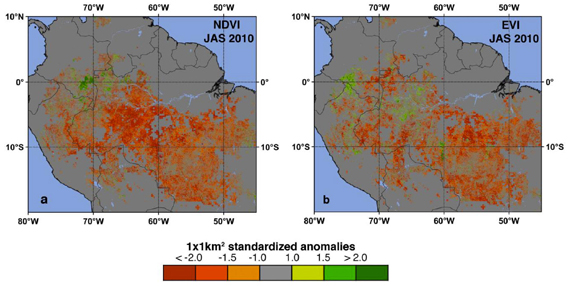
Red and orange identify areas where satellite measurements indicated reduced greenness of the Amazon forest during the 2010 drought. (Green patches are areas of enhanced greenness.) The maps differ only in the method used for determining vegetation greenness from optical data. Click to enlarge.

A new study on its way to being published shows that the Amazon rainforest suffered greatly from last year's drought. Employing satellite data and supercomputing technology, researchers have found that the Amazon was likely hit harder by last year's drought than a recent severe drought from 2005. The droughts have supported predictions by the Intergovernmental Panel on Climate Change's (IPCC) that climate change, among other impacts, could push portions of the Amazon to grasslands, devastating the world's greatest rainforest.

"The greenness levels of Amazonian vegetation—a measure of its health—decreased dramatically over an area more than three and one-half times the size of Texas and did not recover to normal levels, even after the drought ended in late October 2010," explains the study's lead author Liang Xu of Boston University.

According to the study, which will be published in Geophysical Research Letters, nearly a million square miles (2.5 million square kilometers) saw reduced greenness in 2010. This is more than four times the area impacted by the 2005.

According to Arindam Samanta, a co-lead author from Atmospheric and Environmental Research in Lexington, Massachusetts, satellite data taken from NASA's Moderate Resolution Imaging Spectroradiometer (MODIS)] "suggest a more widespread, severe and long-lasting impact to Amazonian vegetation than what can be inferred based solely on rainfall data."

Samanta also studied the 2005 drought, including working on a paper that found little greenness difference in the Amazon between 2005 and non-drought years. However, the level of greenness is not the only line of evidence researchers look to in order to determine the impact of a drought. Other evidence includes tree mortality and the outbreak of fires in the rainforest.

While the prediction that around 40% of the Amazon could flip to grasslands due to climate change has faced criticism from climate skeptics—and become a part of the histrionic and rarely fact-based political fight over greenhouse gas emissions—the science behind the theory has remained strong.

"The main conclusion of the IPCC statement—that Amazonian forests are very susceptible to reductions in rainfall—remains our best understanding of the data available at the time of the IPCC report and also today," reads a letter from some of the world's most well-respected Amazon experts that attempted to clarify misinformation on the issue last year.

Around the same time, Thomas Lovejoy, biodiversity chair at the Washington DC-based Heinz Center for Science, Economics and the Environment, and chief biodiversity adviser to the president of the World Bank, pointed out that the Amazon rainforest did not exist in a laboratory, but faced multiple pressures on top of climate change. Citing a World Bank report that looks at the synergistic effects of deforestation, climate change, and fires, Lovejoy said that the "tipping point for the Amazon is 20 percent deforestation". Currently 17-18 percent of the Amazon has been lost, leading Lovejoy to tell Tierramerica that the Amazon rainforest was "very close to a tipping point".

Both the letter and Lovejoy's statements came prior to the 2010 drought.

Amazon forest becoming less green

Mar 30th 2011
Source: TG Daily


Satellite data is revealing an Amazon rainforest that's decidedly less green than usual, showing the catastrophic effects of last year's record-breaking drought.

"The greenness levels of Amazonian vegetation - a measure of its health - decreased dramatically over an area more than three and one-half times the size of Texas and did not recover to normal levels, even after the drought ended in late October 2010," says study lead author Liang Xu of Boston University.

The study was based on more than a decade's worth of satellite data from NASA's Moderate Resolution Imaging Spectroradiometer (MODIS) and Tropical Rainfall Measuring Mission (TRMM).

The authors developed maps of drought-affected areas using thresholds of below-average rainfall as a guide, and then identified affected vegetation using two different greenness indexes as surrogates for green leaf area and physiological functioning.

The maps show the 2010 drought reduced the greenness of approximately 965,000 square miles of vegetation in the Amazon - more than four times the area affected by the last severe drought in 2005.

"The MODIS vegetation greenness data suggest a more widespread, severe and long-lasting impact to Amazonian vegetation than what can be inferred based solely on rainfall data," says Arindam Samanta of Atmospheric and Environmental Research.

The severity of the 2010 drought was also seen in records of water levels in rivers across the Amazon basin. These show last year to have been the driest year on record based on 109 years of Rio Negro water level data at the Manaus harbor.

Continuing Amazonian droughts could have severe effects on the planet.
Computer models predict that moisture stress could cause some of the rainforests to be replaced by grasslands or woody savannas. This would release the carbon stored in the rotting wood into the atmosphere, and could accelerate global warming.

Amazon rainforest health in decline

March. 30, 2011
Source: UPI

The reduction in the greenness of Amazon forest increased over an area more than three times the size of the state of Texas, scientists said.

The U.S. National Aeronautics and Space Administration funded a study using satellite data to examine vegetation in the Amazon rainforest.

Liang Xu, a researcher from Boston University, said pervasive drought last year had a dramatic impact on the health of the rainforest.

"The greenness levels of Amazonian vegetation -- a measure of its health -- decreased dramatically over an area more than 3 1/2 times the size of Texas," he said in a statement. "It did not recover to normal levels, even after the drought ended in late October 2010."

Scientists using historic satellite data determined changing climate and altered rainfall patterns could result in rainforests transitioning to grasslands or woody savannas. This, researchers found, could limit the amount of carbon stored in the rainforest.

Researchers said a drought in 2010 reduced the greenness of roughly 965,000 square miles of vegetation in the Amazon. Water levels reached record lows in October and have yet to recover.

Last year was one of the driest in more than 100 years for the Amazonian region.

Drought In Amazon Could Lead To Accelerated Global Warming

March 29, 2011
Source: International Business Times

A new study reveals a drought last year in the Amazon basin caused the forest to lose significant levels of vegetation, which in turn could accelerate the pace of global warming.

The study, conducted by an international team of scientists and funded by NASA, uses specific satellite imaging data provided by the agency to draw its conclusions. The Moderate Resolution Imaging Spectroradiometer (MODIS) and Tropical Rainfall Measuring Mission (TRMM) satellites provided more than a decade's worth of data for scientists who studied the de-vegetation of the Amazon rainforest.

The scientists say changing climates with warmer temperatures and altered rainfall could lead to the rainforests turning into grasslands or woody savannas. This causes carbon stored in the rotting wood to be released into the atmosphere, which would add to the greenhouse gases present.

"The greenness levels of Amazonian vegetation -- a measure of its health -- decreased dramatically over an area more than three and one-half times the size of Texas and did not recover to normal levels, even after the drought ended in late October 2010," Liang Xu, the study's lead author from Boston University, said in a statement.

"The MODIS vegetation greenness data suggest a more widespread, severe and long-lasting impact to Amazonian vegetation than what can be inferred based solely on rainfall data," said Arindam Samanta, a co-lead author from Atmospheric and Environmental Research Inc. in Lexington, Mass., in a statement.

The drought was one of the worst in Amazonian history. In rivers across the basin, water levels reached all time lows by the time the drought ended in October of last year. According to the researchers, in 109 years of Rio Negro water level data at the Manaus harbor, 2010 was the driest on record.

To gauge the impact the drought could have on the overall environment, the researchers used NASA's Earth Exchange (NEX) supercomputing facility. The study will be published by Geophysical Research Letters, a journal of the American Geophysical Union.

"Timely monitoring of our planet's vegetation with satellites is critical, and with NEX it can be done efficiently to deliver near-real time information, as this study demonstrates," study coauthor Ramakrishna Nemani, a research scientist at Ames, said in a statement.

Tuesday, March 29, 2011

Amazon still neglected by researchers

March 28, 2011
Source: Mongabay.com

Terra Incognito? Venezuela's Amazon rainforest (a portion of which is viewed here by Google Earth) has been almost wholly ignored by researchers.

Andean forests even less represented in research than the Amazon.

Although the Amazon is the world's largest tropical forest, it is not the most well known. Given the difficulty of access along with the fear of disease, dangerous species, indigenous groups, among other perceived perils, this great treasure chest of biology and ecology was practically ignored by scientists for centuries. Over the past few decades that trend has changed, however even today the Amazon remains lesser known than the much smaller, and more secure, tropical forests of Central America. A new study in mongabay.com's open access journal Tropical Conservation Science, which surveyed two prominent international tropical ecology journals (Biotropica and Journal of Tropical Ecology) between 1995 and 2008, finds that Central America was the subject of twice as many studies as the Amazon. In fact, according to the authors, much of the Amazon remains terra incognito to researchers, even as every year more of the rainforest is lost to human impacts.

"The largest stand of white-sand forest in western Amazonia was first visited by scientists in 2004. The bamboo thickets of southwestern Amazonia, which cover an area larger than the United Kingdom, remain essentially unexamined," write the authors. "The same is true for the swamps and wetlands that cover 6-8 percent of the Amazon basin, aquatic ecosystems across the continent, and most of the eastern slopes of the Andes."

Even when studies were conducted in the Amazon, they are largely done in specific regions due to difficulties of access. In fact, over half the studies occur in just three regions: Manaus, Brazil; Yasuni National Park, Ecuador; and Madre de Dios, Peru, while a staggering 31% of all Amazon studies surveyed were undertaken at just four field stations.

"While field work in Peru's Madre de Dios watershed has produced more than 800 articles in peer-reviewed biology journals to date, the corresponding number for the neighboring and similarly-sized Alto Purús watershed [also in Peru] is nine," the authors write.

Not surprisingly, certain Amazonian countries were more focused on while others have been largely ignored. Almost half (49%) of the Amazon studies were undertaken in Brazil. In contrast 1.6% of Amazonian studies occurred in Venezuela.

"A working understanding of South America's tropical forests does not require that biologists visit every last creek and hilltop, or study every watershed with equal intensity, but it does require that they have a clear picture of the biases that derive from the patchwork exploration of the landscape," the researchers write.

Research in the Amazon was also largely conducted by foreigners: over a third of the Amazonian studies were undertaken by US researchers and over a quarter by Europeans. Brazil makes up most of the difference (23%) while only 6% of research in the Amazon is done by non-Brazilian South Americans.

The Amazon is in second place for tropical research, followed closely by third place, Southeast Asia, and fourth Africa. But no-where is so underrepresented as the Andean tropics.

The Andes: even lesser known

While studies in the Amazon still lag behind research in Central America, the forests of the Andes are the undisputed losers. Six times more studies were conducted in Central America than in the Andes, in fact, more studies were written about the island of Puerto Rico than all of the Andean regions.

According to the paper some areas of the Andes were neglected altogether: "no studies were recorded in large ecoregions of the central and southern Andes (e.g., central Andean dry puna, central Andean puna, Peruvian yungas)."

Like the Amazon, the Andes are usually researched by non-native scientists. Over half of the research done in the Andes was conducted by Europeans with Germans publishing more studies on the Andes than researchers from all of the Andean countries combined.

"The Andean range—the undisputed epicenter of global biodiversity and endemism—remains one of the least-studied tropical regions on the planet," write the authors.

Given the dearth of research in the Amazon and the Andes, the paper calls for "a significant boost in overall research effort and a more equitable geographical coverage in field research."

The researchers argue that funding is key to increasing and diversifying studies in the Amazon and Andes.

"The entities best positioned to make these changes are likely international funding agencies and national-level institutions like universities, museums, government science agencies, and [NGOs)," the authors write, adding that grants should be made available for studies specifically focusing on the Amazon or the Andes.

Field stations also require better support to stay active.

"In the long term, the most cost-effective way to maintain the scientific productivity of [field stations] is via endowments or grant programs that subsidize their operating expenses for long periods," the authors write.

More investment should also be made in educating and training scientists in the regions. But, according to the researchers, this isn't just the responsibility of Amazonian-Andean countries.

"Visiting foreign researchers can do more to boost training opportunities for young South American biologists by designing collaborative research programs, offering training courses, and ensuring that young in-country collaborators take an active role in data analysis and manuscript preparation."

In good news, the authors did find that studies in the Amazon and Andes were growing, albeit very slowly. Central America is likely to remain the undisputed king of tropical studies for some time to come.

"At the rates of growth measured in our dataset, it will take the Andes-Amazon region [around] 120 years to reach the current productivity of Central America, " the authors conclude.

Clean-up of Amazon Jungle Awaits Ecuador following $9 Billion Judgment Against Chevron

March 28th 2011
Source: The Cutting Edge

Since initiated in 1993, the environmental class action lawsuit brought against Texaco’s alleged pollution of Ecuador’s Amazon region has been fought before various courts and judges, always under the shadow of dubious impartiality. After the case had already filed, Chevron bought Texaco in 2001 and assumed its liabilities, including Texaco’s defendant status. On February 14, 2011, after 18 years of intense legal battle, Ecuadorian provincial Judge Nicolás Zambrano ruled against Chevron and ordered the successor corporation to pay more than $9 billion in compensation for decades of petro-contamination of virgin Amazon jungle.

In response, Chevron released a statement in which it characterized the Ecuadorian court’s judgment as “illegitimate and unenforceable.” Chevron went on to argue that the judgment is “the product of fraud and is contrary to…legitimate scientific evidence,” and noted the U.S. corporation’s intent to appeal the decision. Such an appeal will likely inaugurate an even more protracted round of snarling legal proceedings, as Chevron still holds the option of resorting to two other appellate levels of the Ecuadorian judiciary, therefore exhausting their legal rights.

From Chevron’s side, lawyers announced their decision to appeal the lower court’s verdict. Julio Prieto, one of the defendant’s lawyers, said during an interview with FOXBusiness, “We have appealed Judge Nicolás Zambrano’s ruling and basically asked an increase of the amount to remediate the damages.” At this point, the outlook for the plaintiffs is bleak; even if Chevron loses the remaining appeals, it is unlikely that the damages will be paid out, given that Chevron has no remaining assets for Ecuador to attach or any existing drilling operations within the country to be suspended. Meanwhile, the severely-damaged Ecuadorian Amazon ecosystem will further deteriorate while Chevron manages to escape justice.

The basic facts related to the Chevron case were not disputed during the trial. Between 1964 and 1990 Texaco and the Ecuadorian national oil company, PetroEcuador, jointly entered into a concession covering 1,700 square miles of Amazon rainforest. The companies created a sixty-forty percent partnership, with Texaco being the minority partner but exclusive operator. During those years, Texaco was accused of dumping an estimated 18.5 billion gallons of toxic waste into streams and soil within the limits of the Ecuadorian rainforest. Moreover, over 900 open-air pits were dug into the jungle floor, which eventually were filled with toxins that subsequently ran off into nearby streams and rivers. The company additionally burned and vented millions of cubic meters of natural gas into the atmosphere, again without adequate control. All three of these practices violated industry standards, recognized by the U.S. at the time, but not as it was applied within the borders of Ecuador.

The U.S. company’s defense has relied upon a narrow technical argument. In 1990, Texaco agreed to pay $40 million in cleanup costs in exchange for being released from any future environmental claims. By this agreement, the company would clean what they considered to be their responsibility for 40 percent of the damage, while leaving the remaining 60 percent shares for PetroEcuador to handle. Although most ecologists at the time agreed that the cleanup was inadequate, Ecuadorian officials validated both partners for their efforts. However, PetroEcuador never acknowledged this nor took any steps to discharge its share of the agreement. Steven Donziger, who represents the Amazon community in the class action suit, argued in a 2009 interview with NBC´s television show “60 Minutes” that the 1990 agreement by no means releases Chevron from liability. Donziger’s clients were not included in the agreement made between the Ecuadorian government and Texaco. Thus, Chevron inherits the responsibility for Texaco’s earlier damages to the Amazon’s ecosystem.

The disputed $9 billion awarded to the plaintiffs by Judge Zambrano is only one third of the $27 billion worth of damages done, as estimated in the report that the court-appointed expert Richard Cabrera released in November 2008. These damages cover estimated cleanup costs, health impacts, and an “unjust enrichment” penalty, among other liabilities. As a result of this seemingly lenient ruling of $9 billion, negotiators are encouraging both parties to “lower the bar and start getting some measure of cleanup plans secured.” Unfortunately, any such agreement is unlikely to occur because the Ecuadorian Provincial Court of Sucumbios in Quito accepted appeals from both parties on March 16th.

Economic interests, corruptions, human rights violations, the prospect for environmental disasters, and human dignity are all factors in this legal drama that concerns the whole industry. As John Van Schaik said in a Los Angeles Times interview, a ruling against Chevron in this case “sends a signal to oil companies that, more than ever, they need to be good corporate citizens… and companies need to take environmental concerns seriously.” Especially as its ramifications can be felt from the secluded court room of Lago Agrio to the capital, Quito. But now, the resulting verdict from the appeals process will gain greater precedence because of the elevated position of the new court hearing the matter.

The Amazon—due both to its exhaustible resources and fragile indigenous populations—cannot wait for a judge to enforce this or other rebated rulings in order to recover from years of built-up environmental contamination and damages. While the Ecuadorian government certainly has taken sides in this lawsuit, it has failed to obtain stricter policies to protect the Amazon from further damages. As a result, oil companies spend millions of dollars on cosmetic cleanup campaigns instead of adopting more environmentally safe and equitable practices for the defenseless Amazon. It appears that the only green interest that has prevailed thus far among Ecuadorian officials is that of the U.S. dollar.

Former president Clinton apologized for the financial crisis triggered by the US

Tuesday, March 29th 2011
Source: MercoPress

“People are living in a world considerably more unstable and that threatens the future of our children. I have been considering the financial crisis, which started in the US and I apologize for that, and then spread to Ireland and the United Kingdom. Overnight Iceland’s government was gone and China lost an estimated 35 million jobs” said Clinton during a discussion table at the World Forum on Sustainability taking place in the Amazon city of Manaos, Brazil.

Clinton said that political and economic instability are one of three major problems the world is currently facing. The other two are the climate change issue and economic inequality both inside countries and among countries.

Insisting on the instability and lack of security issue, Clinton mentioned the Wikileaks cables which have been exposing confidential documents, information and assessments from the US government.

“People are entering other peoples’ computers. Look as Wikileaks, now everybody knows all about what the US diplomats are thinking, writing, acting…” pointed out the former US president at the largest city in the Brazilian rainforest state of Amazonas.

Clinton also said he was against building more hydroelectric dams in the Brazilian Amazon and insisted he had no patience for people who said there were on alternatives to building hydroelectric dams.

“What is the alternative? You need electricity and you need to preserve the forest. But 20% of the world’s oxygen comes from the Amazon. It’s not an easy decision, but you have to think about these things, and about the future of your children and grandchildren. You also have to consider the indigenous population, the wildlife, and the plant species that can be used to cure illnesses and will be affected by building these dams,” he said, adding that one other alternative was to dig up old landfills and burn the recyclable matter to create energy.

But hydroelectricity powers nearly all of Brazil. At least 82% of the electricity in the country is generated from dams, according to the Ministry of Energy. Brazil currently has a surplus of energy, but will face a deficit by 2015 — a year before the Olympic Games come to Rio de Janeiro — if it does not build out 5,000 megawatts of new power stations each year.

Furthermore hydroelectric dams are being built all the time in Brazil as part of the government’s clean energy policies. The problem is that most of the water resources to build the new dams are all located in the Amazon biome, which accounts for nearly 50% of Brazil’s landmass.

DC motors power Amazon eco-robot

29 March 2011
Source: Control Engineering UK Online

The new robot, which is powered by maxon’s DC motors, has been developed to explore and analyse areas of the Amazon rainforest which are under threat from increased excavation of oil and gas.

The robot minimises its own impact on the environment by using solar power and energy efficient motors to travel unaided through the mud and swamps of the Amazon. This includes eight compact DC motors that are able to deliver high performance in a compact space, with minimal energy usage.

maxon’s RE 40 and RE 35 motors power the wheels and adaptive suspension respectively, while two planetary gearheads provide the necessary torque.

Brushes made of precious metal allow the motors to ensure constant, low contact resistance with the commutator, as well as low start-up voltages and minimal electrical interference.

Monday, March 28, 2011

Brazilian Mining Company Vale’s Avatar Moment

Mar. 25 2011
Source: Forbes

It is a case of life imitating art in the Amazon jungle. The world’s biggest iron ore exporter, Vale (VALE), is considering taking a 9% stake in the world’s most controversial hydroelectric dam — Belo Monte. Location: Xingu River. Where is that? The Amazon rainforest.

First a little background on Belo. It’s an 11,200 megawatt power station that’s been on paper since the 1970s, and changed dozens of times to keep native tribes on their lands, and the Amazon lands around the Xingu River from being flooded. When built, it will be the world’s third largest, trailing China’s Three Gorges Dam and Brazil’s Itaipu (which it shares ownership with Paraguay, for what it’s worth).

Last April, the government of Brazil auctioned off the rights to build Belo Monte. Vale was a bidder with a consortium of energy companies and construction companies. It lost. A consortium of Brazilian government owned power companies won. They call themselves Norte Energia, or NESA for short. On Friday, NESA confirmed Vale’s interest in acquiring a 9% stake in the company after a private equity firm, ironically named Gaia, opted out of the group because it didn’t have enough money to be in the group in the first place, apparently.

NESA has no money either, but received a first phase installation permit by the environmental regulatory agency, Ibama, last month. It’s now making dirt roads and setting up camp for the tens of thousands of workers required to build the estimated $9.35 billion dam. NESA needs to comply with Ibama pre-requisites, 40 of them in all, which has the company spending around $1.5 billion on local infrastructure like water and sewer, among other things. Until it can meet those 40, it does not qualify for a massive loan from Brazilian development bank, BNDES.

Vale is very rich. And Vale, if it entered the consortium, could help foot the bill. That would entice BNDES to get on board. When BNDES gets on board, it means NESA has met the 40 pre-requisites to building and Belo Monte gets underway. Hundreds of acres of virgin rainforest gets flooded and 20,000 people will have to move (compared with 1.3 million during the building of Three Gorges Dam in China). Belo Monte is slated to be complete by 2015.

Vale won’t necessarily gain free access to electric power, because a lot of that power has already been contracted out. They will be paying market rate. But Vale, and other mining companies like Alcoa (AA) and Canada’s gold miner, Colossus Minerals Inc (CSI), will have future access to cheaper electric power, right where they need it: in the ever expanding mine fields of Brazil’s Para state, the second largest state in the Amazon.

If Vale takes a stake, it will likely face immediate negative press and attacks from environmental groups. If Vale is seen spending money to get NESA up to speed on meeting the 40 requirements set forth by Ibama (it has only met about 25 of them so far), that will likely be seen as a negative on the stock. But that is all unclear at the moment.

Investors will wonder if the government is pushing Vale to invest in Belo Monte, which is Brazil’s largest government project since the Itaipu dam, and more costlier than the São Paulo to Rio de Janeiro bullet train the government wants to hire someone to build before the Olympics in 2016.

And if Vale takes a stake, the Belo Monte dam project will have a global mining company involved. That will make the Belo Monte story even more interesting: big corporate government and miners seek to destroy the livelihood of tens of thousands, possibly extincts some fish like the zebra catfish, according to studies, and floods virgin rainforest in the name of development and future mining profits.

The government sees it another way. Clean energy security, and more jobs for relatively poor people who live in undeveloped, unpopulated areas in Para state. Plus, with NESA’s required investments in schools, hospitals, housing, water and sewer, the lives of the people living near Belo Monte will be improved, the government has said numerous times, as has Ibama president Americo Ribeiro.

Last year, Avatar director James Cameron visited Brazil, saw the comparison between the real world and his fictitious one, and then made a short anti-Belo Monte documentary called Message from Pandora.

THE LOST CITY OF Z

27 March 2011
Source: Cool Earth

When Lt. Col. Fawcett disappeared into the Amazon rainforest on his fifth expedition in 1925, he might have chuckled to know that 85 years later people would be writing books and making a film about his adventures trying to find a fabled lost city in the jungle.

On secondment from the British army to the Bolivian government, Lt. Col. Percy Fawcett's diaries speak of landslides, drinking champagne from the expedition's medical supplies, jungle Indians on the warpath, fighting giant anacondas and shooting rapids on the rivers. It's even been claimed that the Hollywood character "Indiana Jones" was based largely on this English maverick.

In his eventful life, Fawcett worked in Asia, Ireland, Africa and the Amazon. He was a British spy for a while in Morocco and was on the front line during the 1st World War. Based in Peru, Bolivia and Brazil for much of the last 20 years of his life, he was involved in surveying and mapping the frontier between Bolivia and Brazil. He is notorious because of the fascinating details in his diaries, some of which were written up by the Colonel's son, Brian Fawcett ("Exploration Fawcett", 1953). His final and fatal expedition apparently led the explorer off into unknown areas of the Brazilian Amazon in search for the Lost City of Z, which he had heard about from the tribes he had met on his other travels.

Another book has been writing about Percy Fawcett's adventures - "The Lost City of Z: a tale of deadly obsession in the Amazon" ( Doubleday: Random House, 2005) - by David Grann. The book was short listed for the Samuel Johnson Prize and has been described by the best-selling author, John Grisham, as "a riveting, exciting and thoroughly compelling tale of adventure." Ironically enough, it's now available at amazon.com and Paramount has purchased the options on developing it into a new Hollywood film, apparently with Brad Pitt in as Percy Fawcett.

Indie TV producers on the rise in Brazil

Sat., Mar. 26, 2011
Source: Variety

RIO DE JANEIRO -- Business is looking up for Brazil's independent TV producers, thanks to a small but rapidly expanding number of pay TV channels owned by local and international companies, all hungry for local content to lure auds.

"The Brazilian independent production market is growing fast," says Roberto Martha, director of production management of Viacom Networks Brasil, which operates Nickelodeon, Nick Jr., VH1, VH1 HD, VH1 Mega Hits and VH1 Classic. "The partnership between indies and international channels is a reality, and we are glad Viacom, which has constantly co-produced with indies, is taking part in this process," he adds.

Indies have long been hampered by broadcasters' tradition of making shows inhouse.

Paulo Barata, general director of Universal Channel, a joint venture between NBCUniversal and local pay TV player Globosat, sees the inhouse TV industry model as a plus in the long run.

"These networks fostered the creation of a topnotch workforce, production expertise and technology, which spread market-wide," he says.

MTV Brazil is also commissioning content. It has partnered with the city of Rio de Janeiro's audiovisual agency RioFilme and the state government's Culture Secretariat to fund production of a 480,000 reals ($290,000) TV series.

The producing partners will make six pilots from the best pitches, which MTV Brazil will air next year. One of these will be picked up for a 13-episode series that will air nationwide on MTV Brazil, says RioFilme prexy Sergio Sa Leitao.

The exec made the announcement at the inaugural edition of the Rio Content Market, an ambitious TV mart and seminar put together by independent producers' org Brazilian TV Producers (ABPI-TV) and partially sponsored by Rio's city and state governments. The fact that Rio Content, which ran March 16-18, attracted 1,500 participants, including reps from 450 companies, 80 of them from overseas, illustrates the strength of the local biz.

David Shore, creator and exec producer of "House," kicked off the event with a pep talk to local producers, saying: "Brazil is a country of 200 million people. It should have its storytellers out there. A lot of new American series are based on foreign stories. I am sure it will happen in Brazil, and I think this type of event will allow this to happen."

ABPI-TV's prexy Marco Altberg sees Rio Content, which included 150 presentations and panels as well as business meetings and pitch sessions, as an extension of the org's international work. For the past seven years, delegations of affiliated producers have traveled to the world's TV markets to establish international co-productions.

Canadian companies are among the main partners of Brazilian indie producers, particularly on animated TV series, as the two countries have a co-production agreement that allows projects to tap in to Canadian and Brazilian incentives.

The org has also organized training programs in Brazil.

Altberg says the Rio Content Market was originally planned as an event that would draw 500 people.

"But the fact that we attracted about 1,500 participants indicates the repressed demand for this type of meeting," Altberg says. "This reflects the positive situation of our country and market. But most of all this event represents the strengthening of the Brazilian independent TV sector."

Execs from U.S.-based production house Starlight Runner made the trek to Rio, where CEO Jeff Gomez announced that it had pacted with local indie Umana on "Moonflower," an animated TV series about British botanical artist and environmentalist Margaret Mee, who specialized in plants from the Brazilian Amazon rainforest.

"We are helping create the story world, making it very robust, perhaps a little bit more commercial at an international level," says Gomez, who spoke at the event's transmedia storytelling panel. "We are going to work with Umana to make sure the content is developed properly for various media platforms."

Brazil has a healthy free-to-air TV sector. Broadcasters, led by top-rated TV Globo, pocketed $9.4 billion in advertising spending in 2010, up 33.6% from the previous year.

The good news for indies is that, over the past few years, a series of regulations and government incentives such as Article 39, which allows companies to invest part of their federal tax in local indie productions, have opened up opportunities. New media platforms provide even more possibilities.

Looking forward, the Brazilian Congress is debating a broad set of regulations that would further boost the indie TV production sector by setting a quota for the amount of locally made programming on skeds.

How one endangered Amazon tribe took destiny into their own hands

Mar 26 2011
Source: Scottish Daily Record

THE chief of Brazil's Paiter Surui tribe knew his people could fight no longer.

After living in the centuries-old ways of their ancestors, their very survival rested with an unlikely ally - Google.

The advance of deforestation into their Amazon habitat had become critical and Almir Narayamoga decided he must reach out to the world in a plea for help.

"We decided not to fight any more with our bows and arrows but to use the internet and technology to bring attention to our situation," said Almir, 36.

"If we hadn't done that, as a people we would have been finished - and so would the rainforest."

To help save his tribe's 250,000-hectare reserve in western Brazil from illegal loggers, Almir made a surprise visit to Google in California in 2007.

Staff from the internet giants visited the reserve, trained the Surui and donated computers which they use in Cacoal, the nearest town.

The tribe have used Google Earth to build a satellite picture of their reserve that they can monitor for illegal logging.

The Surui spread their message using blogs, video messaging and a website.

Now they have embarked on an ambitious project to record the density of the rainforest in their reserve.

Engineers are training them to use GPS equipment and the Surui will be paid to protect their rainforest by planting at least a million trees.

Their work is funded by donations but their goal is financial independence.

Almir said: "Alone, we Surui cannot manage to reconstruct this region. We need the help of the whole world."

The Surui first made peaceful contact with the outside world on September 7, 1969. Previous encounters with rubber planters had ended in bloodshed.

Naramatiga Surui told me how he was one of a group who went to meet the Branco - their name for the white man.

Staff from the Indigenous Protection Service of Brazil signalled to them they wanted to meet the whole tribe. But the meeting was to result in disaster because the Surui had no immunity to diseases carried by their new friends.

Naramatiga, who reckons he is around 65, said: "People started dying quite soon after that first contact - three or four a day."

A state immunisation programme three years later was too late to prevent Surui numbers plunging from 5000 to around 250.

Almir was elected chief at 17 in 1991, and became the first Surui to go to university.

He campaigned at the World Bank in Washington for loans for farming, persuaded the state to provide fresh drinking water and urged his people to have more children.

Then he took on the illegal loggers - which resulted in a $100,000 bounty being placed on his head. He was forced to flee the reserve but returned after seven months.

There are now just over 1300 Surui in 23 villages on the reserve. One of them, Lapetanha, has a school and electricity.

Almir feels hopeful for the future of the rainforest and his people.

He said:"Two or three years ago, nobody believed we'd get all the loggers out of our lands but we did. Every day we believe we'll reach our goal. A better future for all."

Friday, March 25, 2011

Schwarzenegger And Cameron Head To The Rainforest

24 March 2011
Source: Ecorazzi

James Cameron is back in Belo Monte, Brazil – and this time, he brought along an old friend.

Former Governor Arnold Schwarzenegger excitedly tweeted this week that he was headed to the rainforest for “an adventure” with Cameron; all the while posting pics and some video of their journey. It’s a good thing Arnold loves social media – otherwise, we’d have no idea Cameron and Co. were back in the thick of the controversy surrounding the Belo Monte hydroelectric dam project. (Cameron hasn’t updated his Twitter account since Feb 3rd.)

You might remember Belo Monte, construction site of what would be the world’s third largest dam, as a passion project for Cameron during “Avatar’s” epic run at the box office. He even produced a short documentary on the dam’s potential to displace tens of thousands of ingenious people (as well as the environmental effects) that appeared as part of the bonus content on the “Avatar” DVD disc set.

Unfortunately, while slow, movement towards the dam’s groundbreaking is inching ever closer. Earlier this month, work was started on roads that will eventually lead to the $11.3 billion construction site. However, planners thus far have only received a partial environmental license; barring full construction from proceeding. “The struggle to resist the Belo Monte Dam and protect the Xingu river is far from over,”Christian Poirier, the Brazil programme co-ordinator for environmental group Amazon Watch told the UK Guardian. “Resistance on the ground will not waver.”

It appears that Cameron and Schwarzenegger are part of that resistance – though it’s currently unclear how they will drum up support against the project back home. Hopefully Arnold will tweet something shortly to let us know how he’s involved. Stay tuned.

Canada must act to protect its forests

Thursday, March 24, 2011
Source: Canada.com

Until very recently, forests, freshwater lakes and plant and animal life were rarely thought of in terms of their worth to the world's well-being, or even survival. Nature, it was grandly and wrongly assumed, could take anything we threw at it: pollution, garbage, even global warming.

That attitude is changing, and not a moment too soon. As glaciers melt, deserts spread and freshwater bodies dry up, conservationists and economists alike have started to put a dollar figure on nature's irreplaceable "services" -- the air we breathe, the water we drink, the land on which we grow food.

Canada's vast boreal forest, stretching across the top of nearly all the provinces and the northern territories, is one of the most valuable large-scale ecosystems on Earth, the world's largest store of fresh water.

The value of our forest's services has been put at $700 billion a year. These are the services the forest provides: it stabilizes climate, stores carbon, filters water, controls pests, protects biodiversity and, as home to 25% of the world's wetlands, provides clean water. The forest holds an estimated 400 trillion pounds of carbon in lakes and river-delta sediment, peat lands and wetlands -- more than any other terrestrial ecosystem on Earth, and twice as much per square kilometre as tropical forests.

If these services had been included as part of Canada's Gross Domestic Product in 2002, they would have equalled 61% of the country's wealth. In fact, these "non-market" services have a value 13.8 times greater than the net market value of the raw material extracted from the forest, such as minerals, oil, gas, timber and hydroelectric power.

These figures, from a report published last week by the Pew Environment Group, a U.S. based non-profit body, should help Canadians revise their thinking about the 1.2 millionsquare-kilometre boreal forest. Whatever we might have thought in the past, today its role as a unique, life-sustaining ecosystem outweighs by far the value of its extractable raw materials.

Canada can expect now to come under the same kind of pressure to conserve its forest as Brazil, home to the Amazon rainforest, and Borneo, where only 5% of the primary rainforest is left. As recently as the 1960s, the Borneo rainforest was untouched.

We might not be used to thinking of ourselves as guardians of a land and water mass of vital importance to the world -- but we'll have to start. It has been easy to criticize Brazilians slashing and burning their way through the rainforest with no thought to the future safety of the Earth and all who live on it. But now it's our turn.

To date, the federal, provincial and territorial governments have acted to protect 185 million acres from development, a mass that equals 12% of the total forest. Quebec's Plan Nord is held up as a model. It will protect 50% of Quebec's 550,000 square kilometres of boreal forest and apply sustainable development standards to the other half.

As demand for Canada's gas, oil and timber continues to rise, the country will have to figure out a way of protecting the even more valuable services that the boreal forest provides.

McDonald's launches plan to green its menu

Tuesday, 15 March 2011
Source: Independent

McDonald's has announced an ambitious sustainability program that will re-examine where its food comes from.

Last week's announcement came wrapped in a slew of corporate promises, including the pledge to make sure that the food in the company's restaurants comes from sustainable sources. The Sustainable Land Management Commitment, or SLMC, will require that suppliers use agricultural raw materials - unprocessed or minimally processed materials from nature - that originate from sustainably managed lands.

The core of the plan will focus on five priority areas as identified in collaboration with the World Wildlife Fund: beef, poultry, coffee, palm oil and packaging.

A big part of the project includes the banning of beef sourced from slaughterhouses within the Amazon Biome. To green chicken supplies, the company also imposed a series of moratoriums on all soya feed purchased from deforested areas of the Amazon. Soya is the major component of chicken feed.

Coffee and wood fibers for product packaging will also be sourced from third-party certified, sustainable sources.

Meanwhile, palm oil - which is used as the frying oil in restaurants - will also be revisited, as rising demand in palm tree plantations have resulted in the clear-cutting of native, tropical forests. The company pledged to switch to certified sustainable palm oil by 2015.

McDonald's has 32,000 locations in 117 countries.

Just last month, two former veteran executives from McDonald's announced plans to start their own fast-food chain that would ban butter, cream, high-fructose corn syrup and frying oil. The Lyfe Kitchen, which stands for "Love Your Food Everyday," will open its first restaurant in Palo Alto this year, with plans to build 250 more locations across the US over the next few years.

The fast-food outlet will be spearheaded by former McDonald's president and chief operating officer Mike Roberts, former communications boss Mike Donahue, in collaboration with Oprah's personal chef, Art Smith. The dish on the new fast-food chain is that menu items will be sourced from sustainable, local farms.

Adidas Launches 2015 Group Environmental Strategy

March 23, 2011
Source: Environmental Leader


Adidas has achieved targets to launch a sustainable supply chain program and finalize its 2015 group environmental strategy, but has missed targets on ISO 14001 certification and on monitoring its environmental footprint.

The group’s Sustainability Report 2010 outlines the Adidas Group Environmental Strategy 2015, a plan to reduce the company’s environmental footprint 15 percent by 2015, relative to sales. The plan includes a number of targets covering the Adidas supply chain from product creation, sourcing and manufacturing to own-brand store operation and other sales points.

Individual targets under the plan include a 20 percent relative reduction in energy consumption, 30 percent relative cut in carbon emissions, 20 percent increase in water savings per employee, and 25 percent reduction in waste per employee.

The company reported another target met with the launch of its environmental supply chain program at the start of 2010. This initiative includes audit checklists and remediation guidelines. The company reports that 83 percent of its global athletic footwear is sourced from suppliers that are both ISO 14001 and OHSAS 18001 certified.

But the company missed its goal to map and roughly calculate the environmental footprint of its value chain in 2010. It says it has carried out project scoping, and calculations will be made early in 2011.

In contrast, competitor Nike is already reporting greenhouse gas reductions. Nike reduced its overall CO2 emissions across the company and its supply chain by four percent in fiscal year (FY) 2009, compared to FY08, representing a return to FY07 levels, according to the company’s 2007 to 2009 corporate responsibility report.

Adidas has largely met its target to achieve ISO 14001 certification for its group and brand headquarters by 2010, but an audit of the environmental management system at its corporate headquarters in Herzogenaurach, Germany, is scheduled to take place in 2011.

The wide-ranging goals and targets in the newly announced Group Environmental Strategy 2015 include a ten to 15 percent cut in energy emissions by product output at Adidas’s core suppliers. In 2011, the company will conduct environmental assessments of high-risk suppliers and determine packaging targets for 2015.

Adidas aims to have more sustainable content by 2012 in 100 percent of footwear and an increasing amount of apparel. It says it will revise the guidelines of its Better Place product range to ensure alignment with the Eco Index and the index being developed by the Sustainable Apparel Coalition, of which it is a member.

The group has a target to use 40 percent “Better Cotton” – which is grown to social and environmental standards set by the Better Cotton Initiative – by 2015, and 100 percent by 2018. Adidas is already one of the top 12 users of organic cotton.

At least 80 percent of the value of leather that it sources from non-European tanneries will come from Gold Standard tanneries by 2015, Adidas said. (The group agreed in 2009 to cease using leather from cattle raised on former Amazon rainforest lands.)

Adidas said it will cut the energy consumption of its PCs by 30 percent and decommission or virtualize more than 40 physical IT systems, and overall reduce the environmental footprint of its IT infrastructure by 20 percent by 2015.

“The Environmental Strategy targets are interrelated with business targets and also require support from more than one single business function to achieve them,” head of environmental services Karin Ekberg said. “This is the beauty and the challenge in the approach: it is possible to drive the Strategy from different parts of the business, depending on where the leverage is greatest.”

Thursday, March 24, 2011

Amazon deforestation flat since last year

March 23, 2011
Source: mongabay.com

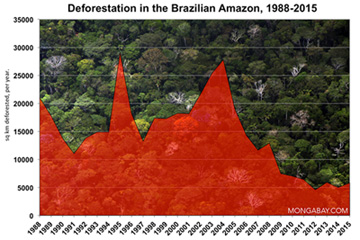
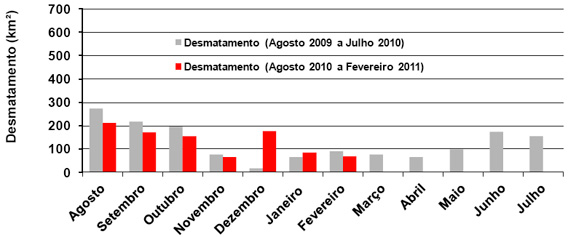
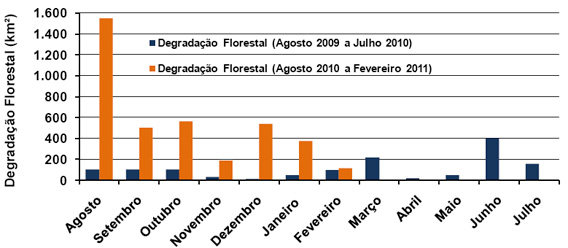
Deforestation in the Brazilian Amazon is roughly flat for the 7 months ended February 28 relative to the same period last year, reports Imazon, a Brazil-based NGO.

Using its the near real-term alert component of its satellite-based deforestation tracking system, Imazon found accumulated deforestation between August 2010 to February 2011 amounted to roughly 925 square kilometers, virtually identical to the 924 square kilometers detected between August 2009-February 2010. But degradation — forest that has been selectively logged, affected by fire, or otherwise damaged — increased by more than 300 percent to 3,836 square kilometers over the year-earlier period.

But Imazon is cautious to draw conclusions from the data. Intra-year estimates for deforestation in the Brazilian Amazon are notoriously difficult to assess due to cloud cover, distinctions between degradation and deforestation, seasonal variations, and other variables. Figures are usually reconciled each August using a different methodology that relies on higher resolution imagery. INPE, Brazil's space research agency, generally publishes these results towards the end of the year.

Deforestation from Aug 2010-Feb 2011 and Aud 2009-Feb 2010

Forest degradation from Aug 2010-Feb 2011 and Aud 2009-Feb 2010

Most analysts had been expecting a rise in Amazon deforestation due to rising commodity prices, although a strengthening real has offset much of the price appreciation. Another factor that could be impacting forest clearing in Brazil is the commitment among major players in the cattle industry to stop buying from ranches involved in deforestation. The restriction was brought about by a Greenpeace campaign and threats by state prosecutors in June 2009.

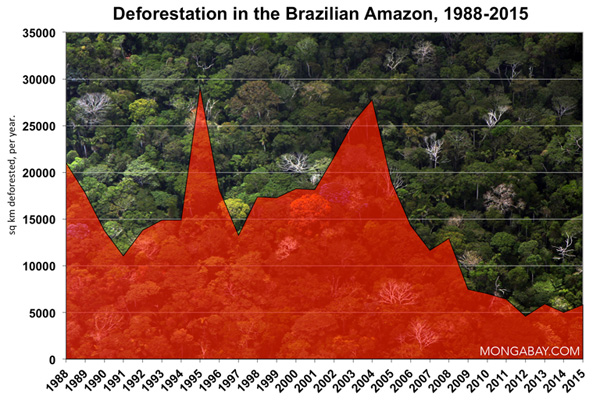
Under its national climate action plan, Brazil has set an ambitious target to reduce its deforestation rate. Deforestation in the Brazilian Amazon last year was more than 75 percent lower than its last peak in 2004.

Ecuador: Claims Trial Against Chevron Is Corrupt

March 22, 2011
Source: Eurasia Review

The court ruling ordering Chevron to pay Ecuadorian communities damages arising from its operations is the “product of fraud,” James Craig, a representative of the oil company, says.

By Gonzalo Ortiz

Chevron, the second largest U.S.-based oil company, believes that, to overturn the verdict ordering it to pay 9.5 billion US dollars in damages for polluting the Ecuadorian Amazon and causing health problems to its population, the best defence is a good offence on all fronts.

The ruling, issued on Feb. 14 by a provincial court in Ecuador, is “corrupt, illegitimate, unenforceable, and the product of a fraud,” according to the company’s Latin American spokesperson, James Craig, interviewed by Tierramérica.

As it prepares to appeal the sentence, the company has presented a request for clarifications from the acting judge, Nicolás Zambrano. But it has also brought an action against the Ecuadorian state in the Permanent Court of Arbitration, seated at The Hague, and is suing the lawyers and lead plaintiffs in a U.S. District Court in New York, accusing them of inventing a fraudulent case against the company.

Craig claims that the judge failed to take into account “many elements that came out in the proceedings,” that he based his ruling only on the studies submitted by the plaintiffs, and that he ignored the fact that the report presented by Richard Cabrera, the expert witness commissioned to conduct an independent assessment, was actually drafted by the plaintiffs.

Although Zambrano explicitly noted in the ruling that he had ignored Cabrera’s questioned report, Craig insists that “the trial is totally corrupted.”

Texaco conducted oil exploration and extraction operations in northeast Ecuador from 1964 to 1990, in association with the state, and it retained a 37.5-percent share in the business until 1992. In 2001 the company was acquired by Chevron.

According to the reports filed, Texaco drilled around 350 oil wells across an area of approximately 6,900 square kilometres in the Amazon rainforest. It dug out 900 unlined open-air pits for oil sludge disposal, and dumped some 68,000 litres of wastewater discharged by its production processes -a mixture of petroleum, acid chemicals, and other toxic substances known as production water-, which seeped into rivers and streams. What follows is an extract of the interview with Craig.

TIERRAMÉRICA: Even before the ruling had been issued in the first instance, Chevron filed a complaint with the court in The Hague demanding that in the event of an adverse ruling against the company, the Ecuadorian state be held accountable for any damages awarded. Why should the state be made to pay if it was your company that operated in that area from 1964 to 1990?

JAMES CRAIG: Texaco was one of the operators in the consortium from 1972 to 1990, when the government of Rodrigo Borja (1988-1992) decided that it no longer needed a foreign partner. The operator for the last 20 years has been the (state-owned company) Petroecuador.

When Texaco left, it was agreed that a number of remediation actions would be carried out in certain places that had been impacted by the consortium’s operations. The state, as the majority shareholder, and Texaco, as the minority shareholder, then signed an agreement in 1995 whereby Texaco was to cover one third of these environmental liabilities and the state was to cover the other two thirds.

Texaco cleaned 162 ponds and six spill areas, it installed seven produced water re-injection facilities, and invested over five million U.S. dollars in social work. And in the year 1998 the final document releasing the company from any responsibility or obligation was signed. (Craig shows the document executed by Ecuadorian authorities and Texaco executives).

If there are any environmental problems, the only one responsible is the Ecuadorian state.

TIERRAMÉRICA: But that agreement did not release Texaco from third-party liability. The state attorney general, Diego García, says that this is a conflict between private parties and therefore the court in The Hague does not have jurisdiction.

JC: We have abundant evidence that shows how this case has been influenced by the government and politics. Besides numerous statements by President (Rafael) Correa against Chevron, we have a press bulletin from the presidency where the government not only declares its support for the plaintiffs, it also undertakes to gather proof to help them.

We have a video of Alexis Mera (legal secretary of the presidency) meeting with attorney (Pablo) Fajardo, (activist Luis) Yanza, and attorneys (Julio) Prieto and Alejandro Ponce Villacís (members of the plaintiff’s litigation team) to discuss how they could go about invalidating the 1998 agreement.

TIERRAMÉRICA: How did you obtain recordings of meetings held in the presidency?

JC: The plaintiffs commissioned a documentary on their “struggle against the evil multinational corporation,” and over the course of two or three years the filmmaker (Joe Berlinger) accompanied them to all their meetings, taping and filming everything for a documentary that was finally released in 2009 under the title “Crude.”

We filed a request with a U.S. court to obtain access to the footage that was not included in the film, and the judge ruled that that material had to be turned over to the company. I have two CDs here -which I’m going to give to you- containing 16 of these videos, although the meeting with Mera is not included. (At the end of the interview, Craig presented a flash drive with images of that meeting).

TIERRAMÉRICA: Before determining whether or not it has jurisdiction, The Hague court ordered the Ecuadorian state to suspend the enforcement of the judgment against Chevron. But any lawyer knows that a judgment cannot be enforced until it becomes final.

JC: The lawyers for the plaintiffs have said themselves that they were going to take the first instance ruling to international forums to begin seizing our assets. Which is why The Hague court decided to take measures to prevent irreparable damage, such as the seizing of offshore platforms or refineries.

TIERRAMÉRICA: But a statement like that, even coming from the plaintiffs, has no legal basis.

JC: That question would have to be answered by The Hague court, which has much of that evidence. We have hundreds of thousands of documents, tens of thousands of compromising email messages.

TIERRAMÉRICA: Also obtained through court orders?

JC: Of course. From hard drives we obtained through several proceedings we initiated last year.

TIERRAMÉRICA: You’ve said that Chevron came in good faith to Ecuador to appear as a respondent in the trial. But when the case was originally brought in the United States, in 1993, you manipulated the proceedings arguing that the case could not be heard in a U.S. court.

JC: If you say “manipulated” you’re twisting the facts. We defended our position with the argument that the courts of the United States were not the proper forum for resolving an issue that was clearly Ecuadorian.

The first instance court agreed with us. The court of appeals did too, but it added as a condition that we could not oppose Ecuador’s jurisdiction if an action was brought against us there. Which is why Chevron came to Ecuador to respond in good faith to the action.

TIERRAMÉRICA: Where does the case go from here?

JC: We don’t know. The response to our request for clarification depends on the judge. We will then have three days to appeal. We’ll appeal to the Higher Court of Sucumbíos and, if necessary, to the National Court of Justice and the Constitutional Court, and, if it comes to that, we’ll take our appeal outside the country.

We have another case pending in New York against Fajardo, Yanza, (U.S. attorney Steven) Donziger, who is the leading attorney, and others who participated in the fraud, colluded with the judges, pressured justice, and induced the government to interfere.

TIERRAMÉRICA: What are you accusing them of?

JC: Fraud, conspiracy and extortion.

TIERRAMÉRICA: And are you suing them for a specific sum of money?

JC: We’re not asking for a specific sum. It’s a civil action. But we do expect to be reimbursed for what we have spent in our defence.
Ecologists have roles in developing carbon markets

March 23, 2011
Source: Cool Earth

According to a report released earlier this year, there has probably never been a more exciting time to be a tropical forest ecologist. With the emerging global forest carbon market alongside the growing interest in payments for ecosystem services, there is an immediate and unprecedented need for ecologists' expertise.

Forest carbon market frameworks, like the UN REDD+ initiative (Reducing Emissions from Deforestation and Forest Degradation), depend on establishing historical baselines for land-use changes and drivers of deforestation, estimating carbon stocks and monitoring the response of forests over 10 to 20 year periods into the future.

The report - "How can ecologists help realise the potential of payments for carbon in tropical forest countries?" - was written by several authors, including Tim baker of the University of Leeds, and published in the Journal of Applied Ecology. Real world examples analysed in the study came mainly from the Peruvian Amazon, which contains 88% of that country's forest. Peru's forests are high in carbon content and face a variety of deforestation rates and threats. There are several REDD type projects already off the ground here and the new Ministry for Environment is about to implement a national programme for forest conservation which aims to collaborate with forest communities, including offering them payments for ecosystem services.

The knowledge that ecologists have about patterns of carbon stocks, biodiversity and the sensitivity of specific ecosystems to changing environmental, climatic and anthropogenic impacts is invaluable in informing the development of avoided deforestation projects within a forest carbon market. REDD+ projects, for example, need to have their carbon as well as social and economic data validated, verified and monitored periodically. Quantifying the changes in carbon stocks and assessing the permanence of project outcomes are issues that require an ecological perspective. The accurate assessment of leakage (negative impacts - like increased deforestation - outside of but related to the conservation project area) and also understanding the implications of a project for biodiversity management are also jobs which call for an ecologist as part of the team.

The single most important input from ecologists to global forest conservation is likely to be into the design of an effective and workable low-cost monitoring system for forest carbon stocks.

‘Wembley final’ Brian changes Amazon date

Thursday 24th March 2011
Source: The Bolton News

A PHOTOGRAPHER travelling to the Amazon to capture the rainforest on film has moved his trip forward — so he can watch Bolton Wanderers if they make it to the FA Cup final.

Brian White, aged 51, is going to South America for seven weeks to capture shots of the wildlife.

The avid Wanderers fan was due to go next month, but he has now altered his travel arrangements so he can be back for the cup final in May.

He heads to Peru today and hopes to snap a variety of creatures, including giant otters, crocodiles, ant eaters, monkeys and anaconda snakes.

The Bolton Camera Club member, from Deane, said: “I love travelling and have been going around the world and taking pictures for many years.

“But the Amazon is the big one, and I have been planning it for three years. There is so much biodiversity and I am looking forward to the trip.”

Monday, March 21, 2011

The boreal forest: ours to preserve

March21, 2011
Source: Montreal Gazette

Until very recently, forests, freshwater lakes and plant and animal life were rarely thought of in terms of their worth to the world's well-being, or even survival. Nature, it was grandly and wrongly assumed, could take anything we threw at it: pollution, garbage, even global warming.

That attitude is changing, and not a moment too soon. As glaciers melt, deserts spread and freshwater bodies dry up, conservationists and economists alike have started to put a dollar figure on nature's irreplaceable "services" - the air we breathe, the water we drink, the land on which we grow food.

Canada's vast boreal forest, stretching across the top of nearly all the provinces and the northern territories, is one of the most valuable large-scale ecosystems left on Earth, the world's largest store of fresh water.

The value of our forest's services has been put at $700 billion a year. These are the services the forest provides: it stabilizes climate, stores carbon, filters water, controls pests, protects biodiversity and, as home to 25 per cent of the world's wetlands, provides clean water. The forest holds an estimated 400 trillion pounds of carbon in lakes and river-delta sediment, peat lands and wetlands - more than any other terrestrial ecosystem on Earth, and twice as much per square kilometre as tropical forests.

If these services had been included as part of Canada's Gross Domestic Product in 2002, they would have equalled 61 per cent of the country's wealth. In fact, these "non-market" services have a value 13.8 times greater than the net market value of the raw material extracted from the forest, such as minerals, oil, gas, timber and hydroelectric power.

These figures, from a report published last week by the Pew Environment Group, a U.S.based non-profit body, should help Canadians revise their thinking about the 1.2 millionsquare-kilometre boreal forest. Whatever we might have thought in the past, today its role as a unique, life-sustaining ecosystem outweighs by far the value of its extractable raw materials.

Canada can expect now to come under the same kind of pressure to conserve its forest as Brazil, home to the Amazon rainforest, and Borneo, where only five per cent of the primary rainforest is left. As recently as the 1960s, the Borneo rainforest was virtually untouched.

We might not be used to thinking of ourselves as guardians of a land and water mass of vital importance to the world - but we'll have to start. It has been easy to criticize Brazilians slashing and burning their way through the rainforest with no thought to the future safety of the Earth and all who live on it. But now it's our turn.

To date, the federal, provincial and territorial governments have acted to protect 185 million acres from development, a mass that equals 12 per cent of the total forest. Quebec's Plan Nord is held up as a model. It will protect 50 per cent of Quebec's 550,000 square kilometres of boreal forest and apply sustainabledevelopment standards to the other half.

As demand for Canada's gas, oil and timber continues to rise, the country will have to figure out a way of protecting the even more valuable services that the boreal forest provides.

Secrets of the Tribe

17 March 2011
Source: PopMatters


I'm Ashamed to Say It

“We no longer want anthropologists. You shouldn’t want to study over here. It’s all over now. Do not come. We want you to always stay where you are. We do not want to work in your land.” Alfredo wears a plaid shirt for his interview. A member of the Yanomamö tribe, Alfredo came to know Western anthropologists during their expeditions to the Amazon rainforest beginning in the 1960s, in particular his home, Mahekoto-teri. How he and other Yanomami came to feel so wary of the visitors is one focus for Secrets of the Tribe.

Airing this month on the HBO channels, this remarkable documentary gets at another focus as well, the interactions of another tribe, the anthropologists. They first appear in José Padilha’s documentary at an anthropologists’ convention, celebrating the work of Napoleon Chagnon, who, says one speaker, “has the distinction of being the only anthropologist who’s ever been accused of genocide.” The researchers and academics share a good laugh at this joke, and then the film goes on to consider the reasons for the accusation, having to do with longstanding antipathies and obligations, loyalties and competitions among these professionals.

This consideration is aptly complex, featuring interviews with participants and observers in several studies of the tribes (Yanomami and anthropologists). First published in 1968, Chagnon’s seminal study, Yanomamö: The Fierce People, helped to bring international attention to the tribe and the area where they lived, in Brazil and Venezuela. Soon translated into multiple languages and used in classrooms worldwide, Chagnon’s book, and 1988 article, “Life Histories, Blood Revenge, and Warfare in a Tribal Population,” argue that the Yanomami are a savage people, their society organized around men’s possession of women and the violent means to that end.

As influential as these studies were, they also came under scrutiny, and raised basic questions concerning the work of anthropologists who spend years alone in remote places and proclaim their findings correct by virtue of their own expertise, based on their particular experiences. Robert Borofsky of Hawaii Pacific University makes the obvious point, when he says, “Let us have data that others can check, that others can go back and look at, not just say, ‘I’ve checked it, I’ve done it,’ and look in the mirror and say, ‘Am I honest? Yes, I’m honest.’”

As it features researchers like Borofsky, the film reveals that such circular logic and remarkably self-involved work are not the only way to do anthropology. At the same time, interviews with Yanomami reveal that much of the work involving their tribe has indeed been troubling, for a variety of reasons.

For one thing, Chagnon’s idea that the tribe was warlike was used to support multiple aggressions in pursuit of their land (the film does not focus on the Amazonian “gold rush” of the 1970s and ‘80s, which led to violence, including the murders of Yanomami, as well as increases in disease, weapons, and prostitution in the tribe’s daily lives). For another thing, Patrick Tierney, who lived among the Yanomami in 1989, argues in a 2000 New Yorker piece and then in his book, Darkness in El Dorado, that Chagnon and his associate James Neel’s data and conclusions were flawed, primarily because they did not take into account their own influences on their subjects. That is, they traded “goods,” like machetes, in order to gain access, and so increased the capacity for violence among the Yanomami. Moreover, Tierney asserts that their team brought in diseases (measles, malaria, dysentery) and did not treat these adequately.

The story unfolds slowly, with several other instances of intrusion and adverse effects. Among these, the decision of anthropologist Kenneth Good to marry one of his study subjects, 14-year-old Yarima, and then write about it in Into the Heart: One Man’s Pursuit of Love and Knowledge Among the Yanomamö. As the film sets up interview clips featuring Good and Chagnon, they snipe at one another’s published work and reputations, as well as their personal circumstances. This lively “exchange” is constructed to seem a series of revelations, as each introduces some infraction committed by the other in order to make himself seem relatively benign.

The arrangement is surely damning of the two individuals, whose self-defenses are undermined not only by each other but also by colleagues’ comments: Cornell University’s Terence Turner notes of the marriage, for instance, “I think by Yanomami standards, it was not an unethical thing. The fact remains that Ken Good is not Yanomami, and by our standards, by standards of his own society, he was marrying a girl who was not of age to make a decision for herself and that sort of thing.” And Ernesto Migliazza, linguist for Chagnon’s 1968 expedition with Neel, says the tribesmen were told, “It was to study if they had diseases or not, that the results would be useful to cure them, which was a half-truth. Instead, after we left, measles broke out among them some of them got sick.”

If each of these incidents is disturbing on its own, their accumulation is no less than stunning. Like Padilha and Felipe Lacerda’s Bus 174 (Ônibus 174), Secrets of the Tribe breaks open the many stories that experts and witness tell themselves in order to justify what they do and understand themselves. This film allows that anthropologists mean well, in theory, but also makes the case that they can’t help but interfere with the people they seek to study. A black-and-white TV clip has Claude Lévi-Strauss explaining to a group of white fellows in suits, nodding as he explains that researchers inevitably “disturb” the milieus they enter. “It’s an excusable way of disturbing in comparison to the upheaval and the destruction of the colonization,” he goes on, “the industrialization, the building of roads, planes flying over. The ethnologist shouldn’t feel so guilty for contributing so little to these developments, which he would certainly lessen if he possibly could.”

The documentary uses this myopic and self-congratulatory declaration to frame its presentation of work by Lévi-Strauss protégé Jacques Lizot, who lived among the Yanomami for 20 years, following his introduction to the tribe by Chagnon as “a good guy.” The trust he absorbed by virtue of this sanction led to what Time magazine terms a “controversy,” namely, sexual abuse of his subjects, including young boys. “I’m afraid to say it, I’m ashamed to say it,” says Alberto of Mahekoto-teri, before illustrating with his hands what Lizot had boys doing to his penis. This went on for years, with tacit consent by tribal adults in pursuit of traded goods as well as fellow researchers and the Brazilian and Venezuelan governments, who had their own deals with the expeditions. Jesús Cardozo observes, “Lizot found the perfect place, a no man’s land there was no government presence, very little supervision of the villages. In a sense, he created his own territory.”

This seems a fitting description of the work of other researchers too. It’s not that Chagnon and Good are unaware that their work has consequences. Chagnon pronounces that he has “interfered,” and furthermore, “If I’m guilty, the entirety of anthropology and social studies is also guilty and every anthropologist on the world is guilty of the same crime and misdemeanor I committed.” But the film contends this is not all consequences are equal, and that those who enter into the business of anthropology must be responsible to their subjects, their colleagues, and themselves.

Fairfield Kids Take Volunteering to New Heights

03/20/11
Source: The Daily Fairfield

From left, Courtney Nettler, Rebecca Chen, Christina Elmore and Annabelle Wanner raise money for Ludlowe Corps' projects.

Annabelle Wanner and Courtney Nettler needed to find a way to attract more attention. Sure, they had already collected a good share of donations by stopping passersby around Fairfield Center. But they still felt they could do more to get noticed. So the Roger Ludlowe Middle School students hopped into trees lining Unquowa Road, putting their personal safety aside. After all, two villages in Ecuador were depending on their fundraiser.

“We’re not sure if this is legal,” Annabelle said of their makeshift signpost. “But it makes a good advertisement.”

Annabelle and Courtney are two members of Ludlowe Corps, a group of middle school students who raise money for international charities. The signs they carried Sunday were to promote Walk for World Water, their second annual walkathon to support three major initiatives. The money will go toward education and flood relief for Guinaw Rails, a slum in the African nation of Senegal. And it will also continue to offer help in Haiti, which was hit by an earthquake last year.

The project that interested Annabelle and her father Uwe, though, is an 11-day trip to the remote Amazon regions of Ecuador. In mid-April, they and 13 other parent-student pairs will head to the South American country with four Ludlowe teachers. They will visit the Ongota and Tambayacu tribes, two groups of indigenous people who rarely have contact with the outside world.

“I told my daughter she’s going to have to have an explanation for [her braces,]” Uwe said. The Ludlowe Corps group will bring 40 handheld water filtration systems to the Ongota and Tambayacu. Uwe demonstrated the remarkable abilities of the filters Sunday afternoon. Taking gray water from a bucket filled with twigs, sand and grime, he pumped out a glass of clear, crisp water. For the indigenous tribes, the filters will help clear out bacteria that cause cholera and other diseases.

Uwe took his older son on the trip last spring. They arrived just after a devastating flood hit the Ongota. So the Ludlowe volunteers helped clean debris and rebuild homes, along with delivering the much-needed filters. He was so moved by his trip that he will take Annabelle, now an eighth-grader herself, to so the same in three weeks.

“Ecuador itself is very nice,” Uwe said. “But once you get over the Andes, into the Amazon rainforest, that’s where the problems are.”

Walk For Water will take place Sunday, March 27, at Fairfield Ludlowe High School’s football field.

Friday, March 18, 2011

Studies in the Amazon

March 17, 2011
Source: Fox News

In my role as Explorer in Residence at UMass Amherst, I teach a course every year in the great Amazon rainforest. The three-credit course entitled “The Shaman’s Pharmacy” offers an introduction to the Amazon rainforest, its biodiversity, and some of the medicinal plants found in that forest.

The name of the course refers to shamans, the medicine men and women of the Amazon who function as doctors, healers, advisors and community leaders. This course gives students a vivid, full-immersion experience in the forest, learning not only from me, but from guides who have lived their entire lives in that environment.

It is one thing to hear about the forest and the river, but an entirely other experience to go there, to see the environment, and to appreciate the natural riches there first-hand. Here is some of the information the students receive:

– The Amazon Rainforest stretches over 1 billion acres in Brazil, Venezuela, Colombia, and the eastern Andean area of Ecuador and Perú.

– More than 20 percent of the world’s oxygen is produced in the Amazon Rainforest. This has earned the area the name “The Lungs of the Planet.”

– The Amazon Basin holds one-fifth of the world’s fresh water.

– Five hundred years ago, an estimated 10 million natives lived in the Amazon rainforest. Today, fewer than 700,000 survive.

– In Brazil, colonists have destroyed over 90 indigenous tribes since the 1900’s. This not only is the destruction of people, but of their cultures, and accumulated knowledge, including that of medicinal plants.

– Most medicine men and women and shamans remaining in the Amazon Rainforest are 70 years old or more. Each time one dies, a vast body of knowledge is lost.

– Most of the shamans today do not have apprentices. So when a shaman dies, thousands of years of accumulated knowledge come completely and irreversibly to an end.

– More than half the world’s approximately 10 million species of plants, animals and insects live in the tropical rainforests.

– Rainforests once covered an estimated 14 percent of the Earth’s surface. They now cover less than 6 percent. At current rates of loss, the rainforests will be completely gone in 40 years.

– One and one-half acres of rainforest land is lost every second. This has far-reaching environmental and economic consequences.

– Rainforest land is mistakenly valued solely for the worth of its timber, mining and oil resources by short-sighted corporations and governments.

– As a result of rainforest destruction, approximately half the world’s species of plants, animals and insects will be destroyed in the next 25 years.

– Due to rainforest destruction, the earth loses an estimated 137 plant, animal and insect species every day. As the rainforest disappears, so do many potentially valuable drugs. Currently 25 percent of Western pharmaceuticals are derived from rainforest materials. But only 1 percent of these materials have been tested.

– One hectare (2.47 acres) of rainforest can contain over 750 types of trees, and 1,500 species of higher plants.

– The developed world has derived approximately 80 percent of its dietary items from rainforests, including items such as oranges, lemons, grapefruit, avocados, coconuts, figs, bananas, guavas pineapples, tomatoes, mangos, corn, potatoes, sugar cane, rice, yams and squash.

– At least 3,000 fruits are found in the rainforests. While only 200 of these are used in the western world, natives consume approximately 2,000.

– Rainforest plants are rich in secondary metabolites, particularly alkaloids. Many alkaloids from higher plants (reserpine, caffeine, vinblastine, etc) are of medicinal and health value.

– Currently over 120 drugs come from plant-derived sources. Of the 3,000 plants identified by the U.S. National Cancer Institute as active against cancer cells, 70 percent come from rainforests.

– One acre of rainforest timber yields an owner $60. One acre for grazing yields an owner $400. One acre of renewable medicinal plants and fruits can yields an estimated $2400.

– Promoting the use of sustainable and renewable rainforest products can help to stop rainforest devastation. The rainforests are much more valuable alive than cut or burned, providing a steady supply of medicinal plants, fruits, nuts and oils.

On a regular basis, I conduct work in the Amazon, establishing trade for medicinal plants, and working with small communities to improve their economies, and to help protect forest acreage.

At this point in time, many good, talented people are needed to conduct this work. In the Peruvian Amazon, the students participating in “The Shaman’s Pharmacy” have a unique opportunity to experience the majesty of the world’s greatest rainforest, and the world’s greatest river. Hopefully they too will become ardent protectors of this great place on earth.

Open source forest accounting methodology for REDD projects developed

March 17, 2011
Source: mongabay.com


Avoided Deforestation Partners, a forest conservation group, has coordinated the development of an "open source" forest carbon accounting methodology that could help speed projects aiming to reduce greenhouse gas emissions from deforestation and degradation. The group says the new protocols could substantially reduce the cost of establishing forest carbon conservation projects under the REDD mechanism. Carbon accounting and methodology costs can easily top $100,000, making it difficult for small projects to win certification.

"These modules offer a system for those who cannot afford the cost of developing tailor-made carbon accounting protocols for their forest protection projects," said Jeffrey Horowitz, founder of Avoided Deforestation Partners (ADP), in a statement. "In addition to eliminating such costs, project developers can hit the ground running."

ADP says the new methodologies enable developers add on to their projects using a pre-defined set op approved modules. In other words, a carbon project could incorporate factors like accounting for aboveground and belowground biomass, leakage or displacement of deforestation to other areas, and forest monitoring without having to seek validation a methodology each factor individually. The process would save time and money, while ensuring that forest carbon offset credits are "real, measurable, verifiable and permanent," in the words of Peter Darbee, CEO, President and Chairman of PG&E Corporation, a California energy company that plans to offset a portion of its emissions through REDD credits.

ADP's open source methodology has been under development for two and a half years and has been approved by the Verified Carbon Standard, a carbon accounting audit body. The effort was coordinated by Charlotte Streck and Robert O’Sullivan of Climate Focus. Tim Pearson and Sandra Brown of Winrock International drafted the methodology with input from Lucio Pedroni of Carbon Decisions International, Dr. Igino Emmer of Silvestrum, and David Shoch of TerraCarbon.

Supporters of REDD believe a properly designed mechanism could significantly reduce greenhouse gas emissions from deforestation while generating benefits for forest-dependent people.

Deforestation and forest degradation account for roughly 10 percent of global carbon emissions.

Victoria indígena en Ecuador – Multa de 8.600 millones de dólares a Chevron por contaminación de crudo en el Amazonas

18/3/11
Source: Noticias Positivas

Los habitantes de la región amazónica de Ecuador han conseguido que se haga justicia después de una larga batalla legal de 18 años de duración para obtener una indemnización por el crudo vertido en sus territorios.

La multa de 8.600 millones de dólares impuesta por un tribunal de Lago Agrio, Ecuador, es la mayor multa asignada a un caso medioambiental, aunque se sitúa por detrás del fondo de compensación de BP, por valor de 20.000 millones de dólares, para subsanar el impacto del vertido de petróleo en el Golfo de México en 2010.


Según diversos grupos de derechos humanos, este caso también representa la primera vez en que los pueblos indígenas han demandado a una multinacional en el país en el que se ha cometido un delito y han ganado.

El caso fue presentado en nombre de las 30.000 personas afectadas por la catástrofe medioambiental ocasionada. Chevron heredó la demanda cuando adquirió Texaco en 2001 y siempre ha negado las acusaciones por daños medioambientales.

Asimismo, el importe de la multa podría duplicarse en caso de que Chevron no pida disculpas formalmente. Además, la compañía tendrá que pagar un 10% más para subsanar los costes de la Coalición de Defensa de la Amazonía, el grupo que representa a los demandantes.

Antes de ser adquirida por Chevron, entre 1972 y 1990, Texaco vertió 84.000 millones de litros de residuos tóxicos a los ríos y demás fuentes acuíferas, señala la demanda. Al parecer, la compañía vertió millones de litros de crudo y dejó una gran cantidad de residuos de crudo en los lechos de los ríos, que siguen contaminando el suelo y el agua. Según las comunidades afectadas, la contaminación ha causado graves problemas de salud en la población.

Pablo Fajardo, abogado de los demandantes, lo calificó como un “triunfo de la justicia”, pero dijo que el grupo ha apelado la sentencia porque la indemnización no es lo suficientemente elevada. Uno de los expertos designados por el tribunal recomendó una indemnización de 27.000 millones de dólares.

“Se trata de una gran victoria”, dijo Emergildo Criollo, demandante y líder Cofán, que vive en el norte de la Amazonía en Ecuador, pero añadió: “Nuestra lucha no se detendrá hasta que Chevron asuma sus responsabilidades y pague todos los daños que dejó en la selva amazónica.”

Chevron también apelará la decisión, después de tacharla de “ilegítima e inaplicable.” En un comunicado, la compañía estadounidense ha afirmado que “es producto de un fraude y es contraria a las evidencias científicas legítimas disponibles.” La ejecución de la indemnización económica ha sido suspendida temporalmente por un tribunal de EE.UU. por las preocupaciones de que la ejecución de dicha compensación a través de activos de Chevron podría provocar alteraciones en el conjunto de la economía. La compañía, que generó 19.000 millones de dólares de beneficios el año pasado, ya no tiene activos en el Ecuador.

La batalla legal podría continuar durante meses o años antes de que los demandantes puedan recibir algún tipo de indemnización, pero los grupos activistas han recibido la sentencia como una decisión histórica para los derechos humanos, la justicia ambiental y la asunción de responsabilidades corporativas. Amazon Watch y Rainforest Action Network, que han pasado años trabajando para ayudar al pueblo ecuatoriano y proteger la Amazonia, afirmaron que la culpabilidad de Chevron con respecto a la enorme contaminación por petróleo ocasionada en la selva amazónica ya se ha hecho oficial.

Ambas organizaciones acusan a Chevron de haber llevado a cabo unas campañas de relaciones públicas y de presión sin precedentes para evitar la limpieza de esta catástrofe medioambiental y de salud pública. “Es hora de que Chevron asuma su responsabilidad,” afirmaron las organizaciones.

La demanda se presentó inicialmente en un tribunal federal de EE.UU. en 1993 y se trasladó a Ecuador, a petición de Chevron. Pero la compañía ha atacado ahora a los tribunales de Ecuador aduciendo que las pruebas se han vuelto en su contra.

“Es una referencia fundamental en esta larga lucha por la justicia”, dijo Han Shan, de Amazon Watch, “una lucha que no terminará hasta que las comunidades afectadas consigan los niveles de limpieza, agua potable e higiene que necesitan y han buscado durante tanto tiempo.”