Thursday, December 22, 2011

Is the Russian Forest Code a warning for Brazil?

December 19, 2011
Source: mongabay.com

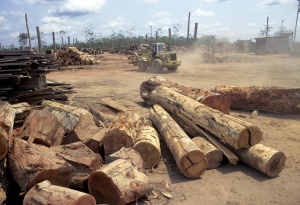
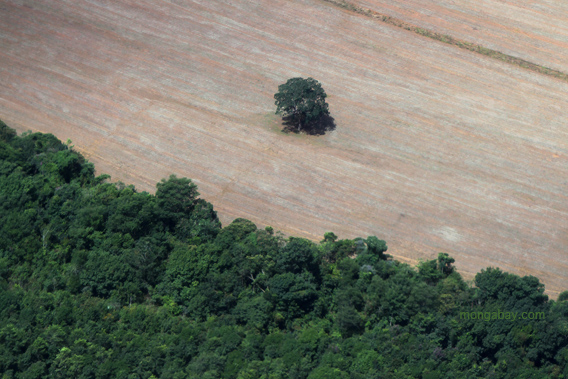
Recent deforestation in the Brazilian Amazon. Photo by: Rhett A. Butler.

Brazil, which last week moved to reform its Forest Code, may find lessons in Russia's revision of its forest law in 2007, say a pair of Russian scientists.

The Brazilian Senate last week passed a bill that would relax some of forest provisions imposed on landowners. Environmentalists blasted the move, arguing that the new Forest Code — provided it is not vetoed by Brazilian President Dilma Rousseff next year — could undermine the country's progress in reducing deforestation.

Based on Russia's recent experience, scientists Victor Gorshkov and Anastassia Makarieva say there may be justification for the concern.

Although one deals with tropical rainforests and the other boreal forests, both nations manage some of the largest forest areas in the world, and one has implemented large-scale changes— Russia— while the other— Brazil— is on the verge of doing so.

At the start of 2007, Russia's new Forest Code went into effect. The new code was meant to move control over forests from federal government to regional governments. Development could now occur without any Environmental Impact Assessment (EIA) with forests viewed largely as commodities rather than ecosystems.

"[The] forest code was meant to take power over forest from the old 'owners' (those officials who inherited forest control from the Soviet Union) and give it to the new Russian businessmen who arranged themselves into a force in the end of the 1990s. Members of our present political elite are said to have had shares in some of the largest forest companies in early 90s. Neither the old or the new managers actually cared much about forest conservation, but in comparative terms the old ones were better," Russian scientists Victor Gorshkov and Anastassia Makarieva, who openly opposed the changes, told mongabay.com.

The transition between the old Forest Code and the new one has proven rocky in Russia as many issues were left vague in the new law, allowing what Gorshkov and Makarieva describe as a free-for-all forest policy.
"In practice [the Russian Forest Code] came to mean that everyone could locally log anything without bearing any responsibility about the consequences or sustainability. [...] The chaos that followed when this raw law was adopted caused illegal logging to spike. [...] The North-European Russia was affected most severely, because it has a richer system of roads than say Siberia," Gorshkov and Makarieva say.

During plans to enact new Forest Code legislation Gorshkov and Makarieva, both with the B.P. Konstantinov Petersburg Nuclear Physics Institute, wrote two open letters to their government "warning against the new forest code." Gorshkov and Makarieva are known as the authors of a revolutionary, and contentious, theory that forests act as a pump for precipitation, bringing rainfall from coastlines to continental interiors. According to them, forests, and not temperatures, drive wind due to condensation. While the theory has received much push-back from some meteorologists, it has also piqued interest among conservationists and other scientists.

In their letters to the government the researchers warned that "enhanced forest exploitation will disrupt the hydrological cycle in the continental Russia and predicted drastic droughts among other climatic extremes."

Three years after the implementation of Russia's New Forest Code, record-breaking heatwave, droughts, and fires struck Russia, leaving Moscow under a shroud of smoke, consuming a fifth of Russia's globally-important wheat harvest, and likely killing thousands.

To some it seemed that Gorshkov and Makarieva's warnings had come true, making the two physicists appear like modern-day Cassandras, the always-right Trojan prophetess doomed to be ignore.

"When in 2010 the disastrous heat wave struck the European part of the country, our letters were widely cited in the Russian Internet. We are convinced that the climate anomalies in Europe are due to massive Russian deforestation, which disrupts the normal west-to-east moisture flow from the Atlantic over Eurasia," Gorshkov and Makarieva say.

Still, the causes behind the record heatwave are under debate: two recent studies conflicted over the role climate change may have played in the heatwave and drought.

But one issue that is not contentious is how Russia's new Forest Code undercut fire management during the 2010 disasters. Responsibility for managing forest fires had passed from the federal government to regional governments, yet few had picked up the slack.

"There were no organized bodies to prevent [the fires'] spread. In the result, we lost lives, property and a great forest area was damaged," Gorshkov and Makarieva say.

In Russia's case, loosening regulations on forests led to large-scale destruction, a situation that was made worse by a vague law, which made little reference to public and community rights over forests. In addition, people took advantage of the uncertainty to cut down forests for short-term profit. While there specific regulations are different, Brazil this March saw a sudden spike in Amazon deforestation, which many observers have linked to the mere possibility of the new Forest Code becoming law, though deforestation was down in total for the year.

Given Russia's experience, one has to ask, if the new Forest Code should become law, how will Brazil rein-in those who would take advantage over temporary government uncertainty?

A more fundamental question may be: is this the time to loosen regulations in the Amazon or strengthen them? Gorshkov and Makarieva argue through their theory that the on-going loss of the Amazon rainforest will lead to widespread drought, a problem that has already plagued the Amazon in recent years.

"Regarding the consequences of enhanced deforestation for Brazil, the biotic pump concept predicts drastic fluctuations and a growing instability of the hydrological cycle with a trend towards desertification. Recent studies (e.g. Espinoza et al. 2009) confirm the decline of precipitation in the Amazon basin which is particularly well manifested since early 1980. In line with this trend, the Amazon basin saw several outstanding droughts in a short term from 1998 to 2010," they say.

Many environmentalists warn that it could become worse, warning that Brazil's proposed code strips longstanding (even if widely flouted) regulations: WWF estimates that the revised Forest Code will reduce forest cover in Brazil by 76.5 million hectares (295,000 square miles), an area larger than Texas. Such a loss could be devastating for freshwater sources, biodiversity, and indigenous people. But according to Gorshkov and Makarieva it will also exacerbate drought conditions, perhaps undermining the entire Amazon ecosystem and leaving Brazil agriculture high and dry.
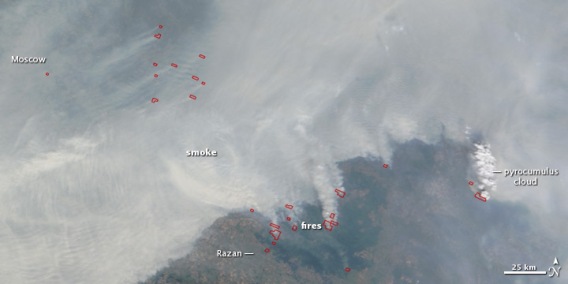
Image of Russia and nearby areas from August 4th, 2010 by NASA's Moderate Resolution Imaging Spectroradiometer during the Russian heatwave in 2010, which sparked drought and fires. Especially intense fires are outlined in red. Smoke from peat and forest fires lead to dangerous levels of pollution throughout Moscow and surrounding areas. Photo by: NASA. Click to enlarge.

Mystery Of Amazonian Tribe's Head Shapes Solved

19 December 2011
Source: LiveScience.comLink

Culture may trigger rapid evolution of various human features, suggests new research into the marital practices of a tribe from the Brazilian rainforest.

Evolution is often thought to be driven by environmental factors, including climate, or geographical obstacles such as rivers and mountains. Still, cultural factors — that is, groups of traditions and behaviors passed down from one generation to another — can have profound effects on behavior and also possibly lead to evolutionary changes.

To learn more, scientists analyzed genetic, climatic, geographic and physical traits of 1,203 members of six South American tribes living in the regions of the Brazilian Amazon and highlands. Their research found that one group, the Xavánte, had significantly diverged from the others in terms of their morphology or shape, possessing larger heads, taller and narrower faces and broader noses. These characteristics evolved in the approximately 1,500 years after they split from a sister group called the Kayapó, a rate that was about 3.8-times faster than comparable rates of change seen in the other tribes.

The major changes the investigators saw apparently occurred independently of the effects of climate or geography on the Xavánte. Instead, cultural factors appear responsible. For instance, in the Xavánte village of São Domingo, a quarter of the population was made up of sons of a single chief, Apoena, who had five wives. The tribe's sexual practices allow successful men in that group to father many offspring, which in turn means that any traits of theirs can quickly dominate their population.

"We have been working with the Xavante for about half a century, and from the beginning their morphology showed differences from the classical Amerindian pattern," researcher Francisco Salzano, a geneticist at Brazil's Federal University of the Rio Grande do Sul, told LiveScience. "We verified that the Xavante experienced a remarkable pace of morphological evolution."

The researchers suggest that assembling databases of cultural and biological data could help uncover other examples of how culture might influence human evolution.

"This specific piece of research is related to a long-term project of investigation involving not only the group responsible for this paper, but many others internationally," Salzano said.

Salzano and his colleagues detailed their findings online Dec. 19 in the Proceedings of the National Academy of Sciences.

Over A Million People Sign Petition Against Brazil's 'Pandora Dam'

12/20/2011
Source: Forbes

Some 1.3 million people signed a petition calling for an end to the construction of Brazil’s massive Belo Monte dam in the Amazon. A delegation of Brazilian celebrities and activists delivered the petition Tuesday to the country’s President Dilma Rousseff and called — yet again — for the immediate suspension of the controversial hydroelectric dam in Para state, located in Brazil’s north.

The dam will be the third largest in the world one built, second to China’s Three Gorges Dam on the Yangtze River. Three Gorges has installed capacity to power 22,000 megawatts of electricity, while Belo Monte has the installed capacity to produce around 11,200 megawatts. Brazil’s Itaipu dam, the world’s second largest, has the installed capacity to generate around 14,000 megawatts.

The Belo Monte dam pits environmental activists, native tribes and clean energy wonks against Brazil’s government and large mining interests like Vale (VALE), which acquired a 9% stake in Norte Energia, the consortium of mostly Brazilian electric power companies that won a bid to own and operate the dam for around 30 years.

Activists say that the dam will destroy a large swath of land in the pristine Amazon rainforest and disrupt the livelihood of at least 20,000 people who will be forced to move because of the flooding that will take place to build the dam’s reservoir. Branches of the Xingu River will be diverted, and this could cause low water levels during the dry season, killing off certain species of fish and making the Bacajá River, a Xingu tributary, unnavigable.

The petition comes after the highly popular “Drop of Water Movement”, a web-based viral video campaign led by actor Sergio Marone with a host of well-known Brazilian celebrities inspired by the “Don’t Vote” video spearheaded by actor Leonardo DiCaprio in 2008. The campaign has prompted significant debate in Brazil about the Belo Monte dam, though it has not been the first attempt to derail the power plant.

James Cameron brought Belo Monte to the attention of global Amazon activists in August 2010 with his short anti-Belo video called “Message to Pandora”. In the video, Cameron compares the construction of the dam to the fight portrayed in his hit movie “Avatar” — only instead of the alien natives being attacked by a massive Earthling mining corporation, the indigenous natives are being ousted off their land by the Brazilian government and a Brazilian mining corporation.

The petition was delivered by Marone and Antonia Melo, coordinator of the grassroots alliance Xingu Alive Forever Movement that has opposed construction of Belo Monte and other dams on the Xingu River for over 20 years. The group met with Gilberto Carvalho, a high-level presidential advisor, Edson Lobão, the Minister of Energy, and Isabella Teixeira, the Minister of the Environment and delivered a letter to President Rousseff calling for a moratorium on the construction and licensing of new dams in the Amazon, activist group Amazon Watch said in a press release on Tuesday.

“We were very satisfied to have opened dialogue,” said Marone after the meeting. “We took one more important step. While the government has proven unyielding, we will continue our campaign demanding the immediate paralyzation of the dam’s construction and push for a debate on energy policy that involves true dialogue where the concerns of the population are heard and taken into consideration,” Marone said in the statement.

Monday, December 19, 2011

Saving the rest of the rainforests

17 December 2011
Source: New Straits Times

Schoolchildren taking part in an outdoor class that teaches them about native Amazon trees in a park in Paragominas, Brazil. AP pic


SINCE the 13th round of climate change talks in Bali in 2007, the issue of reducing greenhouse gas emissions from deforestation and forest degradation in developing countries has moved from laggard to leader in the international climate change negotiations.

Major efforts have been carried out by the international community, donor countries and rainforest countries. This is an area where we truly have a reason to be both proud and optimistic.

Nonetheless, significant challenges remain. The economic drivers of deforestation are strong. Global demand for timber, palm oil, sugar, soya and beef, increasing in light of population growth and higher standards of living, will continue to yield pressure on the forests.

Successfully reducing global deforestation rates will rest on our ability to offer significant incentives to actors making land-use decisions. Business-as-usual is no option -- the consequences would simply be too devastating.

Firstly, the destruction of tropical forests could cause as much as one sixth of all global greenhouse gas emissions. The two-degree target will be impossible to reach without significant reductions in tropical deforestation.

Secondly, forests are the home of indigenous peoples, and constitute a safety net for some of the world's poorest people. One billion people depend directly or indirectly on forests for their livelihoods.

Thirdly, tropical forests contain half of the world's terrestrial species on only seven per cent of the world surface area. Biodiversity is the natural capital for sustainable development.

The value of the earth's natural capital losses has been estimated to be US$2 trillion to US$4.5 trillion (RM6.3 trillion to RM14.3 trillion); in other words, greater than the losses from the financial crisis. Today, 17,000 plant and animal species are endangered globally.

You may say that life's library is in flames. And make no mistake -- extinction is forever.

The loss of biodiversity in our age can be compared to previous mass extinctions, but this time, human beings are the ones responsible. Degradation of ecosystems combined with climate change may lead to so called "tipping points" -- self-reinforcing mechanisms, for example, the release of massive amounts of methane as a result of the melting of the Siberian tundra -- that could make negative developments spin out of human control altogether.

A loss of 20 to 30 per cent in the Amazon combined with an average two-degree rise in the temperature may lead to collapse of the Amazon rainforest. In short: it is time the world's tropical forests get bailed out.

The good news: although challenging, the prospects of saving the world's remaining rainforests have never looked better. Significant progress has been made under the climate change negotiations.

At the recent UN climate change negotiations in Durban, South Africa, the international community further detailed a framework to work collectively to slow, halt and reverse emissions from forests in developing countries. Although several details remain, we are moving forward.

There are important risks involved with Reducing Emissions from Deforestation and Forest Degradation, internationally known as REDD+. However, business-as-usual spells certain disaster. Therefore, we must address the risks of REDD+ head on: developing countries will have to improve forest governance to deliver lasting results in deforestation; groundbreaking levels of transparency will be required to verify the results qualifying for REDD+ finance; and financial mechanisms must be established that balance sovereignty over development spending priorities with the demonstrated application of high international safeguards standards.

A broad constituency of forest countries has emerged, eager to get REDD+ started on the ground. The multilateral and bilateral initiatives, as well as a plethora of academic institutions and civil society organisations, are creating a global community to support REDD+ action. We are learning and sharing valuable lessons every day.

All in all, developments are truly remarkable. Some developing countries -- Brazil, Indonesia, Guyana and the Democratic Republic of Congo in particular -- are leading the way.

For instance, deforestation in the Brazilian Amazon was 64 per cent lower last year than between 1996 and 2005. This equals 850 tonnes of reduced carbon dioxide emissions. Indonesia, the world's third largest emitter after the United States and China, has committed to reduce emissions by 26 per cent out of their own funds and 41 per cent with international assistance. Almost 80 per cent of the emissions in Indonesia come from deforestation and conversion of peat lands.

If Indonesia succeeds by 2020, one billion tonnes of carbon emissions will be saved, equalling as much as seven per cent of what is needed on a global basis to reach the two-degree target. To support these remarkable efforts, Norway has pledged US$1 billion to each country, to be paid based on verified results in reaching their goals.

Tremendous progress has been made since Bali to prepare the world for a global mechanism to reduce tropical deforestation. An integrated multilateral architecture is being created that supports all committed forest countries in their "readiness" efforts.

National strategies are being prepared and monitoring systems and institutional capacities built. Key countries are pushing rapidly ahead.

Now, adequate, predictable and sustainable medium and long term funding is needed to deliver and reward large scale verified results in reducing tropical deforestation. In Bali, the Government of Norway made the pledge to spend up to US$500 million annually for REDD+.

Since then, more commitments for action and financing have been put on the table. Around US$4 billion has been pledged for REDD+ next year and a multitude of developing countries are willing to step up their efforts to reduce deforestation and forest degradation. There is every reason to be optimistic. This is an area where we can, and where we already are, achieving significant results -- even before a final international climate agreement is settled.

Friday, December 16, 2011

Little headway on deforestation - experts

December 15 2011
Source: Independent Online

Brasilia - The UN's Durban conference on climate change failed to make enough headway in efforts to curb deforestation, experts warned, saying forest preservation plays a central role in the global warming debate.

After 14 days of marathon talks in the South African city, the conference on Sunday approved a roadmap towards an accord that for the first time will bring all major greenhouse-gas emitters under a single legal roof.

If approved as scheduled in 2015, the pact will be operational from 2020 and become the prime weapon in the fight against climate change.

“Durban has failed to deliver progress on fundamental issues like social and environmental safeguards, and on strict rules to ensure that global deforestation is reduced,” said Lars Lovold, head of Norway's Rainforest foundation.

One of the main decisions taken at the 2010 Cancun climate conference in Mexico was to include forests in the fight against climate change through a UN mechanism called Reducing Emissions from Deforestation and Forest Degradation.

Known as REDD+, it aims to secure financial and technical support to help curb deforestation in the rainforests of the Democratic Republic of Congo, Indonesia, Brazil and Guatemala.

It also includes a role for conservation, sustainable management of forests and enhancement of forest carbon stocks.

Deforestation, which releases large quantities of CO2 when forests are destroyed, represents around 17 percent of greenhouse gas emissions that causes global warming, more than the total global emissions from transport.

The issue is particularly acute in the Amazon, the world's largest tropical rainforest, dubbed the lungs of the Earth.

Protected areas of the Amazon in Brazil cover more than 2.1

million square kilometres and the government's environmental protection agency IBAMA is playing a key role in deterring deforestation.

An environmental crimes law passed in 1998 gave IBAMA new enforcement powers, which it has used, albeit selectively according to environmentalists, in raids aimed at arresting and fining the most blatant violators of the law.

And experts believe that 40 to 60 percent of the timber extracted from the Amazon is illegal, compared with more than 80 percent 10 years ago.

In 2009, Amazon lumber represented a $2.5 billion market, according to a study by the Imazon institute and the Brazilian forestry agency.

But Durban made only modest headway on REDD+, opening the way to a future carbon market and stressing the need for rules to guarantee emission curbs and protect indigenous communuties and biodiversity.

“We do not have progress on the 'politics behind the money' and without this we cannot talk about sustainability of REDD,” said Louis Verchot, a scientist at the Indonesia-based Center for International Forestry Research (CIFOR).

“REDD was overshadowed in Durban by larger issues,” said Bruce Cabarle, head of WWF's Climate and Forests initiative.

“All of the global analyses show that we have to have reductions in emissions from the forests fairly soon or else we cannot meet the 2050 goal of keeping (climate-temperatures) increasing more than 2 degrees Celsius.”

“For our countries with wide forest coverage, REDD is critical. This requires technical support and resources which is a global responsibility which we have not seen,” Maria Fernanda Espinosa, Ecuador's Cultural Patrimony Minister, told AFP.

Deforestation destroys more than seven million hectares every year in the world's main forests where more than one billion people live.

As scientists slammed increasing deforestation rates in Africa, Rachel Kyte, vice president of the Sustainable Development Network at the World Bank, said: “Forests cannot be sustained if people are hungry.”

“By far the countries where action on deforestation is required are Brazil and Indonesia,” Verchot told AFP. “Together these countries account for more than 70 percent of the deforestation emissions.”

But he also stressed the need for progress in the Congo Basin as well as in Malaysia and Myanmar.

In Latin America, Verchot cited some progress in Central America, but said more was needed there as well as in Venezuela, Peru and Bolivia.

Thursday, December 15, 2011

Peru's Cocha Cashu biological station changes management

December 08, 2011
Source: mongabay.com

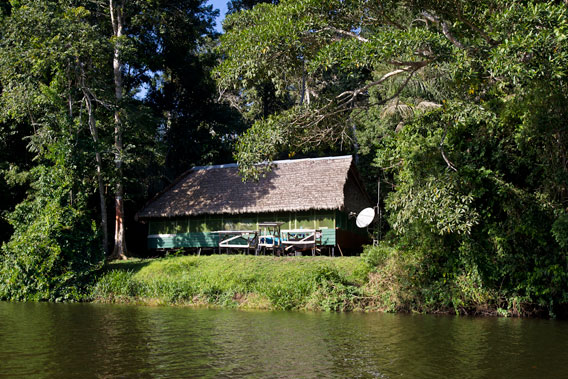
Cocha Cashu lab as viewed from lake. Photo by: Ken Bohn of San Diego Zoo Global.

The San Diego Zoo Global Wildlife Conservancy is taking over management of the productive Cocha Cashu field station in Manu National Park, Peru. To date, nearly 600 scientific papers have come out of research conducted at the station, making it among the five most productive research stations in the Amazon and Andes. Located in a part of the Amazon rainforest that has seen little human impact, the station was founded in 1969, four years before Manu National Park was gazetted.

"I remember my first visit to Cocha Cashu clearly. And I knew of the Stationís reputation long before that. So when I finally walked the half kilometer from the Manu River to the field site I did so with mixed feelings of awe and curiosity," Jessica Groenendijk, Cocha Cashu's Education and Outreach Coordinator for the San Diego Zoo Institute for Conservation Research, told mongabay.com. "I was about to meet a bunch of top tropical ecology researchers in a location which is renowned for its ground-breaking science; would I feel out of place? I need not have worried. As I neared the end of the winding, root-strewn trail, I was greeted by someone washing her clothes in a sun-lit clearing. In front of me were two small buildings with thatched roofs. One was filled with laughing people (I had arrived at lunch time), the other I later learned was known as the bath house. I was invited for a cup of coffee, and found myself face to face with John Terborgh, director of the Center of Tropical Conservation and a professor at Duke University."

Groenendijk says John Terborgh has been instrumental to Cocha Cashu's success as a field station, including supporting Peruvian students, 21 of whom conducted PhD research at the station.

"Over four decades, John turned a small station, built jointly by the La Molina National Agrarian University and the Frankfurt Zoological Society, into a giant: 'giant' not in terms of size, but in terms of its contribution to knowledge and conservation of tropical ecology," she says.

At the beginning of the year, the San Diego Zoo Global Wildlife Conservancy signed an agreement with SERNANP, Peru's Protected Areas Service, to manage the facility.

"Together with SERNANP, we intend to build on the reputation of Cocha Cashu as a premier field research site and training facility for conservation scientists, while maintaining its uniquely simple flavor," says Groenendijk. "Immediate priorities for the station are to establish a reliable power supply, and a more efficient internet, radio, and phone communication with the outside world. We will upgrade infrastructure, including new toilets and showers. Logistics and transportation to and from the site will also be improved with the purchase of another boat and two 4-stroke engines. We are actively recruiting students and scientists to come to the station, in the hope of maximizing its potential. And, in the longer term, we will initiate a capacity-building training course for Park guards and administrators, involve local school children and communities in conservation education initiatives, and develop our own research program."

The San Diego Zoo Global Wildlife Conservancy currently runs a number of additional field stations, including ones in Cameroon, Mexico, Hawaii, Nevada, and San Clemente Island.

Of all the reasons to do research at Cocha Cashu, the stand-out is the rich wildlife of what is often debated as the most biodiverse place in the world.

"It is a place of superlatives: the world record for the number of bird species seen in a single day (14 hours to be exact), without the help of motorized vehicles, was established here by Ted Parker and Scott Robinson in 1982 and is yet to be surpassed ñ they recorded a mind boggling 331 different bird species. Others have discovered a similar diversity amongst the fish, amphibians, mammals, and plants of the area."

Groenendijk says that despite having such a presence in tropical forest research, the Cocha Cashu field station has not lost sight of its roots.

"When I visited Cocha Cashu again recently, I found it had not changed one iota since that first visit of mine in 1999. It has retained its rustic, informal charm, the low thatched buildings, the friendly atmosphere, the pizza night tradition. The giant otters are still on the lake and pass by the lab every day. Researchers still sleep in tents in the forest and are woken by the epic roars of howler monkeys early in the morning. Here, you not only study nature, you are surrounded by it at all times, you live and breathe nature. Very few people who stay at Cashu leave without feelings of regret. Many, even decades later, long to return. Cocha Cashu is a very special place and we intend to keep it that way."

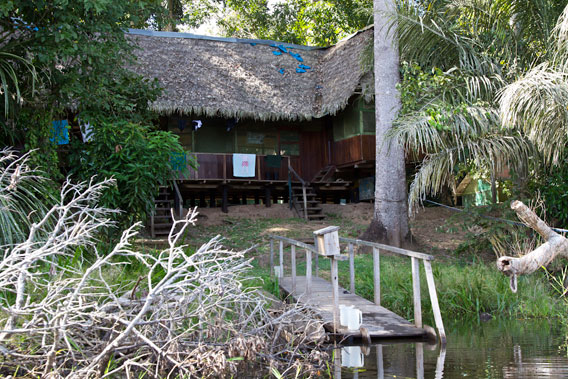
Cocha Cashu bath house. Photo by: Ken Bohn of San Diego Zoo Global.

Urge Brazilian President Dilma Rousseff to save the Amazon rainforest

14th December 2011LinkSource: The Ecologist

The new Brazilian Forest Code proposes to relax land regulation in the Amazon rainforest which will increase logging, cattle ranching and other destructive activities. Tell President Dilma to veto the decision before it is too late

The Amazon rainforest is the world’s largest tropical rainforest covering half of Brazil. It has been described as the lungs of our planet producing about 20 per cent of the world’s oxygen and may house half of all plant and animal species.

More than 20 per cent of the Amazon has been destroyed or deforested for cattle ranches, mining operations, logging or agriculture. Dating back to 1965, the Brazilian Forest Code restricts the amount of forest that can be cleared, establishes general regulations of land use, and determines valid areas for farming and timber exploitation. A New Forest Code agreed by the Brazilian Senate last week (6th December) could see regulation relaxed, opening up an additional 55 million hectares, the size of France, for logging, cattle ranching and other destructive activities. Additionally, it creates an amnesty for illegal deforestation that occurred prior to 2008.

The mandate came about amidst the United Nations climate talks in Durban where Brazilian delegates agreed to a 2020 target to cut its green house gas emissions by 40 per cent and reduce deforestation levels in the Amazon by 80 per cent (from a 1996-2005 baseline). Many environmental groups, such as Greenpeace and the WWF see the New Forest Code as undermining global efforts to combat climate change and regressive to Brazil’s environmental achievements.

There is still hope. The mandate must be passed to and accepted by President Dilma Rousseff. Greenpeace have set up a campaign to urge president Dilma to veto the New Forest Code and to 'protect this irreplaceable resource.’

Western Amazon becomes Ground Zero for Logging

13 Dec 2011
Source: Cool Earth


The rainforest charity Cool Earth is aiming to triple the amount of rainforest they are protecting in Peru to tackle increasing deforestation levels.

The Western AmazLogging in Peru on is fast becoming ground zero for deforestation as logging shifts from Asia to the Amazon to satisfy the increasing timber demands of Korea and China.

Recent announcements by the Brazilian government have highlighted the success of Brazil in curbing their deforestation levels. Deforestation rates dropped 10.9 per cent on the previous year to 6,238 square kilometres between August 2010 and July 2011.

However, Brazil's success in curbing their deforestation levels has added increasing pressue to other rainforest countries to the North and South of Brazil. Guyana has seen deforestation rates triple in the last year whilst Peru has seen a sharp increase in deforestation levels since 2005.

Working on the arc of deforestation in the Western Amazon, Cool Earth is forming a protective shield to halt the advancement of logging into the pristine rainforest behind. In the next eighteen months Cool Earth is working to triple its projects in Peru to bring the escalating deforestation rates under control. Link

Monday, December 12, 2011

Brazil cracks down on illegal logging in Amazon

9 Dec 2011
Source: AFP

A municipal brigade member watches logs at an illegal sawmill in Valdinei Ferreira Jango (AFP/File, Lunae Parracho)

Brazilian authorities on Thursday wrapped up a major operation against illegal logging in the Amazon, seizing thousands of tons of precious timber amid growing frictions over land conflicts in the region.

Operation "Captain of Forest 2" involving federal police, the military as well as experts from several forest protection agencies began on November 18 in this municipality of the northern state of Para.

Authorities said they seized 3,000 cubic meters (105,944 cubic feet) of timber logs worth $2.5 million and six tractors. An illegal lumber yard was also shut down.

More than 90 percent of the logs seized were of ipe wood, a large tropical hardwood tree prized for its durability, strength and natural resistance to decay and insect infestation, they added.

Ipe, an endangered species with the alluring nickname "Amazon gold," is worth more than $1,300 per cubic meter.

The Amazon is the world's largest tropical rainforest, and its protected areas in Brazil cover more than 2.1 million square kilometers (814,000 square miles).

Valdinei Ferreira, the man suspected of large-scale illegal logging in the area, is still at large and was fined only $1 million.

"A large part of the timber illegally logged is for export and leaves from the port of Belem," the capital of Para state, said Davi Rocha, head of IBAMA, the Brazilian government's environmental protection agency, in Itaituba in the southwest of Para.

IBAMA, established in 1989, has played a key role in deterring deforestation.

An environmental crimes law passed in 1998 gave the agency new enforcement powers, which it has used, albeit selectively according to environmentalists, in raids aimed at arresting and fining the most blatant violators of the law.

Experts believe that 40 to 60 percent of the timber extracted from the Amazon is illegal, compared with more than 80 percent 10 years ago.

Ghilherme Betiollo, an expert at public forest protection agency ICM Bio who coordinates the anti-logging operation, explained that protected areas are now swarming with illegal loggers who are blocking access to prevent control operations by authorities.

In 2009, Amazon lumber represented a $2.5 billion market, according to a study by the Imazon institute and the Brazilian forestry agency.

But the government presence in the area is largely insufficient. In Trairao national park, just two officials of ICM Bio must monitor 257,000 hectares (635,000 acres), and in the Riozinho do Anfrisio park two other must keep an eye on 736,000 hectares.

Last October a community leader protesting illegal deforestation was shot to death, the eighth environmentalist farmer to be killed since May in Para state.

Joao Chupel Primo, 55, was killed "because he condemned illegal deforestation in Itaituba," according to pastoral Land Commission spokesman Gilson Rego.

The alleged killer, identified as Carlos Augusto, was arrested.

Yet the local population appears divided over the issue. Some back the official campaign against deforestation.

But others fear reprisals from the illegal loggers, who are armed with guns and global positioning satellite locators, and others see the activity as their only source of income.

"We get involved in logging because the enemy is stronger than us. Here we don't even have a police station," said 41-year-old Moises Rodrigues, who lives in Areia, near Trairao.

But Maria Silva, 60, says logging means work for many local residents.

"Without the loggers, we don't know what we would do," she added.

Why deforesters could soon have freer rein in the Amazon

December 9, 2011
Source: Christian Science Monitor


The Código Forestal or Forest Code now being debated in Congress will determine the future of Brazil’s forests, including the world’s last great rainforest, the Amazon. In order to make good on a 1965 forest code that was rarely if ever enforced, President Dilma Rousseff introduced strong legislation in 2010. Legislators in the Lower House then weakened the bill substantially, and after being approved with minor alterations in the Senate, it is now heading back to the Lower House for congressional sanction.

The bill “constitutes one of the worst regressions for environmental legislation in Brazil,” according to Marina Silva, the rebellious Minister of the Environment under President Luiz Inácio Lula da Silva and the third place candidate in the last presidential election. The Forest Code’s policy example illustrates how representational democracy is not translating citizen interests into law, a universal problem that travels far beyond Brazil.

What Brazilians Want Done

One the country’s leading pollsters surveyed 1,268 citizens across Brazil about the Forest Code in early 2010. They found high public approval for harsh measures against illegal forestry, as reflected by the bill President Rousseff sent to Congress in early 2010. An overwhelming 98 percent of respondents supported the President’s measures and rejected a proposed amendment in the Lower House to grant amnesty for offending deforesters. It is estimated that amnesty for those who deforested between 1998 and 2009 will disclaim 8 billion reais, according to Greenpeace – a huge loss for tax payers.

Yet despite overwhelming public opinion in favor of stricter environmental measures, a huge loss in tax revenue, and the principle of accountability – making lawbreakers pay for their actions – legislators chose to favor the interests of big agro-business. No wonder – the Folha de São Paulo recently reported that agro-interests spent over 15 million reais (nearly $9 million) to stuff the party coffers of 50 representatives deliberating on the bill. Donating companies spent 42 percent more on lobbying in the past two years than they contributed to candidates during the entire 2006 presidential election. The largest donor was the cellulose industry (paper), which donated 4.7 million reais. Influential governors, such as Bahia’s Jacques Wagner (PT), received 4 million reais.

A Weaker Forest Code

In addition to the blanket amnesty for deforesters, the bill as it now stands has substantially weakened the original presidential proposal. Whereas deforested river banks had to be re-planted 30 meters back from the edge of ‘peak’ water levels, the new bill stipulates 15 meters from ‘average’ river heights. To comply with the legal forest reserve quotas – 80 percent forested in Amazon, 35 percent in the Amazon highlands, and 20 percent in the rest of the country – land owners may now use 50 percent ‘exotic’ trees for re-plantation, which opens up the possibility of mono-culture fruit orchards.

Given the way that representatives take action contrary to the expressed public interest, i.e. that business interests trump public interests, news that deforestation in the Amazon has ‘slowed’ this year by more than 10 percent gives us little reason to be hopeful for the future of Brazil’s forests. Brazil needs to adopt and enforce mechanisms to ensure greater accountability – such as lobbying regulation – if true representational democracy is to take hold and do what is right for the country and the planet.

Brazil's Para state rejects three-way split: official

11 Dec 2011
Source: AFP

Para state inhabitants line up to vote at a primary school (AFP, Lucivaldo Sena)

Voters in the Amazonian state of Para on Sunday rejected a proposal to split Brazil's second biggest state in three, authorities announced.

With 4.37 million votes -- 90 percent of the total -- counted in the landmark referendum, more than 67 percent rejected creation of a new state of Carajas and nearly 67 percent opposed establishment of a new state of Tapajos, they said.

The official results were jointly announced by the president of the Higher Electoral Tribunal, Ricardo Lewandowski, and by Ricardo Nunes, head of Para's Regional Electoral Tribunal, the official Agencia Brasil reported.

Speaking earlier in the state capital Belem, Lewandowski hailed the plebiscite as "a historic moment."

"It shows that Brazilian democracy is mature and strengthened," he told reporters.

Under the breakup plan, a truncated Para with Belem as its capital would have been left with 17 percent of the territory but 64 percent of the population.

Tapajos, home to large protected indigenous and forest areas, would have ended up with nearly 59 percent the territory and only 15 percent of the population.

Carajas would have been awarded 24 percent of the territory and 21 percent of the population.

The Brazilian media had portrayed the referendum as a feud between Belem, the state capital, and the Para hinterland, which feels marginalized.

Critics of the division, concentrated in the Belem area, argue that a split would saddle the new states with deficits and would create new expenses for the federal government.

If the yes vote had won, dividing the state -- which has a population of more than seven million -- would have still required approval by both chambers of Congress and President Dilma Rousseff.

Spread across an area more than twice the size of France, Para ranks second only to Amazonas, the country's largest state, and includes more than 74 million hectares (183 million acres) of protected areas.

Both are part of the Amazon region, the world's largest tropical rainforest and one of the world's largest reserves of fresh water.

In 1988, Tocantins, also located in the Amazon region, became the newest Brazilian state when it was created out of the northern part of Goias state.

Brazil, with a total population of more than 191 million people, has 26 states and one federal district which contains the capital, Brasilia.

Saving the Amazon, from forest floor up

Saturday, December 10, 2011
Source: San Francisco Chronicle


Just three years ago, the manmade fires here were so fierce smoke would blot out the Amazon sky, turning the days dark. Towering rainforest trees exploded in flames, their canopies cleared to let pasture grow for cattle.

The ash that snowed down onto this jungle town was shin-deep. Dirty layers hid red-hot timber chunks, glowing coals that burned the bare feet of children walking through the cinder drifts.

Paragominas was losing forest faster than nearly any other place in the Amazon.

Today, the town has risen from those ashes to become a pioneering "Green City," a model of sustainability with a new economic approach that has seen illegal deforestation virtually halted. Experts say the metamorphosis is the best hope for showing the 25 million people who live in the Amazon that the forest is worth more alive than dead.

The transformation came after Brazil cracked down on 36 counties responsible for the worst deforestation in the Amazon. A resulting economic embargo left the town with two options. It could fight against change, or it could embrace a new path and promote development with minimal harm to the environment.

Mayor Adnan Demachki is the unlikely environmental warrior driving the change, a plump 46-year-old bespectacled lawyer who grew up here, and was mayor when his town was one of the worst deforesters.

"Our city was on the government's 'black list,'" Demachki said. "There was no way out other than the new path we had chosen."

His "Green City" plan aims to halt all illegal deforestation through a mix of enforcement, the creation of the Amazon's only local environmental police force, and promotion of an economy that doesn't rely on clearing jungle. Instead, the focus is on sustainable development — using managed forestry for a wood industry, and introducing modern farming techniques to increase production while using less land.

In the past year Demachki's success has earned him high praise from environmental authorities that once harshly criticized his town. He's been featured on Brazil's biggest TV news programs and traveled around the country to spread the gospel of his Green City.

"Paragominas is an example of how to successfully overcome deforestation and begin the transition to an economy that conserves the forest," said Mauro Pires, head of the Environment Ministry's department that fights Amazon destruction. "They changed their stance and followed their leaders down an alternative path, one that coexists with the forest."

The Amazon rainforest is arguably the biggest natural defense against global warming, acting as a giant absorber of carbon dioxide.

As it's cut, the world not only loses this defense, but the destruction itself adds to the problem. About 75 percent of Brazil's emissions come from rainforest clearing, as vegetation burns and felled trees rot. That releases an estimated 400 million tons of carbon dioxide into the atmosphere every year, making Brazil at least the sixth biggest emitter of the gas.

Nearly 20 percent of Brazil's Amazon has been cleared.

The destruction began in force five decades ago, when Brazil's government gave away free land to those who agreed to clear 50 percent of their plot, and incentives didn't end until the 1990s. Endless waves of migrants followed, carving a livelihood out of the jungle. Wood cutters, ranchers and grain farmers chewed up virgin jungle along the Amazon's southern border, a yawning 2,600-mile upside-down arc stretching between Brazil's western and eastern borders, the distance between New York and San Francisco.

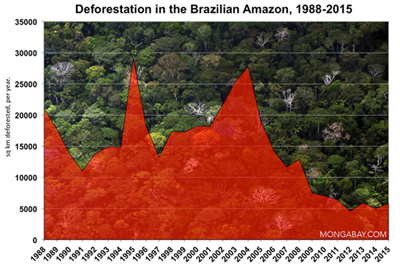
The global economy's growing demand for hardwood timber, soy and beef pushed deforestation into overdrive, hitting a peak in 1995 when 11,220 square miles (29,060 square kilometers) were razed. The vast majority of the deforestation was against the law. But less than 5 percent of the land is deeded, and enforcing environmental laws is difficult when authorities cannot prove who owns it.

The Amazon is the size of the U.S. west of the Mississippi River, and much of it is wild, ruled by the gun in the absence of governmental and legal institutions. More than 1,150 rural activists have been murdered in the last 20 years by gunmen hired by loggers to silence voices decrying illegal cutting. Only a handful of those responsible are in jail.

Its massive expanses and wild nature make it impossible to uniformly enforce environmental laws. Under pressure from the nation's agricultural lobby, Brazil's Senate passed a bill last week that would loosen those laws. The bill is expected to pass both houses within weeks.

The Paragominas experiment is significant, experts say, because it shows it's possible to convince people at the local level that saving the forest is in their best interest.

In 2008 the Brazilian government for the first time set a concrete goal to decelerate rainforest destruction, aiming to reduce it to 1,900 square miles (5,000 square kilometers) by 2017. Armed field agents targeted Paragominas and others on a blacklist of 36 counties, handing out massive fines, confiscating cattle herds and shutting sawmills.

In Paragominas, home to about 100,000 people, federal agents closed nearly 300 illegal sawmills. The town lost 2,300 jobs within a year and the federal government cut off agricultural credits.

Paragominas leaders knew they had to change. So they took an unheard-of leap of faith in the Amazon: they asked the very environmental groups that had been castigating them to help them go green.

Thursday, December 8, 2011

Brazil passes controversial Forest Code reform environmentalists say will be 'a disaster' for the Amazon

December 06, 2011
Source: mongabay.com

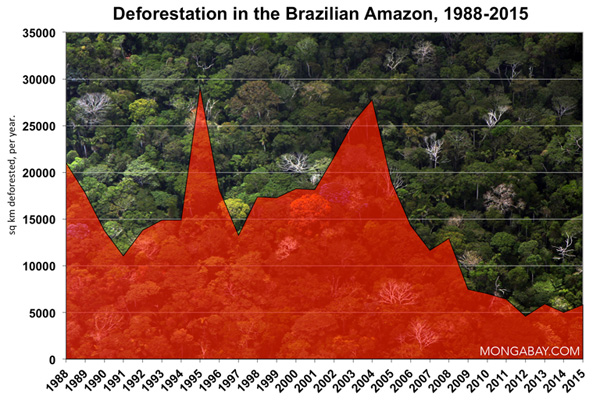
Deforestation in the Brazilian Amazon, 1988-2011. Photos by Rhett A. Butler.

The Brazilian Senate tonight passed controversial legislation that will reform the country's 46-year-old Forest Code, which limits how much forest can be cleared on private lands. Environmentalists are calling the move "a disaster" that will reverse Brazil's recent progress in slowing deforestation in the world's largest rainforests.

The revised Forest Code — which passed the Senate 58-8 — reduces the amount of forest cover landowners are required to maintain and grants amnesty for farmers and ranchers who illegally cleared forest prior to July 2008. Those landowners — provided their properties are less than 400 hectares (988 acres) — won't be required to replant forest to bring their land up to the legal requirement. Larger properties will have 20 years to come into compliance or can offset deforestation by renting or buying a nearby parcel of forest.

The new Forest Code maintains pre-existing forest cover requirements, which range from 20 percent in the drier cerrado to 80 percent in the Amazon rainforest, but landowners are now allowed to count compulsory forest cover along rivers and hillsides as part of their legal reserve. The revision also reduces the required margin along waterways from 30 meters (100 feet) to 15 meters (50 feet).

The revision is not yet law however. It still needs to be approved by lower house of Congress — where it is expected to pass easily — and President Dilma Rousseff who is under intense pressure from environmentalists to keep a campaign promise not to grant amnesty for past deforestation or let rainforest destruction rise. Rousseff however is likely to approve the measure next year, putting Brazil in an awkward position as host of Rio+20, a major environmental conference to be held in Rio de Janeiro in June. Environmentalists are planning to make the Forest Code a top campaign target ahead of the conference.

Accordingly, green groups immediately decried the changes.

"We're at a time in history when the world seeks leadership in smart, forward-thinking development," said WWF International Director-General Jim Leape. "Brazil was staking a claim to being such a leader. It will be a tragedy for Brazil and for the world if it now turns its back on more than a decade of achievement to return to the dark days of catastrophic deforestation."

WWF estimates that the revised Forest Code will reduce forest cover in Brazil by 76.5 million hectares (295,000 square miles), an area larger than Texas.

But the powerful agricultural lobby that pushed the bill through the Senate claimed the new Forest Code would help protect the environment, while facilitating rapid agricultural expansion.

"Approval of this project ends the dictatorship represented by a half-dozen non-governmental organizations controlled by the Ministry of Environment and makes clear that the environmental question is for everybody," Senator Katia Abreu, one of the strongest voices in supporting the bill, was quoted as saying by ABC.es.

"The environment is an essential part of agriculture. We are more dependent on nature than any other economic activity, and we want our forests to remain standing," she added in a press release.

In making their case for reform, supporters of the bill said that because the Forest Code has been so widely flouted—more than 90 percent of landowners in the Amazon are operating illegally—a large component of the Brazilian economy is effectively “illegal”, undermining governance and efforts to improve land management.

But governance is predicated on the political will to enforce the law, which is largely lacking across much of the Amazon. Claudio Maretti, leader of WWF’s Living Amazon Initiative, doubts that the new code will be accompanied by sufficient law enforcement.

"The new draft does not make enforcement any easier," he told mongabay.com prior to the passage of the bill. "It is more complicated, and has far too many exceptions. Nothing now seems to suggest that this version of the law will be better enforced."

Language in the bill that passed today does seem to strengthen enforcement capacity, at least on paper, giving more power to the country's environmental agency Ibama to investigate commodities produced in the Amazon.

The momentum to reform the Forest Code seemed to gather pace in part due to stepped-up law enforcement, including raids by Ibama and "blacklisting" of municipalities where deforestation was high. Blacklisted zones lost preferential access to credit until they complied with environmental laws. Facing with increased regulation, ranchers and farmers — especially in the state of Pará — launched a push to change the Forest Code. Now environmentalists fear the tide is turning against them, despite what they say is strong support from the public on stopping deforestation.

"80% of Brazilians are against the Code promoted by the rural sector - a project approved by 80% of the Chamber for Deputies," said Greenpeace Amazon team leader Paulo Adario. "Dilma will need to choose between 80 percents - those of the Brazilian population or those of the Brazilian Congress."

Roberto Smeraldi, the Director of Amigos da Terra - Amazônia Brasileira, added that the next 180 days would prove crucial in determining whether how the new Forest Code will impact forests in Brazil.

"One step backwards, with the amnesty, one step into the future, with an innovative package of economic instruments," he told mongabay.com. This legislation will lead to a number of judicial conflicts as far as implementation is concerned: a clear example is the rural registry [that has] just one georeferenced coordinate. The next steps include monitoring how government will detail, in 180 days, the plan for economic instruments: unless they are solid and significant, the chances of meaningful implementation would be much reduced."

The vote to reform the Forest Code came a day after the Brazilian government released preliminary data showing that deforestation in the Brazilian Amazon for the year ended July 2011 fell to the lowest level since annual record-keeping began in 1988. In 2009 then-president Luiz Inácio Lula da Silva set a target to reduce deforestation 80 percent by the end of the decade under a national climate plan that would cut greenhouse gas emissions 39 percent from a projected 2020 baseline. Brazil is presently ahead of its deforestation-reduction goals, although some question how much of the reduction is due to government action, and how much is due to macroeconomic factors.

"Deforestation in Brazil remains a serious problem despite the fall in rates between 2005 and 2010. Only part of this decrease was the result of government programs or stricter enforcement of environmental laws," eminent Amazon scientist Philip Fearnside wrote in an op-ed published last week in The Financial Times. "The main reason was that the international price of beef and soya fell from 2003 to 2007, and this was followed by the global economic collapse that began in 2008. Over that period, the Brazilian real almost doubled relative to currencies such as the US dollar. This cut the profits of commodity exporters deeply, as all their expenses remained in reals while their revenues were in diminished foreign currencies."

"Such macroeconomic 'windfalls' can help contain deforestation, but they are only temporary."

Brazilian bill weakens Amazon protection

07 December 2011
Source: Nature.com

The Brazilian Senate passed a bill yesterday that could affect global climate change as well as Brazil’s credibility as a nation committed to reducing deforestation. The Senate voted overwhelmingly to approve a new forest code, which eases regulations on how private landowners must preserve native forest.

The code has further polarized the country into 'ruralist' and environmentalist camps. It also has placed intense pressure on President Dilma Rousseff, who has pledged to veto the legislation. She is not considered an environmentalist, and has been generally pro-development, but she has honoured the pledge that her predecessor, Lula da Silva, made at the 2009 climate talks in Copenhagen that Brazil would slash deforestation by 80% by 2020. If Rousseff does veto the bill, she risks losing already tenuous support from the powerful agriculture lobby.

Some 70 amendments that were fixed to the bill must still be voted on, but sponsors of the legislation are expected to prevent any further changes to the bill’s central points. The measure will return to the lower house, which passed a version with even fewer restrictions on deforestation last May.

The country’s law governing forestry dates back to 1965 and made more stringent in the 1990s, with dramatic results. Annual deforestation in the Brazilian Amazon is now far lower than it was in 1995 (see Amazon deforestation declines to record low). Deforestation accounts for about 15% of global greenhouse-gas emissions and 75% of Brazil’s.

Restrictive and rigorous

Katia Abreu, a senator from the state of Tocantins and president of the Brazilian Confederation of Agriculture and Livestock (CNA) — a lobbying organization representing more than 5 million Brazilian farmers, calls the updated forest code “undoubtedly the most restrictive and rigorous land-ownership legislation in the world”. She says that the final text is not ideal but “is a step forward, especially given Brazil’s need to regulate food production and avoid deforestation”.

Most scientists, however, disagree. They argue that the new bill is too complicated to elicit compliance and doesn’t go far enough to protect the Amazon. Daniel Nepstad, an ecologist who works with the Amazon Environmental Research Institute (IPAM) in Brasilia, says that the new forestry measure could “unleash a wave of impunity” to wipe out forests and woodlands. The law would pardon landowners who illegally deforested before 2008, in effect granting them amnesty to try and encourage them to farm or ranch more sustainably in the future.

The new code could also legalize the clearing of more than 220,000 square kilometres — nearly the size of the United Kingdom — with no penalties, according to an analysis by researchers at the University of Sao Paulo. Brazil’s Amazon spans 5 million square kilometres, of which roughly 3 million square kilometres is intact forests, according to Luiz Antonio Martinelli, an ecologist at the University of São Paulo in Piracicaba who has analysed the legislation for senators.

Landowners will be required to keep between 20% and 80% of their land forested, with the largest set-aside applying to the Amazon rainforest. But the updated code exempts small properties of up 200 hectares from this rule. Those small farms account for 90% of properties in Brazil, although less than half of the surface area, according to Claudio Maretti, head of Washington DC-based conservation group WWF’s Living Amazon Initiative.
Rivers at risk

Another change weakens the status of Permanent Preservation Areas (APP), the ecologically sensitive areas along rivers and streams, on steep slopes and hilltops throughout Brazil. Conservationists are concerned that the pending law would reduce the width of preserved forested areas along rivers, for instance, from 30 to 15 metres. “These are areas of extreme importance,” says Maretti. “They protect soils from erosion, they keep floods from becoming more harmful, and they keep rivers flowing with some quality. They’re very sensitive and they’re under risk.”

The bill’s critics argued that it could not only accelerate climate change and further threaten the Amazon’s fragile ecosystems, but also erode Brazil’s reputation as a global leader in cutting greenhouse-gas emissions. One key test of Brazil's resolve will come next June, when the country hosts the UN Conference on Sustainable Development, known as Rio+20.

“I think Brazil will lose a lot of political bargaining power internationally,” says Martinelli. “On one side we’re doing a heck of a good job curbing Amazon deforestation. But at the same time we’re sending the wrong message by changing the forest code in a way that will increase deforestation again.”

Brazil forest code reignites Amazon fears

December 7, 2011
Source: Financial Times

High quality global journalism requires investment. Please share this article with others using the link below, do not cut & paste the article. See our Ts&Cs and Copyright Policy for more detail. Email ftsales.support@ft.com to buy additional rights. http://www.ft.com/cms/s/0/19374ef0-2103-11e1-8133-00144feabdc0.html#ixzz1fwh3mHxv

Brazil’s senate has passed a landmark forest code that had caused a heated debate between environmentalists and landowners over the future of the Amazon rainforest.

Environmentalists say the new law amounts to an amnesty for illegal clearing by ranchers, while proponents say it provides much-needed legal certainty for farmers in the world’s largest producer of coffee, sugar, beef and orange juice.

“I would like to tell you something: this is not the code of my dreams. This is was what was possible and I believe this is as good as we could get,” said Jorge Viana, the senator from the Amazonian state of Acre who oversaw the passage of the law through Brazil’s upper house.

The bill, which has yet to be signed by President Dilma Rousseff, updates a 1965 law that severely restricted the amount of land farmers can clear in Brazil but which was widely flouted.

The fierce debate over the issue in Brazil comes as the world’s big economies are discussing a global deal to combat climate change at United Nations-backed talks in Durban, South Africa, this week.

Brazil has made strides to reduce the destruction of the Amazon, seen as one of the world’s main bulwarks against climate change, with deforestation falling to its lowest levels since state monitoring began in 1988 in the 12 months until the end of July.

But environmentalists warn that the forest faces multiple threats, ranging from logging, ranching and degradation from fires to climate change itself in the form of higher frequencies of floods and droughts.

An earlier version of the law, which was passed by the lower house, offered a sweeping amnesty for farmers who had illegally deforested before July 2008.

The Senate version has revised this but, out of about 55m hectares – an area the size of France – that would have had to have been reforested according to the old code, farmers will now have to restore only 24m ha, according to Mr Viana.

Farmers who illegally deforested before 2008 will not be required to pay billions of dollars of fines and will instead have time to allow regeneration of some of the areas that should have vegetation.

The law must now go back to the lower house, or Congress, where it is expected to pass virtually unchanged, before it goes to Ms Rousseff, who has veto power.

People familiar with her position say that while she opposed the earlier draft, which offered a fuller amnesty, she is unlikely to oppose this version, arguing that the amnesty has been removed.

“The people who talk about an amnesty are not speaking the truth,” said Mr Viana. “Farmers will have to reforest 24m hectares. If they do that, we will have the greatest reforestation programme in the world.”

But former environment minister Marina Silva, who during her term was credited with cracking down on illegal clearing, said the law amounted to carte blanche for landowners to continue clearing in the expectation of future amnesties.

“There is an amnesty. Why? If you have a tax bill, the fiscal authorities might give you a 10 or 20 per cent discount but a discount of more than 50 per cent is a different thing,” she said.

Tuesday, December 6, 2011

Amazon rainforest loss in Brazil drops to lowest ever reported

December 05, 2011
Source: mongabay.com

Deforestation in the Brazilian Amazon, 1988-2011. Photos by Rhett A. Butler.

Deforestation in the Brazilian Amazon fell to the lowest level on record between August 2010 and July 2011 according to preliminary data from Brazil's National Institute of Space Research (INPE).

Forest clearing during the period amounted to 6,238 square kilometers (2,408 square miles), down about 10.9 percent from a year earlier when 7,000 square kilometers were chopped down. 78 percent of deforestation occurred in Pará, Mato Grosso, and Rondônia, the states where the bulk of agricultural expansion is concentrated.

The numbers are based on Brazil's deforestation monitoring system called PRODES, which can detect clearing in patches down to 6.25 hectares (15.4 acres). The figures are preliminary — last year's deforestation data was revised upwards 8.5 percent this past October.

The data shows deforestation continues to decline in the Brazilian Amazon, which accounts for more than 60 percent of the entire Amazon rainforest. Annual deforestation last peaked in 2003 and 2004 when more than 25,000 square kilometers of forest were destroyed in both years.

The Brazilian government says enforcement efforts, combined with conservation initiatives and sustainable development programs, have contributed to the decline, but analysts contend that macroeconomic trends, including a strong currency, which reduces profits for Brazilian commodity producers, play a bigger role. Research published in 2010 attributed 37 percent of the drop in deforestation between 2002 and 2009 in the Brazilian Amazon to new protected areas.

Brazil did not release data showing forest degradation, which can be an indicator of future deforestation.

Deforestation near the BR-230 highway in Brazil. Courtesy of Google Earth.

Forest Code vote

Brazil's announcement came a day before the Senate planned to vote on a controversial bill that will revise the country's Forest Code, which limits how much forest can be cleared on private lands. The revision, which has been pushed by agroindustrial interests, would grant amnesty for past illegal deforestation (up until mid-2008), while reducing requirements for legal forest reserves and setbacks along waterways. Green groups fear the changes could spur an immediate increase in deforestation.

But another threat looms large over Earth's biggest rainforest: climate change. Scientists have repeatedly warned that higher temperatures in the tropical Atlantic will trigger rainfall shifts that leave much of the Amazon drier and more vulnerable to drought. And there are already signs these warnings should be heeded: in the past five years the Amazon experienced the two worst droughts ever recorded. Researchers say that deforestation and forest degradation will worsen the impacts of climate change by disrupting the hydrological functions of the forest. Such changes could have impacts on agricultural production in regions that currently rely on the Amazon for rainfall, including souther Brazil, Paraguay, and Argentina. Roughly 70 percent of South America's GDP is produced in areas within the rain shadow of the Amazon.

Britain spends £10m to stop deforestation in Brazil

04 Dec 2011
Source: Telegraph.co.uk

Britain is spending £10 million to stop deforestation in Brazil Photo: ALAMY

The money was announced by Caroline Spelman, the Environment Secretary, at the latest UN climate summit in Durban South Africa.

She said the money will stop illegal logging in the Cerrado, scrub forest in central Brazil that is rapidly being cleared to make way for food crops for the rich world.

It is part of a £2.9 billion climate change fund put aside by the UK Government to help poor countries adapt to global warming and cut carbon emissions up to 2015.

Environmentalists welcomed the cash but said if the UK really wants to save the forests then consumers have to stop eating cheap factory-farmed meat.

Much of the Cerrado is being destroyed to grow genetically modified soya, which is fed to pigs, chickens and cattle in the UK.

Traditionally the Amazon has been the frontline for battled over deforestation. But in recent years big farmers have moved into the Cerrado.

The huge forests, as big as the UK, France, Italy and Spain combined, is not as lush as the rainforest but contains one 20th of the world’s species including the rare giant armadillo and blue and yellow macaw.

Peasants and indigenous people are being cleared off the land to make way for the massive plantations.

Mrs Spelman said the money will support environmental registration of rural properties so that small farmers can stop the loggers coming in. It will also help peasant farmers restore vegetation on illegally cleared land and help them to prevent and manage forest farmers.

“The Cerrado is rich in biodiversity and yet, alarming, it has almost halved in size since, because of wild fires and the demand for agricultural products. If we’re going to stop the loss of biodiversity, we need to protect our forests – which house the majority of the world’s wildlife. We won’t succeed in tackling climate change unless we deal with deforestation,” she said.

The UK is pushing for a global agreement on climate change in Durban that would force all countries to reduce emissions.

The deal would include a new mechanism Reducing Emissions from Deforestation known as REDD.

The fund will hand out money to poor countries to stop deforestation.

The goal is to see global deforestation halved by 2020 and net global deforestation halted by 2030.

The UK has already handed out £300 million on top of the £2.9 billion for climate change to stop deforestation.

However there is already concern that Brazil, one of the main supporters on climate change, is reducing its targets on deforestation and other rainforest countries are plagued by corruption.

Friends of the Earth claim genetically modified soy grown on illegally cleared land is being fed to pigs and chickens on UK factory farms.

The charity say the only way to stop the problem is to reform subsidies so that farmers are encouraged to feed animals grass or locally sourced grains. Also consumers must eat less meat and cut out cheap factory farmed products.

Brazil Amazon deforestation 'at lowest level in years'

6 December 2011
Source: BBC News


Rainforest is cleared for timber or to make way for farming

The National Institute for Space Research said 6,238 square km (2,400 square miles) of rainforest disappeared between August 2010 and July 2011, a drop of 11% from the previous year.

The government says the fall is due to its tougher stance on illegal logging.

But in at least two states, Rondonia and Matto Grosso, rainforest clearance rose considerably in the past year.

The research institute has used satellite technology to monitor the rainforest since 1988.

Destruction peaked in recent years at 27,700 square km (10,700 square miles) in 2003-4.

The main causes of illegal clearing of the rainforest are cattle farming and agricultural crop production, as well as logging for timber.

Brazil's congress is due to debate a reform of land laws in the next few days which would reduce the conservation area.

The farming lobby says reform is needed as current regulations are a burden on production. But environmentalists say it would be a setback for efforts to preserve the rainforest.Link

Monday, December 5, 2011

Peruvian Amazon could become global centre of 'carbon piracy': report

Wednesday 30 November 2011
Source: guardian.co.uk

The Peruvian Amazon could become the global centre of 'carbon piracy' a report warns. Photograph: Ricardo Beliel/Alamy

The Peruvian Amazon is the new global centre of "carbon piracy", as banks, conservationists and entrepreneurs rush to snap up the legal rights to trade carbon, according to a report published today at the UN climate talks in Durban.

More than 35 major projects covering around 7m hectares of Peruvian rainforest have been set up to profit from the global voluntary carbon offset market and a proposed UN forestry scheme, say the report's authors, Peruvian group Asociación Interétnica de Desarrollo de la Selva Peruana (AIDESEP).

A UN scheme called Reducing Emissions from Deforestation and Degradation (Redd) allows countries that can reduce emissions from deforestation to be paid for doing so.

World leaders hope to conclude Redd negotiations at Durban next week, potentially opening up a vast new global carbon market for forest-rich countries.

But in a report that suggests that developing countries are not ready for Redd and communities are being pressured to sign agreements against their interests, indigenous leaders say companies, NGOs and individuals are are abusing illiterate communities and are only consulting people after projects have started.

The rush to sign up communities for carbon offsetting has so far been mainly seen in Papua New Guinea, Africa and Indonesia. But Peruvian indigenous leader say the rush in the Amazon has been like a "new fever", comparable to earlier attempts by international companies to find oil and grow rubber in the Amazon.

"NGOs, carbon consultants and investors are roaming the jungle in search of communities with carbon offsetting potential. In one case this even involved an effort to convince communities to sign away their rights to carbon in a contract with no defined end point," said Alberto Pizango Chota, the head of AIDESEP.

"Several of these deals are being conducted using strict confidentiality clauses and with no independent oversight or legal support for vulnerable communities. Some of these peoples are not yet fully literate in Spanish but are being asked to sign complex legal agreements in English," he said.

"At a local level many projects are shrouded in mystery. Information is guarded secretively by project developers, especially from indigenous organisations," says the report.

Of the 35 known projects, at least 11 are planned in officially recognised indigenous lands, but millions more hectares of tribal land that has not been recognised by governments could be the target of "a potential mass land grab" and conflict, says the report.

"In Loreto province alone there are hundreds of requests for environmental concessions by NGOs and private investors while thousands of hectares of indigenous territory applications remain unresolved."

Several British-based companies are said to be linked to offset deals, says the report. WWF and Cool Earth are seen by the authors as representing the more acceptable face of the rush, but others "involve long-term commercial contracts with communities whose terms are extremely favourable to external commercial interests and NGOs," says the report.

"The companies, NGOs and brokers are breeding, desperate for that magic thing, the signature of the village chief on the piece of paper about carbon credits, something that the community doesn't understand well but in doing so the middle-man hopes to earn huge profits on the back of our forests and our ways of life but providing few benefits for communities," said Chota.

People quoted in the report fear that carbon-offsetting and Redd might even be more dangerous to the communities depending on the forest than oil and gas exploration or logging because it will affect the whole Amazon.

"In the communities almost nobody knows what Redd is and there is a risk that the NGOs and the companies will arrive in the communities to cheat and enslave us. Many communities do not know their rights or the laws and are tricked. This is what happens with loggers," said one community leader .

Deforestation and forest degradation slows in Brazil's Amazon since August

December 02, 2011
Source: mongabay.com


Deforestation and forest degradation are down moderately from August through October 2011 relative to the same period a year ago, reports a satellite-based assessment released today by Imazon, a Brazilian group.

Imazon's near-real time system, which tracks change in forest plots 25 hectares (62 acres) or larger, found that 512 square kilometers of rainforest were cleared between August 2011 and October 2011, the first three months of the deforestation calendar year, which runs from August 1 through July 31 to coincide with the dry season when it is easiest to measure forest cover. The figure represents a 4 percent decline from the 533 square kilometers cleared in 2010.

Imazon's system also tracks forest degradation — including logging and fire damage — that often precedes outright deforestation. It recorded a 52 percent decline in degradation from 2,599 sq km to 1,246 sq km.

Overall Imazon estimated that deforestation and degradation in the Brazilian Amazon during the period committed 32 million tons of carbon dioxide to the atmosphere.

Satellite monitoring

The short-term systems used by Imazon and Brazil's National Space Research Agency INPE, which has its own platform, are less accurate than the systems used for tracking annual change in forest cover. These rapid systems are used mostly to identify deforestation hotspots so authorities, provided they have funds and political backing, to take immediate action to stop illegal clearing. The annual systems can identify areas of clearing down to 6.25 hectares (15.6 acres).

Critics of these deforestation tracking systems 𔄆 which are generally considered the best and most transparent national systems in the world 𔄆 complain that ranchers and farmers, wise to the limitations of satellite monitoring, have adapted their clearing practices to evade detection. As such, they contend that deforestation rates may be higher than reported. But researchers are working on more precise monitoring capabilities that would better reflect realities on the ground.

Trends in Amazon deforestation

Deforestation in the Brazilian Amazon has slowed significantly since last peaking in 2004. The Brazilian government says enforcement efforts, combined with conservation initiatives and sustainable development programs, have contributed to the decline, but analysts contend that macroeconomic trends, including a strong real, which reduces profits for Brazilian commodity producers, play a bigger role. Research published in 2010 attributed 37 percent of the drop in deforestation between 2002 and 2009 in the Brazilian Amazon to new protected areas.

The decline in deforestation rates in other Amazon countries has not kept pace with Brazil. For example, Peru has seen a sharp jump in deforestation since 2005 due to the paving of the Transoceanic highway, which has spurred conversion for cattle ranches and large-scale agriculture, mining, and logging. Guyana's deforestation rate more than tripled last year.

Commodity production — including cattle, soybeans, minerals, and timber — is the biggest direct driver of deforestation in the Amazon. Industries seeking to expand production are now exerting considerable political pressure to relax environmental laws. In Brazil, the agroindustrial lobby is pushing hard for an overhaul of the country's Forest Code, which limits the amount of forest landowners are permitted to clear. The proposed revision — which the Senate is expected to vote on next week — would grant amnesty for past illegal deforestation (up until mid-2008), while reducing requirements for legal forest reserves and setbacks along waterways. Green groups fear the changes could spur an immediate increase in deforestation.

But another threat looms large over Earth's biggest rainforest: climate change. Scientists have repeatedly warned that higher temperatures in the tropical Atlantic will trigger rainfall shifts that leave much of the Amazon drier and more vulnerable to drought. And there are already signs these warnings should be heeded: in the past five years the Amazon experienced the two worst droughts ever recorded. Researchers say that deforestation and forest degradation will worsen the impacts of climate change but disrupting the hydrological functions of the forest.

The Golden Curse of the Peruvian Amazon

November 30, 2011
Source: The Epoch Times

A gold miner uses a high-pressure hose to wash away the earth and get gold particles, inside a huge crater near Delta Uno, department of Madre de Dios, southeast Lima, Peru. (Dan Collyns/AFP/Getty Images

Madre de Dios, the name of a region in southeastern Peru bordering Brazil and Bolivia, is a very common designation for the Virgin Mary, meaning Mother of God in Spanish. In real life, however, Mother of God, used as an oath and not a name, expresses what intense and unregulated gold exploration and extraction are doing to this up-to-now privileged area in Peru.

Madre de Dios is a region rich in cotton, coffee, sugarcane, cacao, Brazil nuts, and palm oil. However, plentiful gold has attracted tens of thousands of illegal miners whose activities are having a deleterious effect not only on precious species in the environment but also on the health and quality of life of both native and new populations in the region.

Alluvial gold mining in Peru’s Amazon rainforest has rapidly spread in recent years, driven by the high price of gold. Although many jungle-mining concessions have been granted by the energy and mines ministry, the informal sector has grown out of control.

It is estimated that almost a quarter of the gold produced in Peru, the world’s sixth largest producer, is illegal. The majority of this illegal gold comes from the Madre de Dios region. Local nongovernmental organizations believe that there are up to 30,000 miners in the area.

Gold deposits are mined by both large-scale operators and small-scale miners who use hydraulic mining techniques and heavy machinery to expose potential gold-yielding gravel deposits. Gold is extracted by a sluice box, a piece of gold prospecting equipment that has been in continuous use for over a hundred years. The sluice box is used to separate heavier sediment and mercury is also used for amalgamating the precious metal.

Several studies have shown that small-scale miners are less efficient in their use of mercury than industrial miners. As a result, 2.91 pounds of mercury are released into waterways for every 2.2 pounds of gold produced. It is estimated that more than 40 tons of mercury have been absorbed into the rivers of Madre de Dios, poisoning the food chain.

Mercury not only contaminates waterways and becomes a serious threat to human health but is also a dangerous toxin to fish. Fish in the area contain three times more mercury than the safe levels permitted by the World Health Organization.

According to the World Wildlife Fund, “After fossil fuel burning, small-scale gold mining is the world’s second largest source of mercury pollution, contributing around one-third of the world’s mercury pollution.”

Mercury contamination is not the only drawback of small-scale mining, however. Another significant problem is the significant amount of deforestation it produces while clearing forests for the construction of roads to open remote areas to transient settlers and land speculators.

In addition, deforestation is the result of cutting trees to obtain building material and fuel wood.

The enormity of the damage has been documented in a study by American, French, and Peruvian researchers published in the peer-reviewed magazine PLoS ONE. According to the study, Using satellite imagery from NASA, researchers were able to assess the loss of 7,000 hectares (15,200 acres) of forest due to artisanal gold mining in Peru between 2003 and 2009. This is an area larger than Bermuda.

Jennifer Swenson, the lead author of the study, says that such enormous deforestation is “plainly visible from space,” and suggests that Peru should limit the importation of mercury.

In addition to these problems, illegal gold mining has significantly increased the number of 12-to-17-year-old girls and young women drafted by prostitution rings. These young women are brought from all over the country to brothels that have sprung up in mining camps. Many of the women that fall into these prostitution rings eventually disappear, and are never seen again. Miners also bring diseases to local indigenous populations.

While Peruvian authorities have sent almost 1,000 security forces to destroy river dredgers used by illegal gold miners in the Madre de Dios region even more drastic measures are needed, such as stricter vigilance and regulation. At stake is the survival of what has been recognized as one of the most biologically rich areas in the world.