Tuesday, August 31, 2010

Google Earth animation shows Brazilian plans to turn Amazon into 'series of stagnant reservoirs'

August 30, 2010
Source: mongabay.com

The decision last week by the Brazilian government to move forward on the $17 billion Belo Monte Dam on the Xingu river will set in motion a plan to build more than 100 dams across the Amazon basin, potentially turning tributaries of the world's largest river into 'an endless series of stagnant reservoirs', says a new short film released by Amazon Watch and International Rivers.

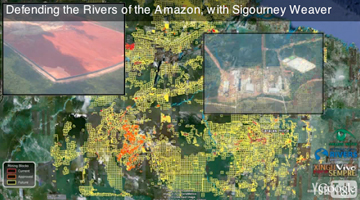
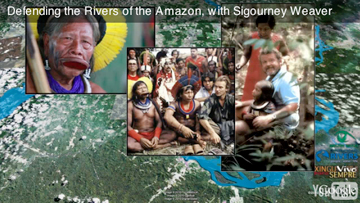
The film, narrated by Sigourney Weaver, uses a Google Earth 3-D tour to illustrate the potential impact of the dam. Belo Monte's reservoirs will flood 668 square kilometers, including parts of the city of Altamira, displacing more than 20,000 people. It will reduce the flow of the mighty Xingu to a trickle during parts of the year, reducing water supplies for downstream indigenous populations, blocking fish migration thereby disrupting local fisheries, and likely condemning several aquatic species to extinction. Flooding of forest areas will generate massive amounts of methane, a greenhouse gas 25 times more potent that CO2, and increase the risk of malaria in surrounding areas. Furthermore, if earlier dam projects in the Amazon are any model, Belo Monte will contribute to large-scale deforestation by local people who can no longer earn income from fishing or traditional livelihoods. Electricity grids, transmission lines, and access roads will put further pressure on the rainforest.

The Belo Monte Dam would be "a disaster for the Xingu River, for the rainforest, and certainly for all the indigenous people and families living along the river," said Weaver, an actress who starred in last year's blockbuster Avatar. "Their way of life will disappear."

Belo Monte has faced fierce opposition from indigenous people, activists, and even celebrities like Weaver and James Cameron, the director of Avatar, Titanic, and the Terminator series of movies. But the project is backed by powerful interests, including the mining sector: Belo Monte is being built to supply electricity for new mines in the Amazon. The video includes a "flyover" via Google Earth showing the nearby Carajas mine, one of the largest iron ore mines on the planet.

The 10-minute video, created by Amazon Watch and International Rivers with technical assistance from Google Earth Outreach, comes as part of the Altamira-based Movimento Xingu Vivo Para Sempre (Xingu River Forever Alive Movement) campaign against the dam.

Antonia Melo, a leader and spokesperson of the Xingu River Forever Alive Movement, said the video will help people better understand the impacts of the project.

"Even for people who live along the Xingu River itself, the impacts of damming the river are difficult to understand. This animation can help the local population visualize the potential damage caused by Belo Monte, and can encourage them to take action," Melo said in a statement.

Rebecca Moore of Google Earth Outreach said she hoped the video would lead to more engagement on the issue.

"Because Google Earth provides such a realistic model of the real earth, it can allow both ordinary people and decision makers to visualize and understand complex environmental and social issues more easily and deeply," she said in a statement. "Ideally, this can lead to a more informed and constructive dialogue, especially for controversial issues such as the Belo Monte Dam."

A Google Earth version of the video can be downloaded at Belo Monte Tour.

Belo Monte is among the most controversial of some 146 major dams planned in the Amazon basin over the next two to three decades. Earlier this month International Rivers launched a new website, Dams in Amazonia, outlining the sites and impacts of these dams with an interactive map.

Prized Bird and Wildlife Area in Amazon Headwaters Purchased With Help of

August 31, 2010
Source: Surfbirds News

American Bird Conservancy (ABC), the nation’s leading bird conservation organization, in cooperation with the Amazon Conservation Association (ACA), has helped finance the purchase of 7,427 acres of world-class bird and wildlife habitat in southern Peru that may contain the highest bird diversity for a single site in the world.

The area is within the spectacular 4.7 million-acre Manu Biosphere Reserve, which is one of the most pristine areas of remaining rainforest in the Amazon.

“We are thrilled to help finance the acquisition of this breathtaking area for conservation. For generations to come, people from all over the world will be able to visit and experience the diverse bird community and other wildlife the site affords,” said Daniel Lebbin, of ABC.

"Hacienda Villa Carmen is sited in an area of extraordinary biological richness, as it lies at the junction of the eastern Andean slope and the Amazonian lowlands. It is one of the least explored life zones of the western Amazon; birds new to science, and new trees are still being found in the area. We believe it has the highest single location bird diversity on the planet where more than 650 bird species can be seen on the property,” says Dr. Adrian Forsyth, President and Founder of the Amazon Conservation Association.

This large property, called Villa Carmen, is situated at the confluence of three rivers, with frontage on two: the Pini Pini and the Tono. The property also has numerous streams and waterfalls, an all-weather road, and a small airstrip. The land ranges from about 1,500 to 3,500 feet in elevation, and contains roughly 90 percent old-growth rainforest, with about five percent diversified agriculture and five percent secondary forest.

The property is adjacent to Amazonia Lodge, a popular birding destination along the Manu road with a bird list of over 600 species including several globally threatened species, such as the Black Tinamou, Military Macaw, Blue-headed Macaw, Wattled Guan and Solitary Eagle. The area also supports wintering habitat for a number of neotropical migrant songbirds. Wintering U.S. WatchList species of conservation concern include the Olive-sided Flycatcher, Cerulean Warbler, and Canada Warbler.

The area joins a growing list of protected areas within the ABC Latin American Bird Reserve Network that currently numbers 36 reserves spanning 700,000 acres in 12 countries. Plans for the new reserve include cooperative efforts with local communities in the area to help preserve the greater Manu ecosystem, stimulating a local conservation economy with demonstration projects in sustainable agroforestry and aquaculture, and hosting environmental education programs, while providing lodging for visiting birders. ABC has also helped protect land elsewhere in Peru through land purchases and concessions at Abra Patricia for the Ochre-fronted Antpitta, an easement at Huembo for the Marvelous Spatuletail, and helping communities establish their own reserves in Vilcanota for the Royal Cinclodes and other birds of Polylepis forests. Many of these efforts are being carried out cooperatively with ABC partner ECOAN – a leading Peruvian conservation organization. Traveling birders interested in visiting Abra Patricia or other reserves should visit www.conservationbirding.org.

SCIENCE: effects of 7.1M Earthquake on Amazon Rain Forest?

Aug 30, 2010
Source: Allvoices

Ecuador's President Rafael Correa speaks near U.S. filmmaker Stone during local release of "South of the Border" in Quito

This very large earthquake just happened at 6:54 A.M., local time in Ecuador this morning, Thursday, 8.12.10. Because it occurred 131 miles deep beneath the Amazon Rainforest, it only caused buildings to sway 110 miles SE of the capitol, Quito. However, I am wondering if any TOURISTS were in the Amazon jungle, close to the epicenter? 90 miles East of Ambito. Since Ecuador borders Peru, those residents near the NW and Northern areas of Peru most likely felt it.

How does an earthquake throw the ecological balance off in such a complicated place as the Amazon Rain Forest?

A Gente Luta mas Come (We Struggle But We Eat Fruit) at the National Museum of the American Indian

Tuesday, August 31, 2010
Source: Washington City Paper

Brazil’s probably best known for its soccer players, supermodels, and steakhouses, but it’s also home to some 200 indigenous peoples, including nearly 70 completely isolated tribes, more than any country in the world. The Ashaninka people, who reside in the state of Acre near the Peruvian border, are the subject of the film A Gente Luta mas Come Fruta, or We Struggle But We Eat Fruit. Directed by Ashaninka brothers Bebito and Isaac Piãko, the documentary recounts how, when its existence was endangered by logging, the tribe organized a sustainable way of life on its patch of the Amazon rainforest. From a young age, Ashaninka children are taught that their place on earth is tenuous—the tribe is constantly under threat from loggers, oil companies, drug traffickers, and diseases brought by outsiders. It’s enough to make you sympathize with some Ashaninkas’ belief that remaining removed from the outside world is for the best.

Monday, August 30, 2010

Jump in fires in Brazil becomes Twitter sensation

August 27, 2010
Source: mongabay.com

The number of fires burning in Brazil more than doubled compared with the same period last year. Surprisingly, the news has sparked a Twitter sensation, with more than 120,000 users "tweeting" messages with the hashtag "#chegadequeimadas" about the fires in a 48 hour window.

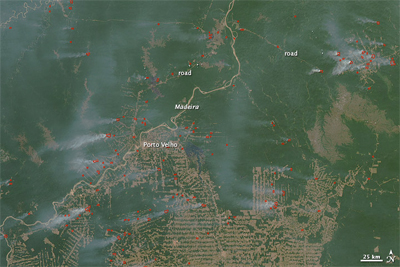
The phenomenon emerged after analysis of satellite data by Brazil's National Institute for Space Research (INPE) revealed the number of "hot spots" between Jan 1 and Aug 26 reached 41,636 in 2010, up from 17,682 for the same period last year.

Alberto Setzer, coordinator of INPE's fire monitoring program, blamed drier and warmer conditions, as well as socio-political factors, like higher commodity prices and upcoming national elections. Afraid of alienating key supporters in the agricultural sector, Setzer told Terra Brasil that politicians are laying off environmental law enforcement under after elections. Uncertainty about the Brazilian environmental legislation - including a possible weakening of the country's strict Forest Code - might also be having an impact.

Fires in the Brazilian Amazon are generally set by developers opening logged forests, deforested scrub, and grassland for pasture and agriculture. Under dry conditions fires often "escape" into adjacent rainforest areas, casting a pall over much of Brazil and in some years affecting transportation and air quality. Fires usually burn until September or October when the rainy season resumes. This year fires are especially concentrated in the drier, but more populated, northeastern and southern parts of the country.

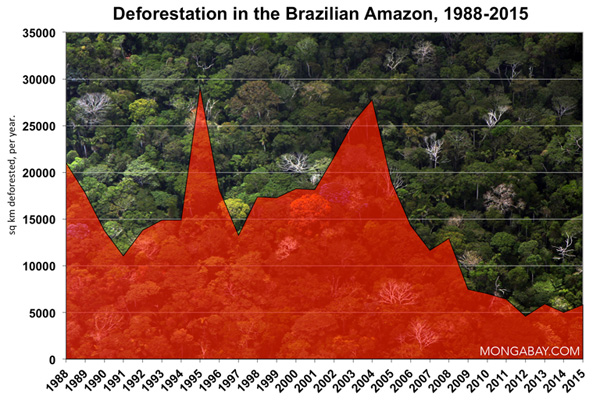
Despite the rise in burning, deforestation in the Brazilian Amazon is expected to be roughly the same as last year — around 7,000 square kilometers — when figures are released later this year. If the forecast is correct, it will continue a trend of markedly lower deforestation than levels seen from the 1980s until about five years ago.

Nevertheless environmentalists fear that a suite of proposed infrastructure projects could accelerate deforestation in the future despite a pledge by the Brazilian government to reduce deforestation significantly by 2018.

Brazil contains the bulk of the world's remaining tropical rainforest, but substantial parts of the country are covered with cerrado grassland, which is more susceptible to fire than forest.


INPE data on accumulated burning, 2005-2010

Was baby Cameron's green gift a good choice?

25 Aug 2010
Source: The Guardian

An acre of rainforest has been sponsored in baby Cameron's name. Photograph: Ricardo Beliel/Alamy

Fittingly for the daughter of a family who gave their home an energy efficiency overhaul and whose Dad promised the greenest government ever, one of Florence Rose Endellion Cameron's first gifts is an ecologically minded one. Not just an organic cotton babygro, a wooden toy made from sustainable timber or a wind-up-powered mobile – but an acre of rainforest.

The gift came from Frank Field, the Labour MP who was appointed by David Cameron to lead an independent commission into poverty. Field sponsored the spot of Amazon rainforest through the charity Cool Earth, which enables individuals to sponsor plots of rainforest to protect them. The TV gardener Joe Swift and designer Vivienne Westwood are among the charity's fans, but not everyone is so keen: some have called it a form of neo-colonialism. Interestingly, deforestation in Brazil is also currently showing a dramatic decline.

But Matthew Owen, Cool Earth's director, is understandably very pleased. "Frank Field organised an acre of rainforest to be sponsored in the name of David Cameron's new baby as a gift to mark this wonderful occasion," he said. "As the hospital where Samantha Cameron is recovering is on the doorstep of Cool Earth's offices in Cornwall, I delivered the gift in person on behalf of Frank who sent his very best wishes."

Buying presents for newborns is tricky at the best of times (have the parents already got 15 bibs and muslins? Will the parents get sniffy about plastic toys?), but I think Field has made a clever choice with his gift. As well as a hopefully positive ecological impact, as a virtual gift it has impeccable green credentials.

What do you think – did Field get baby Cameron's present right? And what other green baby gifts do you recommend from experience?

• This article was amended on 26 August. It originally said individuals could buy an acre of rainforest.

Brazil: Ministering by boat – helping the Capuchin Fathers in the Amazon region

30/8/2010
Source: Aid to the Church in Need

Water, water, everywhere... Relentlessly, the Rio Solimões snakes its way through northwest Brazil, from the Peruvian frontier until it merges with the Rio Negro, close to Manaus. From this point the river is definitively named the Amazon – a river with many names that has produced a quite unique wetland region, ringed by luxuriant tropical rainforest. In several places the river is miles wide, featuring many interwoven streams and vast lakes.

On the banks of the Solimões thousands live, some in permanent settlements, many others, however, in small clusters of just a handful of huts. The people are poor and generally live by fishing. They are of the most varied origins – some are native Indians, some the descendants of plantation workers, drawn here at the time of the rubber boom at the beginning of the 20th century. Fr Gino Alberati, a Capuchin Father, knows them in detail. "There are 14 different ethnic groups living along the river", this Italian born priest explains, during a visit to the headquarters of the international Catholic charity Aid to the Church in Need (ACN). "They are simple, honest people", adds Fr Gino, who after over 30 years now looks on the Rio Solimões as his home.

This 69-year-old priest currently ministers to 27 riverside communities from his mission centre at Santo Antônio do Içá. It is a town of 35,000 souls, situated at the point where the Rio Içá joins the Solimões. But Fr Gino is not only familiar these two rivers, for his mission territory covers hundreds of kilometres – along the Rio Solimões, the relatively densely populated Iça and the Javarí, a river that also forms the frontier with Peru.

Since 2004 Frei Gino has had at his disposal a 50 foot motor launch, the “Fraternidade Itinerant”“, which roughly translates as "travelling brotherhood". ACN was able to fund the purchase of this boat for him, thanks to the generosity of its benefactors. This costly investment of over $140,000 has more than paid off by now, for it has given an enormous boost to the pastoral care among the riverside communities here in the upper Amazon region.

In his “Fraternidade Itinerante”, Fr Gino often spends days on the water. More recently, and so that he can reach the faithful at low water times as well, he has also purchased a 12 foot speedboat, which he has registered in the name “Father Werenfried”, and which travels with him as a shore boat. Via this boat apostolate, Frei Gino is able to visit the communities, as he has done for years, baptising children and adults, celebrating Holy Mass with them, conducting weddings and hearing confessions. He is also very much involved in the youth apostolate and in marriage preparation. For the catechists who support him in his work he offers regular training courses. Many of his activities, including celebrations of Holy Mass, take place on board the “Fraternidade Itinerante”, which has now served this missionary for years as his "presbytery".

At the same time, Fr Gino is much sought-after as an advisor in all life issues, from agriculture through to natural family planning. Everyone who turns to him receives an answer, and no one is turned away, even if he has only come to ask a favour – such as a lift to the next town for example. Fr Gino regularly carries passengers who simply cannot afford the expensive commercial ferry operators. And he is also there to help in emergencies. Just a few weeks ago he was able to get a child to hospital, who had been bitten by a snake. Without this opportunity of travelling by boat, the child would not have stood a chance.

Given the growing workload on the Solimões, Içá and Javarí, his boat is now to be extended and a second boat built. The “Fraternidade Itinerante” has an aluminium hull, making it light and yet strong enough to withstand the half-submerged logs floating downstream, but it is also a little on the short side, as has become evident with daily use. At higher speeds, the powerful motor pushes the bow of the boat too far out of the water, making it less stable and so hindering progress. To overcome this defect, the boat will therefore be extended by some 4 metres. The second boat is already being planned with a length of 19 m (about 63 ft).

Once again, ACN has been asked to help fund the cost of this second boat. Once it is built, the boat will be used by the Capuchin Fathers of Benjamin Constant, a town on the Solimões, right on the border with Peru, for their pastoral work in that area. It will assist them greatly in their task. From Benjamin Constant they travel out to visit the communities on both the Brazilian and the Peruvian sides – on the Peruvian side at the express wish of the local bishop.

If Fr Gino’s wishes are granted, the “Fraternidade Itinerante” will be refitted as quickly as possible, and the new boat will also be available, perhaps even by January 2011. If so, then the Capuchin Fathers will be able to launch their “Projeto Javarí” – a 40 day mission outreach that is being supported among others by the Italian diocese of Assisi. It all began when the bishop across the border in Peru asked the Capuchin Fathers to minister to the Catholic faithful on the Peruvian side of the Rio Javarí, and especially to those living in the “Islandia“ settlement, a stretch that represents around eight hours journey time by motorboat. The “Projeto Javarí“ will involve not only catechists but also dentists and doctors in a preventative medical programme to cut the incidence of malaria among the local population. The bishop of the diocese of Alto Solimões, Dom Alcimar Caldas Magalhães, who is himself a Capuchin, is supporting the initiative.

Since its earliest days, ACN has helped with the provision of transport for pastoral work. In 1947 Father Werenfried van Straaten, the founder of ACN, first purchased motorcycles, with the help of his benefactors, for priests ministering to the refugees in postwar Germany. Soon larger vehicles were being converted into "chapel trucks" to serve in areas where churches had been destroyed or were otherwise lacking. Later, priests and religious in Africa, America and Asia were supported with, cars, bicycles and motorcycles. And in the 1990s ACN helped for the creation of "chapel boats" to serve isolated communities on the Volga and Don rivers in the former Soviet Union.

Gold rush is growing threat to Suriname rainforest

29 Aug 2010
Source: The Associated Press

PARAMARIBO, Suriname — It looks like a meteor strike: From out of nowhere, a huge clearing appears in the jungle — a deep rust-colored pit surrounded by mounds of dirt and thick stands of trees pushed to the side in dense piles of overturned soil.

But this is no act of nature. It is the result of the steady labor of fewer than a dozen barefoot men, who have blasted away at the earth for three days with high-pressure water hoses and earth-movers, searching for gold and destroying a swathe of rainforest.

The miners near a small town called Nieuw Koffiekamp, at the edge of Suriname's vast rainforest hinterland, planned to spend a week tearing into the soil and filtering it through toxic mercury. Then, they will start over again somewhere else.

Juergen Plein, a 29-year-old miner, said he needs the work, and doesn't know any other way to get at the precious metal.

"I think about it," Plein, nearly shouting over the roar of generators, said of the damage. "But survival comes first."

Thanks to record gold prices, hundreds of small-scale mining operations are proliferating along the northeastern shoulder of South America. Small-scale miners produced a record of nearly 16.5 metric tons of gold in 2009, according to Suriname's government.

Miners are tearing up trees, poisoning creeks with mercury and, in some places, erecting makeshift jungle towns with shops, prostitutes and churches. In their wake is a wasteland, said Dominiek Plouvier, regional representative of the World Wildlife Fund.

"All the top soil has been removed, it's finished," Plouvier said. "This ecosystem is very fragile. It is very difficult to get it back in these areas."

The miners, many of them illegal migrants from Brazil, are scattered throughout the northern Amazon basin, occasionally fleeing crackdowns by police or the military in Venezuela, French Guiana and Guyana. But nothing seems to stop them in Suriname, a country rich in resources with the weakest law enforcement in the region.

The new government that took power in August is expected to at least attempt to address the issue. Vice President Robert Ameerali said they will seek to reduce the use of mercury, which is illegal but widely available to miners who use it to separate gold from ore.

Mining consultant Chris Healy said Suriname should set aside areas for small-scale miners and regulate their activities, providing training and assistance to acquire less-polluting technology.

"You can make all kinds of laws and enforcement," he said. "But there is nobody there to enforce it."

An estimated 14,000 small-scale miners and service providers work in Suriname's interior, said Marieke Heemskerk, a consultant and anthropologist who has tracked mining in the country for years. The rampant and unrestricted subletting of mine concessions is illegal, but it's largely tolerated by the government — and it gives people work.

Mining is a touchy subject in Suriname, which has gained praise over the years from environmentalists for placing limits on logging and setting aside large rainforest preserves. The metal, shipped to refiners in North America and Europe, is one of the main exports in a largely poor country of nearly 500,000 people that is about the size of Georgia. It is an important source of income, particularly for Maroons, the descendants of runaway slaves, and Amerindians in the interior, who make money providing transportation or selling access to their land concessions.

In recent years, small-scale miners have grown more destructive as they use more heavy equipment such as earthmovers — flown into remote spots in the jungle or shipped down rivers — to work faster or in more remote, larger areas.

In a country with few real roads, it is difficult to find the mines. But from the air it's a different story.

Satellite analysis of the scarred earth and diverted waterways shows that miners in Suriname have deforested at least 30,000 hectares (74,000 acres) and damaged more than 2,200 kilometers (1,370 miles) of river over the past decade, Plouvier said. WWF estimates the small-scale mining is also responsible for some 20 tons of mercury entering the environment and posing a risk to people through fish consumption.

Some parts of Suriname have become like the Wild West, only with All-Terrain-Vehicles and satellite dishes.

Associated Press journalists visited a mining area about 100 miles south of the capital Paramaribo, reachable only by boat, followed by a bone-jarring ATV ride through the dense jungle.

All around were the huge telltale piles of discarded soil and open pits. In the middle of a network of trails was a town of sorts. The one-street settlement — more of an outpost in the jungle — was a dusty clearing and a line of simple, plywood structures. There were two markets, two churches and four bars, festooned with small Brazilian flags. In the lull of a rainy afternoon, bored prostitutes sat watching TV until the customers returned. Plastic bottles, beer cans and other trash was strewn about everywhere or smoldering in burning piles.

Ines Aboikonbie, who runs a bar with her Brazilian husband, said the settlement of about 200 will probably move soon along with the miners in search of gold.

The largest gold mine in the country, at Rosebel not far from Nieuw Koffiekamp, is run by Toronto-based IAMGOLD Corp. and employs 1,100 people. The mine produced nearly 12 metric tons of gold last year. But while all mining draws critics, environmentalists are more worried about the damage done by small operators over a wide expanse.

IAMGOLD spokesman Bob Tait said many people — including several hundred it accuses of illegally mining on its concession — prefer the informal sector because they like the flexibility and dream of finding riches. "Sometimes it's hard for us to compete," he said.

Plein, the miner at Nieuw KoffieKamp, is a thin man with a scraggly beard and dreadlocks pulled back behind his head. He said the amount his crew earns depends on how much gold they find and how much fuel they use trying to find it — they might gross $40,000 before paying for the equipment rental and dividing the proceeds. One of the biggest challenges, he said, is finding a place to search amid fierce competition and competing claims on land.

"It's hard," said Plein, a Maroon who grew up in the town of dirt streets and small wooden homes. "But I'm used to it."

Saturday, August 28, 2010

Exploring Ecuador, sans the Galapagos Islands

Friday, August 27, 2010
Source: Carroll County Times

GUAYAQUIL, Ecuador - No offense against the Galapagos Islands. Home to giant tortoises, blue-footed boobies, marine iguanas and other exotic creatures, the archipelago off Ecuador's coast ranks for me - and many other travelers - among the top places to visit before I die.

Yet with only two weeks to spend in Ecuador, we drew up an itinerary that bypassed the famous islands in favor of a whirlwind mainland trek that would take me and my husband from the mountains to the rainforest to the southern highlands and finally, the Pacific coast.

Skip the chance to see Lonesome George? Are we crazy? Was there even enough to see and do in a country the size of Colorado?

Ecuador may be one of the smallest South American countries, but its outsized natural and cultural wonders are unparalleled. Two weeks is just enough time to taste the Andean nation's offerings and still be hungry for more.

While Charles Darwin may have been enamored with the Galapagos, Ecuador offers far more. We ended up with an itinerary that took us to five very different places - Quito, the capital; a jungle lodge; the colonial city of Cuenca; the surf town of Montanita; and the country's largest city, Guayaquil.

We planned and booked our trip the hard way - on our own, using guidebooks, Internet reviews and word-of-mouth from friends who once lived there - and without the help of a travel agent or organized tour. The one exception was in Guayaquil where I have extended family who were eager to show us around.

Sometimes we winged it, showing up at a hotel without a reservation, and we used a variety of transportation - including planes, boats and buses - to travel from region to region. Our only requirement was that we experience the different Ecuadorean climes in one trip in an effort to sample the country's diversity.

Our Galapagos-free journey began in Quito, ringed by dramatic volcanic peaks and boasting a revitalized Old Town, a historic center of lively plazas, soaring churches and colonial architecture where we spent most of our time.

Several mornings, we sat on a bench in the Plaza Grande, the main square, and watched couples strolling hand-in-hand, men in business suits breezing by, indigenous women selling their wares and shoeshine boys looking to make a few quarters.

We stood in line for an hour to tour the Palacio del Gobierno - the Presidential Palace flanked by two modelesque uniformed guards - where we got a peek at the grandiose dining hall, the room where the president powwows with his cabinet ministers and a space filled with portraits of past Ecuadorean presidents.

For a bird-eye's view of the city, we hopped on the Teleferiqo, a gondola ride that takes passengers up the flanks of Pichincha volcano. Once at the top some 13,400 feet high, we climbed the trail to the volcano, but did not summit because of clouds and mist that obscured the view.

We soon traded the Andes altitude for the Amazon jungle, flying into the oil town of Coca. From there, we boarded a motorized canoe for a 2 1/2-hour trip up the Napo River to the Yachana Lodge, one of several eco-lodges overlooking the Amazon River tributary.

During a night hike and day trek into the rainforest, we encountered monkeys, toucans, bats, lizards and countless insects. We got our wildlife fix - even if it wasn't the Galapagos kind. Sand flies and other biting insects were annoying, but at least we did not have to worry about yellow fever or malaria (they're not present in the lodge vicinity).

After hiking, we visited a medicine man and tested our blowgun skills using a stuffed parrot as a target (I was 1-for-3; my husband 3-for-3.)

The lodge - with its comfortable rooms and private balcony hammocks - is operated by the nonprofit Yachana Foundation, which also runs a technical high school for indigenous and mestizo students living in the Amazon. Our stay coincided with the graduation - the third one since opening in 2005 - of several dozen students.

On our last night in the jungle, we and other guests were invited to an end-of-year party thrown by the teachers. With a single lamp lighting the volleyball court-turned-dance floor, throngs gyrated to Spanish and American pop songs.

From the rainforest, we flew south to the quaint colonial city of Cuenca known for its cobblestone streets and artsy feel. Our timing wasn't perfect since our only full day fell on a Sunday - a day when most museums and stores are closed.

We hit what we could, including the El Sagrario - the old cathedral turned religious museum - and the Museo de Arte Moderno (Modern Art Museum.) We spent part of the afternoon ambling the banks of the Tomebamba River and admiring the colonial houses that seemed to hang precariously over it, and passed some time on the steps of the neo-gothic Catedral de la Inmaculada Concepcion - the newer of two cathedrals in the main plaza.

Time to leave quaintness behind. We barreled west by bus to the sprawling seaport of Guayaquil, a jumping off point to the Galapagos. Instead, we took a three-hour bus ride up the Pacific coast past sleepy fishing villages to the surf town of Montanita.

High season here is December to May, so it was relatively quiet. But the warm water and rideable waves drew swimmers and surfers despite the drizzly weather. A surfer back home in California, my husband got to try a board made of balsa wood - a material widely found in Ecuador.

We circled back to Guayaquil after a brief beach stay. Ecuador's largest city has undergone a facelift in the past decade, shedding much of its rough-and-tumble image. Its refurbished waterfront boardwalk - known as the Malecon - is pedestrian-friendly and attracts locals and tourists alike.

North of the Malecon is the bohemian Las Penas, Guayaquil's oldest neighborhood housing art galleries and restored homes. We climbed the winding staircase - more than 400 steps - to the lighthouse where we were rewarded with stunning city views.

Guayaquil was the last stop in a packed two-week sojourn through Ecuador. Even after visiting five distinct places, there was still a lot left to experience: A spine-tingling bus ride down the Avenue of the Volcanoes; driving the length of the Ruta del Sol - Ecuador's version of the Pacific Coast Highway - and camping in the national parks.

And that's just on the mainland. The Galapagos is a separate story.

On our last morning in Guayaquil, we had breakfast at the Dulceria La Palma, a bustling old-school bakery/cafe, where locals order cooked eggs in a cup. Upon learning that we lived in Los Angeles, our waiter asked for my husband's autograph. He politely declined.

"La proxima vez," I said. Next time.

Perhaps next time we'll also make the detour to the Galapagos.

Peru's jungle treehouse

Saturday 28 August 2010
Source: The Guardian

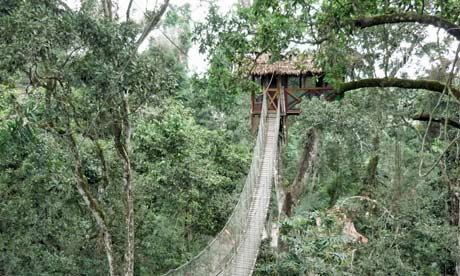
Jungle treehouse ... a bridge leads to the Inkaterra Canopy Tree House

The night before I flew to the rainforest, I stayed at a hotel in Cuzco. There was a startling mural stretching the length of the dining room which showed a fantasy of an Amazonian paradise: bare-breasted maidens bathing in idyllic pools surrounded by luxuriant greenery and compliant jungle animals; the only thing most were wearing was a pendant of vaguely Incaic design. Pass the jojoba shampoo.

I was not quite sure what I expected from the Amazon. It's become such a romanticised ecological symbol – a flagship of all we stand to lose – that it's hard to see the trees for the wood. Which is why I wanted to spend some time in them, on a small patch of land, a malaria-free reserve near the Peruvian town of Puerto Maldonado, close to the Bolivian border.

Specifically, I was headed for the Reserva Amazonica, where José Koechlin, the ecologist and hotelier who helped German director Werner Herzog with his epic films Fitzcarraldo and Aguirre: Wrath of God, has just built a bedroom 90ft up a tree.

When the lodge first told me I'd be sleeping up a tree, I had assumed it was Latin hyperbole; but no, there the treehouse was, clinging to the slender trunk of a cepanchila. To get there you had to climb a wooden tower and a series of rope walkways.

As first guest and "guinea pig" (not a comforting concept in Peru), I was issued with a panic button so that if necessary a member of staff could rush in, strap me to their chest and abseil down to the ground, like a ninja turtle. In the event I kept my finger off the button, although sleeping that high was certainly an intense experience. The nearest analogy I can think of is being in a small cabin at sea, with the wind and outside noise amplified, which was quite something the night a troupe of monkeys descended on the cabin, rattled the walkway and played on the roof. In the early morning, the dawn chorus was raucous and spectacular, from the horned screamer bird which some say sounds like a donkey drowning, to the "water dropping from a giant tube" gloop-gloop-gloop noises of the oropendola. There were also tree frogs that sounded exactly like digital cameras bleeping.

My guide Eric joined me in the treehouse at 5am so we could see the sun rise over the top of the Amazon rainforest. It felt Biblical, a moment of creation. I had become used to seeing the sun slowly filter its way to the forest floor – but above the canopy it came up fast, like a searchlight, and illuminated the heads of the matate and ceiba trees so that they looked like fibre optic lamps.

Eric pointed out a paradise tanager in a nearby tree, its blues startlingly vivid. He listed the ways in which the locals could survive: by logging or gold-panning, which was environmentally destructive; by gathering brazil nuts, which was slow and subject to the whims of the market; but the best of all, said Eric, is you – the tourist. Tourism is one of the few economic factors that can persuade a government to preserve a rainforest. It's a curious thought, but he may be right: if we really want to save the Amazon, we should go and stay there.

Brazil scrambles to put out forest fires

28 August 2010
Source: Focus News

Brasilia. Brazilian firefighters are scrambling to extinguish rampant forest fires across the country as at least 1,391 fire outbreaks were reported from Thursday midnight to Friday noon, Xinhua informed.

A total of 22,730 fire out breaks have been reported so far this month, according to latest statistics provided by National Institute of Space Research (INPE) on Friday.

INPE recorded 41,636 fire outbreaks year to date, a 135-percent increase year on year.

About 10,000 people are involved in the work of fire-fighting, especially in the areas of environmental protection. The Federal Police, the Army and the National Security Force are also supporting the work to combat fire.

Environment Minister Izabella Teixeira said the government has invested about 17 million U.S. dollars to prevent forest fires, but the structure to combat fire may be insufficient due to weather and the large number of illegal fires started mainly by farmers.

This week, Brazilian Environmental Institute gave fines amounting to more than two million dollars for illegal burning in Brazil's North Region where the Amazon rainforest is located.

In the region's Rondonia State, one person was arrested in flagrante and fined 1.9 million dollars on Thursday for setting fire on a pasture, without permission.
In Para, another state in the region, seven farmers were also fined for causing fires in 724.91 hectares of pasture and forest regeneration.

Brazil’s President signs ‘death sentence’ for Amazonian river

Friday 27 August 2010
Source: Survival International

Brazil’s President Lula has signed a contract allowing the construction of the hugely controversial Belo Monte mega-dam on the Amazonian Xingu River to go ahead.

Lula said, ‘I think this is a victory for Brazil’s energy sector’.

Belo Monte, if built, will be the third largest dam in the world. It will devastate the local environment and threaten the lives of the thousands of indigenous people living in the area, whose land and food sources will be seriously damaged.

Experts have warned that the project has serious design flaws. It was described by Walter Coronado Antunes, former Environment Secretary of São Paulo state, as ‘the worst engineering project in the history of hydroelectric dams in Brazil, and perhaps of any engineering project in the world’.

Indians, together with human rights and environmental organizations have traveled to Brazil’s capital, Brasília, to protest against Lula’s signing of the contract. They said, ‘The government has signed a death warrant for the Xingu river and condemned thousands of residents to expulsion’.

Brazilian and international organizations have published a Declaration against the Belo Monte dam, describing the signing of the contract as a ‘death sentence for the Xingu River’, and a ‘scandalous affront to international human rights conventions, Brazilian law and the Brazilian constitution’.

Marcos Apurinã of the Coordinating Body of Indigenous Organizations of the Brazilian Amazon (COIAB), said, ‘Our government is presenting itself as an example to the world. But here in Brazil, at least for indigenous peoples, it is not exemplary at all!’.

The Indians have warned that if the dam is constructed, a ‘war’ could start and the Xingu could become a ‘river of blood’.

They have organized several protests against the project. Hundreds of Indians are currently participating in a protest, alongside experts, human rights and environmental organizations, and Brazil’s Public Ministry, against the Belo Monte dam, as well as the dams on the Madeira, Teles Pires and Tapajós rivers.

Survival International recently published a report highlighting the devastating impacts that dams are bringing to tribal peoples worldwide.

Friday, August 27, 2010

Brazilian agriculture: The miracle of the cerrado

Aug 26th 2010
Source: The Economist

IN A remote corner of Bahia state, in north-eastern Brazil, a vast new farm is springing out of the dry bush. Thirty years ago eucalyptus and pine were planted in this part of the cerrado (Brazil’s savannah). Native shrubs later reclaimed some of it. Now every field tells the story of a transformation. Some have been cut to a litter of tree stumps and scrub; on others, charcoal-makers have moved in to reduce the rootballs to fuel; next, other fields have been levelled and prepared with lime and fertiliser; and some have already been turned into white oceans of cotton. Next season this farm at Jatobá will plant and harvest cotton, soyabeans and maize on 24,000 hectares, 200 times the size of an average farm in Iowa. It will transform a poverty-stricken part of Brazil’s backlands.

Three hundred miles north, in the state of Piauí, the transformation is already complete. Three years ago the Cremaq farm was a failed experiment in growing cashews. Its barns were falling down and the scrub was reasserting its grip. Now the farm—which, like Jatobá, is owned by BrasilAgro, a company that buys and modernises neglected fields—uses radio transmitters to keep track of the weather; runs SAP software; employs 300 people under a gaúcho from southern Brazil; has 200km (124 miles) of new roads criss-crossing the fields; and, at harvest time, resounds to the thunder of lorries which, day and night, carry maize and soya to distant ports. That all this is happening in Piauí—the Timbuktu of Brazil, a remote, somewhat lawless area where the nearest health clinic is half a day’s journey away and most people live off state welfare payments—is nothing short of miraculous.

These two farms on the frontier of Brazilian farming are microcosms of a national change with global implications. In less than 30 years Brazil has turned itself from a food importer into one of the world’s great breadbaskets (see chart 1). It is the first country to have caught up with the traditional “big five” grain exporters (America, Canada, Australia, Argentina and the European Union). It is also the first tropical food-giant; the big five are all temperate producers.

The increase in Brazil’s farm production has been stunning. Between 1996 and 2006 the total value of the country’s crops rose from 23 billion reais ($23 billion) to 108 billion reais, or 365%. Brazil increased its beef exports tenfold in a decade, overtaking Australia as the world’s largest exporter. It has the world’s largest cattle herd after India’s. It is also the world’s largest exporter of poultry, sugar cane and ethanol (see chart 2). Since 1990 its soyabean output has risen from barely 15m tonnes to over 60m. Brazil accounts for about a third of world soyabean exports, second only to America. In 1994 Brazil’s soyabean exports were one-seventh of America’s; now they are six-sevenths. Moreover, Brazil supplies a quarter of the world’s soyabean trade on just 6% of the country’s arable land.

No less astonishingly, Brazil has done all this without much government subsidy. According to the Organisation for Economic Co-operation and Development (OECD), state support accounted for 5.7% of total farm income in Brazil during 2005-07. That compares with 12% in America, 26% for the OECD average and 29% in the European Union. And Brazil has done it without deforesting the Amazon (though that has happened for other reasons). The great expansion of farmland has taken place 1,000km from the jungle.

How did the country manage this astonishing transformation? The answer to that matters not only to Brazil but also to the rest of the world.


An attractive Brazilian model

Between now and 2050 the world’s population will rise from 7 billion to 9 billion. Its income is likely to rise by more than that and the total urban population will roughly double, changing diets as well as overall demand because city dwellers tend to eat more meat. The UN’s Food and Agriculture Organisation (FAO) reckons grain output will have to rise by around half but meat output will have to double by 2050. This will be hard to achieve because, in the past decade, the growth in agricultural yields has stalled and water has become a greater constraint. By one estimate, only 40% of the increase in world grain output now comes from rises in yields and 60% comes from taking more land under cultivation. In the 1960s just a quarter came from more land and three-quarters came from higher yields.

So if you were asked to describe the sort of food producer that will matter most in the next 40 years, you would probably say something like this: one that has boosted output a lot and looks capable of continuing to do so; one with land and water in reserve; one able to sustain a large cattle herd (it does not necessarily have to be efficient, but capable of improvement); one that is productive without massive state subsidies; and maybe one with lots of savannah, since the biggest single agricultural failure in the world during past decades has been tropical Africa, and anything that might help Africans grow more food would be especially valuable. In other words, you would describe Brazil.

Brazil has more spare farmland than any other country (see chart 3). The FAO puts its total potential arable land at over 400m hectares; only 50m is being used. Brazilian official figures put the available land somewhat lower, at 300m hectares. Either way, it is a vast amount. On the FAO’s figures, Brazil has as much spare farmland as the next two countries together (Russia and America). It is often accused of levelling the rainforest to create its farms, but hardly any of this new land lies in Amazonia; most is cerrado.

Brazil also has more water. According to the UN’s World Water Assessment Report of 2009, Brazil has more than 8,000 billion cubic kilometres of renewable water each year, easily more than any other country. Brazil alone (population: 190m) has as much renewable water as the whole of Asia (population: 4 billion). And again, this is not mainly because of the Amazon. Piauí is one of the country’s driest areas but still gets a third more water than America’s corn belt.

Of course, having spare water and spare land is not much good if they are in different places (a problem in much of Africa). But according to BrasilAgro, Brazil has almost as much farmland with more than 975 millimetres of rain each year as the whole of Africa and more than a quarter of all such land in the world.

Since 1996 Brazilian farmers have increased the amount of land under cultivation by a third, mostly in the cerrado. That is quite different from other big farm producers, whose amount of land under the plough has either been flat or (in Europe) falling. And it has increased production by ten times that amount. But the availability of farmland is in fact only a secondary reason for the extraordinary growth in Brazilian agriculture. If you want the primary reason in three words, they are Embrapa, Embrapa, Embrapa.


More food without deforestation

Embrapa is short for Empresa Brasileira de Pesquisa Agropecuária, or the Brazilian Agricultural Research Corporation. It is a public company set up in 1973, in an unusual fit of farsightedness by the country’s then ruling generals. At the time the quadrupling of oil prices was making Brazil’s high levels of agricultural subsidy unaffordable. Mauro Lopes, who supervised the subsidy regime, says he urged the government to give $20 to Embrapa for every $50 it saved by cutting subsidies. It didn’t, but Embrapa did receive enough money to turn itself into the world’s leading tropical-research institution. It does everything from breeding new seeds and cattle, to creating ultra-thin edible wrapping paper for foodstuffs that changes colour when the food goes off, to running a nanotechnology laboratory creating biodegradable ultra-strong fabrics and wound dressings. Its main achievement, however, has been to turn the cerrado green.

When Embrapa started, the cerrado was regarded as unfit for farming. Norman Borlaug, an American plant scientist often called the father of the Green Revolution, told the New York Times that “nobody thought these soils were ever going to be productive.” They seemed too acidic and too poor in nutrients. Embrapa did four things to change that.

First, it poured industrial quantities of lime (pulverised limestone or chalk) onto the soil to reduce levels of acidity. In the late 1990s, 14m-16m tonnes of lime were being spread on Brazilian fields each year, rising to 25m tonnes in 2003 and 2004. This amounts to roughly five tonnes of lime a hectare, sometimes more. At the 20,000-hectare Cremaq farm, 5,000 hulking 30-tonne lorries have disgorged their contents on the fields in the past three years. Embrapa scientists also bred varieties of rhizobium, a bacterium that helps fix nitrogen in legumes and which works especially well in the soil of the cerrado, reducing the need for fertilisers.

So although it is true Brazil has a lot of spare farmland, it did not just have it hanging around, waiting to be ploughed. Embrapa had to create the land, in a sense, or make it fit for farming. Today the cerrado accounts for 70% of Brazil’s farm output and has become the new Midwest. “We changed the paradigm,” says Silvio Crestana, a former head of Embrapa, proudly.

Second, Embrapa went to Africa and brought back a grass called brachiaria. Patient crossbreeding created a variety, called braquiarinha in Brazil, which produced 20-25 tonnes of grass feed per hectare, many times what the native cerrado grass produces and three times the yield in Africa. That meant parts of the cerrado could be turned into pasture, making possible the enormous expansion of Brazil’s beef herd. Thirty years ago it took Brazil four years to raise a bull for slaughter. Now the average time is 18-20 months.

That is not the end of the story. Embrapa has recently begun experiments with genetically modifying brachiaria to produce a larger-leafed variety called braquiarão which promises even bigger increases in forage. This alone will not transform the livestock sector, which remains rather inefficient. Around one-third of improvement to livestock production comes from better breeding of the animals; one-third comes from improved resistance to disease; and only one-third from better feed. But it will clearly help.

Third, and most important, Embrapa turned soyabeans into a tropical crop. Soyabeans are native to north-east Asia (Japan, the Korean peninsular and north-east China). They are a temperate-climate crop, sensitive to temperature changes and requiring four distinct seasons. All other big soyabean producers (notably America and Argentina) have temperate climates. Brazil itself still grows soya in its temperate southern states. But by old-fashioned crossbreeding, Embrapa worked out how to make it also grow in a tropical climate, on the rolling plains of Mato Grosso state and in Goiás on the baking cerrado. More recently, Brazil has also been importing genetically modified soya seeds and is now the world’s second-largest user of GM after the United States. This year Embrapa won approval for its first GM seed.

Embrapa also created varieties of soya that are more tolerant than usual of acid soils (even after the vast application of lime, the cerrado is still somewhat acidic). And it speeded up the plants’ growing period, cutting between eight and 12 weeks off the usual life cycle. These “short cycle” plants have made it possible to grow two crops a year, revolutionising the operation of farms. Farmers used to plant their main crop in September and reap in May or June. Now they can harvest in February instead, leaving enough time for a full second crop before the September planting. This means the “second” crop (once small) has become as large as the first, accounting for a lot of the increases in yields.

Such improvements are continuing. The Cremaq farm could hardly have existed until recently because soya would not grow on this hottest, most acidic of Brazilian backlands. The variety of soya now being planted there did not exist five years ago. Dr Crestana calls this “the genetic transformation of soya”.

Lastly, Embrapa has pioneered and encouraged new operational farm techniques. Brazilian farmers pioneered “no-till” agriculture, in which the soil is not ploughed nor the crop harvested at ground level. Rather, it is cut high on the stalk and the remains of the plant are left to rot into a mat of organic material. Next year’s crop is then planted directly into the mat, retaining more nutrients in the soil. In 1990 Brazilian farmers used no-till farming for 2.6% of their grains; today it is over 50%.

Embrapa’s latest trick is something called forest, agriculture and livestock integration: the fields are used alternately for crops and livestock but threads of trees are also planted in between the fields, where cattle can forage. This, it turns out, is the best means yet devised for rescuing degraded pasture lands. Having spent years increasing production and acreage, Embrapa is now turning to ways of increasing the intensity of land use and of rotating crops and livestock so as to feed more people without cutting down the forest.

Farmers everywhere gripe all the time and Brazilians, needless to say, are no exception. Their biggest complaint concerns transport. The fields of Mato Grosso are 2,000km from the main soyabean port at Paranaguá, which cannot take the largest, most modern ships. So Brazil transports a relatively low-value commodity using the most expensive means, lorries, which are then forced to wait for ages because the docks are clogged.

Partly for that reason, Brazil is not the cheapest place in the world to grow soyabeans (Argentina is, followed by the American Midwest). But it is the cheapest place to plant the next acre. Expanding production in Argentina or America takes you into drier marginal lands which are much more expensive to farm. Expanding in Brazil, in contrast, takes you onto lands pretty much like the ones you just left.


Big is beautiful

Like almost every large farming country, Brazil is divided between productive giant operations and inefficient hobby farms. According to Mauro and Ignez Lopes of the Fundacão Getulio Vargas, a university in Rio de Janeiro, half the country’s 5m farms earn less than 10,000 reais a year and produce just 7% of total farm output; 1.6m are large commercial operations which produce 76% of output. Not all family farms are a drain on the economy: much of the poultry production is concentrated among them and they mop up a lot of rural underemployment. But the large farms are vastly more productive.

From the point of view of the rest of the world, however, these faults in Brazilian agriculture do not matter much. The bigger question for them is: can the miracle of the cerrado be exported, especially to Africa, where the good intentions of outsiders have so often shrivelled and died?

There are several reasons to think it can. Brazilian land is like Africa’s: tropical and nutrient-poor. The big difference is that the cerrado gets a decent amount of rain and most of Africa’s savannah does not (the exception is the swathe of southern Africa between Angola and Mozambique).

Brazil imported some of its raw material from other tropical countries in the first place. Brachiaria grass came from Africa. The zebu that formed the basis of Brazil’s nelore cattle herd came from India. In both cases Embrapa’s know-how improved them dramatically. Could they be taken back and improved again? Embrapa has started to do that, though it is early days and so far it is unclear whether the technology retransfer will work.

A third reason for hope is that Embrapa has expertise which others in Africa simply do not have. It has research stations for cassava and sorghum, which are African staples. It also has experience not just in the cerrado but in more arid regions (called the sertão), in jungles and in the vast wetlands on the border with Paraguay and Bolivia. Africa also needs to make better use of similar lands. “Scientifically, it is not difficult to transfer the technology,” reckons Dr Crestana. And the technology transfer is happening at a time when African economies are starting to grow and massive Chinese aid is starting to improve the continent’s famously dire transport system.

Still, a word of caution is in order. Brazil’s agricultural miracle did not happen through a simple technological fix. No magic bullet accounts for it—not even the tropical soyabean, which comes closest. Rather, Embrapa’s was a “system approach”, as its scientists call it: all the interventions worked together. Improving the soil and the new tropical soyabeans were both needed for farming the cerrado; the two together also made possible the changes in farm techniques which have boosted yields further.

Systems are much harder to export than a simple fix. “We went to the US and brought back the whole package [of cutting-edge agriculture in the 1970s],” says Dr Crestana. “That didn’t work and it took us 30 years to create our own. Perhaps Africans will come to Brazil and take back the package from us. Africa is changing. Perhaps it won’t take them so long. We’ll see.” If we see anything like what happened in Brazil itself, feeding the world in 2050 will not look like the uphill struggle it appears to be now.
Brazil Signs Contract For Construction Of Dam On Amazon

8/27/2010
Source: RTT

Brazil has signed a contract with the Norte Energia consortium for the construction of a hydro-electric dam on a tributary of the Amazon.

Brazilian President Luiz Inacio Lula da Silva on Thursday signed the contract on behalf of his government for the construction of the Belo Monte hydro-electric dam on the Xingu river, a tributary of the Amazon in the northern state of Para

Lula said he himself had criticized the project before being made aware of the advantages the proposed dam would provide the country's supply of electricity (Many environmentalists have protested the proposed construction of the dam).

"You cannot imagine how many times I spoke against Belo Monte without even knowing what it was about, and it is precisely during my government that Belo Monte is being unveiled," Lula said.

Insisting that the signing of the contract was a "victory for Brazil's energy sector," he said his government would try to convince the opponents that "we took seriously into account environmental and social issues."

Earlier, the bidding of the project was stopped thrice since the project was first proposed in the 1990s. Thursday's signing was made possible only after a final court appeal by the government allowed Norte Energia, led by the state-owned Companhia Hidro Eletrica do Sao Francisco, to be awarded the contract.

Opponents to the 3.75-mile-long dam argue that it will inundate about 190 square miles of virgin Amazon rainforest, thereby causing irreparable environmental damage to the region. Environmental campaigners say that the camp will displace more than 50,000 Red Indians.

However, the government says that the dam is crucial for development, pointing out that the project will provide thousands of jobs for the local population. It claims that the dam, when it becomes operational in 2015, would provide electricity to more than 23 million homes.

Officials say those displaced by the dam will be adequately compensated as the bid-winning consortium has promised to pay $800m for protecting the environment and for rehabilitation of those affected by the project.

The construction of the proposed dam is expected to cost between $11bn and $17bn. When completed, it will be third largest of its kind in the world, after the Three Gorges in China and Itaipu dam being jointly run by Brazil and Paraguay.

Sounds of the rainforest versus sounds of the city

27 August 2010
Source: New Scientist

Catherine de Lange, video intern

Close your eyes. Listen. What can you hear?

Most of us are constantly bombarded with different sounds all day and, often, all night. Sometimes, like the humming of a fridge, we don't even notice the noises until they stop, or until we actively listen. This is part of the idea behind Chris Watson's sound installation Whispering in the Leaves.

Amid London's Kew Gardens, the installation is set in the Palm House - a large greenhouse filled with tropical plants and as close to a rainforest as you're likely to get within a few miles of London.

I decided to visit the installation on a Sunday afternoon. Knowing it is set to play on the hour every hour, I sit and wait. Other visitors seem oblivious to the fact that they will soon be surrounded by the real sounds of the rainforest transmitted through 80 speakers surrounding them.

Chris Watson, the man behind the sounds, is a sound recordist with decades of experience working on radio programmes and natural history documentaries, including David Attenborough's. For Whispering in the Leaves, Watson took great care to make sure that the sound levels were right, and decided not to play the audio track continuously, but leave a 40-minute break in between so that it didn't become audio wallpaper. As the sounds began to play, and I closed my eyes and tried to imagine I was in the rainforest of Brazil. I'm drawn into the sound of swarms of insects around me, passing by in waves. I'm listening out for the sound of howler monkeys, which I had read about on the website, but instead get a howling child demanding an ice cream. I try again to pretend I'm not in Kew, but in the Amazon, but an airplane overhead begins its descent into Heathrow airport and the illusion is shattered.

If only I had come at night, I think, when the children were in bed - or perhaps when the skies were clouded with volcanic ash, so there were no low-flying planes. It all seems a bit of a shame that the sounds of the rainforest have been so painstakingly reproduced, and are in such a perfect setting, yet most visitors don't seem to even be aware of it.

I began to wonder what Chris Watson would feel about all of this interruption. Would he mind? Or is this perhaps intentional? I decided to find out for myself. Here's what he had to say.

Were the sounds in Whispering in the Leaves recorded especially for the installation or were they leftovers from a TV programme?

They were recorded over several years on all sorts of trips in Central and South American rainforests. I realised with television that, often, the sounds aren't given space to breathe. Everything is subjugated to create the film, so a sound is often given seconds rather than minutes for people to tune in to. The rainforest isn't a very visual environment: it's very dark on the forest floor under the dense canopy. You see very little but you hear everything, so I was very keen to try and represent that. I really wanted to reflect how you could use those sounds in a different environment and in a different way.

Is it hard to pull all the sounds back together in a realistic way?

Initially I was concerned with the composition of the piece. I didn't want species to sit together unnaturally side by side. Also it's time compressed, so although the dawn and dusk pieces are 18 to 20 minutes long, they represent the passage of several hours. The sounds aren't really changed but they are blended and segued.

I spent a lot of time in the rainforests recording and listening, so from memory and my notes I could weave the thing together into something that was realistic and informative but also had a musical flow and rhythm.

Some people didn't notice the installation. Had you anticipated that?

It was really crucial to me that it wasn't played too loud. Our ears and brains are very clever at working out how things work acoustically and we can tell if something is unnaturally loud. It breaks the spell.

That was quite a challenge given the thousands of people going through the Palm House. It should to be something that is almost on the periphery of your hearing, but at times - like when you hear the howler monkeys or the storm - it becomes obvious that there's something there.

I'm quite happy if people go in and don't notice it, rather than compromise it and turn the levels up so everybody had to shout to be heard. That wouldn't reflect the reality.

Why did you choose those particular animals?

In the rainforest there is a constant, astonishing but varied chorus of insects and some of those insects are still unidentified by scientists. I love that sense of mystery. And yet others, such as the howler monkeys and the magpie jays, have these really loud voices that you wouldn't hear anywhere else - they're the signature sounds of the rainforest.

Has your job changed the way you interact with your environment? Is hearing the first sense you use?

Yes. We don't have earlids - you can't turn your ears off. Even when you're asleep, with our fight or flight instinct we're still listening. We hear everything but we rarely listen, and that's the main aim of Whispering in the Leaves: to be in a place where you can open your ears and listen and engage with an environment in a way that's denied to us, certainly in this country, by noise pollution. We waste so much negative energy blotting out background noise simply to get through the day.

Lemurs endangered by climate change

Aug 25, 2010
Source: Cool Earth

A new study of primates in the island of Madagascar shows in detail how rainforest biodiversity may be directly impacted by global warming.

Reported in the journal Global Change Biology, it appears that at least one species of Madagascan lemur can be seen as an indicator of climate change.

The research, led by Amy Dunham of US Rice University, found a direct correlation between El Niño climatic events and timings with a threat to the local population of Milne-Edwards' Sifaka lemurs in Madagascar, a place which is also a refuge for many other unique species.

Dunham's work throws doubt on a commonly held assumption that biodiversity hotspots like the rainforests of Madagascar and the Western Amazon will play an important role as sanctuaries protecting species against large scale climatic changes.

"This implies that not only is human activity directly impacting on the worlds tropical forests through the penetration of roads, deforestation and mega energy projects, but, to make matters worse, the changing weather conditions from global warming are also having unforeseen negative impacts on biodiversity," claims Matthew Owen of Cool Earth Action. "All the more reason for everyone to take every action possible to mitigate climate change."

A leading lemur expert, Dunham's previous research helped explain why male and female lemurs are the same size. This new study, however, looked into how El Niño weather cycles may increase the rainfall experienced in south eastern Madagascar and how this could impact directly on the reproductive patterns of the Milne-Edwards' Sifaka lemur.

This primate is particularly vulnerable due to the fact that the female of the species is only sexually responsive for one day a year. The evidence suggests that, since lemurs tend to be inactive during heavy rains, their one day a year opportunity for reproducing could be increasingly missed and have a serious negative impact on the lemur population.

Thursday, August 26, 2010

A trek through Ecuador without a stop in the Galapagos is possible

25th Aug 2010
Source: The Canadian Press

GUAYAQUIL, Ecuador — No offence against the Galapagos Islands. Home to giant tortoises, blue-footed boobies, marine iguanas and other exotic creatures, the archipelago off Ecuador's coast ranks for me — and many other travellers — among the top places to visit before I die.

Yet with only two weeks to spend in Ecuador, we drew up an itinerary that bypassed the famous islands in favour of a whirlwind mainland trek that would take my husband and me from the mountains to the rainforest to the southern highlands and finally the Pacific coast.

Skip the chance to see Lonesome George? Are we crazy? Was there even enough to see and do in a country the size of Colorado?

Ecuador may be one of the smallest South American countries, but its outsized natural and cultural wonders are unparalleled. Two weeks is just enough time to taste the Andean nation's offerings and still be hungry for more.

While Charles Darwin may have been enamoured with the Galapagos, Ecuador offers far more. We ended up with an itinerary that took us to five very different places — Quito, the capital; a jungle lodge; the colonial city of Cuenca; the surf town of Montanita; and the country's largest city, Guayaquil.

We planned and booked our trip the hard way — on our own, using guidebooks, Internet reviews and word-of-mouth from friends who once lived there — and without the help of a travel agent or organized tour. The one exception was in Guayaquil where I have extended family who were eager to show us around.

Sometimes we winged it, showing up at a hotel without a reservation, and we used a variety of transportation — including planes, boats and buses — to travel from region to region. Our only requirement was that we experience the different Ecuadorean climes in one trip in an effort to sample the country's diversity.

Our Galapagos-free journey began in Quito, ringed by dramatic volcanic peaks and boasting a revitalized Old Town, a historic centre of lively plazas, soaring churches and colonial architecture where we spent most of our time.

Several mornings, we sat on a bench in the Plaza Grande, the main square, and watched couples strolling hand-in-hand, men in business suits breezing by, indigenous women selling their wares and shoeshine boys looking to make a few quarters.

We stood in line for an hour to tour the Palacio del Gobierno — the Presidential Palace flanked by two modelesque uniformed guards — where we got a peek at the grandiose dining hall, the room where the president powwows with his cabinet ministers and a space filled with portraits of past Ecuadorean presidents.

For a bird's-eye view of the city, we hopped on the Teleferiqo, a gondola ride that takes passengers up the flanks of Pichincha volcano. Once at the top some 4,085 metres high, we climbed the trail to the volcano, but did not summit because of clouds and mist that obscured the view.

We soon traded the Andes altitude for the Amazon jungle, flying into the oil town of Coca. From there, we boarded a motorized canoe for a 2 1/2-hour trip up the Napo River to the Yachana Lodge, one of several eco-lodges overlooking the Amazon River tributary.

During a night hike and day trek into the rainforest, we encountered monkeys, toucans, bats, lizards and countless insects. We got our wildlife fix — even if it wasn't the Galapagos kind. Sand flies and other biting insects were annoying, but at least we did not have to worry about yellow fever or malaria (they're not present in the lodge vicinity).

After hiking, we visited a medicine man and tested our blowgun skills using a stuffed parrot as a target (I was one-for-three; my husband three-for-three).

The lodge — with its comfortable rooms and private balcony hammocks — is operated by the non-profit Yachana Foundation, which also runs a technical high school for indigenous and mestizo students living in the Amazon. Our stay coincided with the graduation — the third one since opening in 2005 — of several dozen students.

On our last night in the jungle, we and other guests were invited to an end-of-year party thrown by the teachers. With a single lamp lighting the volleyball court-turned-dance floor, throngs gyrated to Spanish and American pop songs.

From the rainforest, we flew south to the quaint colonial city of Cuenca known for its cobblestone streets and artsy feel. Our timing wasn't perfect since our only full day fell on a Sunday — a day when most museums and stores are closed.

We hit what we could, including the El Sagrario — the old cathedral turned religious museum — and the Museo de Arte Moderno (Modern Art Museum). We spent part of the afternoon ambling the banks of the Tomebamba River and admiring the colonial houses that seemed to hang precariously over it, and passed some time on the steps of the neo-gothic Catedral de la Inmaculada Concepcion — the newer of two cathedrals in the main plaza.

Time to leave quaintness behind. We barrelled west by bus to the sprawling seaport of Guayaquil, a jumping-off point to the Galapagos. Instead, we took a three-hour bus ride up the Pacific coast past sleepy fishing villages to the surf town of Montanita.

High season here is December to May, so it was relatively quiet. But the warm water and rideable waves drew swimmers and surfers despite the drizzly weather. A surfer back home in California, my husband got to try a board made of balsa wood — a material widely found in Ecuador.

We circled back to Guayaquil after a brief beach stay. Ecuador's largest city has undergone a facelift in the past decade, shedding much of its rough-and-tumble image. Its refurbished waterfront boardwalk — known as the Malecon — is pedestrian-friendly and attracts locals and tourists alike.

North of the Malecon is the bohemian Las Penas, Guayaquil's oldest neighbourhood housing art galleries and restored homes. We climbed the winding staircase — more than 400 steps — to the lighthouse where we were rewarded with stunning city views.

Guayaquil was the last stop in a packed two-week sojourn through Ecuador. Even after visiting five distinct places, there was still a lot left to experience: A spine-tingling bus ride down the Avenue of the Volcanoes; driving the length of the Ruta del Sol — Ecuador's version of the Pacific Coast Highway — and camping in the national parks.

And that's just on the mainland. The Galapagos is a separate story.

On our last morning in Guayaquil, we had breakfast at the Dulceria La Palma, a bustling old-school bakery/cafe, where locals order cooked eggs in a cup. Upon learning that we lived in Los Angeles, our waiter asked for my husband's autograph. He politely declined.

"La proxima vez," I said. Next time.

Perhaps next time we'll also make the detour to the Galapagos.

Amazon tolerates extreme weather

25th Aug 2010
Source: Cool Earth

A recent study, published in the Proceedings of the National Academy of Sciences, suggests that the relatively undisturbed areas of the Amazon rainforest may be more tolerant of seasonal droughts than previously thought.

"Many scientists predict that droughts will become more common in the Amazon as global warming continues to rise, so the forest's response is an issue of critical importance to conservationists and anyone trying to mitigate climate change by maintaining forest carbon stocks", suggests Matthew Owen of Cool Earth Action.

In 2005, the Amazon experienced a "once in a lifetime" drought when rainfall was reduced by up to 75% in some areas. Once again, in 2010, the Amazon is experiencing low river levels because of an unusually dry "dry season" in the river's headwaters located along the western edge of the Amazon Basin.

"Data gathered by NASA's Terra satellite shows that the canopy of the Amazon rainforest actually grew and turned greener during and after the 2005 drought", says Owen.

The explanation may well lie in a combination of factors. Cloud cover is less during drought, enabling more sunlight to reach the forest for photosynthesis; but, the forest also responds to rising levels of atmospheric carbon dioxide. More readily available carbon dioxide helps trees grow faster, absorb more carbon and also reduce water loss during photosynthesis.

Taken together, these factors may help improve forest resilience to drought. Other studies suggest that the availability of nutrients such as nitrogen may be a limiting factor to this general resilience.

Dinners spotlight Kentucky flavor for WEG

Thursday, Aug. 26, 2010
Source: Lexington Herald Leader


Horses are the focus of the Alltech FEI World Equestrian Games, but Kentucky-raised lamb, rabbit, pork and beef are in the limelight also.

The James Beard Foundation has partnered with the Kentucky Horse Park Foundation and WEG for a series of dinners, from Sept. 25 through Oct. 10, which will bring attention to Kentucky chefs and foods.

Celebrity chefs from around the country have been chosen by the Beard Foundation — named for James Beard "the dean of American cookery" and owner of the James Beard Cooking School — to join local high-caliber chefs to create meals that organizers hope will be as captivating as the champion horses.

The Beard Foundation is renowned for its dedication to the educational initiatives, development and recognition of the culinary arts. It annually awards up-and-coming chefs with what are deemed the "Oscars" of the industry.

The WEG dinners, which will cost $300 a person, will be at the historic Farmhouse at the Horse Park, and a commercially outfitted kitchen has been set up in an adjoining tent for the final preparation of the food. The celebrity chefs will prepare their dishes in the kitchens of their host chefs.

Most menus include: passed hors d'oeuvres, three courses and dessert, all with wine pairings.

Bernard Guillas, chef/owner of The Marine Room in La Jolla, Calif., will join Jeremy Ashby in the kitchen at Azur in Lexington. Cooking in the Azur kitchen or the tent kitchen at the Farmhouse will not hinder Guillas' creativity, he said.

"I have cooked in the Amazon rainforest, submerged in a submarine, floating on cruise liners and cooking at the top of the world in Singapore. As I enter the kitchen, I will be able to visualize and implement a plan," he said.

Most of the menus have been planned by long-distance phone calls and e-mail messages between chefs.

Tim Byres, chef/owner of Smoke Restaurant in Dallas, will share the Oct. 1 dinner with Erik Fowler, executive chef at Dudley's in Lexington and Marc Vetri, chef/owner of Vetri in Philadelphia.

"We have divided up the menu equally to showcase our individual cooking styles but are executing the event as a team," Byres said, adding that his speciality is cooking inspired by Southern heritage.

"I cook primarily with firewood and do a lot of curing, smoking and pickling with all natural farm-raised meats. I will be cooking with all Kentucky products and have been in contact with local Fayette County farmers who are shipping me primal cuts to start the long process of curing hams, sausage and bacon. I will be bringing this with me from our smokehouse in Dallas," he added.

The dinner on Oct. 2 will be prepared by John Varanese of Varanese in Louisville; Wally Joe, chef at The Brushmark Restaurant & Acre Restaurant in Memphis; and John Sundstrom of Lark Restaurant in Seattle. Varanese described the menu as "amazing."

"Wally will be doing the striped bass tartar, shrimp dumpling and the pork belly. John S. will be doing paddlefish caviar, quail eggs and chicken liver, and the apple dessert. I will be doing the country ham, squash blossoms and the bone-in filet."

Edward Lee, chef/owner of 610 Magnolia in Louisville, said he and his teammates John Currence, chef at City Grocery in Oxford, Miss., and Mike Lata, chef/owner of Fig in Charleston, S.C., "divided up the courses to see who wanted to do what. With chefs of this caliber, all you have to do is give the logistics. They make the menu happen quickly with their creativity."

For less than $5,000, you can attend all 16 of the dinners. If that's not an option, how do you choose?

About 90 percent of the seats for the opening-night dinner on Sept. 25 are sold, and other days are getting close, said Lisa Wallace, project manager for the dinners. Each dinner can accommodate 75 people.

Chefs for opening night are Jonathan Lundy, chef/owner of Jonathan at Gratz Park in Lexington; Michael Schwartz, chef/owner of Michael's Genuine Food & Drink in Miami; and Traci Des Jardins, chef/owner Jardiniere in San Francisco.

"Ticket sales have been steady and have slowly increased as more people learn about the program and the excitement of this dinner series grows," Wallace said. "We have seen dramatic increases in ticket purchases not just locally but from around the world in the last two weeks and expect that will continue."

Ouita Michel, chef/owner of Holly Hill Inn in Midway, will cook with Michael Cimarusti, chef/owner of Providence in Los Angeles on Oct. 9.

Her thoughts on selecting a meal?

"You can't go wrong," she said. "You won't be able to pick a bad dinner."

ALL IN Energy Expands Product Line with Acai Berry Energy Drink

Aug. 25, 2010
Source: PRNewswire

FirstCall/ - Kore Nutrition Incorporated ("Kore" or the "Company") (OTCBB: KORE) and the Company's wholly owned subsidiary, Go All In, Inc. ("ALL IN"), are pleased to announce the addition of "Go All In Acai Berry" to the ALL IN energy drink product line.

Touted by nutritionists and health practitioners as a "super fruit", all natural acai berry juice has proven to have high concentrations of antioxidants. Acai berries have been found to be nutritionally beneficial to the health of both men and women and young and old alike. The "Go All In Acai Berry" beverage will be the first of its kind to incorporate the phytochemical rich berry juice into an energy drink.

David Powley, President and CEO of ALL IN, states, "The introduction of the acai berry product, in addition to our existing citrus and grape flavored energy drinks and our advanced purified water, will considerably broaden the market reach of the ALL IN brand, offering a product yet unseen in the energy drink market."

Acai berries were first marketed in the United States in 2008, imported from the floodplains of the Amazon rainforest for their unique nutritional attributes. Since then, acai berry beverages and supplements have achieved significant retail success with sales of acai berry juice products alone exceeding $106 million in 2009. However, no company other than ALL IN has combined the remarkable health benefits of the acai berry with an energy-boosting beverage.

ALL IN already provides premium, low calorie, zero sugar, zero carbohydrate energy drinks with adaptogenic herbs, vitamins, and amino acids that provide a sustainable energy, a sharpened sense of focus, and support the immune system.

About Kore Nutrition and ALL IN

Kore, through its wholly-owned subsidiary, ALL IN, is engaged in the business of developing, producing, and selling non-alcoholic beverages. It produces premium energy drinks and an enhanced purified water under the brand name, ALL IN(TM) Energy, to suit the demands of an active world. Unlike competitive energy drinks, which can lack great taste and occasionally create a mere energy blip, ALL IN(TM) Energy is a premium sugar free product, with no carbohydrates, and less than 10 calories per can. ALL IN(TM) Energy uses herbs, vitamins and amino-acids to provide a balanced and sustained sharpening of focus and pure energy. ALL IN(TM) Energy drinks are available in three unique and delicious flavors: Citrus, Grape and Acai Berry. ALL IN also offers a premium water that uses advanced technologies, and preliminary research suggests that ALL IN(TM) water is a faster hydrator than ordinary tap water and other mineral waters. Legendary poker champion Johnny Chan has joined together with fellow top poker professionals, who all endorse ALL IN(TM) Energy drinks. Kore intends to expand the production, sales and distribution of ALL IN(TM) Energy drinks and water over the next twelve months. For additional information, visit ALL IN's websites at www.allinenergy.com

Wednesday, August 25, 2010

In the Amazon, in God's Time!

Tue, Aug. 24 2010
Source: Christian Post

One summer morning, a 12-year-old boy was going about his daily routine in the middle of the Brazilian Amazon rainforest. Jaco Moraes was climbing trees to harvest açaí fruit to help his family raise money for their every day needs. Unfortunately for Jaco, his day was about to take a turn for the worse. At about 9 AM, as he climbed the next tree, he slipped and fell from the 50 foot palm tree to the hard ground below. This steep fall should have killed the young boy, except that God had something else in mind.

It was on this same day that the medical mission boat for World Hope Missions Ministry, the JJ Mesquita, was returning from a weeklong mission trip up the Amazon River. Someone on the boat heard Jaco’s father calling out from his small boat and saw him waving a white flag. Captain Rai,the boat’s captain, immediately turned the boat toward the distress signal. The boat arrived within minutes and was directed to the shore where the young man was found bleeding and in severe respiratory distress. He had been in this condition since early morning and it was now mid afternoon.

Fortunately for Jaco and his family, there were two doctors on board ship. The first was along standing pediatrician, and the other was a medical resident, who had just completed his emergency medicine training. Interestingly enough, this second doctor was on his first mission trip. The two doctors, along with several nurses, took quick action to stabilize Jaco. A water ambulance arrived and the emergency personnel transported him to the nearest hospital. He was evaluated further and then,sent for specialized care at the large hospital in Manaus, Brazil. By the next morning, Jaco was pain free and well enough to eat breakfast. Within a few short days, he was sent home.

Asa result of Jaco’s crisis and the unexpected emergency help he received from World Hope Missions Ministry, Jaco accepted Jesus Christ as his Lord and Savior. He later told Dr. Jonathas Moreira, founder and president of World Hope Missions Ministry, that he will always remember that day as his “thanksgiving celebration.” Jaco was born again in the spirit that day in the jungles of the Amazon rainforest. He now knows that no matter what happens to him, he will have eternal life with Jesus.

Sometime later, Pastor Jonathas Moreira received an e-mail from the head of the Social Services Department at Hospital of Manaus with a word of thanks to the staff and volunteers of the JJ Mesquita congratulating them for their excellent care. She wrote, “A real miracle did happen that day.”

WorldHope Mission Ministry is a registered501 (c) 3 non-profit Christian organization that arranges short-term mission trips to the Amazon River basin in Brazil. Through these unique short-term experiences, hope is spread, healing is given and the love of Christ is shared with the impoverished villagers living along the river banks. The goal of the organization is to take volunteers willing to make a difference in the lives of these forgotten people and create a positive impact in their lives.

The heart of the Ministry is about sharing the good news of Jesus with those whom we come in contact with during the boat journey. Recognizing that the truth of the gospel is made real when people share His love in a personal and tangible manner, we provide these villagers with much needed medical and dental care as well as spiritual nurturing. As soon as the boat docks on the riverbank, people immediately come with their families seeking medical attention. It is hard to imagine that some of these people may be seeing a doctor for the first time in their life.

For those volunteers who do not have a medical background, there is plenty of other work to be done. At each village, non-medical personnel evangelize door to door,conduct vacation bible school, organize soccer games with the children or maybe even, make repairs to a villager’s home. Thus, we welcome all volunteers, no matter your age or background. We especially would love to have entire family groups to participate and share the experience as a family unit. If you or your church is interested in learning more about the organization and the mission trips, please contact the World Hope office and Dr. Moreira would love to share his heart for the ministry with you.

As with the young boy Jaco Moraes, many lives have been saved and transformed by people like you who decide to be a short-term missionary in the Amazon with World Hope Mission Ministry. But if cannot go in person, you can support us with your prayers and your donations. Please visit our website www.amazon-mission.org, and get involved.