Wednesday, December 29, 2010

How South America's Rainforests Are Being Sacrificed on the Altar of Energy

December 28, 2010
Source: AlterNet

The construction of five hydroelectric dams in Peru as part of an energy deal with Brazil will do considerable damage to the environment, such as the destruction of nearly 1.5 million hectares of jungle over the next 20 years, according to an independent study.

More than 1,000 km of roads will have to be carved out of primary and secondary forests to build the dams and power plants and put up power lines, says the report, carried out by engineer José Serra for ProNaturaleza, a leading conservation organisation in Peru.

The dams to be built under the agreement signed by the two South American nations in June will have a projected potential of 7,200 megawatts.

The energy complexes include the Inambari dam, to be built where the provinces of Cuzco, Madre de Dios and Puno converge in the Amazon rainforest in southeastern Peru. The hydropower project will be the largest in Peru and the fifth largest in Latin America.

The next in size will be Paquitzapango on the Ene river in the central province of Junín, home to the Asháninka Indians. The other three projected dams are Mainique 1 in Cuzco, and Tambo 40 and Tambo 60, in Junín.

The total combined investment is estimated at between 13.5 and 16.5 billion dollars.

Serra's study, "Inambari: la urgencia de una discusión seria y nacional" (Inambari: the urgent need for a serious national debate), highlights the great variety of flora and fauna, including endangered and threatened species, in the areas to be flooded.

For example, the extremely rare Black Tinamou (Tinamus osgoodi), a threatened species of ground bird, is found in the area where the Inambari dam is to be built.

"There will be a serious impact on the Amazon ecosystems," Serra told IPS.

Extrapolating from past developments in the Amazon, he projects that 1,446,000 hectares of well-preserved rainforest will disappear over the next 20 years, as a result of the construction of the five hydropower dams.

That estimate takes into account a 10-km strip that would be deforested along each of the roads that have to be built in order to install the transmission towers and power lines.

It does not consider further deforestation in areas already degraded by the construction of the Southern Interoceanic Highway, which will link the Amazon jungle state of Acre in Brazil with several Pacific port cities in Peru.

The study mentions a number of impacts for the Inambari and Araza river basins, such as the dams' interruption of the migration of many species of fish upriver to their breeding grounds, which will in turn affect riverbank populations that depend on fish as a staple food.

Peru ranks fifth in the world in terms of diversity of fish species, with more than 1,000 species, around 600 of which can be found in the Madre de Dios river alone, the report says.

If these areas are deforested, the study also warns, sedimentation would build up even faster in the reservoirs, reducing the availability of nutrients in the water, which would hurt the river ecosystems downriver and the forests that depend on the nutrients.

In addition, the rotting vegetation in the reservoirs will contribute to the generation of greenhouse gases like methane, over 20 times more powerful at warming the atmosphere than carbon dioxide.

In Serra's view, it is simply unsustainable to say that hydropower is a form of clean energy.

The mud that accumulates in the reservoirs is similar to the tailings water generated by the mining industry, in the sense that it holds all kinds of chemical pollutants that can be lethal, the report adds.

The Inambari hydroelectric project is to be built partly in the buffer zone of the Bahuaja-Sonene National Park, one of the most biodiverse natural reserves in the country.

The Brazilian consortium Egasur (Southern Amazon Electrical Generation Company), which is to build Inambari, identified 139 species of trees, bushes and other plants in the area to be flooded. And 50 species of amphibians and 203 kinds of birds have been identified in the dry season.

The company also found 25 species of medium to large sized mammals. Local residents in the area told IPS that animals there include the lowland or Brazilian tapir, the jaguar, and the paca, a large rodent.

Mariano Castro, an expert with the Peruvian Society for Environmental Law, told IPS that "the state only puts a priority on the economic and commercial dimension, without considering the natural value of these places or the high environmental costs.

"What's more, there is a belief that these environmental considerations hinder private investment, and there is no acknowledgement that these are requisites necessary for developing sustainable investment," he said.

Congressman Yonhy Lescano said President Alan García told him that Egasur planned to pull out of Inambari. But neither the company nor the government has confirmed the report.

Experts believe it is unlikely because Inambari Geração de Energía, Egasur's parent company, recently increased its capital -- an indication that it intends to expand, rather than close down, projects.

Meanwhile, fears are rising among 18 Asháninka communities and 33 other human settlements that would be displaced by the flooding caused by the Paquitzapango dam, to be built on the Ene river by Odebrecht, one of Brazil's largest construction companies.

The natural ebb and flow of the Ene river and its tributaries will be modified in that area, along with the availability of fish for human consumption, Ernesto Ráez, a biologist with the Cayetano Heredia University's Centre for Environmental Sustainability, told IPS.

The Mainique dam, for its part, is slated to be built in an area that is sacred to the Matsiguenga indigenous people, who live in the jungle along the Urubamba river in Cuzco province.

The sacred spot is the Pongo de Mainique, a narrow whitewater canyon with abundant fish species that forms part of the Megantoni National Sanctuary, a nature reserve.

Before signing the agreement with Brazil, the Peruvian government should have commissioned an environmental impact study, to assess the damages, Castro remarked to IPS.

He also said it was a mistake not to include in the decision-making process environmental regulatory agencies and government bodies that work with indigenous communities.

Energy experts say Peru does not need to tap Amazon jungle resources to meet domestic demand for electricity, because the country's installed capacity of more than 6,000 megawatts is sufficient to cover current needs.

They also say future demand, projected to grow to 12,000 megawatts by 2020, will easily be covered by the wind energy potential of the country's Andean highlands and coastal regions, estimated at 22,000 megawatts.

But going against the grain of recommendations, the García administration introduced a bill in Congress in October that would waive the requirement for companies granted concessions to build hydropower dams to present environmental impact studies

In Peru's Forests, New Discoveries Signal Encroaching Dangers

12/28/2010
Source: Treehugger

Peru is home to more than 200,000 square miles of forest land. Photo credit: tadd_debbie/Creative Commons

Peru is famous for the Andes Mountains, but more than 60 percent of the country is covered by the Amazon rainforest—making the country a hotbed of biodiversity and the site of frequent species discoveries. Indeed, every year, a new bird is discovered in Peru and every four years a new mammal is discovered.

These species—both recently discovered and still unknown—are at risk, however, by the rapid development and resource extraction underway in the country. The problem, conservationists point out, is highlighted by the fact that many of these discoveries are not made by scientists, but by employees of oil, gas, and timber companies.

Michael Valqui, WWF Peru's Amazon program director, explained:

Most of these discoveries don't happen during scientific expeditions, which are often costly. They most often come when workers are digging exploration sites for oil, mining or lumber companies...this type of discovery is also simultaneously endangering the species that is being discovered in its one and only habitat.

In recent years, the land available for resource extraction in Peru has increased significantly. Since 2006, the area has nearly doubled and now includes 16 percent of Peru's 270,270 square miles of forest land.

At the same time, Peru is working to conserve important land and currently lists 15 percent of its land under protected status. Environment Minister Antonio Brack commented that Peru is "aiming for 30 percent."

Still, an awkward balance exists between those interested in exploiting Peru's natural resources—which provides an important economic stimulus—and those determined to preserve them.

And the distinction is not always clean. One of Peru's critically endangered species, the Lima gecko, makes its home in the dark corners of huacas, pre-Hispanic burial grounds dotted across Lima and the coast. These shadowy homes, however, are threatened by the work of archeologists whose work is at once critical for the preservation of the huacas and a threat to the rare lizard.

Whether justified by cultural preservation or economic development, the push into the fragile habitats of Peru is part of a global trend. Worldwide, conservationists believe, species are being lost before they are even discovered. This means, that for every fortuitously uncovered new species, countless more have disappeared.

Dr. Lindsey Duncan's Top 7 Superfoods For Women

28/12/2010
Source: Opposing Views

Superfood expert Dr. Lindsey Duncan told The View the top 7 new superfoods for women.

So what are they?

1. Resveratrol Place of origin: Resveratrol can be found in the skin of grapes - therefore, present in any of the vineyards of the world: from Italy, France, Spain, Chile, etc. to the vineyards of California. French women have been touting the benefits of Resveratrol for decades with a diet rich with red wine.

What it is: Resveratrol is a potent, protective antioxidant found naturally in the skin of grapes, red wine, blueberries, cranberries, pomegrantes and a few other natural sources such as Japanese knotweed.

What are the benefits: Resveratrol helps support cardiovascular health, a youthful appearance and antioxidant levels

Why it's important for women: Worldwide, 8.6 million women die from heart disease each year. Heart disease is one of the biggest killers of women, and as women age, their heart health declines; especially after menopause

How to incorporate into diet: French women for decades have been getting their share of Resveratrol in red wine - notoriously known as "The French Paradox." Dr. Duncan doesn't recommend getting your resveratrol by drinking countless glasses or bottles of red wine. A high quality resveratrol juice or 100% liquid supplement can contain more resveratrol than 50 to 100 glasses of red wine. He'd recommend resveratrol in juice form. Many grocery stores and big box retailers like Walmart and Walgreens offer Resveratrol juices right in the refrigerated section.

2. Goji Berries Place of origin: Goji berries come from the valleys of the Himalayan mountain region of China, Mongolia and Tibet. What it is: Goji berries are small reddish orange berries that look kind of like a tiny chili pepper that grow on bushes.

What are the benefits: In Asia, goji is known as the "happy berry" for its ability to support positive moods, as well as a sharp mind and memory and eye health.

Why it's important for women: Hormones affect women's health, and as they age their health and mood-supporting hormones decrease.

How to incorporate into diet/everyday routine: Since dried goji berries can be found at places like Whole Foods, it's easy to incorporate this superfruit into an everyday routine/diet. Sprinkle goji berries on your food such as oatmeal, yogurt, cereal, on salads, or even bake them into side dishes or desserts.

3. Mangosteen Place of origin: Mangosteen grows in the jungles of Thailand.

What it is: Mangosteen is a small white-fleshed fruit with a dark purple rind that tastes sweet-like a cross between a strawberry and a peach. What are the benefits: Mangosteen contains over 40 xanthones (super-potent antioxidants) that help fight free radical damage, and keep your bodies inflammatory responses in check.

Why it's important for women: As you age, risk of inflammatory health concerns rise. Plus, it's no secret that with age comes weaker joints.

How to incorporate into diet/everyday routine: You'd have to fly all the way to Thailand to actually get fresh mangosteen. Luckily, Mangosteen juice are popping up at specialty grocery stores across the country in juice and liquid supplement form. You can also make smoothies with these juices with a combination of fiber, yogurt.

4. Raw Cacao Place of origin:
The tropical belt:
countries within 10°N and 10°S of the equator.

What it is: Cacao (Theobroma cacao) is the purest, rawest form of chocolate.
What are the benefits: Cacao is an antioxidant powerhouse that helps support healthy antioxidant levels and heart health; plus natural energy, mental alertness and focus.

Why it's important for women: Many women are deficient in the mineral magnesium (which is one reason why women crave chocolate when it's that time of the month. Magensium supports a healthy heart and magnesium is needed in order for your body to be able to absorb and utilize calcium.

How to incorporate into diet/everyday routine: Cacao is one of the easiest superfoods to incorporate into your daily diet and routine. Who doesn't love chocolate?

5. Sea Buckthorn Berries Place of origin: Sea buckthorn hails from some of the harshest environments of Eastern Asia, Mongolia and the Himalayan Mountain regions.

What it is: A tiny, sour and pungent orange berry that's no larger than a pea, but packed with vitamin C and other powerful nutrients.

What are the benefits: Sea buckthorn supports healthy skin, hair and nails, healthy energy and immune support.

Why it's important for women: Antioxidants are even more important for women as they age.

How to incorporate into diet/everyday routine: Sea Buckthorn in natural form (ie: the berries) is not typically found at local grocery stores. However, liquid supplements and softgel capsules are becoming increasingly available at stores and online. Just a note - It's a very tart, pungent flavor...so you might like to mix or chase this with a juice or tea.

6. Coconut Water Place of origin: Thailand and other tropical regions.

What it is: The liquid extracted from a young, green coconut. What are the benefits: Coconut water supports the balancing of your body's electrolytes, natural energy and healthy hydration.

Why it's important for women: Lack of energy is a common complaint of women, oftentimes due to dehydration.

How to incorporate into diet/everyday routine: Coconut water is in liquid form in and easy to drink. You can feel the hydration almost instantly when drinking coconut water: it's Nature's hydration drink, which hydrates without the sugar and calories of most sports/fitness drinks. I'd suggest making coconut water part of your daily regimen: it tastes great and hydrates better than water.

7. Acai Berries Place of origin: Acai berries grow in the Amazon rainforest region of Brazil.

What it is: Acai is a tiny purple berry (and powerful superfruit) that grows on palm trees in the Amazon.

What are the benefits: Acai berries help suport natural energy; healthy hair, skin and nails, and antioxidant levels.

Why it's important for women: Women need protein, fiber, omega fatty acids and antioxidants.

How to incorporate into diet/everyday routine: With a variety of acai products available in the market, incorporating acai into your daily diet/everyday routine is pretty easy. One easy and popular way to get your daily dose of Acai is in a delicious chew form - they're about the size of a postage stamp, but can pack some nutritional punch.

Ioby.Org: New Yorkers Do Eco-Philanthropy in Their Own Backyards

Dec 25, 2010
Source: TakePart - Inspiration to Action

What it's all about: You've heard of micro-lending. But have you heard of micro-philanthropy? Instead of loaning small amounts—say, $100—to wannabe entrepreneurs with the expectation that they'll pay you back once they start earning money, micro-philanthropy entails giving sums as little as $5 to nonprofit groups.

And now that the Great Recession has taken a bite out of charitable giving, every dollar counts.

IOBY stands for In Our Backyard. It aims to counter the "not in my backyard" attitude that typically saddles lower-income communities with environmentally undesirable projects. According to its website, "[we support] communities with a larger share of environmental problems and fewer resources to confront them."

How it works: The site allows NYC nonprofits, such as community garden and composting groups, to list their small-scale projects—such as an installation of solar panels on a gazebo or a canning workshop—along with the total funds needed to make the project a go. Site visitors choose a project and decide how much they'd like to kick in. Once a project is fully funded, IOBY.org transfers the money to the nonprofit. (Projects that don't raise the necessary funds are reviewed by IOBY staff members to see if they can be completed on a smaller scale. If not, the funds are distributed to similar projects.)

Why we dig it: The site helps important grassroots projects take off; it also teaches people that "the environment" isn't only in the polar ice caps or the Amazon rainforest—it's also in the concrete canyons of Gotham.

Tuesday, December 28, 2010

Agricultural lending jumps in Brazil, will Amazon deforestation follow?

December 27, 2010
Source: Mongabay.com

With commodity prices surging, lending to Brazilian farmers for tractors, harvesters and plows reached 8.2 billion reais ($4.8 billion) for the July through November 2010 period, a 64 percent increase since the same period last year and the fastest pace since 2004, reports Bloomberg.

Banco do Brasil, the country's biggest state-owned bank and the largest farm lender, boosted lending for agricultural capital equipment 38 percent for the first five months of the harvest season. The increase was also the biggest since 2004. Overall, commercial farm lending grew 29 percent to $49.8 billion this harvest season.

The news that agricultural lending is rising does not come as a surprise. Commodity markets are booming: soy and sugar prices have climbed more than 30 percent in the past year, while beef is up by 25 percent and coffee prices jumped 60 percent. Brazil is the world's largest producer of sugarcane, coffee, and cattle, and trails only the United States in soybean production.

But increased lending to the agricultural sector may raise environmental concerns, particularly in the Amazon rainforest and cerrado, a vast savanna that borders the Amazon and is the primary area of expansion for agriculture.

Commodity production is a key driver of deforestation in the Brazilian Amazon and the last time lending rose this fast was 2004, a year when deforestation in the Brazilian Amazon reached 27,772 square kilometers, the second highest level on record (in 1995 29,059 square kilometers were cleared). Analysis released earlier this month by Imazon, an NGO, found that forest degradation, which is often a pre-cursor to outright deforestation, has risen sharply in recent months. Degradation this year has been exacerbated by a severe drought, which has caused rivers in the Amazon Basin to fall to record lows. The drought has turned vast tracts of the Amazon into a tinderbox, worsening the impact of land-clearing fires set by ranchers and farmers.

Nevertheless, Brazilian lending institutions have put some safeguards in place since 2004. Last year, BNDES, Brazil's national development bank, mandated a zero-deforestation policy for cattle production. The bank, which lends more money than the World Bank, now requires meatpackers to have a traceability system to ensure cattle production does not result in deforestation. BNDES has also launched a 1 billion reais ($588 million) fund to finance projects to reduce greenhouse gas emissions associated with agriculture. Meanwhile, Banco do Brasil earlier this month announced it will now require farmers applying for credit to certify the origin of their soybeans to ensure production does not come at the expense of ecologically sensitive areas. Private banks like Rabobank have also implemented stricter environmental criteria for lending to the agricultural sector.

Sacrificing the Rainforest on the Altar of Energy

Dec 27, 2010
Source: Inter Press Service

The construction of five hydroelectric dams in Peru as part of an energy deal with Brazil will do considerable damage to the environment, such as the destruction of nearly 1.5 million hectares of jungle over the next 20 years, according to an independent study.

More than 1,000 km of roads will have to be carved out of primary and secondary forests to build the dams and power plants and put up power lines, says the report, carried out by engineer José Serra for ProNaturaleza, a leading conservation organisation in Peru.

The dams to be built under the agreement signed by the two South American nations in June will have a projected potential of 7,200 megawatts.

The energy complexes include the Inambari dam, to be built where the provinces of Cuzco, Madre de Dios and Puno converge in the Amazon rainforest in southeastern Peru. The hydropower project will be the largest in Peru and the fifth largest in Latin America.

The next in size will be Paquitzapango on the Ene river in the central province of Junín, home to the Asháninka Indians. The other three projected dams are Mainique 1 in Cuzco, and Tambo 40 and Tambo 60, in Junín.

The total combined investment is estimated at between 13.5 and 16.5 billion dollars.

Serra's study, "Inambari: la urgencia de una discusión seria y nacional" (Inambari: the urgent need for a serious national debate), highlights the great variety of flora and fauna, including endangered and threatened species, in the areas to be flooded.

For example, the extremely rare Black Tinamou (Tinamus osgoodi), a threatened species of ground bird, is found in the area where the Inambari dam is to be built.

"There will be a serious impact on the Amazon ecosystems," Serra told IPS.

Extrapolating from past developments in the Amazon, he projects that 1,446,000 hectares of well-preserved rainforest will disappear over the next 20 years, as a result of the construction of the five hydropower dams.

That estimate takes into account a 10-km strip that would be deforested along each of the roads that have to be built in order to install the transmission towers and power lines.

It does not consider further deforestation in areas already degraded by the construction of the Southern Interoceanic Highway, which will link the Amazon jungle state of Acre in Brazil with several Pacific port cities in Peru.

The study mentions a number of impacts for the Inambari and Araza river basins, such as the dams' interruption of the migration of many species of fish upriver to their breeding grounds, which will in turn affect riverbank populations that depend on fish as a staple food.

Peru ranks fifth in the world in terms of diversity of fish species, with more than 1,000 species, around 600 of which can be found in the Madre de Dios river alone, the report says.

If these areas are deforested, the study also warns, sedimentation would build up even faster in the reservoirs, reducing the availability of nutrients in the water, which would hurt the river ecosystems downriver and the forests that depend on the nutrients.

In addition, the rotting vegetation in the reservoirs will contribute to the generation of greenhouse gases like methane, over 20 times more powerful at warming the atmosphere than carbon dioxide.

In Serra's view, it is simply unsustainable to say that hydropower is a form of clean energy.

The mud that accumulates in the reservoirs is similar to the tailings water generated by the mining industry, in the sense that it holds all kinds of chemical pollutants that can be lethal, the report adds.

The Inambari hydroelectric project is to be built partly in the buffer zone of the Bahuaja-Sonene National Park, one of the most biodiverse natural reserves in the country.

The Brazilian consortium Egasur (Southern Amazon Electrical Generation Company), which is to build Inambari, identified 139 species of trees, bushes and other plants in the area to be flooded. And 50 species of amphibians and 203 kinds of birds have been identified in the dry season.

The company also found 25 species of medium to large sized mammals. Local residents in the area told IPS that animals there include the lowland or Brazilian tapir, the jaguar, and the paca, a large rodent.

Mariano Castro, an expert with the Peruvian Society for Environmental Law, told IPS that "the state only puts a priority on the economic and commercial dimension, without considering the natural value of these places or the high environmental costs.

"What's more, there is a belief that these environmental considerations hinder private investment, and there is no acknowledgement that these are requisites necessary for developing sustainable investment," he said.

Congressman Yonhy Lescano said President Alan García told him that Egasur planned to pull out of Inambari. But neither the company nor the government has confirmed the report.

Experts believe it is unlikely because Inambari Geração de Energía, Egasur's parent company, recently increased its capital -- an indication that it intends to expand, rather than close down, projects.

Meanwhile, fears are rising among 18 Asháninka communities and 33 other human settlements that would be displaced by the flooding caused by the Paquitzapango dam, to be built on the Ene river by Odebrecht, one of Brazil's largest construction companies.

The natural ebb and flow of the Ene river and its tributaries will be modified in that area, along with the availability of fish for human consumption, Ernesto Ráez, a biologist with the Cayetano Heredia University's Centre for Environmental Sustainability, told IPS.

The Mainique dam, for its part, is slated to be built in an area that is sacred to the Matsiguenga indigenous people, who live in the jungle along the Urubamba river in Cuzco province.

The sacred spot is the Pongo de Mainique, a narrow whitewater canyon with abundant fish species that forms part of the Megantoni National Sanctuary, a nature reserve.

Before signing the agreement with Brazil, the Peruvian government should have commissioned an environmental impact study, to assess the damages, Castro remarked to IPS.

He also said it was a mistake not to include in the decision-making process environmental regulatory agencies and government bodies that work with indigenous communities.

Energy experts say Peru does not need to tap Amazon jungle resources to meet domestic demand for electricity, because the country's installed capacity of more than 6,000 megawatts is sufficient to cover current needs.

They also say future demand, projected to grow to 12,000 megawatts by 2020, will easily be covered by the wind energy potential of the country's Andean highlands and coastal regions, estimated at 22,000 megawatts.

But going against the grain of recommendations, the García administration introduced a bill in Congress in October that would waive the requirement for companies granted concessions to build hydropower dams to present environmental impact studies.

*This story is part of a series of features on biodiversity by Inter Press Service (IPS), CGIAR/Biodiversity International, International Federation of Environmental Journalists (IFEJ), and the United Nations Environment Programme/Convention on Biological Diversity (UNEP/CBD) - all members of the Alliance of Communicators for Sustainable Development (http://www.complusalliance.org).

The rate of felling is falling fast in the Amazon rainforest – but can it last?

December 24th, 2010
Source: Telegraph.co.uk

Deforestation presents a major threat to the enviroment (Photo: EPA)

Now here’s some really good news. Deforestation in the Amazon – poster child for the world’s rainforests – has plunged to unprecedentedly low levels. Indeed, at around 6,500 square kilometres this year, less than a quarter as much has been felled as in 2004. Admittedly that was a peak year, if not quite the worst ever; that dubious distinction belongs to 1995, but it has fallen steadily for five of the last six years, the most sustained reduction on record.

Much of this is down to deliberate action by the government of outgoing President Luis Inacio Lula de Silva, which has enforced the country’s Forest Code and cracked down on illegal logging. So successful has it been that it recently brought forward its target for achieving an 80 per cent cut in deforestation by four years: not to be satisfied, a coalition of environmental groups is pressing for it to be reduced to zero by 2015.

All this is excellent news for wildlife species (which achieve their greatest terrestrial abundance in rainforests), for the indigenous people who depend on the forest, and even for Brazil’s food supplies – since the rains that water its southern breadbasket are generated by the Amazonian trees. But it is also important for the climate.

Felling trees – and burning them or letting them rot – releases carbon dioxide: deforestation worldwide is responsible for around a fifth of the emissions of the principal greenhouse gas from human activities. Brazil’s reduction, the Union of Concerned Scientists calculates, now adds up to an emission cut of 870 million tonnes of it each year. That makes the country far and away the world’s champion at tackling global warming, far outdistancing even the greenest industrialised country: for comparison, even if all the countries of the European Union fulfils its pledge to cut emissions by 20 per cent by 2020, they will still have less of a reduction, some 850 million tonnes annually.

But this progress could yet be reversed. Amendments to the Forest Code proposed in the Brazilian Congress, and backed by agricultural interests, could create loopholes that would send deforestation rates rising again. Everyone is waiting to see if Lula’s protégée president-elect Dilma Rousseff, shares his commitment to conserving Amazonia.

Study: Dams will damage Peru's environment

Dec. 27, 2010
Source: UPI.com


Environmentalists say construction of five hydroelectric dams in Peru as part of an energy agreement with Brazil will damage the environment.

A study by ProNaturaleza, a conservation organization in Peru, said almost 3.7 million acres of jungle would be destroyed over the next 20 years, Inter Press Service reported Monday.

The proposals include the Inambari dam, to be built in the Amazon rainforest in southeastern Peru. It will be the largest in Peru and the fifth largest in Latin America.

"There will be a serious impact on the Amazon ecosystems," engineer Jose Serra, who prepared the report for ProNaturaleza, said.

Before signing the agreement with Brazil, the Peruvian government should have commissioned an environmental impact study to assess the damages, Ernesto Raez, a biologist with the Cayetano Heredia University's Center for Environmental Sustainability, told IPS.

Energy experts say Peru does not need to tap Amazon jungle resources to meet domestic demand for electricity, as the country's installed capacity of more than 6,000 megawatts is sufficient to cover current needs.

Future demand, projected to grow to 12,000 megawatts by 2020, can easily be covered by the wind energy potential of the country's Andean highlands and coastal regions, they say.

Monday, December 27, 2010

Amazon no longer in Flames

25.12.2010
Source: Pravda

Brazil is struggling to achieve its goals of zero deforestation. Learn why they are so important.

COP-16 this year brought an important piece of news, which made the Brazilian commission of the UN come out almost exultant from Cancun: deforestation in the Amazon was the lowest in 22 years. The reduction is 13.6% compared to 2009: 6,451 km ² is an area slightly larger than the Federal District.

Although the number is still alarmingly high, it represents a victory from previous years. In going from 2003 to 2004, the deforested area was four times greater, it had hovered around 27,423 km ².

To draw attention to this question in 2008, actor Harrison Ford had his chest waxed on camera while saying "Every bit of rainforest that is lost there ... it really hurts here."

But why is there such intense combat against deforestation? Because it's not just governments, but do national and international companies worry seriously about the number of trees in the Amazon region?

One of the reasons for this to be such a central issue for the present day is that it touches on global warming. It is from illegal deforestation that comes between 15 and 20% of CO ² in the world, and Brazil and Indonesia hold the two highest rates. Trees absorb carbon dioxide and the last great Amazon forest is still standing. But it is not just losing a large retainer of CO ²: burning, which is still the most widely used method to bring down large tracts of trees also releases very high levels of toxic gases into the atmosphere.

An interesting note ed.: A single mature tree can absorb carbon dioxide at a rate of 48 lbs./year and release enough oxygen back into the atmosphere to support 2 human beings.

Deforestation causes soil erosion. Plant roots anchor the soil and prevent its erosion in case of rain, for example-without them, the land is easily drawn, which explains the frequent landslides in cities. Changes in water regime are also significant because the trees retain water and release it into the atmosphere. Without this invisible cycle, courses of the water can be changed or interrupted.

Deforestation is also responsible for the disappearance of thousands of species every year, not only plants but also animals that have lost their habitat. It is likely that many species never come to be known by man; extinct before recorded.

The Earth is the only planet in our solar system, galaxy and the entire length of the known universe to produce life. When a species is extinct, there is no turning back: it's lost not only for us but for the entire universe. Life is a miracle that carries responsibilities. It is up to us to protect it. We cannot continue destroying the Amazon without worrying about the consequences, so terrible as to be durable.

Peru Amazon Natives win key victory against big oil

Dec 27, 2010
Source: Indian Country Today

Amazon Natives of the Achuar tribe together with Amazon Watch and EarthRights International have managed a significant victory in their long battle to get oil companies such as California’s Occidental Petroleum to both better care for the Amazon rainforest and compensate Natives for pollution.

The Achuar tribe numbers some 4,500 individuals that live on subsistence level in central-northern Peru and rely on fishing and hunting. Starting in the 1960s they began to see oil production and pollution in their area and its consequences. In May 2007, with the support of activists they sued Occidental Petroleum in Los Angeles accusing them of deadly pollution.

The Ninth Circuit Court decided Dec. 6 that it would judge over the matter reversing a previous U.S. decision from April 2008 that it was up to Peruvian courts to rule on the matter.

“This is a major victory for the rights of indigenous peoples,” said Marco Simons, Legal Director of EarthRights International, who argued the appeal before the Ninth Circuit. “Oxy will now face justice in the U.S. federal courts, rather than in a Peruvian legal system that has never compensated indigenous groups for environmental contamination.”

Occidental says it did not pollute

Occidental, which operated in Peru for decades until it sold its rights over concession areas known as Block 8 and Block 1-AB in the central Amazon to Argentina’s Pluspetrol a decade ago, said that it never polluted the area and that by contract it is now Pluspetrol that has to answer for any pollution.

“We have empathy for the continuing issues the Achuar people have raised with Pluspetrol and the Peruvian government, but to our knowledge there are no credible data indicating negative community health impacts resulting from Oxy’s operations,” the company said in statements provided by a spokesperson.

Pluspetrol assumed responsibility for past, current and future liabilities, Occidental added.

A Pluspetrol spokeswoman did not reply to a request for comment Dec. 8, which was a holiday in Peru.

“Occidental believes that the U.S. courts are not the appropriate forum to litigate these Peruvian claims, and will continue to advocate that position. When Oxy operated in Peru, it met applicable government requirements and industry standards,” the company stressed.

Accusations, Peru credibility

Occidental has been accused of dumping toxic wastewater in the rainforest as well as improper gas flaring and improper storage of waste from its oil operations all of which has caused lead and cadmium poisoning, among other health impacts, according to the charges.

The area and rivers where Achuar tribes lived is crossed by pipelines and traffic which often caused spills. Just one month ago, a major protest started in the Amazon to demand clean up after a June spill in the Maranon river of 400 crude barrels that was related to a barge accident.

Tribes including the Achuar have long complained that Peruvian authorities do little to protect the environment and often side with big multinational companies instead of protecting the rights of the natives.

At times when tribes get together to confront efforts by oil and lumber developers they often face police and weapons with deadly consequences. In June 2009, a total of 34 people died as a result of a confrontation between Natives protesting legal changes affecting their territories and Peruvian police.

“The Ninth Circuit’s opinion indicates that it was not convinced of the ability of the Peruvian courts to satisfactorily handle this case, citing corruption and disorder in the Peruvian judiciary,” the statement added.

Amazon Watch Executive Director Atossa Soltani anticipated a major change in the treatment of the Amazon as a result of the decision.

“This ruling means that the Achuar will finally get their day in U.S. court and signals the end of the era when companies could destroy indigenous communities and their environment with impunity.”

Rain May Disappear from the World's Breadbasket

Dec 26, 2010
Source: Inter Press Service

South America still has vast extensions of land available for growing crops to help meet the global demand for food and biofuels. But the areas of greatest potential agricultural production -- central-southern Brazil, northern Argentina, and Paraguay -- could be left without the necessary rains.

Every deforested hectare in the Amazon -- a jungle biome extending across the northern half of South America -- weakens the system that has been protecting the region from the desert fate of the Sahara, a third of Australia, and other lands located approximately 30 degrees latitude north and south, warns scientist Antonio Nobre, of the Brazil's national space research institute, INPE.

Halting deforestation in the Amazon needed to be done "by yesterday" and Brazil's official goal to reduce it 80 percent by 2020 is like "quitting smoking when you have advanced lung cancer; when you're already dying," Nobre told IPS. We should already be rebuilding the destroyed forests in order to restore equilibrium, he said, adding that monoculture of eucalyptus and African palm trees is not the answer.

"We don't know where the point of no return is," when forest degradation will become irreversible, and lands that benefited from the rains generated in the Amazon turn to desert, said the agronomist who lived 22 years in that region as a researcher, before joining INPE, in São José dos Campos, 100 kilometres from São Paulo.

The Amazon forest and the barrier created by the Andes Mountains, which run north-to-south through South America, channel the humid winds, now known as "flying rivers." Those winds ensure rainfall for a region that is the continental leader in meat, grain and fruit exports, and a world leader in sugar, soybeans and orange juice.

The flying-river phenomenon, as established by climate researchers, led Nobre and other scientists around the globe to a new theory, the "biotic pump," which explains climate phenomena, equilibrium and disequilibrium in the Earth's natural systems -- and in which forest biomes play an essential role.

Another climate phenomenon known as the Hadley circulation is also a component in the process. The air rises in the equatorial zone, warmed by the sun, forming the clouds that ensure the heavy rains that feed the tropical forests. At a certain altitude they move to the north and south, to about 30 degrees latitude in the two hemispheres.

On the Earth's surface, the winds flow towards the Equator to fill the space left by the rising air, in a circular motion that removes moisture -- creating a band where many deserts can be found: the Atacama in Chile, Namib in Namibia and Angola, and central Australia (Southern Hemisphere), and Africa's Sahara, part of the Middle East and the southwestern United States (Northern Hemisphere).

For the most part, a large portion of the South American Southern Cone has escaped that desert fate, thanks to the rainfall generated by the Amazon. But deforestation is hurting this "long-distance irrigation." The desertification of part of Rio Grande do Sul state, in Brazil's extreme south, is a symptom of that, warned Nobre.

Another exception is southern China, with its subtropical forests. The Himalayan Mountains, in the northwest, serve a similar function to that of the Andes, redirecting humid winds and monsoons.

"Flying winds" is an expression made popular by a project of Gérard Moss, a Swiss naturalised Brazilian who, along with his wife, Margi Moss of Kenya, uses an airplane to track and study the humid winds as they leave the Amazon.

Every drop of water in the clouds has its "signature or DNA," indicating if it is from the Amazon or the ocean. The idea is to identify the routes and amounts of rainfall that the Amazon provides for different points in Brazil, said Moss.

Brazil is "the nation of water, before Carnival or football," because each year it registers rainfall of 13,400 cubic kilometres of water, he said. In central cities, like Brasilia, about 30 percent of the rain comes from "Amazon recycling," although the precise figure has yet to be proved, said Moss.

The forests are "water pumps" that moisten the winds, proportionally more than the oceans do, according to Nobre. One tree has many leaves, which multiplies the surface area for evaporation, while the sea is a single surface, he said.

A large tree in the Amazon can evaporate up to 300 litres of water in a day. One measure suggests that the Amazon generates 20 billion tonnes of water vapour daily. The Amazon River, in comparison, churns out 17 billion tonnes of water into the ocean.

Nobre estimates that half of that water falls in the Amazon jungle itself, as part of a dynamic that suctions the humid winds of the ocean in a recycling that increases local rainfall and its extension towards the south, partially neutralising the effects of the Hadley circulation.

Furthermore, the forests along the wind routes resupply them with water, expanding the reach of the flying rivers. Without those "tributaries," the winds would lose their moisture more quickly. Without the forest factor, the land far from the sea would tend to turn to desert, as is occurring in Eastern Europe.

"Where there is forest, there is rain" is an old saying of indigenous peoples -- a truism that science took too long to recognise, because "it was more concerned with engineering than with nature," said Nobre.

For rain to form, it needs micro-particulates upon which water can condense. Recent studies have shown that the Amazon forest emits organic vapours that act as the "seed" of condensation and rain.

But excess particulates -- like smoke from fires, dust from arid or denuded land, and air pollution in general -- has the opposite effect. As a result, in areas where fire is commonly used to clear land for cultivation or ranching in the Amazon, there is more drought.

Deforestation and burning reduce local rains and make the surrounding areas more vulnerable and inflammable, because the roots of the rainforest vegetation do not go very deep. In contrast, the typical plant species of the Cerrado, the Brazilian savannah, have deeper roots, having adapted to long periods of dry weather.

Although the pace of forest destruction is on the decline, it can still have a snowball effect, because each deforested area contributes to new losses. The increased frequency of Amazonian droughts between 2005 and 2010 has only caused more worry.

"The biosphere regulates the terrestrial system," which has a sort of "thermostat" to balance itself, but humans are "capable of interfering with its metabolism" and destroying a level of stability that has lasted millions of years, said the INPE researcher.

Nobre believes that the planet is now in an "intensive care unit, with multiple organ failure."

But he does maintain some optimism. It lies in the growing public awareness of the problem and in the latest scientific knowledge, which could even reverse the desertification process, he said, citing the example of Egypt, where reforestation of some areas of the Sahara region has begun.

Travel tours that give back, let you connect with culture

Monday, December 27, 2010
Source: MLive.com

PEGUCHE, Ecuador — It’s one thing to travel like a local when you’re on a tour and can count on a reputable company to have a solid link to villagers, tour guides and others with whom you’ll interact. The logistics are a bit trickier when you’re going it alone. You might not want to go the couch surfing route with a native tribe whose language you don’t speak.

One way to go is through responsibletravel.com, a company that teams with Conservation International to run trips that give back and also include meaningful interaction with the local culture. The company lists 74 trips around Ecuador, many focused around the craft villages, volcanoes and clear lakes of the Otavalo/Peguche area in the Andean highlands.

The company offers rentals of community-run lodges in four craft villages in the foothills of the Cotacachi volcano, as one option. Guests have their own one-bedroom guest house with fireplace. Meals are served by local Kichwa (often spelled Quechua) families who live on the same grounds and tend gardens featuring traditional culinary and medicinal plants. It also employs native guides, certified by the Ecuadorian government, who can lead day trips from the lodge base, while other trips with more set itineraries offer options such as seeing the Amazon through the eyes of the Huaorani people, and includes participation in a conservation and research project.

If you’re planning for 2012, Wildlife and Nature Travel Inc. has its next opening for its popular Ecuador trip April 2-12, 2012, with an optional extension to the Galapagos Islands April 12-20. The Traverse City-based, conservation-oriented travel company focuses its itinerary around local lore, medicines, water gathering techniques and how to find animals in the dark, in the Amazon rainforest. More trip details are available on the website, wantexpeditions.com, or by calling 231-668-9848.

Owner Jessica Posciak says the tales of herbal medicinal magic, spun by local guides, are memorable moments.

“At any time, he may pick up something like the devil’s cup fungus, and place a piece in your ear, then he’ll start to tell you a tale of an ancestor who was traveling through the forest with an earache and finally fell to the ground in pain, fell asleep, then saw visions of devils dancing and drinking around him,” she said. “When the man awoke, he found a fungus shaped just like one of the cups growing right under his ear, and the earache was gone. ... As it turns out, the devil’s cup fungus produces an antibiotic, and when placed under any pressure, it is released.”

If you’re traveling on your own and flying into Quito, a taste of the indigenous culture is offered at the Kallari Cafe, a restaurant, chocolate, craft and coffee shop owned by an association of Kichwa communities that grow and harvest the cacao beans and makes the chocolate.

Also, as a good Anthropology 101 course and for a photo opp must, head to La Mitad del Mundo, the “center of the earth.” A whole complex of museums and shops has been built on the equator, and the museum includes fascinating dioramas detailing the cultural traditions of the country’s many, and highly individual, indigenous tribes.

Friday, December 24, 2010

Saving the old with the new

December 24, 2010
Source: Montreal Gazette

I had travelled by car, plane, boat and foot to a place where the old ways have not been forgotten. Here local people interpret the world through their dreams and the forest spirit known as arutamis said to inhabit the mighty kapok tree, and healing and insight is sought from a hallucinogenic plant brew the indigenous people call natem, known elsewhere as ayahuasca, or "vine of the soul."

My trip was to be a departure from the typical Amazon tourism, which tends to package wildlife viewing with a certain cultural voyeurism. I wanted something more immersive and participatory: an experience with Ecuador's indigenous people known as the Achuar that would expose me to a different orientation altogether.

Casting myself into a world that was utterly foreign, I hoped to return with new insight into the familiar.

Earlier in the week, I had landed in Quito, Ecuador's capital, which sprawls at 2,850 metres in elevation along the base of an active volcano in a distinctive atmosphere of thin air and diesel fumes.

With me was David Tucker of the Pachamama Alliance, a San Francisco-based nongovernmental organization that supports the cultural and territorial rights of Ecuador's indigenous people and operates specialized tours into their homeland. (In my case, it was a weeklong trip to explore the Ecuadorean rainforest and get to know the Achuar, who, for more than a decade, have been using limited tourism as a means to preserve and protect their land and way of life.)

Tucker had arranged for us to drive to the Amazon basin; fly to Tiinkias, a remote community that had recently built a small tourist camp in the forest; and then travel by foot and river to a more established lodge, Kapawi.

The five-hour drive east from Quito into the Amazon basin passes through a highland corridor known as the Avenue of the Volcanoes.

Pichincha, Cotopaxi, Antisana, Illiniza -their snow-white peaks rise above Ecuador's fertile central valley like giants, and Andean indigenous people humanize them as such, relating to them as elder family members who hold great influence.

The Achuar people, numbering about 6,000 on an ancestral territory of 8,000 square kilometres in southeastern Ecuador, were among the last of the country's rainforest tribes to have contact with outsiders (Salesian Catholic missionaries arrived in the 1960s). Elders say that in the early '90s they began having dreams about an imminent threat coming from the external world. Soon after, they learned the western edge of their homeland had been given over to Arco as an oil concession.

Most of Ecuador's estimated 4.7 billion barrels in crude oil reserves -the third largest in South America -lie under the northeast Amazon region, where foreign corporations have left a legacy of pollution and displacement that has been widely decried.

But the Achuar had watched northern tribes struggle against oil companies, and beginning in 1991 organized their scattered -and historically warring -communities into a political entity that has so far saved them from a similar fate.

Recognizing a need for outside allies, they met with a group of Americans to form the Pachamama Alliance, which for the last 15 years has helped the Achuar and other Amazonian indigenous groups from its Quito office with land titling, skills training, economic development and policy advocacy.

Turning to tourism for development, the Achuar in 1996 opened Kapawi Lodge & Reserve, which receives an average of 1,000 visitors a year. In September, the United Nations named it one of the top five outstanding environmental conservation and community development projects in the world. Most of its 30 staff members are natives, and some received hotel management training in Quito.

But the benefits of tourism have a corollary: the loss of communal values and a new market mentality, alcohol abuse, litter, men cutting off their traditional ponytails. The Achuar now want to expand a controlled form of tourism farther into their territory, and have built a camp in the forest near the remote community of Tiinkias to offer visitors a more rustic experience than Kapawi. I would be the first tourist there.

After spending a night at the luxuriant El Jardin Hotel in Puyo, a provincial capital, we took off that afternoon in a small Cessna operated by Aerotsentsak, the Achuar's aviation service. Below us, wispy clouds lingered over the virgin forest, while mochacoloured rivers coursed through it like capillaries.

After an overnight stop in Chichirat, a forested settlement of 10 families where I met my guide Shakai, we headed off to Tiinkias, which we reached after a short trek through the muggy forest and a motorized canoe ride down-river. Its two dozen inhabitants were awaiting us in the communal house, beside a dirt clearing with a volleyball net woven from plant fibres. Laundry hung to dry between thatched-roof dwellings. An uneven footbridge spanned part of a small lagoon where a caiman rested on a log.

Over two idyllic days, I found myself content simply in the Achuar's mellow presence. We spent hours in the communal house drinking nijiamanch, a staple brew of sweet fermented manioc, tended by women constantly squeezing the pulp by hand.

We slept in the new tourist camp, built on a forested knoll just outside the settlement, with a simple layout of elevated wooden platforms covered by thatched roofs that extend into eating and sleeping areas meant to accommodate groups of up to 16 visitors.

Shakai became not just my guide to the forest but also its interpreter. In a nondescript leafy plant, he saw a remedy for gastritis; in an electric blue morpho butterfly that fluttered erratically past, he saw the ears of a deceased ancestor. "What does a stick bug represent?" I wondered aloud. Shakai said it was just a stick bug.

Our next stop was the Kapawi Ecolodge & Reserve; we motored down the Bobonaza River, up the wide Pastaza, to the Capahuari -a four-hour journey that dipped us briefly into Peruvian territory. The lodge is set on a sheltered lagoon; 18 palm-thatched bungalows, built on stilts above the shallow water in traditional Achuar style -without nails, but with modern comforts like solar-heated showers and eco-friendly flush toilets -are connected with airy dining and lounging areas by an elevated boardwalk. The lagoon behaves as a town plaza for bird life, and screened back walls and shaded balconies ensure that guests are always well positioned, from bed or hammock, to observe its lively happenings.

Visitors typically fly in to the lodge from Shell -a one-street frontier town on the edge of the Amazon basin that was established in the 1930s and later abandoned by the Shell oil company -on four-, five-or eight-day packages of standard jungle lodge fare: dugout-canoe rides, guided forest walks and spotting animals (Kapawi's remote location within a protected reserve offers a particularly excellent chance of that). Riding back the next morning from a clay lick enjoyed by chestnut-fronted macaws, we came across pink river dolphins. Later we paddled a canoe looking for anaconda but returned satisfied by yellow-rumped caciques nesting beside hoatzins, a prehistoric-looking, pheasant-sized bird with a spiky mohawk.

But Kapawi places an emphasis on cultural activities, and guests can learn how women make nijiamanch or spend a night in a local Achuar community. Lodge staff members also can arrange participation in a dream-sharing ceremony with guayusa tea. Through a local shaman who knew and trusted Tucker and Shakai, I received a special invitation to drink natem, which is how I landed, on that final evening, in Tsumpa's house.

Tsumpa and his wife, along with a dozen children and grandchildren, live high above the Pastaza River on a tidy clearing ringed by coconut palms, manioc plants, fruit trees and a garden of various plant medicines. It was dusk when we arrived; in the distance, isolated cumulonimbus thunderclouds were set aflame by the pink-orange sun.

Tsumpa served me the natem in an adjacent hut. All appeared normal, until after what seemed like 20 minutes it no longer did. Unmoored and disoriented, I became adrift in a more expansive reality. My thoughts wavered between visions. Afterward, I stepped outside. The night was alive and glorious. "Look at the stars," Shakai said. The constellations stretched overhead as a low-hanging ceiling.

I laid myself down on a palm leaf, spent and contented. Tucker and I chatted into the night. The Achuar conversed in their huts. Babies cried and were hushed. A gunshot went off in the forest, the sound of a lone man hunting. Within this dynamic nightscape, the boundaries between waking and sleeping, between inside and outside -indeed between humans and nature -blurred to nothing.

Forest fragment climate not driven by edge-effect

December 19, 2010
Source: Mongabay.com

Examining ten forest fragments in Brazil's Atlantic Forest, researchers have undercut the theory that the climate of forest fragment' is driven by the edge-effect. Writing in mongabay.com's open source journal Tropical Conservation Science, researchers found that edge-effect was too simple to explain the microclimate of isolated forest fragments from 3 to 3,500 hectares large, each at least 80-years-old.

After a forest is fragmented heat and moisture are exchanged occur between the forest and the outlying area, causing the forest near the border to get warmer and drier. This impact, known as the edge-effect, in turn negatively impacts biodiversity and forest survival. However, it "is not sufficiently robust to explain the environmental changes faced by old-forest fragments, even in a highly homogeneous matrix consisting of sugar-cane fields," the researchers write.

Instead, measuring air temperature, humidity, vapor, and light, researchers found that other conditions play a bigger role in the microclimate, most importantly the percentage of forest cover and the size of the fragment.

"Each fragment appears to exhibit a particular or even idiosyncratic pattern of [its microclimate] in response to fragment size and percentage of forest cover around it," the researchers write.

Once the second greatest tropical forest of South America—after the Amazon—the Atlantic Forest is today one of the world's most endangered ecosystems. Less than 7 percent of the Atlantic Forest remains and most of what remains is degraded and fragmented. In addition, every year forest cover continues to fall.

According to the study Brazil should focus on "protecting large areas and preventing further fragmentation of continuous large patches" in the Atlantic Forest.

Important Victories in 2010

12/21/2010
Source: Favstocks

In China, we helped 600,000 farmers in three provinces improve their agricultural efficiency, reduce their emissions, and earn an income stream in China’s voluntary carbon market. EDF carbon farming demonstration projects are designed to simultaneously reduce carbon pollution and alleviate poverty.

Fighting global warming with cleaner cars

Breakthrough California clean car legislation and a U.S. Supreme Court victory helped EDF and our allies set the table for the Obama administration’s April 2010 release of first-ever national limits on tailpipe carbon pollution from cars and light trucks. The first phase of these historic rules will improve car mileage (comparable to 35.5 miles per gallon) by model year 2016.

Shuttering the dirtiest coal plants
Denver-area residents will breathe easier in the future — we helped negotiate a groundbreaking deal between Excel Energy and the state of Colorado that will lead to the closing of all area coal-fired power plants. Mercury, nitrous oxide, and sulfur emissions in the region will plummet 80 percent. EDF also helped the U.S. EPA craft new proposals to clean up dirty coal-fired plants in 31 eastern states; these measures would prevent as many as 36,000 early deaths each year.

Cleaning up dirty ships
EDF was a prime mover in the International Maritime Organization’s new agreement allowing the U.S. EPA to require that ships entering American waters (which extend 200 miles from shore) burn low-sulfur, relatively clean fuels instead of the staggeringly dirty “bunker fuel” that most of today’s ships use. Air quality will improve along the coasts and even hundreds of miles inland, and EPA estimates that by 2020 the agreement will prevent as many as 14,000 premature deaths and 5 million cases of acute respiratory illness each year.

Fighting global warming by saving rainforests
Rainforest destruction emits as much planet-warming pollution as all the cars and factories in the U.S., combined. (Photo by John Wang / Photodisc / Getty Images)

Amazon deforestation declined by an impressive two-thirds between 2004 and 2010, in part because of long-term efforts by EDF and our partners to make rainforests worth more alive than dead. Cutting and burning rainforests is the source of 15 percent of the world’s greenhouse gas pollution.

Twenty years ago, EDF helped pioneer REDD (Reducing Emissions from Deforestation and Forest Degradation), an approach that leverages global carbon markets to protect rainforests; EDF is now working to open carbon markets to REDD emissions reductions.

Cut fertilizer pollution in the nation’s waterways
In a step toward curbing runoff pollution from farms — which fouls river and streams and has led to ever-larger “dead zones” in the Gulf of Mexico, Great Lakes, and Chesapeake Bay — EDF collaborated on a farming-demonstration project with the Iowa Soybean Association.

This year, the project proved in 10 states that farmers can reduce fertilizer use by 20 percent without lowering crop yield

The power of private equity
The results are in for our two-year-old partnership with Kravis Kohlberg Roberts (KKR): eight companies in the private equity firm’s portfolios forestalled 345,000 metric tons of greenhouse gas emissions, avoided 1.2 million tons of solid waste, and saved 8,500 tons of paper. In 2010, we launched a new partnership with the Carlyle Group — another one of the world’s largest private equity firms — to achieve environmental results.

Warning investors about climate change
Underscoring the growing threat of rising seas and hotter temperatures, the Securities and Exchange Commission (SEC) issued new guidelines advising corporations of their obligation to publicly disclose global warming vulnerabilities to investors. EDF and our partners successfully petitioned the SEC to issue this first-of-its-kind economy-wide climate risk disclosure requirement.

Making the prairie safer for wildlife
Pronghorn trace ancient migratory paths across federal, state, and private land. (Photo by istockphoto.com / Tom Tietz)

Fencing can injure and kill wildlife and block migration. EDF scientists solved this problem with simple, cheap methods that make 170 million acres of government land in the West safer for wildlife, including rare prairie birds and pronghorn.

Forging a new water path
We helped enact new laws in California and North Carolina requiring states to assess the ecological needs of rivers — the first step towards ensuring they have enough water to stay healthy. In Texas, our work helped establish water needs in two river basins. Along the Colorado River, EDF is making progress towards a new U.S.-Mexican framework to protect and restore the Colorado Delta, also by providing water for environmental needs.

Pecan Street Project: The smartest and greenest electric grid

In Austin, Texas, EDF is a key player in the Pecan Street Project, a bold effort to build a smart, green electric grid for the 21st century. At the end of 2009 we helped our partners —Dell, GE Energy, IBM, Intel, Oracle, Cisco Systems, Microsoft, and other technology companies; the famed Austin Technology Incubator at the University of Texas; Austin Energy; the City of Austin and Greater Austin Chamber of Commerce — win a $10 million federal grant.

EDF is now barreling forward on development of a pilot project in a mixed residential and commercial development, designed to test “smart” appliances, two-way communication that allows residents to sell excess solar energy from their rooftops, and innovative financial incentives for homeowners to let the utility use their plug-in electric vehicles as storage batteries for renewable energy.

Support our work
Our successes aren’t possible without your help. Donate now.

Healing herbs revealed on NaturalNews Talk Hour

Thursday, July 15, 2010
Source: NaturalNews.com

(NaturalNews) This week's NaturalNews Talk Hour presents "Rainforest Herbs - How to Heal Naturally". The Amazon Rainforest is one of the richest places on earth. We'll reveal the most powerful nutritional treasures in the world. Clear your mind, increase your energy and improve your health with a deeper understanding about healing herbs.

Our show begins this Thursday evening at 6pm Pacific / 9pm Eastern, and registration is FREE. Simply enter your email address in the registration form on the right column of this page and you'll receive call-in details for the show.

Thank you Jonathan and Mike for the constant feed of life changing and empowering information... All you both do is so greatly appreciated...thank you! - Regina

Discover the Amazon Rainforest

The Amazon rainforest, also called the "Lungs of Our Planet" is one of the world's greatest natural resources. Its rich vegetation continuously turns carbon dioxide into oxygen. About 30% of the earth's oxygen is produced by the Amazon rainforest.

The Amazon rainforest gets its name from the Amazon River, the life force of the rainforest. It starts in the Peruvian Andes, and travels east over the northern part of South America. It connects with the Atlantic Ocean in Belem, Brazil. Over 4,000 miles long, the river basin covers nearly 3 million square miles, and goes through Brazil, Columbia, Peru, Venezuela, Ecuador, Bolivia, and the three Guyanas.

Jonathan Landsman, Host of the Talk Hour says, "Get ready to experience greater clarity of mind, sustainable energy and a stronger immune system. Our next guest, Richard Cicchetti represents a unique blend of experience, wisdom and compassion. We'll talk about healing, herbs and how to support an eco-friendly lifestyle."

Stop the Insanity

Today, over 20% of the Amazon rainforest has been destroyed and is gone forever. Trees are being killed for raising cattle, mining and logging. In the last 50 years, over half of the world's rainforests have been destroyed by fire and logging. Experts estimate that 130 species of plants, animals, and insects are lost every day. In other words, the rainforest could be completely destroyed in less than 40 years - we must educate ourselves, share this information and prevent its destruction!

Thursday, December 23, 2010

Students teach lesson in caring for community

December 22, 2010
Source: StarPhoenix

Celina Clarke proudly details the work she did on the "Mount Royal Mustang," a shiny black car that will be raffled off next spring.

Proceeds from the raffle of the 1968 Ford Mustang will be dedicated to Habitat for Humanity, turning some hot wheels into a new home.

Clarke, a Grade 12 student at Mount Royal Collegiate, worked on the car nearly every day last year in automotive class. She worked extensively on the car's interior and had the chance to showcase the vehicle at the last Draggins Rod and Custom Car Show, where she confronted stereotypes head on.

"People thought I was just there cheerleading for my school," she said, noting viewers at the car show were surprised to find out she knew so much about the vehicle. She says she enjoys the automotive world and learned a lot working on the car's detailed interior.

Students at Mount Royal Collegiate have worked on the car for six years, says principal Dave Sloboda, building a legacy project that more than 150 of the school's automotive students have had some part in, from salvaging the frame in a scrap heap to hand-stitching its interior.

The decision to donate proceeds from a raffle of the car to Habitat for Humanity came from the school's long partnership with the organization. Habitat works to build affordable housing projects in the city and students in the Mount Royal carpentry program have helped build homes with Habitat since 2004.

"People are pumped up," said Sloboda, who noted sales of the $5 tickets are "brisk." The draw for the car will be held in June 2011.

The project is just one example of the many philanthropic efforts students in Saskatoon take on throughout the school year, combining learning with community engagement.

While the holiday is a time of charity and giving, students are busy doing good for others at home and abroad all year long at the city's public and separate schools.

In the month of November, 14 students and teachers at E.D. Feehan High School put their facial follicles to good use.

Participants in the project grew beards and moustaches all month long while collecting pledges for the Pennies for Pakistan campaign. Funds support victims of flooding in Pakistan earlier this year.

At Wildwood School, students hosted a community garage sale for Pakistan flood relief and raised $1,800, which was matched by the federal government for a total of $3,600.

Students at Prince Phillip School sent 115 Christmas shoeboxes to Haiti and students at Brevoort Park School held a "coin trail for Haiti," which raised $960 for the Broken Wings Mission in the earthquake ravaged country.

Students at Bedford Road Collegiate contributed to Free the Children, an organization founded by Craig Keilburger. The school will support a campaign to adopt a village by raising money to build a school in Kenya.

Locally, students at Saskatoon's public schools raised money for Adelle House, baked holiday treats for families at Ronald MacDonald House and donated books to the Friendship Inn. Students at Holliston School made Christmas ornaments for patients in oncology wards, donated books to the children's ward at a hospital or Interval House and donated food and cat litter to the Saskatoon SPCA.

Students at Saskatoon schools collected more than $15,000 for the Terry Fox Foundation this fall and a volleyball tournament at Centennial Collegiate raised $1,800 to build a new playground at Westmount Community School.

"One of the things that we try to pride ourselves on is teaching kids in school about values. One of those values is giving back to the community," said Ray Morrison, board chair of Saskatoon Public Schools. "We think it's really important that as a part of public education that we teach kids about being citizens of the global community. Part of that being a citizen is giving back to the community whenever you can."

At Bethlehem Catholic High School a unique partnership allowed students to focus on social justice and fundraising, all the while corresponding with a team exploring the Amazon rainforest.

Students worked with an organization called Impossible2Possible (i2P), co-founded by Canadian ultramarathoner Ray Zahab and endurance athlete Bob Cox. This year organizers led a 200-kilometre trek through the Amazon rainforest to raise funds to build a school in Taguara, one of the communities the team visited.

Students from 116 schools around the world, including Bethlehem, were able to follow the expedition via video conferencing, receiving live broadcasts from the Amazon.

The Bethlehem fundraising campaign for i2P began with a Bingo for Biodiversity event, with students competing for prizes. This event, in combination with snack sales, allowed students to raise more than $1,200 for the new school in Taguara.

"One of the hallmarks of our division is the fact we encourage students to serve others. That whole belief about making the world a better place -- I think we have to not only say it but we have to live it," said Diane Boyko, board chair of Greater Saskatoon Catholic Schools.

At St. Philip School, a mere 200 students raised more than $700 to support breast cancer research in the province with its Think Pink campaign this fall. During the month of October, the school held a raffle in which students could buy tickets for prizes donated by business around the city.

Staff at the school also volunteered to be pied in the face by students, who bought $1 tickets for this prize. Students were also able to choose which teacher they wanted to "pie" in the face. The raffles and "sea of pink" day -- where students and staff dressed in pink -- brought in $738.05 for research in Saskatchewan.

"There's lots of good kids out there. They care about the world," said Boyko.

British expat murdered at Amazon home

22 Dec 2010
Source: Telegraph.co.uk

Barry Brett, a British expat killed in the city of Iquitos, Peru

Barry Brett, 68, was found naked and tied up on his bed in the city of Iquitos, Peru by a neighbour at 11:45am last Wednesday.

Some of his possessions, including his laptop and camera, were found to be missing from the flat when police investigated, leading detectives to believe that he was killed during a robbery.

Mr Brett, who grew up on the Isle of Wight, had lived in Iquitos for the majority of the past six years.

A keen writer, he had published a book called Jungle Freeze Frame, a collection of stories about life “in the city of Iquitos, smack in the centre of the rainforest”, earlier this year.

On his website, he described himself as having travelled the world before making a home in the US, where his son, Rocky, still lives. He stumbled across Iquitos by accident during a holiday to Peru.

"After almost forty years in Southern California, I found the Iquitos city climate inviting and the evenings relaxing," he wrote on a blog of his decision to move there. "I thought a week or two in Iquitos would do the trick. A week turned into a month and the months turned into years."

Peru’s national police service have said that they believe Mr Brett may have known his assailant, or assailants.

A spokesman for the FCO said: “We can confirm the death of a British national on December 15, in Iquitos, Peru. We are providing consular assistance to the next of kin.”

Top designer wraps up Christmas for newspaper readers, in aid of the charity Cool Earth

21 Dec 2010
Source: Cool Earth

A top fashion designer has pulled off a first for Christmas by producing a free wrapping paper in The Sun newspaper in aid of the charity, Cool Earth.

Dame Vivienne Westwood produced the wrapping paper to raise awareness about rainforest protection and Cool Earth's latest campaign to save a tree with every jar of Cool Earth Coffee sold. The wrapping paper which is today available in The Sun newspaper is a pull-out, big enough to wrap a large present. It features her iconic "Prince Charming" design with the slogan, "Climate Change is Not a Fairy tale." The wrapping paper also details in print her involvement with Cool Earth saying; "Dame Vivienne Westwood is backing new Cool Earth Coffee where the sale of each jar protects a tree. Each jar gives 20p to a community-led Peruvian project area that is protecting 150 acres of the Amazon....." Cool Earth Coffee went on sale in 600 Tesco's stores earlier this year and is available from the website coolearth.org/coffee. The wrapping paper also contains Christmas Greetings from the iconic fashion designer who talks about her make do and mend philosophy; "....I feel like it is better to buy a nice dress than to buy 10 t-shirts and tights put them in the washing and in a couple of weeks they all look horrible." Vivienne Westwood goes on to say; "There are so many confusing messages about (climate change) - but I believe the one of the best things you can do to help is simply saving a tree."

You can save a tree now with the charity Cool Earth at coolearth.org/protect-a-tree

Annual Penarth Christmas Tree Festival is a resounding success

Sunday 19th December 2010
Source: Penarth Times

THE tenth annual Penarth Christmas Tree Festival proved a resounding success last weekend (December 11 and 12) - with 45 festive entries, several hundred visitors and more than £2,000 raised for charity.

The festival - held at St. Augustine’s Church - began with breakfast with Santa in the Parish Hall, Albert Road, before the town crier, Dave Horgan, led more than100 children and their families behind the Piper, the Town Mayor and Santa, for the short procession through Belle Vue Park to St Augustine’s steps where the Mayor, Councillor Paul Church, cut the tape and declared the Festival open.

Among the winners of the festival were Headlands School in the children’s class, Foxy’s Deli in the Business Class, and Olwen Dyer in the Family and Individual Class.

But the judges' overall award for best Christmas Tree went to Odds and Bodkins, for their “Dont ditch it, stitch it” themed tree - with all decorations sowed and knitted together from recycled materials. And the overall public vote championed Evenlode Primary for their bright and colourful brazilian themed effort - making it a triple success for the school, who have taken the prize for the last three years in a row.

Fiona Gracia-Thomas is the art co-ordinator at the school.

“Evenlode is linked with a school in Brazil, so we thought it would be a nice touch to theme the tree after that,’ she said.

“A number of classes have also been studying the rainforest so we made that the central feature of the tree, with a blue sash representing the Amazon river.

“We have won it for three years in a row now so it’s a triple success for us in a fanatastic competition which encapsulates the true meaning of xmas - particularly with it being held at the church.

“The children love it.”

The festival organisers were also delighted with the creativity on display.

“The trees showed an amazing variety of decoration and gave the independent judges a near impossible task to declare winners in the different categories,” said Liz Morgan, director of the event.

“Visitors to the trees raised some £2,000 for the nominated charities - the success of the festival owes so much both to them and to those who took part by preparing and decorating a tree, and also to the army of volunteers looking after every detail from the electrics to the dismantling of the show until next year when this ever popular event comes round again.

“Thanks also to the various local groups who played some fine seasonal music and sang for the spectators, and to those who served the several hundred visitors some good home-made food down at the hall.”

Full list of winners:

Family and Individual Class

* 1. Olwen Dyer

* 2. Alan and Gloria Gill

* 3. Mrs Hoare and Mrs Preece

Children’s Class:

* 1. Headlands School

* 2. Evenlode School

* 3. St Joseph’s School

Business Class:

* 1. Foxy’s Deli

* 2. Penarth Police

* 3. Kate Dumbleton and Anthony Slaughter

Organisation / Group Class:

* 1. Odds and Bodkins

* 2. Windsor Lawn Tennis Club

* 3. The Soroptimists

Judges’ Overall winner:

* Odds and Bodkins

Overall winner by public vote:

* Evenlode Primary School

Wednesday, December 22, 2010

Top 10 Environmental Stories of 2010

December 20, 2010
Source: Mongabay.com

Below is a quick review of some of the biggest environmental stories of 2010.

Climate change rears it ugly head (Hance)
A streak of freak floods in the US, a deadly heat-wave across Central Russia, record drought in the Amazon, deadly floods in Colombia and Venezuela, record highs all over the globe, and a catastrophic flood in Pakistan that affected 20 million people: this is the year when the impacts of climate change no longer appeared hazily in an abstract future, but seemed to be knocking on our collective doorstep.

While scientists have long stated that it is difficult to connect a single weather event—such as a single flood or drought—directly to climate change, the patterns of more frequent and severe weather worldwide is directly in line with climate change expectations. As natural disasters unfolded this year, both scientists and government officials came forward to state that such events were almost certainly worsened by a warming world.

Who knows what next year will bring?

Oil spill in the Gulf (Hance)

On April 20th, BP's Deepwater Horizon oil rig exploded sending 4.9 million barrels of oil into the Gulf of Mexico over three months. The resulting ecological and economic disaster, mostly affecting Louisiana’s working class, will probably never be known. However, thousands of dead marine animals were pulled from the oil-stained waters and evidence has been found of oil killing coral reefs and coating parts of the deep sea floor. It will take years, if not decades, for the region to recover to its less-than-pristine pre-spill state.

Yet, perhaps that biggest and least reported part of this story is the lack of political change in the aftermath. Multinational big oil corporations continue to drill off-shore, many in deep water (water deeper than the Horizon), and some now are pushing to drill in the melting Arctic; Americans continue to consume oil like there's no tomorrow (and no future generations) while electing a large array of pro-fossil fuel, climate-change deniers in the House and Senate; and the Obama Administration has backpedaled on tackling America’s dependency on oil like so many administrations before it.

In other words: America experienced its worst environmental disaster in its history, and no one learned a thing.

Agreement to save global biodiversity (Hance)
A landmark agreement was reached in Nagoya, Japan by 193 nations in the Convention on Biological Diversity (CBD) to save the world's species. Conservationists largely stated that the agreement was noteworthy and a sizable step forward with 20 measurable goals, such as restoring 15 percent of degraded lands and protecting 10 percent of marine waters by 2020.

However, only time will tell if the agreement will be effective. It is a voluntary pact with no penalty for non-compliance or simply ignoring it. In fact, an earlier CBD agreement reached in 2002 promised to stem the loss in biodiversity worldwide by 2010. By all accounts that goal was widely missed. On the positive side, many participants at the meeting said there was a greater understanding of the connection of biodiversity to human well-being, as well as the recognition of looming mass extinction if business continues as usual.

Illegal logging crisis in Madagascar (Butler)
Illegal logging continued to plague Madagascar's rainforest parks including Masoala and Makira. A survey in October found more than 10,000 people living within Masoala, the island's most biodiverse reserve. Meanwhile NASA satellite data in December showed an uptick in forest fires in the region where most of the logging is occurring.

But there were signs that pressure from the outside world and Malagasy fed up with corruption and destruction of their natural resources started to have an impact. In March, the transition government, which seized power during a military coup last year, passed a decree banning logging and trade in rainforest hardwoods, including rosewood, following widespread international condemnation of timber trafficking. Evidence linking Andry Rajoelina to the rosewood trade kicked off a national "rosewoodgate" scandal, which at times pit the "interim authority" against local officials and civil servants in the water and forests department. The conflict continues to this day, but log exports from Madagascar remain greatly reduced relative to this time last year.

REDD kicks off in Indonesia (Butler)
Indonesia and Norway signed a billion dollar agreement to protect forests in the Southeast Asian nation, which has become the world's third largest greenhouse gas emitter due to deforestation and peatlands degradation. Under the agreement, Indonesia will establish a two-year moratorium on new forestry concessions in primary forest areas and peatlands beginning in January 2011. The agreement also provides for a monitoring, reporting, and verification system as well as a degraded lands database, which will help Indonesian officials get a better sense of what land, outside forest areas, is available for development. The payments are performance-based but Norway will receive no carbon offsets from the program.

Critics fear the partnership may by stymied by corruption in the forestry sector and political pressure from the forest development lobby, primarily loggers, pulp and paper producers, and palm oil companies.

Brazil deforestation falls to its lowest level (Butler)
Deforestation in the Brazilian Amazon fell to the lowest rate on record, putting Brazil well on track to meet its targets for reducing rainforest destruction.

Analysis of satellite imagery by Brazil’s National Institute for Space Research (INPE) shows that 6,450 square kilometers of rainforest were cleared in the Amazon in the 12 months ended July 31, 2010, a 14 percent drop from the year earlier period. Brazil's declining deforestation rate was attributed in several studies to a drop in global emissions from tropical deforestation since 2005. Deforestation is now estimated to account for around 10 percent of carbon dioxide emissions, down from 15-18 percent a decade ago.
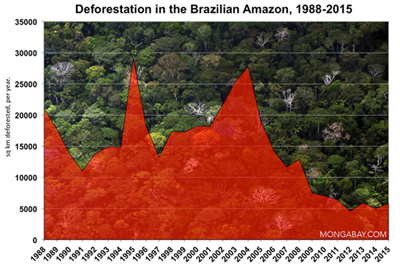
But while the results in Brazil were encouraging, there were already signs that 2011 might not be as rosy. Analysis released by Imazon, an NGO, revealed a sharp increase in "degradation", which is often a precursor to deforestation. Sharply higher commodity prices, combined with resumption of agricultural lending and recovery of the Amazon cattle herd, will challenge efforts to reduce deforestation next year.

The Brazilian Amazon also showed the effects of climate change. 2010 saw the worst drought on record, which helped spur a large increase in wildfires and a spike in forest degradation in recent months. Climate modelers say drought in the southern Amazon is likely to worsen as sea surface temperatures in the tropical Atlantic rise. Perversely, the western and northern parts of the Amazon may see an increase in rainfall due to climate shifts.

Hungary's red sludge (Hance)
It sounds like a monster from a badly-written horror movie of the 1950s, but indeed a million cubic meters of red sludge devastated two Hungarian villages, killing nine, and chemically burning a hundred or so others. Photos from the blood-red horror circled the world as if it were, in fact, a toxic monster from the deep. However, the red sludge was actually waste products from an aluminum processor. The waste poured into villages after a dam, containing it in a reservoir, broke open.

While the sludge eventually reached the Danube, scientists believed that its levels of heavy metals were not high enough to cause long term damage. However, the red muck did extinguish freshwater life in a number of local rivers.

Disasters such as this are not the only impacts of aluminum mining. More prosaic impacts include deforestation, water and energy use, and less dramatic, but still dangerous, pollution. One of the world's most popular metals, aluminum is 100% recyclable, unlike many materials, without any loss in its physical properties.

Nestle caves to social media activists (Hance)
This David-vs.-Goliath story shows how social media sites such as Facebook and Twitter may be the new face of aggregated activism. The tale begins with Greenpeace posting a clever ad linking food-giant Nestle to destruction of rainforests in Southeast Asia through its palm oil. That may not have amounted to much until Nestle decided to ban the video from YouTube, citing copyright infringement. This sparked on-line outrage that was inflamed when a moderator on Nestle's Facebook page was perceived as being snide with protesters. Months later, the food giant caved to demands, putting forward a detailed plan to rid all of its products—not just those containing palm oil—from any 'deforestation footprint'.

The success of Greenpeace's campaign, which really became online grassroots, proves just how potent (and powerful) social media sites have become in pressuring big business to change—quickly.

But the story does not end there. Sinar Mas Group, the conglomerate that controls the palm oil company that lost Nestle, responded with an aggressive campaign of its own, targeting Greenpeace and other environmental groups. But the effort floundered when it became clear Sinar Mas was doing little more than greenwashing, including spinning independent audits and using front groups to misrepresent its environmental performance. Sinar Mas now finds itself under more pressure than ever before.
Global climate framework back on the table? (Butler)
Progress at UNFCCC talks in Cancun, Mexico raised hopes that the multilateral process is back on track toward a global climate framework. Some 26 individual agreements were reach in Cancun, including language that advances the Reducing Emissions from Deforestation and Forest Degradation (REDD+) mechanism, which aims to compensate developing countries for protecting their forests. The Cancun Agreement also opened the door for peatlands restoration as a climate change mitigation strategy.

Beyond forests and peatlands, the Cancun Agreement advanced on several other controversial areas, including a climate finance mechanism. Parties agreed to create a Green Climate Fund, which will mobilize and administer up to $100 billion a year by 2020. The fund will be run by the U.N. — not the World Bank — under the supervision of a board with "equal representation" from developed and developing countries. The fund would include technology transfer to help develop economies "leapfrog" a carbon-intensive development path. The Kyoto Protocol's Clean Development Mechanism will be strengthened to encourage investments in green emission reduction projects in the developing world.

Developing countries also committed to bi-annual reporting of their actions to reduce emissions. For industrialized countries, parties agreed to avoid a gap in emissions reductions efforts and monitoring between the expiration of the Kyoto Protocol and whatever treaty succeeds it at the end of 2012.

Next year's climate conference will take place in Durban, South Africa.

New mammals galore (Hance)
2010 saw the discovery of a new monkey in Brazil and another new monkey in Myanmar. But that wasn't all: a strange new carnivore and a new species of lemur were announced in Madagascar, DNA and sound analysis proved a new ape in Southeast Asia, and a camera trap has photographed what is likely a new species of elephant shrew in Kenya! This has been a staggering year for wildlife discoveries that make for mainstream news, i.e. new mammals everywhere. However, in almost every case, each of these new mammal species is thought to be threatened with extinction, with some of them already on the precipice. Rapid conservation action will be necessary if these new 2010 mammals are not to vanish as quickly as they appeared.

Honorable Mentions

Census of Marine Life ends (Hance)
This would have made it into the top ten list of the past decade, but it falls in our Honorable Mentions list since it’s simply the last year of a vast initiative to explore the unexplored, discover the undiscovered, and come to know the unknown. With 540 expeditions over the past decade, 2,700 researchers increased the number of known marine species (so far) from 230,000 to a quarter of a million.

Kiwis stop government from mining protected areas (Hance)
The New Zealand public, or Kiwis as they are affectionately known, successfully halted a government plan to mine in a number of protected areas this year. The New Zealand government dropped the plan after a whopping 40,000 people marched against it. Critics said the mining would have imperiled New Zealand's impressive tourism industry and threatened a number of already endangered species, including some of the world's most bizarre amphibians, Archey's and Hochstetter's frogs.

California affirms climate commitment (Butler)
California citizens voted overwhelming (by a 23% margin) to maintain the state's climate law, AB32. More than $31 million was raised to oppose Proposition 23, which would have overturned state efforts to reduce greenhouse gas emissions and transition toward a low carbon economy.

The California Air Resources Board would subsequently vote 9-1 to adopt cap and trade regulations for AB32. The move, which established the first compliance carbon trading system in the United States, opened the door for carbon offsets generated via forest conservation projects. Accordingly, California signed reducing emissions from deforestation (RED) deals with the Mexican state of Chiapas and the Brazilian state of Acre that would let those states sell carbon offsets generated via forest conservation in California's cap-and-trade market, which is set to launch in 2012. Under California's proposed rules, up to 8 percent of emissions reductions could be met through offsets. Observers say the agreement may pave the way for future state-to-state REDD deals.

Road to cut Serengeti (Hance)
If there were a list of the Top 10 worst ideas in 2010 this would come out near the top: in one of the world’s most beloved wildlife areas—arguably its most—the government of Tanzania wants to build a road . Slicing through the world-famous Serengeti National Park, researchers say the road would threaten one of the Earth's last great migrations and place the whole ecosystem at risk. In addition, anything that hurts the Serengeti, hurts Tanzania's burgeoning tourism industry. What's even more odd about this plan is that proposals have been put forward of alternate routes which would connect the same cities, but bypass the park altogether. Still, the Tanzanian government insists it will go ahead with its plans and is set to begin construction in 2011. Look for this on next year’s list!

Papua New Guinea strips landowners of rights (Hance)
In a governmental move that makes way for big corporations to strip Papua New Guinea of its forests—as they have in Indonesia, Malaysia, and Brazil—communal land rights have been undercut in favor of business. An amendment passed this May made it so resource corporations working in Papua New Guinea are protected from any litigation related to environmental destruction, labor laws, and landowner abuse, essentially placing all environmental safeguards with a government that is cozy with industry and opening the door for environmental disaster.

Yasuni-ITT deal rises and falls (Hance)
Although it's not yet dead, the fund that would pay Ecuador NOT to drill for oil in rainforest reserve has seen good and bad news in 2010. On the good news: the UN has created a trust fund for donors, however, the bad news is that donations are slow to materialize, and Ecuador has said that if doesn't receive $100 million by the end of next year, the deal to save arguably the world's most biodiverse place will be thrown out.